Energy and Environment Latest News
Nancy Sutley Focuses on Energy Efficiency in New York
Posted by on January 19, 2010 at 6:00 PM ESTI was happy to return to my hometown, New York City, on Thursday and Friday with a focus on energy efficiency. This gave me an opportunity to appreciate New York City in a different way as energy efficiency efforts are underway throughout the five boroughs -- both in policy and in practice. In the morning, I met with Mayor Bloomberg to discuss New York’s ambitious plan to retrofit buildings to save energy. This is one example of the work mayors are doing throughout the country to reduce their city's carbon footprint, improve air quality and put people back to work through energy efficiency upgrades.
Later, I visited my home borough of Queens, where I toured the Mason Tenders Training Center to see workers being trained in energy efficiency upgrading and weatherization. The work they are learning to do -- caulking windows and doors, adding insulation, investigating HVAC systems, replacing energy inefficient light bulbs -- is the type of work that will lower home owners’ energy bills, reduce greenhouse gas emissions and create good, green jobs.
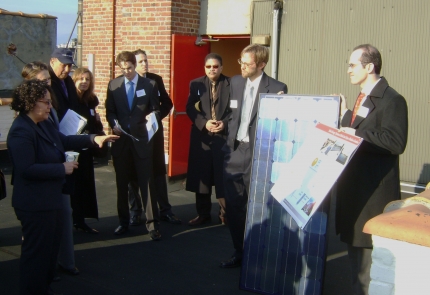
Council on Environmental Quality Chair Nancy Sutley views retrofit plans on the rooftop of the West 135th St. Apartments in New York City. January 14, 2010.
Afterwards, I traveled to the West 135th St. Apartments in Harlem to visit the first Section 8 multi-family housing property to receive Recovery Act funding through the Green Retrofit Program from the U.S. Department of Housing and Urban Development. Jonathan Rose Companies, a New York-based property owner and developer is receiving a $3.6 million loan to retrofit this 198-unit, 10 building historic property. This loan will fund a comprehensive energy retrofit project that, when completed, will enhance quality of life for the residents, reduce energy costs, cut water consumption, improve indoor air quality, and create quality local jobs.
We see home energy upgrades and retrofits as a part of the President’s vision for a clean energy economy. That is why I am leading the Administration’s work on Recovery Through Retrofit, which builds on the foundation laid in the Recovery Act to expand green job opportunities and boost energy savings by making homes more energy efficient. In the U.S., 130 million homes are responsible for more than 20 percent of our carbon emissions. Energy efficiency retrofits present the opportunity to increase energy efficiency, while also creating new businesses and good green jobs.
You can learn more about Recovery Through Retrofit on our website.
Nancy Sutley is the Chair of the White House Council on Environmental Quality
Learn more about Economy, Energy and EnvironmentProgress on Green Jobs from the Recovery Act
Posted by on January 14, 2010 at 3:31 PM ESTEd. Note: You may have missed yesterday's CEA report on the Recovery Act finding that it has saved or created 1.5-2 million jobs; Heather Zichal takes a look at the green jobs component of the data.
A report delivered by the Council of Economic Advisers today found that the clean energy investments of the American Recovery and Reinvestment Act (ARRA)are not only creating jobs today, but for the future. The clean energy provisions of ARRA alone have already saved or created 63,000 jobs and are expected to create more than 700,000 by 2012. When we talk about clean energy jobs, we mean new work for skilled laborers who can install efficient heating and cooling systems and windows, who can retrofit homes to save electricity, who can build and install solar panels, wind turbines and other clean energy technologies. These investments are positioning the American workforce to remain competitive and keep our nation at the forefront of a new low-carbon global economy. At the same time, these initiatives are changing the way that we produce, distribute, and use energy to reduce green house gas emissions and cut our dependence on foreign oil.
As we have seen across the portfolio of Recovery Act clean energy programs, demand is in some cases exceeding expectations with programs receiving far more qualified applicants than there is currently funding available. That is why, as part of the jobs package on which the President is urging Congress to act, he has called for additional clean energy investments – including home weatherization and advanced energy manufacturing tax credits - which could put even more Americans to work right away.
The global competition to develop the technologies of a clean energy economy is happening right now. We do not want to lose that competition and see the technology and jobs of tomorrow built overseas. The Recovery Act investments are a good start, stimulating the American innovation and investments necessary to be the leader of a new energy future, but ultimately, to ensure the U.S. leads the world in the production of clean energy and to induce the necessary private investment, we must also pass comprehensive energy reform. This will help unlock the true potential of the millions of jobs needed for the clean energy economy of tomorrow.
NOTE: In case you missed it, this week Carol Browner, Assistant to the President for Energy and Climate Change, held a live chat. You can watch the video here. Also, get some additional perspectives on the President's record on clean energy and climate change from the Center for American Progress and the Natural Resources Defense Council.
Heather Zichal is Deputy Assistant to the President for Energy and Climate Change
Learn more about Economy, Energy and EnvironmentA Visit to America's River of Grass
Posted by on January 12, 2010 at 9:59 AM ESTLast week I had the opportunity to visit the Everglades and the Kissimmee River region in Florida along with Jo Ellen Darcy, Assistant Secretary of the Army for Civil Works, Sam Hamilton, Director of the U.S. Fish and Wildlife Service, and Tom Strickland, Assistant Secretary at the Department of the Interior. Despite unusually chilly temperatures, I had a fascinating visit to a dynamic network of sawgrass prairies, hardwood hemlocks, mangrove islands and cypress forests that make up the largest wilderness east of the Mississippi River and the largest subtropical wilderness in the United States. We saw a vibrant and diverse landscape, but also one that is fragile and threatened. The Everglades are critically important to both the State of Florida and the Nation as a whole.

Nancy Sutley and Jo Ellen Darcy participate in the Picayune Strand Restoration Project Groundbreaking Ceremony. January 7, 2010.
On Thursday I attended the groundbreaking ceremony for the Picayune Strand Restoration project, that will work to preserve and enhance native Florida wetlands by restoring the natural hydrology of the area, and improving the water quality of downstream coastal estuaries. On Friday, I participated in the Everglades Coalition Conference and discussed ways to meet the challenges that growth and climate change place on the long-term sustainability of the Everglades. I enjoyed speaking with so many of the people who are working to preserve this region and was happy to have the opportunity to recognize incredible accomplishments of those dedicated to Everglades restoration and applaud their energetic advocacy.
I conveyed to the people of Florida a simple message: we are committed to the conservation and restoration of this iconic ecosystem and it is a key priority for the Obama Administration. I look forward to continuing to work with this region in the future.

The Everglades, seen from the air, make up the largest wilderness east of the Mississippi River and the largest subtropical wilderness in the United States. January 7, 2010.
Nancy Sutley is the Chair of the White House Council on Environmental Quality
Learn more about Energy and EnvironmentA Year Laying the Foundation for the Clean Energy Economy
Posted by on January 11, 2010 at 10:53 AM ESTEd. Note: This is the first in a week's worth a blog posts recapping progress on major issues, each of which will be followed in the afternoon by an online video chat with a major policy official. Join us at 3:30 EST today for a chat with Carol Browner, Assistant to the President for Energy and Climate, via WhiteHouse.gov/Live or Facebook.
In his first year in office, President Obama launched America on a 21st century clean energy renaissance that is creating jobs in the short term and laying the foundation for a low carbon economy in the long term. These actions will improve energy efficiency, incentivize production of renewable energy like wind and solar, reduce our dependence on foreign oil and curb the emissions that contribute to climate change. A memo from the Vice President in December laid out how the foundation for this sort of transformation has been laid over the past year.
Ultimately, to ensure the U.S. leads the world in the production of clean energy, we must also pass comprehensive energy reform. The House of Representatives has already passed such legislation and the Senate is working on a bipartisan basis to do the same. The President will continue to make passage of legislation a top priority given its benefits for our economy, our security and the environment.
The overarching goal is to make clean energy the profitable kind of energy and to invest in a diverse national energy portfolio that includes: clean coal, nuclear power, domestic oil and gas, renewable energy and advanced biofuels; a bigger, better, smarter transmission grid; and more efficient cars, trucks, homes and buildings. These initiatives will continue to be the focus of our efforts in 2010.
Progress So Far
Recovery Act: The American Recovery and Reinvestment Act included more than $80 billion in clean energy investments. Through these investments, American companies and American workers are involved in unprecedented growth in the generation of renewable energy sources, expanding manufacturing capacity for clean energy technology, advancing vehicle and fuel technologies, and building a bigger, better, smarter electric grid…all while creating new, sustainable jobs. $23 billion will likely create 253,000 jobs and leverage over $43 billion in additional investment that could support up to 469,000 more jobs, while putting us on track to meet the goal of doubling our renewable energy generation, including solar, wind and geothermal, in just 3 years.
- Recovery Act investments in renewable generation and advanced energy manufacturing of $23 billion will likely create 253,000 jobs and leverage over $43 billion in additional investment that could support up to 469,000 more jobs, while putting us on track to meet the goal of doubling our renewable energy generation, including solar, wind and geothermal, in just 3 years.
- The Federal Government, partnering with industry, has committed to invest up to $16 billion in projects that will transform the transportation sector, including plug-in hybrids, all-electric vehicles and the infrastructure needed to power them, as well as new clean fuels. Over the next six years, three new electric vehicle plants—the first ever in the U.S.—and 30 new battery and other electric vehicle manufacturing plants will be fully operational.
- The $4 billion in Recovery Act smart grid investments will likely result in 43,000 new jobs, and be matched more than one-to-one by private sector funding that could support up to 61,000 additional jobs on smart grid projects that will reduce cost, increase reliability and give consumers more choice and control over their energy use and reduce electricity usage by more than 4% by 2030, an annual utility bill savings of $20.4 billion for U.S. businesses and consumers.
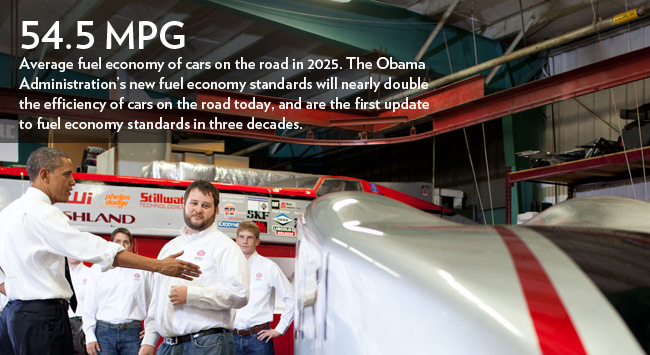
Efficiency Standard for Automobiles: President Obama announced the first ever joint fuel economy/greenhouse gas emissions standards for cars and trucks in May. The new standards are projected to save 1.8 billion barrels of oil over the life of the program with a fuel economy gain averaging more than 5 percent per year and a reduction of approximately 900 million metric tons in greenhouse gas emissions.
Appliance Efficiency Standards: The Administration has forged more stringent energy efficiency standards for commercial and residential appliances, including microwaves, kitchen ranges, dishwashers, light bulbs and other common appliances. This common sense approach makes improved efficiency a manufacturing requirement for the everyday appliances used in practically every home and business, resulting in a significant reduction in energy use. Altogether, about two dozen new energy efficiency standards will be completed in the next few years.
Offshore Energy Development: Within the Administration’s first 100 days, a new regulatory framework was established to facilitate the development of alternative energy projects in an economic and environmentally sound manner that allows us to tap into the vast energy potential of the Outer Continental Shelf (OCS). The National Renewable Energy Lab estimates that development of wind energy alone on the OCS may provide an additional 1,900 gigawatts of clean energy to the U.S.
Emissions Inventory Rule : For the first time, the U.S. will catalogue greenhouse gas emissions from large emission sources – an important initial step toward measurable and transparent reductions.
Federal Government Sustainability: President Obama signed an Executive Order on Federal Sustainability, committing the Federal government to lead by example and help build a clean energy economy through Federal government operations. The Executive Order, among other initiatives, requires Federal agencies to set a 2020 greenhouse gas emissions reduction target; increase energy efficiency; and reduce fleet petroleum consumption.
International Leadership: After years of standing on the sidelines and ignoring the real threat of climate change, the United States has changed course this year and chosen to lead. Under President Obama’s leadership, the international community has taken significant measures toward a global solution to this global threat, including reinvigorating the Major Economies Forum (MEF); eliminating fossil fuel subsidies; fostering bilateral energy and climate partnerships with China, India, Mexico, Canada and others; phasing down HFCs (Hydrofluorcarbons); and reaching an historic accord at the Copenhagen climate summit that maintains progress toward a legally binding international agreement that will ensure a prosperous and secure future for our children and grandchildren.
UPDATE: Get some additional perspectives on the President's record from the Center for American Progress and the NRDC.
Heather Zichal is Deputy Assistant to the President for Energy and Climate Change
Learn more about Economy, Energy and Environment183 projects, 43 states, Tens of Thousands of High Quality Clean Energy Jobs
Posted by on January 8, 2010 at 3:40 PM ESTToday the President is awarding $2.3 billion in Advanced Energy Manufacturing Tax Credits – another key component of the American Recovery and Reinvestment Act that included historic investments designed to foster job creation and growth in the clean energy sector.
The investment tax credits, worth up to thirty percent of each planned project, will leverage private capital for a total investment of nearly $7.7 billion in high-tech manufacturing in the United States.
One hundred eighty three projects in 43 states will create tens of thousands of high quality clean energy jobs and the domestic manufacturing of advanced clean energy technologies including solar, wind and efficiency and energy management technologies.

As the President has stated before, the country that leads the way in harnessing clean, renewable energy will lead the 21st century. It’s no surprise that countries around the world are taking charge in this effort. China is making record investments in energy efficiency. American innovation pioneered solar technology, but we’ve fallen behind countries like Germany and Japan in producing it.
The United States once led the way on these technologies. And because of steps like the one we’re taking today, the U.S. can lead again: we’re beginning to produce more of the batteries we use to power our hybrid cards and trucks at home; once-shuttered factories are beginning to spring back to life manufacturing materials that make our buildings and homes more efficient; and in 2008 we generated more total wind power than any other nation on Earth.
This is only the beginning and the global competition is fierce.
Programs like the Advanced Energy Manufacturing Tax Credits reveal the immense power of American innovation and ingenuity to create good jobs, and the vibrant workforce that has carried our nation to great heights before. This particular program in the Recovery Act was oversubscribed by a ratio of more than 3 to 1, reflecting a deep pipeline of high quality clean energy manufacturing opportunities in America. That is why President Obama has already called on Congress to provide an additional $5 billion to expand the program.
The President knows that these are the companies that will lead the 21st century and help America take control of our energy future to build a more secure, energy independent and prosperous nation.
Check out the map below to see where many of the tomorrow’s clean energy jobs will be created:
Carol Browner is Assistant to the President for Energy and Climate
Learn more about Economy, Energy and EnvironmentAn Electrifying Event
Posted by on January 7, 2010 at 7:00 PM ESTI was in Brownstown Township, Michigan today to watch as the first battery for the Chevy Volt rolled off the line. It was another huge step toward building a new advanced battery industry in America.
The auto industry has always been the backbone of American manufacturing, and we continue to need a strong auto industry in America. Right now, however, 98 percent of the batteries that power America's hybrid cars are made by Japanese companies. Revitalizing the auto industry will require change and innovation to produce the fuel efficient cars that consumers demand. That’s why today was so important – not just for one company, but for the entire country.

U.S. Energy Secretary Steven Chu (left center) talks with General Motors Chairman and CEO Ed Whitacre (center) and other elected officials after the first Chevrolet Volt battery came off the assembly line at the GM Brownstown Battery plant in Brownstown Township, Michigan. The facility is the first lithium ion battery pack manufacturing plant in the U.S. operated by a major automaker. January 7, 2010. (by Jeffrey Sauger for General Motors)
The Department of Energy has been proud to partner with GM in developing this battery. Overall, the Department of Energy has invested $266 million to help develop the Volt’s battery technology. That includes nearly $106 million from the Recovery Act that helped fund the battery facility we were in today. We announced this money just five months ago, and it is already putting people to work.
Nationwide, the Recovery Act invested $2.4 billion in advanced battery and electric vehicle projects. Over the next six years, this investment will help lead to three new electric vehicle plants – the first ever in the U.S. – and 30 new battery-related manufacturing plants like the one I was at today.
By changing how we power our vehicles, we can reduce our dependence on foreign oil, clean up the air we breathe and cut down on carbon pollution. Most importantly, we can and will create new jobs and new industries right here in America.
Steven Chu is Secretary of Energy
Learn more about Energy and Environment
- &lsaquo previous
- …
- 183
- 184
- 185
- 186
- 187
- 188
- 189
- 190
- 191
- …
- next &rsaquo
Related Videos
-
 May 09, 2014 8:21 AM
Inside the White House: Solar Panels
-
 September 01, 2016 8:25 PM
President Obama Delivers a Statement to the Press
White House Blogs
- The White House Blog
- Middle Class Task Force
- Council of Economic Advisers
- Council on Environmental Quality
- Council on Women and Girls
- Office of Intergovernmental Affairs
- Office of Management and Budget
- Office of Public Engagement
- Office of Science & Tech Policy
- Office of Urban Affairs
- Open Government
- Faith and Neighborhood Partnerships
- Social Innovation and Civic Participation
- US Trade Representative
- Office National Drug Control Policy