




Energy and Environment Latest News
World Health Day: Healthy Cities, Healthy People
Posted by on April 9, 2010 at 10:19 AM ESTBravo to the World Health Organization (WHO) for focusing global attention on the impact of urbanization on health. On April 7th the WHO recognized World Health Day 2010 with the "1000 Cities - 1000 Lives" campaign, calling on cities around the world to hold events that open up streets for activities promoting health and wellness.
Smart investment in the built environment is the foundation of a healthy community. The location of your parks, supermarket, and schools (among other things) directly affect the health of an individual. And as people gravitate toward urban areas across the globe, we see increased demand on infrastructure, housing, and services. Global urbanization magnifies the responsibility of planners, governments and communities to develop more livable, walkable and active environments.
Our Administration is working each day to bring federal agencies together to promote comprehensive investments in communities that enhance health and quality of life. The Sustainable Communities Partnership with Housing & Urban Development, Transportation and Environmental Protection is an interagency effort to support community plans that will reduce vehicle miles traveled; connect green, safe, and affordable housing options to transportation; and create inclusive and inspiring community spaces. We are aligning housing, education, safety and health and human service policies such that every child grows up in a rich and nurturing community.
World Health Day also speaks to the key role urban leaders can play in a cultural shift toward healthy living. The First Lady’s Let’s Move! Initiative is an example of such an effort here in the US. The WHO’s “1000 Cities Initiative” urges cities across the world to do the same. This weekend I plan a long bike ride with the kids in support of global health and wellness.
Are you ready? Let’s Move!
Adolfo Carrión, Jr. is the Director of the White House Office of Urban Affairs
Orlando Goes Green
Posted by on April 8, 2010 at 10:01 AM ESTEarlier this week I had the opportunity to visit Orlando to see first-hand some of the sustainability initiatives the city has underway through the Green Works Orlando program. Green Works Orlando is a citywide plan to promote environmental conservation and stewardship, energy efficiency in homes and businesses, and outdoor green spaces. Like Orlando, cities across the country are doing exciting and innovative things to make their communities greener and more sustainable.
My first stop was at one of Orlando's six LEED (Leadership in Energy and Environmental Design) certified fire stations. With a focus on energy efficiency and sustainability, the fire station has employed innovative techniques to save energy and conserve water. For example, the lighting and hot water are powered through rooftop solar panels, a cistern system collects rain water for use in the station's toilets, and native plant species, which require less water, are planted around the fire station -- including on the green roof.
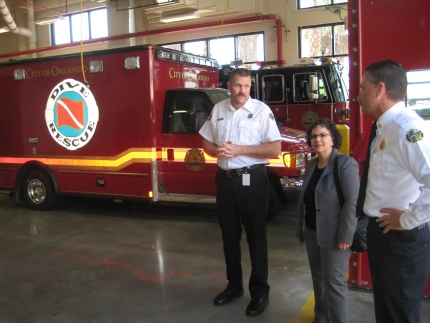
Nancy Sutley visits Fire Station 1, one of Orlando's six LEED certified fire stations. April 5, 2010.
In the afternoon, I toured the Iron Bridge Regional Water Reclamation Facility, where the city is testing technology for an innovative process to reuse water. It also creates byproducts, such as clean sand and recovered metals, which can then possibly be sold in established markets. Additionally, the process generates a significant amount of heat energy, which can be captured and used to generate electricity.
Under President Obama's Executive Order 13514 on Federal Leadership in Environmental, Energy, and Economic Performance, we will improve energy efficiency, conserve water, reduce waste, use less petroleum in our vehicle fleets, and leverage Federal purchasing power to promote environmentally-responsible products and technologies.
Over the past 15 months, I've had the chance to travel coast to coast seeing first-hand how the United States is building a greener future. Communities across the nation are planting the seeds of a new prosperity -- one that is based on the promise of good, high-paying, American clean energy jobs. Together, with the hard work and innovation that have always defined Americans, we are on our way to a healthier, more prosperous future.
Nancy Sutley is the Chair of the White House Council on Environmental Quality
Learn more about Energy and EnvironmentFinding Homegrown Solutions to our Economic and Energy Security Challenges
Posted by on April 7, 2010 at 10:12 AM ESTYesterday, Agriculture Deputy Secretary Kathleen Merrigan and Assistant Secretary of the Navy for Energy, Installations and Environment Jackalyne Pfannenstiel kicked off the first of several energy forums in front of a packed room to look at ways to increase biofuels production and meet the Navy’s renewable energy needs. The forum comes as a result of the Memorandum of Understanding (MOU) recently signed by the USDA and the Navy to encourage the development of advanced biofuels and other renewable energy systems.
As the President pointed out in his energy security remarks last week, “…the Pentagon isn’t seeking these alternative fuels just to protect our environment; they’re pursuing these homegrown energy sources to protect our national security. Our military leaders recognize the security imperative of increasing the use of alternative fuels, decreasing energy use, reducing our reliance on imported oil, making ourselves more energy-efficient.”
And as Deputy Secretary Merrigan explained, the military’s significant fuel demands can serve, “…as a catalyst to increase demand for biofuels and spur economic opportunities in rural communities throughout the country.”
Hawaii was selected as the location for the initial collaboration between USDA and the Navy because Hawaii's energy costs are among the highest in the nation and imported oil supplies 90 percent of the State's energy. Today’s forum is an important first step in developing homegrown solutions to the Navy and Hawaii’s significant energy challenges through biofuels.
For example, Maj. Gen Pawling (HIANG), Chief of Staff of the U.S. Pacific Command, spoke about the whole-of-government team they have put together to begin developing an enterprise model and strategy to eventually procure 25% of its jet fuel (20 million gallons/year) from locally grown and locally refined sources. Participants in this effort include USDA, Department of Energy, and State of Hawaii as well as several DoD offices, including the Office of the Secretary of Defense, Defense Energy Support Center, Navy and Air Force Energy Offices, DARPA, and more.
This local working group recognizes that recent technological advancements now make it feasible and cost effective to produce advanced biofuels that meet military specifications for jet fuel, with the Air Force just completing a successful test flight last month. So now they are turning their attention to the issue of supply. Through a $150 million investment by DARPA in an algae-derived jet fuel demonstration on Kauai, and active participation by private industry and the landowner, it is now feasible to have a plan for locally-derived biofuels.
These are exactly the kinds of initiatives we need – bringing together local, state and Federal officials; leveraging both the public and private sector – to find the creative and sustainable solutions to our economic and energy challenges that are mutually beneficial to the local community by creating clean energy jobs and industries; and our national security by helping to achieve our energy independence goals.
Since taking office, President Obama and his Administration have worked hard to accelerate the investment in and production of American biofuels and reduce our dependence on fossil fuels as part of the President’s comprehensive energy plan. But, to use an agricultural analogy, what businesses need to take root and to grow is certainty, the kind of certainty that would be provided by comprehensive energy and climate legislation that puts a price on carbon and incentivizes the development of the clean energy technologies that will power the 21st century economy.
Heather Zichal is Deputy Assistant to the President for Energy and Climate Change
Learn more about Economy, Energy and EnvironmentClean Energy Economy Powering Recovery
Posted by on April 2, 2010 at 12:20 PM ESTToday, President Obama visited workers at Charlotte, North Carolina-based Celgard, Inc. and delivered remarks on jobs and the economy. Celgard is a global leader in the development and production of components for state-of-the-art batteries - batteries that will help fuel a clean energy economy and create jobs. (Watch a personal testimonial by Celgard’s workers on the role the Recovery Act played in their employment).
It is American innovative companies like this that are developing the technologies and industries that will power the global economy in the 21st Century. With the help of a $50 million American Recovery and Reinvest Act grant under the Department of Energy’s Electric Drive Vehicle Battery and Component Manufacturing Initiative, Celgard is not only adding nearly 300 jobs – and more than a thousand jobs for contractors and suppliers – but it is also helping America build the batteries that will power cleaner and more efficient cars and trucks. Before the Recovery Act, we had the capacity to make less than 2 percent of the world’s lithium ion batteries. In the next 5 years, we’ll be able to make 40 percent of these advanced batteries right here in the United States, so we are not just talking about creating jobs in the near-term, but also sustained growth and opportunity in the long run.
Celgard is just one of dozens of electric drive vehicle battery and component manufacturers benefiting from Recovery Act investments and contributing to the reduction in the use of oil and greenhouse gas emissions. Advanced batteries, capable of meeting standards for durability, performance, and weight, are a key technology for plug-in hybrid electric vehicles capable of getting up to 100 miles per gallon.
As the President said in his energy security remarks on Wednesday, the Administration’s efforts are all part of a comprehensive energy plan. A plan that reduces dependence on foreign oil, increases domestic energy production, improves energy efficiency…all while developing the new technologies and industries that will drive the global clean energy economy and create millions of new jobs here in America.
Heather Zichal is Deputy Assistant to the President for Energy and Climate Change
Learn more about Energy and EnvironmentHelp Us Find Out a Nobel Answer
Posted by on March 29, 2010 at 1:24 PM ESTAs many of you have probably heard, last week President Obama announced the nomination of Nobel Prize winner Carl Wieman to head up OSTP’s Science Division.
So this got us thinking; has there ever been a sitting Nobel Prize winner in the sciences (that is, chemistry, physics, or medicine) named to a position in the White House? As stated in the White House release, Dr. Wieman received the Nobel Prize in Physics in 2001 for the creation of a new form of matter known as a “Bose-Einstein condensate.” We’ve looked through all of our archives and have been unable to find another OSTP staffer or other government employee in the Executive Office of the President who came to the job with a science Nobel in hand.
Then it occurred to us: What a great opportunity to do some crowdsourcing! If you know of a previous employee in the White House complex who had earned a Nobel Prize in one of the sciences before joining the staff here, please let us know via Twitter @whitehouseostp using #WHNOBEL.
Thanks, and we look forward to your suggestions!
Learn more about Energy and Environment, TechnologyHightailing to Haiti, Scientists Plumb Depths for Data, Deliver Goods
Posted by on March 22, 2010 at 5:21 PM EST[Ed. Note: OSTP senior policy analyst Kate Moran just returned from Miami, where she helped greet the return of Research Vessel (R/V) Endeavor after its voyage to Haiti in the aftermath of the devastating January 12 earthquake. In a remarkable demonstration of how nimble the Federal scientific enterprise can be, the ship—which is owned by the National Science Foundation and operated by the University of Rhode Island—steamed out of Narragansett, RI, only days after the earthquake, a far cry from the months of preparations usually required before a scientific mission takes to sea.
The research plan, put together on short notice under the leadership of Cecilia McHugh, a marine geologist at Columbia University’s Lamont-Doherty Earth Observatory and professor at Queens College in New York, was to study the sea bottom near the quake site before wave action, storms, and other shallow-water processes erased any underwater features caused or revealed by the earthquake. The hope is that the research might give clues to understanding this unique quake-prone area and the likelihood and probable scale of follow-on temblors in the region. The research will also help to reveal why a small tsunami followed the quake despite predictions to the contrary by computer models. Along the way, the crew also managed to perform a number of humanitarian missions. Here is her report.]
I met the R/V Endeavor at Pier 22 in Port Everglades, anxious to hear from some of my longtime colleagues how the trip had gone and excited to get some of the first looks at the data they had collected. They told me that when the ship’s crew had first learned that it had been selected to conduct the expedition, Endeavor was alongside a ship repair facility with its generators disassembled—part of a routine wintertime refit. Putting the pieces back together normally takes a month, but the crew completed the work in one week. The scientific expedition was organized with similar rapidity by Lamont-Doherty scientists, with participation of researchers from the Haitian Bureau of Mines and the University of Haiti as well as the universities of Missouri, Texas, California and Rhode Island. The images they brought back were spectacular, including sonar images of the seafloor and seismic profiles that revealed structures down to about 50 meters below the seafloor. The crew also managed to retrieve a number of sediment cores.
The ship spent most of its two-week mission in waters just west of the capital city of Port-au-Prince, around the coastal village of Grand Goâve. As the NSF had previously reported, the surprising presence of corals stranded above sea level had made it clear, in conjunction with other evidence, that the coast in this area had been thrust upward as much as a foot and a half during the quake, while adjoining areas had apparently dropped—suggesting, along with other observations, the presence of unmapped faults in addition to the known, main fault in that area.
The science team’s new maps of the seafloor revealed what is likely a slip along an underwater fault that occurred on January 12th. While the team members were surveying offshore, they were communicating, in real time, with a science team working onshore. Because of the work conducted on Endeavor, the land-based team was able to locate and conduct studies where the offshore fault extended onshore. The science team aboard Endeavor also discovered a huge sediment plume (600 meters from top to bottom and extending across a wide area) in the water column that was likely caused by earthquake-induced underwater landslides. Such landslides are suspected to have been the cause of the observed tsunamis. These plumes eventually settle and are deposited over a large area, leaving an easily distinguished layer of sediment. By studying the sediment cores they collected, team members will be able to identify and determine the age of earlier sediment markers and reconstruct past earthquakes to help predict future events.
But this voyage was not just about data. The ship also carried to Port-au-Prince more than 40 large tents, each the size of a Quonset hut, donated by the children’s charity Plan USA. Endeavor was able to efficiently discharge its humanitarian cargo upon arrival with the assistance of U.S. Navy Port Logistics and Military Sealift Command personnel. The tents were used to set up the first schools in the affected area. Once in Haiti, the ship also picked up two graduate students and a research scientist from the Haitian Bureau of Mines in Port-au-Prince, who participated in the imaging studies. The university there is in ruins, but thanks to the actions of Professor Eric Calais (a member of the onshore science team) from Purdue University, the two students have now been granted admission to Purdue to finish their studies.
Before leaving, Endeavor was able to accomplish an additional valuable task: It performed seafloor sonar surveys of an area that shows potential to be developed into a new port. As has been widely reported, the existing port is considered unusable and irreparable, in part because of the large amount of wreckage blocking the waters there. Operating in part at night to avoid the small fishing boats in the area, Endeavor mapped out the sea bottom of a promising area that may become the country’s next major port.
After spending a few hours onboard Endeavor with Cecilia and her team, I came away buoyed by what I had seen and heard. The expedition was mobilized with record speed because of a dedicated ship operator; a federal science agency responded to the disaster by funding the research quickly; the expert science team (led by a dynamic woman with a long record of mentoring students of all ages) was organized on a similarly short time-line; research institutions contributed and shipped science equipment at their own cost; the initial science results were spectacular with more results to come; students participated shoulder-to-shoulder with experienced scientists; Haitian students, who lost their university in the quake, will now finish their studies; the captain and crew carefully took the ship into hazardous areas to achieve the science and deliver the tents; and all of this was complemented by two humanitarian efforts.
Wow, isn’t science great?!
Kate Moran is a Senior Policy Analyst at OSTP

The U.S. Research Vessel Endeavor is seen here off the coast of Haiti. (Photo by Michael Brennan) March 22, 2010.
- &lsaquo previous
- …
- 179
- 180
- 181
- 182
- 183
- 184
- 185
- 186
- 187
- …
- next &rsaquo
Related Videos
-
 May 09, 2014 8:21 AM
Inside the White House: Solar Panels
-
 September 01, 2016 8:25 PM
President Obama Delivers a Statement to the Press
White House Blogs
- The White House Blog
- Middle Class Task Force
- Council of Economic Advisers
- Council on Environmental Quality
- Council on Women and Girls
- Office of Intergovernmental Affairs
- Office of Management and Budget
- Office of Public Engagement
- Office of Science & Tech Policy
- Office of Urban Affairs
- Open Government
- Faith and Neighborhood Partnerships
- Social Innovation and Civic Participation
- US Trade Representative
- Office National Drug Control Policy