Energy and Environment Latest News
The GreenGov Challenge: Turning Ideas into Action
Posted by on February 18, 2010 at 11:17 AM ESTLast fall, President Obama asked all Federal and military personnel to join in the GreenGov Challenge to share their ideas on how we can lead by example, green the government, and meet the goals of the Executive Order on Federal Sustainability. Today, the President is calling on us to turn those ideas into action to put the Federal Government on the path to a clean energy future, and to meet our greenhouse gas pollution reduction target of 28% by 2020.
The GreenGov Challenge gathered more than 5,300 ideas and 165,000 votes from thousands of our colleagues in the Federal and military community from every agency, across America and around the globe.
The top ideas are summarized in the GreenGov Final Report. Among the most popular ones were expanding teleworking, landscaping with native plants that require less watering, making use of digital signatures to reduce printing documents, replacing non-recyclable materials with biobased cups and other service items in Federal cafeterias, and installing solar panels of Federal buildings. An initial summary of the GreenGov Challenge was presented to the Steering Committee on Federal Sustainability at a recent meeting, and each Federal Agency’s Senior Sustainability Officer is already working to incorporate your suggestions into their annual Sustainability Plans.
Today President Obama is issuing a new challenge to Federal and military personnel to put these ideas to work. To get started, check out the GreenGov Challenge Final Report and pick an idea you can champion in your workplace. Then sign up for the GreenGov Collaborative to work with colleagues across the government to put your ideas into action. You’ll be able to share your strategies, ask questions, and create a “green team” in this online community.
You answered the GreenGov challenge, now be part of the GreenGov transformation.
Nancy Sutley is the Chair of the White House Council on Environmental Quality
Learn more about Energy and EnvironmentNuclear Energy and an Energy-Independent Future
Posted by on February 16, 2010 at 2:45 PM ESTEarlier today in Maryland, President Obama spoke about the importance of clean energy for the country's future.
Whether it’s nuclear energy, or solar or wind energy, if we fail to invest in the technologies of tomorrow, then we’re going to be importing those technologies instead of exporting them. We will fall behind. Jobs will be produced overseas, instead of here in the United States of America. And that's not a future that I accept.
As one plank of that future, he announced loan guarantees through the Department of Energy to operate two new nuclear reactors at a plant in Burke, Georgia. It will be the first new nuclear power plant in nearly three decades. The plant is expected to create approximately 3500 construction jobs and 800 permanent jobs. When the nuclear reactors come online, they will provide reliable electricity for 1.4 million people in Georgia.
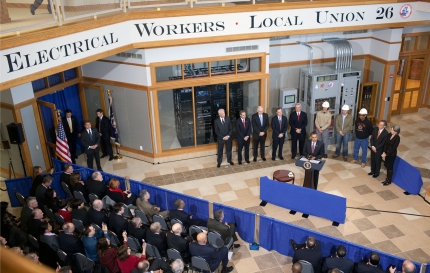
President Barack Obama delivers remarks on new investments by the administration to create energy jobs during his visit to International Brotherhood of Electricians (IBEW) Local 26 headquarters in Lanham, Md. February 16, 2010. (Official White House Photo by Pete Souza)
Under the Energy Policy Act of 2005, the plants will be held to strict standards to find ways of disposing waste safely, and avoid or reduce emissions of greenhouse gases. The President discussed the need to increase the supply of nuclear power to meet growing energy needs and prevent the worst consequences of climate change. The plant is expected to cut carbon pollution by 16 million tons each year. "That's like taking 3.5 million cars off the road," he explained.
President Obama called for a bipartisan energy and climate legislation to create incentives that will make clean energy profitable.
What I hope is that with this announcement, we're underscoring both our seriousness in meeting the energy challenge and our willingness to look at this challenge not as a partisan issue but as a matter that's far more important than politics - because the choices we make will affect not just the next generation but many generations to come.
Project sponsors include Georgia Power Company (GPC), Oglethorpe Power Corporation (OPC), the Municipal Electric Authority of Georgia (MEAG) and the City of Dalton, Georgia (Dalton).
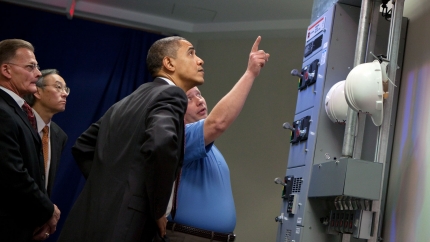
Sean Myers points out a feature on a Motor Control Panel to President Barack Obama during a tour of the jobs training center at the International Brotherhood of Electricians (IBEW) Local 26 headquarters in Lanham, Md., Feb. 16, 2010. Looking on at left are Chuck Graham, Business Manager of IBEW Local Union 26 and Energy Secretary Steven Chu. February 16, 2010. (Official White House Photo by Samantha Appleton)
Learn more about , Energy and Environment, Foreign PolicyLeading by Example – Making the Federal Government More Sustainable
Posted by on February 4, 2010 at 5:37 PM ESTYesterday I had the opportunity to co-convene a meeting with the Office of Management and Budget (OMB) and leaders from across the Federal community who are helping to make sustainability a reality for the Federal government. Following up from President Obama’s announcement on Friday when he set a government-wide greenhouse gas emissions reduction of 28 percent by 2020, I can speak for all who were there when I say there is a lot of excitement in the air!
So what does this goal mean? Achieving this 28 percent reduction will reduce Federal energy use by 646 trillion BTUs, which is equal to 205 million barrels of oil, or taking 17 million cars off the road for one year. And this is also equivalent to a cumulative total of $8 to $11 billion in avoided energy costs through 2020 based on current energy prices. Now that is impressive.
The next step towards Federal Sustainability is an important one: each agency is developing a “Sustainability Plan” that defines how they’ll meet their GreenGov goals, reduce energy use, drive long-term savings, save taxpayer dollars, and help create local clean energy jobs.
Cities, states, and American businesses have helped to forge the way by showing that greening their operations is not only good for the environment, but good for business; we have ample best practices and lessons to look to from our colleagues around the country.
And Federal Departments and Agencies are already taking actions to achieve greenhouse gas pollution reductions, such as installing solar arrays at military installations, tapping landfills for renewable energy, putting energy management systems in Federal buildings, and replacing older vehicles with more fuel efficient hybrid models. You can view examples of projects that are underway here.
The 28% Federal target announced on Friday is the aggregate of 35 Federal Agency self-reported targets. For example, the Department of Defense announced it will reduce greenhouse gas emissions from non-combat activities by 34% by 2020 and the Department of the Treasury will reduce its emissions by 33%.
We are very excited by the progress that is already occurring, and will continue to watch these developments in the future. Moving forward, implementation of the Executive Order will focus on integrating achievement of sustainability goals with agency mission and strategic planning. The goal is to optimize performance and minimize costs.
You will all be able to chart the Federal government’s progress through “scorecards” that will grade each agency on how well it is meeting its performance targets. And to ensure transparency and accountability, annual progress will be reported online to the public. I’m looking forward to sharing more updates in the months ahead!
Nancy Sutley is the Chair of the White House Council on Environmental Quality
Learn more about Energy and EnvironmentMoving America’s Clean Energy Economy Forward: Boost for Biofuels, Clean Coal
Posted by on February 3, 2010 at 7:05 PM ESTIn his State of the Union Address last month, the President promised that this Administration would move aggressively to catalyze American innovation and economic growth, especially in a competitive global environment -- and he pointed out that, "no area is more ripe for such innovation than energy."
Today, at a meeting with a bipartisan group of Governors from around the country, the President announced actions to accelerate the development of biofuels and clean coal technologies, two critical components of his comprehensive plan for transitioning to a clean energy economy.

President Barack Obama listens to a question from Sen. Arlen Specter, D-Pa. during the Senate Democratic Policy Committee Issues Conference at the Newseum in Washington, D.C., Feb. 3, 2010. Watching, from left are, Sen. Byron Dorgan, D-N.D., Senate Majority Whip Richard Durbin, D-Ill., and Senate Majority Leader Harry Reid, D-Nev. (Official White House Photo by Chuck Kennedy) February 3, 2010. (Official White House Photo by Chuck Kennedy)
On biofuels, three complementary actions will help create new opportunities for job growth, infrastructure development, and technological innovation, encouraging Americans to produce clean, homegrown energy.
Renewable Fuel Standard: The Environmental Protection Agency issued its final rule setting a new renewable fuel standard, which will create a market for advanced biofuel producers in the U.S. and help America fulfill the renewable energy mandate set by Congress. By 2022, the new fuel standard is projected to increase farmers’ incomes by $13 billion annually, create a stabilizing effect for prices at the pump, and increase our energy independence.
Biomass Crop Assistance Program: The U.S. Department of Agriculture has proposed a new Biomass Crop Assistance Program (BCAP), which will provide financial incentives to farmers, ranchers and forest landowners who invest in and establish production of biomass for energy and other purposes. The program will reduce the financial risk to these entrepreneurs, helping kick-start this new industry and spurring the economic recovery of rural America.
Biofuels Report: The President’s Biofuels Interagency Working Group released its first report – Growing America’s Fuel, which lays out a strategy to advance the development and commercialization of a sustainable biofuels industry to meet or exceed the nation’s biofuels targets.
Presidential Memorandum for a Comprehensive Federal Strategy on Carbon Capture and Storage: The President established a new interagency task force on Carbon, Capture and Sequestration (CCS). CCS technologies aim to collect heat-trapping gases released during the burning of coal and to sequester them so that they do not contribute to climate change. The President has consistently emphasized the need to invest in advanced technology as it is a critical part of the transition to a clean energy economy.
Whether we’re talking about coal states or coastal states – urban states or rural – we can all agree these investments in clean energy mean progress for all Americans. Even if you disagree with the need to take action on climate change, investing in the promise of a new clean energy economy is the right thing to do to secure American competitiveness and ensure future prosperity. The President said it best:
China’s not waiting to revamp its economy. Germany’s not waiting. India’s not waiting. These nations aren’t standing still. These nations aren’t playing for second place. They’re putting more emphasis on math and science. They’re rebuilding their infrastructure. They are making serious investments in clean energy because they want those jobs.
This is about strengthening our country to compete in the global market. And that’s why the President is committed to passing comprehensive energy and climate legislation for our economy, for our security and for our future.
Learn more about Energy and EnvironmentOne Step Closer to the Future on High-Speed Rail
Posted by on January 29, 2010 at 12:33 PM ESTIt's not often that the President and the Vice President get together for a town hall, but the occasion yesterday was something special for Vice President Biden. They were in Florida, one of the sites just announced for a massive down payment on high-speed rail, the future of transportation, and a great source of jobs in the here-and-now. See a map of the full web of high-speed rail, and emerging high-speed rail projects being funded by the nearly $8 billion investment in the Recovery Act.
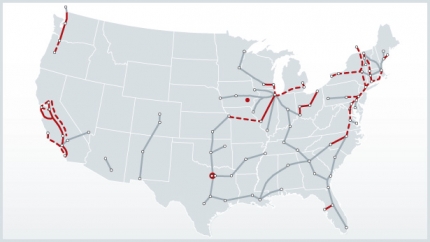
You can also read more from Transportation Secretary Ray LaHood in his blog post from yesterday. It's probably fair to say that both he and the Vice President, were fired up and ready to go:
THE VICE PRESIDENT: Ladies and gentlemen, we're determined to restore America to its rightful place at the leading edge of innovation, with bold ideas that will create jobs immediately and serve as the foundation, a new platform -- (applause) -- a new platform to build this economy on that will serve not just our immediate needs but future generations; ideas like wind power, solar energy, a smart grid, broadband -- (applause) -- and high-speed rail. And that's why we're here today. (Applause.)
Having made over 7,900 round trips, literally, on Amtrak, 250 miles a day, I am very familiar with rail. (Laughter.) And today you have no idea how pleased I am to talk about the announcement that we made yesterday awarding -- in total, nationwide -- nearly $8 billion from the Recovery Act, funding to move us in the direction of developing a high-speed rail service in 13 travel corridors covering 31 states all across this country. (Applause.)Ladies and gentlemen, these investments -- these investments have several goals: first, to improve existing rail lines to make train service faster, more reliable; two, to pull cars off the road, reducing congestion, cutting pollution, and increasing productivity; and three, to begin to develop new corridors for high-speed trains that will go from 169 to 230 miles an hour. (Applause.)
Ladies and gentlemen, like a corridor, right here from Tampa to Orlando -- (applause) -- so you'll be able to get on a train here to Orlando in less than an hour, without battling traffic and congestion, arrive at your destination. Ladies and gentlemen, this single investment is not going to solve all our transportation issues overnight. Instead, with more than $55 billion of proposals from 50 states all across the country, we're providing $8 billion in seed money. And today's awards provide only initial funding for the rail system. Like Tampa and Orlando route, more funding is going to come in the future as progress is made.
We have committed to another $5 billion in funding over the next five years. It's a down payment on a truly national program that's going to reshape the way we travel. It will change the way which we go from place to place, change the ways we work and live, and will connect communities to each other in a way that in the past was impossible. Just like the Interstate Highway structure did back in the mid-'50s, it will have far-reaching consequences.
Let me ask you a question: How can we, the leading nation in the world, be in a position where China, Spain, France -- and name all the other countries who have rail systems that are far superior to ours?
Ladies and gentlemen, it's about time we move. But this time -- but this time, we're not only going to be providing a better way to transport; we're going to be taking cars off of congested highways, reducing carbon emissions, and saving billions of dollars in human productivity lost just sitting in traffic jams, as studies point out.
Most important, we're creating jobs -- good jobs. (Applause.) Construction jobs. Manufacturing jobs. And we're going to be creating them right now. We're going to spur economic development in the future and we're making our communities more livable all in the process.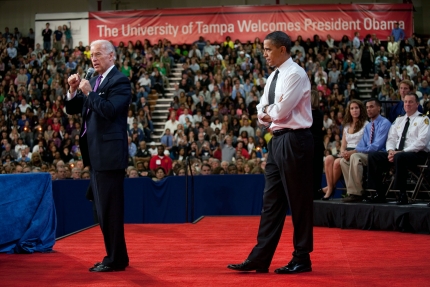
President Barack Obama and Vice President Joe Biden take part in a town hall meeting at the Bob Martinez Sports Center at the University of Tampa in Tampa, Fla. January 28, 2010. (Official White House Photo by Pete Souza)
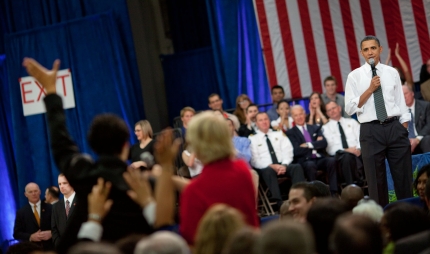
President Barack Obama listens to a question at the town hall meeting at the University of Tampa Bob Martinez Sports Center in Tampa, Fla. January 28, 2010. (Official White House Photo by Samantha Appleton)
Learn more about Economy, Energy and EnvironmentPresident Obama Sets Greenhouse Gas Emissions Reduction Target for Federal Operations
Posted by on January 29, 2010 at 10:01 AM ESTOn January 29, 2010, President Barack Obama announced that the Federal Government will reduce its greenhouse gas (GHG) pollution by 28 percent by 2020. Reducing and reporting GHG pollution, as called for in Executive Order 13514 on Federal Sustainability, will ensure that the Federal Government leads by example in building the clean energy economy. Actions taken under this Executive Order will spur clean energy investments that create new private-sector jobs, drive long-term savings, build local market capacity, and foster innovation and entrepreneurship in clean energy industries.
Examples of agency actions that are underway are available. You can also visit our Initiatives page for more information.Learn more about Energy and Environment
- &lsaquo previous
- …
- 181
- 182
- 183
- 184
- 185
- 186
- 187
- 188
- 189
- …
- next &rsaquo
Related Videos
-
 May 09, 2014 8:21 AM
Inside the White House: Solar Panels
-
 September 01, 2016 8:25 PM
President Obama Delivers a Statement to the Press
White House Blogs
- The White House Blog
- Middle Class Task Force
- Council of Economic Advisers
- Council on Environmental Quality
- Council on Women and Girls
- Office of Intergovernmental Affairs
- Office of Management and Budget
- Office of Public Engagement
- Office of Science & Tech Policy
- Office of Urban Affairs
- Open Government
- Faith and Neighborhood Partnerships
- Social Innovation and Civic Participation
- US Trade Representative
- Office National Drug Control Policy