Energy and Environment Latest News
Protecting Jobs in the American Wind Industry
Posted by on June 7, 2012 at 11:35 AM EDT
Heather Zichal speaks at the WINDPOWER 2012 Conference and Exhibition in Atlanta, Georgia.
Earlier this week, I spoke at the WINDPOWER 2012 Conference and Exhibition – the largest wind industry event in the world. Building on President Obama’s remarks in Newton, Iowa, I highlighted a few key items on the President’s To-Do list for Congress -- including extending the Production Tax Credit (PTC) and the 48C Advanced Energy Manufacturing Credit.
These credits have played an important role in fueling job creation and supporting a manufacturing base in clean energy. As I told the crowd in Atlanta:
This is a priority for the President because he sees the American wind industry as an American success story. Over the past few years – thanks in part to these tax credits – this industry has flourished. Today, we have enough wind capacity to power 10 million homes across the country. In 2011, which was a banner year for the industry, nearly one-third of all new power capacity in the United States came from wind. Five states now produce more than 10 percent of their electricity from wind power. And in places like Iowa and South Dakota, that figure is closer to 20 percent.
So this is an industry with momentum. And it’s an industry that’s putting people back to work. It used to be that we had to import most of the 8,000 component parts that go into a modern wind turbine. But today, with nearly 500 wind-related manufacturing facilities in 43 states, we’re producing more and more of those parts in America.
Learn more about Economy, Energy and EnvironmentGreen Button Momentum
Posted by on June 7, 2012 at 11:30 AM EDTTo make it easier for business and consumers to save energy and money, we need to make it easier for them to understand how they use energy. That is why the Obama Administration partnered with the utility industry and issued a challenge to them to make it easier for electricity customers to get secure online access to their own household or building energy-use in a consumer- and computer-friendly format, called “Green Button.”
In addition to empowering consumers and business to make informed decisions, Green Button data can fuel new products and services. By putting customers in control of their own energy data, they can choose which private sector tools and services can help them manage or upgrade their own household or building energy performance.
Learn more about Energy and Environment, TechnologyBrainstorming With Energy Data
Posted by on June 5, 2012 at 6:01 PM EDTStaff from the White House and the Department of Energy recently participated in an “Energy Data Jam” in Silicon Valley—part of the Administration’s new Energy Data Initiative. The program brought together some of America’s most innovative entrepreneurs, software developers, CEOs, energy experts, and policy makers to take think creatively about how to leverage the growing volumes of publicly accessible government data to spark new private-sector tools, products, and services while rigorously protecting personal, proprietary, and national security information.
Building on the success of the Green Button initiative—which is providing consumers with secure access to their own energy data and has facilitated the voluntary release of energy-use data in computer-readable form to encourage private-sector innovation—the Energy Data Initiative aims to harness the power of energy data through a combination of technology and ingenuity.
Learn more about Energy and Environment, TechnologyHarnessing America’s Energy Future in the Great Lakes
Posted by on May 29, 2012 at 11:57 AM EDTEditor’s Note: This blog introduces readers to Victoria Pebbles, Program Director at the Great Lakes Commission based in Ann Arbor, Michigan.
Last week, the Great Lakes Offshore Wind Energy Consortium met for the first time. This fledging group is comprised of representatives of five states (Il, MI, MN, NY and PA) and 10 federal agencies that signed a federal-state Memorandum of Understanding (MOU) on March 30 this year to cooperate on siting offshore wind in the Great Lakes. Not dissimilar to international protocols which set forth rules for intergovernmental cooperation, the three non-signatory states can sign the MOU at any time in the future.
The MOU aims to “promote the efficient, expeditious, orderly and responsible evaluation of offshore wind power projects in the Great Lakes.” Signatories are committed to documenting their existing regulatory frameworks for offshore wind by June 30, 2013. This “regulatory roadmap” will provide a starting point for identifying opportunities to improve coordination and efficiencies with evaluating applications for offshore wind projects. The agreement also commits the signatories participate in pre-application consultations and joint application reviews — a practice that sometimes occurs with other projects but one that should become more standard practice as a result of the MOU. Ultimately, signatories are also committed to applying lessons through the Consortium when evaluating future offshore wind proposals.
The best lessons are learned from actual experience. At this time, all eyes are on Lake Erie where the only active Great Lakes offshore wind project is being planned for a 20-30 megawatt (MW) pilot project seven miles offshore downtown Cleveland. The developer, Freshwater Wind, enjoys broad-based community support from the Lake Erie Energy Development Corporation (LEEDCo), a private, non-profit regional corporation working to build wind turbines in Lake Erie and stimulate an offshore freshwater wind industry.
Companies all around the Great Lakes see the offshore wind industry as a catalyst for employing the region’s outstanding engineering and manufacturing assets to design and build the offshore wind turbines; and using the region’s natural assets, the Great Lakes and connecting waterways, to move these large products to other parts of the country and overseas.
That is why it is important for the Great Lakes Offshore Wind Energy Consortium to carefully complete its work. Then, when more proposals for offshore wind in the Great Lakes come, and they will come, states and federal agencies will have a rational policy framework for evaluating proposed offshore wind power projects in the Great Lakes that is efficient, expeditious, fair, and responsible.
Victoria Pebbles is Program Director at the Great Lakes Commission
Learn more about Energy and EnvironmentWeekly Wrap Up: President Obama Tweets to America
Posted by on May 25, 2012 at 5:19 PM EDTHere's a quick glimpse at this week on WhiteHouse.gov:
An Affront to American Values: At the Symposium on Global Agriculture and Food Security President Obama addressed how world hunger does not receive the attention it deserves from the global community, including our own nation. He mentions that, “When tens of thousands of children die from the agony of starvation, as in Somalia, that sends us a message we’ve still got a lot of work to do. It’s unacceptable. It’s an outrage. It’s an affront to who we are."
G8 Summit: This past weekend the U.S. hosted leaders from the eight largest nation’s in terms of economy at Camp David in Chicago. At this summit, world leaders held conversations about world hunger, as well as on the priority of growth in jobs in the world economy.
The Final Chapters: President Obama participated in the International Security Assistance Force meeting on Afghanistan, with more than 60 countries where he reiterated that troubles in Afghanistan were not over, but that serious progress has been made towards solving issues with Al Qaeda.
Resilience in the face of Tragedy: Then President Obama made his way to Joplin, Missouri to attend the town’s high school graduation. This visit nearly coincided to the day with the one year anniversary of the tornado that devastated the town. President Obama remarked on how the spirit of Joplin was commendable, and a testament that the American people are in it together, even in the toughest of times.
The Future of Energy: President Obama’s last stop this week landed him in Newton, Iowa where TPI Composites manufactures wind turbine blades. Here he restated the importance of cleaner, renewable energy and pushed Congress to act on his To-Do-List. "If Congress doesn’t act, companies like this one will take a hit," he said. "Jobs will be lost. That’s not a guess, that’s a fact. We can’t let that happen." The President followed up this talk up with a session of live tweeting to people, answering thier questions in less than 140 characters.
President Obama Talks Clean Energy in Iowa
Posted by on May 24, 2012 at 8:21 PM EDT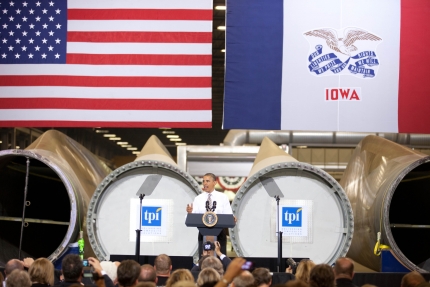
President Barack Obama delivers remarks urging Congress to act on the “To Do List” and highlighting the need to invest in clean energy by passing legislation, at TPI Composites Iowa’s wind turbine blade facility in Newton, Iowa, May 24, 2012. (Official White House Photo by Chuck Kennedy)
In Iowa this afternoon, President Obama continued to press lawmakers to take action on his To-Do List for Congress.
He traveled to Newton to push for the renewal of a tax credit for companies that produce clean energy. The credit currently supports as many as 37,000 jobs.
His host for the visit was TPI Composites -- a company that makes blades for wind turbines and employs more 700 people.
"If Congress doesn’t act, companies like this one will take a hit," he said. "Jobs will be lost. That’s not a guess, that’s a fact. We can’t let that happen."
Currently, 20 percent of all the electricity used in the Iowa is generated by wind power, and there are currently more wind power jobs in the state than in any other in America.
Overall, the United States generates enough electricity from wind to power 10 million homes. And there are 500 production facilities in 43 states putting people to work in that industry.
Later, he answered questions about the To-Do List on Twitter.
Learn more about Economy, , Energy and Environment
- &lsaquo previous
- …
- 71
- 72
- 73
- 74
- 75
- 76
- 77
- 78
- 79
- …
- next &rsaquo
Related Videos
-
 May 09, 2014 9:21 AM
Inside the White House: Solar Panels
-
 September 01, 2016 9:25 PM
President Obama Delivers a Statement to the Press
White House Blogs
- The White House Blog
- Middle Class Task Force
- Council of Economic Advisers
- Council on Environmental Quality
- Council on Women and Girls
- Office of Intergovernmental Affairs
- Office of Management and Budget
- Office of Public Engagement
- Office of Science & Tech Policy
- Office of Urban Affairs
- Open Government
- Faith and Neighborhood Partnerships
- Social Innovation and Civic Participation
- US Trade Representative
- Office National Drug Control Policy