Energy and Environment Latest News
Partnership for Sustainable Communities Marks Three Years Helping Communities Build a Foundation for Prosperity
Posted by on June 29, 2012 at 6:10 PM EDTEd. note: This is cross-posted from FastLane.dot.gov.
Building strong, resilient communities starts with having a great team. In 2009, President Obama challenged us to improve how our agencies work together to help communities around the country better meet their housing, transportation, and environmental goals, laying the groundwork for an economy that provides good jobs now and creates a strong foundation for long-term prosperity.
Americans have made it clear they are ready for a new vision for their communities – one that cleans up and reuses neglected brownfields for economic development, reduces traffic congestion, and provides affordable transportation and housing choices that have been missing during these tough times. The U.S. Department of Transportation (DOT), U.S. Department of Housing and Urban Development (HUD), and U.S. Environmental Protection Agency (EPA) have forged a partnership to streamline resources, better collaborate with local stakeholders, and achieve superior results for communities. By coordinating federal investments and technical assistance, we are meeting economic, environmental, and community objectives with each dollar spent.

For three years our agencies have been coordinating their work through the Partnership for Sustainable Communities. The Partnership has funded 744 projects in all 50 states, the District of Columbia, and Puerto Rico with approximately $3.7 billion in assistance. And demand for Partnership assistance has been extraordinary -- as of April 2012, Partnership agencies have received more than 7,700 applications requesting almost $102 billion in funding.
These efforts are making a real difference in communities and neighborhoods. In Bridgeport, Connecticut, the Partnership agencies are working together to help meet sustainability goals. In 2010, Bridgeport received $11 million in TIGER multimodal transportation funding from DOT to upgrade roads around the East Side’s Steel Point Peninsula in preparation for redevelopment. These funds build on an EPA Environmental Justice Showcase Community Grant, which led to many improvements in Bridgeport’s distressed East End and East Side neighborhoods, including a new fishing pier and renewed access for residents who had been unable to get to the waterfront.
Learn more about , Economy, , Energy and EnvironmentLandmark Court Decision Upholds EPA's Actions to Protect Families
Posted by on June 29, 2012 at 3:48 PM EDTEarlier this week, the United States Court of Appeals for the D.C. Circuit affirmed – via a unanimous ruling – several important steps taken by the Environmental Protection Agency (EPA) to protect the health of American families, save consumers money at the pump, and reduce our dependence on foreign oil.
This was a landmark decision with several key components:
- The Court upheld EPA’s science-based finding that carbon pollution endangers the public’s health and welfare, noting the “substantial record evidence.”
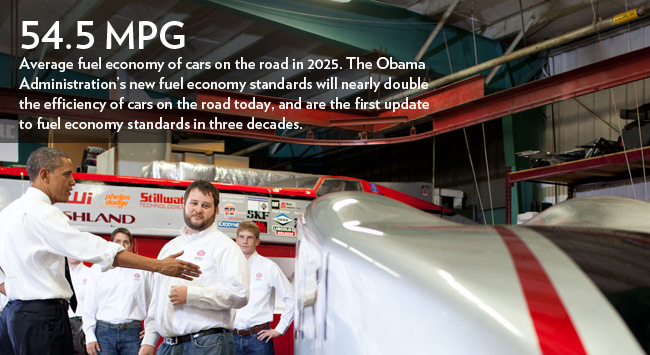
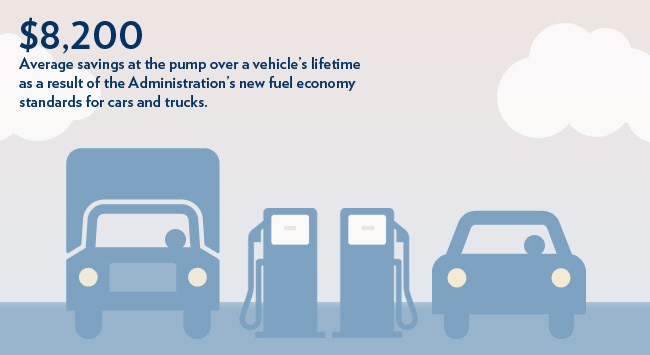
- The Court protected the Administration’s historic fuel economy standards for cars and trucks, adding that EPA’s implementation of the Clean Air Act was “unambiguously correct.”
- Finally, the Court dismissed several petitions challenging a requirement for some of the nation’s largest polluters – starting with new power plants – to install widely-available and cost-effective pollution control technology, while shielding smaller emitters, arguing that “no petitioner had standing.”
Learn more about Economy, Energy and EnvironmentAdvanced Vehicles: Advancing Our Communities
Posted by on June 27, 2012 at 5:58 PM EDTEditor's Note: This blog introduces readers to Jules Toraya, Project Manager at the City of Atlanta's Mayor's Office of Sustainability.
Today at an event held at the White House, the Obama Administration recognized innovators in the auto sector, and the positive impacts the resurgence of the auto industry is having in communities across the country. As the leader of the City of Atlanta's plug-in electric vehicle readiness strategy -- and an officer currently assigned to the Inactive Reserves -- I was honored to be recognized and to engage in a conversation on this topic.
My interest in advanced vehicles and clean energy is tied to my history as a Captain in the U.S. Army. After two tours in Iraq supporting Operation Iraqi Freedom, I became motivated to find ways to reduce petroleum consumption and minimize the need for the Department of Defense to secure America's oil supply chain.
In my last year of active duty, I volunteered for Clean Cities Atlanta and the City of Atlanta's Mayor's Office of Sustainability to help make Atlanta Electric-Vehicle (EV) ready -- and ended up working as a full time administrator on a Department of Energy EV Community Readiness Project with the Center for Transportation and the Environment. Now, I am also coordinating a local public-private partnership, Plug-in Georgia, which is taking a regional approach and working with communities throughout Alabama, Georgia and South Carolina to ease the deployment of EVs. As more plug-in vehicles become available, they are likely to become popular since the Southeast is home to some of the lowest electric utility rates in the country. Atlanta EV infrastructure is building as more plug-in electric vehicles become available. This past Memorial Day in Atlanta, City Council opened Atlanta's first Neighborhood Electric Vehicle Charging Station to the public in honor of those who have been killed in Operations Iraqi Freedom, New Dawn and Enduring Freedom.
Today's event with diverse industry, labor and government leaders reiterated how far we have come in developing advanced vehicles that reduce our country's dependence on foreign oil, and grow jobs in our communities. The Obama Administration's new fuel economy standards, developed in partnership with stakeholders, will encourage even more innovation, and save consumers trillions of dollars at the pump. Mayor Kasim Reed has pledged that the City of Atlanta will become one of the top 10 most sustainable cities in the United States. Supporting advanced vehicles will help us achieve this goal, and keep our communities healthy and strong.
Jules Toraya is Project Manager at the City of Atlanta's Mayor's Office of Sustainability
Learn more about Energy and EnvironmentBuilding Momentum
Posted by on June 27, 2012 at 5:11 PM EDTAs of this week, more than 100 public and private sector partners have come together through President Obama’s Better Buildings Challenge which supports job creation by catalyzing private sector investment in commercial and industrial building energy. Just yesterday, 36 new States, local governments, and school districts joined the growing list of partnerships that are proving how modernizing our country’s buildings to become more energy efficient creates jobs, cuts energy costs, and reduces pollution. Combined, these commitments bring the total square footage of buildings enrolled in this public-private partnership to 2 billion, the equivalent of more than 34,000 football fields.
This announcement also adds $300 million in new estimated investments in building energy upgrades to the nearly $4 billion in public and private sector financial commitments that were announced in December 2011.
Last year, commercial buildings consumed roughly 20 percent of all the energy used by the U.S. economy. With the help of former President Clinton and the President’s Council on Jobs and Competitiveness, President Obama’s Better Building’s Challenge will help make America’s buildings 20 percent more efficient over the next decade, while reducing energy costs for American businesses by nearly $40 billion.
The Federal government is also committed to creating jobs and cutting costs by investing in energy efficiency in Federal buildings. Since President Obama signed a Presidential Memorandum last December directing Federal agencies to invest at least $2 billion in two years in building energy efficiency, agencies have identified $2.1 billion in such projects – all paid for with savings through energy savings performance contracts with no up-front cost to taxpayers.
Learn more about Energy and EnvironmentAnnouncing the Winners of the Youth Sustainability Challenge
Posted by on June 21, 2012 at 9:00 AM EDTRight now, representatives from around the world are gathering at the United Nations Conference on Sustainable Development, or Rio+20, to take part in a global conversation about sustainability and economic growth. The Obama Administration believes that engaging and harnessing the energy and creativity of the world’s youth is critical for long-term sustainability. Innovative ideas and actions often originate from young people around the world, and have the potential to inspire a new generation to help build a more sustainable and prosperous future. Accordingly, the U.S. is making every effort to involve youth as a core part of our sustainability efforts.
That’s why we launched our first ever Youth Sustainability Video Challenge. Our hope was to showcase how youth are already playing an important role in the sustainability conversation. In early May, Nancy Sutley, Chair of the White House Council on Environmental Quality, and Lisa P. Jackson, Administrator of the U.S. Environmental Protection Agency, challenged youth from around the country to tell the world what they are doing in their communities to foster sustainability and help create an America, and a world, built to last.
The results are really quite impressive, and show how innovative young Americans are today. From high school students deploying a micro-grant program, to a young group of engineers creating a solar powered water purification system, the videos showcase a range of creative approaches to sustainability.
Submitted videos were eligible for up to five awards reflecting innovation, contribution to sustainability, communication, and popular choice. After careful review by a panel of Administration officials, the winners are:
- For best overall: “A Generation of Energy: Georgetown Energy”
- For contribution to sustainability: “Every Day Actions, Enduring Results”
- For success in communicating sustainability: “Carmel Green Teen Micro-Grant Program”
- For innovation: “Operation Gulliver International”
- The popular choice (voted by the public on Challenge.gov): “Growth”
Susan Ruffo is Deputy Associate Director for Climate Change Adaptation at the White House Council on Environmental Quality
Learn more about Energy and EnvironmentAnother Step Forward Toward Energy Security
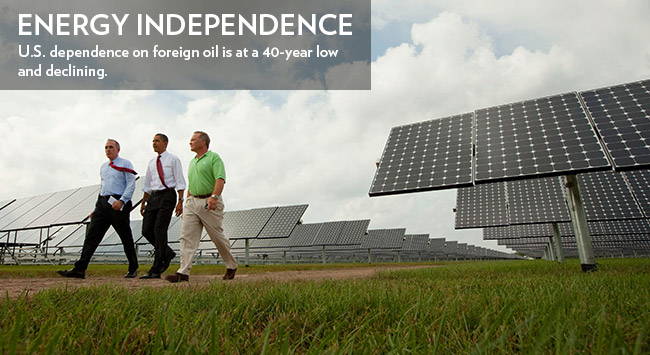
Posted by on June 20, 2012 at 5:05 PM EDTToday, the Obama administration is offering 39 million acres of the most oil- and gas-rich area of the Gulf of Mexico in order to increase the exploration and production of America’s domestic energy resources. This is a landmark sale – we estimate that up to 1.6 billion barrels of oil and 6.6 trillion cubic feet of natural gas could be produced as a result of the acres leased. Holding this lease sale reinforces our commitment to increasing U.S. production, reducing America’s dependence on foreign oil, and incentivizing prompt development of the leases that industry holds.
The bottom line: it’s good news for American jobs, good news for the Gulf economy, and it’s good news for the President’s efforts to expand safe and responsible production of America’s abundant domestic resources.
Despite misleading rhetoric from some, the President has made clear he is committed to expanding oil and natural gas production safely and responsibly, and today’s sale is just the latest example of his administration delivering on that commitment. As part of the President’s all-of-the-above energy strategy, this sale builds on a series of actions taken by the Obama administration, including additional lease sales in both onshore and offshore areas for oil and gas development.
Learn more about Economy, Energy and Environment
- &lsaquo previous
- …
- 69
- 70
- 71
- 72
- 73
- 74
- 75
- 76
- 77
- …
- next &rsaquo
Related Videos
-
 May 09, 2014 9:21 AM
Inside the White House: Solar Panels
-
 September 01, 2016 9:25 PM
President Obama Delivers a Statement to the Press
White House Blogs
- The White House Blog
- Middle Class Task Force
- Council of Economic Advisers
- Council on Environmental Quality
- Council on Women and Girls
- Office of Intergovernmental Affairs
- Office of Management and Budget
- Office of Public Engagement
- Office of Science & Tech Policy
- Office of Urban Affairs
- Open Government
- Faith and Neighborhood Partnerships
- Social Innovation and Civic Participation
- US Trade Representative
- Office National Drug Control Policy