Energy and Environment Latest News
Advancing National Security Through Energy Security
Posted by on July 27, 2012 at 10:56 AM EDTRecently, I had the great privilege to watch our highly skilled sailors doing what they do best, and to witness the U.S. Navy's most sophisticated air and sea platforms perform complex operations using advanced biofuel and energy efficient technologies.
Last week during RIMPAC, the largest maritime exercise in the world, the U.S. Navy successfully demonstrated the Great Green Fleet, a Carrier Strike Group's aircraft and surface ships, on advanced biofuel to test the fuel's performance while conducting operations, including: fueling helicopters and jets from the deck of a nuclear-powered carrier; completing arrested landings of aircraft onto a carrier, the first ever using biofuels; refueling a destroyer while underway; and air-to-air refueling.
The demonstrations confirmed that advanced biofuels can be integrated seamlessly for the user and perform the same as traditional fossil fuel. The demonstration also showcased energy efficiency technology that increases combat capability.

The guided-missile cruiser USS Princeton is participating in the Great Gleen Fleet demonstration at the RIMPAC 2012 exercise (Photo from United States Navy, Mass Communications Specialist 2nd Class Eva-Marie Ramsaran)
The Navy is pursuing alternatives because the nation’s reliance on foreign oil is a significant and well-recognized military vulnerability. The ability to use fuels other than petroleum is critical to our energy security because it will increase our flexibility and reduce the services' vulnerability to rapid and unforeseen changes in the price of oil. A $1 change in the price of a barrel of oil, for example, results in an approximately $30 million change in the Navy budget. This is why the Navy will only purchase operational quantities of biofuel blends when they are competitive with petroleum, period. We simply cannot afford to do it otherwise and will not do it.
Joining me at the demonstration was Chief of Naval Operations Jonathan Greenert, and the commanders of U.S. Pacific Fleet and U.S. 3rd Fleet. Their participation signaled to the Navy and the nation the Navy’s commitment to pursuing alternatives to imported fossil fuels because we believe it is critical to our national security.
A viable advanced biofuels market can inject competition into the liquid fuel market, which could drive down the cost of liquid fuels and dampen price volatility. We recently pushed more competition into the shipbuilding industry, which allowed the Navy to bring down the cost of our ships. We can do the same for the fuel we purchase to power those ships and other platforms.
The Navy has always led in energy transformations, moving from wind to coal, coal to oil, and then pioneering the use of nuclear power. The Great Green Fleet was named in honor of the Great White Fleet that circled the globe beginning in 1907 and introduced America as a global power. It comprised the most advanced ships of its time; battleships made from steel and powered by steam, and represented America’s greatness and ingenuity. The Great Green Fleet demonstration continues our long tradition of energy transformation by powering the Fleet with alternative fuels.
Ray Mabus is the United States Secretary of the Navy
Learn more about Energy and EnvironmentInventing a Sustainable Future for Latin America
Posted by on July 27, 2012 at 10:39 AM EDT
The future has always been far away. Ever since I was a child, I remember thinking about the future as a very distant event. I remember thinking that the future would be different and, in one word, better than whatever the present was for me back then.
Today, I realize I live in the future, just not the future I wanted for my family, my children and the people I care about. I realize the future I live in is a future I contributed to create mostly by not doing much about it.
Granted, the world we live in has been marred by a series of unfortunate events, some caused by us, some not. In the last ten years alone we’ve had perhaps the worst financial crisis the world has seen in 80 years, as well as a series of crises relating to the lack of or uneven distribution of natural resources, including water, food and oil. And most recently, climate change. The problem is not necessarily the amount of damage caused by these crises, but rather the long term, and even irreversible, effects they could have.
The financial crisis of 2008 served as a wakeup call for the entire planet. The effects of the crisis were felt all over the world, especially in developing countries. It was a moment in which we had to decide whether to pursue the same goals that had brought us to this point, or to change the ways we think about the economy, the environment, technology and society. That is, we were at a cross roads where we needed to decide what kind of future we wanted for ourselves, our children and the entire world.
Learn more about Energy and EnvironmentU.S. Public Lands Continue to Create Jobs and Boost Local Economies Through Tourism, Restoration Efforts, and Energy Initiatives
Posted by on July 26, 2012 at 1:16 PM EDTAmerica’s national parks, forests, wildlife refuges, and other outdoor spaces are treasured for their beauty, their enjoyment, and for their value to our culture and history -- sometimes, it can be easy to overlook that they also serve as economic drivers for American communities. In sectors ranging from tourism to outdoor recreation and energy development, our nation’s public lands and waters are creating jobs and supporting local economies across the country.
Today, the U.S. Department of Agriculture (USDA) released an annual visitor survey, which highlights how our nation’s forests are contributing billions of dollars to the economy and creating jobs in tourism, restoration, and renewable energy. The report showed that USDA Forest Service lands attracted 166 million visitors in 2011, and, as a result, visitor spending in nearby communities sustained more than 200,000 full- and part-time jobs. The survey also reveals that these jobs produced labor income of more than $7.6 billion, while forest and grassland visitor spending contributed more than $13 billion to the gross domestic product.
In addition, a recently-released report from the Department of the Interior shows that in Fiscal Year 2011, the activities of the Department contributed $385 billion to the economy and supported over 2 million homegrown, American jobs. The findings show the real, lasting impacts of these activities—which range from facilitating energy and mineral development to encouraging tourism and recreation at national parks, monuments, and refuges—on our economy.
These are not the first reports to show the positive impact public lands have on the U.S. economy. An earlier study by Interior’s Office of Policy Analysis found that recreation in national parks, refuges, and other public lands alone led to nearly $47 billion in economic contribution and 388,000 jobs in 2010. Another report released by the Outdoor Industry Association revealed that 140 million Americans spent a combined $646 billion on hunting, fishing, hiking, biking, and other outdoor recreation on public and private lands supporting more than 6 million American jobs.
President Obama is working to bolster these impacts through a number of initiatives, including:
Learn more about Energy and EnvironmentPromoting Sustainable Health Care
Posted by on July 24, 2012 at 3:26 PM EDT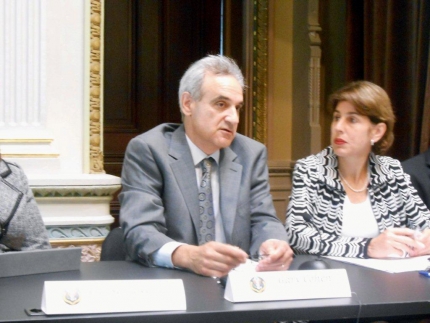
Health Care Without Harm President and Founder Gary Cohen speaks during a panel discussion at the White House event on Sustainability and the Health Care Industry (White House Council on Environmental Quality)
Imagine energy efficient hospitals that save money on energy bills to use for critical patient care, and that promote renewable energy as a community health and resilience strategy. Imagine hospitals that create healthy food environments to help address the epidemic of obesity and diabetes in our country. Imagine hospitals that lead society in reducing toxic chemical exposures , and that are reducing their waste, saving money and improving patient care at the same time. Imagine a health care system that redefines “community benefit” to include improving the living conditions of communities that hospitals serve, and focusing on the prevention of disease through environmental health in addition to treatment. Imagine a health care system that makes up over 20 percent of the U.S. economy and becomes the driving force for safer products, cleaner energy, and healthier communities.
This vision is what the Healthier Hospital Initiative is bringing to reality today and is proud to share with the Obama Administration at the White House event on Health Care and Sustainability. We have created a roadmap for hospitals to embed sustainability into their core business model and are providing technical assistance to offer every hospital in America the chance to participate for free. Health Care Without Harm has joined with our sister organization Practice Greenhealth, The Center for Health Design and 11 of the largest hospital systems in America to create the Healthier Hospital Initiative and drive this movement in health care for healthier hospitals. We already have the participation of more than 600 hospitals and we aim to recruit 2,000 overall and track the progress of the sector in achieving our goals.
Learn more about Energy and EnvironmentMaking Plans for GreenGov 2012: Leading by Example
Posted by on July 24, 2012 at 10:45 AM EDTThe third annual GreenGov Symposium is taking place in Washington, D.C. September 24 - 26, 2012. Co-hosted by the Council on Environmental Quality and the Association of Climate Change Officers (ACCO), the Symposium will bring sustainability leaders and newcomers in the federal, state, and local government, academic, non-profit and private sectors together to learn from each other, share ideas, and help develop innovative solutions to our energy and sustainability challenges. By design, the Symposium helps the Federal Community save energy, save money, and address our sustainability goals and targets under Executive Order 13514: Federal Leadership in Environmental, Energy, and Economic Performance.
Now, you can take a look at the preliminary agenda for the Symposium on http://www.greengov2012.com/program-agenda.html. With ten tracks over two days, the Symposium will have more than 50 informative sessions, including panel discussions with leading experts, best practice case studies, and new concept, 101-education sessions. And, we are ensuring that some sessions will be webcast to allow those who cannot attend to share in the GreenGov experience. This year we are also hosting post-conference workshops and meetings on September 26, 2012, to allow for additional discussion and training related to sustainability.
The Symposium is unlike any other annual gathering, designed specifically for the benefit of government employees who are dedicated to helping their agencies and the Federal government lead by example in meeting sustainability targets laid forth by the President. The work accomplished during the Symposium is beneficial to all levels of government, with initiatives targeting better management and fewer taxpayer dollars spent on government operations.
Learn more about Energy and EnvironmentBrainstorming Apps for a Clean Energy Future
Posted by on July 20, 2012 at 8:55 AM EDTBuilding off the recent launch of the Energy Data Initiative, fifty technologists, entrepreneurs, and investors joined staff from the White House, Department of Energy, and the Environmental Protection Agency to participate in an “Energy Data Jam” last week in New York City. One of the goals of the half-day workshop was to brainstorm how freely available datasets—i.e., open data—might be used by clean-energy entrepreneurs for new products, services, or apps.
Launched by the Obama Administration earlier this year, the Energy Data Initiative aims to help Americans shrink their energy costs, improve the environment, and create jobs. By “liberating” data from the vaults of the government and other sources, the Energy Data Initiative empowers innovators to transform data into valuable tools that we can actually use in our daily lives.
Learn more about Energy and Environment, Technology
- &lsaquo previous
- …
- 67
- 68
- 69
- 70
- 71
- 72
- 73
- 74
- 75
- …
- next &rsaquo
Related Videos
-
 May 09, 2014 9:21 AM
Inside the White House: Solar Panels
-
 September 01, 2016 9:25 PM
President Obama Delivers a Statement to the Press
White House Blogs
- The White House Blog
- Middle Class Task Force
- Council of Economic Advisers
- Council on Environmental Quality
- Council on Women and Girls
- Office of Intergovernmental Affairs
- Office of Management and Budget
- Office of Public Engagement
- Office of Science & Tech Policy
- Office of Urban Affairs
- Open Government
- Faith and Neighborhood Partnerships
- Social Innovation and Civic Participation
- US Trade Representative
- Office National Drug Control Policy