Energy and Environment Latest News
Energy Datapalooza: Unleashing the Power of Open Data to Advance our Energy Future
Posted by on October 1, 2012 at 8:03 AM EDTImagine it is a scorching hot summer day, and your smart phone beeps, asking if you’d like it to raise your home thermostat a degree or two to save money. Or, envision an easy-to-use software package that lets a building owner perform virtual energy audits at a fraction of the cost of in-person audits, so real savings are calculated instantly, building upgrades launched sooner, and construction jobs created faster.
These are the kinds of advances that are on display today at the White House as more than 150 of America’s entrepreneurs, software developers, energy experts, and policy makers come together for an Energy Datapalooza. The gathering is a chance to celebrate new products, services, and apps that are advancing a secure, clean energy future—all built with freely available data from the government and other sources.
Learn more about Energy and Environment, , TechnologyWomen in Clean Energy Symposium
Posted by on September 27, 2012 at 10:33 AM EDTEd. note: This is cross-posted from U.S. Energy Department.
Join Us Live This Friday: Women in Clean Energy Symposium
If we are to succeed in the global clean energy race, we need the talents and contributions of all members of society. This is the driving force behind the Clean Energy Education & Empowerment (C3E) initiative. Launched in partnership with eight other governments at the inaugural Clean Energy Ministerial -- C3E leverages the skills and talents of women worldwide to help advance the global clean energy economy.
This Friday, September 28, organizers of C3E will celebrate an important milestone -- the launch of the Women in Clean Energy Symposium. Hosted by the U.S. Energy Department and the MIT Energy Initiative – the Women in Clean Energy Symposium will bring together distinguished and emerging leaders to help lay the foundation for a broader, continuing effort to advance women's leadership in clean energy.
The centerpiece of the symposium will be the first-ever C3E Awards ceremony -- recognizing six mid-career individuals with outstanding accomplishments in the clean energy field. Awards will be given out in a range of categories including: innovation and technology development, entrepreneurship, policy and advocacy, and advancements for the developing world.
Best of all, the symposium will not be limited to those attending in person. We’re making the event interactive so that you can share your own thoughts and perspectives throughout.

National Renewable Energy Laboratory researcher Kirsten Alberi works in the lab's luminescence mapping laboratory at the Solar Energy Research Facility. Here she aligns a laser and sample to map the photoluminescence coming off the sample. (Photo Credit: Dennis Schroeder, National Renewable Energy Laboratory)
GreenGov 2012: Leading by Example
Posted by on September 21, 2012 at 3:22 PM EDTOn September 24-26, 2012, the third annual GreenGov Symposium will convene leaders in the public and private sectors here in Washington, DC for a focused dialogue on energy and environmental sustainability in the Federal Government. The Symposium, co-hosted by the Council on Environmental Quality and the Association of Climate Change Officers (ACCO), is two days of nearly 60 informative sessions, including panel discussions with leading experts, best practice case studies, and 101-education sessions. We will be wrapping up the third day with a series of workshops, roundtable discussions, and training opportunities.
One of the exciting features of this year’s Symposium is the option to watch a live web stream of some of our most innovative sessions. This means that our keynote sessions, as well as at least one session from each of the tracks will be available online in real time for anyone who cannot attend GreenGov. Another great feature of this year’s Symposium is a new session track – Public-Private Partnerships and Third Party Financing. Financing might not be the first thing that comes to mind when talking about energy and sustainability, but it is an incredibly important part of our progress and our future capacity when it comes to saving energy and money in the Federal Government. Innovative financing ideas and partnerships can help us reap the benefits of capital-intensive projects, such as energy retrofits, without the need to provide the upfront capital required for construction.
Alternative financing is just one area where the Federal government is leading by example when it comes to finding innovative solutions to our energy and sustainability challenges. We are looking forward to having more than 1,000 attendees at the Symposium this year as we continue to grow the community that is leading by example on energy and environmental sustainability. I hope that if you can’t make it to DC for GreenGov, you’ll be sure to tune in online.
Jon Powers is the Federal Environmental Executive at the White House Council on Environmental Quality
Learn more about Energy and EnvironmentChimney Rock Becomes Our Newest National Monument
Posted by on September 21, 2012 at 12:54 PM EDTToday, President Obama designated spectacular Chimney Rock in southwest Colorado as our nation’s newest national monument, an historic step honoring a place rich in beauty, history and Native American culture.
With the strong support of the people of Colorado, from the congressional delegation to Governor Hickenlooper to the Native American community and local residents, President Obama has ensured this extraordinary national treasure will be protected for generations to come.
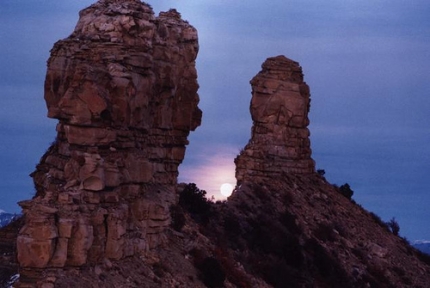
Chimney Rock, designated a national monument on Sept. 21, 2012, was home to the Ancestral Pueblo People about 1,000 years ago and is culturally significant for Native American tribes. The dramatic Great House Pueblo was likely was used as an observatory for the annual summer solstice. (Photo credit: U.S. Department of Agriculture)
A thousand years ago, Chimney Rock was home to Ancestral Pueblo People who built more than 200 homes and ceremonial buildings high above the valley floor. Many of the structures remain today, and are designed to perfectly align with lunar events such as seasonal solstices and equinoxes, drawing visitors from across the world.
Beyond protecting this special place, this designation also ensures Chimney Rock will be a source of economic opportunity in Colorado, attracting new business and tourism. According to a study commissioned by the National Trust for Historic Preservation, the national monument designation is expected to double economic activity from tourism in the area over the next five years. Outdoor places like Chimney Rock provide us with opportunities for rest and respite, with a link to our Nation’s proud outdoor traditions and culture, and with jobs and economic opportunities across the country. In fact, outdoor recreation alone contributes an estimated $650 billion a year to our economy, according to the Outdoor Industry Association.
Learn more about Economy, Energy and EnvironmentDelivering Energy Savings to Taxpayers
Posted by on September 18, 2012 at 12:52 PM EDTIt is no secret Americans everywhere are looking for more ways to save. From electricity bills to gas pumps, families and businesses are turning over more stones to save on their energy use.
The Federal Government is no different. As the nation’s top energy consumer, there is great potential to deliver energy savings to taxpayers. Thankfully, there is a giant opportunity right in front of us: Commissioning.
As with ships, commissioning for new buildings is meant to assure that systems are properly installed and operate within specifications. Commissioning identifies and corrects such errors as fans installed backwards or wired to stay “always-on,” faulty equipment, and improperly programmed building energy systems. Properly done, commissioning includes training so building staff can provide high performance operation.
However, over time, building performance tends to drift. Building use can change, equipment can be altered, and new staff are not always fully trained. Equipment may no longer operate within specifications; leaks may go unrepaired. The result is that energy performance suffers, along with occupant comfort. This can drive up energy costs and our bills. Without a quality-assurance process, problems may go unfixed for years and even decades.
Recommissioning (or retrocommissioning for a building not previously commissioned) can be thought of as a “tune-up” to restore and enhance building performance. Commissioning agents work with building operators to do this. Good recommissioning includes training so operators can keep buildings operating optimally long after the process.
And the savings offered are impressive. A Lawrence Berkeley National Laboratory study of 643 buildings across 26 states found that commissioning led to median energy savings of 16 percent in existing buildings and 13 percent in new construction.
Most of this vast potential remains untapped – but change is coming. California and New York City both recently began including commissioning as part of their strategies to advance building efficiency, and the Energy Independence and Security Act of 2007 established commissioning as part of its Federal energy management goals and requirements.
As the operator of more than 500,000 buildings covering 3.1 billion square feet, the Federal Government is leading by example here. But they cannot do it alone. Add in 5 million commercial buildings totaling 72 billion square feet and commissioning becomes a prime opportunity for business and government to come together to help Americans save money and power the economy forward.
Commissioning and other innovative ideas will be discussed at the upcoming 2012 GreenGov Symposium, which will focus on sharing ways to create jobs and save taxpayers money by making the Federal Government more sustainable and energy efficient.
Kateri Callahan is President of the Alliance to Save Energy
Learn more about Energy and EnvironmentCelebrating the 25th Anniversary of the Montreal Protocol
Posted by on September 17, 2012 at 5:03 PM EDTSeptember 16th marked the 25th anniversary of the ratification of the Montreal Protocol on Substances that Deplete the Ozone Layer, one of the world's greatest environmental protection success stories. The United States played a leading role during its negotiation in 1987 and, today, Americans continue to benefit from its impacts. By phasing out the production of chemicals that threatened the ozone layer, the Montreal Protocol today protects the health of billions of people across the world.
In the 1970s, evidence began to surface that certain products we use every day, from aerosol spray cans to refrigerators, contained chemicals known as chlorofluorocarbons (CFCs) that were depleting the Earth’s protective ozone layer and increasing the level of ultraviolet radiation reaching the Earth’s surface. Overexposure to ultraviolet radiation can cause serious health problems, including higher incidence of skin cancer, and negatively impact our environment by damaging crops and food sources.
The United States was instrumental in crafting a solution to this risk. On September 16, 1987, twenty four nations, including the United States, signed the Montreal Protocol. Today, all 197 member nations of the United Nations have followed our lead, making it the most widely ratified international environmental agreement in history.
The Montreal Protocol has been and continues to be a clear and resounding success. The United Nations estimates that global production of ozone-depleting substances has fallen 98% since ratification. As a result, the ozone layer is recovering, and experts project that it will return to its pre-1980 levels as early as 2060.
When the world first grappled with the challenge of a diminishing ozone layer, few substitutes existed for ozone-depleting chemicals and many observers warned that tackling the problem would impose tremendous economic burdens. But global innovation, led by a number of American companies, proved them wrong. An unprecedented research and development effort has led to the rapid, widespread adoption of low-cost alternatives to harmful CFCs. Today, everyday products that once contained CFCs, from spray cans and computers to furniture and packing peanuts, are produced with ozone-friendly materials.
These accomplishments have produced real benefits for Americans, preventing sicknesses and deaths, and saving us money on health care costs. In fact, the U.S. Environmental Protection Agency estimates that every dollar invested in ozone protection provides $20 in health benefits here at home.
The Montreal Protocol has also played a significant role in helping to address climate change. Many ozone-depleting substances are potent greenhouse gases. By dramatically reducing the production of these substances, the Montreal Protocol has so far averted the equivalent of 135 billion metric tons of carbon dioxide worldwide, according to United Nations estimates.
In the 1970s and 1980s, there was widespread concern that the depletion of our ozone layer would have a long-lasting negative impact on our health and communities. Today, thanks to the United States’ leadership on important environmental issues, we are well on our way toward restoring the ozone layer, and its benefits. On the 25th anniversary of this agreement, it is important to recognize that the success of the Montreal Protocol is not only a cause of celebration, but also a model of how we can work together to build healthier, cleaner communities and spur innovation and economic growth.
Gary Guzy is Deputy Director and General Counsel for the White House Council on Environmental Quality
Learn more about Energy and Environment
- &lsaquo previous
- …
- 64
- 65
- 66
- 67
- 68
- 69
- 70
- 71
- 72
- …
- next &rsaquo
Related Videos
-
 May 09, 2014 9:21 AM
Inside the White House: Solar Panels
-
 September 01, 2016 9:25 PM
President Obama Delivers a Statement to the Press
White House Blogs
- The White House Blog
- Middle Class Task Force
- Council of Economic Advisers
- Council on Environmental Quality
- Council on Women and Girls
- Office of Intergovernmental Affairs
- Office of Management and Budget
- Office of Public Engagement
- Office of Science & Tech Policy
- Office of Urban Affairs
- Open Government
- Faith and Neighborhood Partnerships
- Social Innovation and Civic Participation
- US Trade Representative
- Office National Drug Control Policy