Energy and Environment Latest News
Taking Action for a Stronger, Smarter, Cleaner Electric Grid
Posted by on February 26, 2013 at 9:25 AM EDTToday, the Obama Administration’s National Science and Technology Council released A Policy Framework for the 21st Century Grid: A Progress Report—an update highlighting the Administration’s most recent achievements to make the Nation’s electric grid stronger, smarter, and cleaner than ever before.
In his State of the Union address this month, President Obama recognized that “no area holds more promise than our investments in American energy.” As part of his plan to grow the economy and create middle class jobs, the President called for continued investment in infrastructure, including “self-healing power grids.” In the same address, he also warned against ignoring the “overwhelming judgment of science” that the threat of climate change is real and demands attention. These two calls to action—each independently important to our country’s future—intersect at the Nation’s electric system.
To date, the Obama Administration has taken a number of important steps to help the Nation prevent and recover quickly from power outages, including by working closely with industry partners to upgrade the electric system with “smart grid” technologies that can detect and prevent outages, improve system efficiency, and better integrate clean energy sources. While we’ve come a long way, recent extreme weather events have reinforced the reality that our work is not done. Many Americans suffered power loss during the spate of strong storms, droughts, and record high temperatures of the past year—all of which, to varying degrees, threatened the operation of the Nation’s electric grid. We can do better.
Working Together to Understand and Predict Arctic Change
Posted by on February 19, 2013 at 2:04 PM EDTToday, the Administration’s National Science and Technology Council released a five-year Arctic Research Plan that outlines key areas of study the Federal government will undertake to better understand and predict environmental changes in the Arctic. The Plan was developed by a team of experts representing 14 Federal agencies, based on input from collaborators including the Alaska Governor’s Office, indigenous Arctic communities, local organizations, and universities. Seven research areas are highlighted in the Plan as both important to the development of national policies and well-poised to benefit from interagency collaboration, including among them: regional climate models, human health studies, and adaptation tools for communities.
Environmental changes in the Arctic—such as rapidly-melting ice on land and at sea—are not only having profound impacts on local Arctic populations but are also affecting more distant communities and businesses that depend on Arctic resources to thrive. Among an array of effects, melting land-ice contributes to rising sea levels, and will have costly implications for communities, businesses, and infrastructure located on coasts. Diminishing sea-ice changes the composition and distribution of species found in regional ocean waters and, as a result, forces communities that depend on those resources for food to alter their harvest practices and/or their diets. Waning sea ice accelerates global warming and alters circulation in the atmosphere and oceans in ways that change storm patterns in other parts of the world.
Learn more about Energy and EnvironmentReducing Pollution For All American Families
Posted by on February 14, 2013 at 12:00 PM EDTWhen I first became Administrator of the U.S. Environmental Protection Agency, I made a list of my priorities for the Agency. Working for environmental justice was at the top of that list. Ensuring equal environmental protections for all Americans is the unfinished business of the environmental movement.
It’s a simple idea – that all Americans are entitled to clean air to breathe, safe water to drink and a healthy community to raise their families – but often, it is America’s low-income and minority communities that bear the brunt of our country’s pollution.
As a result, these communities are also hit harder by the many illnesses pollution is linked to – conditions like asthma, heart disease, cancer and strokes. Studies show that minority groups face a greater risk of having asthma, and once they have it, they are at a greater risk of needing emergency treatment. African-American children are hospitalized for asthma at twice the rate of white children, and asthma-related deaths among African-American children take place at a rate of four times that of non-Hispanic white children. Hispanic children -- especially of Puerto Rican descent -- also face higher rates of asthma.
Dirty air, polluted water and contaminated lands not only put families at higher risks of serious and potentially costly diseases – they also discourage new developments and new jobs. Poison in the ground often means poison in the economy. Limiting the economic possibilities of low-income and minority communities only makes it harder to break the cycle of poverty.
Open for Questions: The State of the Union and Energy and the Environment
Posted by on February 13, 2013 at 8:00 PM EDTToday, Heather Zichal, Deputy Assistant to the President for Energy and Climate Change, answered questions from the public about President Obama's State of the Union Address in an “Open for Questions” session moderated by Popular Science. Check it out below.
Learn more about Energy and EnvironmentState of the Union 2013: White House “Open for Questions” Marathon
Posted by on February 11, 2013 at 10:23 PM EDTOn Tuesday, February 12 at 9:00 p.m. ET, President Obama will deliver his annual State of the Union Address. Once again, we will be streaming an enhanced version of the speech that features graphics, data and stats that highlight the issues thePresident is discussing on WhiteHouse.gov/SOTU. We will also live stream that broadcast through the White House Live App on Facebook, YouTube and our Google+ page.
Immediately following the speech, we’ll be streaming a virtual Q&A live from the White House. During this special “Open for Questions” event, a panel of senior advisors will be answering questions about the President's address submitted by citizens via Twitter (using the hashtag's #WHChat & #SOTU), Google+ and Facebook, as well as from the live in-person audience of White House Social participants.
In the days following the speech, Administration officials will continue to take questions on key issue areas addressed in the President's speech submitted by the public on social media during an "Open for Questions" marathon.
President Obama Names Sally Jewell to Lead the Department of the Interior
Posted by on February 6, 2013 at 6:24 PM EDT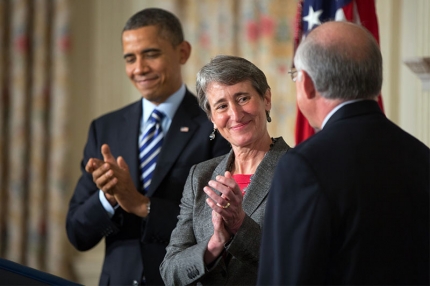
President Barack Obama and Sally Jewell applaud outgoing Interior Secretary Ken Salazar after President Obama announced Jewell as his nominee to replace Salazar, in the State Dining Room of the White House, Feb. 6, 2013. (Official White House Photo by Pete Souza)
Speaking in the State Dining Room at the White House, President Obama today announced that he has chosen Sally Jewell to be the next Secretary of the Interior. For the past eight years, Ms. Jewell has been the CEO of REI, one of America's most successful and environmentally conscious retailers. Previously, she had worked in oil fields in Oklahoma and Colorado, and as an energy expert in banking -- experience the President highlighted as he introduced Ms. Jewell to the American people:
So even as Sally has spent the majority of her career outside of Washington -- where, I might add, the majority of our interior is located -- she is an expert on the energy and climate issues that are going to shape our future. She is committed to building our nation-to-nation relationship with Indian Country. She knows the link between conservation and good jobs. She knows that there’s no contradiction between being good stewards of the land and our economic progress; that in fact, those two things need to go hand in hand. She has shown that a company with more than $1 billion in sales can do the right thing for our planet.
Learn more about Energy and Environment,
- &lsaquo previous
- …
- 61
- 62
- 63
- 64
- 65
- 66
- 67
- 68
- 69
- …
- next &rsaquo
Related Videos
-
 May 09, 2014 9:21 AM
Inside the White House: Solar Panels
-
 September 01, 2016 9:25 PM
President Obama Delivers a Statement to the Press
White House Blogs
- The White House Blog
- Middle Class Task Force
- Council of Economic Advisers
- Council on Environmental Quality
- Council on Women and Girls
- Office of Intergovernmental Affairs
- Office of Management and Budget
- Office of Public Engagement
- Office of Science & Tech Policy
- Office of Urban Affairs
- Open Government
- Faith and Neighborhood Partnerships
- Social Innovation and Civic Participation
- US Trade Representative
- Office National Drug Control Policy