
Energy and Environment Latest News
A Strategy for the Arctic, Informed by Sound Science
Posted by on May 10, 2013 at 3:19 PM EDTToday, the Obama Administration released the first-ever National Strategy for the Arctic Region—an approach to protecting national security, promoting environmental stewardship, supporting native cultures, providing for appropriate economic development, and strengthening international cooperation in the Arctic region. The Strategy, which was developed by an interagency team of Administration experts with significant input from the State of Alaska and Alaska Native organizations, articulates several key objectives for Federal activity in the Arctic over the next decade—including increased scientific understanding of the region.
The Strategy is guided by the Nation’s interest in safeguarding peace and stability in the Arctic; ensuring that resource management decisions are based on the best available information; strengthening and forging public-private and international partnerships; and coordinating Arctic-based efforts with Alaska Natives. It also serves to focus our national efforts in the Arctic at a time when the region is undergoing rapid environmental change.
Fast-melting ice on land and at sea has important implications for natural Arctic environments, human well-being, national security, transportation, and economic development. For instance, in addition to contributing to further global warming, diminishing sea-ice changes the distribution of species found in regional ocean waters, which in turn can have profound effects on local economies. Waning sea-ice also changes ocean circulation patterns and navigation pathways, with significant impacts for commercial and military navigation.
Learn more about Energy and EnvironmentProtecting Our Interests in the Arctic
Posted by on May 10, 2013 at 2:21 PM EDTToday, the Obama Administration released the National Strategy for the Arctic Region that outlines our Nation’s priorities in the rapidly changing area over the next 10 years. The Strategy unifies Federal efforts across these broad goals: advancing U.S. security interests, pursuing responsible Arctic region stewardship, and strengthening international cooperation. The United States is an Arctic nation. As new challenges and opportunities emerge in the region as the result of a changing climate, this strategy builds on the significant work that has already been done by Federal agencies, the State of Alaska, and area Tribes over the past years and decades.
One of the many building blocks of the Arctic Strategy is the Administration’s recently released National Ocean Policy Implementation Plan. The Implementation Plan translates the Administration’s National Ocean Policy into on-the-ground actions to better leverage Federal resources, streamline decision-making, and encourage collaboration among Federal agencies, states and marine stakeholders on ocean issues. A key focus of the Implementation Plan is the Arctic. Federal agencies are targeting their work in the Arctic on monitoring the impacts of changing conditions, developing better mapping and charting to aid in safe navigation, improving Arctic sea-ice forecasting, and coordinating readiness for environmental incident response – all actions that support the priorities of the National Strategy for the Arctic Region.
The United States has broad interests in the Arctic, from national security to energy development, commerce, environmental protection, scientific research, and preservation of a rich cultural heritage. All of these interests must be addressed in the context of dramatic changes to the environment and accessibility of the region. Through better Federal coordination, improved access to science and information, and more efficient decision-making, the National Ocean Policy will help achieve the priorities laid out in the Arctic Strategy. I look forward to the National Ocean Council’s continued contribution to this effort, for the benefit of all Americans.
To read the National Strategy for the Arctic Region, click here.
Nancy Sutley is Chair of the Council on Environmental Quality
Learn more about Energy and EnvironmentOpen Data for Climate and Health Insights
Posted by on May 9, 2013 at 2:23 PM EDTEd. note: This is cross-posted from the Office of Science and Technology Policy blog
Today, in conjunction with a series of landmark steps announced by the Obama Administration to unleash troves of useful data from the vaults of government, the interagency US Global Change Research Program (USGCRP) launched a new online tool that promises to accelerate research relating to climate change and human health—the Metadata Access Tool for Climate and Health, or “MATCH.”
The Administration announcements made today include an Executive Order signed by the President declaring that information is a valuable national resource and strategic asset, and a new government-wide Open Data Policy requiring that, going forward, data generated by the government shall be made available in open, machine-readable formats. The move will make troves of previously inaccessible or unmanageable data more readily available to entrepreneurs, researchers, and others who can use open data as fuel for innovation, businesses and new services and tools.
MATCH is one such tool, driven by open data, which could open the door for new scientific insights in the public health and climate science communities. It is a publicly accessible digital platform for searching and integrating metadata—standardized contextual information—extracted from more than 9,000 health, environment, and climate-science datasets held by six Federal agencies.
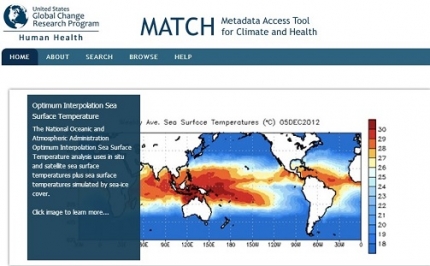
Screenshot of the Metadata Access Tool for Climate and Health (MATCH), the US Global Change Research Program's online tool for researchers that offers centralized access to metadata ‐ standardized contextual information ‐ about thousands of government-held datasets related to health, the environment, and climate-science.
Learn more about Energy and EnvironmentOpen Data for Climate and Health Insights
Posted by on May 9, 2013 at 1:28 PM EDTToday, in conjunction with a series of landmark steps announced by the Obama Administration to unleash troves of useful data from the vaults of government, the interagency US Global Change Research Program (USGCRP) launched a new online tool that promises to accelerate research relating to climate change and human health—the Metadata Access Tool for Climate and Health, or “MATCH.”
The Administration announcements made today include an Executive Order signed by the President declaring that information is a valuable national resource and strategic asset, and a new government-wide Open Data Policy requiring that, going forward, data generated by the government shall be made available in open, machine-readable formats. The move will make troves of previously inaccessible or unmanageable data more readily available to entrepreneurs, researchers, and others who can use open data as fuel for innovation, businesses and new services and tools.
MATCH is one such tool, driven by open data, which could open the door for new scientific insights in the public health and climate science communities. It is a publicly accessible digital platform for searching and integrating metadata—standardized contextual information—extracted from more than 9,000 health, environment, and climate-science datasets held by six Federal agencies.
Screenshot of the Metadata Access Tool for Climate and Health (MATCH), the US Global Change Research Program's online tool for researchers that offers centralized access to metadata ‐ standardized contextual information ‐ about thousands of government-held datasets related to health, the environment, and climate-science.
Green Button: Enabling Energy Innovation
Posted by on May 2, 2013 at 11:12 AM EDTEd. note: This is cross-posted from the Office of Science and Technology Policy blog
Last year, in response to the Obama Administration’s call to action, 35 utilities and energy providers committed to provide 36 million homes and businesses with their own energy usage information in the consensus, industry-standard Green Button format.
Not only are utilities implementing Green Button Download My Data across the country for homes and businesses to securely download their information, but utilities in California and the Mid-Atlantic are beginning to implement Green Button Connect My Data functionality— making it easier for their customers to securely transfer their own energy usage data to authorized third parties, based on affirmative (opt-in) customer consent and control. These efforts will provide more than 11 million customers with an easy and secure way to automatically and routinely participate in energy saving opportunities.
Adopting the Green Button standard will enable households and businesses to more easily use web and smartphone apps to pick the best rate plan for them; take advantage of customized energy efficiency tips; utilize easy-to-use tools to size and finance rooftop solar panels; and download virtual energy audit software that can cut costs for building owners and help get retrofits started sooner.
Today, we’re excited to see Green Button enable energy innovation through new announcements for the industry-led Green Button Initiative:
- Ecova will take advantage of the Connect My Data platform to save commercial building owners money by offering more targeted energy saving opportunities.
- Solar City is integrating Connect My Data into its sales consultations to help customers assess solar's potential to reduce home energy consumption and monthly electricity bills
- MyEnergy is now able to convert your utility bill into electronic Green Button data for you – almost anywhere in the country.
- WeatherBug-Earth Networks is integrating Connect My Data with its real-time hyper-local weather data to improve load management and save consumers money
- EnerNOC is using Green Button data to quality check their real-time sensor data, and separately, has published a open data set of anonymized energy consumption data from 100 buildings in the Green Button format
- Bidgely is using Connect My Data to offer appliance-level energy consumption insights to consumers
- ChargePoint will use Green Button to report energy consumption data to utilities from electric vehicle charging stations
- Wegowise is now using Green Button data to drive multi-family and commercial building energy efficiency
- With support from the Department of Energy, the Pike Powers Laboratory and Center for Commercialization has launched a Green Button app testing center and the Pecan Street Research Institute will also make the largest open set of disaggregated and anonymized consumer energy use data available in the Green Button format.
Green Button is also adding value in the public sector. In Washington, DC, for example, the local government is working with the utility company Pepco to acquire details on energy usage in local government buildings, in order to identify opportunities to conserve energy, save money, and meet local sustainability goals. The Environmental Protection Agency’s ENERGY STAR program also just launched a new version of the Home Energy Yardstick tool that incorporates a Green Button feature. The Yardstick helps people compare their home’s actual energy performance to other homes.
As energy innovation continues to show promise for growing our economy, protecting privacy remains a priority for the Administration. To that end, DOE is helping to facilitate a multi-stakeholder process with utilities, privacy advocates, and others to develop a code of conduct that will help clarify for consumers and providers how energy usage data should be protected and when it can be shared.
Green Button is part of a comprehensive grid-modernization strategy, and recent estimates indicate that the Administration’s early smart grid investments have generated significant economic benefits for the American public. Investing in a modern grid – and continuing smart partnerships through the Green Button initiative - are important components of our strategy to cut energy waste in half by 2020 - and build a stronger, more resilient, and more competitive economy.
Monisha Shah is Deputy Associate Director for Energy and Climate Change at the White House Council on Environmental Quality
Nick Sinai is Deputy US Chief Technology Officer at the White House Office of Science and Technology Policy
Learn more about Energy and EnvironmentGreen Button: Enabling Energy Innovation
Posted by on May 2, 2013 at 9:12 AM EDTThis article is cross-posted from the Council on Environmental Quality blog
Last year, in response to the Obama Administration’s call to action, 35 utilities and energy providers committed to provide 36 million homes and businesses with their own energy usage information in the consensus, industry-standard Green Button format.
Not only are utilities implementing Green Button Download My Data across the country for homes and businesses to securely download their information, but utilities in California and the Mid-Atlantic are beginning to implement Green Button Connect My Data functionality— making it easier for their customers to securely transfer their own energy usage data to authorized third parties, based on affirmative (opt-in) customer consent and control. These efforts will provide more than 11 million customers with an easy and secure way to automatically and routinely participate in energy saving opportunities.
Adopting the Green Button standard will enable households and businesses to more easily use web and smartphone apps to pick the best rate plan for them; take advantage of customized energy efficiency tips; utilize easy-to-use tools to size and finance rooftop solar panels; and download virtual energy audit software that can cut costs for building owners and help get retrofits started sooner.
Learn more about Energy and Environment, Technology
- &lsaquo previous
- …
- 57
- 58
- 59
- 60
- 61
- 62
- 63
- 64
- 65
- …
- next &rsaquo
Related Videos
-
 May 09, 2014 9:21 AM
Inside the White House: Solar Panels
-
 September 01, 2016 9:25 PM
President Obama Delivers a Statement to the Press
White House Blogs
- The White House Blog
- Middle Class Task Force
- Council of Economic Advisers
- Council on Environmental Quality
- Council on Women and Girls
- Office of Intergovernmental Affairs
- Office of Management and Budget
- Office of Public Engagement
- Office of Science & Tech Policy
- Office of Urban Affairs
- Open Government
- Faith and Neighborhood Partnerships
- Social Innovation and Civic Participation
- US Trade Representative
- Office National Drug Control Policy