Energy and Environment Latest News
What You Need to Know About the Energy Security Trust
Posted by on March 15, 2013 at 11:35 AM EDTAmerica’s scientists are a national treasure. Every day, idea by idea, innovation by innovation, they are developing new technology that will help secure our energy future. If we want to keep moving forward, we need scientists to keep inventing and innovating, to keep unlocking new solutions and pushing new breakthroughs.
In his 2013 State of the Union address, President Obama called on Congress to create an Energy Security Trust Fund, which would free American families and business from painful spikes in gas prices. The President’s plan builds on an idea that has bipartisan support from experts including retired admirals and generals and leading CEOs, and it focuses on one goal: shifting America’s cars and trucks off oil entirely.
So how does it work? The Energy Security Trust will invest in research that will make future technologies cheaper and better – it will fund the advances that will allow us to run cars and trucks on electricity or homegrown fuels, and on the technology that will enable us to drive from coast-to-coast without a drop of oil.
Over 10 years, the Energy Security Trust will provide $2 billion for critical, cutting-edge research focused on developing cost-effective transportation alternatives.The funding will be provided by revenues from federal oil and gas development, and will not add any additional costs to the federal budget. The investments will support research into a range of technologies – things like advanced vehicles that run on electricity, homegrown biofuels, and domestically produced natural gas. It will also help fund a small number of real-world experiments that try different transportation techniques in cities and towns around the country using advanced vehicles at scale.
In each of the last four years, domestic production of oil and gas has gone up and our use of foreign oil has gone down. And while America uses less foreign oil now than we’ve used in almost two decades, there’s more work to do. That’s why we need to keep reaching for greater energy security. And that’s why we must keep developing new energy supplies and new technologies that use less oil. The Secure Energy Trust will ensure American scientists and research labs have the support they need to keep our country competitve and create the jobs of the future.
 Learn more about Economy, Energy and Environment
Global Change Research to Benefit the Nation
Posted by on March 7, 2013 at 10:17 AM EDT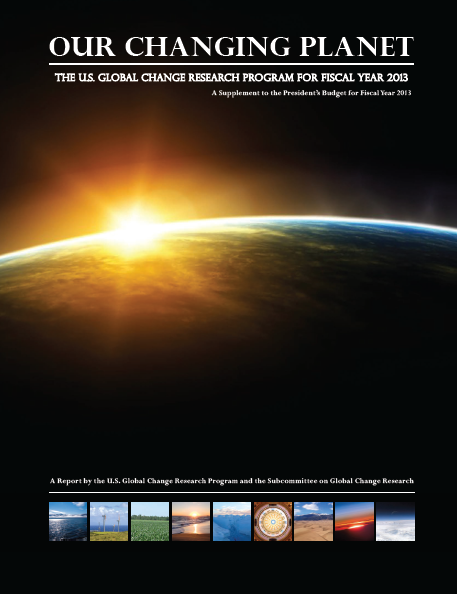 Today, the Administration’s interagency U.S. Global Change Research Program (USGCRP) delivered its annual report to Congress for fiscal year 2013: “Our Changing Planet.” The report highlights recent activities by 13 Federal agencies to strengthen our scientific understanding of global changes—including climate change—the threats and opportunities they present, and how they are likely to evolve over time.
USGCRP’s scientific portfolio spans multiple systems and scales, from organisms to ecosystems to the entire planet—including changes brought about by human behavior as well as by larger natural forces. It incorporates information from nearly all forms of scientific work, including laboratory experiments, field research, computer modeling, scientific assessment, and observations of Earth from land, air, sea, and space. This vast body of work has been carried out by 13 government agencies—all working together to paint a clearer picture of global change so that citizens and decision makers have the information they need to plan, prepare, and respond.
Learn more about Energy and EnvironmentPresident Obama Announces Three Nominees to Help Tackle "Our Most Important Challenges"
Posted by on March 4, 2013 at 2:26 PM EDT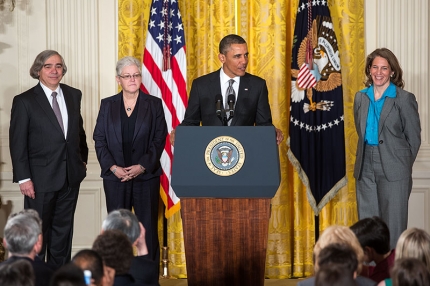
President Barack Obama announces the nominations of, from left, Ernest Moniz as Energy Secretary, Gina McCarthy as Environmental Protection Agency Administrator, and Sylvia Mathews Burwell as Director of the Office of Management and Budget, in the East Room of the White House, March 4, 2013. (Official White House Photo by Lawrence Jackson)
Today, President Obama announced his nominees for director of the Office of Management and Budget, Secretary of Energy and administrator of the EPA.
Sylvia Matthews Burwell, the President's pick for Office of Management and Budget Director, is an expert on budgetary and domestic policy. She served as Deputy Director of the OMB from 1998 to 2001, as well as Deputy Chief of Staff to the President and Chief of Staff to the Secretary of the Treasury during the Clinton administration.
President Obama said that Burwell "understands that our goal when we put together a budget is not just to make the numbers add up. Our goal is also to reignite the true engine of economic growth in this country, and that is a strong and growing middle class -- to offer ladders of opportunity for anybody willing to climb them."
Why We Can’t Afford Arbitrary Budget Cuts for the Public Lands and Waters that Fuel Our Economy
Posted by on February 28, 2013 at 2:27 PM EDTAs CEO of Confluence Watersports, one of the largest manufacturers of kayaks, canoes, and watersports accessories, I naturally value the accessibility of our country’s public lands and waterways – not just for the quality of life they provide or our environmental legacy, but also for the 425 people we employ in South Carolina, about 75 percent of whom work in manufacturing.
Over the last 5 years, our business has experienced consistent growth, enabling us to expand our workforce and invest in our future. We recently moved into a new 300,000-square-foot facility, and have committed to investing up to $12 million in capital expenditures over the next few years. But to thrive as a U. S. manufacturer in this industry, our customers need access to quality on-water experiences. My business, employees, and community depend on it. In fact, the entire U.S. economy depends on quality outdoor recreation experiences.
Outdoor recreation is a huge driver of the U.S. economy. According to a report published by the Outdoor Industry Association (OIA) last year, the outdoor recreation industry supports 6.1 million jobs across the United States, and generates $646 billion in direct spending and $79 billion in tax revenue annually. The OIA recently released figures tallying the state-by-state impacts of outdoor recreation, including direct spending, jobs, salaries, and tax revenue.
This week, I joined several outdoor industry colleagues at the White House for a Roundtable on the Outdoor Recreation Economy with officials from the Council on Environmental Quality, National Economic Council, U.S. Army Corps of Engineers, and U.S. Departments of Agriculture, Commerce, and Interior. Our focus was the economic benefit of getting more Americans outside. It was a great dialogue among diverse agencies that realize the importance of outdoor recreation for our economy and for our citizens.
The Administration has demonstrated that it understands the significant connection between outdoor recreation, a healthy economy, and a healthy country. President Obama’s signature recreation and conservation initiative, America’s Great Outdoors (AGO), has led to unprecedented interagency collaboration. Thanks to AGO, agencies are effectively working with one another and with local communities to reconnect Americans with the outdoors by creating, expanding, and enhancing access to our country’s amazing network of public lands and waters.
Our country’s remote wilderness, national and local parks, wild rivers and scenic waterways, hiking trails, and bicycle paths span the country and provide places where Americans can seek nature and recreate outdoors. These places will continue to create jobs and drive the economy if our elected leaders choose to manage and invest in this national outdoor recreation system.
The national outdoor recreation system intersects with several agencies that will face automatic budget cuts if Friday’s sequester is not averted. It is important that lawmakers do all they can to ensure that the agencies that manage our recreational assets are not subject to these arbitrary cuts.
We know the folks we met with this week understand the economic benefits of the national outdoor recreation system. We look forward to helping them support the recreation economy, and we hope that Congress begins to recognize fully what it means for this country to get outside. After all, I think most Americans can agree that it is important to promote healthy, happy citizens and a legacy of public lands that future generations have the right to enjoy. And, I think that all Americans agree that preserving and creating U.S. jobs is a national priority.
Sue Rechner is the CEO of Confluence Watersports
Learn more about Energy and EnvironmentLeading the Effort to Cut Energy Waste
Posted by on February 26, 2013 at 1:55 PM EDTToday at the White House, CEQ hosted a GreenGov Dialogue on Demand Response that brought together leaders from government, the private sector, non-profits and academia to identify opportunities to reduce our peak energy demand, promote a more stable electric grid, and help the Federal Government save energy and money in its operations. This important initiative is in line with the goal laid out by the President in his State of the Union Address: to cut in half the energy wasted by our homes and businesses over the next 20 years. The event showcased how the Federal Government is leading by example by setting aggressive energy targets, reducing its carbon pollution, and leveraging Federal purchasing power to curb waste and deliver the best value for the American taxpayer.
The event also highlighted other innovations and actions needed to cost-effectively reduce the nation’s peak demand for energy—a strategy that reduces the need to construct new sources of electricity generation. In particular, leaders discussed the important role that state and local governments play in enabling the nation’s tremendous demand response potential, a role recognized in the National Action Plan on Demand Response.
The event kicked off with remarks from White House Council on Environmental Quality Chair Nancy Sutley, who stressed the themes laid out by President Obama in his State of the Union Address, followed by Director of the White House Office of Science and Technology Policy John Holdren, who announced that the cabinet-level National Science and Technology Council released a progress report outlining the Administration’s most recent achievements in electric grid modernization. The event featured additional keynote speakers including Federal Energy Regulatory Commission Chairman Jon Wellinghoff, Commissioner of the Public Buildings Service at the U.S. General Services Administration Dorothy Robyn, Assistant Secretary for the Department of Energy’s Office of Electricity Delivery and Energy Reliability Patricia Hoffman, and Acting Deputy Under Secretary of Defense for Installations and Environment John Conger.
GreenGov Dialogues – such as this one encouraging a conversation on broader use of demand response technology – build on progress made at Federal sustainability events such as the annual GreenGov Symposium, and continue the momentum of Federal agencies' efforts under the Executive Order on Federal Leadership in Environmental, Energy, and Economic Performance.
Here is what others are saying about why taking advantage of demand response technology makes sense for Federal agencies and for the private sector:
Jon Wellinghoff, Chair, Federal Energy Regulatory Commission
"Demand response is a substantial and reliable resource in wholesale electric markets throughout this country. Demand response lowers greenhouse gas emissions, improves the resilience of our nation's power grid and provides cost-savings to consumers. As the largest electricity consumer in the United States, the Federal Government has both a budgetary and environmental responsibility to maximize its participation by federal facilities in the delivery of demand response products to electric energy markets.”Terry Boston, CEO, PJM Interconnection
“Increasingly, PJM is seeing demand response and energy efficiency becoming more competitive with traditional power supply resources. Our capacity auction last year procured a record 14,800 megawatts of demand response, a seven-fold increase over the past five years and more than 900 megawatts of energy efficiency.”Thurman Thomas, Founder and President, Legends Energy Group
“The Demand Response industry is an example of entrepreneurial activity in the Green Economy. In an industry that did not exist ten years ago, demand response has now provided 200 well-paying jobs and continues to grow in a rust belt town like Buffalo.”Sonal Kemkar is Senior Program Manager in the Office of the Federal Environmental Executive at the White House Council on Environmental Quality
Learn more about Energy and EnvironmentTaking Action for a Stronger, Smarter, Cleaner Electric Grid
Posted by on February 26, 2013 at 1:33 PM EDTEd. note: This is cross-posted from the Office of Science and Technology Policy blog
Today, the Obama Administration’s National Science and Technology Council released A Policy Framework for the 21st Century Grid: A Progress Report—an update highlighting the Administration’s most recent achievements to make the Nation’s electric grid stronger, smarter, and cleaner than ever before.
In his State of the Union address this month, President Obama recognized that “no area holds more promise than our investments in American energy.” As part of his plan to grow the economy and create middle class jobs, the President called for continued investment in infrastructure, including “self-healing power grids.” In the same address, he also warned against ignoring the “overwhelming judgment of science” that the threat of climate change is real and demands attention. These two calls to action—each independently important to our country’s future—intersect at the Nation’s electric system.
To date, the Obama Administration has taken a number of important steps to help the Nation prevent and recover quickly from power outages, including by working closely with industry partners to upgrade the electric system with “smart grid” technologies that can detect and prevent outages, improve system efficiency, and better integrate clean energy sources. While we’ve come a long way, recent extreme weather events have reinforced the reality that our work is not done. Many Americans suffered power loss during the spate of strong storms, droughts, and record high temperatures of the past year—all of which, to varying degrees, threatened the operation of the Nation’s electric grid. We can do better.
Investing to modernize the grid is a common sense approach to enhance energy reliability for consumers, improve security of critical infrastructure, and speed the Nation’s transition to a clean-energy economy. That’s why, in the past year-and-a-half, the Administration has ramped up efforts to build a smart 21st century grid. Since June 2011—in partnership with utilities, communities, and local governments across the country—the Obama Administration has taken concrete steps to:
- Incorporate New Technology into the Grid. Nearly 13 million smart meters, 5,000 automated distribution circuits, and several hundred advanced grid sensors have been integrated into the Nation’s electric system under the Recovery Act to improve system efficiency and reliability by diagnosing, pinpointing, and solving problems before they disrupt business operations or household activities.
- Support Grid Modernization in Rural America. The U.S. Department of Agriculture Rural Utility Service met its goal of delivering more than $250 million in loans for smart grid technology deployment to rural areas—a step that will help catalyze economic development in those regions.
- Train an Advanced Workforce for an Advanced Grid. Under the Recovery Act, smart grid workforce training awards comprising nearly $100 million across 50 projects are creating training opportunities to produce the skilled professionals needed to operate a modernized grid. These grants have benefited military veterans by helping them connect to well-paying civilian opportunities. To date, $46.2 million has been distributed.
- Improve Opportunities for Customers to Save Money. The Green Button initiative, launched in January 2012, has already provided new and improved energy-use monitoring tools to more than 16 million homes and businesses. In the coming year or so, the program is on track to reach another 20 million homes and businesses, with the aim of helping consumers make better-informed energy decisions and save on their bills.
- Keep the Grid Secure from Cyber and Physical Disruption. The President recently signed an Executive Order to strengthen the cybersecurity of critical infrastructure industries, including the electric power sector. New tools such as the Electric Sector Cybersecurity Capability Maturity Model are being developed for utilities to enhance the protection of critical infrastructure from cybersecurity threats. Other efforts such as the Recovery Transformer program aim to drastically reduce the time needed to recover from downed extra-high-voltage transformers and other physical assets.
Going forward, the Administration will continue to look for new ways to work with the electric sector and state governments to modernize grid infrastructure, facilitate development of new tools to support a clean and efficient energy economy, empower customers to make smart energy decisions, foster new areas for innovation, and protect our critical infrastructure from threats.
Continuing our work toward a stronger, smarter, cleaner electric system will benefit American families and communities, and ensure our Nation remains competitive and innovative in a 21st century economy.
Read the full Progress Report here.
Nick Sinai is US Deputy CTO at the White House Office of Science and Technology Policy
Rick Duke is Associate Director for Energy and Climate Change at the White House Council on Environmental Quality and Domestic Policy Council
Learn more about Energy and Environment
- &lsaquo previous
- …
- 60
- 61
- 62
- 63
- 64
- 65
- 66
- 67
- 68
- …
- next &rsaquo
Related Videos
-
 May 09, 2014 9:21 AM
Inside the White House: Solar Panels
-
 September 01, 2016 9:25 PM
President Obama Delivers a Statement to the Press
White House Blogs
- The White House Blog
- Middle Class Task Force
- Council of Economic Advisers
- Council on Environmental Quality
- Council on Women and Girls
- Office of Intergovernmental Affairs
- Office of Management and Budget
- Office of Public Engagement
- Office of Science & Tech Policy
- Office of Urban Affairs
- Open Government
- Faith and Neighborhood Partnerships
- Social Innovation and Civic Participation
- US Trade Representative
- Office National Drug Control Policy