21st Century Government Latest News
Around the Agencies: Fresh Initiatives, Fresh Blogging
Posted by on March 18, 2009 at 7:13 PM EST- OMB Director Peter Orszag debunks the attack that the President’s budget represents "the biggest increase ever" in domestic spending.
- The State Department supports the UN Statement on "Human Rights, Sexual Orientation, and Gender Identity." The President also joined Secretary Clinton in announcing the appointment of Major General J. Scott Gration as the U.S. Special Envoy for Sudan.
- Transportation Secretary LaHood blogs about his new partnership with Secretary Donovan in HUD on livable communities: "In Secretary Donovan, I have a great partner who gets the relationship between housing and transportation. In his Hill appearance with me today, he captured the need for joint action perfectly: ‘HUD’s central mission – ensuring that every American has access to decent, affordable housing – can be achieved only in context of the housing, transportation, and energy costs and choices that American families experience each day.’"
- The United States Senate today overwhelmingly approved (pdf) the nomination of USTR designee Ron Kirk as the nation’s 16th trade representative. The vote was 92-5.
- The Labor Department issued guidance to states on the $3,514,500,000 in Recovery Act funding for the nation’s workforce system and network of One-Stop Career Centers. Secretary of Labor Hilda Solis: "Through the One-Stops, the workforce system will play a vital role in America's economic recovery by assisting workers who are facing unprecedented challenges to retool their skills and re-establish themselves in viable career paths."
- Kudos to the White House Counsel’s office for helping to uphold the President’s Executive Order on Ethics, whole-heartedly commended today (pdf) by several good government groups.
Weekly Address: Reversing a Troubling Trend in Food Safety
Posted by on March 14, 2009 at 4:30 AM ESTIn this week's address, President Barack Obama makes key announcements regarding the safety of our nation's food."We are a nation built on the strength of individual initiative. But there are certain things that we can't do on our own. There are certain things that only a government can do. And one of those things is ensuring that the foods we eat, and the medicines we take, are safe and don't cause us harm."Watch Your Weekly Address below to learn more about the President's measures to make the food that lands on America's dinner tables safer.Viewing this video requires Adobe Flash Player 8 or higher. Download the free player.Learn more about Ethics, Health CareEthics Update
Posted by on March 10, 2009 at 5:54 PM ESTIn the spirit of transparency, Norm Eisen, special counsel to the president for ethics and government reform, asked us to pass along this update on the President’s Executive Order on Ethics:
The White House periodically gets questions about the President’s Executive Order on Ethics and how it is being implemented. In addition to responding to these questions individually, we thought it might make sense to provide an overview to the public of the background for the Order and how it has been working so far.One of President Obama’s first official acts upon taking office was to sign the ethics Executive Order. The Order establishes some of the toughest ethics rules ever imposed on executive branch appointees. It has been widely praised by commentators and leading good government advocates for the hard line it takes on lobbyists and others riding the revolving door between government service and the private sector in order to achieve personal gain at the expense of the public interest.Because the rules are so stringent, it is important to have reasonable exceptions in case of exigency or when the public interest so demands. That is why the Order provides that a waiver of the restrictions may be granted when it is determined "(i) that the literal application of the restriction is inconsistent with the purposes of the restriction, or (ii) that it is in the public interest to grant the waiver." Sec. 3(a). The Order goes on to explain that the "public interest" may include, but is not limited to, exigent circumstances relating to national security or to the economy and that de minimis contact with an executive agency shall also be cause for a waiver. Sec. 3(b). As we discuss below, this provision was intended to be used sparingly, and has been so used.The availability of a waiver has been praised by ethics experts and commentators alike:*Norman Ornstein, a Resident Scholar at the American Enterprise Institute stated that "This tough and commendable new set of ethics provisions goes a long way toward breaking the worst effects of the revolving door. There are many qualified people for the vast majority of government posts. But a tough ethics provision cannot be so tough and rigid that it hurts the country unintentionally. Kudos to President Obama for adding a waiver provision, to be used sparingly for special cases in the national interest. This is all about appropriate balance, and this new executive order strikes just the right balance."*Thomas Mann, Senior Fellow of Governance Studies and the Brookings Institution said that "The new Obama ethics code is strict and should advance the objective of reducing the purely financial incentives in public service. I applaud another provision of the EO, namely the waiver provision that allows the government to secure the essential services of individuals who might formally be constrained from doing so by the letter of the code. The safeguards built into the waiver provision strike the right balance."*The Washington Post editorialized that the President had "adopted a tough ethics policy . . . sweeping in time and scope." Specifically endorsing the waiver granted to Bill Lynn, the editorial board wrote that "The president's rule ensures that any conflicts will be carefully watched, and his flexibility despite certain criticism signals an ability to make hard but reasonable calls."Out of the approximately 800 appointments to the executive branch made to date, only three waivers have been granted. In addition to Bill Lynn, Jocelyn Frye and Cecilia Muñoz have received the only other waivers to date. Both Ms. Frye and Ms. Muñoz were granted waivers from paragraphs 2 and 3 of the ethics pledge pursuant to section 3(a)(ii) of the Executive Order. The waivers are attached. Both Ms. Frye and Ms. Muñoz will otherwise comply with the remainder of the pledge and with all preexisting government ethics rules.We took the rare step of granting the waivers to Ms. Frye and Ms. Muñoz because of the importance of their respective positions and because of each woman’s unequalled qualifications for her job. Each is a leading substantive expert on the relevant issue areas and each also has long-standing relationships with constituencies important to their respective offices.Ms. Frye now serves as the Director of Policy and Projects in the Office of the First Lady. In that regard, she is responsible for the entire range of issues with which Mrs. Obama is concerned, with a particular focus on women, families and on engagement with the greater D.C. community. She was previously General Counsel at the National Partnership for Women & Families, where she directed the National Partnership’s Workplace Fairness Program and, in that capacity, focused primarily on a wide range of employment and gender discrimination issues, with a particular emphasis on employment barriers facing women of color and low-income women. Her work involved monitoring and analyzing the effectiveness of federal equal employment enforcement efforts, as well as the scope of gender- and race-based employment barriers. In these areas, she became an expert on the relevant employment laws and their applications. She has also worked with federal agencies as a technical expert on these issues, and has testified before Congress and the Equal Employment Opportunity Commission on federal enforcement of employment discrimination laws. She coordinated the organization’s work on amicus curiae briefs and judicial nominations and worked with the public to improve education on employment discrimination, women’s rights and civil rights policies.Ms. Frye has also written extensively on a wide range of issues affecting women and employment. Her assessment of the Equal Employment Opportunity Commission appeared in Change for America: A Progressive Blueprint for the 44th President (Mark Green and Michele Jolin eds., 2008). And she has written or co-authored numerous articles on women’s rights and civil rights, including "The Pregnancy Discrimination Act: Where We Stand 30 Years Later," (National Partnership for Women & Families, 2008) (co-author); "Women at Work: Looking Behind The Numbers 40 Years After The Civil Rights Act of 1964," (National Partnership for Women & Families, 2004) (co-author) and "Affirmative Action: Understanding the Past and Present," in THE AMERICAN WOMAN 1996-97 (Cynthia Costello and Barbara K. Krimgold eds., 1996).Ms. Frye has also participated in numerous coalitions and volunteer organizations. She has served as the co-chair of the economic security and employment task forces for the Leadership Conference on Civil Rights. She served on the Board of Directors at the National Cathedral School for Girls. She was on the Board of Deacons at the Shiloh Baptist Church. And she has served as a volunteer attorney at the Washington Legal Clinic for the Homeless. We note her deep involvement in these community endeavors because, in addition to her mastery of the policy areas of significance to her new role, the strong community ties she brings with her to the First Lady’s Office make her an ideal aide to a First Lady committed to being a part of the local Washington, D.C., community.Ms. Muñoz now serves as the Director of Intergovernmental Affairs in the Executive Office of the President. In that capacity, she manages the White House’s relationships with state and local governmental entities and also serves as a principal liaison to the Hispanic community. She was previously the Senior Vice President for the National Council of La Raza (NCLR), where she supervised all legislative and advocacy activities conducted by NCLR policy staff nationally, including on the state and local levels.In her twenty years at NCLR, Ms. Muñoz became one of the nation’s foremost experts on a range of issues critically important to the Latino community, including immigration, civil rights, employment, poverty, farm worker issues, education, and housing. Ms. Muñoz regularly represented NCLR before the media, Congress, and policy-makers on a variety of issues of concern to Latinos, and received regular requests from members of Congress, major media outlets, and Latino community institutions for presentations and strategic advice.Prior to her time at NCLR, Ms. Muñoz worked as a community organizer for the Catholic Charities of the Archdiocese of Chicago. In that capacity, she trained Latino community groups to set up neighborhood community services to address local problems and directed Chicago's largest non-profit legalization program under the Immigration Reform and Control Act of 1986.Ms. Muñoz has written extensively on immigration and civil rights issues. Her writing has appeared in publications such as Migration Week, The American Prospect, and NACLA Report on the Americas, and she has published opinion editorials for the Washington Post, Christian Science Monitor, American Enterprise, and the Miami Herald, among others.Ms. Muñoz’s leadership skills have been widely recognized. She has served as the Chair of the Board of the Center for Community Change, and served on the U.S. Programs Board of the Open Society Institute and the Board of Directors of the Atlantic Philanthropies. She has received the Irma Flores Gonzalez Award from the Farmworker Justice Fund, an advocacy achievement award from the Washington, D.C. NCLR affiliate AYUDA, and was honored by the Chair of the Congressional Black Caucus as a leader of the 21st century civil rights movement.In June 2000, Ms. Muñoz was awarded a MacArthur Foundation "genius grant" in recognition of her innovative work, including on immigration and civil rights. As the daughter of immigrants from Bolivia, she brings a deep personal commitment to these causes that makes her an authoritative voice nationally. As with Ms. Frye, we felt the public interest would be sacrificed if she could not serve in the White House, and so made the determination to grant the waiver.* View the signed waiver for Jocelyn Frye (pdf)
* View the signed waiver for Cecilia Muñoz (pdf)Learn more about EthicsOverhaul
Posted by on February 25, 2009 at 7:18 PM EST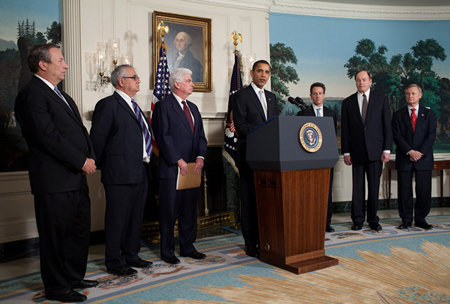 White House photo 2/25/09 by Pete SouzaIt's clear that a lot of factors led us into this economic crisis, but one of the biggest was that our economy was left exposed by regulations that were out of date and regulators who weren't minding the store.President Obama today took that problem head on by laying out 7 key principles for transforming the nation's regulatory system. We must:
- Enforce strict oversight of financial institutions that pose systemic risks
- Strengthen markets so they can withstand both system-wide stress and the failure of one or more large institutions
- Encourage our financial system to be open and transparent, and to speak in plain language investors can understand
- supervise financial products based on "actual data on how actual people make financial decisions"
- Hold market players accountable, starting at the top
- Overhaul our regulations so they are comprehensive and free of gaps
- Recognize that the challenges we face are global
"I have the utmost confidence that if these outstanding public servants standing beside me are working in concert, if we all do our jobs, if we once again guide the market's invisible hand with a higher principle, our markets will recover," the President said, standing alongside his economic team. "Our economy will once again thrive, and America will once again lead the world in this new century as it did in the last."He also had some strong words for people who have been misrepresenting this plan:Let me be clear: The choice we face is not between some oppressive government-run economy or a chaotic and unforgiving capitalism. Rather, strong financial markets require clear rules of the road, not to hinder financial institutions, but to protect consumers and investors, and ultimately to keep those financial institutions strong. Not to stifle, but to advance competition, growth and prosperity. And not just to manage crises, but to prevent crises from happening in the first place, by restoring accountability, transparency and trust in our financial markets. These must be the goals of a 21st century regulatory framework that we seek to create.Eye on Darfur
Posted by on February 24, 2009 at 9:55 AM ESTBringing relief to the battered region of Darfur is a top priority for the administration, the President and Vice President assured the actor and activist George Clooney last night.In separate meetings with President Obama and Vice President Biden, Clooney told them what he saw on his recent trip to Eastern Chad."We saw an awful lot of fear," Clooney told Larry King last night of his visit to the region. "There was [also] a tremendous amount of hope."After six years of fighting, it’s estimated that 300,000 people have been killed and more than 2.7 million displaced in the Darfur region of Sudan.
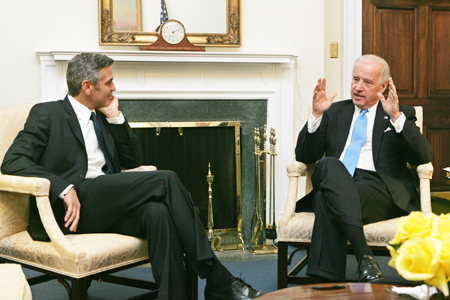 White House photo 2/23/09 by Sharon FarmerLearn more about Ethics, Foreign Policy
Owning up to what we owe
Posted by on February 23, 2009 at 7:26 PM EST This is big -- the President today promised that by the end of his first term, he will cut in half the massive federal deficit we've inherited. And we'll do it in a new way: honestly and candidly."This will not be easy. It will require us to make difficult decisions and face challenges we've long neglected," President Obama said. "But I refuse to leave our children with a debt that they cannot repay -- and that means taking responsibility right now, in this administration, for getting our spending under control."Before we turn this boat around, we've got to acknoweldge how deep underwater we are:"For too long, our budget process in Washington has been an exercise in deception -- a series of accounting tricks to hide the extent of our spending and the shortfalls in our revenue and hope that the American people won't notice.... budgeting zero dollars for the Iraq war -- zero -- for future years, even when we knew the war would continue; budgeting no money for natural disasters, as if we would ever go 12 months without a single flood, fire, hurricane or earthquake.""We do ourselves no favors by hiding the truth about what we spend," the President said. "In order to address our fiscal crisis, we're going to have to be candid about its scope."As the summit concluded, the President took questions and comments from the assembled members of Congress and the business and non-profit communities. He started with Sen. John McCain (R-AZ), who emphasized the need to cut excess from defense spending -- citing as an example reports that the two-year-old plan to overhaul the fleet of Marine One helicopters had gone significantly over-budget."We all know how large the defense budget is," Sen. McCain said. "We all know that the cost overruns -- your helicopter is now going to cost as much as Air Force One. I don't think that there's any more graphic demonstration of how good ideas have cost taxpayers an enormous amount of money...[W]e have to make some tough decisions -- you, Mr. President, have to make some tough decisions about not only what we procure, but how we procure it.""The helicopter I have now seems perfectly adequate to me. Of course, I've never had a helicopter before -- maybe I've been deprived and I didn't know it," the President joked, before continuing with a more serious response. "But I think it is an example of the procurement process gone amuck. And we're going to have to fix it....One of the promising things is I think Secretary Gates shares our concern and he recognizes that simply adding more and more does not necessarily mean better and better, or safer and more secure."
White House photos 2/23/09 by Pete SouzaLearn more about Ethics, Fiscal Responsibility
- &lsaquo previous
- …
- 27
- 28
- 29
- 30
- 31
- 32
- 33
- 34
- 35
- next &rsaquo