Health Care Blog
Word from the White House: Business Roundtable Hewitt Report "Health Care Reform: Creating a Sustainable Market"
Posted by on November 12, 2009 at 11:20 AM ESTIt's no secret that institutions of all stripes focus their communications on certain messages day to day. We thought it would all be a little more open and transparent if we went ahead and published what our focus will be for the day, along with any related articles, documents, or reports.
Supporting report: "Health Care Reform: Creating a Sustainable Health Care Marketplace," Business Roundtable, November 2009 (pdf)
Talking Points: Business Roundtable Hewitt Report "Health Care Reform: Creating a Sustainable Market"
The BRT report confirms that the status quo is unsustainable. The BRT report finds that without health reform, costs will continue to rise at the same trend they have for the last ten years. The report concludes that without reform, by 2019, employment-based spending on health care for large employers will be 166% higher than today on a per-employee basis.
The BRT report confirms that Congress is moving in the right direction on both fiscal responsibility and cost containment. The BRT-Hewitt report finds that many of the delivery system reform policies that are currently in health reform legislation will make important contributions to cost reduction, when implemented effectively. As the report explains, "[a] number of the proposed reforms offer real promise, not only to save federal dollars, but also to reduce the rate of increase in private sector spending if adopted and implemented appropriately."
- These policies include: value-based purchasing, a new CMS Innovation Center, "accountable care organizations" and reducing preventable hospital re-admissions. The BRT report also notes that with additional steps such as administrative simplification, electronic medical records, and increased information transparency for better decision-making, even more savings could be reached. Some of these additional policies were included in ARRA and many others are included in health reform legislation currently pending in Congress.
- With health reform, as much as $3,000 could be saved by 2019. The BRT-Hewitt study finds that with many of the legislative reforms currently in the health reform bills, costs could be reduced by as much as $3,000 per employee.
Learn more about Health CareFiscally Responsible Health Reform Redux
Posted by on November 10, 2009 at 2:00 PM ESTEvery two weeks or so, there seems to be a story ringing the alarm bells over the fiscal dimension of health reform.
As I've said time and again, the President is committed to signing a health reform bill that is deficit neutral in the first decade – and deficit reducing thereafter. The legislation under consideration in the Senate and the bill passed Saturday by the House both meet these tests.
But health reform effort must go beyond simply being deficit neutral over the first decade and deficit reducing thereafter; it must also begin the process of transforming the health care system so that it delivers better care, not just more care. Building the health care system of the future requires information technology; cutting-edge research into what works and what doesn’t; incentives for doctors and hospitals to focus on the quality of care; prevention and wellness; and a process that allows policy to adapt flexibly to changes in the health care marketplace over time.
The House and Senate versions of reform share a variety of measures that will help create this health care system of the future, which will help to contain health care cost growth while also providing Americans with higher quality care. In addition to historic investments in health information technology, research into what works and what doesn't, and prevention and wellness investments that were included in the Recovery Act, some of the key provisions under consideration in the health reform bills include:
- Changing the way we pay hospitals, to discourage mistakes and unnecessary readmissions.
- Creating incentives in the payment system to reward quality of care rather than just the quantity of procedures.
- Giving physicians incentives to collaborate in the coordination of patient care.
- Investing in research into what works and what doesn’t in health care.
- Reducing hospital-acquired infections and other avoidable health-center acquired conditions through rigorous reporting and transparency.
- Imposing a fee on insurance companies offering high-premium plans — which would create a strong incentive for more efficient plans that would help reduce the growth of premiums.
- Establishing a Medicare commission — which would develop and submit proposals to Congress aimed at extending the solvency of Medicare, slowing Medicare cost growth, and improving the quality of care delivered to Medicare beneficiaries.
As we approach the final stages of this health reform process, we have on the table a robust set of options that represent some of the most auspicious reforms we can take to transform our health care system and rein in health care cost growth. But don’t take my word for it. A bipartisan group of experts recently wrote that health reform legislation under discussion "offers many promising ideas to improve the overall performance of the U.S. health care system. In addition to steps that would reduce the number of Americans without insurance coverage, the plan includes ways to slow long-term spending growth while building the high-value health care system our nation urgently needs." Or read what a group of some of the most prominent health care and budget experts wrote in an open letter (pdf) released last week.
As we go through the rest of the process, the Administration will remain focused on ensuring that reform is fiscally responsible and helps to build the health care system of the future.
Peter Orszag Is Director of the Office of Management and Budget
Learn more about Health CareWord from the White House: Controlling Costs for Families, Small Businesses, and the Government
Posted by on November 10, 2009 at 11:53 AM ESTIt's no secret that institutions of all stripes focus their communications on certain messages day to day. We thought it would all be a little more open and transparent if we went ahead and published what our focus will be for the day, along with any related articles, documents, or reports.
Supporting blog post: "Bending the Curve in More Ways Than One," OMB Blog, OMB Director Peter Orszag, 10/13/09
Talking Points: Controlling Costs for Families, Small Businesses, and the Government
- From the beginning of this process, President Obama has been clear that health insurance reform must not only provide security and stability for Americans with insurance and affordable options for uninsured Americans, but also slow the unsustainable cost growth that is burdening families, threatening businesses' viability, and exploding our national deficit.
- Fortunately, the House and Senate versions of reform share a variety of measures that will reduce the rapid growth in health care costs while also providing Americans with higher quality care including:
- Changing the way we handle hospitalizations, to prevent mistakes and to prevent unnecessary readmissions.
- Creating incentives in the payment system to reward quality of care rather than just the quantity of procedures.
- Giving physicians incentives to collaborate in the coordination of patient care.
- Investing in research into what works and what doesn't in health care.
- Reducing hospital-acquired infections and other avoidable health-center acquired conditions through rigorous reporting and transparency.
- Putting prevention first, rewarding care that focuses on wellness and treating the whole patient in an integrated and coordinated delivery system.
- Tackling the insurance bureaucracy, streamlining the payment system to save time and money that is now spent processing claims and navigating through the byzantine insurance system.
- Establishing a health insurance exchange with a public insurance option, where individuals and small businesses can buy lower-cost insurance that will spur competition and put downward pressure on costs.
- These measures build upon the significant down payment we already made in the American Reinvestment and Recovery Act to begin switching from paper records to computerized records; to strengthen preventive care; to invest in patient-centered health research; and to build up the workforce of primary care providers.
- And there are also ideas that will further control cost growth that have been proposed and are being looked at as the legislative process continues, such as:
- A fee on insurance companies offering high-premium plans — which would create a strong incentive for more efficient plans that would help reduce the growth of premiums.
- Establishing a Medicare commission — which would develop and submit proposals to Congress aimed at extending the solvency of Medicare, slowing Medicare cost growth, and improving the quality of care delivered to Medicare beneficiaries.
Learn more about Health CareWord from the White House: Passage of the Affordable Health Care for America Act
Posted by on November 9, 2009 at 10:54 AM ESTIt's no secret that institutions of all stripes focus their communications on certain messages day to day. We thought it would all be a little more open and transparent if we went ahead and published what our focus will be for the day, along with any related articles, documents, or reports. Today we publish our second batch.
Supporting website: "Affordable Health Care for America Act," Speaker.gov
Talking Points: Passage of the Affordable Health Care for America Act
- Saturday night, in an historic vote, the House of Representatives passed a bill that would finally make real the promise of quality, affordable health care for the American people.
- The Affordable Health Care for America Act provides stability and security for Americans who have insurance; quality affordable options for those who don't; and brings down the cost of health care for families, businesses, and the government while strengthening the financial health of Medicare.
- It is also fully paid for and will reduce our long-term federal deficit.
- Thanks to the hard work of the House, we are just two steps away from achieving health insurance reform in America.
Talking Points: Closer to Reform than Ever Before
- The House of Representatives' historic step brings us far closer to comprehensive health insurance reform than ever before.
- Now it's time for the United States Senate to follow suit. We are absolutely confident that it will and President Obama looks forward to signing reform into law by the end of this year.
- Thanks to the long hours and hard work the Senate has already put in, it too is close to passing reform legislation. And the level of agreement between the House and Senate versions of reform is remarkable.
- Like the House bill, the Senate legislation would provide unprecedented security and stability for Americans with insurance. It would provide quality, affordable options for Americans without insurance. And it would lower costs for families, businesses, and the nation as a whole.
- And like the House version, the Senate proposal is also fully paid for and would reduce our national deficit.
Learn more about Health CareHistory: The House Debates Health Reform
Posted by on November 7, 2009 at 5:33 PM ESTToday the House reaches another major milestone in the effort to pass health insurance reform, and effort decades in the making.
Predictably, opponents of reform are taking their misleading claims to new heights. For example, they claim that CEA Chair Christina Romer has said that reform would cost millions of jobs. This is flatly false, as demonstrated by the independent watchdog Politifact and Romer's own statement.
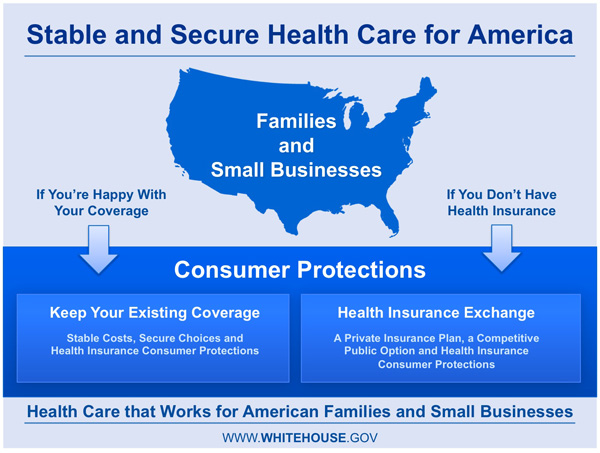
Opponents of reform have also manufactured a chart attempting to depict reform as some sort of maze of bureaucracy. This is also false. Here is a chart that accurately reflects the President's plan:
 Learn more about Health Care
Word from the White House: House Republican Health Care "Plan" Putting Families at Risk
Posted by on November 4, 2009 at 3:08 PM ESTIt's no secret that institutions of all stripes focus their communications on certain messages day to day. We thought it would all be a little more open and transparent if we went ahead and published what our focus will be for the day, along with any related articles, documents, or reports. Today we publish our second batch.
Supporting article: "Republicans want to make the insurance industry more like the credit card industry," Ezra Klein, Washington Post, 11/3/09
Supporting article: "Boehner's Health Care Bill At Odds With Pre-Existing GOP Positions," Huffington Post, 11/3/09
Talking Points: House Republican Health Care "Plan": Putting Families at Risk
- After months of offering nothing but obstruction and roadblocks, House Republicans have now put together a hastily-constructed, last-minute "plan" for health reform. But the reality is that their plan would put families at risk by giving insurance companies more power to discriminate against patients while accumulating record profits.
- The bottom line is that under the House Republican plan, millions of Americans would lose the coverage and security they currently have.
- There is a lot of empty GOP rhetoric out there about this plan, so let's look at the reality of what they’re offering American families:
RHETORIC: The House Republican health care plan expands coverage to those who cannot get insurance now.
REALITY: The Republicans' bill leaves affordable health insurance out of reach for millions of Americans.
No Elimination of Discrimination Based on Pre-existing Conditions: Nowhere does the bill make it illegal for insurance companies to deny coverage based on pre-existing conditions. As a result, consumers will never be fully protected and guaranteed coverage options.
High-Risk Pools Will Not Provide Americans with Access to Affordable Coverage: The Republican bill states that it improves access through high-risk pools, but according to the bill, those states that currently do not have high-risk pools never need to develop them, and those states that have high-risk pools could close them.
Democrats Ensure No American Remains Uninsured Due to A Pre-existing Condition As a Bridge to REAL Health Insurance Reform. The President and House Democrats support affordable access to a high-risk pool nationwide for individuals with pre-existing conditions as a bridge to real insurance reform in 2013.
RHETORIC: The House Republican health care "plan" lets families and businesses buy health insurance across state lines.
REALITY: Unlike the House Leadership bill, the Republicans' bill takes us backwards rather than forwards.
In the Absence of Insurance Reform, This Policy will Undermine Patients' Protections: This proposal, which would allow insurance to be sold across state lines in the absence of any broader reforms to prevent discrimination in the individual marketplace, would undermine patients’ protections and drive up premiums. Under this policy, states would have a further incentive to gut consumer protections, which would create a devastating race to the bottom.
Insurers Can "Cherry Pick" Healthy Individuals: Without any additional protections, insurers would be allowed to cherry pick healthy enrollees by marketing strategies, benefit design, and targeting those states with the least consumer protections. That would drive up premiums for everyone else trying to buy insurance in the state.
RHETORIC: The House Republicans' bill allows individuals, small businesses, and trade associations to pool together to acquire health insurance at lower prices, the same way large corporations and labor unions do today.
REALITY: So-called "Association Health Plans" will reduce choices for small businesses and leave consumers vulnerable to fraud and abuse.
Association Health Plans are Exempt from State Consumer Protections: Association Health Plans (AHPs) allow small businesses from different states to pool together to buy health insurance that is exempt from consumer protections secured by many state laws. They undermine states’ comprehensive tools to prevent, identify and shut down fraudulent plans.
AHPs Allow Insurers to Cherry Pick Healthy Workers: By avoiding state consumer protections, AHPs make it easier for insurance companies to "cherry pick" healthy individuals and firms, leaving out those who are older or sicker, raising premiums for everyone else.
RHETORIC: The House Republican bill gives states the incentives through bonus payments to create their own reforms that lower health care costs and increase coverage.
REALITY: The Republican bill provides neither the means for cost containment nor the support that states need to get at cost drivers and increase the affordability of health care. It includes:
NO policies to promote quality health care and efficiency of health care in private or public health insurance.
NO premium assistance for middle-income families that struggle to pay for health insurance.
NO increased support or options for states to build the platforms to improve the delivery system.RHETORIC: The House Republican bill ends junk lawsuits that contribute to higher health care costs.
REALITY: The Republican bill offers new no ideas. The bill caps the amount of damages a person injured can receive and will preempt state consumer protection laws.
President Obama and House Democrats support a range of ideas on how to put patient safety first and let doctors focus on practicing medicine. That’s why President Obama issued a Presidential Memorandum on September 17th directing the HHS Secretary to move forward with an initiative to give states and health systems the opportunity to apply for medical liability demonstration projects. House Democrats have also included a voluntary state incentive grants program in their bill to encourage states to develop alternatives to traditional malpractice litigation.
Learn more about Health Care
- &lsaquo previous
- …
- 182
- 183
- 184
- 185
- 186
- 187
- 188
- 189
- 190
- …
- next &rsaquo
From the Press Office
Related Videos
-
 December 13, 2016 5:04 PM
Signing Ceremony for the 21st Century Cures Act
-
 December 10, 2016 5:00 AM
Weekly Address: It’s Time to Get Covered on the Health Insurance Marketplace