Health Care Blog
David Simas: "A gesture that means something"
Posted by on May 16, 2013 at 3:20 PM ESTThis afternoon, David Simas sent the message below to the White House email list, asking people to speak out in favor of the health care law. If you didn't get the email, be sure to sign up.
Hi all --
Today, Republicans in the House of Representatives are going to come together, cast a vote, and try to repeal the Affordable Care Act just as they've done nearly 40 times before.
Don't expect much to come of it.
The health care law was passed by Congress, signed by the President, and upheld by the Supreme Court. It's been the law of the land for more than three years. It's not going anywhere. We know that, and so do the lawmakers on Capitol Hill. But instead of creating jobs and growing the economy, some of them want to make yet another gesture of protest -- even if it's meaningless.
So we're responding with a little gesture of our own, and we need your help.
We're asking people like you to speak out, to let us know if you're one of the 85 percent of Americans who've already benefitted from the health care law, and make a public stand in support of Obamacare.
Learn more about Health CareRaising Awareness about Mental Health and Suicide Prevention in the AAPI Community
Posted by on May 10, 2013 at 4:22 PM EST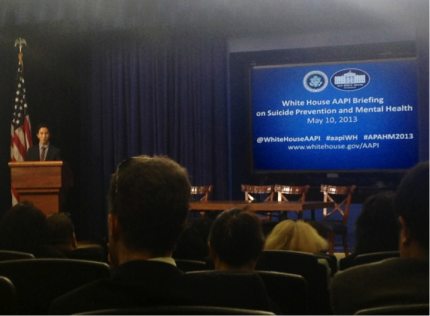
The White House Initiative on Asian Americans and Pacific Islanders (WHIAAPI) and the White House Office of Public Engagement Briefing on Suicide Prevention and Mental Health, May 10, 2013 (Photo by WHIAAPI).
The White House Initiative on Asian Americans and Pacific Islanders and the White House Office of Public Engagement hosted a briefing today on mental health issues and suicide prevention for the Asian American and Pacific Islander (AAPI) community. As May is both AAPI Heritage Month and National Mental Health Awareness Month, it was a timely occasion to bring these issues to the forefront. The event convened government officials, community leaders, students and health care advocates for a discussion about the Obama Administration’s efforts to prevent suicide and address mental health issues within the AAPI community.
Mental health concerns are not prominently or routinely addressed in AAPI communities, however, these issues are primary contributors to overall health and well-being. National studies show that the prevalence rates for mental health conditions are generally the same or slightly less for AAPIs compared to the general population. However, the burden of mental health conditions for AAPI families and communities is often greater due to limited access and engagement in mental health services, lower rates of treatment and poorer quality care leading to worse outcomes. AAPI families are often reluctant to seek care due to the stigma and discrimination associated with mental health conditions, difficulties in finding appropriate services and lack of understanding of both the mental health condition and the complex service system. Higher rates of uninsurance also impede attempts to access mental health treatment.
The briefing also highlighted AAPI-serving community mental health programs, suicide prevention initiatives such as the National Suicide Prevention Lifeline and the National Strategy for Suicide Prevention and government resources. Also featured was the California Reducing Disparities Project Asian Pacific Islander report “In Our Own Words,” which outlined effective strategies for reducing AAPI behavioral health disparities and provided specific program examples.
During this month of celebration of the AAPI community, this event was a fitting opportunity to recognize and re-dedicate ourselves to the ongoing work to increase awareness of mental health, address disparities and improve the wellbeing of AAPIs across the nation. Please visit the Office of Behavioral Health Equity and Substance Abuse and Mental Health Services Administration (SAMHSA) website to learn more about mental health and substance use among AAPIs, and to access a new data spotlight on AAPIs and suicide.
Larke N. Huang, Ph.D. is the Director of the Office of Behavioral Health Equity at the Substance Abuse and Mental Health Services Administration, U.S. Department of Health and Human Services
Learn more about Health CarePresident Obama Explains How Health Reform Is Helping Women
Posted by on May 10, 2013 at 4:20 PM EST
President Barack Obama delivers a statement on the Affordable Care Act in the East Room of the White House, May 10, 2013. (Official White House Photo by Lawrence Jackson)
With Mother’s Day just around the corner, President Obama today spoke to a group of women – including many moms – about the ways the Affordable Care Act is already helping millions of Americans like them.
"Women in particular now have more control over their own care than ever before," the President said. "And I’m pleased to be joined today by many women who wrote in to tell us what the Affordable Care Act means to them."
Carol was one of the women who wrote to the President, and today, she introduced him in the East Room. Carol's son, a 22-year-old college grad and traumatic brain injury survivor with a rare genetic lung disease, was able to stay on his family’s health insurance policy instead of being kicked off the plan this year. Finding coverage on his own would have been nearly impossible, as Carol wrote to the President: “Given his history, he would be virtually uninsurable under the old set of ‘rules.’ Instead of contemplating law school, all of his resources would have been channeled into somehow, somewhere, finding health insurance.”
Carol and her son are why the Affordable Care Act lets young people stay on their parent’s plan until they turn 26, President Obama said.
Alycia was also standing behind the President today.
"Alycia is the mother of Avey, who is a beautiful, sweet, 3-year-old girl who also happens to have Leukemia," he explained. "Imagine what that’s like for a parent. While you’re just figuring out how to take care of a baby, you’ve got to figure out how you’re going to pay for expensive treatment that could save your baby’s life.
Learn more about Health Care, WomenWeekly Wrap Up: “We’ll Meet That Task”
Posted by on May 3, 2013 at 5:21 PM ESTWatch the West Wing Week here.
Mexico & Costa Rica Trip: On Thursday, President Obama started a three day trip to Mexico and Costa Rica for his first visit to Latin America of the second term. During the trip, the President hopes to reinforce the deep cultural, familial, and economic ties we share with Mexico and Central America.
Yesterday, the President had a bilateral meeting with Mexican President Peña Nieto at Palacio National in Mexico City. The bulk of his discussions in Mexico will cover the economy, and in Costa Rica, the President will meet with Central American leaders, who are important partners in improving foreign policy and the economy.
Ben Rhodes, Deputy National Security Advisor for Strategic Communications, previewed the trip before leaving Washington. Check out the video on YouTube.
Transportation Secretary Nominated: On Tuesday, the President nominated the Mayor of Charlotte, Anthony Foxx, for Transportation Secretary. As mayor, Foxx modernized the electric train service to Charlotte’s downtown area, expanded the international airport, and extended the city’s light rail system. The President hopes cities can mimic the work done in Charlotte to attract more business, create more jobs, and stay competitive in the global economy.
Our top priority as a nation right now is doing everything we can to grow our economy and create good jobs and rebuild opportunity for the middle class. And one of the best ways we can do that is to put more Americans back to work rebuilding our infrastructure.
- What You Need to Know About President Obama's Plan to Improve American Infrastructure
- Fact Sheet: The President’s Plan to Make America a Magnet for Jobs by Investing in Infrastructure
- The “Rebuild America Partnership”: The President’s Plan to Encourage Private Investment in America’s Infrastructure
Learn more about , , , Defense, Economy, , Education, Foreign Policy, Health Care, Immigration, Veterans, , WomenA Big Sister’s Advice – Get Covered!
Posted by on May 3, 2013 at 4:54 PM ESTEd. note: This is cross-posted from the HHS Blog
As originally posted on NBC Latino on April 30th by Mayra Alvarez
Alejandra was born when I was eleven years old. She’s sassy, smart, beautiful, but first and foremost, my baby sister. Our two older sisters and I have done our best to keep her safe and healthy. Today, Alejandra is attending Kaplan College in southern California, on her way to becoming a patient care technician and, someday, a nurse practitioner. As a soon-to-be health care professional, she has certain medical requirements for the school year; when she went to the doctor’s office, she sent me a text message that said, “I paid $300 by myself. For a checkup and some shots.” It’s Alejandra I think about when I consider the importance of the Marketplaces launching this October.
If you’re a young person like Alejandra, you might not be thinking a lot about health insurance—until the day you need it. You’ve got other priorities. But what if you get into an accident, are diagnosed with a serious illness, or have certain medical requirements for school or work? Today, Alejandra knows firsthand the importance of health insurance, and what it means for her and other young adults across the country.
The Affordable Care Act is expanding affordable health insurance options for young adults in several ways. If you’re under 26, you can now be insured as a dependent on your parent’s plan, with a couple of exceptions — for instance, if you are eligible for your own job-based coverage. Also, new health plans must now cover many critical preventive services at no out-of-pocket cost. The $300 bill Alejandra paid for her checkup; That could’ve been free.
And there’s more. When the new Marketplaces open for enrollment in October for coverage beginning as soon as January 1st, 2014, individuals and small business owners will be able to compare their options for buying health insurance and find the quality plan that best fits their budget. The Marketplaces will be competitive, transparent, and simple to navigate—and while you’ll be able to shop for coverage over the phone or in person, if you’re like Alejandra, you’ll probably prefer to check out your new options online through the easy-to-use Marketplace website, healthcare.gov.
Of course, if Alejandra needs help navigating the application, she’ll have it. And if she needs help paying for coverage, she’ll have help with that too. If you make less than $45,000, and your job doesn’t offer affordable coverage, you may get financial assistance to help pay for insurance. Another option, if you make less than $15,000, may be Medicaid, which will be expanding in many states beginning in 2014.
Alejandra, like so many other young adults across the country, is just trying to make something of herself. She’s doing her best to make ends meet in order to take that next step in life. Fortunately for my sister, she’ll have one more tool to ensure her long-term health and financial stability – affordable health coverage. Open enrollment in the health insurance marketplace begins on October 1, 2013, and it can’t come soon enough for Alejandra and millions of other young adults in need of health coverage.
I hope all of us who are big sisters, brothers, friends, or neighbors can help spread the word about this great opportunity. I know I will.
Mayra Alvarez is director of Public Health Policy in the Office of Health Reform at the U.S. Department of Health and Human Services.
Learn more about Health CareWhat Health Reform Means for Latinos – and Young Sisters
Posted by on May 3, 2013 at 4:05 PM ESTMayra Alvarez, Director of Public Health Policy in the Office of Health Reform at the U.S. Department of Health and Human Services, recently wrote an op-ed for NBC Latino encouraging her younger sister Alejandra and others to register for the Health Insurance Marketplace, which opens in October 2013.
The Marketplace is one of the many important provisions of the Affordable Care Act. The Act means a few other things for Latinos and their families:
- An estimated 6.1 million Latino Americans with private insurance now have access to expanded preventive services with no cost-sharing which include well-child visits, flu shots, blood pressure and cholesterol screenings, and mammograms for women;
- 3.9 million elderly and disabled Latinos who receive health coverage from Medicare have access to an expanded list of preventive services with no cost-sharing, including annual wellness visits with personalized prevention plans, cancer and obesity screening, and mammograms;
- Major federal investments to improve quality of care are improving management of chronic diseases that are more prevalent among Latinos; and
- 736,000 Latino young adults between ages 19 and 25 who would have been uninsured now have coverage under their parent’s employer-sponsored or individually purchased health plan.
The Affordable Care Act will not only expand affordable health insurance options for Latinos it will also help them compare options to find the best plan for their budget, as Mayra notes in her piece:
When the new Marketplaces open for enrollment in October for coverage beginning as soon as January 1, 2014, individuals and small business owners will be able to compare their options for buying health insurance and find the quality plan that best fits their budget. The Marketplaces will be competitive, transparent, and simple to navigate—and while you’ll be able to shop for coverage over the phone or in person, if you’re like Alejandra, you’ll probably prefer to check out your new options online through the easy-to-use Marketplace website, healthcare.gov.
Learn more about Health Care
- &lsaquo previous
- …
- 63
- 64
- 65
- 66
- 67
- 68
- 69
- 70
- 71
- …
- next &rsaquo
From the Press Office
Related Videos
-
 December 13, 2016 5:04 PM
Signing Ceremony for the 21st Century Cures Act
-
 December 10, 2016 5:00 AM
Weekly Address: It’s Time to Get Covered on the Health Insurance Marketplace