Health Care Blog
As ACA Implementation Continues, Consumer Health Care Cost Growth Has Slowed
Posted by on July 29, 2013 at 3:45 PM ESTPrices for personal consumption expenditures (PCE) on health care goods and services rose just 1.1 percent over the twelve months ending in May 2013, the slowest rate of increase in nearly 50 years. The slowdown in PCE health care inflation has been widespread, with important contributions from two large components: hospital and nursing home services (which comprise 42 percent of total health care expenditures) and outpatient services (which comprise 34 percent of total health care expenditures). As the chart below shows, since March 2010, these two components of health spending have made notably smaller contributions to overall consumer health care inflation than in previous years.

The slowdown in consumer health care price inflation is consistent with a broad array of other evidence suggesting that the growth rate of health care costs is slowing:
- Data from the Bureau of Labor Statistics’ Employer Costs for Employee Compensation survey indicate that for private sector employers offering health insurance, the annualized growth rate of real (inflation-adjusted) costs for workers’ health insurance has slowed from 2.2 percent a year from 2006:Q4 to 2009:Q4 to 1.8 percent a year from 2009:Q4 to 2012:Q4, with a particularly marked slowdown occurring at smaller establishments. For establishments with fewer than 50 employees, employers’ real costs for workers’ health insurance grew just 1.0 percent a year from 2009:Q4 to 2012:Q4, half the rate observed over the preceding three years.
- During the past several years, the Congressional Budget Office reports that it “has made a series of downward adjustments to its projections of spending for Medicaid and Medicare.” For example, “mostly reflecting the slower growth in the programs’ spending in recent years,” CBO now expects combined spending on the two programs to be about $200 billion lower in 2020 than what it forecast three years ago.
- From 2009 to 2011, nationwide real per capita health expenditures grew at the slowest pace since reporting began in 1960.
- In 2012, premium growth for employer-sponsored insurance was at its lowest rate (3 percent) since the Medical Expenditure Panel Survey started in 1996.
- In 13 states that have publicly reported premiums for 2014, the average of the lowest-cost plan is nearly 20 percent below projections based on CBO premiums. This includes New York State, which recently announced that health insurance rates in 2014 will be at least 50 percent lower, on average, than the plans currently available in the state. These substantially more affordable plans will soon be available through the new Health Insurance Marketplace established by the Affordable Care Act.
Learn more about Ethics, Health CareHealthy Baby, Happy Baby: The Indian Health Service Announces Designation of Two Baby-Friendly Hospitals
Posted by on July 26, 2013 at 10:20 AM ESTEd. note: This is cross-posted from the Let's Move! blog.
The Baby-Friendly Hospital Initiative is a global program that was launched by the World Health Organization (WHO) and the United Nations Children’s Fund (UNICEF) in 1991 to encourage and recognize hospitals and birthing centers that offer an optimal level of care for infant feeding and mother/baby bonding. As part of Let’s Move! in Indian Country, the Indian Health Service (IHS) has committed to certifying all IHS hospitals as Baby-Friendly by the end of 2014, and is proud to announce that to date, five of our facilities are now certified as Baby-Friendly.
Claremore Indian Hospital in Oklahoma and the Phoenix Indian Medical Center in Arizona are the first hospitals in their respective states to receive this prestigious designation. Three other IHS facilities — the Quentin N. Burdick Memorial Health Care Facility, Pine Ridge Hospital, and Rosebud Indian Hospital — received their certification in December 2012 and are the only hospitals in North and South Dakota to be designated as Baby-Friendly.
Improving health in early childhood is a critical pillar of the Let’s Move! initiative. IHS is working to reduce the risk that children will develop obesity and diabetes in the future by supporting new parents who choose to breastfeed.
The Indian Health Service (IHS) is the primary federal health care provider for American Indians and Alaska Natives throughout Indian Country. In June 2011, IHS started its Baby-Friendly Hospital Initiative to give clinicians the tools and information needed to support mothers who choose to breastfeed, giving those mothers information, confidence, and skills.
We are committed to making all our obstetric hospitals Baby-Friendly. We are pleased and proud that IHS hospitals are setting the standard for maternity care in so many states. Our work shows how this initiative can succeed in populations that will most benefit from the Baby-Friendly Hospital Initiative.
Yvette Roubideaux, M.D., M.P.H., is the Acting Director of Indian Health Service, the Federal Health Program for American Indians and Alaska Natives.
Learn more about Health CareCelebrating Forty Years of Advancing AAPI Issues
Posted by on July 24, 2013 at 7:43 AM EST
Tina Tchen delivers remarks at the OCA National 40th Anniversary National Convention in Washington, D.C., Saturday, July 20, 2013 (Photo by Rui Barros Photography, courtesy of OCA National)
Since 1973, OCA has brought together diverse and far reaching communities for a common cause: to advance the social, political, and economic wellbeing of Asian Americans and Pacific Islanders (AAPI) in the United States. Last week, I had the honor of addressing OCA at its 40th Anniversary Gala in Washington, D.C. and paying tribute to the organization’s history and legacy. OCA’s many accomplishments over the last forty years are a reminder that, individually, our voices are often swept into the wind, but when we speak together our words have the power to move mountains.
Even as we celebrate this milestone anniversary, we are reminded that important work remains to be done. AAPIs have prospered in this country as a direct result of our nation’s immigration system; but, as we know all too well, the system is broken and needs reform. The reform plan passed by the Senate modernizes the immigration system, secures the border, streamlines the process to citizenship, and is projected to add $1.4 trillion to our economy. AAPI immigrant entrepreneurs, small business owners, families, and leaders are key contributors to our nation’s future and growth. In the coming weeks and months, community leaders across the country have an opportunity to use their combined voices to raise awareness about the importance of commonsense immigration reform and the impact it will have on the AAPI community.
Our work does not end at immigration reform. One in five AAPIs lacks health insurance. AAPIs are also more likely to suffer from chronic diseases, but the least likely to seek the necessary preventative care. On October 1st, individuals, families, and businesses will have a one-stop shop to buy affordable health coverage. If all goes well, an estimated 2 million uninsured Asian Americans and Pacific Islanders will be able to access the care they need. Through the implementation plan, we will once again call upon leaders in the community, like OCA, to build knowledge and raise awareness in the community about the host of resources available on HealthCare.gov.
OCA’s 40-year story reminds us that if AAPIs continue to raise their voices and continue to strive for prosperity, we will succeed, and the landscape of the community will be forever altered.
Tina Tchen is Assistant to the President, Chief of Staff to First Lady Michelle Obama, and Executive Director of the White House Council on Women and Girls.
Learn more about Health CareStrengthening Health Care in Indian Country
Posted by on July 19, 2013 at 5:24 PM EST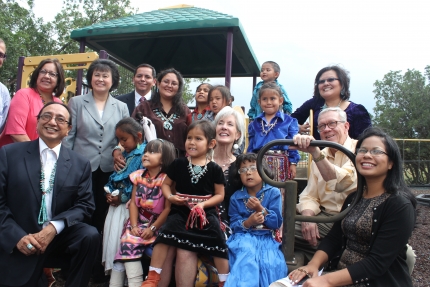
Health and Human Services Secretary Kathleen Sebelius meets with the children of Sawmill Headstart. (Photo Credit Navajo Nation Press Office)
I recently had the honor of visiting leaders and members of the Navajo Nation in Arizona. Their hospitality and kindness speak to the best values of the Navajo culture and traditions. And they, like tribes across the country, are critical partners in the Administration’s efforts to promote the health and well-being of all Americans.
At the Sawmill Head Start Program and local Boys and Girls Club, I saw how local educators are helping prepare young American Indian children to succeed in school and pursue their dreams. On a tour of the Navajo Special Diabetes Program for Indians Wellness Center, I saw dedicated caretakers work to prevent and manage a disease that affects too many on and off the reservations. During a visit to a Tribal elder’s home, I gained a greater understanding of ways we can improve living conditions for all families in the Navajo Nation.
And I was especially proud of the great effort by the staff of the Gallup Indian Medical Center, who recently achieved a Level III Trauma Center designation – a first for the Indian Health Service (IHS). The work of the IHS at this facility, and throughout Indian Country, saves countless lives. That’s why since day one of this Administration, improving the IHS has been a top priority.
In fact, we’ve done more to modernize the IHS and advance overall health in Indian Country in President Obama’s first term than has been done in years. We have increased the IHS budget by almost a third, which is helping improve access to needed services.
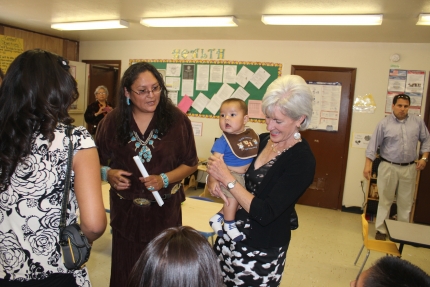
Health and Human Services Secretary Kathleen Sebelius meets members of the Sawmill Headstart Parents Council at the Sawmill Headstart. (Photo Credit Navajo Nation Press Office)
Another critical step forward is implementing the Affordable Care Act, which contains many important benefits for American Indians and Alaska Natives. First and foremost, it includes the permanent reauthorization of the Indian Health Care Improvement Act, ensuring that the IHS is here to stay. It also improves benefits and protections for American Indians and Alaska Natives who have insurance, whether they receive care inside or outside the IHS. And it gives them more choices for health coverage, including Medicaid and the Federal Employees Health Benefits Program.
Learn more about Health CareA Refund from Your Health Insurance Company? Thank the Affordable Care Act
Posted by on July 18, 2013 at 3:40 PM EST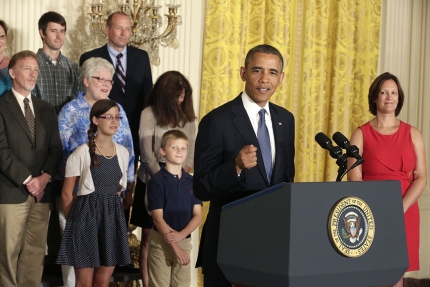
President Barack Obama delivers remarks on the Affordable Care Act's Medical Loss Ratio Refunds, in the East Room of the White House, July 18, 2013. (Official White House Photo by Chuck Kennedy)
Did you know that 8.5 million Americans are getting a refund this year from their health insurance companies?
Thanks to a provision in the Affordable Care Act, if your insurance company isn’t spending at least 80 percent of your premium dollars on medical care, they have to send you some money back.
Today in the East Room, President Obama explained that “last year, millions of Americans opened letters from their insurance companies -- but instead of the usual dread that comes from getting a bill they were pleasantly surprised with a check. In 2012, 13 million rebates went out, in all 50 states." Another 8.5 million rebates are being sent out this summer, averaging around $100 each, he said.
Morgan, a woman from Maryland who has been purchasing her own health insurance for many years, introduced the President today. She said that after she got a rebate for the first time, “it felt like someone was actually being held accountable for the dollars I was spending on health care.”
That’s one of core principles of the Affordable Care Act, President Obama said today – “holding insurance companies and providers accountable so that we all get a better deal.”
Learn more about Health CareHealthCare.Gov Provides Tools to Help AAPIs Get Health Insurance
Posted by on July 10, 2013 at 7:55 AM EST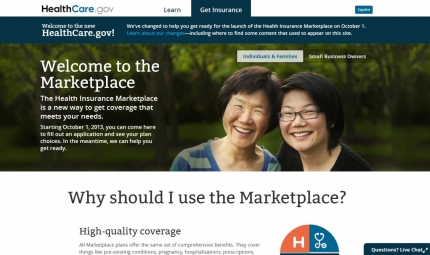
Too often, Asian Americans and Pacific Islanders (AAPIs) are viewed as a “model minority” group – one that is wealthy, healthy and happy. However, this misconception masks many of the challenges the AAPI community faces – including persistent disparities in health and health care. For instance, nearly one out of every five AAPIs lacks health insurance. Moreover, AAPIs, like other racial and ethnic minority groups, suffer disproportionately from chronic diseases such as hepatitis B, diabetes, heart disease and cancer. AAPIs are also the least likely among all racial groups to receive routine mammograms and pap smears.
Three years after its passage, the Affordable Care Act is proving to be a tipping point in our efforts to help address these disparities. Access to affordable health insurance coverage is one of the most important determinants of an individual’s health. Because of the health care law, AAPIs are already gaining greater access to health coverage, thanks to provisions that allow young adults to stay on their parents’ health insurance plans until age 26, and prohibit insurance companies from denying coverage to children because of a pre-existing condition, like diabetes.
And, that’s just the beginning; starting in 2014 nearly 2 million uninsured Asian Americans and Pacific Islanders will have new opportunities for coverage through the Health Insurance Marketplace. Also, increased funding to community health centers is enabling more AAPIs to receive culturally and linguistically appropriate care. Strengthened data collection standards that distinguish between AAPI subgroups will help providers and policymakers better understand the diverse needs of different groups in the AAPI community, and make more informed decisions about how best to address health disparities. These are just a few of the many ways the Affordable Care Act benefits AAPIs.
An important feature of the Affordable Care Act is the new Health Insurance Marketplace. The Marketplace will serve as a one-stop shop for individuals, families, and small businesses to search for health coverage options and apply to enroll in the plan that best fits their needs. Individuals can compare plans based on price, benefits, and other features, as well as find out if they are eligible for assistance to help pay for premiums or other programs like Medicaid and the Children’s Health Insurance Program. Enrollment in the Marketplace begins October 1, 2013 for coverage beginning in (or after) January 2014, so it’s important to get ready now to apply and enroll.
HealthCare.gov is the official website for the latest and most accurate information about the Marketplace. With resources, videos, and checklists, and a live web chat available 24/7, the website is the best resource for consumers to learn about health coverage options and enrollment now. Beginning October 1, HealthCare.gov will be the place to go to directly access the Marketplace. Consumers can also call the toll-free number now at 1-800-318-2596 to speak with a representative. The call center offers assistance 24 hours a day, 7 days per week in over 150 languages, including Bengali, Chinese, Hindi, Korean, Tagalog and Vietnamese.
Brochures, fact sheets, posters, infographics and videos (including materials in Asian languages) are also available at marketplace.cms.gov. The White House Initiative on AAPIs also provides more information on the Affordable Care Act specifically for the AAPI community. Now is the time to learn about your options, prepare for enrollment, and spread the word to your loved ones and your communities about these new opportunities for health coverage and health care.
Dr. J. Nadine Gracia is the Deputy Assistant Secretary for Minority Health and the Director of the Office of Minority Health at the U.S. Department of Health and Human Services (HHS).
Learn more about Health Care
- &lsaquo previous
- …
- 59
- 60
- 61
- 62
- 63
- 64
- 65
- 66
- 67
- …
- next &rsaquo
From the Press Office
Related Videos
-
 December 13, 2016 5:04 PM
Signing Ceremony for the 21st Century Cures Act
-
 December 10, 2016 5:00 AM
Weekly Address: It’s Time to Get Covered on the Health Insurance Marketplace