Health Care Blog
Health Datapalooza IV Tops Off a Huge Year in Health Data Liberation & Innovation
Posted by on June 7, 2013 at 11:29 AM ESTThis article is cross-posted on HHS.gov
Health Datapalooza IV has officially wrapped and with over 1900 attendees and 80 companies, this was the biggest palooza yet. Kicked off by Secretary Sebelius for the second year in a row, this year’s event was a tremendous display of health data in action.
Looking back now, it is amazing to think that four years ago this all started with 45 people in a small room at the Institute of Medicine. Over the course of those four years the Department of Health and Human Services (HHS) has liberated over 400 datasets, participated in a countless number of codeathons, and has seen and helped developers build hundreds of apps, services, and products using health data.
At HHS, we have evolved and improved how we make health data available to the public. Last year, we launched a new version of healthdata.gov and made it significantly easier for our internal publishers to get their datasets listed, both manually and through an application programming interface (API). We've added the ability to generate APIs from any dataset that's stored directly in our database; TXT4Tots is the most recent example of this. And lastly, building on the Presidential Open Data Executive Order, we’ve made data more discoverable by releasing our healthdata.gov/data.json file. This will make it very easy for other data catalogs to consume the records in Healthdata.gov, allowing for the easy spread of open health data. We even open-sourced the CKAN extension that generates the data.json file on Project Open Data .
This year at Health Datapalooza we featured a Data Lab Session with HHS’s Health Data Leads. The Health Data Leads are subject matter experts who are changing the culture of data liberation at HHS by identifying and releasing new data sets, describing the context of data and providing insights into its use, and providing data education to entrepreneurs. This session highlighted datasets from a number of HHS agencies, including the Centers for Medicare and Medicaid Services, the Food and Drug Administration, the National Institutes of Health and more.
Good News: Americans Saved Billions Thanks to the Affordable Care Act – And Medical Loss Rebates Are On the Way
Posted by on June 6, 2013 at 12:12 PM ESTAccording to a new report, Americans buying individual market health insurance saved $1.2 billion in 2011 and $2.1 billion in 2012 because law has begun to hold insurance companies accountable.
Under the Affordable Care Act, insurance companies are required to spend 80 to 85 percent of premium dollars on medical care and health care quality improvement, rather than on administrative costs. If they don’t, the insurance companies must provide a rebate to their customers. Last year, over 13 million consumers received $1.1 billion in rebates – the average consumer rebate was around $151.
Today a new analysis from the Kaiser Family Foundation provides the most complete look yet at the benefits of the policy. In addition to rebates from insurers who are charging more for overhead than care (those with medical loss ratios below 80 percent), the report estimates the savings that resulted from insurers exceeding 80 percent, who provided more value for each consumer dollar than history shows they otherwise would have.
The study found that the average medical loss ratio went from 78 percent in the individual market in 2010 to 83 percent in 2012 in the individual market. Had medical loss ratios remained at 2010 levels, premiums would have been much higher than they actually were. Combining these savings from better medical loss ratios with rebates, the Kaiser analysis estimates that the 80 / 20 rule yielded $3.2 billion in lower health care costs to consumers – not counting savings to employers’ health plans.
Learn more about Health CareBringing Mental Illness Out of the Shadows
Posted by on June 5, 2013 at 10:30 AM EST
President Barack Obama delivers remarks during the National Conference on Mental Health in the East Room of the White House, June 3, 2013. Standing with the President, from left, are: Health and Human Services Secretary Kathleen Sebelius, Education Secretary Arne Duncan, and Veterans Affairs Secretary Eric Shinseki. (Official White House Photo by Pete Souza)
One in five Americans suffers some form of mental illness, such as depression or anxiety, schizophrenia or PTSD. Chances are you probably know someone who struggles with these issues ... or you might have struggled yourself.
On Monday at the White House, President Obama described a key challenge with addressing mental health:
We know that recovery is possible, we know help is available, and yet, as a society, we often think about mental health differently than other forms of health. You see commercials on TV about a whole array of physical health issues, some of them very personal. And yet, we whisper about mental health issues and avoid asking too many questions.
Americans – advocates and educators, health care providers and faith leaders, members of Congress and representatives from local governments – came from all over the country to take part in Monday's National Conference on Mental Health and talk about ways we can work together to increase understanding and awareness about mental health issues.
Secretary Sebelius moderated a panel discussion featuring five people with personal connections to mental illness. The panelists talked about steps they’ve taken to raise awareness about mental health and reduce the negative attitudes that all too often prevent those who are struggling from asking for help.
The panel was followed by a series of five short presentations focused on successful outreach tactics. The presentations were designed to help conference participants learn about creative and effective ways to reach their own community, audience or membership about the issue of mental health. Each of the presenters highlighted powerful techniques that could be incorporated into efforts that combat stigma around mental illness and promote action to help the millions of Americans who need assistance recognize the importance of asking for it.
Check out the videos below to learn more about what each presenter had to share. For more resources, visit mentalhealth.gov.
Learn more about Health CareThe National Conference on Mental Health
Posted by on June 3, 2013 at 12:34 PM ESTNationally, an estimated 45 million Americans suffer from illnesses like depression, schizophrenia or post-traumatic stress syndrome.
And today, the White House hosted a day-long conference with health care experts, psychologists, faith leaders, advocates for veterans, and a host of administration officials to kick off a national conversation about mental health in the United States.
"We all know somebody -- a family member, a friend, a neighbor -- who has struggled or will struggle with mental health issues at some point in their lives," President Obama said as he opened the gathering.
The conference focused on ways we can all work together to reduce stigma and help the millions of Americans struggling with mental health problems recognize the importance of reaching out for assistance, as President Obama explained:
We know that recovery is possible, we know help is available, and yet, as a society, we often think about mental health differently than other forms of health. You see commercials on TV about a whole array of physical health issues, some of them very personal. And yet, we whisper about mental health issues and avoid asking too many questions.
The brain is a body part too; we just know less about it. And there should be no shame in discussing or seeking help for treatable illnesses that affect too many people that we love. We've got to get rid of that embarrassment; we've got to get rid of that stigma.
Too many Americans who struggle with mental health illnesses are still suffering in silence rather than seeking help, and we need to see it that men and women who would never hesitate to go see a doctor if they had a broken arm or came down with the flu, that they have that same attitude when it comes to their mental health.
Today’s conference is just one part of the Obama administration’s effort to raise awareness and improve care for Americans experiencing mental health issues. The Affordable Care Act is expanding mental health coverage for millions of Americans, we're working to improve access to mental health services for veterans, and we're supporting initiatives to help educators recognize and refer students who show signs of mental illness.
Learn more about Health CareMedicare Trustees: Medicare is Growing Stronger, with Help from the Affordable Care Act
Posted by on May 31, 2013 at 11:30 AM ESTToday, the Medicare Trustees reported some good news for seniors and taxpayers: The Medicare program will be solvent through 2026, nearly a decade longer than projected at the time of passage of the Affordable Care Act. This is 2 years longer than projected last year. Their annual report also shows that the long run actuarial deficit in the Hospital Insurance Trust Fund – a measure of its long-term fiscal health – has been cut by more than 70 percent since enactment of the health care law. The long-run Medicare deficit has fallen from 3.88 percent of taxable payroll in the 2009 Trustees Report to 1.11 percent in this report.
These long-run gains are matched by short-term relief: the Trustees also project that the Part B premium will not increase between 2013 and 2014, keeping out-of-pocket costs for beneficiaries down. Medicare cost growth has remained at historically low levels over the past three years even as new benefits for preventive care and prescription drugs have helped tens of millions of beneficiaries access care at lower cost. The law reduces prescription drug costs by closing the donut hole, a policy that has already saved more than 6 million seniors more than $700 each. And more than 32 million seniors have accessed a free preventive service under the law, helping them stay healthy and avoid future illness.
Learn more about Health CareAffordable Care Act Increases Insurance Choices
Posted by on May 30, 2013 at 11:46 AM ESTToday, many Americans who buy health insurance on the individual market have only a few options to choose from when selecting an insurance company.
In fact, in 2012 just one or two different insurance companies dominated the individual insurance market in most states -- in 29 states, one insurer covered more than 50% of all enrollees in the individual insurance market. In 11 states, the largest two issuers covered 85% or more of the individual market.
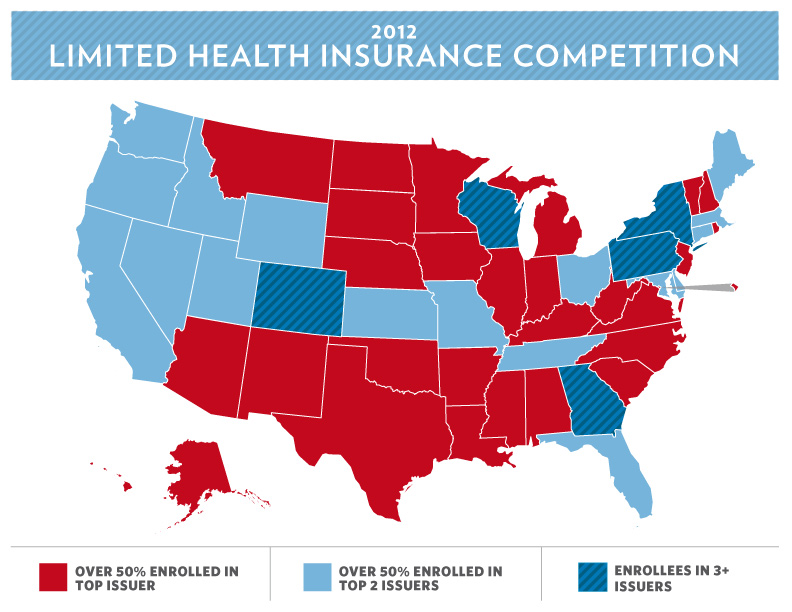
But here’s the good news: the Affordable Care Act is helping to drive competition and choices for consumers by creating a Health Insurance Marketplace that offers people more choice and control over their insurance choices.
A memo released today shows that, based on early reports, the Marketplace is attracting new insurance choices and increasing competition for consumers, all across the country. In the states with early data, an estimated 80 percent of the people who will enroll in the Marketplace will have five or more different insurance companies to choose from, instead of just one or two. On average, issuers plan to offer more than 15 qualified health plans per state, according to early reports.
Learn more about Health Care
- &lsaquo previous
- …
- 61
- 62
- 63
- 64
- 65
- 66
- 67
- 68
- 69
- …
- next &rsaquo
From the Press Office
Related Videos
-
 December 13, 2016 5:04 PM
Signing Ceremony for the 21st Century Cures Act
-
 December 10, 2016 5:00 AM
Weekly Address: It’s Time to Get Covered on the Health Insurance Marketplace