Health Care Blog
A One-Stop-Shop on the Health Care Law for Businesses Big and Small
Posted by on August 1, 2013 at 10:00 AM ESTAs we implement the Affordable Care Act, we continue listening to the needs of the business community. Based on our many conversations with leaders of our nation’s businesses, large and small, today we are launching Business.USA.gov/healthcare, a one-stop-shop where employers of all sizes can go for information on the Affordable Care Act.
The new site includes a web-based tool that allows employers to get tailored information on how the health law may affect them based on their business’ size, location, and plans for offering health benefits to their workers next year. From tax credits for small businesses to help make coverage affordable, to measures to help slow the growth of health care costs, there are a variety of ways that the Affordable Care Act can help businesses expand health care coverage and compete.
Learn more about , Health CareNominate a White House Champion of Change for Public Health and Prevention
Posted by on July 31, 2013 at 3:57 PM ESTSince its earliest days, the Obama Administration has worked to improve the health and well-being of our families and our communities. From tackling childhood obesity, to combating the tobacco epidemic, to expanding access to affordable health coverage, the Administration has focused on innovative and meaningful ways to support a healthier America.
The Administration believes that prevention and public health are a top priority because they have lasting effects on the health of Americans. That’s why the Affordable Care Act provides unprecedented resources through the Prevention and Public Health Fund to support community-based strategies to prevent chronic diseases, such as heart disease, diabetes and cancer, and support public health. Communities across the country are working with their public health leaders, employers, schools and citizens and across sectors like health, transportation, housing and education, to build partnerships that promote healthy lifestyles.
The Affordable Care Act also created the National Prevention, Health Promotion, and Public Health Council, which provides federal leadership to engage states, communities, and private partners in creating a healthier America through the recommendations of the National Prevention Strategy. The Prevention Fund is supporting projects that will put the National Prevention Strategy into action, helping to move the nation from a focus on sickness and disease to one based on wellness and prevention.
But we know that efforts to promote the public’s health and prioritize prevention happen in America’s towns and cities, in schools and parks, in churches and community centers. Every day, local leaders across America’s communities are stepping up in big ways to make sure all Americans have the opportunity to live a healthy life.
This September, the White House will host a “Champions of Change” event to celebrate these local change-agents, whose exemplary leadership is helping to improve health outcomes and reduce health disparities in our communities.
The event will bring together and honor extraordinary individuals who are taking innovative approaches to support longer, healthier lives in communities across the country. These leaders will be invited to the White House to celebrate their accomplishments and showcase their actions to support healthier communities.
Today, we’re asking you to help us identify these standout local leaders by nominating a Champion of Change for Public Health and Prevention by midnight on Friday, August 9th. A Champion’s work may involve:
- Supporting community and clinical prevention efforts to address chronic disease, increase education and outreach, and integrate primary and behavioral health;
- Creating healthy and safe communities by promoting healthier schools, homes, and workplaces that make the healthy choice the easy choice;
- Working to address health disparities and empower all Americans to make healthy choices by addressing health concerns that disproportionately affect certain populations;
- Strengthening public health infrastructure and improving public health’s capacity to detect and control disease and other threats;
- Increasing the uptake of important preventive services; and
- Promoting tobacco prevention,
We are looking forward to hosting this event and to highlighting the great work communities across the country are doing to advance the health and well-being of the American people.
We look forward to hearing from you.
Nominate a Prevention and Public Health Leader as a Champion of Change (under theme of service, choose "Prevention and Public Health Leaders").
Carole Johnson works at the Domestic Policy Council.
Learn more about Health CareWhat Do the New CLAS Standards Mean for AAPI Behavioral Health?
Posted by on July 31, 2013 at 1:27 PM ESTA visit to the doctor can be daunting enough, but imagine how much more challenging it would be if you couldn’t communicate with your doctor or if your doctor didn’t take into account your health beliefs or practices. Language and culture are critical factors to consider in providing high quality health care and services, and with the rapidly growing Asian American and Pacific Islander (AAPI) population in our nation, cultural and linguistic competency has never been more important.
Last month, the U.S. Department of Health and Human Services unveiled the enhanced National Standards for Culturally and Linguistically Appropriate Services in Health and Health Care (CLAS Standards), expanding the scope and improving the clarity of the first CLAS standards issued in 2000. The CLAS standards are intended to advance health equity, improve quality, and help eliminate health care disparities by providing a blueprint for individuals and health care organizations to implement culturally and linguistically appropriate services. So what do the CLAS standards mean for AAPIs, behavioral health care systems and practitioners?
Research shows that there are disparities in behavioral health among racial, ethnic, sexual and gender minority populations. For instance, among individuals admitted for substance abuse treatment, AAPIs were more than three times as likely to report methamphetamines as the primary substance of abuse than for all other races combined, according to data from the Treatment Episode Data Set (TEDS). Studies have also shown that minority populations, including AAPIs, have worse access to behavioral health care, receive lower quality care, and experience poorer outcomes even when they do receive care. Barriers such as stigma, cultural beliefs and limited English proficiency can contribute to these disparities.
Implementing strategies to improve and ensure cultural and linguistic competency in our behavioral health care systems is a powerful way to address these disparities and ensure all populations have equal access to services and supports. Capacity building efforts focused on improving cultural and linguistic competency and incorporating the CLAS standards in systems can elevate awareness; enhance the ability to monitor program access, service use, and outcomes; and improve quality as a result. Practitioners and administrators can participate in training to better understand clients and be responsive to diverse cultural health beliefs and practices, preferred languages, health literacy and other communication needs. Community leaders can use Substance Abuse and Mental Health Services Administration’s new Toolkit for Community Conversations About Mental Health to start a conversation about mental health in their communities, and help identify ways to ensure mental health needs are addressed appropriately. On a broader scale, some states have taken steps to weave the cultural and linguistic competency into the fabric of their health systems, by passing legislation to implement the CLAS standards.
This National Minority Mental Health Awareness Month, I invite you to learn more about the enhanced
Larke Nahme Huang, Ph.D., a licensed clinical-community psychologist, is a Senior Advisor in the Administrator's Office of Policy Planning and Innovation at the Substance Abuse and Mental Health Services Administration in the U.S. Department of Health and Human Services.
Learn more about Health CareSecretary Sebelius: Medicare Helps Millions
Posted by on July 30, 2013 at 4:15 PM ESTEd Note: This is a cross post from The Huffington Post. You can find the original post here.
My 92-year-old father first ran for public office after he finished his military service in World War II. He served on the city council, and later was elected to Congress. In 1965, he helped write and voted for Medicare and Medicaid, which celebrate their 48th anniversary today.
Since then, Medicare has been a guaranteed benefit earned after a lifetime of hard work for millions of America's seniors. Medicaid has provided affordable health coverage for millions of low-income working Americans and families. Both programs have helped keep people from falling into poverty. Both have been lifelines to better health and sources of peace of mind and security.
That's why President Obama has made it a top priority to strengthen Medicare and Medicaid so that our seniors and future generations can get the health care they need and peace of mind they deserve.
Because of the health law, seniors are seeing more dollars saved in their wallets and better benefits to their health.
More than 6.6 million people on Medicare have saved an average of more than $1,000 on prescription drugs since the enactment of the Affordable Care Act. That's money that has been used for groceries, utilities, and visits with grandchildren instead of being sent to drug companies -- and that's how the Affordable Care Act is closing the "donut hole" that too many seniors fall into.
Learn more about Health CarePresident Obama Meets with Congressional Asian Pacific American Caucus
Posted by on July 30, 2013 at 10:19 AM ESTLast week, President Obama met with members of the Congressional Asian Pacific American Caucus (CAPAC) at the White House to discuss a range of important issues facing the Asian American and Pacific Islander (AAPI) communities. The President thanked CAPAC for their work to expand the middle class within AAPI communities and among all Americans, and said that he looks forward to continuing to work with them.
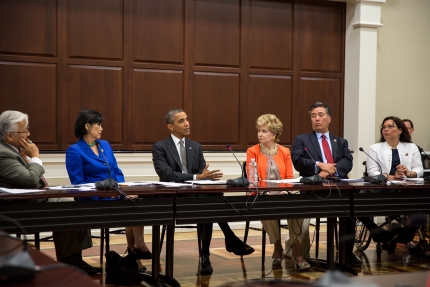
President Barack Obama meets with the Congressional Asian Pacific American Caucus in Room 350 of the Eisenhower Executive Office Building, July 23, 2013. (Official White House Photo by Pete Souza)
The President stressed that the Administration continues to urge the House to take action to pass commonsense immigration reform that would secure our borders, crack down on illegal employment, offer a path to earned citizenship for undocumented persons, and modernize our legal immigration system so that it once again addresses our needs and reflects our values as a nation. He thanked CAPAC for their ongoing efforts on this important issue and both sides agreed on the need to pass immigration reform now to help grow the economy, create jobs and reduce the deficit. The President urged CAPAC to continue to reach out to their colleagues in the House to find consensus and complete work on this important issue at the earliest possible opportunity. In the coming weeks, members of the Cabinet and Senior Administration officials will stress the economic need for commonsense immigration reform, including highlighting the economic benefits of reform and the high costs of inaction.
The President also said that he was proud of his efforts to make the Executive Branch and the federal judiciary more diverse. CAPAC thanked the President for more than doubling the number of AAPI federal judges currently serving. The President reiterated his commitment to ensuring that his Administration is composed of highly qualified public servants who reflect the diversity of America. CAPAC also thanked the President for the ongoing work of the White House Initiative on AAPIs to better connect AAPI communities to the federal government.
The President also thanked CAPAC for their strong support in passing the Affordable Care Act and discussed the robust ongoing efforts to successfully implement the law. Starting in 2014 nearly 2 million uninsured AAPIs will have new opportunities for coverage through the Health Insurance Marketplace. And, increased funding to community health centers is enabling more AAPIs to receive culturally and linguistically appropriate and accessible care. The President and CAPAC pledged to work together to ensure that all qualified individuals are able to sign up for the Health Insurance Marketplace.
The President was joined at the meeting by Office of Legislative Affairs Director Miguel Rodriguez, Director of Presidential Personnel Jonathan McBride, and Executive Director of the White House Initiative on AAPIs Kiran Ahuja.
Gautam Raghavan is an Advisor in the White House Office of Public Engagement.
Learn more about Health Care, ImmigrationWhat the Affordable Care Act Really Means for Job Growth
Posted by on July 29, 2013 at 4:31 PM ESTToday, the White House released a new analysis of the relationship between the Affordable Care Act (ACA) and job growth on Tumblr in the form of an animated GIF.
Recent news stories have cited anecdotes that restaurants are cutting employees’ hours and refraining from hiring workers due to the ACA. In reality, however, restaurants have had the fastest job growth of any industry in the retail and food services sector since the Affordable Care Act was signed into law. The GIF also shows that restaurants have had even faster job growth than what would have been predicted from their growth in sales. Furthermore, workers in the restaurant industry have seen their average weekly hours increase since the ACA was signed, contrary to the notion that there has been a widespread shift to part-time hours.
Learn more about , Economy, Health Care
- &lsaquo previous
- …
- 58
- 59
- 60
- 61
- 62
- 63
- 64
- 65
- 66
- …
- next &rsaquo
From the Press Office
Related Videos
-
 December 13, 2016 5:04 PM
Signing Ceremony for the 21st Century Cures Act
-
 December 10, 2016 5:00 AM
Weekly Address: It’s Time to Get Covered on the Health Insurance Marketplace