Health Care Blog
By the Numbers: $1 Billion
Posted by on May 17, 2012 at 11:55 AM EST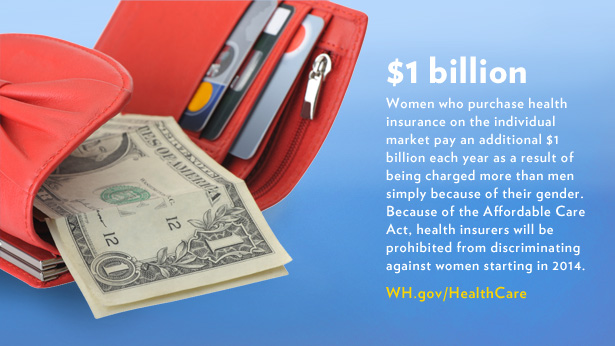
Thursday is the fourth day of National Women’s Health Week. Women often play a leading role in making medical decisions for their families, but their own health needs are often unmet, which is why President Obama worked to make health care more accessible and affordable for women across the country through his health reform law, the Affordable Care Act.
For example, women who purchase health insurance on the individual market pay an additional $1 billion each year because insurance companies charge them more than men, simply because of their gender. Thanks to the Affordable Care Act, health insurers will be prohibited from discriminating against women by charging higher premiums.
President Obama’s health reform law also requires new health insurance plans to cover preventive services such as mammograms, pap smears, and well-woman visits with no co-pay or deductible. Because of this provision in the Affordable Care Act, more than 20.4 million women with private health insurance have received preventive health services at no additional cost.
Learn more about Health Care, WomenNational Women's Health Week by the Numbers: 20.4 Million
Posted by on May 15, 2012 at 12:27 PM EST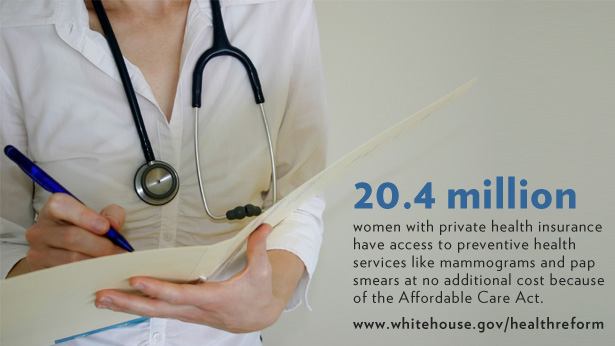
Tuesday is the second day of National Women’s Health Week, and an opportunity for all women to prioritize their health well-being by scheduling annual screening and exams.
President Obama’s health reform law requires that new health insurance plans cover preventive services such as mammograms, pap smears, and well-woman visits with no co-pay or deductible. Because of this provision in the Affordable Care Act, more than 20.4 million women with private health insurance have received preventive health services at no additional cost.
Learn more about Health Care, WomenDon't Forget!
Posted by on May 13, 2012 at 10:46 AM ESTIt's Mother's Day!
As rewarding as being a mom can be, it sure isn't easy. That's part of why the Obama Administration is taking steps to level the playing field for mothers and their families.
To help you show some appreciation for the mom in your life, we've put together two Mother's Day cards. One focuses on important health care reforms and the other on heroic military moms across the country.
Check them out and share them:
 From all of us here at the White House, Happy Mother's Day!
Guaranteeing Value for Your Premium Dollars
Posted by on May 11, 2012 at 11:04 AM ESTEd note: this post was originally published on the blog at healthcare.gov
When we pay for health insurance, we want to know that most of what we are paying for is for health care, not advertising, executive bonuses or overhead. It’s pretty simple: we want to get a good value for our premium dollars.
Thanks to a new rule (the “80/20 rule”) in the Affordable Care Act, you can be sure that insurance companies are spending generally at least 80 cents of every dollar you pay in premiums on your health care or activities that improve health care quality. If the insurance company fails to meet this standard, or the “medical loss ratio”, in any year, they have to pay you a rebate.
Insurance companies that didn’t meet the standard for coverage provided in 2011 are required to provide these rebates no later than August 1 of this year, and to make sure you know what you are owed, insurance companies that owe rebates will also send a letter telling you how much you’ll receive. You can see what that letter will look like here. According to early estimates from the Kaiser Family Foundation, insurance companies will provide 15.8 million Americans with $1.3 billion in rebates.
Today, we’re also finalizing a notice for insurance companies to send you if they meet or exceed the standard. If your insurance company is providing fair value for your premium dollars, you should know that too. You’ll be able to see your plan’s medical loss ratio on HealthCare.gov starting this summer.
If you don’t get a rebate, that means your plan may have lowered prices or improved your coverage already. For example, one insurer in West Virginia improved its medical loss ratio by lowering premiums by an average of $2,500 for 4,200 small businesses, cutting their premiums to give consumers welcome cost relief. This is one of the ways the 80/20 rule is bringing value to consumers for their health care dollars.
Learn more about Health CareWhite House Rural Council: Rural Stakeholders Meeting
Posted by on May 11, 2012 at 10:33 AM ESTOn Tuesday, May 1st, the White House Rural Council, along with Health and Human Services Secretary Kathleen Sebelius and Agriculture Secretary Tom Vilsack, hosted a group of 24 rural health care providers and experts to discuss issues around access to care and improving health outcomes in rural communities.
Rural physicians, nurses, mental hospital administrators, and rural health associations from across the country gathered to discuss a range of rural health issues--from the need to expand broadband to support telehealth services in California, to ways to improve health outcomes by focusing on nutrition and healthy living choices in Ohio.
During the meeting, Secretary Sebelius, announced $10.4 million in funding for 70 Rural Health Outreach Grants. These grants will address the needs of a wide range of population groups; including low-income families and individuals, the elderly, pregnant women, children, minorities and individuals with special health care needs.
Both Sebelius and Vilsack remarked that in their experience as Governors, they learned firsthand how important health care is for a vibrant rural community. They both agree that without access to quality, affordable, health care rural communities cannot compete for growth and economic development.
A recent RAND study that shows that 5.5 million rural Americans will now have access to health coverage because of the passage of the Affordable Care Act. In addition, 394,000 young adults in rural areas have gained coverage thanks to being able to stay on their parent’s insurance plan. Click here for more information on how this law is making a difference in the lives of millions of people like you.
Health care has long been a key focus area for the White House Rural Council. In August, the Administration announced a number of policy initiatives including expanding the National Health Service Corps to Critical Access Hospitals and improving access to capital for helping hospitals and clinics leverage emerging health information technology such as electronic health records. This session served as an excellent forum to discuss important opportunities and challenges and to initiative further solutions that can help rural Americans receive the best health care possible. Stay tuned for more updates on Rural Council events and announcements.
Fighting Fraud and Making Medicare Stronger
Posted by on May 8, 2012 at 1:00 PM ESTFighting Medicare fraud has long been a top priority for President Obama. Today, we are releasing a new infographic that describes how the Affordable Care Act – the new health care law – is helping the Obama Administration crack down on Medicare fraud and make Medicare stronger. The new infographic shows how the law increases penalties for criminals who commit fraud and provides new enforcement tools to stop fraud and save taxpayers money.
We are committed to using these new tools to fight Medicare and other health care fraud, and we are getting results: The Administration’s anti-fraud efforts recovered $4.1 billion in taxpayer dollars last year, the second year recoveries hit this record-breaking level. Total recoveries over the last three years were $10.7 billion. Prosecutions are way up, too: the number of individuals charged with fraud increased from 797 in fiscal year 2008 to 1,430 in fiscal year 2011 – a more than 75 percent increase.

Just last week, the Department of Health and Human Services and the Department of Justice announced “a nationwide takedown by Medicare Fraud Strike Force operations in seven cities has resulted in charges against 107 individuals, including doctors, nurses and other licensed medical professionals, for their alleged participation in Medicare fraud schemes involving approximately $452 million in false billing.” And on Monday, the Departments announced that, as a part of their Health Care Fraud Prevention and Enforcement Action Team initiative, they had resolved an investigation into a pharmaceutical company’s unlawful promotion of a prescription drug. The Justice Department reported that, “the resolution – the second largest payment by a drug company – includes a criminal fine and forfeiture totaling $700 million and civil settlements with the federal government and the states totaling $800 million.”
Learn more about Economy, Health Care
- &lsaquo previous
- …
- 79
- 80
- 81
- 82
- 83
- 84
- 85
- 86
- 87
- …
- next &rsaquo
From the Press Office
Related Videos
-
 December 13, 2016 5:04 PM
Signing Ceremony for the 21st Century Cures Act
-
 December 10, 2016 5:00 AM
Weekly Address: It’s Time to Get Covered on the Health Insurance Marketplace