Health Care Blog
We Can’t Wait Update: Advancing Innovation in Health Care
Posted by on May 8, 2012 at 9:15 AM ESTEd note: this post was originally published on the blog at healthcare.gov
From the electric light bulb to the Internet, American innovations have made lives better for people in this country and all over the world.
The kind of work we’ve done to advance technology, communication and so many other aspects of people’s lives is about to get a jump start in health care, thanks to today’s announcement of 26 Health Care Innovation Awards. The awards are part of our We Can’t Wait initiative.
“What America does better than anyone else is spark the creativity and imagination of our people," said President Obama during his 2011 State of the Union address, and that’s exactly what the Health Care Innovation Awards aim to do. These awards provide our most creative minds—whether they’re health care professionals, technology innovators, community-based organizations, patients’ advocacy groups, or others—with the backing they need to build the strong, effective, affordable health care system of the future. These are 26 unique projects, tailored to the needs of patients by local doctors, hospitals, and other leaders in their communities.
These awards will save $254 million over the next three years by testing innovative approaches to improve the quality of health care and prevent disease and illness. And we’re just getting started. We’ll announce another round of innovation awards in June.
Learn more about Health CareBy the Numbers: 3,000
Posted by on May 7, 2012 at 1:26 PM ESTEd. note: Today at 3:30 pm EDT, Mary Wakefield, a Registered Nurse and Administrator of the Health Resources and Services Administration, will host a session of Office Hours on Twitter to kick off National Nurses Week and discuss what the health law means for nurses. Find out how you can get involved here.
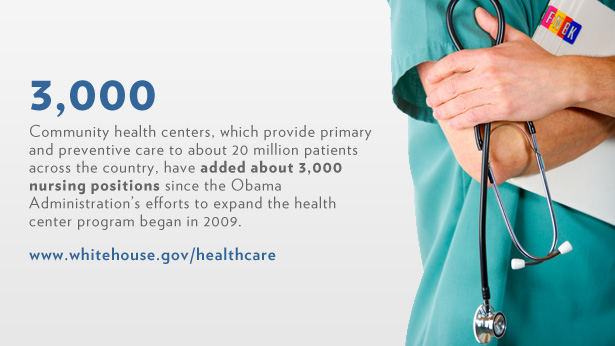
Thanks to the President’s new health care law, the Affordable Care Act, there will be significantly more nurses to help make our health care system stronger. One place where we’re already seeing more nursing positions added is in community health centers, which provide low-cost care to more than 20 million people across the country, many of whom do not have health insurance or live in communities with little access to other sources of quality health care. These centers have added about 3,000 jobs for nurses since the Obama Administration’s efforts to expand the community health center program began in 2009.
A new report released today, the beginning of National Nurses Week, shows some of the other ways the new law is helping invest in education and training opportunities for nurses:
- The Affordable Care Act’s investment in Nurse Managed Clinics is projected to help train more than 900 nurses by 2013 and serve 94,000 patients.
- The Affordable Care Act’s Prevention and Public Health Fund is supporting the training of 600 new nurse practitioners and nurse midwives by 2015.
- Training and educational support programs reauthorized through the Affordable Care Act are supporting more than 50,000 nurses and students.
Learn more about Health CareOvercoming Society’s Barriers to Bring Mobility to the World
Posted by on May 7, 2012 at 11:15 AM EST
Ralph Braun is being recognized as a Champion of Change for leading education and employment efforts in science, technology, engineering and math for Americans with disabilities.
I was diagnosed with muscular dystrophy when I was just six years old. Doctors told my parents I’d only live to be a young teenager. They encouraged my parents to leave me behind to be studied and to be institutionalized. Fortunately, my parents refused.
Years later, we discovered that the doctors had diagnosed me with the wrong type of MD. Eventually the disease took away my strength, just not as quickly as the doctors had originally thought. By the time I was 13, I was relying on piggyback rides from my dad to get out of my wheelchair and into the backseat of my family’s car. Back then accessibility simply did not exist. My parents fought our local school board to have an elevator installed in our brand new high school; and they lost. My classmates had to carry me to many of my classrooms. Nothing came easily, but my parents never let me feel sorry for myself.
I wanted an education, a career and a family – I just had to work a little harder at it. With the help of my family, I invented a motorized scooter (I called it the Tri-Wheeler) so I could conserve energy. The Tri-Wheeler is what allowed me to maintain my job as a Quality Control Inspector at a nearby factory. When that factory moved several miles from my home, I had to figure out a way to get to and from my job no matter the distance or the weather.
Beyond Challenges: Biological Sciences and Civic Engagement
Posted by on May 7, 2012 at 11:00 AM EST
Nasrin Taei is being recognized as a Champion of Change for leading education and employment efforts in science, technology, engineering and math for Americans with disabilities.
I aspire to use the opportunities provided to me by this great nation to make scientific advances for the benefit of others. My passion in science led me to explore the astonishing world of biochemistry and how it influences millions of lives each day. Hypertrophic cardiomyopathy (HCM), a heart-related abnormality, is the most common cause of sudden death in young athletes at sporting events. Oftentimes, there are no warning signs. As a contributor to Professor Douglas Root’s University of North Texas biological sciences investigative team, I have developed a model peptide system that can serve to test potential candidate drugs that ameliorate the structural effects of heart-disease-causing mutations such as HCM and to characterize the mutations causing this disease.
My experiments make use of sophisticated spectroscopy measurements of resonance energy transfer, to help gauge the accuracy of computational simulations of protein dynamics. I use these methods to measure precisely the stability changes in this protein following the addition of such compounds as antibodies that bind to the affected region. I hope to find a small molecule drug that will change the stability of this part of the myosin protein to counteract the destabilizing effects of the disease-causing mutations. Other members of my laboratory will use techniques such as force spectroscopy and single-molecule assays to further investigate the compounds that I screen, providing a more complete picture of the actions of these compounds. My goal is to have at least one of these compounds save the lives of some of the people affected by HCM.
New Report: Health Care Law Invests in Nurses
Posted by on May 7, 2012 at 6:20 AM ESTNote: This live session of Office Hours has concluded. Check out the full question and answer session below or at Storify.com
Today, we are excited to celebrate the start of National Nurses Week. Nurses are at the center of the American health system. And they do it all, from delivering preventive care to our children to helping seniors manage chronic disease.
Thanks to the President’s new health care law, there will be significantly more nurses to help make our health care system stronger. The Obama Administration is committed to educating new nurses, improving the training of today’s nurses, and placing nurses in the parts of the country where they are needed most.
The new law and the Obama Administration are investing in education and training opportunities for nurses. According to a new report we released today:
- The number of National Health Service Corps primary care providers nearly tripled between 2009 and 2011 with support from Affordable Care Act, the Recovery Act and ongoing appropriations, supporting more than 1,900 nurse practitioners and certified nurse midwives.
- Since the beginning of 2009, community health centers have added about 3,000 nursing positions, including 800 in advanced practice, a 20 percent increase.
- The Affordable Care Act’s investment in Nurse Managed Clinics is projected to help train more than 900 nurses by 2013 and serve 94,000 patients.
- The Affordable Care Act’s Prevention and Public Health Fund is supporting the training of 600 new nurse practitioners and nurse midwives by 2015.
- Training and educational support programs reauthorized through the Affordable Care Act are supporting more than 50,000 nurses and students.
To kick off National Nurses Week and discuss what the health law means for nurses, we’ll be hosting a session of Office Hours on Monday, May 7th at 3:30pm EST with Mary Wakefield, a Registered Nurse and Administrator of the Health Resources and Services Administration, which runs many of the programs that help train and support nurses.
Here’s how White House Office Hours work:
- Ask your questions now and during the live event on Twitter with the hashtag #WHChat
- Follow the Q&A live through the @WHLive Twitter account
- If you miss the live session, the full session will be posted on WhiteHouse.gov and Storify.com/WhiteHouse
We hope you’ll join us!
Learn more about Health CareWe Can’t Wait Update: Fighting Prescription Drug Shortages
Posted by on May 3, 2012 at 10:22 PM ESTEditor’s Note: As part of the We Can’t Wait initiative, President Obama signed an Executive Order directing the Food and Drug Administration (FDA) to take action to help further prevent and reduce prescription drug shortages. An update from FDA Commissioner Margaret Hamburg is below.
This week marks the six-month anniversary of President Obama signing an Executive Order to help FDA in our ongoing efforts to prevent and resolve prescription drug shortages. At FDA, we saw the Executive Order as an important step in bringing awareness to this critical public health issue and signaling the necessary tools and resources, such as early notification and additional staff, FDA must have to help address this problem. Following the Executive Order, we sent out letters to drug manufacturers asking them to voluntarily report to FDA if they saw the emerging potential for a drug shortage.
Learn more about Health Care
- &lsaquo previous
- …
- 80
- 81
- 82
- 83
- 84
- 85
- 86
- 87
- 88
- …
- next &rsaquo
From the Press Office
Related Videos
-
 December 13, 2016 5:04 PM
Signing Ceremony for the 21st Century Cures Act
-
 December 10, 2016 5:00 AM
Weekly Address: It’s Time to Get Covered on the Health Insurance Marketplace