Health Care Blog
By the Numbers: 100 Percent
Posted by on March 23, 2012 at 10:55 AM EST
Before the Affordable Care Act was signed into law, insurance companies had free rein to deny coverage or charge higher rates to anyone who had what they considered to be a “pre-existing condition.” These conditions include everything from asthma to high-blood pressure to cancer—some plans even consider pregnancy to be pre-existing. Today, however, insurers are banned from denying coverage to children with pre-existing conditions, and beginning in 2014, that ban will prevent insurers from discriminating against anyone based on their medical history.
Until that piece of President Obama’s health reform law takes effect, the Affordable Care Act established a temporary Pre-Existing Condition Insurance Plan, which give people are uninsured because of pre-existing conditions access to coverage. More than 50,000 people have obtained coverage through that plan, like James from Katy, Texas, who found himself with no health insurance after being diagnosed with brain cancer.
For more information:
- See how health reform is helping people in your state
- MarkCare: How health reform is making health insurance more affordable for small businesss
- StevenCare: How health reform enables Steven, a 23-year-old, two-time cancer survivor, to keep the insurance he needs
- HelenCare: How health reform is giving Helen, a senior from Philadephia, peace of mind and more money in her pocket
- VanessaCare: How health reform is helping Vanessa and her family
Learn more about Economy, Health CareFaces of the New Health Care Law
Posted by on March 23, 2012 at 10:42 AM ESTEach day this week, you’ve heard stories about what the new health care law means for every day people. Today, March 23, marks the second anniversary of the Affordable Care Act, and three remarkable women share their stories about how the new health care law is affecting their lives and the lives of their families. They are truly the faces of the Affordable Care Act, representing the millions of Americans already benefiting from health care reform and looking forward to full implementation of the consumer protections in the health care law in 2014.
Alycia Steinberg’s family was stunned when the pediatrician told them last fall that 2-year-old Avey had leukemia. Her first hospital stay at Johns Hopkins cost $100,000 and she has 2 ½ more years of chemotherapy ahead of her. “Being uninsured is not an option for my family,” Alycia says.
The Affordable Care Act protects Avey’s health insurance coverage because it bars insurance companies from denying coverage to children for pre-existing conditions.
“Childhood cancer is cruel. To have to worry about how your child will get treatment and how you will maintain your family’s most basic financial security is also cruel. ...When discussing health reform, we often talk about our goal of protecting the most vulnerable among us. What we forget is that we are all vulnerable,” Alisha says.
The Affordable Care Act and Latinos
Posted by on March 22, 2012 at 5:52 PM ESTAs we commemorate the second anniversary of the Affordable Care Act this Friday, it’s worth taking a look at the many ways this landmark health reform law is making a difference in the lives of Americans, especially Latinos who suffer disproportionately from a lack of access to coverage. Thirty two percent of Latinos were uninsured in 2009 – higher than any other racial or ethnic group – and half of Latinos did not have a regular doctor, compared to only one-fifth of white Americans. And twenty percent of low-income Hispanic youth have gone a year without a health care visit. When you look at these numbers, it’s clear that the Affordable Care Act has had and will continue to have a profound effect on the health of the Latino community.
Secretary of Labor Hilda Solis wrote an op-ed this past week for ImpreMedia on the Affordable Care Act and Latinos in which she highlighted that “Too often because of cost, Latinos don’t get the preventive care they need to stay healthy. This is particularly true during tough economic times, when many are forced to forego health services for other needs, like rent or groceries. A recent study found that 6.1 million Latinos gained prevention coverage in their private insurance plans in 2011.” You can read the rest of her op-ed HERE.
And throughout the week, the U.S. Department of Health and Human Services has highlighted how the new law has:
- Helped more than 5.1 million people with Medicare save over $3.2 billion| en español
- Provided more than 45 million women access to preventive health care services| en español
- Helped young adults get and keep affordable health coverage
- Made it possible for nine states to deem health insurance rate hikes “unreasonable”
Learn more about Health CareThis Week in Office Hours: Two Years of Health Care Progress
Posted by on March 22, 2012 at 2:27 PM ESTThis week, we are holding a series of White House Office Hours with Administration officials as we mark the two year anniversary of the Affordable Care Act.
On Monday, Nancy-Ann DeParle, Deputy Chief of Staff and former Director of the White House Office of Health Reform, held Office Hours on Twitter to answer your questions. Tweets poured in from individuals, local governments, and advocacy groups accross the country. Check out the full questions and answer session below, or on Storify.
Have more questions about the health care law and what it means for you and your family? We're holding another session with Cecilia Muñoz, Director of the Domestic Policy Council, this Friday, March 23rd at 2:00 p.m. EDT. Here's how you can get involved:
- Starting now, ask your question on Twitter with the hashtag #WHChat. You can also use #hcr and #ACA.
- On Friday, March 23rd at 2:00 p.m. EDT, Cecilia will be on the @WHLive account and ready to answer your questions
- You can follow the Q&A through the @WHLive Twitter account and the hashtag #WHChat
- If you miss the live event, the full session will be posted on WhiteHouse.gov and Storify.com/WhiteHouse
Learn more about health care reform progress by exploring the timeline and map -- and send us your #MyCare stories here.
Learn more about Health CareHealth Care Reform in Action: One Family's Story
Posted by on March 22, 2012 at 11:42 AM ESTWe met Nathan and his son, Thomas, in 2009. Thomas was born with hemophilia, and he hit lifetime limits on his health coverage with two different insurance companies before he turned seven years old. Two years ago, Nathan was hopeful about what the Affordable Care Act would mean.
Last week we spoke with Thomas’s family again and they made it clear: Health reform has improved their quality of life. It means they can focus on making sure Thomas has the best possible care. It's changing their lives for the better.
Thomas is not alone. He's just one of the 105 million Americans who no longer has lifetime dollar limits on his coverage.
By the Numbers: $2,300
Posted by on March 22, 2012 at 10:51 AM EST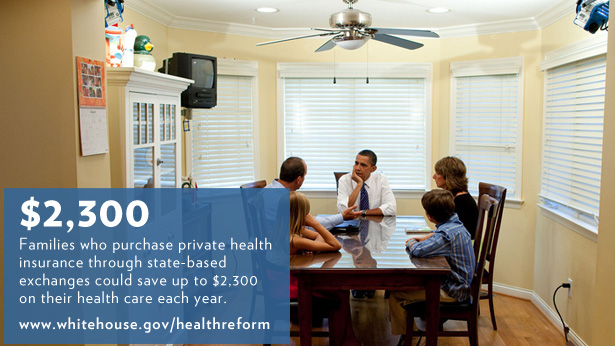
The Affordable Care Act is already helping small business owners with the costs of providing health insurance for their employees, and many Americans now have access to care they didn’t before, including children with pre-exsiting conditions and young adults who can now stay on their parents' plan until age 26. Millions more have access to free preventive services, and seniors are getting help paying for the medications they need.
But, there are provisions in President Obama’s health reform law that don’t take effect until 2014 and will do even more to make health insurance cheaper and easier to obtain for millions of Americans. For example, families who purchase private health insurance through state-based exchanges that come online in 2014 could save up to $2,300 each year on their health care spending.
Exchanges will be a single market where families or individuals can purchase and enroll in an affordable health insurance plan that meets their needs. They’ll be able to compare health plans, get answers to questions about their insurance options, and find out if they are eligible for tax credits for private insurance or health programs like the Children’s Health Insurance Program.
Learn more about Economy, Health Care
- &lsaquo previous
- …
- 85
- 86
- 87
- 88
- 89
- 90
- 91
- 92
- 93
- …
- next &rsaquo
From the Press Office
Related Videos
-
 December 13, 2016 5:04 PM
Signing Ceremony for the 21st Century Cures Act
-
 December 10, 2016 5:00 AM
Weekly Address: It’s Time to Get Covered on the Health Insurance Marketplace