
Joining Forces Blog
Never Leave a Fallen Comrade: The Story of One Continuing Mission on the Homefront
Posted by on July 3, 2012 at 11:44 AM EDTAs we celebrate the 4th of July, we celebrate our patriotism and the millions who have shown their love of country by wearing the uniform. There are a few Veterans among us -- 16,000 so far -- who came home and volunteered for a second time and served their communities though AmeriCorps.
As announced by Dr. Jill Biden at the National Conference on Volunteering and Service last month, Nearly 1,000 new AmeriCorps Members will serve by and for veterans and military families in 2012. On average, they will bring along another forty volunteers with them, who combined, will Join Forces to give more than 2 million hours of service to the veteran and military families of America over the course of their service year.
I visited one of the winning grantees, a new VetCorps, The AmeriCorps Veterans Justice Corps last month. I sat down with a fellow combat veteran and a medic, who has committed her time to helping veterans re-integrate into society after a run-in with the legal system.
Amber Hale is a soft spoken, but direct no-nonsense veteran. She was as clear about her motivations for serving her community in Minnesota, as she was about serving in Iraq.
“When I was in Iraq, I was a medic. I helped to put people back together, to help make them well and whole again … when I came home I wanted to do the same thing, so I joined AmeriCorps. Now I work with veterans who took a wrong turn, and wound up in the criminal justice system,” said Amber “When these Veterans are ready to come home they will know that another Veteran is standing on the other side waiting to help them put their lives back together ... that’s why I chose to serve again.”
23 States Have Now Passed Pro-Military Spouse License Portability Measures
Posted by on June 26, 2012 at 4:32 PM EDT
First Lady Michelle Obama holds the “Military Family Licensing Act,” signed by Illinois Gov. Pat Quinn, which will help military spouses and veterans transfer their professional licenses to Illinois more easily, during a signing ceremony at the Donnelly Armory in Chicago, Ill., June 26, 2012. (Official White House Photo by Lawrence Jackson)
Earlier today in Chicago, I had the wonderful privilege of joining First Lady Michelle Obama and Illinois Governor Pat Quinn as the Governor signed into law the “Military Family Licensing Act,” which will help literally thousands of military spouses and veterans transfer their professional licenses to Illinois more easily.
Were you to tell me last year that we’d be standing in Illinois – or any other state for that matter – with the First Lady and witnessing the Governor signing a bill supporting military spouse license portability, I wouldn’t have thought it was possible
.Well, we’re beyond possible in Illinois, license portability for military spouses is now… the law.
Here’s the story of how we got here and what it means.
The First Lady and Dr. Jill Biden spoke to the nation’s Governors and their spouses in February about how they could support military spouses by making it easier for their licenses to transfer as they move from state to state.
You can appreciate that there are hundreds of issues that the First Lady and Dr. Biden could have addressed but they focused on supporting our nation’s military spouses and in this case the 100,000 military spouses in the country who serve in professions that require state licenses.
Back in February, only 11 states had pro-spouse legislation in-place.
Today, Illinois became the 23rd state to adopt pro-military spouse license portability measures. The Bill will allow military spouses moving to bases in Illinois, for example, to more quickly and efficiently join the work force. So if your husband or wife gets orders and you’re heading to Naval Station Great Lakes to train the next generation of young sailors at “Boot Camp” and you’re a nurse – or your spouse got orders to Scott Air Force Base to help manage the issues of global logistics and you’re a physical therapist ----- your life just got a LOT better.
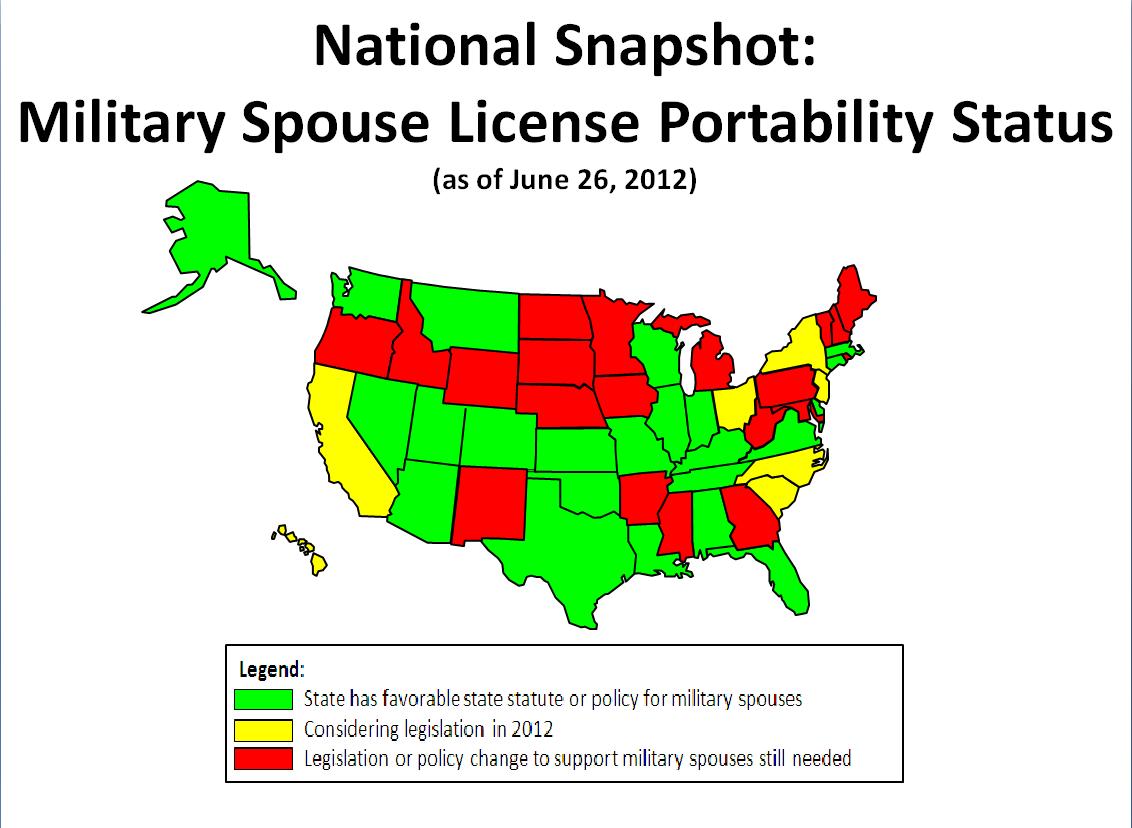
This leap of support from around the country is truly extraordinary– in less than 4 months since the First Lady and Dr. Biden’s call to action, the number of states supporting military spouse licensing portability has more than doubled.
That’s a huge leap – particularly because the issue of license portability is not new – it’s decades old. I’m an Army brat and I remember my parents talking about this when I was a kid. And this issue affects dozens of professions who are impacted including teachers, nurses, speech pathologists, dental hygienists, physical therapists, counselors, and so many more.
So whether it’s bringing companies together to hire military spouses or breaking down barriers to employment, every spouse in this country should know that America has your back. So as you serve this country, we’ll continue to work hard and serve you – and we won’t stop until you feel the thanks of a grateful nation.
Brad Cooper is the Executive Director of Joining Forces. Sign up for the Joining Forces newsletter, like us on Facebook, and follow us on Twitter.
Learn more about Veterans, Working FamiliesAmerica’s Largest Human Resources Organization Joining Forces to Hire Veterans and Military Spouses
Posted by on June 25, 2012 at 11:52 AM EDTWhen the creation of Joining Forces was officially announced last year by the First Lady and Dr. Biden, seated right behind them in the White House were representatives of several organizations that had already taken the step forward to support our veterans and military families.
This is a fitting time to salute one of those groups, the Society for Human Resource Management, or SHRM. Not only is SHRM having its annual conference in Atlanta right now, but the opening ceremonies of that meeting includes a renewed commitment to the career transition needs of military service members and their families.
We talk often here about forward-thinking employers making special efforts to encourage and support the transition of service members and their spouses back into the civilian workforce. And its members of SHRM who are doing the work to actually get our veterans hired.
DOT Launches Web Portal for Veterans Seeking Transportation Jobs
Posted by on June 21, 2012 at 12:12 PM EDTEd note: This post was first published on Fastlane, the official blog of the Department of Transportation
President Obama has asked that we serve our veterans as well as they’ve served us, and we at DOT are proud to answer the President’s challenge. That’s why today, in conjunction with the U.S. Department of Veterans Affairs, we’re launching a web portal to help veterans find transportation jobs in the private sector.
Our veterans have the skills and experience to help rebuild America, and we want to put them to work in the skies, on the roads, and throughout our transit systems.

Translating Veterans' Skills into Veterans' Jobs
Posted by on June 20, 2012 at 2:43 PM EDTAmerica’s veterans are national and civic assets. Veterans bring extraordinary skills and experience to the civilian work force when they leave the work force – and it's clear that companies want to hire veterans because it’s good for their bottom line.
But translating one’s military experience into language that is easily understood by civilian employers can sometimes be one of the most difficult tasks a veteran in transition faces. Let’s use me as an example: I’ve been in the Navy for 27 years -- my major skill sets are: driving warships, firing Tomahawk missiles and finding stealthy submarines in the ocean’s depths. Let’s face it, while those talents work well in the Navy, there just aren’t a lot of companies who need those specific skills.
The good news is: organizations and companies throughout America are stepping up to help with veterans’ “skill translation” -- and the timing is important: more than 1,000,000 veterans will be transitioning out of the military and into the civilian workforce in the coming years.
Last November, through the President’s leadership, the White House coordinated a public-private effort with the Departments of Defense, the Department of Veterans Affairs, and the Department of Labor -- along with major tech companies -- to establish the Veterans Job Bank, a single site with a built-in skills translator and more than 800,000 jobs for veterans today.
Military Spouse Attorneys Answer the Joining Forces Challenge
Posted by on June 14, 2012 at 4:55 PM EDTOne year ago today, Mary Reding, Esq. and the Hon. Erin Masson Wirth formed the Military Spouse JD Network (MSJDN). Inspired by the launch of Joining Forces, these women, military spouses themselves (Air Force and Coast Guard, respectively), wanted to make a meaningful change in their own profession.
As attorneys, they knew firsthand the challenge of balancing a career with being a military spouse. In their profession, the two or three day licensing exam is only given in July and February. Every time they moved to a new state, they would need to apply for, study, take the exam, and wait for results. This process could take almost a year and cost thousands of dollars. Then, they had to convince an employer to hire them even though their stay in the area would be only a few years.
Since graduating from law school in 1995, Wirth moved seven times, took the licensing examination three times, and found eleven full or part time jobs. She considers herself lucky – she was able to find work in every port.
Because of these licensing and employment barriers, military families made choices. Often, either the legal profession or the armed forces lost a well trained and valued member.
After meeting each other online, they decided to change the system. They approached the American Bar Association. Working with the Commission on Women, they wrote a Resolution supporting military spouse attorneys. Wirth addressed the 500+ members of the ABA House of Delegates – the preeminent body of legal professionals – and urged them to support military spouses. The Resolution passed without any opposition.
- &lsaquo previous
- …
- 36
- 37
- 38
- 39
- 40
- 41
- 42
- 43
- 44
- …
- next &rsaquo

White House Blogs
- The White House Blog
- Middle Class Task Force
- Council of Economic Advisers
- Council on Environmental Quality
- Council on Women and Girls
- Office of Intergovernmental Affairs
- Office of Management and Budget
- Office of Public Engagement
- Office of Science & Tech Policy
- Office of Urban Affairs
- Open Government
- Faith and Neighborhood Partnerships
- Social Innovation and Civic Participation
- US Trade Representative
- Office National Drug Control Policy
categories
- AIDS Policy
- Alaska
- Blueprint for an America Built to Last
- Budget
- Civil Rights
- Defense
- Disabilities
- Economy
- Education
- Energy and Environment
- Equal Pay
- Ethics
- Faith Based
- Fiscal Responsibility
- Foreign Policy
- Grab Bag
- Health Care
- Homeland Security
- Immigration
- Innovation Fellows
- Inside the White House
- Middle Class Security
- Open Government
- Poverty
- Rural
- Seniors and Social Security
- Service
- Social Innovation
- State of the Union
- Taxes
- Technology
- Urban Policy
- Veterans
- Violence Prevention
- White House Internships
- Women
- Working Families
- Additional Issues