
Joining Forces Blog
New Guide Highlights Best Practices and Innovations in Helping Veterans Thrive in the Private Sector
Posted by on June 11, 2012 at 12:16 PM EDTLast November, more than 30 organizations, including businesses, government agencies, think tanks and veteran advocates, joined forces in New York City for a “best practices” summit on veteran employment. Keynote speakers included Richard D. Parsons, now former chairman of the board of Citigroup, and Mrs. Patricia Shinseki - two of the Joining Forces three-member advisory board.
Just last week, the results of the summit came to fruition with the release the Guide to Leading Practices and Resources Supporting the Employment of Veterans and Military Families. The guide was published by Syracuse University’s Institute for Veterans and Military Families (IVMF) and reflects a collaborative contribution of major private-sector employers and others who agreed to share their own lessons learned and innovations with regard to effective recruitment, assimilation, retention, and development of veterans in the civilian workforce - all in an effort to advance employment opportunities for the nation’s veterans and military family members.
With American troops out of Iraq and our responsible withdrawal from Afghanistan now well underway, more than 1,000,000 veterans are expected to transition out of the military in the coming years. This guide is timely - and an imporant resource for every company in America looking to recruit, employ and retain our nation’s veterans.
We know that veterans are valuable additions to any company and are good for the bottom line. The White House Business Council has generated a “Guide to Hiring Veterans” and significant efforts are underway to address veteran and military spouse employment. More than 1,600 companies have hired 70,000 veterans and military spouses in the past year through Joining Forces. And in just the last 2 weeks, the President has announced a new measure to help veterans secure meaningful work in the manufacturing sector.
Learn more about VeteransVA’s Business Conference and Hiring Fair: Putting Vets Back to Work
Posted by on June 8, 2012 at 10:54 AM EDT
Ed. Note: This is a cross post from VA.gov
The National Veteran Small Business Conference is fast approaching, along with the associated Veteran Hiring Fair and VA Open House. From June 26-29, thousands of Veterans will gather in Detroit’s Cobo Center for the three VA-hosted events below.
The Blinded Veterans Association
Posted by on May 30, 2012 at 6:57 PM EDTEye injuries occurring through combat are changing and the nature of our current conflicts are pushing the numbers higher. Today’s battlefield conditions result in 16 percent of all those wounded/evacuated having penetrating eye injuries and/or TBI-related visual dysfunction due to blast forces. It is estimated that approximately 55,000 service members have some type of eye injury and 70 percent of those with eye blast injuries also endure traumatic brain injury (TBI) visual dysfunction. Serious combat eye trauma is now, according to VA data, the fourth most common combat injury, trailing only PTSD, TBI, and hearing loss.
One example is Sgt. Dorian Gardner, who was on foot patrol at the Forward Operating Base Kajaki, near the Kajaki Dam on the Helmand River, when he took a prone fighting position and began to scan for enemy activity. Shortly after laying down, a mortar exploded near his position, and instantaneously everything changed. After being treated at the National Naval Medical Center in Bethesda Maryland, Sgt. Gardner ended up losing his left eye, and only retaining 15-20 percent vision in his right eye. He was now legally blind. After attending the week-long convention hosted by the Blinded Veterans Association, Sgt. Gardner was able to unite with fellow visually-impaired veterans and join a peer support group. While still facing many challenges, Gardner now has a new group of friends and mentors who understand and can relate. To read the full story, please see the following link- Sgt. Gardner's Story (on page 34).
Learn more about Disabilities, VeteransWomen Chart a New Course Onboard U.S. Navy Submarines
Posted by on May 29, 2012 at 6:58 PM EDTIn 2009, U.S. Navy Secretary Ray Mabus announced that for the first time in Navy history, women would be assigned to serve aboard Navy submarines.
Yesterday, the first contingent of 24 women who completed the Navy’s nuclear submarine program met with President Obama and First Lady Michelle Obama at the White House. They were joined by Defense Secretary Leon Panetta, Navy Secretary Ray Mabus and the Vice Chief of Naval Operations, Admiral Mark Ferguson.

President Barack Obama and First Lady Michelle Obama greet the U.S. Navy’s first contingent of women submariners to be assigned to the Navy’s operational submarine force, in the Blue Room of the White House, May 28, 2012. The 24 women were accepted into the Navy’s nuclear submarine program after completing an intensive training program and serve on ballistic and guided missile submarines throughout the Navy. Also attending were ADM Mark Ferguson, left, Navy Secretary Ray Mabus and Defense Secretary Leon Panetta, right. (Official White House Photo by Pete Souza) May 28, 2012.
The commitment by the Navy to put women on submarines has gone from idea to reality in just a few short years -- these women are now serving in a variety of important jobs aboard ballistic and guided missile submarines in the Navy's Atlantic and Pacific Fleets.
Communities in Action: A Trip to Norfolk
Posted by on May 29, 2012 at 4:03 PM EDT“Our soldiers, our sailors, our airmen, Marines, Coast Guardsmen, and civilians in Afghanistan have done their duty. Now we must summon that same sense of common purpose. We must give our veterans and military families the support they deserve, and the opportunities they have earned. And we must redouble our efforts to build a nation worthy of their sacrifice.”
President Barack Obama, 2012
The President’s message to those who serve is clear: when you come home to America, America will be there for you. Together, the federal government, state and local governments, and the private sector, will work to establish a holistic and balanced approach for providing unprecedented levels of support for our servicemembers, veterans, wounded warriors, and military families.
Recently, I had the pleasure of visiting the city of Norfolk, VA to meet with the Mayor's team and discuss their design of a strategy aimed at enhancing the support available to their returning service members.
Overall, the city of Norfolk’s vision is to accomplish this by partnering with federal and state agencies, educational institutions, non-profit organizations, local industry, and employers to implement a place-based strategy that leverages investments and efforts in an integrated way. By focusing on a particular place, with regional scale in mind, the goal is to have the most transformative, effective, and efficient impact.
To support this initiative, Norfolk has designated a leader for the effort, and has also created commissions to provide advice and direction. The community of Norfolk will band together, amassing resources and manpower to ensure that returning veterans will get the support they need. Servicemembers coming home to Norfolk will be able to effectively reintegrate into society, and local employers will see them as the assets that they are.
Norfolk's not the only place finding innovative ways to support our veterans. The city of New York, along with the Robin Hood Foundation, has applied business metrics and management oversight to find and fund the most creative and effective ways to support our veterans. Their focus will consist of five key pillars: outreach, employment, housing, health care, and education. Together, these focus areas will help facilitate a healthy transition for our nation’s veterans, and begin building a model that can be scaled in communities across the country.
Building on these efforts, the White House is convening a July conference with city leaders and representatives from across the nation, to focus on sharing best practices. Together we will ensure that the best possible care is provided to our veterans, servicemembers, and their families -- now and far into the future.
Rosye Cloud is the Director of Veterans, Wounded Warriors and Military Families Policy.
Learn more about VeteransBroadcasting a Message of Gratitude
Posted by on May 28, 2012 at 11:15 AM EDT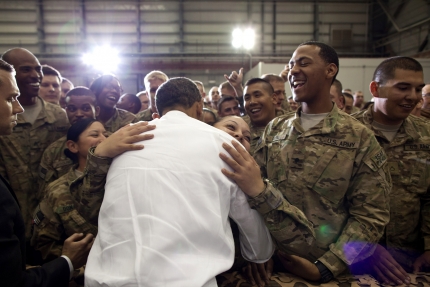
President Barack Obama greets U.S. troops following his remarks at Bagram Air Field, Afghanistan, May 1, 2012. (Official White House Photo by Pete Souza)
Earlier this month, President Obama visited Afghanistan, where he met with President Karzai and signed an historic agreement that lays the groundwork for the next phase of our relationship with the country as we bring a responsible end to years of war.
While in Afghanistan, the President also paid a surprise visit to American troops at Bagram Air Base. He wanted to thank the men and women serving there for the sacrifices that they and their families have made. He paid tribute to their successes, saying "You guys represent what is best in America." Some 3,200 American servicemen and women were assembled to hear the President offer his thanks for their service.
But there was another group of service members who could not be in attendance at the event. These were the men and women behind the scenes, providing security, manning radios and maintaining operations to ensure that the President's visit went smoothly. President Obama wanted to thank these individuals as well. So, after visiting wounded warriors at the base hospital, the President used a nearby radio to broadcast his thanks to all the service members who could not be at the event.
"I just wanted to say how proud I am of you, how grateful I am to you, and just wanted to let you know that everyone back home knows what you guys are doing and cares deeply about it. And I know your families are sacrificing just like you are. So please do me a favor and let them know how much I appreciate them as well."
"Just know that you're making a difference here. You're keeping America secure," the President said. He went on to add, "All of us are grateful for everything you do and all the sacrifices you make."
You can listen to the President's remarks below. In the coming years, as we bring the war in Afghanistan to a responsible end, thousands of veterans will be returning home to their families. These veterans and their families have earned our thanks and our support. This administration is committed to ensuring that they receive the benefits and opportunities they have earned. To find out how you can help our Veterans and military families, visit joiningforces.gov.
Watch President Obama Thank the Troops in Afghanistan, here.
Darienne Page is the Assistant Director of the White House Office of Public Engagement.
Learn more about Veterans
- &lsaquo previous
- …
- 37
- 38
- 39
- 40
- 41
- 42
- 43
- 44
- 45
- …
- next &rsaquo

White House Blogs
- The White House Blog
- Middle Class Task Force
- Council of Economic Advisers
- Council on Environmental Quality
- Council on Women and Girls
- Office of Intergovernmental Affairs
- Office of Management and Budget
- Office of Public Engagement
- Office of Science & Tech Policy
- Office of Urban Affairs
- Open Government
- Faith and Neighborhood Partnerships
- Social Innovation and Civic Participation
- US Trade Representative
- Office National Drug Control Policy
categories
- AIDS Policy
- Alaska
- Blueprint for an America Built to Last
- Budget
- Civil Rights
- Defense
- Disabilities
- Economy
- Education
- Energy and Environment
- Equal Pay
- Ethics
- Faith Based
- Fiscal Responsibility
- Foreign Policy
- Grab Bag
- Health Care
- Homeland Security
- Immigration
- Innovation Fellows
- Inside the White House
- Middle Class Security
- Open Government
- Poverty
- Rural
- Seniors and Social Security
- Service
- Social Innovation
- State of the Union
- Taxes
- Technology
- Urban Policy
- Veterans
- Violence Prevention
- White House Internships
- Women
- Working Families
- Additional Issues