The White House

Office of the Press Secretary

Summary of Technical Understandings Related to the Implementation of the Joint Plan of Action on the Islamic Republic of Iran’s Nuclear Program

On January 12, 2014, the P5+1 (the United States, United Kingdom, Germany, France, Russia, and China, coordinated by EU High Representative Catherine Ashton) and Iran arrived at technical understandings for the Joint Plan of Action, which will be implemented beginning on January 20, 2014.

The Joint Plan of Action marks the first time in nearly a decade that the Islamic Republic of Iran has agreed to specific actions that stop the advance of its nuclear program, roll back key aspects of the program, and include unprecedented access for international inspectors.  The technical understandings set forth how the provisions of the Joint Plan of Action will be implemented and verified, and the timing of implementation of its provisions.  Specifically, the technical understandings specify the actions that Iran will take to limit its enrichment capacity at Natanz and Fordow, as well as the limits on safeguarded research and development (R&D); the actions Iran will take to implement its commitments not to fuel the Arak reactor or install remaining components at the reactor; and the actions Iran will take to facilitate International Atomic Energy Agency (IAEA) verification and confirmation that Iran is fully implementing these commitments.  The understandings also clarify the reciprocal actions that the P5+1 and the EU will take.

Between now and January 20th, Iran, the IAEA, the United States, and our international partners, will take the remaining required steps to begin implementing the Joint Plan of Action on that date. 

What Iran Has Committed To Do

On January 20th, the IAEA will report on the current status of Iran’s nuclear program, and particularly on its uranium enrichment program and the Arak reactor.  The IAEA will also report on several specific steps that Iran has committed to take by or on the first day of implementation, including:

  • Halting production of near-20% enriched uranium and disabling the configuration of the centrifuge cascades Iran has been using to produce it.
  • Starting to dilute half of the near-20% enriched uranium stockpile that is in hexafluoride form, and continuing to convert the rest to oxide form not suitable for further enrichment.

In addition, over the course of the Joint Plan of Action, the IAEA will verify that Iran is:

  • Not enriching uranium in roughly half of installed centrifuges at Natanz and three-quarters of installed centrifuges at Fordow, including all next generation centrifuges.
  • Limiting its centrifuge production to those needed to replace damaged machines, so Iran cannot use the six-month period to stockpile centrifuges.
  • Not constructing additional enrichment facilities.
  • Not going beyond its current enrichment R&D practices.
  • Not commissioning or fueling the Arak reactor.
  • Halting the production and additional testing of fuel for the Arak reactor.
  • Not installing any additional reactor components at Arak.
  • Not transferring fuel and heavy water to the Arak reactor site.
  • Not constructing a facility capable of reprocessing.  Without reprocessing, Iran cannot separate plutonium from spent fuel.

Iran has also committed to a schedule for taking certain actions during the six-month period.  This includes:

  • Completion of dilution of half of its stockpile of near-20% uranium hexafluoride in three months, and completion of conversion of the rest of that material to oxide in six months.
  • A cap on the permitted size of Iran’s up to 5% enriched uranium stockpile at the end of the six-month period.

Verification Mechanisms

To ensure Iran is fulfilling its commitments, the IAEA will be solely responsible for verifying and confirming all nuclear-related measures, consistent with its ongoing inspection role in Iran.  In addition, the EU, P5+1 and Iran will establish a Joint Commission to work with the IAEA to monitor implementation of the Joint Plan of Action.  The Joint Commission will also work with the IAEA to facilitate resolution of past and present concerns with respect to Iran’s nuclear program. 

The Joint Commission will be composed of experts of the EU, P5+1 and Iran, and it will convene at least monthly to consider the implementation of the Joint Plan of Action and any issues that may arise.  Any decisions that are required on the basis of these discussions will be referred to the Political Directors of the EU, the P5+1, and Iran.

Transparency and Monitoring

Iran committed in the Joint Plan of Action to provide increased and unprecedented transparency into its nuclear program, including through more frequent and intrusive inspections as well as expanded provision of information to the IAEA.

The Iranian enrichment facilities at Natanz and Fordow will now be subject to daily IAEA inspector access as set out in the Joint Plan of Action (as opposed to every few weeks).  The IAEA and Iran are working to update procedures, which will permit IAEA inspectors to review surveillance information on a daily basis to shorten detection time for any Iranian non-compliance.  In addition, these facilities will continue to be subjected to a variety of other physical inspections, including scheduled and unannounced inspections. 

The Arak reactor and associated facilities will be subject to at least monthly IAEA inspections – an increase from the current inspection schedule permitting IAEA access approximately once every three months or longer. 

Iran has also agreed to provide for the first time:

  • Long-sought design information on the Arak reactor;
  • Figures to verify that centrifuge production will be dedicated to the replacement of damaged machines; and
  • Information to enable managed access at centrifuge assembly workshops, centrifuge rotor production workshops and storage facilities, and uranium mines and mills.

These enhanced monitoring measures will enable the IAEA to provide monthly updates to the Joint Commission on the status of Iran’s implementation of its commitments and enable the international community to more quickly detect breakout or the diversion of materials to a secret program.

What the P5+1 and EU Have Committed To Do

As part of this initial step, the P5+1 and EU will provide limited, temporary, and targeted relief to Iran.  The total value of the relief is between $6 and $7 billion – a small fraction of the $100 billion in Iranian foreign exchange holdings that will continue to be blocked or restricted.  Some relief will be provided from the first day; most will be provided in installments over the span of the entire six-month period.  The relief is structured so that the overwhelming majority of the sanctions regime, including the key oil, banking, and financial sanctions architecture, remains in place – and sanctions will continue to be vigorously implemented throughout the six-month period. 

Once the IAEA has confirmed Iran is implementing its commitments, in return the P5+1 and EU have committed to do the following on the first day of implementation:

  • Suspend the implementation of sanctions on Iran’s petrochemical exports and Iran’s imports of goods and services for its automotive manufacturing sector.
  • Suspend sanctions on Iran’s import and export of gold and other precious metals, with significant limitations that prevent Iran from using its restricted assets overseas to pay for these purchases. 
  • License expeditiously the supply of spare parts and services, including inspection services, for the safety of flight of Iran’s civil aviation sector.
  • Pause efforts to further reduce purchases of crude oil from Iran by the six economies still purchasing oil from Iran. 
  • Facilitate the establishment of a financial channel intended to support humanitarian trade that is already permitted with Iran and facilitate payments for UN obligations and tuition payments for students studying abroad.
  • Modify the thresholds for EU internal procedures for the authorization of financial transactions.

The P5+1 and EU have also committed to take certain actions to facilitate Iran’s access to $4.2 billion in restricted Iranian funds on a set schedule at regular intervals throughout the six months.  Access to a small portion of these funds will be linked to Iran’s progress in completing the dilution process for near-20% enriched uranium.  Iran will not have access to the final installment of the $4.2 billion until the last day of the six-month period. 

The installments will be released on the schedule below, contingent on the IAEA confirming that Iran is fulfilling its commitments.

February 1st - $550 million (installment #1)

March 1st - $450million (contingent on the IAEA confirming that Iran has completed dilution of half of the stockpile of near-20% enriched uranium it is required to dilute)

March 7th - $550 million (installment #2)

April 10th - $550 million (installment #3)

April 15th - $450 million (contingent on the IAEA confirming that Iran has completed dilution of its entire stockpile of near-20% enriched uranium it is required to dilute)

May 14th - $550 million (installment #4)

June 17th - $550 million (installment #5)

July 20th - $550million (installment #6 is on day 180) (contingent on the IAEA confirming that Iran has fulfilled all of its commitments)

A Comprehensive Solution

With this implementation plan, we have made concrete progress.  We will now focus on the critical work of pursuing a comprehensive resolution that addresses our concerns over Iran’s nuclear program.  Shortly after the Joint Plan of Action takes effect on January 20th, the United States will determine with our P5+1 partners our approach to the comprehensive solution.  Discussions with Iran will follow that coordination process.

With respect to the comprehensive solution, nothing is agreed to until everything is agreed to.  We have no illusions about how hard it will be to achieve this objective, but for the sake of our national security and the peace and security of the world, now is the time to give diplomacy a chance to succeed.

The White House

Office of the Press Secretary

Statement by Press Secretary Jay Carney on the Special Tribunal for Lebanon

The United States welcomes today's start of the Special Tribunal for Lebanon’s trial for four defendants accused of the 2005 assassination of former Prime Minister Rafik Hariri and others that were killed in that bombing.  We have strongly supported the Tribunal’s efforts to hold accountable those responsible for destabilizing acts of violence in Lebanon.  The Tribunal’s work must continue unimpeded and the perpetrators of these acts must be brought to justice.  The United States reiterates our condemnation of the use of violence as a political tool.  We call on all parties to work together to insulate Lebanon from further instability, including by supporting the institutions of the Lebanese state, assisting the Lebanese Armed Forces, and by respecting Lebanon’s neutrality as agreed in the Baabda Declaration. 

The White House

Office of the Press Secretary

Statement by the Press Secretary on H.R. 667, S. 1614

On Thursday, January 16, 2014, the President signed into law:

H.R. 667, which redesignates the Dryden Flight Research Center as the Neil A. Armstrong Flight Research Center and the Western Aeronautical Test Range as the Hugh L. Dryden Aeronautical Test Range; and

S. 1614, the “Accuracy for Adoptees Act,” which requires that a Federal Certificate of Citizenship for a child born outside of the United States reflect the child's name and date of birth as indicated on a State court order or State vital records document issued by the child's State of residence after the child has been adopted in that State.

The White House

Office of the Press Secretary

Remarks by the President and First Lady at College Opportunity Summit

South Court Auditorium
Eisenhower Executive Office Building

11:37 A.M. EST

MRS. OBAMA:  Good morning.  Thank you, everyone.  (Applause.)  Thank you so much.  Thank you.  You guys rest yourselves.  Thank you so much. 

It is really great to be here today with all of you.  We have with us today college and university presidents; we have experts and advocates, and civic and business leaders.  And I want to thank all of you for taking the time to be here today and for working every day to help young people pursue their education and build brighter futures for themselves and for our country.  

And I’d also like us to give a really big hand to Troy for sharing that story.  (Applause.)  That’s pretty powerful stuff, and presented so eloquently.  I know yesterday I met Troy -- he was nervous.  (Laughter.)  I don’t really know why you were nervous.  You're pretty awesome.

MR. SIMON:  Thank you.

MRS. OBAMA:  Troy's story reminds us all of the limitless capacity that lies within all of our young people no matter where they come from or how much money they have.  Troy is an example of why we all should care deeply about this issue.

And Troy, and millions of others like him, are why I care so much about this issue, and why in the coming years I'm going to be spending more and more of my time focusing on education.  Because as everyone here knows, education is the key to success for so many kids.  And my goal specifically is to reach out directly to young people and encourage them to take charge of their futures and complete an education beyond high school.  And I’m doing this because so often when we talk about education, we talk about our young people and what we need to do for them.  We talk about the programs we need to create for them, about the resources we need to devote to them. 

But we must remember that education is a two-way bargain.  And while there is so much more we must do for our kids, at the end of the day, as Troy described, the person who has the most say over whether or not a student succeeds is the student him or herself.  Ultimately, they are the ones sitting in that classroom.  They’re the ones who have to set goals for themselves and work hard to achieve those goals every single day.

So my hope is that with this new effort, that instead of talking about our kids, we talk with our kids.  I want to hear what’s going on in their lives.  I want to inspire them to step up and commit to their education so they can have opportunities they never even dreamed of.  I’m doing this because that story of opportunity through education is the story of my life, and I want them to know that it can be their story, too –- but only if they devote themselves to continuing their education past high school. 

And for many students, that might mean attending a college or university like the ones many of you represent.  For others, it might mean choosing a community college.  It might mean pursuing short-term professional training.  But no matter what they do, I want to make sure that students believe that they have what it takes to succeed beyond high school.  That’s going to be my message to young people. 

But here’s the thing:  I know that that message alone isn’t enough.  Like I said, this is a two-way street, and that means we all have to step up.  Because make no mistake about it, these kids are smart.  They will notice if we're not holding up our end of the bargain.  They will notice if we tell them about applying for college or financial aid, but then no one is there to help them choose the right school or fill out the right forms.  They will notice if we tell them that they're good enough to graduate from college, but then no college asks them to apply, no college invites them to visit their campus. 

And so we've got to re-commit ourselves to helping these kids pursue their education.  And as you discussed in your first panel today, one of the first steps is getting more underserved young people onto college campuses.  The fact is that right now we are missing out on so much potential because so many promising young people -- young people like Troy who have the talent it takes to succeed -- simply don’t believe that college can be a reality for them.  Too many of them are falling through the cracks, and all of you know that all too well.   

And that’s why so many of you are already finding new ways to reach out to the underserved students in your communities.  You’re helping them navigate the financial aid and college admissions process, and you’re helping them find schools that match their abilities and interests.  And I know from my own experience just how important all of that work is that you’re doing. 

See, the truth is that if Princeton hadn’t found my brother as a basketball recruit, and if I hadn’t seen that he could succeed on a campus like that, it never would have occurred to me to apply to that school -- never.  And I know that there are so many kids out there just like me -- kids who have a world of potential, but maybe their parents never went to college or maybe they’ve never been encouraged to believe they could succeed there. 

And so that means it’s our job to find those kids.  It’s our job to help them understand their potential and then get them enrolled in a college that can help them meet their needs.  But then we all know that just getting into school is only half the story, because once students are there, they have got to graduate.  And that’s not always easy, especially given what many of these kids are dealing with when they get to campus. 

Just think about it.  You just heard a snippet from Troy.  Just to make it to college, these kids have already overcome so much -- neighborhoods riddled with crime and drugs, moms and dads who weren’t around, too many nights when they had to go to bed hungry.  But as I tell these kids when I talk to them, we can’t think about those experiences that they've had as weaknesses -- just the opposite.  They’re actually strengths. 

In facing and overcoming these challenges, these kids have developed skills like grit and resilience that many of their peers will never be able to compete with -- never.  And when they get out in the world, those are the exact skills they will need to succeed.  And they will succeed.  

But imagine how hard it is to realize that when you first get to college.  You’re in a whole new world.  You might have trouble making friends because you don’t see any peers who come from a background like yours.  You might be worried about paying for classes, and food, and room and board because you have never had to set your own budget before.  You might be feeling guilty when you call home because Mom and Dad are wondering why you didn’t get a job so you could help support their family.  Those are the kinds of obstacles these kids are facing right from day one. 

But let’s be clear -- all of that isn’t just a challenge for them.  It’s a challenge for folks like us, who are committed to helping them succeed.  And make no mistake about it, that is our mission -- not simply giving speeches or raising money or hosting conferences, but to take real, meaningful action that will help our young people get into college, and more importantly, actually get their degree. 

And here’s the good news:  Time and again you all have shown that you have the experience, the passion and the resources to help these young people thrive.  For example, in recent decades, you’ve realized that students from across the socioeconomic spectrum have been coming to campus with more and more issues like eating disorders and learning disabilities, emotional challenges like depression and anxiety, and so much more.  And luckily, you all have not shied away from these issues.  I've seen it.  I worked at a university.  And you haven't said, these aren’t our problems; we’re a university, not a hospital or a counseling center.  No, you’ve stepped up. 

And while there’s still work left to do on these issues, you’re working every day to support these kids through treatment programs and outreach initiatives and support groups, because you know that these issues have a huge impact on whether students can learn and succeed at your school.  So now, as you begin to see more and more underserved students on your campuses, we need you to direct that same energy and determination toward helping these kids face their unique challenges. 

Now, fortunately, you’ve already got the expertise you need to address these issues.  And simply by building on what you're already doing best, you can make real differences for these kids.  And that’s what so many of you are doing with commitments you’ve made here at this summit. 

For example, every school offers financial aid services, but listen to what the University of Minnesota is doing.  They’re committing to expand those services to include financial literacy programs to help students and their families manage the costs of college.  And every school has advisors who desperately want their students to succeed.  Oregon Tech is committing to set up a text message program so that these advisors can connect more easily with students who need some extra encouragement or academic support. 

And every college has orientation programs or learning communities to help students transition to college.  And many of the schools here today are supplementing those programs by partnering with organizations like the Posse Foundation so that underserved students can connect and build a social network before they even step foot on campus.  And those were the types of resources that helped a kid like me not just survive but thrive at a school like Princeton.

When I first arrived at school as a first-generation college student, I didn’t know anyone on campus except my brother.  I didn’t know how to pick the right classes or find the right buildings.  I didn’t even bring the right size sheets for my dorm room bed.  (Laughter.)  I didn’t realize those beds were so long.  (Laughter.)  So I was a little overwhelmed and a little isolated. 

But then I had an opportunity to participate in a three-week, on-campus orientation program that helped me get a feel for the rhythm of college life.  And once school started, I discovered the campus cultural center, the Third World Center, where I found students and staff who came from families and communities that were similar to my own.  And they understood what I was going through.  They were there to listen when I was feeling frustrated.  They were there to answer the questions I was too embarrassed to ask anyone else. 

And if it weren’t for those resources and the friends and the mentors, I honestly don’t know how I would have made it through college.  But instead, I graduated at the top of my class, I went to law school -- and you know the rest.  (Laughter.)  So whether it’s aligning with an organization like Posse or offering a new advising or mentoring program, or creating a central space where students can connect with one another, you all can take simple steps that can determine whether these kids give up and drop out, or step up and thrive.

And that’s not just good for these young people, it’s good for your schools -- because if you embrace and empower these students, and if you make sure they have good campus experiences, then they’re going to stay engaged with your school for decades after they graduate.  They will be dressed up in school colors at homecoming games.  They’ll be asking to serve on your committees and advisory boards.  And they’ll be doing their part when fundraising season rolls around.  (Laughter.) 

So believe me, these will be some of the best alumni you could possibly ask for, because after everything these kids will have overcome to get into college and get through college, believe me, they will have all the skills they need to run our businesses and our labs, and to teach in our classrooms, and to lead our communities.

Just look at me, and look at Troy and the countless success stories from the organizations and schools represented here in this room.  That’s how we will win, this country.  We will win by tapping the full potential of all of our young people so that we can grow our economy and move this country forward.  And let me tell you that is something that my husband understands deeply, because his life story, just like mine, is rooted in education as well.  And as President, that is was drives him every single day -- his goal of expanding opportunity to millions of Americans who are striving to build better futures for themselves, for their families and for our country, as well.

So now it is my pleasure to introduce my husband, the President of the United States, Barack Obama.  (Applause.)  

THE PRESIDENT:  Thank you.  (Applause.)  Thank you, everybody.  Everybody, please have a seat.  Have a seat.  Welcome to the White House, everybody.  And let me begin by thanking Troy and sharing his remarkable story.  I could not be more inspired by what he’s accomplished and can’t wait to see what he’s going to accomplish in the future. 

My wife -- it’s hard to speak after her.  (Laughter and applause.)  We were in the back, and Gene Sperling, who did extraordinary work putting this whole summit together, said, “Everybody is so excited that Michelle is here.”  (Laughter.)  And I said, well, what about me?  (Laughter.)  But you should be excited, her being here, because she brings a passion and a body of experience and a passion to this issue that is extraordinary.  And I couldn’t be prouder of the work she’s already done and the work I know that she’s going to keep on doing around these issues.

She did leave one thing out of her speech, and that is it’s her birthday tomorrow.  (Applause.)  So I want everybody to just keep that in mind.

Now, we are here for one purpose:  We want to make sure more young people have the chance to earn a higher education.  And in the 21st century economy, we all understand it’s never been more important.

The good news is, is that our economy is steadily growing and strengthening after the worst recession in a generation.  So we’ve created more than 8 million new jobs.  Manufacturing is growing, led by a booming auto industry.  Thanks to some key public investments in advances like affordable energy and research and development, what we’ve seen is not only an energy revolution in this country that bodes well for our future, but in areas like health care, for example, we’ve slowed the growth of health care costs in ways that a lot of people wouldn’t have anticipated as recently as five or ten years ago. 

So there are a lot of good things going on in the economy.  And businesses are starting to invest.  In fact, what we’re seeing are businesses overseas starting to say, instead of outsourcing, let’s insource back into the U.S.

All that bodes well for our future.  Here’s the thing, though:  We don’t grow just for the sake of growth.  We grow so that it translates into a growing middle class, people getting jobs, people being able to support their families, and people being able to pass something on to the next generation.  We want to restore the essential promise of opportunity and upward mobility that’s at the heart of America -- the notion that if you work hard, you can get ahead, you can improve your situation in life, you can make something of yourself.  The same essential story that Troy so eloquently told about himself. 

And the fact is it’s been getting harder to do that for a lot of people.  It is harder for folks to start in one place and move up that ladder -- and that was true long before the recession hit.  And that’s why I’ve said that in 2014, we have to consider this a year of action, not just to grow the economy, not just to increase GDP, not just to make sure that corporations are profitable and the stock market is doing well and the financial system is stable.  We’ve also got to make sure that that growth is broad-based and that everybody has a chance to access that growth and take advantage of it.  We’ve got to make sure that we’re creating new jobs and that the wages and benefits that go along with those jobs can support a family.  We have to make sure that there are new ladders of opportunity into the middle class, and that those ladders -- the rungs on those ladders are solid and accessible for more people.

Now, I’m going to be working with Congress where I can to accomplish this, but I’m also going to act on my own if Congress is deadlocked.  I’ve got a pen to take executive actions where Congress won’t, and I’ve got a telephone to rally folks around the country on this mission. 

And today is a great example of how, without a whole bunch of new legislation, we can advance this agenda.  We’ve got philanthropists and business leaders here; we’ve got leaders of innovative non-for-profits; we’ve got college presidents -- from state universities and historically black colleges to Ivy League universities and community colleges.  And today, more than 100 colleges and 40 organizations are announcing new commitments to help more young people not only go to, but graduate from college.  And that’s an extraordinary accomplishment, and we didn’t pass a bill to do it.
   
Everybody here is participating, I believe, because you know that college graduation has never been more valuable than it is today.  Unemployment for Americans with a college degree is more than a third lower than the national average.  Incomes -- twice as high as those without a high school diploma.  College is not the only path to success.  We’ve got to make sure that more Americans of all age are getting the skills that they need to access the jobs that are out there right now.  But more than ever, a college degree is the surest path to a stable, middle-class life.

And higher education speaks to something more than that.  The premise that we’re all created equal is the opening line in our American story.  And we don’t promise equal outcomes; we’ve strived to deliver equal opportunity -- the idea that success does not depend on being born into wealth or privilege, it depends on effort and merit.  You can be born into nothing and work your way into something extraordinary.  And to a kid that goes to college, maybe like Michelle, the first in his or her family, that means everything.
 
And the fact is, is if we hadn’t made a commitment as a country to send more of our people to college, Michelle, me, maybe a few of you would not be here today.  My grandfather wasn’t rich, but when he came home from the war he got the chance to study on the GI Bill.  I grew up with a single mom.  She had me when she was 18 years old.  There are a lot of circumstances where that might have waylaid her education for good.  But there were structures in place that allowed her then to go on and get a PhD.  Michelle’s dad was a shift worker at the city water plant; mom worked as a secretary.  They didn’t go to college.  But there were structures in place that allowed Michelle to take advantage of those opportunities. 

As Michelle mentioned, our parents and grandparents made sure we knew that we’d have to work for it, that nobody was going to hand us something, that education was not a passive enterprise -- you just tip your head over and somebody pours education into your ear.  (Laughter.)  You’ve got to work for it.  And I’ve told the story of my mother -- when I was living overseas, she’d wake me up before dawn to do correspondence courses in English before I went to the other school.  I wasn’t that happy about it.  (Laughter.)  But with that hard work -- but also with scholarships, also with student loans, and with support programs in place -- we were able to go to some of the best colleges in the country even though we didn’t have a lot of money.  Every child in America should have the same chance.

So over the last five years, we’ve worked hard in a variety of ways to improve these mechanisms to get young people where they need to be and to knock down barriers that are preventing them from getting better prepared for the economies that they’re going to face.  We’ve called for clearer, higher standards in our schools -- and 45 states and the District of Columbia have answered that call so far.  We’ve set a goal of training 100,000 new math and science teachers over the next 10 years, and the private sector has already committed to help train 40,000.  We’ve taken new steps to help students stay in school, and today the high school dropout rate is the lowest it has been in 40 years -- something that’s rarely advertised.  The dropout rate among Hispanic students, by the way, has been cut in half over the last decade. 

But we still have to hire more good teachers and pay them better.  We still have to do more training and development, and ensure that the curriculums are ones that maximize the chances for student success.  When young people are properly prepared in high school, we’ve got to make sure that they can afford to go to college, so we took on a student loan system that was giving billions of dollars of taxpayer dollars to big banks and we said, let’s give that money directly to students.  As a consequence, we were able to double the grant aid that goes to millions of students.  And today, more young people are earning college degrees than ever before. 

So we’ve made progress there, but as I’ve discussed with some of you, we’re still going to have to make sure that rising tuition doesn’t price the middle class out of a college education.  The government is not going to be able to continually subsidize a system in which higher education inflation is going up faster than health care inflation.  So I’ve laid out a plan to bring down costs and make sure that students are not saddled with debt before they even start out in life. 

Even after all these steps that we’ve taken over the last five years, we still have a long way to go to unlock the doors of higher education to more Americans and especially lower-income Americans.  We’re going to have to make sure they’re ready to walk through those doors.  The added value of a college diploma has nearly doubled since Michelle and I were undergraduates.  Unfortunately, today only 30 percent of low-income students enroll in college right after high school and, far worse, by their mid-twenties only 9 percent earn a bachelor’s degree. 

So if we as a nation can expand opportunity and reach out to those young people and help them not just go to college but graduate from college or university, it could have a transformative effect.  There is this huge cohort of talent that we’re not tapping.

Now, what this meeting today tells me is we’ve got dedicated citizens across the country who are ready to stand up and meet this challenge.  And what I want to really do is highlight some of the commitments that have been made here today.  So we know that not enough low-income students are taking the steps required to prepare for college.  That's why I'm glad the University of Chicago, my neighbor, and the place where Michelle and I both worked in the past, is announcing a $10 million College Success Initiative that will reach 10,000 high schools over the next five years.  It’s why iMentor, a mentoring program that began 15 years ago with just 49 students in the South Bronx, has committed to matching 20,000 new students with mentoring in more than 20 states over the next five years. 

We also know that too many students don’t apply to the schools that are right for them.  They may sometimes underestimate where they could succeed, where they could go.  There may be a mismatch in terms of what their aspirations are and the nature of what's offered at the school that's close by.  And they kind of assume, well, that's my only option.  So UVA, for example, is going experiment with new ways to contact high-achieving, low-income students directly and encourage them to apply.  Organizations like the College Board are going to work with colleges to make it easier for students to apply to more schools for free.

I know sometimes for those of you in university administrations, the perception may be that $100 application fees is not a big deal.  But for a lot of these students, that's enough of a barrier that they just don't end up applying.

Number three, we know that when it comes to college advising, and preparing for tests like the ACT and the SAT, low-income kids are not on a level playing field.  We call these standardized tests -- they're not standardized.  Malia and Sasha, by the time they're in seventh grade at Sidwell School here, are already getting all kinds of advice and this and that and the other.  The degree of preparation that many of our kids here are getting in advance of actually taking this test tilts the playing field.  It's not fair.  And it's gotten worse. 

I was telling Michelle, when I was taking the SAT I just barely remembered to bring a pencil.  I mean, that's how much preparation I did.  (Laughter.)  But the truth of the matter is, is that we don't have a level playing field when it comes to so-called standardized tests.  So we've got a young man here today named Lawrence Harris who knows this better than most.  Lawrence went to the University of Georgia, and like a lot of first-generation college students it wasn’t easy for him.  He had to take remedial classes.  He had to work two part-time jobs to make ends meet.  At one point, he had to leave school for a year while he helped support his mom and his baby brother.  Those are the kinds of just day-to-day challenges that a lot of these young people with enormous talent are having to overcome.  Now, he stuck with it.  He graduated. 
 
But now he’s giving back.  He’s made it his mission to help other young people like him graduate, as a college advisor at Clarke Central High School in Athens, Georgia.  And today the National College Advising Corps, the program that placed Lawrence in Clarke Central, is announcing plans to add 129 more advisors who will serve more than 80,000 students over the next three years.

Finally, we know that once low-income students arrive on campus -- Michelle I think spoke eloquently to her own personal experience on this -- they often learn that even if they were at the top of their high school class, they still have a lot of catching up to do with respect to some of their peers in the classroom.  Bunker Hill Community College is addressing this by giving more incoming students the chance to start catching up over the summer before their freshman year.  And we’ve got 22 states and the District of Columbia who have joined together in a commitment to dramatically increase the number of students who complete college-level math and English their first year.   

So these are just a sampling of the more than 100 commitments that your organizations and colleges are making here today.  And that’s an extraordinary first step.  But we’ve got more colleges and universities than this around the country.  We’ve got more business leaders around the country and philanthropies around the country.  And so we have to think of this as just the beginning; we want to do something like this again, and we want even more colleges and universities and businesses and non-for-profits to take part. 

For folks who are watching this who were not able be here today, we want you here next time.  Start thinking about your commitments now.  We want you to join us.  For those who were able to make commitments today, I want to thank you for doing your part to make better the life of our country -- because what you’re doing here today means that there are a bunch of young people, like Troy and like Michelle and like me, who suddenly may be able to see a whole new world open up before -- that they didn’t realize was there.  

So I’ll end with a great story that I think speaks to this.  There’s a former teacher here today named Nick Ehrmann.  Where’s Nick?  So here’s Nick right here.  Five years ago, Nick founded a New York City nonprofit called Blue Engine, and they recruit recent college graduates to work as teaching assistants in public high schools that serve low-income communities, teaming up to help students build the skills they need to enter college ready for college. 

The first group of students to work with those teaching assistants are seniors now.  One of them, Estiven Rodriguez, who also is here today -- where is he?  There he is -- good-looking, young guy right here.  (Laughter.)  Could not speak a word of English when he moved to the United States from the Dominican Republic at the age of nine.  Didn’t speak much more English by the time he entered sixth grade. 

Today, with the support of a tightly knit school community, he’s one of the top students in his senior class at Washington Heights Expeditionary Learning School, or WHEELS.  Last month, he and his classmates put on their WHEELS sweatshirts, unfurled a banner, waved flags and marched down the streets of Washington Heights in New York City through cheering crowds.  You would have thought it was the Macy’s parade.  (Laughter.)  But the crowds on the sidewalk were parents and teachers and neighbors.  The flags were college pennants.  The march was to the post office, where they mailed in their college applications.  (Applause.)  And Estiven just heard back -- this son of a factory worker who didn’t speak much English just six years ago won a competitive scholarship to attend Dickinson College this fall.  (Applause.)

So everywhere you go you've got stories like Estiven's and you've got stories like Troy's.  But we don't want these to be the exceptions.  We want these to be the rule.  That's what we owe our young people and that's what we owe this country.  We all have a stake in restoring that fundamental American idea that says:  It doesn’t matter where you start, what matters is where you end up.  And as parents and as teachers, and as business and philanthropic and political leaders -- and as citizens -- we've all got a role to play. 

So I'm going to spend the next three years as President playing mine.  And I look forward to working with you on the same team to make this happen.  Thank you very much, everybody.  (Applause.)

END
12:15 P.M. EST

The White House

Office of the Press Secretary

President Obama Signs Alaska Disaster Declaration

The President today declared a major disaster exists in the State of Alaska and ordered federal aid to supplement state, tribal and local recovery efforts in the area affected by flooding during the period of October 27-28, 2013. 

Federal funding is available to state and eligible tribal and local governments, and certain private nonprofit organizations on a cost-sharing basis for emergency work and the repair or replacement of facilities damaged by the flooding in the Kenai Peninsula Borough.

Federal funding is also available on a cost-sharing basis for hazard mitigation measures statewide. 

W. Craig Fugate, Administrator, Federal Emergency Management Agency (FEMA), Department of Homeland Security, named Dolph A. Diemont as the Federal Coordinating Officer for federal recovery operations in the affected area. 

FEMA said additional designations may be made at a later date if requested by the state and warranted by the results of further damage assessments.

The White House

Office of the Press Secretary

President Obama Nominates Four to Serve on the United States District Courts

WASHINGTON, DC -- Today, President Obama nominated Stephen R. Bough, Richard Franklin Boulware II, Judge Salvador Mendoza, Jr., and Staci Michelle Yandle to serve on the United States District Courts.

“I am pleased to nominate these distinguished individuals to serve on the United States District Court bench,” said President Obama.  “I am confident they will serve the American people with integrity and a steadfast commitment to justice.”

Stephen R. Bough: Nominee for the United States District Court for the Western District of Missouri
Stephen R. Bough is a partner at the Law Offices of Stephen R. Bough, where his practice focuses on insurance coverage and personal injury litigation.  Before he founded his current firm in 2006, he practiced law at Henning & Bough from 2002 to 2006 and at Shamberg, Johnson & Bergman from 1999 to 2002.  Bough began his career as a law clerk for Judge Scott O. Wright of the United States District Court for the Western District of Missouri from 1997 to 1999.  He received his J.D. in 1997 from the University of Missouri—Kansas City School of Law, where he served as editor-in-chief of the UMKC Law Review, and his B.S. in 1993 from Missouri State University.

Richard Franklin Boulware II:  Nominee for the United States District Court for the District of Nevada
Richard Franklin Boulware II has worked at the Federal Public Defender’s Office in Las Vegas since 2007 and has been the lead attorney on complex white-collar cases since 2010.  From 2003 to 2007, he was a trial attorney at the Federal Defenders of New York.  Boulware began his legal career as a law clerk to Judge Denise Cote of the United States District Court for the Southern District of New York from 2002 to 2003.  He received his J.D. in 2002 from Columbia Law School and his A.B. cum laude in 1993 from Harvard College. 

Judge Salvador Mendoza, Jr.: Nominee for the United States District Court for the Eastern District of Washington
Judge Salvador Mendoza, Jr. has served as a judge on the Superior Court for Benton and Franklin Counties since 2013.  From 1999 to 2013, Judge Mendoza practiced law as a solo practitioner and in various law partnerships, where his practice focused on criminal defense.  During that same period, Judge Mendoza also served as a judge pro tempore in various district, municipal, and juvenile courts in Benton and Franklin Counties.  From 1998 to 1999, he served as a Deputy Prosecuting Attorney in the Franklin County Prosecutor’s Office and, from 1997 to 1998, he served as an Assistant Attorney General in the Washington State Attorney General’s Office.  Judge Mendoza received his J.D. in 1997 from the UCLA School of Law and his B.A. in 1994 from the University of Washington.

Staci Michelle Yandle: Nominee for the United States District Court for the Southern District of Illinois
Staci Michelle Yandle has been a solo practitioner in southern Illinois since 2007, where her practice focuses on civil litigation in federal and state court.  From 2003 to 2007, Yandle was a partner with The Rex Carr Law Firm LLC, and, from 1987 to 2003, she was an associate with the law firm of Carr, Korein, Schlichter, Kunin, Montroy, Glass & Bogard.  She received her J.D. in 1987 from the Vanderbilt University School of Law and her B.S. in 1983 from the University of Illinois.  Yandle served by appointment on the Illinois Gaming Board from 1999 to 2001, and on the Illinois Advisory Committee to the United States Commission on Civil Rights from approximately 1992 to 1996.

A Budget Deal That Invests in Our Youngest Children

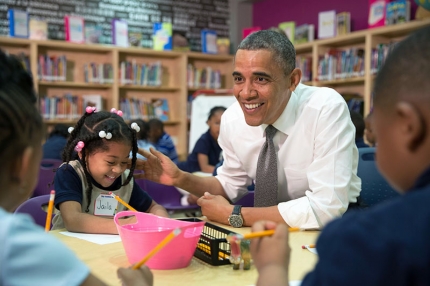
President Barack Obama participates in a literacy lesson with children while visiting a pre-kindergarten classroom

President Barack Obama participates in a literacy lesson with children while visiting a pre-kindergarten classroom at Moravia Elementary School in Baltimore, Md., May 17, 2013. (Official White House Photo by Pete Souza)

In last year’s State of the Union address President Obama laid out his bold vision to expand access to high-quality pre-school to every child in America

He called on Congress to help turn this vision into reality, not just because studies show that children who start learning at the earliest ages are more likely to succeed in school and in life, but because for every dollar that is invested in early education, we save multiple dollars in areas like improved educational outcomes, increased labor productivity, and a reduction in crime.

You can find more about those stats and the President’s proposal in this blog post, but in short, an investment in America’s children is a great investment.

The President also made it clear during last year’s State of the Union address that the Administration couldn’t do this on our own - we needed Congress to step up and do their part, and make America’s children a priority.

Cecilia Muñoz is the Director of the Domestic Policy Council
Related Topics: Education, Maryland

The White House

Office of the Press Secretary

FACT SHEET: The President and First Lady’s Call to Action on College Opportunity

To view the White House report on Increasing College Opportunity for Low-Income Students, click HERE.  To view the list of Commitments to Action on College Opportunity, click HERE.

The President believes he has a job to do, and every day he is fighting to create more opportunities for working and middle class Americans. And while he will continue to work with Democrats and Republicans in Congress to move our country forward, the President is committed to partnering with colleges and universities, business leaders, nonprofits and others to do everything he can to support more college opportunities for students across the country.

Today, in response to the President’s call to action, the President and First Lady are joining with leaders in higher education to announce over 100 new commitments to expand college opportunity. To help more students afford and graduate from college with the skills they need, the Administration has already taken action including doubling Federal investments in Pell Grants and college tax credits and reforming student loans.  Last August, the President laid out an ambitious new agenda aimed at improving college value, removing barriers to innovation and competition, and ensuring that student debt remains affordable. As the Administration continues to push for changes that keep college affordable for all students and families, we can and must do more to get more low-income students prepared for college, enrolled in quality institutions, and graduating if we are to achieve our North Star goal of leading the world in the share of college graduates by 2020. Together, the President, the First Lady and these leaders in higher education are taking another step to help ensure that every child, rich or poor, has the opportunity for a quality college education so they can get ahead. 

  • Over 100 New Commitments to Expand College Opportunity: The participants in today’s event were asked not simply to attend an event – but to commit to new action in one of the following areas crucial to college opportunity: 

  • Connecting more low-income students to the college that is right for them and ensuring more graduate
  • Increasing the pool of students preparing for college through early interventions
  • Leveling the playing field in college advising and SAT/ACT test preparation
  • Strengthening remediation to help academically underprepared students progress through and complete college 

Today, over 100 colleges and universities and 40 organizations are announcing new commitments to action to build on their existing efforts in this area. Together, these actions will serve hundreds of thousands of students across the country.

  • Improving College Opportunity Is Important to Increasing Economic Mobility and Growing the Economy: Without college, a child born in the bottom quintile has only a 5 percent chance of making it to the top quintile. However, the chance of making it to the top nearly quadruples with a college degree – with a nearly equal chance of making it to the top quintile as staying in the bottom quintile. Yet only 9 percent of those born in the bottom quartile attain a bachelor’s degree by age 25, compared to 54 percent in the top quartile. Improving college success is one of the most powerful tools to increase economic mobility and reduce inequality. 

  • Taking Further Action to Expand College Opportunity: This event is not the culmination of these efforts, but rather the launch of a mobilization by the White House and the Department of Education, which will help share and develop additional evidence on what works and foster new commitments to action from a broader range of colleges and universities, business, nonprofits and other leaders. In 2014, the White House and the Department of Education will work with outside groups to engage in further gatherings, catalyze new and additional commitments, develop a follow-up report on progress and hold a White House convening over the next year. 

The President and First Lady’s Call to Action on College Opportunity

As part of the President and First Lady’s national call to action on college opportunity, over 100 college presidents and 40 non-profits, foundations and other organizations are announcing new commitments in the following key areas:

  1. Connecting more low-income students to the school that is right for them and ensuring more students graduate.  Many low-income students do not apply to or attend schools where they are most likely to succeed, often because they are not fully aware of their options available to them. Building on models that have had success in better matching low-income students to colleges where their outcomes will be best, participants have committed to doing more to enroll low-income students and ensure they matriculate and graduate. Over 80 colleges and universities and 15 organizations are making commitments in this area, with selected examples including: 

    • A Doubling of STEM Posse Partner Institutions: The Posse Foundation is announcing a doubling to 10 of its STEM Posse Partner Institutions – serving, over the next five years, 250 additional students from diverse, urban backgrounds who might otherwise be overlooked, providing a total of $35 million in full-tuition, four-year scholarships, and helping students to complete science, technology engineering and mathematics (STEM) degrees at some of the nation’s top colleges and universities. 

    • College Board Joining With Member Institutions to Offer Four Free Fee Waivers to Eligible Students for College Applications: The College Board is joining with its member institutions to announce that every income-eligible student who takes the SAT will receive four free fee waivers to apply to college for free. 

    • More than $95 Million in Commitments to Help More Students Complete STEM Degrees: Investments totaling $95 million are being announced today from the Howard Hughes Medical Institute ($65 million over five years) and the Leona M. and Harry B. Helmsley Charitable Trust ($30 million over three years) and to help more students complete STEM degrees.  

    • Action By More than 80 Colleges and Universities: Over 80 colleges and universities are – in addition to their efforts in other categories – taking actions like engaging in new efforts to recruit students who might not otherwise attend their university, expanding need-based aid for low-income students, setting new goals for increasing the share of low-income students, committing to additional community college transfers and taking new steps to improve outcomes for low-income students once they arrive on campus. 

  1. Increasing the Pool of Students Preparing for College Through Early Interventions:  Low-income students are less likely to prepare to apply for college by taking recommend courses, visiting college campuses, and taking the SAT or ACT.  Building on models that have had success in getting more students to prepare for college through early interventions, participants have committed to working with elementary, middle, and high schools to encourage college-going and assist with preparation. More than 30 colleges and 12 organizations have made commitments in this area, with selected examples including:
    • A New $5 Million Effort to Design Pathways to Success for Careers: Deloitte, Darden, Walmart, AT&T, Mutual of America, and the Samberg Family Foundation are committing $5 million over four years to support College Summit, and in particular a partnership called ScholarJob that will help low-income students across America connect getting an education with getting a great career. This year, with an investment from the Bezos Family Foundation, ScholarJob volunteers will partner with College Summit student Peer Leaders to scale the program, equipping more than 100,000 high school students from low-income communities in 10 cities with cutting-edge technology to help them explore careers, and to attend and complete college. 

    • $4.5 Million in New Commitments to Redesigned Schools: The Irvine Foundation and Pacific Gas & Electric are making a combined $4.5 million commitment to support the President’s initiative to redesign high schools to include more real-world learning and business partnerships. 

    • Matching Tens of Thousands of Students With Mentors and Rigorous College-Preparation: iMentor is matching 20,000 new first-generation college students with mentors and Blue Engine is expanding academic preparation in college gateway skills to 10,000 additional students over the next five years 

    • $12.5 Million in New Funding to Support Excellent STEM Teaching: 100kin10, a network formed in response to the President’s call to action to prepare 100,000 excellent STEM teachers over a decade, is announcing an additional $12.5 million in funding with support from JP Morgan Chase, the Overdeck Family Foundation, the Hewlett Foundation and the New York State Attorney General. 

    • Efforts by More than 35 Colleges and Universities to Prepare More Students for College: More than 35 colleges and universities are – along with efforts in other categories – taking actions like hosting summer enrichment programs for low-income students; partnering with local high schools to create programs that span high school and link students to college; and encouraging current students or faculty to tutor and interact with low-income high school students 

  1. Leveling the Playing Field in College Advising and Test Preparation. Low-income students are often at a triple disadvantage when it comes to advising and mentorship:  their schools have fewer counselors, they can’t afford extra advising or test prep, and often cannot turn to their parents or peers for college insight. Building on models that have had success in boosting low-income college enrollment, participants have committed to increasing access to mentors and advisors. More than 20 colleges and 16 organizations have made commitments in this area, with selected examples including: 

    • Serving An Additional 80,000 Students Through the National College Advising Corps: The National College Advising Corps is announcing new commitments from partner universities that will provide more than 80,000 students over three years with college counseling that has shown effectiveness in increasing college enrollment. 

    • Offering Additional Resources to School Counselors: The National Association for College Admission Counseling will offer free resources and additional training to school counselors to help guide students and their families on the path to college. 

    • New Effort by Khan Academy to Provide College Advising Support: Khan Academy is developing a new college advising and counseling section, along with new college-prep features that focus students on the specific content they need to be prepared for college math placement tests. 

    • Providing Thousands of Additional Students With College Prep Support: Organizations including College Possible, College Spring, College Track, OneGoal, Leadership Enterprise for a Diverse America (LEDA) as well as a coalition of groups under the National College Access Network are making commitments to serve thousands of additional students, providing counseling services, high-quality SAT/ACT prep, and other support for students applying to college 

    • New Commitments by More than 20 Colleges To Offer Advice to Students Navigating College Application: More than 20 colleges and universities are – along with efforts in other categories – taking actions to expand summer college preparation programs for low-income students; creating new relationships with high schools to provide advising about college and financial aid; and expanding opportunities for current college students to work in high schools and middle schools to help advise students on college options 

  1. Seeking Breakthroughs in Remedial Education. While increasing college access is critical, we must ensure that low-income students are successful once they get there. Far too many students enter college underprepared to succeed, and remediation needs at four-year institutions are greatest for low-income students. Only one in four students in remedial classes will eventually earn a degree from a community college. An additional 14 percent will transfer to a four-year college without a certificate or degree. But new models are emerging that have the promise of dramatically improving college outcomes for students in need of remediation.  Participants have committed to significantly improving outcomes for academically underprepared students to ensure they succeed in college by strengthening instruction, using technology, better supporting students in remediation, and reducing the need for remediation. More than 20 colleges and universities, 22 states and the District of Columbia, and 10 organizations have made commitments in this area, including: 

    • A New Commitment by 22 States and the District of Columbia to a Comprehensive Approach to Address Remediation: 22 states and the District of Columbia supported by Complete College America, have committed to comprehensive approaches to addressing remediation that will help them achieve a significant increase in the number of college students assigned to remediation completing college level math and English their first year, recognizing that most of these students will need additional academic support. Completion of these gateway courses will lead to many more students completing their degrees. 

    • Providing Colleges With Tools And Resources to Serve Academically Underprepared Students: Key organizations are teaming up to ensure that colleges interested in improving their remediation activities have tools and resources they need to successfully serve students who are academically underprepared.  Achieving the Dream, Carnegie Foundation for the Advancement of Teaching, and Jobs for the Future—experts in institutional change, faculty engagement and curriculum reform, and policy development, respectively, are working to create a "Breakthrough Collaborative." The collaborative will work with willing community colleges, higher education organizations, philanthropy and other stakeholders to help learn together the best ways to implement and improve promising practices that accelerate progression through remediation and gateway courses, especially for those students who are the least college-ready.

In addition to these steps, the Department of Education is taking the following actions to help support low-income students.  This builds on announcements by the Department of Education at the Higher Education “Datapalooza” earlier in the week.

  • Leveraging Work-Study Jobs to Support Near-Peer Mentoring: To build on promising evidence around the effectiveness of near-peer students as college advisers, the Department of Education will develop and announce in the coming weeks a new effort that would encourage and support institutions to place students into college counseling and mentoring work-study jobs through the Federal Work-Study program. This effort would assist institutions to establish, in partnership with school districts, work-study jobs that will help expand access and strengthen secondary-to-postsecondary transitions by raising awareness about college and financial aid among high school students, as well as provide on-campus work-study mentoring jobs that will help increase postsecondary persistence and completion. 

  • Building the Evidence Base for Early Intervention through GEAR UP: The Department of Education will partner with the National Council for Community and Education Partnerships (NCCEP) to support NCCEP’s efforts to develop and evaluate best practices from GEAR UP programs related to college fit and college readiness. In addition, the Department will announce that the approximately $62 million GEAR UP grant competition scheduled for next year will focus on building and promoting the use of successful practices aimed at improving college fit, college readiness, and helping ensure students achieve the necessary milestones that provide a pathway to college success.

  • Testing the Best Approaches to College Advising and Matching Through Upward Bound:  During 2014-15, the Department of Education will commit to developing and testing a new professional development program for Upward Bound staff that includes tools and resources building on lessons and strategies learned in the field to support college matching and in-person college advising. The tool kit and training are being developed in collaboration with the College Board, ACT, and the Council for Opportunity in Education, and will be designed for use with both Upward Bound staff and high school counselors.

  • Using FAFSA Completion Information to Support College Going: The Department of Education commits to providing a process for sharing data on Free Application for Federal Student Aid (FAFSA) completion with states, so states and school districts can better identify which students have completed their forms and target efforts to increase completion. This initiative would allow the scaling up of successful initiatives that the Department has launched around FAFSA completion in cities like Chicago, San Antonio and Detroit, which raised FAFSA completion rates by more than 30 percent in some cases. This will be implemented formally through agreements between the Department of Education and state student aid agencies in early 2014, which coincides with the beginning of the FAFSA application cycle for academic year 2014-15.

The White House

Office of the Press Secretary

Statement by the Press Secretary on H.J. Res. 106

On Wednesday, January 15, 2014, the President signed into law:

H.J. Res. 106, which provides fiscal year 2014 appropriations for projects and activities of the Federal Government through Saturday, January 18, 2014. 

The White House

Office of the Press Secretary

Readout of the President’s Meeting with Members of the Senate Democratic Caucus

Today, the President met with members of the Senate Democratic Caucus. The group discussed their shared goals for 2014, and the President expressed his desire to continue to work together to advance a number of our priorities for the year to strengthen our economy, create jobs and build the middle class. The President has declared 2014 a year of action, and while he will continue to use his executive authority - his pen and phone - to get things done, he will also work with Congress to make progress on behalf of the American people. The President addressed a number of issues with the Caucus, including increasing the minimum wage so those Americans working hard can have a living wage, passing commonsense immigration reform, strengthening education and promoting a number of other jobs and growth measures.