The White House

Office of the Press Secretary

Press Gaggle by Press Secretary Jay Carney Aboard AF1 en route Raleigh, NC, 1/15/2014

Aboard Air Force One
En Route Raleigh, North Carolina

10:25 A.M. EST

MR. CARNEY:  Good morning, ladies and gentlemen.  Welcome aboard Air Force One for the first outing of the New Year.  I hope you look forward to it as I do.  I just wanted to say a couple of things about where we’re going and the event the President will participate in.

Today the President will visit Vacon, a company that manufactures AC drives, which are used to control the speed of electric motors to maximize energy efficiency.  At 11:35 a.m. the President will tour the R&D facility, accompanied by Dan Isaksson, Vacon vice president, and Secretary Moniz.  At 1:00 p.m. at North Carolina State University, the President will announce new steps with the private sector to strengthen the manufacturing sector, boost advanced manufacturing, and attract good jobs with good wages that a growing middle class requires.

The President will announce the selection of a North Carolina headquartered consortium of businesses and universities led by North Carolina State University to lead a manufacturing innovation institute for next generation power electronics.

President Obama has declared the year 2014 a “Year of Action.”  And while he will continue to work with Congress on new measures to create jobs and grow the economy, he will also use his executive authority to get things done.  After shedding jobs for a decade, our manufacturers have added 568,000 jobs over the past nearly four years, including 80,000 over the past five months.  Manufacturing production has grown since the end of the recession at its fastest pace in over a decade.  The President is committed to building on that progress. 

With that, I’ll take your questions.

Q:    Could you respond to some of the criticisms that Judge Bates made of recommendations regarding surveillance?  He objects, for example, to the appointment of a special advocate to a rigorous procedure for national security letters, and so on.

MR. CARNEY:  Mark, as you know, we are in the final stages of wrapping up the administration’s review of our signals intelligence programs.  As we’ve been saying, we’re not going to discuss decisions and outcomes while the review is ongoing, and we wouldn’t discuss observations or assessments by others about recommendations that the President himself is considering as he makes final decisions prior to his remarks at the Justice Department on Friday.

Q:    What about the New York Times story today that the NSA is using radio waves to tap into computers around the world and monitor them?

MR. CARNEY:  As you know, I won’t discuss specific tools or processes.  But the NSA operates under heavy oversight and is focused on discovering and developing intelligence about valid and foreign intelligence targets, such as terrorists, human traffickers, and drug smugglers.  They are not interested in the personal information about ordinary Americans, nor do they use foreign intelligence capabilities to steal the trade secrets of foreign companies on behalf of, or give intelligence that we collect to U.S. companies to enhance their international competitiveness or increase their bottom line.

Q:    Do you have anything to add to your statement last night about the unemployment insurance?  Who is to blame for this?

MR. CARNEY:  I think if you look at my statement, we’re very disappointed that Republicans blocked a common-sense, compromise solution that would have extended unemployment insurance benefits to the 1.3 million Americans and their families who have been cut off from this emergency assistance.

It’s very frustrating when, again, the previous President, a Republican, signed similar extensions five times without offsets.  And Majority Leader Senator Reid has gone quite a distance to try to accommodate the concerns of Republicans who have shown a desire and an interest in extending these benefits when it comes to offsets and when it comes to offering amendments. 

So we’re going to continue to work with congressional leaders, with Senate leaders to move this forward.  The need is urgent.  It should not be tied up in ideological or partisan debate.  The Americans who need this assistance are Republicans, they're Democrats, they're independents, they're unaffiliated -- they're Americans.  And Congress should act.

Q:   Will the President address the vote or the lack of votes in the Senate in his remarks today?

MR. CARNEY:  He might bring it up in his remarks, but it’s certainly not the focus of his remarks.

Q:    Agenda for his meeting with Senate Democrats?  What’s at the top of the agenda?

MR. CARNEY:  Well, it’s basically to sync our watches on the policy agenda that the President has been putting forward and will add to in his State of the Union address.  So there will be a broad array of topics, including -- as you heard him say yesterday at the Cabinet meeting -- efforts we’re undertaking to work with Congress legislatively to move the country forward and efforts that he can undertake using the unique authorities and powers that a President has to make advances on behalf of the middle class and the American economy.  And today’s event in North Carolina is a perfect example of the President using that power and that authority.

Q:    Jay, speaking of today’s event, these manufacturing institutes, as you know, were an initiative announced at the State of the Union last year, and here we are two weeks before this year’s State of the Union.  Is there any frustration that it’s taken him close to a year to announce the establishment of the first one of what’s supposed to eventually be 45 of these institutes?

MR. CARNEY:  Not at all.  I mean, I think if we had announced everything in a week, you would have said it wasn’t serious, it wasn’t real, and the assessments made about where to launch these initiatives weren’t vigorous and substantive.

I think that we have seen extremely positive growth in our manufacturing sector.  We’ve seen areas with huge potential for further growth, especially in advanced manufacturing, in technologies and businesses that the United States can dominate, and by doing so can create high-paying jobs that support middle-class families here at home.

This is something the President is very committed to, and he’s very excited about today’s event.

Q:    “Year of Action” -- his economic issues can we see -- expect action on more health care actions, immigration, other issues on the President’s domestic agenda?

MR. CARNEY:  The answer is, yes.  I think the point that the President has been making and others have made on his behalf is that in many ways the American economy, as it has emerged from the recovery, has grown steadily and created 8.2 million jobs, is on a precipice of even greater strides forward.  And we want to do everything we can, using our authorities, the President's authorities to take action through the executive and through the power of the pen and the power of the phone, as well as take action through and with Congress legislatively on immigration reform and so many other issues that we can work together on.

It bears notice that, despite all of our differences, despite our disappointment and frustration with the decision by Republicans to block UI benefits thus far, that there has also been steady progress on the omnibus legislation that is the product of a bipartisan compromise on a budget deal.  And that omnibus legislation, that funding bill protects some of the President's key priorities, including in manufacturing, SelectUSA, including in early childhood education and others. 

So there's a lot of positive things that can happen and are happening on behalf of the economy and the middle class and the American people, and we just need to keep moving forward.  So the President is going to talk a lot about, in the days ahead and in the State of the Union address, ways that we can use all the tools available to us to grow the economy and create jobs that middle-class families can depend on.

Q:    Can you talk about the significance of the phrase “Year of Action” compared to previous years, which seemed were also years of action?  Why are you pointing out that this year is a year of action? 

MR. CARNEY:  Well, that’s a profound question, Zack.  The fact of the matter is this President has throughout his time in office utilized the tools available to him.  But we're going to reinvigorate that process.  We're going to continue to look for creative and innovative ideas to do things like advance the cause of developing high-tech and other advanced manufacturing centers across the country; to expand access to early childhood education; to move forward with rebuilding our infrastructure. 

One other positive outcome of the omnibus legislation that’s moving through the Congress now is that it provides significant funds for TIGER investments -- for TIGER grants.  And that goes right to the infrastructure needs that we have in this country.  And as you know, investment in infrastructure, as had been recognized by both Democrats and Republicans over the years, provide an immediate jolt to the economy, immediate job creation, as well as long-term positive benefits because of improved infrastructure. 

Q:    Jay, can I ask about Iran?  As you know and have reacted to, Iran's foreign minister laid a wreath at the grave of a Hezbollah leader who was involved in a terrorist attack against Americans.  And we spoke yesterday about these reports of a Russian-Iran oil-for-goods deal.  You’ve made the case repeatedly of why you think Congress should wait and give diplomacy a chance.  Are you concerned that events like these, which you can't control, could have a negative effect and sort of weaken the argument that you're making with folks on the Hill that, look, you need to give us a window of time to try to get a deal done?

MR. CARNEY:  Well, I’d say a couple things.  On the matter of the Iranian foreign minister honoring Imad Mugniyah, the United States condemns the decision taken by the Iranian foreign minister to place a wreath at the grave of a former leader of the Lebanese Hezbollah responsible for heinous acts of terrorism that killed hundreds of innocent people, including Americans.  The inhumane violence that Mugniyah perpetrated and that Lebanese Hezbollah continues to perpetrate in a region with Iran’s financial and materiel support has had profoundly destabilizing and deadly effects for Lebanon and the region.

The decision to commemorate an individual who has participated in such vicious acts and whose organization continues to actively support terrorism worldwide sends the wrong message and will only exacerbate tensions in the region.

Now, I think this speaks to the fact that through the P5-plus-1 and the agreements that have been negotiated, and the process moving forward, we are addressing with our international partners the profound and important challenge of ensuring that Iran does not develop and obtain a nuclear weapon.  There are a host of vital national security interests at stake here, as well as the national security interests of our allies and friends.

Even as we pursue that and do it in a way that demands transparency and verifiability from the Iranians, we do not let up in our views and our positions when it comes to other activities, including the support of terrorist organizations that Iran engages in.

On the matter of the reports about the oil-for-goods deal with Iran that Russia may be engaged in, we've been very clear that we're concerned about that.  When we saw those reports, press reports, it was immediately raised at the highest levels by Secretary Kerry, with Foreign Minister Lavrov.  And I can tell you that if that deal moves forward it would raise serious concerns as it would be inconsistent with the terms of the P5-plus-1 agreement with Iran and could potentially trigger U.S. sanctions against the entities and individuals involved in any such transactions.

So our disposition has not changed on these matters.  And that's why it’s so important to be clear that the actions that Iran takes, the steps it takes to either comply with or not comply with commitments it makes are what we judge Iran by -- not by statements meant for a domestic audience or by promises rather than action.  So we’re going to press forward. 

When it comes to the need to implement the Joint Plan of Action and engage in negotiations through the P5-plus-1 with the Iranians, it is absolutely the right thing to do to test whether or not we can resolve the challenge posed by Iran’s nuclear program peacefully.

The President retains all options, including military options, to fulfill his policy goal.  But it is absolutely preferable to him, to the American people, and to all those who demand that Iran forsake nuclear weapons that this be resolved peacefully.

Q:    The Senate Intelligence Committee has released a declassified report on Benghazi that found that -- or concluded that the attacks there were preventable and based on known security shortfalls, and the explanations for what caused the attack were -- inaccurately referred to the protests without sufficient eyewitness accounts or intelligence to base that on.  Is there any response to those findings today?

MR. CARNEY:  Well, you know the administration has made extraordinary efforts to work with seven different congressional committees investigating what happened before, during, and after the Benghazi attacks, including testifying at 13 congressional hearings, participating in 50 staff briefings, and providing over 25,000 pages of documents. 

Today’s report largely reaffirms the findings reached by the independent Benghazi Accountability Review Board, and a number of the recommendations are consistent with the work the State Department has taken to improve diplomatic security, including upgrading security cameras, improving fire-protective equipment, and increasing Marine security guard presence. 

I’d refer you to the State Department for the status on implementing each of those recommendations.  But as you know, the administration is focused on two pieces:  bringing to justice those responsible for the deaths of four Americans; and making sure that we take the steps necessary to improve the security at vulnerable facilities so that our men and women serving overseas in diplomatic positions are -- rather, to improve their security, as I said.

So I think this reinforces what other investigations have found, which is that there was not enough security to protect the four Americans who lost their lives and that there are things that we must do and that we are doing to ensure that we do everything we can to protect the security of Americans serving overseas, often in difficult circumstances and dangerous circumstances.

Q:    Jay, any details on the First Lady's 50th birthday party?

MR. CARNEY:  No, I don’t have anything on that.  I’d refer you to the East Wing. 

Q:    No Jay-Z, Beyoncé dance party?  (Laughter.)

Q:    Are you going?

MR. CARNEY:  Again, I'd refer you to the East Wing.

Q:    Have you been invited?

MR. CARNEY:  I'd refer you to the East Wing.  (Laughter.) 

Q:    Do you dance?

MR. CARNEY:  I do.  Anybody else?

Q:    One other thing.  Can you confirm that the President is going to nominate Maria Contreras-Sweet to head the SBA?

MR. CARNEY:  I can.  The President will do that this afternoon --

Q:    In his remarks?

MR. CARNEY:  No, upon return to the White House.  And I think if you look at her remarkable career, you will see that she is an excellent candidate for this position.  And the President is grateful that he will be able to nominate her today. 

Q:    One more for you.  What do the lobbying efforts look like from the White House on the fast-track TPA bill?

MR. CARNEY:  It’s a priority of the President’s, his entire trade agenda, and we’re working with Congress to move that forward.

Q:    Thank you.

MR. CARNEY:  Thanks.

END
10:55 A.M. EST

The White House

Office of the Press Secretary

Statement from the President on the Retirement of Congressman Jim Moran

In his twenty-three years in the United States Congress, Jim Moran has pushed to create jobs and economic opportunity for hardworking Virginians and has consistently demonstrated a commitment to growing a strong American economy.  And because of Jim’s leadership, our brave service members and veterans are better protected, our civil service is stronger, and our air and water are cleaner and safer.  Michelle and I thank Congressman Moran for his service, and we wish him and his family the very best in the future.

###

The White House

Office of the Press Secretary

FACT SHEET: U.S. Conventional Arms Transfer Policy

Today, the Administration announced the update of the U.S. Conventional Arms Transfer Policy.  After a two-year comprehensive review, the President approved this update to ensure that our conventional arms transfer policies support 21st century national security and foreign policy objectives.  The policy was last updated in 1995.

The New Policy

The Administration’s review concluded that the 1995 conventional arms transfer policy was effective but needed to be updated to address 21st century national security and foreign policy objectives.

Our policy continues to be guided by two fundamental tenets:  to support transfers that meet the legitimate security requirements of our allies and partners in support of our national security and foreign policy interests; and to promote restraint, both by the United States and other suppliers, in transfers of weapon systems that may be destabilizing or dangerous to international peace and security.

The new policy provides greater clarity and transparency with respect to U.S. goals for arms transfers and on the criteria used to make arms transfer decisions.  More specifically, it highlights the importance the United States places on key factors such as respect for human rights, international stability, homeland security, counter-terrorism, combatting transnational organized crime, and supporting nonproliferation.

The scope of the policy has also broadened to include not only transfers of arms, but also the provision of related services and the transfer of technical data related to arms.  The 1995 policy had dealt with these issues in general terms; the new policy addresses them directly.

Today’s announcement and the release of the new U.S. policy highlight the President’s commitment to continued U.S. leadership in responsible and transparent conventional arms transfers. 

The White House

Office of the Press Secretary

Presidential Policy Directive -- United States Conventional Arms Transfer Policy

January 15, 2014

PRESIDENTIAL POLICY DIRECTIVE/PPD-27

SUBJECT: United States Conventional Arms Transfer Policy

Conventional weapons have continued to play a decisive role in armed conflict in the early 21st century and will remain legitimate instruments for the defense and security policy of responsible nations for the foreseeable future. In the hands of hostile or irresponsible state and non-state actors, however, these weapons can exacerbate international tensions, foster instability, inflict substantial damage, enable transnational organized crime, and be used to violate universal human rights. Therefore, global conventional arms transfer patterns have significant implications for U.S. national security and foreign policy interests, and the U.S. policy for conventional arms transfer has an important role in shaping the international security environment.

United States conventional arms transfer policy supports transfers that meet legitimate security requirements of our allies and partners in support of our national security and foreign policy interests. At the same time, the policy promotes restraint, both by the United States and other suppliers, in transfers of weapons systems that may be destabilizing or dangerous to international peace and security.

Goals of U.S. Conventional Arms Transfer Policy

United States conventional arms transfer policy serves the following U.S. national security and foreign policy goals:

  1. Ensuring U.S. military forces, and those of allies and partners, continue to enjoy technological superiority over potential adversaries.
  2. Promoting the acquisition of U.S. systems to increase interoperability with allies and partners, lower the unit costs for all, and strengthen the industrial base.
  3. Enhancing the ability of allies and partners to deter or defend themselves against aggression.
  4. Encouraging the maintenance and expansion of U.S. security partnerships with those who share our interests, and regional access in areas critical to U.S. interests.
  5. Promoting regional stability, peaceful conflict resolution, and arms control.
  6. Preventing the proliferation of conventional weapons that could be used as delivery systems for weapons of mass destruction.
  7. Promoting cooperative counterterrorism, critical infrastructure protection, and other homeland security priorities.
  8. Combating transnational organized crime and related threats to national security.
  9. Supporting democratic governance and other related U.S. foreign policy objectives.
  10. Ensuring that arms transfers do not contribute to human rights violations or violations of international humanitarian law.

Process and Criteria Guiding U.S. Arms Transfer Decisions

Arms transfer decisions will continue to meet the requirements of applicable statutes such as the Arms Export Control Act, the Foreign Assistance Act, the International Emergency Economic Powers Act, and the annual National Defense Authorization Act, as well as the requirements of all applicable export control regulations and of U.S. international commitments.

All arms transfer decisions will be guided by a set of criteria that maintains the appropriate balance between legitimate arms transfers to support U.S. national security and that of our allies and partners, and the need for restraint against the transfer of arms that would enhance the military capabilities of hostile states, serve to facilitate human rights abuses or violations of international humanitarian law, or otherwise undermine international security. This includes decisions involving the transfer of defense articles, related technical data, and defense services through direct commercial sales, government-to-government transfers, transfers of arms pursuant to U.S. assistance programs, approvals for the retransfer of arms, changes of end-use, and upgrades. More specifically, all arms transfer decisions will be consistent with relevant domestic law and international commitments and obligations, and will take into account the following criteria:

  • Appropriateness of the transfer in responding to legitimate U.S. and recipient security needs.
  • Consistency with U.S. regional stability interests, especially when considering transfers involving power projection capability, anti-access and area denial capability, or introduction of a system that may foster increased tension or contribute to an arms race.
  • The impact of the proposed transfer on U.S. capabilities and technological advantage, particularly in protecting sensitive software and hardware design, development, manufacturing, and integration knowledge.
  • The degree of protection afforded by the recipient country to sensitive technology and potential for unauthorized third-party transfer, as well as in-country diversion to unauthorized uses.
  • The risk of revealing system vulnerabilities and adversely affecting U.S. operational capabilities in the event of compromise.
  • The risk that significant change in the political or security situation of the recipient country could lead to inappropriate end-use or transfer of defense articles.
  • The degree to which the transfer supports U.S. strategic, foreign policy, and defense interests through increased access and influence, allied burden sharing, and interoperability.
  • The human rights, democratization, counterterrorism, counterproliferation, and nonproliferation record of the recipient, and the potential for misuse of the export in question.
  • The likelihood that the recipient would use the arms to commit human rights abuses or serious violations of international humanitarian law, retransfer the arms to those who would commit human rights abuses or serious violations of international humanitarian law, or identify the United States with human rights abuses or serious violations of international humanitarian law.
  • The impact on U.S. industry and the defense industrial base, whether or not the transfer is approved.
  • The availability of comparable systems from foreign suppliers.
  • The ability of the recipient to field effectively, support, and appropriately employ the requested system in accordance with its intended end-use.
  • The risk of adverse economic, political, or social impact within the recipient nation and the degree to which security needs can be addressed by other means.

Supporting Arms Control and Arms Transfer Restraint

A critical element of U.S. conventional arms transfer policy is to promote control, restraint, and transparency of arms transfers. The United States will continue its participation in the U.N. Register of Conventional Arms and the U.N. Standardized Instrument for Reporting Military Spending, in the absence of an international legally binding treaty that requires such transparency measures. The United States will continue to urge universal participation in the U.N. Register and encourage states reporting to the Register to include military holdings, procurement through national production, and model or type information for transfers, thereby providing a more complete picture of change in a nation's military capabilities each year. The United States will also continue to examine the scope of items covered under the Register to ensure it meets current U.S. national security concerns. Additionally, the United States will support regional initiatives to enhance transparency in conventional arms.

The United States will continue its participation in the Wassenaar Arrangement on Export Controls for Conventional Arms and Dual-Use Goods and Technologies, which began operations in 1996 and is designed to prevent destabilizing accumulations of conventional arms and related dual-use goods and technologies. By encouraging transparency, consultation, and, where appropriate, national policies of restraint, the Arrangement fosters greater responsibility and accountability in transfers of arms and dual-use goods and technologies. We will continue to use the Wassenaar Arrangement to promote shared national policies of restraint against the acquisition of armaments and sensitive dual-use goods and technologies for military end-uses by states whose behavior is a cause for serious concern.

The United States will also continue vigorous support for current arms control and confidence-building efforts to constrain the demand for destabilizing weapons and related technology. The United States recognizes that such efforts bolster stability in a variety of ways, ultimately decreasing the demand for arms.

The United States will not authorize any transfer if it has actual knowledge at the time of authorization that the transferred arms will be used to commit: genocide; crimes against humanity; grave breaches of the Geneva Conventions of 1949; serious violations of Common Article 3 of the Geneva Conventions of 1949; attacks directed against civilian objects or civilians who are legally protected from attack or other war crimes as defined in 18 U.S.C. 2441.

Also, the United States will exercise unilateral restraint in the export of arms in cases where such restraint will be effective or is necessitated by overriding national interests. Such restraint will be considered on a case-by-case basis in transfers involving states whose behavior is a cause for serious concern, where the United States has a substantial lead in weapon technology, where the United States restricts exports to preserve its military edge or regional stability, where the United States has no fielded countermeasures, or where the transfer of weapons raises concerns about undermining international peace and security, serious violations of human rights law, including serious acts of gender-based violence and serious acts of violence against women and children, serious violations of international humanitarian law, terrorism, transnational organized crime, or indiscriminate use.

Finally, the United States will work bilaterally and multilaterally to assist other suppliers in developing effective export control mechanisms to support responsible export control policies.

Supporting Responsible U.S. Transfers

The United States Government will provide support for proposed U.S. exports that are consistent with this policy. This support will include, as appropriate, such steps as: tasking our overseas mission personnel to support overseas marketing efforts of U.S. companies bidding on defense contracts; actively involving senior government officials in promoting transfers that are of particular importance to the United States; and supporting official Department of Defense participation in

international air and trade exhibitions when the Secretary of Defense, in accordance with existing law, determines such participation to be in the national interest and notifies the Congress. The United States will also continue to pursue efforts to streamline security cooperation with our allies and partners, and in the conduct of conventional arms transfer policy and security cooperation policy, the United States Government will take all available steps to hasten the ultimate provision of conventional arms and security assistance.

This Directive supersedes Presidential Decision Directive/ NSC-34, dated February 10, 1995.

###

The White House

Office of the Press Secretary

President Obama Announces New Public-Private Manufacturing Innovation Institute


North Carolina headquartered consortium of 18 companies and 6 universities partnering with the federal government to strengthen U.S. manufacturing

WASHINGTON, DC – The President today will announce new steps with the private sector to strengthen the manufacturing sector, boost advanced manufacturing, and attract the good paying jobs that a growing middle class requires. The President will announce the selection of a North Carolina headquartered consortium of businesses and universities, led by North Carolina State University, to lead a manufacturing innovation institute for next generation power electronics. 

President Obama has declared 2014 a year of action, and while he will continue to work with Congress on new measures to create jobs and grow the economy, he will also use his executive authority to get things done. After shedding jobs for a decade, our manufacturers have added 568,000 over the past nearly four years, including 80,000 over the past five months.  Manufacturing production has grown since the end of the recession at its fastest pace in over a decade. The President is committed to building on that progress. 

In last year’s State of the Union address, the President proposed a series of three new manufacturing institutes that the Administration can create using existing resources - this is the first of those institutes.  In May, President Obama launched a competition for these three new manufacturing innovation institutes with a Federal commitment of $200 million across five Federal agencies – Defense, Energy, Commerce, NASA, and the National Science Foundation, building off the success of a pilot institute headquartered in Youngstown, Ohio.  The additional two institutes led by the Department of Defense – focused on Digital Manufacturing and Design Innovation and Lightweight and Modern Metals Manufacturing – are still in the selection process and will be awarded in the coming weeks.

Each institute is designed to serve as a regional hub designed to bridge the gap between applied research and product development, bringing together companies, universities and other academic and training institutions, and Federal agencies to co-invest in technology areas that encourage investment and production in the U.S.  This type of “teaching factory” provides a unique opportunity for education and training of students and workers at all levels, while providing the shared assets to help companies, most importantly small manufacturers, access the cutting-edge capabilities and equipment to design, test, and pilot new products and manufacturing processes.

The new manufacturing innovation institute announced today in North Carolina is focused on enabling the next generation of energy-efficient, high-power electronic chips and devices by making wide bandgap semiconductor technologies cost-competitive with current silicon-based power electronics in the next five years.  These improvements will make power electronic devices like motors, consumer electronics, and devices that support our power grid faster, smaller, and more efficient.   The winning team, led by North Carolina State University, brings together a consortium of leading companies that included some of the world’s leading wide band gap semiconductor manufacturers, leading materials providers, and critical end-users like John Deere and Delphi with universities on the cutting edge of technology development and research, all in a vibrant and entrepreneurial region that can serve as the foundation for ongoing U.S leadership in this important technology.  The Department of Energy is awarding $70 million over five years, matched by at least $70 million in non-federal commitments by the winning team of businesses and universities, along with the state of North Carolina.

Today’s announcement is another step forward toward fulfilling the President’s vision for a full national network of up to 45 manufacturing innovation institutes, which will also require legislation from Congress. In July 2013, Senators Brown (D-OH) and Blunt (R-MO) and Congressmen Reed (R-NY) and Kennedy (D-MA) co-sponsored bipartisan legislation in both the Senate and House that would create a network for manufacturing innovation led by the Department of Commerce consistent with the President’s vision, helping the United States to take advantage of this unique opportunity to accelerate growth and innovation in domestic production and create the foundation for well-paying jobs that strengthen the middle class.  The President will continue to support this bipartisan legislation and will work with Congress to get it passed, and will continue to make progress where he can through existing authority to boost these partnerships that are key to supporting high-quality manufacturing jobs.  

Additional Background on the Next Generation Power Electronics Innovation Institute:

The Next Generation Power Electronics Institute will provide the innovation infrastructure needed to support new product and process technologies, education, and training to become a global center of excellence for the development of wide bandgap semiconductor devices and industry-relevant processes.  The DOE-supported manufacturing innovation institute’s headquarters will be located on North Carolina State University’s Centennial Campus. The university will also host some of the institute’s shared research and development facilities and testing equipment, as well as workforce development and education programs.

In the last century, silicon semiconductors transformed computing, communication and energy industries, giving consumers and businesses more and more powerful devices that were once unimaginable. Today, as we reach the limits of silicon-based electronics for some critical applications, WBG semiconductors offer a new opportunity to jumpstart the next generation of smaller, faster, cheaper and more efficient power electronics for personal devices, electric vehicles, renewable power interconnection, industrial-scale variable speed drive motors and a smarter, more flexible grid.

The institute will provide shared facilities, equipment, and testing and modeling capabilities to companies across the power electronics supply chain, particularly small and medium-size manufacturers, to help invent, design and manufacture new semiconductor chips and devices. The institute will also pair chip designers and manufacturers with large power electronic manufacturers and suppliers, such as John Deere and Delphi, to bring these technologies to market faster and will offer training, higher education programs and hands-on internships that give American workers the skills for new job opportunities and meet the needs of this emerging and globally competitive industry.

Compared to silicon-based technologies, wide bandgap semiconductors can operate at higher temperatures and have greater durability and reliability at higher voltages and frequencies – ultimately achieving unprecedented performance while using less electricity. These technologies can reduce the size of consumer electronics like laptop adapters by 80% or the size of a power station to the size of a suitcase.  By supporting the foundation for a strong wide bandgap semiconductor manufacturing base, the United States can lead in some of the world’s largest and fastest growing markets from consumer appliances and industrial-scale equipment to telecommunications and clean energy technologies – creating the well-paying jobs that support a growing middle class.

The winning consortium, led by North Carolina State University and headquartered in Raleigh, North Carolina, includes the State of North Carolina and:

18 Companies: ABB, APEI, Avogy, Cree, Delphi, Delta Products, DfR Solutions, Gridbridge, Hesse Mechantronics, II-VI, IQE, John Deere, Monolith Semiconductor, RF Micro Devices, Toshiba International, Transphorm, USCi, Vacon

7 Universities and Labs: North Carolina State [Lead], Arizona State University, Florida State University, University of California at Santa Barbara, Virginia Polytechnic Institute, National Renewable Energy Laboratory, U.S. Naval Research Laboratory

Background on DOD-led Manufacturing Innovation Institutes:

Competitions continue for the two Department of Defense led manufacturing innovation institutes, which will be selected and awarded in the coming weeks.  Those institutes will focus on technologies critical to the Department’s needs that also have broad commercial applications across different manufacturing industries that will help to drive U.S. leadership in the technologies and skills needed to encourage job-creating investment in the U.S.  The two institutes are:

  • Digital Manufacturing and Design Innovation: Advanced design and manufacturing tools that are digitally integrated and networked with supply chains can lead to 'factories of the future' forming an agile U.S. industrial base with significant speed to market advantage. A national institute focusing on the development of novel model-based design methodologies, virtual manufacturing tools, and sensor and robotics based manufacturing networks will accelerate the innovation in digital manufacturing increasing U.S. competitiveness.
  • Lightweight and Modern Metals Manufacturing: Advanced lightweight metals possess mechanical and electrical properties comparable to traditional materials while enabling much lighter components and products. A national institute will make the U.S. more competitive by scaling-up research to accelerate market expansion for products such as wind turbines, medical devices, engines, armored combat vehicles, and airframes, and lead to significant reductions in manufacturing and energy costs.

Wide Bandgap Semiconductors: Essential to Our Technology Future

Ed. note: This is cross-posted from energy.gov. See the original post here.

Hidden inside nearly every modern electronic is a technology -- called power electronics -- that is quietly making our world run. Yet, as things like our phones, appliances and cars advance, current power electronics will no longer be able to meet our needs, making it essential that we invest in the future of this technology.

Today, President Obama will announce that North Carolina State University will lead the Energy Department’s new manufacturing innovation institute for the next generation of power electronics. The institute will work to drive down the costs of and build America’s manufacturing leadership in wide bandgap (WBG) semiconductor-based power electronics -- leading to more affordable products for businesses and consumers, billions of dollars in energy savings and high-quality U.S. manufacturing jobs.

Integral to consumer electronics and many clean energy technologies, power electronics can be found in everything from electric vehicles and industrial motors, to laptop power adaptors and inverters that connect solar panels and wind turbines to the electric grid. For nearly 50 years, silicon chips have been the basis of power electronics. However, as clean energy technologies and the electronics industry has advanced, silicon chips are reaching their limits in power conversion -- resulting in wasted heat and higher energy consumption.

Ernest Moniz is the Secretary of Energy

The White House

Office of the Press Secretary

Daily Press Briefing by the Press Secretary 1/14/14

James S. Brady Press Briefing Room

1:45 P.M. EST

MR. CARNEY:  Good afternoon, everyone.  Thank you for being here.  I appreciate your patience.  A lot of meetings today, including the President’s Cabinet meeting, which was substantive and ran a little long.

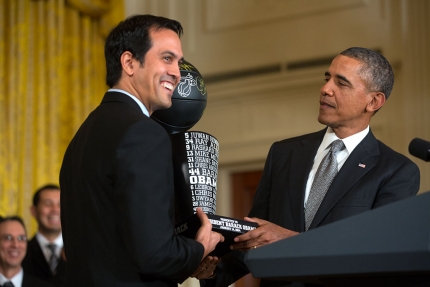
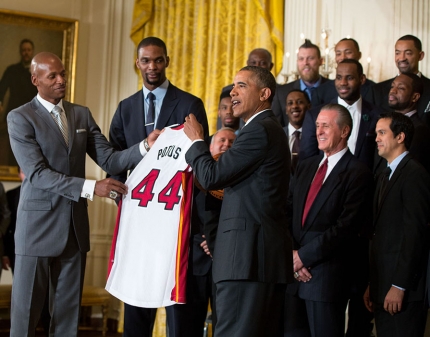
I just want to mention at the top, for those of you Miami Heat fans who are planning on being at the event, I think the call time is 2:25 p.m.  No problem here if you get up and leave and we're still taking questions.  That is okay with me.  In the interest of keeping it tight, I'll go straight to questions. 

Jim.

Q    Thanks, Jay.  On Iran, today President Rouhani said that the Geneva agreement means "the surrender of the big powers before the great Iranian nation."  I’m wondering if you have any reaction to that statement, and do you find it helpful?

MR. CARNEY:  Jim, it's not surprising to us, nor should it be to you, that the Iranians are describing the agreement in a certain way for their domestic audience.  They did the same thing following the agreement of the Joint Plan of Action in November, and we certainly expected they would do the same thing this time.

The fact is the agreement marks the first time in a decade that Iran has agreed to specific actions that halt progress on its nuclear program and roll back key aspects of the program, stopping the advance of the program and introducing unprecedented transparency into Iran's nuclear activities while we negotiate a long-term comprehensive solution.

So, again, as I said yesterday, it doesn’t matter what they say; it matters what they do.  And the Joint Plan of Action and the implementation agreement are concrete documents that commit Iran to take specific steps in a verifiable, transparent way.  And the coinciding moderate relief comes in tranches, specifically as the adherence to its commitments -- Iran's adherence to its commitments is verified along the way over the course of the six months.

So, again, I think the issue here is the agreements that Iran has made, the fact that it has committed itself to halting progress on its nuclear program, rolling back key aspects of it, and engaging in further negotiations in pursuit of a comprehensive solution to this problem.

Q    So you reject his statement that this agreement is an admission by the world of Iran’s peaceful nuclear program?

MR. CARNEY:  Well, again, I would just point you to what I said before, which is that we fully expected Iranian leaders to describe the agreement in ways -- in a certain way for their domestic audience.  They did that in November.  What matters to us, to the P5-plus-1, to the international community, is what Iranian leaders do, what Iran does in keeping its commitments in this agreement. 

Q    On another subject, on unemployment insurance.  As of last night, some Republicans were talking about a three-month extension that was paid for, but also included -- eliminated a cut on benefits to veterans.  Is that an argument or a position that the President would support?

MR. CARNEY:  Our position on this has been clear from the beginning.  Senator Reid has taken steps to try to address the concerns of Republicans who have said they want to extend unemployment insurance benefits to the 1.3 million Americans and their families who need them now and we support rapid action. 

I'm not going to assess each floated proposal on how to do that.  What the Senate should do and then the House should do is pass an extension of benefits right away.  There is an existing bill, has made some progress in the Senate that would do that immediately without offsets for just a short duration, three months, in the manner that was done under President George W. Bush five times.  And we certainly support that.  We also have said that we would entertain discussions with Congress about how to move forward for a longer-term extension.  But I don’t have a view on or a characterization of other proposals that are popping up.  We simply want the Senate and then the House to act.

Q    And as a general matter, would the White House prefer that the full COLA increases for veterans be instated? 

MR. CARNEY:  What I would simply say on that again, when it comes to the UI extension, we want it done.  I'm not going to -- associating specific ideas with this and asking for our view on it kind of takes away from the urgent need for the Senate to act and the House to act.  Senate leaders are working on this as we speak.  We hope to see progress.  We hope to see resolution.  And if we have more specifics on individual proposals that are actually serious and are going to get to the floor, we'll let you know.

Q    Are there any changes to plans for the upcoming state visit of French President Hollande and his partner?

MR. CARNEY:  There are no changes.  The President looks forward to seeing President Hollande for the state visit in February.  On issues of the delegation that the French come with, I would refer you to the French government.

Q    And Secretary of State Kerry said that the President is going to visit the Vatican.  Can you tell us anything about this trip -- when it would happen, and moreover, what the purpose of such a visit would be?

MR. CARNEY:  The President looks forward to a meeting with the Pope in the near future.  I do not have any more details for you on that timing or location except to say that the President very much looks forward to a meeting.

Q    And lastly, on Secretary of State Kerry, Israel’s Defense Minister said that his quest for Middle East peace is obsessive.  How does the White House respond to that?

MR. CARNEY:  I think you’re referring to comments that were reported out of a private meeting as I understand it.  So what I can tell you is that the remarks of the Israeli Defense Minister, if accurate, are offensive and inappropriate, especially in light of everything that the United States is doing to support Israel’s security needs.

Secretary Kerry and his team have been working nonstop in their efforts to promote a secure peace for Israel because of the deep concern the United States has and the deep commitment the United States has for and to Israel’s future and the Israeli people.  To question Secretary Kerry’s motives and distort his proposals is not something we would expect from the defense minister of a close ally.  Again, that’s if those remarks are accurate as reported.

Q    Do you know if this was discussed in last night’s dinner with the Vice President and Netanyahu?

MR. CARNEY:  I don’t have a readout beyond what’s been reported on, on that dinner.  I can tell you that we are -- as we always make clear -- committed to Israel’s security.  We are committed to the Middle East peace process in a way that secures Israel. 

And as you know, Secretary Kerry met in Paris on Sunday with the Arab Peace Initiative follow-up committee as part of a regular process of the negotiation consultations on the final negotiation process between the Israelis and the Palestinians. 
The API follow-up committee has been enormously helpful and constructive in this effort.  The Arab Foreign Ministers made clear to Secretary Kerry that they support Israeli and Palestinian leaders’ efforts to take the next bold, courageous steps of agreeing to a framework for permanent status negotiations. 

I would also note that President Abbas and Prime Minister Netanyahu have both demonstrated courageous and determined leadership over the last five months.  They’ve made tough choices and they are contemplating even tougher choices in the weeks ahead.  We have made progress with both parties and narrowed some of the gaps, and we will continue to seek to narrow the gaps.  So we’re pressing forward with both the Israelis and the Palestinians on this process and hope that it bears fruit.

Brianna.

Q    Thanks, Jay.  White House officials including yourself have likened a vote in Congress to adopt new sanctions against Iran to “a march to war.”  And you now have Democrats pushing back against that.  You’ve seen that from the Senate Foreign Relations Chairman, and just a short time ago, Steny Hoyer said that it’s “an irresponsible assertion and ought to be clarified and retracted.”  What is your response to that?

MR. CARNEY:  Brianna, I think I took questions on this for the last couple of days.  Our view is that Congress has --

Q    He just said this today so I’m asking you specifically to refer to Hoyer's comment. 

MR. CARNEY:  Well, as I will now, as I have referred to others and I'm happy to do so again, the President believes that Congress has been an excellent partner in the effort to construct the most comprehensive, effective sanctions regime in history, a sanctions regime that was designed specifically to try to change Iranian behavior, to try to compel Iran to the negotiating table. And what we have seen in the last several months is that that effort has produced progress.  It helped lead Iran to the negotiating table.  It helped the P5-plus-1 reach the Joint Plan of Action agreement and the implementation agreement.

And now we will see whether or not Iran is serious about reaching a comprehensive resolution so that we can, in a verifiable, transparent way, be confident that Iran is not pursuing and will not obtain a nuclear weapon, and to do that peacefully.  That is certainly the President's preferred course of action.  Our view is simply that Congress ought not pass new sanctions now because doing so could inadvertently, no doubt, actually compromise the potential to reach the shared goal that we have by, instead of strengthening the sanctions regime, weakening it; instead of bolstering the P5-plus-1's position in negotiations with Iran, fraying the unity that has been established and the consensus that has been established around the world as regards Iran's need to uphold its international obligations and to come into compliance with international obligations. 

So our view is not one that says sanctions are bad.  Quite the contrary.  This President has led the way in constructing the most comprehensive and effective and punitive sanctions regime in history.  And he has done so because he has rallied the international community behind a consensus view on the need to prohibit Iran from acquiring a nuclear weapon.  So our view is simply that Congress ought to hold in abeyance any action on further sanctions pending action by Iran, progress or the lack of progress by Iran in the negotiations. 

And I think to the point you made in the beginning, the issue here isn't motive or intent.  It's that the consequence potentially of sanctions legislation, which would have the negative, unintended effect of destabilizing the sanctions regime or fraying the consensus, would be that it might limit the options available to the President in achieving his commitment to prevent Iran from acquiring a nuclear weapon.

So I know that was a long answer, but I think it gives the full view of how we are looking at this and how we are having these conversations with lawmakers about our shared view that we need to take the necessary steps, at the right time, to achieve our objective.

Q    Is that the clarification, then, on “a march to war”?

MR. CARNEY:  Well, it’s the answer I’ve been giving for several days, and it is consistent with what we said in the past.

Q    But do you stand by that or --

MR. CARNEY:  I’m not sure to what you are specifically referring.  I know others have characterized what we said in that regard, and I would simply say that --

Q    You said in I believe November, “Americans don’t want a march to war.”

MR. CARNEY:  I don’t think Americans want a march to war.  What I’m saying about actions in Congress or potential actions in Congress is that we share the objectives that leaders on this issue have in Congress.  We certainly share a commitment to the efficacy and effectiveness of sanctions.  Our position has simply been that now is not the time to potentially and inadvertently fray the coalition that has assembled behind a position that has forced Iran to the negotiating table or undermine the actual sanctions regime that has been so effective thus far. 

Surely nobody in Congress wants that as an objective, and we share the desire to make sure that Iran is held to account.  But we need to do so in a way that allows maximum flexibility to achieve a resolution here peacefully.

Q    On the President’s speech tomorrow in North Carolina, Senator Kay Hagan will not be attending.  It’s obviously her home state.  Is the President worried that he is a drag on some vulnerable Democrats in this key election year?

MR. CARNEY:  Brianna, I think Senator Hagan’s offices addressed that.  I think she’s here working on important business.  The President looks forward to his visit to North Carolina -- A.  B, we’re certainly not looking at a visit designed to highlight the need to continue the progress we’ve made with advanced manufacturing as an issue of electoral politics. 

The fact is, thanks to the grit and determination of the American people, thanks to the quality of the American workforce, and thanks to the policies pursued by this administration, we have seen a rebound in manufacturing in the United States.  Many people and experts viewed the decline in manufacturing in this country that we had experienced over a number of years to be something that was irreversible, but this nation has proved and the American people have proved otherwise.  And the fact is we’ve created more than 500,000 new manufacturing jobs.  And the more of them that are created in the advanced manufacturing space, the more high-paying those jobs are, the more those jobs bring economic security and stability to middle-class families across the country.  So that’s what the President wants to highlight tomorrow.

Q    And my point -- and I know you’re saying that her office has addressed this, that she’s here, the Senate is in session.  But I mean, it’s kind of the -- I think people take that as the congressional equivalent of, “I can’t go, I’m washing my hair.”  So do you --

MR. CARNEY:  You think voting on potentially --

Q    No, I don’t, I don’t --

MR. CARNEY:  -- budget resolutions, or omnibus resolutions, or --

Q    -- but I think there’s a way to -- I think there’s a way to thread the needle.

MR. CARNEY:  -- extending unemployment insurance --

Q    No, but I think --

MR. CARNEY:  -- I think that most senators would disagree with that.

Q    I think there’s a way to thread the needle and some -- try to maybe fit both things in.  And she said that she welcomes campaigning with the President, but it doesn’t seem that she jumped at this opportunity.

MR. CARNEY:  This isn’t a campaign event, Brianna.  I understand, having been there, the urgent desire --

Q    But it’s a campaign year for her.

MR. CARNEY:  -- to turn every story 10 months out into an election story. 

Q    Does the President --

MR. CARNEY:  I promise you this is not one.

Q    My question is just does the President worry that he is a drag at this point in a time where he needs to maintain the Senate so that he can push his --

MR. CARNEY:  All I can tell you is that the President is traveling to North Carolina tomorrow.

Jon.

Q    Coming back to Iran, the President has been very clear, you’ve been very clear, there have been multiple veto threats, you’ve said over and over again that this sanctions bill would derail these talks.  Why, then, are so many Democrats willing to defy the President on this?

MR. CARNEY:  I would say that the President shares with every member of Congress who has made this issue one of special attention and focus the same commitment to depriving Iran from acquiring a nuclear weapon, the same commitment to building a comprehensive and effective sanctions regime, which includes sanctions levied -- leveled by the United States through legislation passed by Congress.  We have worked very closely with Congress and Congress has been an excellent partner in that effort, and the senators who have been discussing action in the current time period have been leaders on this issue. 

So we have shared their objectives.  We have shared their commitment.  Our view -- very strong view is that passing new sanctions now would be counterproductive.  It would actually undermine the goals that we share potentially.

Q    And I feel like you’ve been crystal-clear on that point.  But ever since the White House issued that first veto threat and said it in exactly those terms we’ve had more Democratic co-sponsors of this bill.  So I’m just wondering, this is a top -- correct me if I’m wrong -- this is a top foreign policy priority for the President if not the first this year, and yet you have had several top Democrats simply say, no way, we’re going ahead anyway. 

MR. CARNEY:  Look, I think that you also have --

Q    I mean, why aren’t they giving the White House the benefit of the doubt?

MR. CARNEY:  -- and there have been a number of Democratic senators who have come out strongly today urging this bill not to be voted on, urging this bill not to -- senators, their colleagues, not to support this legislation now precisely for the reasons that the President has said.  So you’ll have to interview and talk with each individual member to learn from them their reasoning behind their actions here and what they support.

Our point is that we actually share the same views on these matters with those who have been pushing further sanctions.  We simply think, as a matter of maximizing the potential for resolving this conflict with Iran peacefully, Congress should not pass legislation that introduces new sanctions at this time.  Now is not the time to do that.  There may be the time, and if and when that time arises, Congress can be most effective by holding in abeyance new sanctions until then.  And so we will work with Congress if that time does arrive.

I don’t think anyone doubts, given the shared views on this, the commitment that Congress has demonstrated, the support for depriving Iran of obtaining a nuclear weapon, the support for the security of our allies in the region, that if Iran were to fail to meet its commitments, if it were to violate the terms of the agreement, the Joint Plan of Action, or if it were to scuttle or walk away from the negotiations over a comprehensive resolution, Congress could and would act very quickly to impose new sanctions.  And even better, given that that would have been triggered by Iranian behavior, our partners around the world would be much more likely to follow suit. 

And building that international consensus has been what allowed us -- has to this point been what has allowed us to make this sanctions regime so effective, because unilateral sanctions imposed by the United States can achieve only so much, as you know.  And it has been the broad international consensus that has been constructed here with the leadership of the United States that has made this sanctions regime so effective, having the impact it has had on the Iranian economy, on the views of the Iranian people, which in turn have led to the moment where Iran decided that they ought to get serious apparently about negotiating with the P5-plus-1 over the disposition of its nuclear program.

Yes, Nadia.

Q    Two questions on Syria and Egypt.  On Syria first.   This administration seems to be threatening the Syrian opposition of cutting aid to them if they don’t show up at Geneva II.  Can you verify this?  And also, what's the chances of giving them incentives like releasing political prisoners or a ceasefire -- limited ceasefire, an accord that could be achieved before Geneva II?

MR. CARNEY:  Well, I would simply say that we expect the Syrian opposition to come to Geneva and we expect they will.  We recognize that there are current divisions among the opposition, and that the path to Geneva is a difficult one.  But we expect that members of the opposition will attend. 

We are focused on moving the parties to the Geneva II conference because there is no military solution to the crisis in Syria, as we've said.  A negotiated, political transition is the best opportunity to end the violence and the suffering of the Syrian people, and to begin a process of ending the conflict through the full implementation of the Geneva Communique. 

In Paris this weekend, Secretary Kerry engaged in an intensive round of diplomacy regarding Syria, including meeting with the ministers of the London 11, Syrian Opposition Coalition President Jarba, and Russian Foreign Minister Lavrov and Joint Special Representative Brahimi. 

So we continue to move forward towards the Geneva II conference.  We expect the opposition to attend.  And we expect that because we are absolutely confident that there is no way to resolve this crisis except through a political negotiated resolution. 

Q    So will you resume the aid even if they don’t show up in Geneva?

MR. CARNEY:  I think you're mistaking -- or you're misstating our position.  We didn’t cut off all aid.  We cut off
-- we halted some aid because of the need to verify the security of the aid that was delivered.  I think I announced earlier this week that we were resuming some of the aid that we've been providing and that we remain committed to the SMC as well as to the broad Syrian opposition, as well as through our humanitarian aid which has continued to flow to the Syrian people who have suffered so much because of President Assad.

Q    I was stating a specific incident.  I'm talking about something else.  But regardless.

MR. CARNEY:  You said we cut off aid, and we haven't. 

Q    No, I said, are you threatening to cut off more aid if they don't show up in Geneva -- that was my question.

MR. CARNEY:  That is not my understanding, no.

Q    On Egypt, do you feel -- does the administration feel victory that actually the spending bill now is passing without any -- giving you basically -- without researching, giving you a waiver regarding the aid --

MR. CARNEY:  What I can tell you is that on the omnibus legislation is that Congress has laid down parameters and conditions for continuation of assistance to Egypt, and pending passage of the bill -- it has not yet passed -- we will determine whether those conditions are being met.  Our view is that this does not imply any immediate changes with regard to our October 9 assistance decision, which I know you recall.  So we will evaluate it upon passage, but our view is that it doesn’t imply any immediate changes.

April.

Q    Jay, I have a couple of questions and I want to start with a papal visit -- a future papal visit.  Has the President been influenced -- and if so, how and why -- by the Pope and some of his initiatives, particularly when it comes to poverty, those who are not in the middle class -- things of that nature? 

MR. CARNEY:  The President, I believe in his remarks in Anacostia late last year, referred to the Pope and what he has said and what he is doing about the problem of inequality, about the problem of economic mobility around the world.  So I think that you can take from that that the President is certainly aware of and paying attention to the work being done by the Pope and the Vatican.

Beyond that, with regards to a meeting the President is looking forward to, I just don't have any more details about when that will happen or where.

Q    And as you talk about -- you talk about inequality and poverty and things of that nature.  Could you give us the mindset as we're going into January 28th, the mindset around this White House?  What is the state of this union?  As you're talking about unemployment insurance, bringing more people into the middle class, fixing inequality, what is the mindset of what the state of the union should be when the President says --

MR. CARNEY:  That the American people and our economy have come a long way from the depths of the worst recession since the Great Depression.  We've come a long way from the time when we were hemorrhaging jobs at 800,000 jobs per month, when the economy was shrinking at something like 7 percent annualized in a given quarter to a situation where we have been steadily creating jobs -- 8.2 million, if I'm not mistaken, private-sector jobs -- where we have been growing steadily. 

But we have much more work to do.  We are not where we need to be.  And that is why the President is so committed to working with everyone in Congress and outside of Congress who shares his interest in advancing the country economically in addressing the need for creating more advanced manufacturing jobs, the need for providing greater educational opportunities to our children, the need to make work pay, which is what raising the minimum wage would do, the need to increase our investments in our infrastructure, creating jobs now and creating the potential for economic growth later. 

And I think you heard the President mention at the top of the Cabinet meeting today that he wants action this year, and he believes that he has two unique powers as President -- the power of the pen and the power of the telephone -- to try to instigate action.  He can sign bills.  He can sign executive orders.  And he can get on the phone as President of the United States with unique abilities to rally support behind ideas that can promote growth, promote education reform, promote job creation. 

So that's what he's going to do.  And we're going to do it every day of the year with the aim of continually improving the state of the union, and improving it for the middle class and for those Americans who were working hard every day, playing by the rules and trying to save for their retirement, trying to pay for college and trying to get by.  And we're trying to make it a little easier for them.  

Q    And anything new on Southern Sudan, any movement from the White House on that?

MR. CARNEY:  I don't have any updates on South Sudan at this time.

Q    Jay, what --

MR. CARNEY:  Wait.  Should we sing "Happy Birthday" or not?  (Laughter.) 

MR. PLANTE:   Spare me.  (Laughter.)

MR. CARNEY:  Just from all of us, Bill, it's happy birthday. And also just having somebody with the amount of experience you've had around here I think is a help to all your colleagues. It's a help to us and we're glad you're here.  (Applause.)

MR. PLANTE:   Thank you.  You're very gracious.  And now, I have a question.  (Laughter.)  Does the President’s expressed willingness today to use his powers to create action by executive action and order indicate that he doesn’t believe that he'll be able to work with this Congress?

MR. CARNEY:  No, it indicates that he will use every opportunity available to him to move the ball down the field with Congress.  And wherever there’s an opportunity to do that he will seize it.  But he will not limit himself because he certainly doesn’t think the American people would want him to limit himself just to what he can do legislatively with Congress, because as President, there is a lot more he can do.  And he's demonstrated that throughout his term in office, and he will continue to do that with renewed vigor this year because there is much to be done and there is great opportunity to get it done using every means available to him.

Q    What kinds of executive actions and order would he take?  What could he do that he can't accomplish with the help of Congress?

MR. CARNEY:  Well, I think you've seen over the course of his presidency actions that he's taken through his executive authority to accomplish remarkable things, including the fuel efficiency standards that, alone, will achieve more to reduce carbon pollution in this country than almost any legislative initiative you could imagine passing through Congress. 

It's not an either/or proposition.  It's a both/and proposition.  So I won't get ahead of him in talking about what other actions he might be able to take using his executive authority, and I wouldn’t see it even narrowly through that prism alone in terms of executive orders and pieces of paper the President can sign to create action.  Part of the authority the President referred to today is an authority related to the influence of the office, to the capacity of a President to rally people around a cause, create public-private partnerships when it comes to hiring veterans or investing in education and communities so that you have public sector and private sector partnerships to make sure that folks -- young people in those cities and towns and communities are getting the skills they need for the jobs available in their communities, jobs available at private sector businesses.

So those are just a couple of examples of the kinds of things that we can do that are beyond legislation and beyond even executive orders.

Ed.

Q    Just a couple of topics.  First, Iran.  Is it still the administration's position that Iran should not enjoy a right to enrich uranium

--

MR. CARNEY: -- that has never been what we've said.  It's not enshrined in the agreement.  In fact, it's explicitly stated otherwise.  So I think that’s important to note.

Q    So during these negotiations, they can enrich?

MR. CARNEY:  I would point you to the agreement and what commitments Iran makes in terms of the level of enrichment they're allowed to meet.  But the assertion, often misstated in various quarters, that the agreement recognizes a "right to enrich" is false.

Q    On the deal in general, you've said several times earlier that the importance of this deal is that it's verifiable and it's transparent.  In the interest of transparency, why didn’t the State Department this weekend, why didn’t you yesterday and today as you discussed this talk about what's now reported to be a secret side agreement, a 30-page secret annex dealing with this agreement that the Iranian side has revealed.  Is that true?

MR. CARNEY:  No, and it’s another indication of reporting that’s not accurate.  There is no secret agreement.  The documentation associated with the implementation arrangements tracks completely with what we have described, which are technical plans submitted to the IAEA.  The technical understandings clarify how the provisions of the Joint Plan of Action -- the publicly-released Joint Plan of Action -- will be implemented and verified in the timing of implementation of its provisions. 

Now, I remind you, this is not solely a U.S. process.  This is not an agreement negotiated solely between the United States and Iran.  These are understandings that were reached with our P5-plus-1 partners, the European Union, the IAEA and Iran.  And we will make the text available to the Congress and the public, but we must work with the parties on when and in what format the information will be released.  And we hope to do that soon.

Q    So why would the Iranian side be out there suggesting there’s a side agreement?  Is it just --

MR. CARNEY:  I think -- well, again, what Iranian leaders say for their domestic audience purposes is far less meaningful than what they do and what the agreements commit them to.  So I would point you to that, and point you to the fact that we will be making the text available both to Congress and the public.

Q    Okay.  Two other quick things on Benghazi.  There were newly declassified documents released by Republicans on the Hill yesterday.  They show that in private testimony to a House panel, some of the President’s top military advisors at the time -- General Ham, General Dempsey and others -- believed within minutes of the attack in Benghazi that it was an attack, probably a terror attack.  And yet you know -- we’ve talked about this before -- for many days after, the President, but you specifically at that podium, said we did not know whether it was a terror attack.  Why -- if these military leaders testified to Capitol Hill that they knew it was an attack almost immediately, why did you continue to --

MR. CARNEY:  Well, I’d say one thing -- two things.  First of all, of course it was an attack.  The facility was attacked.

Q    Right, but you said it was a demonstration.

MR. CARNEY:  There was never any doubt about -- come on, Ed. I mean, I know there’s a desire here to --

Q    But that’s what you said.  It’s in the transcript.

MR. CARNEY:  -- color outside the lines, but this is just not factual.  Of course it was an attack.  It was an attack that led to the deaths of four Americans.  And there has been a significant amount of investigation to find out what went wrong when it came to security and to recommend steps that should be taken, and which we are taking, to do everything we can to ensure it doesn’t happen again.

So I think there has been a lot of reporting on this, and there has been a lot of inaccurate reporting on it -- generally speaking, not just this particular case of House Republicans selectively releasing more testimony to outlets so that they can use it for political purposes --

Q    They were releasing it to the public --

MR. CARNEY:  -- but the idea that we were somehow saying it wasn’t an attack?  I mean, the sky is blue.  Up is not down, down is not up.  Of course it was an attack.

Q    Okay.  And they also explored, this House panel, a September 10th, 2012 conference call the President had with military and security officials about the 9/11 anniversary of 2012.  You remember -- you’ve talked about it before, you put out a press release at the time -- about the force posture and how this administration was making sure that you were prepared around the world for the anniversary.  In this testimony, General Dempsey privately told this House panel that, A, Libya did not come up on that conference call with the President, and B, that after the call, there was not a single directive issued by any military leaders to change our force posture, Libya or anywhere around the world.

So my question is, in that press release where you said that the President had had this call, this meeting, and was preparing the posture, was that an exaggeration when there were no military directives after changing our posture in any way?

MR. CARNEY:  Ed, a couple of things.  One, our military and our other services devoted to our national security don’t wait till September 10th to prepare for contingencies on an anniversary like September 11th of any year.  Secondly, I don’t know specifically whether Libya or other areas of the world were discussed.  What was the case, as I think you remember, is that there was a lot of unrest in the region and that was certainly an issue of concern in terms of the security of our embassies and our American personnel around the world.

But any -- I mean, again, I’m not really sure what -- you can address questions about force posture to the Department of Defense.  If the suggestion is there was not adequate security to protect the lives of four Americans in Benghazi, Libya, I think that’s obvious, as we have made clear, and that should not have been the case.  And that’s why we have had the investigations we’ve had.  That’s why the State Department and others have acted on the many positive recommendations of the Accountability Review Board, and why we have taken the steps that we’ve taken to make sure that we’re doing everything we can to protect Americans, our civilian Americans serving abroad, often in very difficult and dangerous circumstances.

Q    Jay, first, I just want to get a sense if the President was updated at any point today about the shooting that took place in Roswell, New Mexico -- a 14-year-old boy and a 13-year-old girl in critical condition -- or the shooting that took place late yesterday, I think, in Florida at a movie theater where a man was apparently shot for texting. 

MR. CARNEY:  I will have to take the question about the shooting from yesterday.  I can tell you that the White House is in close touch with our federal partners, including the FBI, with regards to the shooting in Roswell.  The New Mexico State Police is on scene, so I’d refer you to them for any specifics about the shooting.  Our understanding is this is not an active shooter situation. 

The President’s team is monitoring the situation and is in close touch with our federal partners.  For more information about some of the details you mentioned with regards to this shooting, I’d refer you to the New Mexico State Police.

Q    The President punctuated his last State of the Union address with that emotional refrain -- he said, “They deserve a vote,” naming off the cities that have now become synonymous with mass violence, mass gun violence.  The President got that vote.  It failed.  Now what?  What does the White House do now as we visit, in some ways, the one-year anniversary of that emotional refrain?

MR. CARNEY:  I think this goes a little bit to the point I was making earlier about using every resource available to him to advance an agenda that he believes is in the interest of the American people.  And you’ve seen action that he has taken, executive action that he’s taken that was part of the commitment he made after the task force delivered its recommendations.  And we have acted on every one of those executive actions, and he will continue to take steps.

Q    So what will he do?

MR. CARNEY:  Well, I don’t want to preview everything that we will do or can do.  We will continue to urge action by Congress.  But there is no question that Congress, the Senate made a decision against the will of the overwhelming majority of the American people when it failed to pass legislation that would have simply expanded our background check system, legislation that would have in no way impinged upon the Second Amendment rights of the American people.

But that doesn’t mean we stand still.  We move forward.  We look where we can take steps.  And I think there was not long ago -- I know there was -- action taken with regards to mental health, which is an important aspect of this problem -- executive action.  And we'll continue to look for ways to advance an agenda that will help the safety of the United States, help our children in particular in their safety without in any way infringing upon the Second Amendment rights of the American people.

Q    I guess, very simply, acknowledging -- following up on some of the questions from the row before me, the gist is you've already completed all those executive actions that you committed to successfully, so the question is, is this an example where after those executive actions are completed, if Congress doesn’t act, at some point your hands are tied and there's no further you can go?

MR. CARNEY:  Well, no.  I think that we're always looking for ways and will continue to look for ways that we can move forward on this issue and many others.  The fact that we've already taken actions certainly doesn’t mean that there aren't more actions we can take, or that we can't use the pen or the phone to try to rally support behind actions in communities or states when it comes to this issue, but again, so many other issues.  So, no, I don’t think that the fact that we've actually taken action suggests we can't take more.

Q    Tomorrow there's another deadline -- not as significant as passed deadlines we've covered when it comes to the Affordable Care Act -- it's the last day to sign up for coverage beginning February 1st.  Yesterday we got our first real look at the numbers through the end of 2013 in terms of enrollments.  The mix remains to be seen, what it will look like by the end of March, as you'll surely communicate to me in a moment.  But I want to get a sense from you about what the real concerns are right now  -- given the President's recent visit with young people for lunch not far from here -- what the real concerns are about getting to the numbers that you need to achieve in time for that deadline.

MR. CARNEY:  I think, as you saw yesterday in the data that was released by CMS, an enormous amount of progress made, especially in December, in terms of a sharp surge in enrollments overall, and an even sharper surge in the enrollment of young Americans under 35.  And we are working very aggressively with all stakeholders to ensure that that progress continues.

We got off to a very shaky start, and that was on us.  And it's on us to make up for the deficit that we created for ourselves.  But nobody contests anymore whether or not there is a huge appetite for this product.  Nobody contests anymore whether or not Americans are enrolling and signing up for health care through the exchanges at a very healthy clip. 

And what I think we saw in the data yesterday is something that reflects very much the experience that Massachusetts had, specifically with regards to young adults and young people overall.  In Massachusetts, over the first three months of enrollment, when they had the closest thing to the antecedent to the Affordable Care Act, you saw percentages that were 15, 23 and 23 percent in the first three months.  Yesterday, CMS announced that we were in the 24 percent range, and 30 percent if you take all young Americans under 35.  And when you talk about actuarial tables that counts -- going from zero to 34. 

It's also, I think for anybody who has been young -- and I assume that includes everybody -- a statement of the obvious that young people are going to be, by and large, late to the party when it comes to signing up.  When you're talking about young people who are not insured, as opposed to the population of people who have purchased insurance on the individual market in the past who are middle-aged, who may have health conditions and they need insurance, they've had insurance or they need insurance and haven't had insurance, they are much more likely to sign up early.  And that's reflected in the data. 

What we saw in Massachusetts, what we've seen in every other comparable past experience, is that young people will sign up late and in large numbers.  And that's what we expect.  It's what we saw for the January 1st deadline, which for a lot of young people wasn't even the motivating deadline.  The motivating deadline will be March 31st.  So we're confident that come March 31st, we will have, as you stated, a different demographic picture.  But the demographic picture we have today is certainly solid evidence that we're making a lot of progress.

Q    Thank you, Stuart Smalley.  (Laughter.)

MR. CARNEY:  Roger.

Q    Thanks.  I want to talk to you about the omnibus bill, the agreement reached yesterday.  It's got some new requirements for the National Security Agency.  They would be required to turn over data about the collection of bulk phone records, including how many Americans have had calls intercepted by the agency.  How would you respond?

MR. CARNEY:  I'm not aware of that item in the omnibus, so I'll have to take the question. 

George, and then Mark.

Q    Congressman Bill Owens has said he's not going to run for reelection, in just the latest of --

MR. CARNEY:  Is this an election year question?  Come on, there's 10 months, 11 months.

Q    Yes, but he just announced that he's not running for reelection.  He's the latest of many moderates running for the exits.  So what does it say about the state of Washington that so many moderates feel unwelcome?

MR. CARNEY:  Well, I don’t write political analysis anymore, so I won't deliver the piece I might have written verbally from the podium.  I'll simply say that the American people who send elected representatives to Washington expect them not to follow the party line, not to respond to interest groups, but to deliver for them in each of these districts.  And no matter how red or how blue a district is, by and large, the values and the desires and goals of the people in those districts are similar across the country.  And what they expect out of Washington when it comes to common-sense progress on behalf of the middle class is pretty similar, which suggests to me that there is room to move forward here, there is room for compromise. 

And we saw it in the budget agreement reached by a Republican chairman in the House and a Democratic chairman in the Senate.  We saw it in the omnibus legislation that was filed. It was nobody's idea of a perfect document -- not the President's, not Democratic leaders, not Republican leaders -- but it represents compromise that we think each side can live with so that we can make the right investments in our economy and in our people and we can do what's necessary to protect the United States, our armed forces, our civilians and our allies. 

So I think -- I know that doesn’t answer your question with regards to specific retirements.  I think there are retirements every cycle.  But that’s what I think -- I believe that about most people who send -- go to the ballot box and send folks to Washington, and it's certainly I think what motivates us here. 

Marc.

Q    Jay, there's been some reports in the last few days that the Russians are negotiating an oil-for-goods swap with the Iranians.  Your colleague said yesterday that Secretary Kerry had raised this issue with the Russian Foreign Minister.  I'm wondering whether you've gotten an explanation from the Iranians and the Russians about what this is, and whether you're satisfied with it, or whether you're worried that it, in fact, raises questions about whether it's at odds with the terms of the interim nuclear deal.

MR. CARNEY:  We remain very concerned about these reports, as Secretary Kerry expressed directly to his Russian counterpart. And if the reports are true, such a deal would raise serious concerns as it would be inconsistent with the terms of the P5-plus-1 agreement with Iran and could potentially trigger U.S. sanctions.

Again, this is about action, not about words; not about how things are characterized, but how things are done.  And that last statement I think reflects our views.  It could potentially, if true as reported, trigger U.S. sanctions because it would not be consistent with the agreement negotiated between the P5-plus-1 and Iran.  So we're concerned.  We're continuing to look into this and we're expressing those concerns.

Q    And the format we're expressing those concerns?

MR. CARNEY:  I don’t have a specific additional readout on that meeting except to confirm that our serious concerns were raised.

Q    Just one thing.  You've talked a lot about the unity of the partners in dealing with Iran.  Wouldn’t one of the key partners negotiating a deal with the Iranians that would be serious enough to warrant sanctioning represent a splintering of the coalition you described?

MR. CARNEY:  Again, I think that if the reports are true that it would be a serious concern because of the fact that it would be inconsistent with the very agreement negotiated by the P5-plus-1 with Iran, so one of the P5-plus-1 plus Iran, if this is true, would be working on a deal that would be inconsistent with that agreement. 

Jared.

Q    I want to follow up on Peter's question about gun violence and some anniversaries last week.  It was three years since the shooting that killed six and injured Congresswoman Giffords.  When was the last time the President spoke with the former congresswoman? 

MR. CARNEY:  We can get that for you.  The President has spoken with her on a number of occasions, and I believe on that anniversary, the Vice President spoke with her. 

Q    And you mentioned at the top, Jay, that the Cabinet meeting went a little long.  Did the President have any guidance or suggestions for people who might be in the future wanting to write a memoir or any other comments about --

MR. CARNEY:  Well, I won't read out with any more specificity the Cabinet meeting, except to say that that issue did not come up.

Laura.

Q    A French question -- what do you expect from --

MR. CARNEY:  Oh, I thought I was going to have to answer in French, which would have been pretty entertaining.  (Laughter.)

Q    What do you expect from the state visit in February?  Because President Hollande just finished his press conference.  He was talking a lot about his arrival on February 11.  And do you expect the French First Lady to come with him?

MR. CARNEY:  The President looks forward to seeing President Hollande for the State visit in February.  In terms of that question that you asked, I'd refer you to the French government. We look forward to hosting the President of France here in February.  This is our longest, most enduring alliance and an important and valued relationship at every level.  So the President is very much looking forward to the event and to his discussions with President Hollande.
 
Q    Has there been a state visit where there was just one person?

MR. CARNEY:  I think Mark Knoller is the right person to ask historical questions.  I have no idea. 

Yes, Alexis.

Q    Two questions.  Following up on Marc's question, can you just explain, was this question about the oil for goods, this was not ironed out before the interim agreement was announced and described?  In other words, it didn't come up as a potential wrinkle?
MR. CARNEY:  The implementation agreement is a very -- were specific negotiations about the technical aspects and instructions provided to the IAEA for the implementation of a Joint Plan for Action.  So I'm not -- I don't know the specific contents of every conversation that took place around those negotiations.  But the United States Secretary of State raised this issue directly with the Foreign Minister of Russia and expressed our concern, and I think you just heard me say what our view is on this matter if the reports are true.

Q    Second question.  The President, all Presidents have the pen and the podium and the telephone, and the President has used that, as we've already discussed, and he had a whole initiative called We Can't Wait.  Looking ahead at his agenda this year, is there something different about the agenda items the President wants to tackle this year that makes this executive initiative new or distinct or different than what we've seen him do in the past?

MR. CARNEY:  At one level, Alexis, I'd have to say wait to see what initiatives the President discusses in his State of the Union address and moving forward.  To your point, there's no question that throughout his presidency, President Obama has worked with Congress to pass legislation -- major legislation and smaller legislation -- all of it meaningful.  He has also used his executive authority to advance important aspects of his agenda, including on matters of reducing carbon pollution, for example, and a host of others. 

So what I think we're talking about here is a renewed effort, a renewed focus on using all of the tools available to the President, acknowledging that we're not likely to get everything we would want legislatively done through Congress, but not acknowledging that there aren't significant things that we can do legislatively through a Congress.  We believe we can, but we're not putting all our eggs in any single basket when it comes to advancing an agenda that grows the economy, creates more security for the middle class, opens up opportunity for all Americans, improving economic mobility.  We're going to do everything we can across the board.

And whether it's year five or year six, or whether you're looking at the entire eight years of a two-term presidency, there's a lot of time to advance an important agenda for the American people, and there are always new ideas that creative thinkers produce for moving forward on an agenda, and there is always the potential for new energy behind older ideas so that they can move forward. 

And that’s the kind of energy and enthusiasm that I think is imbuing this place right now, as we look forward towards 2014 and look forward across not just the next three years but into the future beyond that.  Because the kinds of steps the President has always been focused on have been, when it comes to the economy, ones that would produce dividends for the middle class and dividends for the American economy well into the future beyond his time in office.

Q    On immigration, last year, the White House was pretty clear that the President did not believe he had additional room to use his executive authority, as some advocates on immigration reform had urged him to do.  Going into this year, does that continue to be the case, the President's view?

MR. CARNEY:  Our position hasn't changed.  The way to address all of these issues is through comprehensive immigration reform.  The Senate did extraordinary work in passing a bipartisan comprehensive immigration reform bill that enhanced border security beyond even what we've done in the first five years; that levels the playing field when it comes to our businesses, making sure everybody is playing by the same rules; that enhances our legal immigration system so that engineers and software designers and super-smart people from around the world who study in our universities stay here to create jobs and businesses; and that creates a system where the 11 million undocumented people in this country can go to the back of the line and engage in a process that, if all the steps are taken, results in citizenship.

And that was a bipartisan effort supported by a remarkable coalition of conservatives and liberals and business and labor and law enforcement and church groups, faith groups.  So we're optimistic that further progress can be made in 2014 on this major piece of action that has so many economic benefits associated with it.

So our views have not changed.  And we look forward to working with Congress, working with the House to advance that very important item on the agenda.

Q    Can I ask just ask a quick one?

MR. CARNEY:  Sure.

Q    About the Iran-Russia potential oil deal.  You said that there's basically a threat of sanctions if it turns out this report is true.  Is that sanctions against Russia, or Iran, or both?

MR. CARNEY:  I think we're talking about U.S. sanctions in the context of the sanctions regime with Iran.  And again, that’s if reports are true.  So there's conditions here.  Such a deal would raise serious concerns, as it would be inconsistent with the terms of the P5-plus-1 agreement with Iran.  So this is -- but I think that is meant to convey the seriousness of the matter and how we view it.

Thank you very much.

END
2:45 P.M. EST

President Obama Honors the 2013 NBA Champion Miami Heat

January 14, 2014 | 9:33 | Public Domain

President Obama welcomes the Miami Heat to the White House to honor their 2013 NBA championship.

Download mp4 (419MB) | mp3 (23MB)

Read the Transcript

Remarks by the President Honoring NBA Champion Miami Heat

East Room

3:02 P.M. EST

THE PRESIDENT:  Hello!  (Applause.)  Everybody, please have a seat.  Have a seat.  Welcome to the White House.  Actually, for these guys, it is welcome back to the White House -- (applause) -- after being back-to-back world champions, the Miami Heat.

Now, one of the cool things about this job is welcoming championship sports teams from across the sporting world to the White House.  And usually people enjoy coming to the White House.  I have to say, I’ve never seen folks more excited than the Heat when they came last year.  (Laughter.)  I mean, LeBron was so pumped up I thought he was going to give me a hug and knock me over like the guy in the SportsCenter who hit the half-court shot.  But it was wonderful to see them then.  It wonderful to see them back. 

We’ve got some outstanding members of Congress who are big fans of the Heat.  They’re from both parties -- because we all know nothing brings people together like the Miami Heat.  (Laughter and applause.)  Across the NBA there’s just a unifying -- (laughter) -- sense about the Heat. 

I want to congratulate Coach Spoelstra for the outstanding work that he does; legendary team president, Pat Riley, for his outstanding leadership; and all the coaches and players, members of the staff and crew to make a championship season.  This group has won twice now, but it’s gone to the finals three times.  And sometimes it feels like they’re still fighting for a little respect.  I can relate to that.  (Laughter.)

Last season, the Heat put together one of the most dominating regular seasons ever by a defending champion.  They won a team-record 66 games.  At one point, they won 27 games straight -- the second-longest winning streak ever, extraordinarily impressive -- almost as impressive as the Bulls’ 72-win season.  (Laughter.)  Riley and I were reminiscing about those Knicks years.  (Laughter.) 
 
But as these guys know, winning a title is never easy.  In the playoffs, the Pacers put them through seven bruising games.  In the finals, the Spurs showed us all that they’ve got an awful lot of life left in them, and one of the greatest players of all time, and one of the greatest coaches of all time.  In fact, San Antonio had the series all but wrapped up in game six.  As you will recall, Miami was down five points, less than 30 seconds to go.  The last 122 times that happened in the playoffs, the team that was down lost 122 times. 

And then they brought out the ropes.  And then Ray Allen saw them bring out the ropes.  (Laughter.)  And with five seconds left, Chris Bosh gets an incredible offensive rebound, passes it out to Ray; Ray is backing up, he’s got to jump forward; hits one of the most iconic shots of all time.  And then he added a few choice words about the ropes, which we cannot -- (laughter) -- which we cannot repeat here.  But, Ray, I do want you to know that when you say those things on the court, like, people can read your lips, right?  (Laughter.)  You do understand that? 

RAY ALLEN:  Yeah.

THE PRESIDENT:  Okay.  All right.

So the Heat won game six, went on to win game seven, their third title in eight seasons.  LeBron James earned his second straight Finals MVP to go along with four regular-season MVPs in five years.  Dwayne Wade, warrior that he is, played through a pair of injured knees, always came through when it mattered.  Chris Bosh was there playing great defense, getting the rebound, hitting a clutch shot.  Everybody on this team participated.

And from Ray’s big shot to the contributions of Mario Chalmers, Shane Battier, Udonis Haslem, Birdman, Birdman’s tattoos -- (laughter) -- Birdman’s mohawk -- (laughter) -- the Heat showed us the kind of heart and determination it takes to be a champion.

And they also showed what heart means off the court.  Last year, they raised close to $2 million for local charities.  Before this event, they met with some of our amazing wounded warriors over at Walter Reed, and we’re proud to have some of those wounded warriors here in the audience here today.  Honoring our troops -- (applause) -- honoring our troops isn’t just something that they do when they come to the White House -- it’s something they do all year round with their Heat Home Strong initiative.  And Pat Riley I know has been hugely invested in this, and we talked a little bit about this -- his incredible admiration for our men and women in uniform, but more concretely his willingness to do something about how we support them I think is a credit to the entire organization.

On top of that, Coach Spoelstra serves as a member of the NBA Fit team to encourage healthy habits among young people.  I know Michelle is thankful for the support that many of these players have given to her Let’s Move initiative.  I heard that all of you are getting ready to embarrass yourselves by singing some karaoke for Shane’s education foundation.  (Laughter and applause.)  Just leave Al Green to the pros, people.  (Laughter.) 

So bottom line is, outstanding athletes, outstanding organization, outstanding team, but also outstanding members of their community.  And so we’re very proud to have them back.  We wish them great luck for the rest of the season, unless they’re playing the Bulls.  (Laughter.) 

And with that, I think we should take a picture, but we should make it quick before one of these guys starts yelling at Mario.  (Laughter and applause.)  I mean, sometimes it’s just a bad pass, guys.  It’s not Mario’s fault.  (Laughter.)  I got your back, man.

COACH SPOELSTRA:  Well, this is a great honor for the entire Miami Heat family.  It does not get old.  And what this is, is we put this together before the playoff run last year, and it was a covenant between all of us that we signed that we would commit to each other -- all the way to the end.

THE PRESIDENT:  This is outstanding.

COACH SPOELSTRA:  So we have marks for each win, and it signified each player would mark the win for that game, and the final one was the team one.  So this one right here, you can see “44” and your name right there.

THE PRESIDENT:  There you go.  It was added to it.  You know, you guys are winning me over a little bit.  (Laughter.) 

COACH SPOELSTRA:  Getting there.  Getting there.  We promise we’ll put together another one for you and let you mark it this year.  (Laughter.) 

THE PRESIDENT:  Congratulations.  (Applause.) 

END
3:11 P.M. EST

Close Transcript

President Obama Holds a Cabinet Meeting

January 14, 2014 | 6:58 | Public Domain

In the first official Cabinet meeting of the new year, President Obama says that 2014 is going to be year of action.

Download mp4 (255MB) | mp3 (17MB)

Read the Transcript

Remarks by the President Before Cabinet Meeting

Cabinet Room

11:04 A.M. EST

THE PRESIDENT:  I’m glad to be able to pull together my Cabinet for the first official Cabinet meeting of the year, and I want to wish everybody a wonderful New Year.

We’ve got a lot to do in 2014.  As I’ve said before, this is going to be a year of action.  We’ve seen the economy improve.  We want to maximize the pace of our recovery, but most importantly, we want to make sure that every American is able to benefit from that recovery, that we’re not leaving anybody behind and everybody is getting a fair shot.

I was very pleased to see the House and the Senate agree to a budget and to put forward a bill that will fund our government at levels that allow us to take some important steps to provide the services and the help that Americans need and American families need in order to get ahead in this economy.  And so I would urge that Congress pass that funding measure as quickly as possible so that all these agencies have some certainty around their budgets. 

And Congress is going to have some additional work over the course of the next several weeks; specifically, it’s important that they do something about unemployment insurance.  Although we’ve seen improvements in the economy and job creation in our economy, I think we all know that there are a lot of hardworking Americans out there who are desperately looking for a job, and unemployment insurance is not only good for them and necessary for them, but it’s also good for our economy as a whole and will actually accelerate our growth if we go ahead and get that done. We know that we need to get immigration reform done -- a major piece of unfinished business from last year. 

So Congress is going to be busy, and I’m looking forward to working with Democrats and Republicans, House members and Senate members, to try to continue to advance the economic recovery and to provide additional ladders of opportunity for everybody.  But one of the things that I’ll be emphasizing in this meeting is the fact that we are not just going to be waiting for a legislation in order to make sure that we’re providing Americans the kind of help that they need.  I’ve got a pen and I’ve got a phone -- and I can use that pen to sign executive orders and take executive actions and administrative actions that move the ball forward in helping to make sure our kids are getting the best education possible and making sure that our businesses are getting the kind of support and help they need to grow and advance to make sure that people are getting the skills that they need to get those jobs that our businesses are creating. 

And I’ve got a phone that allows me to convene Americans from every walk of life -- non-profits, businesses, the private sector, universities -- to try to bring more and more Americans together around what I think is a unifying theme:  making sure that this is a country where if you work hard, you can make it. 

So one of the things that I’m going to be talking to my Cabinet about is how do we use all the tools available to us, not just legislation, in order to advance a mission that I think unifies all Americans -- the belief that everybody has got to take responsibility, everybody has got to work hard, but if you do, that you can support a family and meet the kinds of obligations that you have to yourself and your family but also to your communities and to your nation.

We’re already seeing some examples of that.  In fact, this week I’ll be traveling tomorrow down to North Carolina to talk about a manufacturing innovation hub that we initiated, talked about in our State of the Union last year.  It’s going to be moving forward.  And there are a lot of folks down in North Carolina who are excited, because it’s a perfect example of the kind of public-private partnership that can really make a difference in growing our economy faster and creating the kinds of good-paying jobs that help people get ahead.

I’ll also be pulling together university presidents from all across the country to talk about how we can make college education more accessible to more young people around this country.  And we’re going to be bringing CEOs from across the country to also have a conversation about commitments they can make to start hiring the long-term unemployed -- people who oftentimes have terrific skills, have a great work ethic, have wonderful experience, but because of the misfortune of having been laid off or lost their jobs during the depths of an extremely severe recession, have been out of work long enough that now we’re finding it’s very hard for them to just get in the door and make their case to an employer; that there’s some screening that’s taking place for people who have been out of work for more than a month or two and it makes it harder for them to get the kind of shot that they need.  And we’re going to try to work with CEOs to make a pledge that we’re going to take a second look at these Americans who are very eager to get back to work and have the capacity to do so, but aren’t getting the kind of shot that they need.

So, overall, the message to my Cabinet and that will be amplified in our State of the Union is that we need all hands on deck to build on the recovery that we’re already seeing.  The economy is improving, but it could be improving even faster.  A lot of people are doing better than they were in the depths of the recession, but there are still a lot of folks who need help. And I am absolutely confident that in 2014, if we’re all working in the same direction and not worrying so much about political points but worrying much more about getting the job done, that we can see a lot of improvement this year, and people will look back on 2014 as a year in which we didn’t just turn the corner in the aggregate for the economy, but everybody started feeling a little more optimistic about our futures.

So I’m looking forward to the discussion.  And with that, I’m going to kick you all out.  (Laughter.)

Q    How do you think the NSA is going to affect your year this year?  And will you address it on Friday?

Q    Have you finished your review on the NSA?

THE PRESIDENT:  Actually, it’s getting close.  So I’ll have quite a bit to say about that very soon. 

Thank you, guys.
   
END
11:11 A.M. EST

Close Transcript

President Obama Welcomes the 2013 NBA Champions the Miami Heat

Today, President Obama welcomed the Miami Heat back to the White House to honor the team for winning their second-straight championship title. 

"Last season, the Heat put together one of the most dominating regular seasons ever by a defending champion," President Obama said. "They won a team-record 66 games.  At one point, they won 27 games straight -- the second-longest winning streak ever."

Miami Heat Coach Erik Spoelstra presents President Barack Obama with a team trophy

Miami Heat Coach Erik Spoelstra presents President Barack Obama with a team trophy to honor the 2013 NBA Champion Miami Heat on winning their second-straight Championship title, in the East Room of the White House, Jan. 14, 2014. (Official White House Photo by Lawrence Jackson)

The President congratulated head coach Eric Spoelstra, team president Pat Riley, and members of the staff and crew, and gave a special congrats to the all-star Heat lineup for their hard work last season including finals MVP Lebron James, Dwayne Wade, Ray Allen, Chris Bosh, Mario Chalmers, Shane Battier, Udonis Haslem, and of course-- "Birdman, Birdman's tattoos and Birdman's mohawk"

LeBron James, Chris Bosh and Dwyane Wade present President Barack Obama with a basketball and a jersey

LeBron James, Chris Bosh and Dwyane Wade present President Barack Obama with a basketball and a jersey during an event to honor the 2013 NBA Champion Miami Heat, Miami Heat President Pat Riley, and Coach Erik Spoelstra on winning their second-straight Championship title, in the East Room of the White House, Jan. 14, 2014. (Official White House Photo by Pete Souza)

"The Heat showed us the kind of heart and determination it takes to be a champion," the President said. "And they also showed what heart means off the court."

Last year, the team raised close to $2 million for local charities. And today, while at the White House, players met with wounded warriors from the Walter Reed National Military Medical Center. 

Related Topics: Inside the White House