President Obama Promises Support for the People of Burma

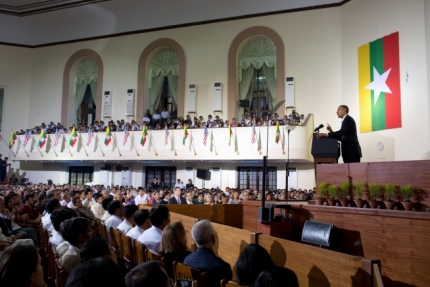
President Barack Obama delivers a speech at the University of Yangon (November 19, 2012)

President Barack Obama delivers a speech at the University of Yangon in Rangoon, Burma, Nov. 19, 2012. (Official White House Photo by Pete Souza)

When President Obama arrived in Rangoon on Monday, he became the first sitting president ever to visit Burma -- the Asian nation bordering Thailand, China, and Bangladesh.

For nearly fifty years, from the 1962 to 2011, the country was ruled by a military junta. But over the past year and a half, reform has begun to take root.

"A civilian now leads the government, and a parliament is asserting itself," President Obama said in a speech at the University of Yangon. "The once-outlawed National League for Democracy stood in an election, and Aung San Suu Kyi is a Member of Parliament. Hundreds of prisoners of conscience have been released, and forced labor has been banned. Preliminary cease-fires have been reached with ethnic armies, and new laws allow for a more open economy."

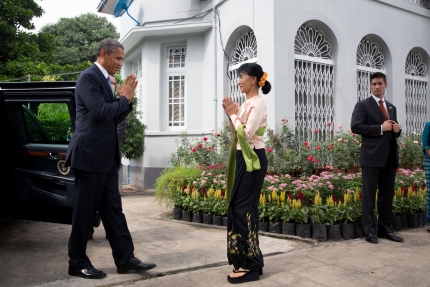
President Barack Obama greets Aung San Suu Kyi (November 19, 2012)

President Barack Obama greets Aung San Suu Kyi during a stop at her private residence in Rangoon, Burma, Nov. 19, 2012. (Official White House Photo by Pete Souza)

Earlier today, President Obama met with President Thein Sein -- one of those helping to usher in reform -- and Aung San Suu Kyi -- the Nobel Prize winning pro-democracy activist. And while much remains to be done, President Obama made clear that the United States stands ready to help the people of Burma as they emerge from decades of isolation.

The White House

Office of the Press Secretary

Fact Sheet: The U.S.-ASEAN Expanded Economic Engagement (E3) Initiative

Today, at the U.S.-ASEAN Leaders Meeting in Phnom Penh, Cambodia, President Obama and Leaders of the ten ASEAN (Association of Southeast Asian Nations) states welcomed the launch of the “U.S.-ASEAN Expanded Economic Engagement” (E3) initiative – a new framework for economic cooperation designed to expand trade and investment ties between the United States and ASEAN, creating new business opportunities and jobs in all eleven countries.  E3 identifies specific cooperative activities to facilitate U.S.-ASEAN trade and investment, increase efficiency and competitiveness of trade flows and supply chains throughout ASEAN, and build greater awareness of the commercial opportunities that the growing U.S.-ASEAN economic relationship presents.  Furthermore, by working together on these E3 initiatives, many of which correspond to specific issues addressed in trade agreements, the United States and ASEAN will lay the groundwork for ASEAN countries to prepare to join high-standard trade agreements, such as the Trans-Pacific Partnership (TPP) agreement that the United States is currently negotiating with ten countries in Asia and the Western Hemisphere.   

E3 will begin with a set of concrete joint activities that will expand trade and investment:

• negotiation of a U.S.-ASEAN trade facilitation agreement, including simplified customs procedures and increased transparency of customs administration;

• joint development of Information and Communications Technology principles, to guide policymakers on issues like cross-border information flows, localization requirements, and the role of regulatory bodies.

• joint development of Investment Principles; principles would address essential elements of investment policies, including market access, non-discrimination, investor protections, transparency, and responsible business conduct. 

• additional work on standards development and practices; Small and Medium-sized Enterprise (SMEs); and trade and the environment.

Joint work under E3 will be further reinforced by USAID’s trade facilitation capacity-building assistance to the ASEAN members.  E3 will also help ASEAN countries integrate their markets further as ASEAN seeks to build an ASEAN Economic Community by 2015.

With a population of approximately 620 million and a combined GDP of over $2.2 trillion, ASEAN is the United States’ fourth largest export Market and fifth largest trade partner overall (2011). ASEAN’s continued rapid economic development creates opportunities for U.S. exports.  Currently four members of ASEAN (Singapore, Brunei, Malaysia and Vietnam) are participating in the Trans-Pacific Partnership (TPP) trade negotiation.

President Obama and Aung San Suu Kyi Deliver Remarks

November 19, 2012 | 5:25 | Public Domain

On the first trip to Burma by an American president, President Obama and Daw Aung San Suu Kyi discuss democratic reform in the country.

Download mp4 (198MB) | mp3 (13MB)

Read the Transcript

Remarks by President Obama and Daw Aung San Suu Kyi

Aung San Suu Kyi Residence
Rangoon, Burma

1:05 P.M. MMT
 
DAW AUNG SAN SUU KYI:  I would like to say how happy I am to receive President Obama in my country and in my house.  The friendship between our two countries is of long standing.  The United States has been staunch in its support of the democracy movement in Burma, and we are confident that this support will continue through the difficult years that lie ahead.  I say difficult because the most difficult time in any transition is when we think that success is in sight.  Then we have to be very careful that we are not lured by a mirage of success and that we are working to a genuine success for our people and for the friendship between our two countries.
 
I believe that we have been able to discuss our various concerns openly, and that as a result of the President’s visit to this country, the relations between our countries can only progress in the right direction.
 
I intend fully to keep in touch with the United States government as far as possible, and to make sure that we always liaise one another on the most important matters. 
 
Now, I’m told I have three minutes, and I think this is about three minutes.  So thank you all for coming.  And I leave the floor to President Obama.
 
PRESIDENT OBAMA:  Well, I’ll try to be pretty brief, although not as eloquent.  I was honored to be the first President to welcome Daw Aung San Suu Kyi to the White House.  I’m proud to be the first American President to visit this spectacular country, and I am very pleased that one of my first stops is to visit with an icon of democracy who has inspired so many people not just in this country but all around the world.
 
I especially want to thank Aung San Suu Kyi for welcoming me to her home.  Here, through so many difficult years, is where she displayed such unbreakable courage and determination.  It’s here where she showed that human freedom and dignity cannot be denied. 
 
Today marks the next step in a new chapter between the United States and Burma.  Last year, in response to early flickers of reform, I asked Secretary Clinton to visit this country and explore with Aung San Suu Kyi and the government whether the United States could empower reform efforts and begin a new relationship between our peoples. 
 
In the year since, we’ve seen some very encouraging progress, including Daw Aung San Suu Kyi’s release and election to Parliament; the release of political prisoners; the lifting of restrictions on the press; and new laws to expand labor rights and eliminate the use of child soldiers.  And at my direction, the United States has responded to support these reforms, including the easing of sanctions.
 
Now, as a former legislator myself, I followed your role in the new Parliament with interest and admiration.  Real democracy involves having different branches of government check and balance each other, and I applaud your efforts in that regard, particularly as the head of the committee of the rule of law. 
 
In my discussions here in Yangon, our goal is to sustain the momentum for democratization.  That includes building credible government institutions, establishing rule of law, ending ethnic conflicts, and ensuring that the people of this country have access to greater education, health care, and economic opportunity.
 
And I want to make a pledge to the people of this country that I am confident we can keep, and that is if we see continued progress towards reform, our bilateral ties will grow stronger and we will do everything we can to help ensure success.
 
I'm so happy, by the way, to be joined by Secretary Clinton.  This is her last foreign trip that we're going to take together, and it is fitting that we have come here to a country that she has done so much to support. 
 
Where did Hillary go?  Where is she?  There she is.  (Applause.) 
 
I could not be more grateful, not only for your service, Hillary, but also for the powerful message that you and Aung San Suu Kyi send about the importance of women and men everywhere embracing and promoting democratic values and human rights.
 
So again, I want to thank you, Daw Aung San Suu Kyi, for your extraordinary hospitality and grace; the power of your example, which has been an inspiration to people all around the world, including myself.  Clearly, you will be playing a key role in your country's future for many years to come as Burma seeks the freedom and the prosperity and the dignity that not only the people of this country deserve but people all around the world deserve.
 
So thank you for your inspiring message.  (Applause.) 
 
END               
1:11 P.M. MMT
 

Close Transcript

The White House

Office of the Press Secretary

Fact Sheet: U.S.-ASEAN Leaders Meeting

On November 19, 2012, President Obama met with the leaders of the 10 member states of the Association of Southeast Asia Nations (ASEAN) to deepen our diplomatic, economic, security, and people-to-people ties with the key Asian multilateral organization.  With a population of approximately 620 million and a combined GDP of over $2.2 trillion, ASEAN is the United States’ fourth largest export market, includes two treaty allies, one of our closest security partners, several emerging regional powers, and sits astride some of the world’s most important trading routes and sea lines of communication.

Recognizing the importance of enhancing U.S.-ASEAN ties, the Leaders agreed to institutionalize the Leaders Meeting to an annual Summit as a further step towards raising the U.S.-ASEAN partnership to a strategic level.  The Leaders welcomed the Final Report from the U.S.-ASEAN Eminent Persons Group, and incorporated the recommendations as a road map to implementing the five-year ASEAN-U.S. Plan of Action, which was adopted at the 2011 U.S.-ASEAN Leaders Meeting. 

The United States and ASEAN welcomed the launch of the U.S.-ASEAN Expanded Economic Engagement (E3) initiative – a new framework for economic cooperation designed to expand trade and investment ties between the United States and ASEAN, creating new business opportunities and jobs in all eleven countries. 

See U.S.-ASEAN Expanded Economic Engagement (E3) Initiative Fact Sheet

Leaders welcomed additional steps to improve economic relations, including Secretary of State Clinton’s participation in the first-ever U.S.-ASEAN Business Forum in July in Siem Reap, Cambodia, which brought together government and private sector leaders to further economic engagement, integration, and opportunities.

Leaders welcomed the two U.S. Trade and Development Agency U.S.-ASEAN Connectivity Cooperation Initiative events held this year on disaster reduction and recovery and smart grid technology, bringing together the public and private sector from throughout the ASEAN region. 

Leaders endorsed the U.S.-ASEAN Innovation in Science through Partners in Regional Engagement (INSPIRE) initiative to enhance science and technology (S&T) cooperation between the United States and ASEAN.  Designed to complement bilateral science, technology and health cooperation which the United States has already established with individual ASEAN countries, INSPIRE will strengthen our collective approach to achieving important S&T, disaster preparedness, and health objectives and deepen ties between ASEAN and U.S. scientific communities.

Leaders discussed the importance of building the role and influence of the East Asia Summit so that it can effectively address pressing political and strategic issues in the region.  Leaders discussed the importance of putting mechanisms and processes in place to peacefully manage disputes over competing claims in the South China Sea.  In this context, they expressed support for the ASEAN Foreign Ministers’ Statement on “Six-Point Principles on the South China Sea” and called for early conclusion of a Regional Code of Conduct.

The United States announced the creation of the Expanded ASEAN Seafarer’s Training (EAST) program to improve counter-piracy training and education in the region.  The ASEAN region is home to over half of the world’s seafaring workers.  The program, administered by the U.S. Department of Transportation’s Maritime Administration, will be expanded from its current pilot phase working with the Philippines. 

To further enhance cooperation confronting the shared challenge of piracy, the United States announced its intention to join the Regional Cooperation Agreement on Combating Piracy and Armed Robbery against ships in Asia (ReCAAP).  ReCAAP is a first of its kind regional multilateral agreement between 18 countries to facilitate the dissemination of piracy-related information.

The United States launched the ASEAN Youth Volunteers Program and sponsored the ASEAN Commission on Women and Children visit to the United States this past April to connect with U.S. civil society groups to share best practices.
The United States committed to enhancing its collaboration with ASEAN Member States in addressing human trafficking, to include support for efforts to harmonize legal frameworks in defining and prohibiting human trafficking, increase cross-border joint investigation, and build capacity for a standardized response to the needs of trafficking victims.

Leaders welcomed the implementation ofthe United States Partnership with ASEAN on Brunei-U.S. English Language Enrichment Project and the deployment of the first group of 60 students to Hawaii’s East-West Center and Universiti Brunei Darussalam.  This ambitious, five-year, $25 million initiative, supported by the governments of Brunei and the United States with the East-West Center in Hawaii as an implementing coordinator, reflects a commitment to help unify the diverse members of ASEAN, improve English-language capacity, and advance educational and economic opportunities in the region.

The meeting was attended by the ten ASEAN Leaders, Sultan Hassanal of Brunei, President Thein Sein of Burma (Myanmar), Prime Minister Hun Sen of Cambodia, President Yudhoyono of Indonesia, Prime Minister Thongsing of Laos, Prime Minister Najib of Malaysia, President Aquino of the Philippines, Prime Minister Lee of Singapore, Prime Minister Yingluck of Thailand, and Prime Minister Dung of Vietnam, as well as ASEAN Secretary General Surin.

The White House

Office of the Press Secretary

Press Gaggle by Press Secretary Jay Carney and Deputy National Security Advisor Ben Rhodes

Aboard Air Force One
En Route Phnom Penh, Cambodia

4:33 P.M. ICT

MR. CARNEY:  All right.  Thanks for joining us as we make our way from Burma to Cambodia.  I have joining me Ben Rhodes, Deputy National Security Advisor for Strategic Communications, who is here to give you an update on the President’s meetings in Rangoon and other matters.
 
Ben.
 
MR. RHODES:  Okay, I’ll try to be as quick as I can.  But the President just concluded a very, I think, exciting and consequential visit to Burma.  Just to run through, I think, some of the areas that we think are the most important steps that have been taken around the visit:  We welcome the Burmese government providing access to the International Committee of the Red Cross to prisoners.  We also welcome their decision to establish a process to adjudicate the remaining prisoners of conscience that we believe are being held within the country.  And we’ll work with them to provide names of people that we think should be a part of that process. 
 
Their decision to bring in the UN High Commissioner for Human Rights will both help strengthen the monitoring capacity in the country and help build the capacity of Burma to deal with human rights issues.  They’ve reiterated a commitment to pursue a ceasefire in Kachin State, which is the one remaining ethnic insurgency that they’re confronting.  And with regards to the Rohingya in the Rakhine State, they reiterated their commitment to not just calm the situation, but to address the underlying issues including returning displaced people to their home and addressing the issue of citizenship for the Rohingya.
 
On nonproliferation, they came into the additional protocol of the IAEA, which submits them to additional safeguards and brings them into a nonproliferation regime that is important to the United States and the world.  And they came in line with UN Security Council Resolution 1874, which further commits them to end the military relationship with North Korea. 
 
To go through the President’s meetings quickly, he began --
 
Q    That was all put down on paper ahead of time.  Did he talk about each of those things in the bilat?
 
MR. RHODES:  Yes.  So getting to the bilats, every one of those issues actually came up in the bilateral meeting with President Thein Sein.  Just a couple of notes of color:  At the beginning, the President commented to both President Thein Sein and Aung San Suu Kyi how much the people and the landscape of the country reminded him of Jakarta and Indonesia as a child.  The President was struck by that, how similar it was as a setting.  Thein Sein also went out of his way not just to welcome the President, but also to note what he’d learned about the President’s grandfather spending time in the country during World War II. 
 
In their bilateral meeting, they addressed all of the issues that I just went through.  The general message from President Obama was that they’ve taken bold steps that have set the country on a path to reform, but now they have to continue down that path so that it’s irreversible, and that the more they do to demonstrate that they’re implementing a reform agenda, the more we can do to assist them -- with our USAID mission that has begun again; with U.S. businesses and other international companies getting into the Burmese market; with military-to-military engagement to lift up the professionalism of the Burmese military.
 
So on a host of matters the President’s core message was, the more you do to continue down the path of reform, the more we will be able to do to help bring greater economic development to your country and to help consolidate the democratic progress that we’ve seen.
 
So it was a very positive discussion atmospherically.  I think President Thein Sein went out of his way to signal his commitment to address issues like democracy and human rights.  He understood that the ethnic challenges that remain are fundamental to continuing the process of reform, and he very much signaled how much he wants the United States to be engaged within Burma going forward.  And we can get into any additional questions you have in a moment.
 
With Aung San Suu Kyi, the President -- his opening message was simply how much he admires what she’s done and that her, just as Thein Sein and the Burmese government’s, decisions have helped begin a process of reform.  None of that would have been possible without the extraordinary sacrifices that Aung San Suu Kyi made over so many years.  And the President reiterated how much he believes that the reform process needs to include, as he said in his speech, clear checks and balances so the legislative branch that Aung San Suu Kyi is a part of, again, is a key player in the Burmese system and that they’re addressing issues like constitutional reform, which are going to be necessary to consolidate the reform process.
 
Aung San Suu Kyi spoke about her work in the legislature, laws that she’s introduced, including the law to reopen the university that the President spoke at today, but also, again, the need to continue moving forward with issues such as constitutional reform and a full transition to civilian control going forward -- or a completion of that transition.
 
So those were the main issues discussed.  They obviously discussed the broader reform agenda as well.  I’d note that the President was very pleased to see in Aung San Suu Kyi’s house -- he had enjoyed introducing her to Bo, and he was very pleased to see that the stuffed Bo that we gave her was displayed in the -- where she was, in the room where the meeting was.
 
Q    -- Aung San Suu Kyi talked about the full transition to civilian control?  Did he talk about that with the president?
 
MR. RHODES:  Yes.  And what I mean by that, to be clear, is there’s been a transition to civilian leadership, but they’re on a path to an election in 2015, and so that as a part of that transition they’re going to be addressing how to make sure that’s a free and fair election, what amendments need to be considered for the constitution as they look to consolidate their democracy. 
 
So again, they’ve transitioned to civilian leadership, yet this needs to -- for that to be irreversible they need to make sure that the types of reforms that they’ve begun are consolidated within the political system.  So that was the gist of it. 
 
He discussed both -- a similar set of issues with both leaders.  Again, the reforms that have been taken, the reforms that need to be done on issues like rule of law, ethic -- the need for national reconciliation, the -- again, the -- and then the role the U.S. can play in supporting Burmese development going forward with the easing of our sanctions, with the USAID mission, and with our increased diplomatic engagement with the country.
 
Before I take questions I just want to give you an update on what we’ve been doing on Gaza, because I know there’s been some interest in that.  First of all, basically the President has been updated regularly by both Tom Donilon and Secretary Clinton, who are traveling with him.  Secretary Clinton has spoken to a number of world leaders in the last couple of days.  She spoke to the French foreign minister and to Bank Ki-moon before they went to the region.  She spoke to the Egyptian prime minister after he left Gaza.  And she spoke to both the Qatari and the Turkish foreign ministers.  So she is speaking to those nations in the region and those leaders who are going to the region about our efforts to achieve a de-escalation of the conflict that includes an end to rocket fire from Gaza.
 
In addition to that, Tom Donilon has spoken to the Israeli national security advisor on a more-than-daily basis.  And then both Secretary Clinton and Tom Donilon have been speaking to our ambassadors in Israel and Egypt.  In fact, Secretary Clinton and Tom Donilon had a conference call with our ambassador in Israel on the flight into Burma.  And then at lunch, at the embassy, Tom Donilon and Secretary Clinton briefed the President on their discussions on Gaza.  So Tom provided an update in the morning, and then at the embassy, Secretary Clinton and Tom were able to give him an additional update. 
 
Q    Has the President reached out to any foreign leaders?
 
MR. RHODES:  He has not yet today.  We’ll let you know if he does later tonight or tomorrow.
 
Q    -- if he’s already?
 
MR. RHODES:  He’s not yet reached out to any -- the President has not spoken to any foreign leaders today.  We’ll keep you updated if he does.  Again, basically Secretary Clinton is speaking to a number of her counterparts, Tom is as well, and then our ambassadors in Egypt and Israel have been in frequent contact with both of them and they’re able to update the President on it.
 
Q    What is the U.S. strategy in all these discussions?  I mean, what points are you making?  What are you trying to get each side to do?  And how are you doing that?
 
MR. RHODES:  Again, I think what -- our position continues to be that those nations in the region, particularly nations that have influence over Hamas, and that’s principally Egypt and Turkey, also Qatar -- as I said, the Secretary spoke to the Qatari prime minister -- that those nations need to use that influence to de-escalate the conflict.  And de-escalation has to begin with, again, an end to rocket fire from Gaza.
 
We are also speaking to the Israelis on a regular basis to update them about our contacts with these various countries.  The Israelis are having their own conversations I’m sure.  But the general goal here is de-escalation, because as the President said -- as you heard him in the press conference say, Israel has a right to defend itself.  The best way to make sure that Israel is secure and the situation doesn’t escalate is for there to be a peaceful resolution and de-escalation rather than a military -- a continued military conflict.
 
Q    Ben, you’ve touched on this a little bit, but did the President have any sort of impressions or kind of reaction to just the scene, all the people lining the streets, waving flags?
 
MR. RHODES:  The President was very moved by the outpouring of people lining the streets.  Actually I should have added, too, that the President -- we had originally not thought we had enough time to go to Shwedagon.  And the President basically decided in the motorcade to the first meeting with Thein Sein that he was going to go to Shwedagon no matter whether there was time or not.
 
Q    When we were going to the airport -- to the parliament?
 
MR. RHODES:  Yes.  So, I mean, because of the beauty of the site and the importance of it to the Burmese people.  But I think he was struck by the reception he received.  And then I’d say, look, in each meeting, the leaders could not have been more positive and gracious.  And President Thein Sein went out of his way; multiple times in the meeting he used the President’s campaign slogan.  You heard him do it in his public comments, but he did -- multiple times in the bilat he said, “I want to do what you’ve been talking about, I want to move forward.”
 
Q    Was there an exclamation point?
 
MR. RHODES:  I think there was an exclamation point.  But in terms of with these -- with the reforms that he’s launched -- and he knew the issues we were interested in and was ready to make commitments to move forward on them, understanding that they’re going to have to follow through and that there’s going to be hard work in the follow-through.
 
So I think he was struck by the welcome he received from the people.  He had a very positive meeting with the president in terms of the warmth with which he was received.
 
Then, with Aung San Suu Kyi, he commented about how moving it was to visit her in her home where she had previously been imprisoned, and now to visit her as a member of parliament is a remarkable testament to her and also to the progress that’s been made.  And I think when you meet with Aung San Suu Kyi in her home, you’re sitting around a very small, round table, and it’s very intimate, and they were able to have a very free-flowing discussion. 
 
And the point that she made to him is that she’s now a political figure in the country, and she’s been a symbol and a leader of a movement, but she’s also now a member of parliament.  And so they discussed things on her agenda, like how can they create better opportunity for the Burmese people; how can they expand access to education and health care; again, how can we move forward with reforms to the constitution and laws that, again, make the progress that’s taken place irreversible.
 
And the President then, I think, at the speech site, was able to have this clutch, this brief meeting backstage with a number of people who have made extraordinary sacrifices -- the leader of the Saffron Revolution, political prisoners who have been released after many years in jail, representatives of ethnic minorities.  And the President commented how struck he was by the sacrifices that these people had made and the perspective that gives you about, well, all the challenges that we’re dealing with.  In some respects, these people have made extraordinary sacrifices in their own lives that are an inspiration to him as well.
 
And when he left he said -- he commented on how much he’d like to -- again, would have liked to have spent even more time in this country if he could.  So I think all in all he was quite moved by the day.
 
Q    Was his decision to go to the temple related to his reaction of seeing the people on the streets?  You said them together, I wasn’t sure whether those two were related.
 
MR. RHODES:  I think he actually saw the temple as we flew in and was discussing with us how important it was to this country as a symbol of national unity and something that they’re very proud of.  And he just felt it was important to make sure that we took the time to do that, again, to send a signal of both respect for the culture of the country and also to be able to take in a remarkable site.  And he very much enjoyed it.
 
Q    What did he say?  Did he say anything afterwards, like dousing the flames of anger, hatred?
 
MR. RHODES:  Aung San Suu Kyi made sure that he poured water on his birthday.  And she asked him what day of the week it was, and he said Friday.  And she said, well, make sure you did it on a Friday, and he said yes, I did.  And he described to her how he hit the gong and had gone through this very moving --
 
Q    Did he hit the gong today?
 
MR. RHODES:  Let me check that actually.  I’m not sure.  I wasn’t there.  You guys were closer to it than I was.  But he was describing the process.
 
But so, again, I think that given the importance of it to this country, he felt it was important to go to the site.
 
Q    In the Thein Sein meeting he referenced Myanmar instead of Burma.  Was that just a slipup or is it kind of a sign that you guys are sort of easing your references to the name?
 
MR. RHODES:  The President felt that given the fact that -- the government obviously goes by Myanmar; it’s still a disputed issue.  The United States government position is still Burma.  Aung San Suu Kyi still refers to Burma.  But then in his meeting with Thein Sein and his comment that he would refer to Myanmar, that that was a diplomatic courtesy to do, doesn’t change the fact that the U.S. government position is still Burma. 
 
But we’ve said we recognize that different people call this country by different names, and we obviously accept that.  We certainly accept that that’s the view of President Thein Sein. 
 
So our view is that this is something we can continue to discuss moving forward, and it’s a symbol of how this country, again, is working through issues that in the past stood in the way of progress but now can be addressed through dialogue. 
 
Q    Did he just decide that on the spot?  Because the guidance we had gotten ahead of time was that he was likely not to use either name.
 
MR. RHODES:  Well, I think that was in reference to the speech when you asked me that question.  No, I think in diplomatic meetings, it is often customary that when you’re meeting with certain government officials you use Myanmar; when you’re meeting with Aung San Suu Kyi and others who use Burma, you use Burma.  So I think within the meeting it was the diplomatic practice to use Myanmar, and then he used it in his public comment, and then --
 
Q    What are the historical analogies for that, when you had -- what does that diplomatic custom derive from?
 
MR. RHODES:  Well, it derives from the -- well, it’s -- I’m only speaking uniquely to this country.
 
Q    Oh, yes.
 
MR. RHODES:  This is what our diplomats do.  So --
 
Q    Okay.
 
MR. RHODES:  Yes.
 
Q    I’m just saying, is there some historical example?
 
MR. RHODES:  No, no, I was referring to that that’s basically the practice of our diplomats in Burma.
 
Thanks, guys.
 
Q    Thanks. 
 
END
4:50 P.M.  ICT

The White House

Office of the Press Secretary

Statement by the Press Secretary on the Visit of President-elect Peña Nieto of Mexico

President Obama will host President-elect Enrique Peña Nieto of Mexico at the White House on Tuesday, November 27.  The President looks forward to meeting President-elect Peña Nieto and hearing about his vision for leading Mexico over the next six years.  They plan to discuss a broad range of bilateral, regional and global issues during their Oval Office meeting.  The President welcomes the opportunity to underscore the shared values and strong bonds of friendship between the United States and Mexico.  The United States remains committed to work in partnership with Mexico to increase economic competitiveness in both countries, promote regional development, advance bilateral efforts to develop a secure and efficient 21st Century Border, and address our common security challenges.

The White House

Office of the Press Secretary

Remarks by President Obama at the University of Yangon

Rangoon, Burma

2:39 P.M. MMT

PRESIDENT OBAMA:  Thank you.  (Applause.)  Myanmar Naingan, Mingalaba!  (Laughter and applause.)  I am very honored to be here at this university and to be the first President of the United States of America to visit your country. 

I came here because of the importance of your country.  You live at the crossroads of East and South Asia.  You border the most populated nations on the planet.  You have a history that reaches back thousands of years, and the ability to help determine the destiny of the fastest growing region of the world.

I came here because of the beauty and diversity of your country.  I have seen just earlier today the golden stupa of Shwedagon, and have been moved by the timeless idea of metta -- the belief that our time on this Earth can be defined by tolerance and by love.  And I know this land reaches from the crowded neighborhoods of this old city to the homes of more than 60,000 villages; from the peaks of the Himalayas, the forests of Karen State, to the banks of the Irrawady River.

I came here because of my respect for this university.  It was here at this school where opposition to colonial rule first took hold.  It was here that Aung San edited a magazine before leading an independence movement.  It was here that U Thant learned the ways of the world before guiding it at the United Nations.  Here, scholarship thrived during the last century and students demanded their basic human rights.  Now, your Parliament has at last passed a resolution to revitalize this university and it must reclaim its greatness, because the future of this country will be determined by the education of its youth.

I came here because of the history between our two countries.  A century ago, American traders, merchants and missionaries came here to build bonds of faith and commerce and friendship.  And from within these borders in World War II, our pilots flew into China and many of our troops gave their lives.  Both of our nations emerged from the British Empire, and the United States was among the first countries to recognize an independent Union of Burma.  We were proud to found an American Center in Rangoon and to build exchanges with schools like this one.  And through decades of differences, Americans have been united in their affection for this country and its people.
 
Above all, I came here because of America’s belief in human dignity.  Over the last several decades, our two countries became strangers.  But today, I can tell you that we always remained hopeful about the people of this country, about you.  You gave us hope and we bore witness to your courage.

We saw the activists dressed in white visit the families of political prisoners on Sundays and monks dressed in saffron protesting peacefully in the streets.  We learned of ordinary people who organized relief teams to respond to a cyclone, and heard the voices of students and the beats of hip-hop artists projecting the sound of freedom.  We came to know exiles and refugees who never lost touch with their families or their ancestral home.  And we were inspired by the fierce dignity of Daw Aung San Suu Kyi, as she proved that no human being can truly be imprisoned if hope burns in your heart.

When I took office as President, I sent a message to those governments who ruled by fear.  I said, in my inauguration address, “We will extend a hand if you are willing to unclench your fist.”  And over the last year and a half, a dramatic transition has begun, as a dictatorship of five decades has loosened its grip.  Under President Thein Sein, the desire for change has been met by an agenda for reform.  A civilian now leads the government, and a parliament is asserting itself.  The once-outlawed National League for Democracy stood in an election, and Aung San Suu Kyi is a Member of Parliament.  Hundreds of prisoners of conscience have been released, and forced labor has been banned.  Preliminary cease-fires have been reached with ethnic armies, and new laws allow for a more open economy.

So today, I’ve come to keep my promise and extend the hand of friendship.  America now has an Ambassador in Rangoon, sanctions have been eased, and we will help rebuild an economy that can offer opportunity for its people, and serve as an engine of growth for the world.  But this remarkable journey has just begun, and has much further to go.  Reforms launched from the top of society must meet the aspirations of citizens who form its foundation.  The flickers of progress that we have seen must not be extinguished -- they must be strengthened; they must become a shining North Star for all this nation’s people.

And your success in that effort is important to the United States, as well as to me.  Even though we come from different places, we share common dreams:  to choose our leaders; to live together in peace; to get an education and make a good living; to love our families and our communities.  That’s why freedom is not an abstract idea; freedom is the very thing that makes human progress possible -- not just at the ballot box, but in our daily lives.

One of our greatest Presidents in the United States, Franklin Delano Roosevelt, understood this truth.  He defined America’s cause as more than the right to cast a ballot.  He understood democracy was not just voting.  He called upon the world to embrace four fundamental freedoms:  freedom of speech, freedom of worship, freedom from want, and freedom from fear.  These four freedoms reinforce one another, and you cannot fully realize one without realizing them all. 

So that's the future that we seek for ourselves, and for all people.  And that is what I want to speak to you about today.

First, we believe in the right of free expression so that the voices of ordinary people can be heard, and governments reflect their will -- the people's will. 

In the United States, for more than two centuries, we have worked to keep this promise for all of our citizens -- to win freedom for those who were enslaved; to extend the right to vote for women and African Americans; to protect the rights of workers to organize. 

And we recognize no two nations achieve these rights in exactly the same way, but there is no question that your country will be stronger if it draws on the strength of all of its people.  That’s what allows nations to succeed.  That’s what reform has begun to do. 

Instead of being repressed, the right of people to assemble together must now be fully respected.  Instead of being stifled, the veil of media censorship must continue to be lifted.  And as you take these steps, you can draw on your progress.  Instead of being ignored, citizens who protested the construction of the Myitsone dam were heard.  Instead of being outlawed, political parties have been allowed to participate.  You can see progress being made.  As one voter said during the parliamentary elections here, “Our parents and grandparents waited for this, but never saw it.”  And now you can see it.  You can taste freedom.

And to protect the freedom of all the voters, those in power must accept constraints.  That's what our American system is designed to do.  Now, America may have the strongest military in the world, but it must submit to civilian control.  I, as the President of the United States, make determinations that the military then carries out, not the other way around.  As President and Commander-In-Chief, I have that responsibility because I'm accountable to the people. 

Now, on other hand, as President, I cannot just impose my will on Congress -- the Congress of the United States -- even though sometimes I wish I could.  The legislative branch has its own powers and its own prerogatives, and so they check my power and balance my power.  I appoint some of our judges, but I cannot tell them how to rule, because every person in America -- from a child living in poverty to me, the President of the United States -- is equal under the law.  And a judge can make a determination as to whether or not I am upholding the law or breaking the law.  And I am fully accountable to that law. 

And I describe our system in the United States because that's how you must reach for the future that you deserve -- a future where a single prisoner of conscience is one too many.  You need to reach for a future where the law is stronger than any single leader, because it's accountable to the people.  You need to reach for a future where no child is made to be a soldier and no woman is exploited, and where the laws protect them even if they're vulnerable, even if they're weak; a future where national security is strengthened by a military that serves under civilians and a Constitution that guarantees that only those who are elected by the people may govern. 

On that journey, America will support you every step of the way -- by using our assistance to empower civil society; by engaging your military to promote professionalism and human rights; and by partnering with you as you connect your progress towards democracy with economic development.  So advancing that journey will help you pursue a second freedom -- the belief that all people should be free from want.

It's not enough to trade a prison of powerlessness for the pain of an empty stomach.  But history shows that governments of the people and by the people and for the people are far more powerful in delivering prosperity.  And that's the partnership we seek with you.

When ordinary people have a say in their own future, then your land can’t just be taken away from you.  And that's why reforms must ensure that the people of this nation can have that most fundamental of possessions -- the right to own the title to the land on which you live and on which you work.

When your talents are unleashed, then opportunity will be created for all people.  America is lifting our ban on companies doing business here, and your government has lifted restrictions on investment and taken steps to open up your economy.  And now, as more wealth flows into your borders, we hope and expect that it will lift up more people.  It can't just help folks at the top.  It has to help everybody.  And that kind of economic growth, where everybody has opportunity -- if you work hard, you can succeed -- that's what gets a nation moving rapidly when it comes to develop. 

But that kind of growth can only be created if corruption is left behind.  For investment to lead to opportunity, reform must promote budgets that are transparent and industry that is privately owned. 

To lead by example, America now insists that our companies meet high standards of openness and transparency if they're doing business here.  And we'll work with organizations like the World Bank to support small businesses and to promote an economy that allows entrepreneurs, small businesspeople to thrive and allows workers to keep what they earn.  And I very much welcome your government’s recent decision to join what we've called our Open Government Partnership, so that citizens can come to expect accountability and learn exactly how monies are spent and how your system of government operates. 

Above all, when your voices are heard in government, it's far more likely that your basic needs will be met.  And that’s why reform must reach the daily lives of those who are hungry and those who are ill, and those who live without electricity or water.  And here, too, America will do our part in working with you. 

Today, I was proud to reestablish our USAID mission in this country, which is our lead development agency.  And the United States wants to be a partner in helping this country, which used to be the rice bowl of Asia, to reestablish its capacity to feed its people and to care for its sick, and educate its children, and build its democratic institutions as you continue down the path of reform.

This country is famous for its natural resources, and they must be protected against exploitation.  And let us remember that in a global economy, a country’s greatest resource is its people.  So by investing in you, this nation can open the door for far more prosperity -- because unlocking a nation’s potential depends on empowering all its people, especially its young people. 

Just as education is the key to America’s future, it is going to the be the key to your future as well.  And so we look forward to working with you, as we have with many of your neighbors, to extend that opportunity and to deepen exchanges among our students.  We want students from this country to travel to the United States and learn from us, and we want U.S. students to come here and learn from you.

And this truth leads me to the third freedom that I want to discuss:  the freedom to worship -- the freedom to worship as you please, and your right to basic human dignity.

This country, like my own country, is blessed with diversity.  Not everybody looks the same.  Not everybody comes from the same region.  Not everybody worships in the same way.  In your cities and towns, there are pagodas and temples, and mosques and churches standing side by side.  Well over a hundred ethnic groups have been a part of your story.  Yet within these borders, we’ve seen some of the world’s longest running insurgencies, which have cost countless lives, and torn families and communities apart, and stood in the way of development.

No process of reform will succeed without national reconciliation.  (Applause.)  You now have a moment of remarkable opportunity to transform cease-fires into lasting settlements, and to pursue peace where conflicts still linger, including in Kachin State.  Those efforts must lead to a more just and lasting peace, including humanitarian access to those in need, and a chance for the displaced to return home.

Today, we look at the recent violence in Rakhine State that has caused so much suffering, and we see the danger of continued tensions there.  For too long, the people of this state, including ethnic Rakhine, have faced crushing poverty and persecution.  But there is no excuse for violence against innocent people.  And the Rohingya hold themselves -- hold within themselves the same dignity as you do, and I do.

National reconciliation will take time, but for the sake of our common humanity, and for the sake of this country’s future, it is necessary to stop incitement and to stop violence.  And I welcome the government’s commitment to address the issues of injustice and accountability, and humanitarian access and citizenship.  That’s a vision that the world will support as you move forward.

Every nation struggles to define citizenship.  America has had great debates about these issues, and those debates continue to this day, because we’re a nation of immigrants -- people coming from every different part of the world.  But what we’ve learned in the United States is that there are certain principles that are universal, apply to everybody no matter what you look like, no matter where you come from, no matter what religion you practice.  The right of people to live without the threat that their families may be harmed or their homes may be burned simply because of who they are or where they come from. 

Only the people of this country ultimately can define your union, can define what it means to be a citizen of this country.  But I have confidence that as you do that you can draw on this diversity as a strength and not a weakness.  Your country will be stronger because of many different cultures, but you have to seize that opportunity.  You have to recognize that strength. 

I say this because my own country and my own life have taught me the power of diversity.  The United States of America is a nation of Christians and Jews, and Muslims and Buddhists, and Hindus and non-believers.  Our story is shaped by every language; it’s enriched by every culture.  We have people from every corners of the world.  We’ve tasted the bitterness of civil war and segregation, but our history shows us that hatred in the human heart can recede; that the lines between races and tribes fade away.  And what’s left is a simple truth: e pluribus unum -- that’s what we say in America.  Out of many, we are one nation and we are one people.  And that truth has, time and again, made our union stronger.  It has made our country stronger.  It’s part of what has made America great.

We amended our Constitution to extend the democratic principles that we hold dear.  And I stand before you today as President of the most powerful nation on Earth, but recognizing that once the color of my skin would have denied me the right to vote.  And so that should give you some sense that if our country can transcend its differences, then yours can, too.  Every human being within these borders is a part of your nation’s story, and you should embrace that.  That’s not a source of weakness, that’s a source of strength -- if you recognize it.

And that brings me to the final freedom that I will discuss today, and that is the right of all people to live free from fear.

In many ways, fear is the force that stands between human beings and their dreams.  Fear of conflict and the weapons of war.  Fear of a future that is different from the past.  Fear of changes that are reordering our societies and economy.  Fear of people who look different, or come from a different place, or worship in a different way.  In some of her darkest moments, when Aung San Suu Kyi was imprisoned, she wrote an essay about freedom from fear.  She said fear of losing corrupts those who wield it -- “Fear of losing power corrupts those who wield it, and fear of the scourge of power corrupts those who are subject to it.”

That's the fear that you can leave behind.  We see that chance in leaders who are beginning to understand that power comes from appealing to people’s hopes, not people's fears.  We see it in citizens who insist that this time must be different, that this time change will come and will continue.  As Aung San Suu Kyi wrote: “Fear is not the natural state of civilized man.”  I believe that.  And today, you are showing the world that fear does not have to be the natural state of life in this country.

That’s why I am here.  That’s why I came to Rangoon.  And that’s why what happens here is so important -- not only to this region, but to the world.  Because you're taking a journey that has the potential to inspire so many people.  This is a test of whether a country can transition to a better place.

The United States of America is a Pacific nation, and we see our future as bound to those nations and peoples to our West.  And as our economy recovers, this is where we believe we will find enormous growth.  As we have ended the wars that have dominated our foreign policy for a decade, this region will be a focus for our efforts to build a prosperous peace.

Here in Southeast Asia, we see the potential for integration among nations and people.  And as President, I have embraced ASEAN for reasons that go beyond the fact that I spent some of my childhood in this region, in Indonesia.  Because with ASEAN, we see nations that are on the move -- nations that are growing, and democracies that are emerging; governments that are cooperating; progress that’s building on the diversity that spans oceans and islands and jungles and cities, peoples of every race and every religion.  This is what the 21st century should look like if we have the courage to put aside our differences and move forward with a sense of mutual interest and mutual respect.

And here in Rangoon, I want to send a message across Asia: We don’t need to be defined by the prisons of the past.  We need to look forward to the future.  To the leadership of North Korea, I have offered a choice:  let go of your nuclear weapons and choose the path of peace and progress.  If you do, you will find an extended hand from the United States of America.

In 2012, we don’t need to cling to the divisions of East, West and North and South.  We welcome the peaceful rise of China, your neighbor to the North; and India, your neighbor to the West.  The United Nations -- the United States will work with any nation, large or small, that will contribute to a world that is more peaceful and more prosperous, and more just and more free.  And the United States will be a friend to any nation that respects the rights of its citizens and the responsibilities of international law.  

That's the nation, that's the world that you can start to build here in this historic city.  This nation that's been so isolated can show the world the power of a new beginning, and demonstrate once again that the journey to democracy goes hand in hand with development.  I say this knowing that there are still countless people in this country who do not enjoy the opportunities that many of you seated here do.  There are tens of millions who have no electricity.  There are prisoners of conscience who still await release.  There are refugees and displaced peoples in camps where hope is still something that lies on the distant horizon.

Today, I say to you -- and I say to everybody that can hear my voice -- that the United States of America is with you, including those who have been forgotten, those who are dispossessed, those who are ostracized, those who are poor.  We carry your story in our heads and your hopes in our hearts, because in this 21st century with the spread of technology and the breaking down of barriers, the frontlines of freedom are within nations and individuals, not simply between them.

As one former prisoner put it in speaking to his fellow citizens, “Politics is your job.  It’s not only for [the] politicians.”  And we have an expression in the United States that the most important office in a democracy is the office of citizen -- not President, not Speaker, but citizen.  (Applause.)

So as extraordinary and difficult and challenging and sometimes frustrating as this journey may seem, in the end, you, the citizens of this country, are the ones who must define what freedom means.  You're the ones who are going to have to seize freedom, because a true revolution of the spirit begins in each of our hearts.  It requires the kind of courage that so many of your leaders have already displayed. 

The road ahead will be marked by huge challenges, and there will be those who resist the forces of change.  But I stand here with confidence that something is happening in this country that cannot be reversed, and the will of the people can lift up this nation and set a great example for the world.  And you will have in the United States of America a partner on that long journey.  So, cezu tin bad de.  (Applause.) 

Thank you.  (Applause.)

END  
3:10 P.M. MMT


The White House

Office of the Press Secretary

Remarks by President Obama and President Thein Sein of Burma After Bilateral Meeting

Parliament Building
Rangoon, Burma

11:12 A.M. MMT
 
PRESIDENT SEIN:  (As interpreted.)  First of all, the entire people of Myanmar, including myself, join me in welcoming here Excellencies -- Mr. President, the first ever visit of a U.S. President to Myanmar.  And it is in Myanmar -- our bilateral relationship. 
 
In fact, Myanmar established diplomatic relations with the United States since -- in the year 1947, a year before our -- the year before our independence.  The United States was one of the first countries to establish diplomatic relations with Myanmar, and our countries have long history and have maintained friendly relations.
 
For the first 20 years, there were some difficulties and obstacles in our bilateral relations.  But, however, when President Obama took office in the United States, and because of the visions -- a reengagement policy of the President as well as the efforts of the Secretary of State and the contributions of the ambassadors -- our bilateral relations have been progressing steadily.  And then, in this regard, I would like to reiterate our commitment to continue cooperation to strengthen our bilateral relations in the years to come. 
 
In this regard, we would like to reiterate that based on mutual respect, understanding and cooperation, we will move forward to further strengthen and promote our bilateral relations with the United States. 
 
During our discussion, we also reached agreements that -- for development of democracy in Myanmar and for promoting of human rights to be in -- of international standard.  We will continue to cooperate with the United States to -- for the capacity buildings of our officials and for development of our -- development of social -- in the area of social -- such as education and health -- public health care services for the people of Myanmar.
 
In this regard, I would like to -- we will redouble our efforts that the discussion -- the discussions that we had will bring benefit for the people of Myanmar and bring prosperity to our country.  And in this regard, we will continue to work with -- as partner with the United States. 
 
Lastly, I would like to take this opportunity to express our sincere appreciation to President Obama's visions, and the support as well as the efforts of -- excellent efforts of Secretary Clinton, as well as the responsible officials from the State Department which have paved the way for promotion of our bilateral relations and cooperation between our two countries. 
 
I want to use the exact word used by the President Obama.  We will continue to move forward.  We will move forward.  (Laughter.)   
 
PRESIDENT OBAMA:  Well, I just want to thank the President for hosting us here today and the incredible hospitality that everybody here has shown us so far.  And I'll be very brief    because I know that I'll be giving a speech later and have an opportunity to share my vision further with the people here.
 
But I just want to share that we had a very constructive conversation.  I shared with President Thein Sein our belief that the process of reform that he is taking is one that will move this country forward.  The steps that he has already taken for democratization, elections, the release of prisoners of conscience, a commitment to work with us on a human rights dialogue all can unleash the incredible potential of this beautiful country.
 
And I shared with him the fact that I recognize that this is just the first steps on what will be a long journey.  But we think that a process of democratic reform and economic reform here in Myanmar that has been begun by the President is one that can lead to incredible development opportunities here.  And we are committed to continuing to work very hard to try to strengthen the bilateral relationship so that we can promote progress that will be good not only for this country but for the region and for the international community. 
 
And the last point I would just make is we appreciate this concrete cooperation that the President has announced with respect to non-proliferation issues, including the IAEA additional protocol, because I think we share an interest in trying to curb the proliferation of weapons of mass destruction.  And that is obviously a significant security concern for the United States, but also for the world.  And so we very much appreciate that step forward.
 
So, Mr. President, thank you for your hospitality.  I look forward to not only a good visit today, but hopefully another visit sometime in the future.

END
11:24 A.M. MMT 

The White House

Office of the Press Secretary

Remarks by President Obama and Daw Aung San Suu Kyi

Aung San Suu Kyi Residence
Rangoon, Burma

1:05 P.M. MMT
 
DAW AUNG SAN SUU KYI:  I would like to say how happy I am to receive President Obama in my country and in my house.  The friendship between our two countries is of long standing.  The United States has been staunch in its support of the democracy movement in Burma, and we are confident that this support will continue through the difficult years that lie ahead.  I say difficult because the most difficult time in any transition is when we think that success is in sight.  Then we have to be very careful that we are not lured by a mirage of success and that we are working to a genuine success for our people and for the friendship between our two countries.
 
I believe that we have been able to discuss our various concerns openly, and that as a result of the President’s visit to this country, the relations between our countries can only progress in the right direction.
 
I intend fully to keep in touch with the United States government as far as possible, and to make sure that we always liaise one another on the most important matters. 
 
Now, I’m told I have three minutes, and I think this is about three minutes.  So thank you all for coming.  And I leave the floor to President Obama.
 
PRESIDENT OBAMA:  Well, I’ll try to be pretty brief, although not as eloquent.  I was honored to be the first President to welcome Daw Aung San Suu Kyi to the White House.  I’m proud to be the first American President to visit this spectacular country, and I am very pleased that one of my first stops is to visit with an icon of democracy who has inspired so many people not just in this country but all around the world.
 
I especially want to thank Aung San Suu Kyi for welcoming me to her home.  Here, through so many difficult years, is where she displayed such unbreakable courage and determination.  It’s here where she showed that human freedom and dignity cannot be denied. 
 
Today marks the next step in a new chapter between the United States and Burma.  Last year, in response to early flickers of reform, I asked Secretary Clinton to visit this country and explore with Aung San Suu Kyi and the government whether the United States could empower reform efforts and begin a new relationship between our peoples. 
 
In the year since, we’ve seen some very encouraging progress, including Daw Aung San Suu Kyi’s release and election to Parliament; the release of political prisoners; the lifting of restrictions on the press; and new laws to expand labor rights and eliminate the use of child soldiers.  And at my direction, the United States has responded to support these reforms, including the easing of sanctions.
 
Now, as a former legislator myself, I followed your role in the new Parliament with interest and admiration.  Real democracy involves having different branches of government check and balance each other, and I applaud your efforts in that regard, particularly as the head of the committee of the rule of law. 
 
In my discussions here in Yangon, our goal is to sustain the momentum for democratization.  That includes building credible government institutions, establishing rule of law, ending ethnic conflicts, and ensuring that the people of this country have access to greater education, health care, and economic opportunity.
 
And I want to make a pledge to the people of this country that I am confident we can keep, and that is if we see continued progress towards reform, our bilateral ties will grow stronger and we will do everything we can to help ensure success.
 
I'm so happy, by the way, to be joined by Secretary Clinton.  This is her last foreign trip that we're going to take together, and it is fitting that we have come here to a country that she has done so much to support. 
 
Where did Hillary go?  Where is she?  There she is.  (Applause.) 
 
I could not be more grateful, not only for your service, Hillary, but also for the powerful message that you and Aung San Suu Kyi send about the importance of women and men everywhere embracing and promoting democratic values and human rights.
 
So again, I want to thank you, Daw Aung San Suu Kyi, for your extraordinary hospitality and grace; the power of your example, which has been an inspiration to people all around the world, including myself.  Clearly, you will be playing a key role in your country's future for many years to come as Burma seeks the freedom and the prosperity and the dignity that not only the people of this country deserve but people all around the world deserve.
 
So thank you for your inspiring message.  (Applause.) 
 
END               
1:11 P.M. MMT
 

President Obama's First Stop in Asia Is in Thailand

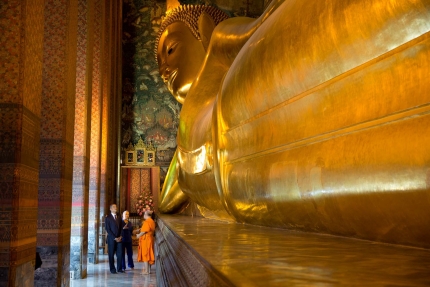
President Obama and Secretary of State Clinton tour the Wat Pho Royal Monastery

President Barack Obama and Secretary of State Hillary Rodham Clinton view the Vihan of the Reclining Buddha while touring the Wat Pho Royal Monastery with Head Monk Chaokun Suthee Thammanuwat in Bangkok, Thailand, Nov. 18, 2012. (Official White House Photo by Lawrence Jackson)

The first nation on the itinerary for President Obama's Asia trip is Thailand -- America's oldest friend on the continent, with diplomatic ties stretching back nearly 180 years.

Though his stop to the country lasted for less than one full day, the President visited a Buddhist temple at the Wat Pho monastery, met with Thai King Bhumibol Adulyadej, held a joint press conference with Thai Prime Minister Yingluck Shinawatra, and enjoyed a dinner hosted by the prime minister at the Government House in Bangkok.

President Barack Obama, with Secretary of State Hillary Rodham Clinton and Ambassador Kristie Kenney, left, meet with King Bhumibol Adulyadej

President Barack Obama, with Secretary of State Hillary Rodham Clinton and Ambassador Kristie Kenney, left, meet with King Bhumibol Adulyadej of the Kingdom of Thailand, at Siriraj Hospital in Bangkok, Thailand, Nov. 18, 2012. (Official White House Photo by Pete Souza)