President Obama Tours Storm Damage in New York

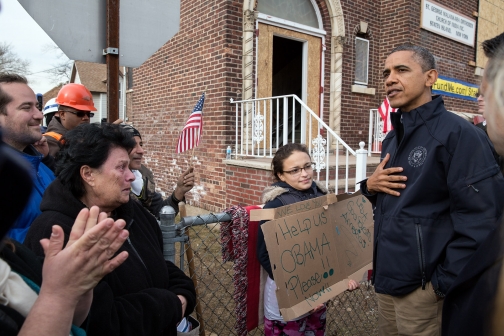
President Obama on Cedar Grove Avenue

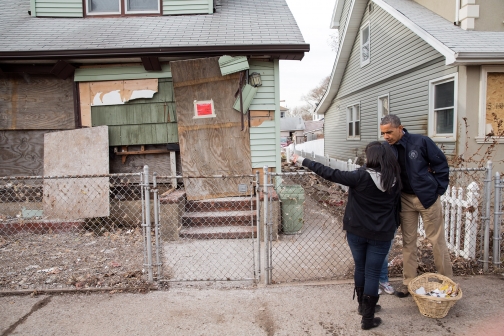
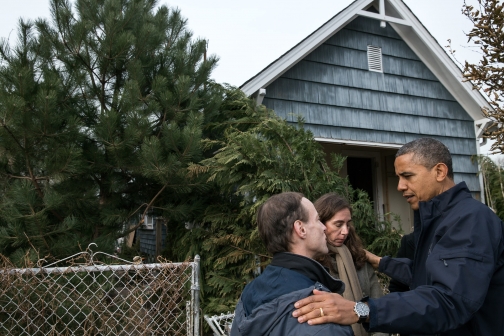
President Barack Obama talks with residents on Cedar Grove Avenue during a walking tour of Hurricane Sandy storm damage in Staten Island, N.Y., Nov. 15, 2012. (Official White House Photo by Pete Souza)

On Thursday, the President travelled to New York to assess the storm damage of Hurricane Sandy, and meet with local residents, first responders, and elected officials coping with the recovery process. He promised the communities affected by the storm full support from the federal government every step of the way as they begin to rebuild.

Alongside New York Mayor Michael Bloomberg, New York Governor Andrew Cuomo, and Administration officials, the President surveyed some of the most devastated areas of New York from Marine One, including Breezy Point, a Queens neighborhood where more than 100 houses burned to the ground. Following his aerial tour, the President spoke with Staten Island residents, first responders, and volunteers about the recovery process that lies ahead. 

White House photographers were on hand to document the trip. Check out the photo gallery below:

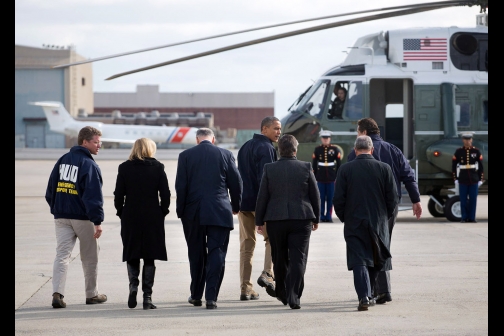
  • President Obama Prepares to Board Marine One

    President Obama prepares to board Marine One for an aerial tour of Hurricane Sandy storm damage. (Official White House Photo by Sonya N. Hebert)

    1 of 13
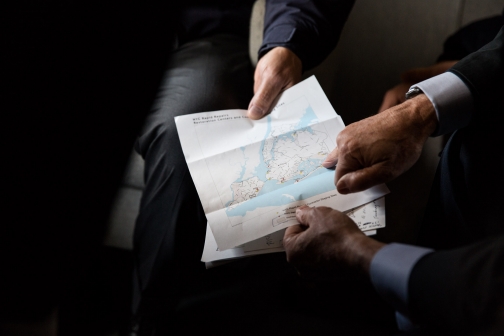
  • New York Mayor Bloomberg and New York Governor Cuomo Point Out Areas on a Map

    New York Mayor Michael Bloomberg and New York Governor Andrew Cuomo point out areas on a map of the region. (Official White House Photo by Pete Souza)

    2 of 13
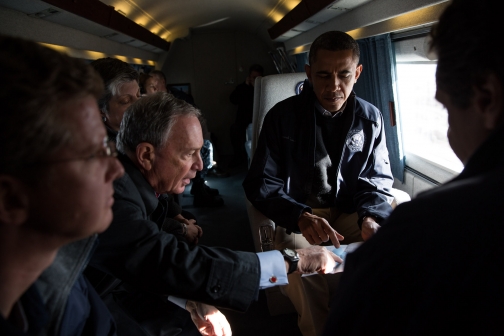
  • President Obama Aerial Tour of Hurricane Sandy Storm Damage

    New York Mayor Bloomberg points out areas on a map of the region during an aerial tour of storm damage. (Official White House Photo by Pete Souza)

    3 of 13
  • People Photograph President Obama as he Meets with Local Officials

    People photograph the President with local officials, first responders, FEMA staff and families. (Official White House Photo by Sonya N. Hebert)

    4 of 13
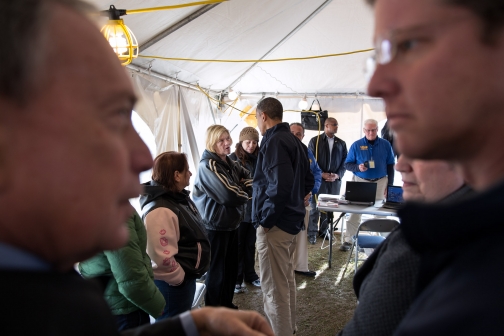
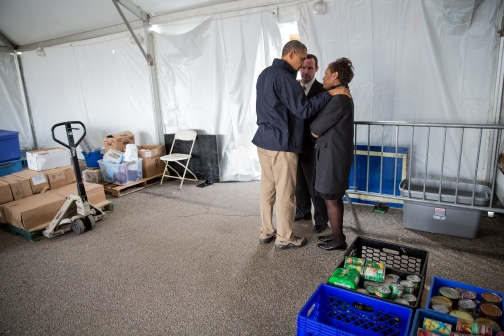
  • President Obama in FEMA Disaster Recovery Center

    President Obama talks with residents in a FEMA Disaster Recovery Center tent in Staten Island, N.Y. (Official White House Photo by Pete Souza)

    5 of 13
  • President Obama Talks with Residents at a FEMA Disaster Recovery Center

    President Obama talks with residents in a FEMA Disaster Recovery Center tent in Staten Island, N.Y. (Official White House Photo by Pete Souza)

    6 of 13
  • President Obama with Damien and Glenda Moore

    President Obama meets privately with Damien and Glenda Moore at a FEMA Disaster Recovery Center. (Official White House Photo by Pete Souza)

    7 of 13
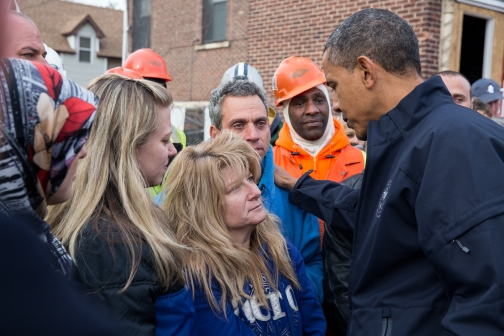
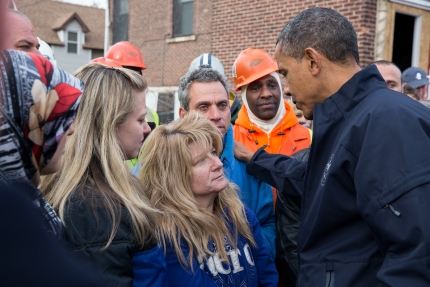
  • President Obama with Residents on Cedar Grove Avenue

    President Obama talks with residents during a walking tour of storm damage in Staten Island, N.Y. (Official White House Photo by Pete Souza)

    8 of 13
  • President Obama with Cedar Grove Avenue Residents

    President Obama talks with residents during a walking tour of storm damage in Staten Island, N.Y. (Official White House Photo by Pete Souza)

    9 of 13
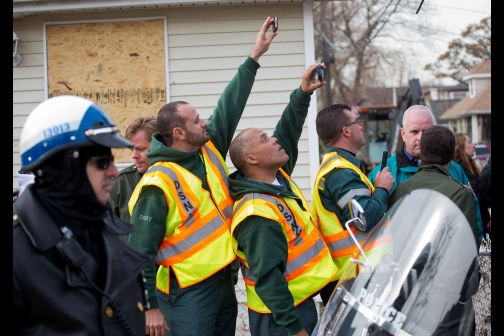
  • City of New York Department of Sanitation Employees Take Pictures

    City of New York Department of Sanitation employees take pictures of President Obama. (Official White House Photo by Sonya N. Hebert)

    10 of 13
  • President Obama Talks with Residents

    President Obama talks with residents on Cedar Grove Avenue during a walking tour of storm damage. (Official White House Photo by Pete Souza)

    11 of 13
  • President Obama Talks with Residents in Staten Island

    President Obama talks with residents during a walking tour of storm damage in Staten Island, N.Y. (Official White House Photo by Pete Souza)

    12 of 13
  • President Obama on Cedar Grove Avenue

    President Obama talks with residents during a walking tour of storm damage in Staten Island, N.Y. (Official White House Photo by Pete Souza)

    13 of 13

Learn more:

The White House

Office of the Press Secretary

Remarks by the President before Meeting with Congressional Leadership

Roosevelt Room

10:25 A.M. EST

THE PRESIDENT:  Well, I want to welcome the congressional leadership here and thank them for their time.  I think we're all aware that we have some urgent business to do.  We've got to make sure that taxes don't go up on middle-class families, that our economy remains strong, that we're creating jobs.   And that's an agenda that Democrats and Republicans and independents, people all across the country share.

So our challenge is to make sure that we are able to cooperate together, work together, find some common ground, make some tough compromises, build some consensus to do the people’s business.  And what folks are looking for -- and I think all of us agree on this -- is action.  They want to see that we are focused on them, not focused on our politics here in Washington.

So my hope is, is that this is going to be the beginning of a fruitful process where we're able to come to an agreement that will reduce our deficit in a balanced way, that we will deal with some of these long-term impediments to growth, and we're also going to be focusing on making sure that middle-class families are able to get ahead.

So I want to thank all the leadership for coming.  And with that, we're going to get to work.  Thank you very much, everybody.

Oh, wait, wait, excuse me.  There’s actually one other point that I want to make, and that is that my understanding is tomorrow is Speaker Boehner’s birthday.  So for those of you who want to wish him happy birthday we will -- we're not going to embarrass him with a cake because we didn’t know how many candles were needed.  (Laughter.) 

SPEAKER BOEHNER:  Yeah, right.  (Laughter.) 

THE PRESIDENT:  But we do want to wish him a happy birthday. 

SPEAKER BOEHNER:  Thank you.  Thank you.

THE PRESIDENT:  Thank you, everybody.

END
10:27 A.M. EST

West Wing Week: 11/16/12 or "That's Who We Are"

Welcome to the West Wing Week, your guide to everything that's happening at 1600 Pennsylvania Ave. This week, the President invited fourteen middle-class Americans to stand with him as he spoke on next steps for our continued economic recovery, honored Veteran's Day with veterans, service members and their families at Arlington National Cemetery, held a news conference in the East Room and traveled to New York to continue to work on recovery efforts from Hurricane Sandy.

West Wing Week: 11/16/12 or "That's Who We Are"

November 15, 2012 | 6:08 | Public Domain

This week, the President invited fourteen middle-class Americans to stand with him as he spoke on next steps for our continued economic recovery, honored Veteran's Day with veterans, service members and their families at Arlington National Cemetery, held a news conference in the East Room and traveled to New York to continue to work on recovery efforts from Hurricane Sandy.

Download mp4 (193.6MB)

Read the Transcript

West Wing Week: 11/16/12 or "That's Who We Are"

Welcome to the West Wing Week, your guide to everything that's happening at 1600 Pennsylvania Ave. This week, the President invited fourteen middle-class Americans to stand with him as he spoke on next steps for our continued economic recovery, honored Veteran's Day with veterans, service members and their families at Arlington National Cemetery, held a news conference in the East Room and traveled to New York to continue to work on recovery efforts from Hurricane Sandy.

Friday, November 9th:
  • The President spoke to reporters in the East Room, flanked by middle-class Americans and urged House republicans to support a Senate passed bill that would prevent tax increases on middle-class families, and 97% of small businesses from taking effect at the end of the year.
Sunday, November 11th:
  • The President and First Lady were joined by the Vice President and Dr. Biden to honor Veteran's Day at Arlington National Cemetery, where the President laid a wreath, addressed the gathering  at the Memorial Amphitheater, and traveled to section 60, to visit with families of service members killed in Iraq and Afghanistan.
Wednesday, November 14th: 
  • The President convened an East Room news conference where he pledged to work with Democrats and Republicans to find a balanced deficit reduction plan.  He also repeated his view that the plan should strengthen the middle class, help create good private sector jobs and ask those who at the top of the income scale to do their fair share to deal with our fiscal challenges.
Thursday, November 15th:
  • The President traveled to Staten Island, New York, to meet with state and local officials about the ongoing response and recovery efforts to Hurricane Sandy.  He met with victims still struggling with the effects of the Super Storm that ravaged the region.
  • Back at the White House, Deputy National Security Adviser Ben Rhodes gave us a preview of the President's upcoming trip overseas.
 

Close Transcript

The White House

Office of the Press Secretary

On-the-Record Conference Call on the President's Upcoming Trip to Asia

Via Telephone

3:06 P.M. EST

MR. RHODES:  Thanks, everybody, for getting on the call here.  We wanted to walk you through the schedule and objectives for the President’s upcoming trip to Asia.  We’ll do this on the record.  You’ll have me and then Danny Russel, who’s our Senior Director for Asia on the NSC, and Samantha Power, who’s our Senior Director for Multilateral Affairs and Human Rights on the NSC.

I’ll just begin by making a few comments about our schedule and objectives.  Danny can talk a little bit about the context for our Asia policy, and then Samantha can talk a little bit about some of the work she’s been doing associated with the issues that we’re addressing on the trip.

First of all, as you all know, the President has made it a critical part of his foreign policy to refocus on the Asia Pacific as one of the most important regions to the future of the United States, both economically and in terms of our political and security objectives in the world.  We devoted an extraordinary amount of time in the first term of the administration to refocusing on Asia and increasing our presence in Asia, both economically, politically, and through our security relationships.

When many of you ask about our second term agenda, I can tell you that continuing to fill in our pivot to Asia will be a critical part of the President’s second term and ultimately his foreign policy legacy.  We see this as an opportunity to dramatically increase U.S. exports, to increase U.S. leadership in the fastest growing part of the world, and in advancing our values as well as our interests, which this trip is designed to do.

Let me just walk you through the three stops with a word about each, because each of them is indicative of an element of our Asia policy.  Thailand is representative of our focus on alliances.  Burma is a key part of our efforts to promote democracy and human rights.  And Cambodia represents our engagement in the multilateral organizations that are shaping the agenda in the Asia Pacific region.

We’re going to begin in Thailand because our alliances in the region are the cornerstone of our engagement there, and Thailand has been a longstanding and close ally of the United States.  This is an opportunity to reaffirm this relationship. 

We’ll get to Bangkok at roughly three o’clock in the afternoon local time on Sunday.  The President will begin his visit with a tour of the Wat Pho Royal Monastery, which is one of the iconic religious and cultural sites in Thailand.  From there he will visit the King of Thailand and have a royal audience with the King.  The King is obviously tremendously well thought of within in Thailand, and a longstanding friend of the United States. 

Following his visit with the King, the President will go to the Government House where he will have a bilateral meeting with Prime Minister Yingluck of Thailand.  Danny can speak a little bit more about the agenda for that meeting.

Following the bilat, the President will have a joint press conference with the Prime Minister.  And again, this is one of our key allies in the region, and we will be discussing with them a range of issues that Danny can walk you through.

After the joint press conference, the President will be hosted at a dinner and reception by the Prime Minister that night.  And that will conclude the Thailand portion of our schedule.  We will spend the night in Bangkok.

Then, the next morning, the morning of Monday, November 19th, we will leave for Burma.  Just a few words about the trip to Burma.  From the beginning of the administration, as you know, the President has signaled an openness to engagement with governments who have not had relations with the United States, provided that we see those governments taking steps to change course and to respect the rights of their citizens. 

And we pursued a period of engagement with the Burmese government that helped encourage and lead to fairly dramatic reforms that we’ve seen.  And again, Danny and Samantha can speak to those.  But we’ve seen, certainly, the greatest political opening in Burma in the last two years that we’ve seen in many decades.  And it was for that reason that the President decided last year, while he was in Asia, to send Secretary of State Hillary Clinton to Burma to pursue a continued opening between our two countries.  It's also why we've sent an ambassador to Burma, we've looked at a set of sanctions on Burma, and now why the President is going.

I want to be very clear that we see this visit as building on the progress that the Burmese government has made, but they are at the beginning of a journey towards democracy and human rights.  And we are going in part to encourage them to continue down that road, because much more needs to be done within Burma to realize the full potential of its people.

So the President is going at a pivotal moment in Burmese history to embrace the progress that’s been made and to encourage the government and the people of Burma to move forward on their transition to democracy.  He will do so in a number of ways.

He will begin his time in Burma, which will be in Rangoon, by having a bilateral meeting with President Thein Sein of Burma.  That will be held in the Parliament Building in Rangoon.  Thein Sein was recently here for the U.N. General Assembly in his first visit here to the United States as President of Burma, and now the President will have a bilateral meeting with him at the Parliament House.  We expect there to be, for your planning purposes, a statement to the press at that meeting.

Following his visit with President Thein Sein, the President will travel to Aung San Suu Kyi's residence in Burma.  The President was able to host Aung San Suu Kyi here at the White House in the Oval Office, and he is very much looking forward to the opportunity to go to her residence.  Of course, many Americans have been moved by her courage in resisting arrest -- many years of house arrest in her own country on behalf of her pursuit of democracy. 

Her release and election to Parliament is one of the positive developments that have taken place.  She is now an important opposition figure in the Parliament, working with the government to advance a reform agenda.  So the President will have an opportunity to have a bilateral meeting with her at her residence where of course she spent so much time under house arrest.  Following that meeting, we anticipate that Daw Suu Kyi and the President will have an opportunity to make a statement to the press as well. 

The President will then travel to our embassy where he'll be able to meet with embassy staff.  We have ramped up our mission there considerably as a part of our opening to the country, so he will have an opportunity to thank them for the work they're doing in building out our relationship. 

Following that, the President will deliver a speech about the future of Burma and the future of the relationship between the United States and Burma.  That speech will be held at the University of Rangoon, which is a very historic -- has played a key role in the history of the country, first in supporting the independence movement in the 1930s, then being one of the leading universities in Asia; being a center of the democracy movement in the 1980s. 

So we see it as a very fitting venue for the President to address the people of Burma and to discuss the broad range of areas where we want to work together to support continued reforms across many different areas.  That would include continued political reform towards democracy.  That would include continued national reconciliation, including with various ethnic groups who have been in conflict with the government.  That includes support for economic development for the Burmese people.  And that also includes the way in which Burma is a critical part of our vision for the future of Southeast Asia and America's relationship with this very important region of the world.

We also anticipate that the President will have an opportunity on the margins of that speech to meet with a variety of members of Burmese civil society, to hear directly from them as well. 

Following the speech, the President will depart Burma en route to Cambodia.  Now, we are traveling to Cambodia, as I said, to attend the East Asia Summit.  Last year, those of you who came to Bali with us will recall the U.S. for the first time joined in the East Asia Summit.  So again, this is a part of our efforts to join in the regional architecture of the Asia Pacific so that the United States has a seat at the table, has a voice in setting the agenda, and is a part of the discussion about the future of this incredibly important region.

He will begin his trip to Cambodia with a meeting with ASEAN.  ASEAN is of course the organization of Southeast Asian nations that we have invested a lot of time and diplomacy in strengthening the relationship between the U.S. and ASEAN.  So we'll have a full agenda with them.  Danny can speak to this as well. 

We also anticipate meeting with Prime Minister Hun Sen of Cambodia as the host of ASEAN and EAS.  My colleagues will speak to this.  The President will have a chance to talk about the agenda of ASEAN, of the EAS.  The President of course will also raise our concerns about the need to respect human rights within Cambodia going forward. 

Following the ASEAN meeting, that night there is a dinner for the East Asia Summit leaders and others who were in attendance for the summit.  So the President will get to Cambodia, participate in the ASEAN meeting, and then participate in the EAS dinner, and spend the night in Phnom Penh. 

Then, on Tuesday, November 20th is the East Asia Summit.  So throughout the day, the President will be participating in a number of plenary sessions associated with the summit.  Again, Danny can speak to the agenda a bit.  We also anticipate he'll have some chance -- some opportunities to have meetings on the margins of the summit.  In particular, we're expecting that he'll meet with Premier Wen Jiabao of China and Prime Minister Noda of Japan.  We also anticipate that he will meet with the other leaders who are part of the Trans-Pacific Partnership Trade Agreement that many of you know we've been promoting as a cornerstone of our trade agenda going forward.

We see extraordinary potential in deepening the economic ties within the Asia Pacific.  And as we look to the future of our trade agenda, completing that successful Trans-Pacific Partnership Agreement will ultimately lead to a great deal of economic benefit to the United States.  So this will be an opportunity to check in with those leaders as we continue those negotiations going forward. 

And then, at the completion of the EAS, the President will meet with our embassy staff in Cambodia.  And then he will return back to the United States, getting here very late overnight, Tuesday night into Wednesday morning.

So those are the three stops.  I’ll give the floor here to Danny now to talk about some of the substantive agenda of those stops.

MR. RUSSEL:  Great.  Thank you very much, Ben.  I’ll say a few things about the Asia context overall, and then work through the three stops that you’ve mentioned. 

At the top, though, let me say that I’d commend everyone to the transcript of the remarks that the National Security Advisor gave at the CSIS conference just a few hours ago, where he laid out a comprehensive and a strategic vision for our approach to the Asia Pacific region.

This is the fifth trip by President Obama to Asia in four years.  And those of you who heard Mr. Donilon’s remarks know there’s a lot more to rebalancing and to the pivot to Asia than just hard power.  There was a heavy focus last year, of course, on the security side, which is very significant.  But what this visit by the President will highlight, I believe, is the diversity and breadth of our engagement and our involvement throughout the region.

And secondly, that rebalancing includes rebalancing within Asia.  We’re building out our engagement with Southeast Asia.  We’re building out our presence there.  And as Ben said, the itinerary and the three elements of the itinerary reflect the emphasis on allies, on values, and on the institution building. 

If 80 percent of life is just showing up, then I think this trip delivers the other 20 percent in terms of substance, in terms of getting things done, pushing the agenda forward, and driving towards progress and outcomes that directly benefit us, the U.S. and the people of the U.S., but also the people in the countries in the Asia Pacific region.

So country by country -- in Thailand, the President and the Prime Minister will expand the cooperation that is already underway on the fight against proliferation, the fight against narcotics, against terrorism, and against trafficking.  They will build on the work that Secretary of Defense Panetta is doing today in Bangkok with the Defense Minister on modernizing our security alliance and developing our military cooperation, which include exercises in disaster relief and counter piracy. 

The President and the Prime Minister will also put in place a program to promote innovation and to connect universities, business, and research; and lastly, showcase some of the cooperation we’re doing in terms of sustainable development through projects in the Mekong River area and elsewhere.

On Burma, what I would add to what Ben said -- and then also you’ll hear from our colleague, Samantha Power -- is that
this is not a victory celebration; this is a barn raising.  This is a moment when we believe that the Burmese leaders have put their feet on the right path, and that it’s critical to us that we not miss a moment to influence them to keep them going.  It’s an uphill climb, and we want to make progress irreversible.  We want to show the people of Burma that there are benefits to be had from the hard work, and move some of the leaders off this fence and into the reform program.

The President is not someone who has ever believed that problems just solve themselves.  He’s a “pitch in and help out” person, and I think the measure of our policy and the efficacy of his visit is going to be the longer term impact that it has on the process of reform and democratization.  So what I would say is that the thing to watch is both what the President says to the people of Burma and what we see in the aftermath of this visit, which, I think in addition to being historic, will also have a heavy impact.

In terms of the meetings in Phnom Penh, as Ben laid out, there are two sets of meetings.  The first, ASEAN, is an organization that President Obama has invested heavily in since he took office.  This is the fourth summit in four years, and I think -- at least by my informal count -- the President has held eight bilateral summit meetings with individual ASEAN leaders.  He’s named an ambassador to the ASEAN headquarters.  And we've developed a range of programs and initiatives with ASEAN that the President in his meetings in Phnom Penh will advance.  These cover economic and security, political -- quite a wide range of issues. 

What's worth flagging about the meetings this year is that the Eminent Persons Group, a small group of distinguished Americans and representatives from each of the 10 ASEAN countries, have been working throughout the year since they were convoked in Bali to develop some recommendations to the leaders  -- a report that ought to be coming out shortly.  And I think that as part of the five-year plan of action, their recommendations towards developing a more strategic relationship, expanding our economic engagement, and promoting cultural and educational ties will be a big part of what the President and the ASEAN leaders agree to.

So I think the thing to watch at the U.S.-ASEAN Summit is that area:  What concrete areas have expanded economic and trade engagement they can agree to, and in what respects are they able to push forward practical programs in terms of education and people-to-people ties.

Lastly, I would say, with regard to the East Asia Summit -- and here, again, the President made the decision to participate in the EAS based on the principle that the institutions in the region weren't going to perfect themselves; that he needed to roll up his sleeves and participate in that.  This is, from our perspective, the venue at which it is possible to have a political, security, and strategic dialogue among leaders, a dialogue that frankly can't be had in other fora. 

The President's focus will be first on our priorities at EAS, which include non-proliferation; they include humanitarian assistance and disaster response; and they include maritime security.  But there are other important agenda items there with regard to global health, global development, food security, and energy security.  Invariably -- inevitably, the leaders will want to discuss the salient strategic and security issue facing the region, which is the issue stemming from the competing territorial claims in the South China Sea.

So I think the things to watch at the East Asia Summit are, first of all, what is the program of work that the leaders set for themselves in the course of 2013.  I think energy security is one area that could be lifted up and that they may want to focus in on.  And secondly, what kind of discussion do the leaders have on the South China Sea and on the issues of competing sovereignty claims.  Will the leaders affirm the kind of guiding principles that President Obama articulated last year at Bali, and will there be a consensus around and a push towards both progress between ASEAN and China on a code of conduct, but also a general trend towards pushing for deescalation.

MR. RHODES:  Great.  Thanks, Danny.  We'll go to Samantha now and then take your questions.

MS. POWER:  I’ll be brief, especially because Ben and Danny have covered much of the Burma ground, which is the country I'd emphasize here in these comments in addition to saying a couple of words about Cambodia.

As Ben said, and Danny reinforced, we have long indicated  -- the President has long indicated a willingness to engage countries that show concretely a will to reform, a will to make political progress.  And the reason we engage is not to reward, but to lock down progress and to push on areas where progress is urgently needed. 

And I give a couple of examples of why this logic makes sense at this time in the Burma context.  First, we’ve seen, as many of you know, some progress that the government has made in establishing ceasefires with various ethnic groups -- not long-lasting solutions, but ceasefires that mean that fewer people are hurting day to day, and genuine progress.  However, we’ve also seen very disturbing violence in Rakhine state that -- between the events of June, and then the events that started in October and drifted into this month and are still really ongoing in terms of the crisis -- has resulted in hundreds of deaths and more than 32,000 displaced just in the most recent episode, and the Rohingya, of course, who are suffering the brunt of the violence in this instance. 

But it is an incredibly tense, dangerous, and important issue for us to be engaging on at every level we can.  And the government has taken some responsible steps in trying to diffuse the violence, but there are long-term structural issues that need to be addressed in terms of the recognition to the Rohingya people and the welfare generally of all Buddhists and Muslims and others living in that Rakhine state.  Just an example, again -- a little bit of progress in the ethnic sort of area overall, but a very, very severe and important issue that we get an opportunity now to go and engage on at the ultimate level, at the highest possible level.

Similarly, in the ethnic context of Kachin, where a ceasefire has not been possible, the importance of humanitarian access, the importance of moving to a ceasefire and then to addressing the long-term political grievances that of course fueled the conflict in the first place.

A second example, we’ve heard a lot and Ben mentioned the progress on political prisoners -- hundreds have been released since this reform process began, including Aung San Suu Kyi, who now of course has taken a seat in the Parliament, and about whom President Thein Sein said he could imagine her being head of state someday.  I mean, remarkable progress but many, many political prisoners still behind bars and hearing less out there, but at least several hundred political prisoners we believe.  And as the Secretary of State has said, even one political prisoner is one too many. 

So again, as long as there are political prisoners, it makes sense for the United States not to be simply heralding the release of those who -- some of whom the President will have a chance to interact with on the trip, some of those who spent 10, 15, 20 years in prison -- not just to herald that they are out of jail and able to be part of this political process, but push for more progress, and ensure that those who have been released no longer have the threat of re-apprehension hanging over their heads.

So that’s just to give a couple of examples of the areas where we’ve seen a little bit of important progress in this journey, but where by virtue of the President taking this trip at this historic moment, we get a chance to try to really drive for further progress.

And then there are a range of other issues, of course:  corruption; proliferation; trafficking; the freedom of NGOs that these groups get up and running now; media -- the censorship law has been lifted, but it’s -- the new regulations are honored in some cases, in some areas, very much in the breach; freedom of association -- very hard for groups to get permits to actually have political protests.  These are the kinds of issues that by virtue of a trip of this magnitude, we get a chance to really drive home the core messages about the next steps that need to be taken on the path to reform and the opportunities that exist by virtue of the space that’s opened up.

The last point I’d make just about Burma is that beyond the engagement on these specific issues, the trip I think is also -- will also hopefully have the effect of reaching an audience broader than the government and broader than the elite.  And so far -- and we talk a lot about this internally here -- this has been a very unusual political journey, political transition in the sense that it’s very top down in terms of how the reforms are being dispensed; in many cases, edicts issued where political prisoners are free, or laws are changed, or announcements are made summarily, and often, again, very important and constructive announcements.

But as the political space opens up, one of President Obama’s key messages, of course, is that there is a need not simply for government officials to talk to one another and the executive branch to talk to the Parliament, but for the youths, for legal professionals, for businesspeople, for soldiers in the rank and file of the military, for teachers, for the citizens of Burma to take ownership of this process now as it enters its next phase, and to build the checks and balances that are really the requirement in this country for these reforms to be sustainable and for this to become a true democracy over time.

And then the last thing I’d say is just by taking this trip -- I think this is a very important point -- we are also, I think -- the President is sending a signal to other countries where reform either is not happening or repression is happening, we have a chance to say, if you take these steps -- he said it in the inaugural, but now we’re actually showing in a very concrete case -- we will meet you action for action.  And needless to say there are a lot of countries around the world where we would very much like other leaders to take this message and to take steps similar to those that have been taken in Burma in very expedited fashion, but again, only at the beginning of a long path.

On Cambodia, just briefly, some of you may have already noticed that Hun Sen has actually, it looks like, sort of stepped up some of the infringements on civil society, and there’s been incidents of individuals who were making visual appeals to President Obama to do certain things with regard to calling for free and fair elections in the next election.  Right now, there’s no sign that those elections will be free and fair.

All I would say about our engagement with the Cambodians on a bilateral basis is that the thrust of the message -- and Danny can underscore this as well -- is on the importance of free and fair elections, the end of land seizures, the protection and promotion of human rights.  That's the core function of the engagement with Hun Sen.  He is the host, Cambodia is the host of these important summits and these diplomatic gatherings, but our message to him on a bilateral basis is very much about the human rights abuses that are being committed within Cambodia’s borders, and urging him once and for all to actually start to take these concerns seriously, rather than continuing to move in very worrying directions.

And I will say, just the last point on process, the President is, of course, tied up in the summits in this very condensed trip, but his senior advisor, Valerie Jarrett, and myself will do two roundtables on the Tuesday -- one with trafficking advocates and survivors, because trafficking of course is an issue there and we’ve sought to strengthen the Cambodian government’s efforts in that regard with prosecutions and also supporting victim services and so forth.  So we’re going to -- President Obama gave a big speech on trafficking back in September, and this is -- we’re going to have diplomatic follow-through throughout this trip with all the governments that we engage. 

But there will be that roundtable.  And then the second roundtable will be a sort of human rights, political roundtable, women’s rights, and focusing on the election and the state of civil society, NGOs, and basically politics in Cambodia.  And so that’s an opportunity for one of the President’s top advisors to hear firsthand from Cambodians just what their concerns are, so that we may, again, inject those concerns at the highest levels of the bilateral relationship.

MR. RHODES:  Great.  Thanks.  We’ll take your questions, then.

Q    Hi guys.  Thanks very much for doing the call.  Two questions.  Ben, could you read out some of the bilaterals that the President will be doing at the summit?  And perhaps, Samantha or Danny, could you expand on what the President will say in Burma, both publicly and privately, about the Rohingya minority in that situation?  Thank you.

MR. RHODES:  Thanks, Jeff.  In terms of the summit, the President has -- because he has the ASEAN meeting, the leaders dinner, and then the EAS most of the next day, we don’t anticipate a heavy schedule of formal bilats.

Right now, the meetings that we are looking to on the margins of the summit are the ones I referenced:  China with Wen Jiabao, Japan with Prime Minister Noda, and getting together with the leaders of the TPP to assess progress in those negotiations.  We’ll keep you updated of course if there are additional meetings that come up on the margins.

I’ll just say something about Burma and see if my colleagues have anything to add.  As Samantha mentioned, broadly speaking, we’ve seen progress in recognizing the need to resolve the ethnic challenges in the country.  Eleven out of twelve have reached ceasefires that open the door to more sustainable reconciliation.  And the government has shown that they understand that part of their reform effort has to be dealing with the ethnic uncertainty and ethnic violence.  As Samantha mentioned, the remaining ceasefire that we’re encouraging them to pursue is with the Kachin. 

As it relates to the Rohingya, what we’ve seen is the continued violence, as Samantha mentioned.  And the government has sought to step in and help save lives in the situation in some instances.  But clearly, more needs to be done to foster an environment where tensions are reduced, where there's not incitement, and where those communities are able to address their differences peacefully rather than in the outbreaks of violence that we've seen.

So I think the President will be addressing the broad context of ethnic reconciliation and national reconciliation within Burma.  Specifically, I think what we'd like to see is continued work to stabilize the situation, but also to bring down the temperature and reduce the tensions.  But I don’t know if you guys have anything to add to that.

MS. POWER:  I'd just add that in terms of the messages and the President is still working on the speech, and so we'll see what happens there.  But in terms of the core messages that we're seeking to convey basically in every encounter, including those that Ambassador Mitchell is carrying out every day, the importance of independent humanitarian access to the area so that there's independent reporting on what is actually happening again in this very, very tense environment right now, and that humanitarian assistance can be provided.  And that's a major issue that remains outstanding.

Second, the safety and security of individuals -- because before there can be any talks of the future of coexistence, the mob attacks and the violence and the provocations have to stop.  And that's where, as Ben said, the fact that the government has sent in kind of national troops into an area where local forces were involved in many of the abuses is an important step, but that we need to -- there has to be a sustainable security solution so that people aren't living in the kind of fear and really terror that they're living with today. 

Thirdly, the government has come out and said it wants to hold the perpetrators accountable, which is important.  And that's something they're going to have to follow through on.  It will be very challenging, given again the degree of community support for some of what went on.  But that's something that we will reaffirm their commitment in that space, because that's critical.

And then, the ultimate -- ultimately, the legal status of the Rohingya of course in this country as well as in the region needs to be resolved.  And so that is something that we will engage them on I'm sure certainly privately and in some form publicly.

Q    Hi.  I have two questions, also.  One is, last year on the Asia trip, there was a lot of talk about the U.S. engaging more in the region and some actions on that trip.  I'm wondering if you could fill in any concrete progress that has been made in terms of the U.S. presence and engagement since then.  And secondly, regarding the Burma trip, to what extent is the decision to go there a way of, in fact, asserting the U.S. presence in the region, especially vis-à-vis China?

MR. RHODES:  I'd just say a couple of things.  First of all, in terms of filling in our presence and our engagement in the region, a number of the initiatives that we launched on the last trip have essentially been coming on line.  So just to give you a few examples, the announcement that the President made in Darwin, Australia about the rotational deployment of U.S. Marines and the U.S. military in Australia is coming on line and is helping us deepen our partnership not just with Australia, but across the region. 

On the military side, we've also seen continued focus on deepening our partnerships through joint exercises, port visits and continued cooperation with regional military.  Thailand is an ally and a key part of that effort as well.  So this focus on the U.S. having a presence not just in North Asia but in south -- in the South Pacific and in building our partnerships with Australia and other allies is something that we pursued coming out of the last trip.

On the economic side, we’ve seen a lot of our export growth in this region.  That trajectory has continued upward since the President’s trip.  The TPP agreement is something that we’re continuing to pursue through negotiations.  It’s grown since the President’s trip in that you’ve had Canada and Mexico join negotiations, but also expressions of interest in joining from other Asian countries.  So we’re pursuing those negotiations on the economic side.

I think Burma is in many respects one of the clearest manifestations of increased engagement.  Since the President’s last trip, we have lifted a substantial amount of U.S. sanctions.  And so what that’s going to allow is U.S. investment; U.S. companies beginning to get into the mix in Burma, which we think is good for our own economy, but also is also going to be good for the development of a private sector within Burma that can create a broader base of prosperity in a country where the government controlled so much of the economy in the past.

Similarly we have an ambassador on the ground; have sent our Secretary of State to Burma.  We’ve begun the process of military-to-military engagement with the Burmese, which had been frozen.  That dialogue has been focused on things like the professionalism of the Burmese military, human rights. 

And so we’re engaging in Burma across a range of areas:  economically, militarily, and politically.  All of those have significantly ramped up since the President made his announcement in Bali that we were going to pursue this opening, and this visit really completes the realization of that process.  We've also, of course, seen the South Korea free trade agreement that we completed come into force.

So a lot of these initiatives that we've launched have come on line, and similarly we'll be looking to put forward new markers on this trip as to how we can continue to push into areas like energy cooperation and continued security cooperation going forward.

On the trip to Burma -- I think it's -- it falls into two categories.  I mean, first of all, this is one of the most significant developments related to Democratic values that have taken place in the last decade, in that you have this dramatic opening of a country that had been so closed for so long.  So this is very much a values-driven trip, in that we want to promote a complete transition to democracy going forward.  However, Burma is also an incredibly important country.  It sits at the crossroads of South Asia and East Asia; it borders the Indian Ocean and the Pacific Ocean; it has tremendous natural resources; its people are incredibly talented.

So we see Burma as an important potential partner for the United States going forward if they continue down this path of reform.  We also see the importance of Burma being fully integrated with ASEAN, which is an incredibly important block of emerging economies.  And if Burma can duplicate the type of Democratic development that we've seen by so many ASEAN countries, it could be an extraordinary boost to the economy of the region and to the global economy.

So we do believe that, in addition to wanting to support the democratic agenda and the human rights agenda that we've been promoting in Burma, we also see a very positive future for Burma as a partner within Southeast Asia and within the region for the United States.  In that context, we'll obviously continue to be engaged with the Chinese; they have a leadership transition that is underway. 

And we've always made it clear that we don’t see our engagement as coming at the expense of another country; it's based on the fact that the United States has important interest in this region.  And as it relates to China, we're going to continue to work cooperatively with the Chinese where we have common interests and where we have differences, particularly as it relates to making sure that China is living up to the rules of the road.  We'll be clear about those as well.

One thing -- Danny wanted to add one thing.

MR. RUSSEL:  Thank you, Ben.  Yes, I'd like to reinforce the point that you made because I think there is a certain amount of misapprehension on this issue. 

First of all, we -- the U.S. has made clear at every level, including by Secretary Clinton when she was in Burma last December, that the improvement in the relationship between Burma and the United States doesn’t come at the expense of China and that we consider Burma’s relationship with China to be important. 

But the key point I believe is that U.S. policy in Asia is about U.S. interests.  It’s not about China.  We have important bilateral relationships -- important in their own right -- and we have important work to do with regional institutions such as ASEAN and the East Asia Summit. 

Now, China is a full participant in the East Asia Summit, and the fact is that the U.S. and China have extensive areas of cooperation in the Asia Pacific region and in the EAS agenda itself, and that’s something that the region values and wants to see.  But as Ben pointed out, we have areas of competition and we have areas of difference of view.  And we have, in every context made clear to Beijing, that there’s a cost to coercive behavior, problematic conduct, whether that’s on the economic front or on the security front. 

Our objective is to shape the environment in the Asia Pacific region in which the peaceful rise of important countries, including China, contributes to the common good, is fundamentally stabilizing and not destabilizing, and in which every party can contribute to the work at hand.

Q    Hi, thanks again for doing the call.  Real quickly, I just wanted to nail down -- it sounds like you’re not setting the stage for major deliverables or major progress on the South China Sea, but just continued dialogue on these fronts.  I just want you to confirm that.  And second of all, we’ve gotten some background this afternoon about discussions related to Israel and Gaza, but I’m wondering if you could put on the record for us conversations that the President personally or other top staff have had with Israel or what you’re asking Israel to do, what you’re asking through others Hamas to do in the context of the violence.  Thanks very much.

MR. RHODES:  On the South China Sea, what I’d say is we don’t resolve territorial disputes through ASEAN and the EAS.  These wouldn’t be venues to adjudicate competing territorial claims.  So in that sense you’re not going to see a resolution of the issues related to the South China Sea. 

However, what we do want to insist upon is that there is an understanding about how maritime security is viewed and how disputes should be resolved going forward.  And again, our belief is that there needs to be a process to resolve them consistent with international law; that we support the de-escalation of incidents that could lead to conflict; and that we’re supporting ASEAN as they pursue a code of conduct in the region.

So by putting this on the agenda in this type of forum -- the issue of maritime security -- we want to lift up the principles that we believe will be critical to resolving disputes in places like the South China Sea.  And so they’re critical venues, again, to lift up those principles and to express those views even as we know that resolution will have to take place consistent with international law in other forums.  Dan, you may want to add to that.

But on Israel -- the President spoke to Prime Minister Netanyahu yesterday; Vice President Biden also spoke to Prime Minister Netanyahu.  The President also spoke to President Morsi.  Our view, as you’ve seen expressed in the readouts of those calls and in Jay’s comments today, is that the continued threat posed by rocket fire from Gaza against the Israeli people is unacceptable; that Israel has the right to defend itself against that outrageous threat that continues; that the United States has supported Israel in having defensive capabilities to deal with rocket fire, for instance in funding the Iron Dome system, but also understands that Israel must have a right to self-defense when its citizens are faced with these types of attacks. 

We've encouraged that, of course, all steps be taken to avoid civilian casualties, and we deeply regret the loss of life on the Israeli and Palestinian side.  Ultimately, the onus is on Hamas here to de-escalate and to stop these rocket attacks so that peace can prevail in the region.

As it relates to today, we continue to be in close contact with the Israelis to have an understanding of their plans going forward.  We’ve also urged those who have a degree of influence with Hamas -- such as Turkey and Egypt and some of our European partners -- to use that influence to urge Hamas to de-escalate.  Because our concern is obviously that Israel must be secure from these types of attacks; and that also, as this situation continues to unfold, it’s only going to pose a greater threat to civilians and risk continued conflict in the region. 

So again, our focus is on communicating with the Israelis, and also communicating with those like Turkey, Egypt, and some European countries to make it clear to Hamas that they need to de-escalate.

At the United Nations, where this is being discussed, we’ve sought to keep the focus where it should be, which is on Hamas’ rocket fire as the precipitating cause here in posing such a grave threat to the Israeli people, and to oppose efforts to single out Israel for the actions that they’ve taken in response to that rocket fire.  So that’s kind of where we are.  We’ll have additional -- the State Department has been in touch with a variety of actors; so have a number of U.S. officials here in the White House.  And we’ll keep you updated if the President has any engagement going forward.

Anything -- Danny might have one more comment on South China Sea.

MR. RUSSEL:  I think what you can expect the President to reinforce and to underscore in the meetings in Phnom Penh is that the economic growth and importance of the Asia Pacific region is too vital to the interests of not only the U.S. but of all the countries there and their people to allow these long-standing disputes over boundaries, over territory, over sovereignty, to jeopardize the stability that’s necessary for continued growth.

And so the President would surely reiterate the principles that he has consistently articulated on the need for a peaceful resolution, for a diplomatic process that is collaborative and consensual, on the rejection of threats or use of force or the use of coercion, the importance of freedom of navigation, and of course on the unimpeded lawful conduct. 

So while, as Ben said, the EAS is not a forum in which countries will adjudicate or prosecute their particular claims, it is a forum in which they can discuss these principles and give encouragement to the ongoing diplomatic process between ASEAN and China that seeks to establish rules under a code of conduct that would govern behavior and prevent 24:13.

Q    Hi.  Two questions.  One, on Burma -- the U.S. still refers to Myanmar as Burma.  Is that something that will continue to go on?  Do you expect Myanmar to change its name back to Burma?  And then on the Middle East again -- is the U.S. fearful about Israeli ground forces entering Gaza?  Is that something the U.S. would support?

MR. RHODES:  First of all, I would note that on your first question, it is the continued U.S. policy that we refer to Burma.  We recognize and understand that Myanmar is the name that is used by many within the country and around the world as well, although there are some who also continue to use the traditional name of Burma. 

So, again, we’ll continue to refer to Burma, but we certainly understand that this is something that different countries take different views on, and as a matter of courtesy, we understand that in our engagements in Burma, Myanmar may be what officials -- government officials use in referring to their country.  So that’s how we approach that issue.

On your second point, again, our view is that the Israelis have the right to self-defense when their citizens are faced with the threat of indiscriminate rocket fire from within Gaza.  Ultimately, it’s up to the Israeli government to make determinations about how they’re going to carry out their military objectives.

What we’ve also said is that the best course of action would be for there to be a general de-escalation of the violence, but that the onus is on Hamas and those with influence over Hamas to help bring about that de-escalation so that we don’t see a widening conflict. 

So we certainly want to see a de-escalation.  We certainly want to see a broader conflict avoided.  And, again, though, we want to make clear that Israel has the right to self-defense, so it’s going to be incumbent on Hamas and those who are in contact with Hamas to encourage them to take those types of de-escalatory steps.

Okay, thanks, everybody, for getting on the call here.  We’ll be able to continue to take your queries going forward.

END
3:59 P.M. EST
President Obama Meets Sandy Survivors in Staten Island

President Obama Hugs Glenda Moore, Staten Island, N.Y., Nov. 15, 2012

President Barack Obama meets privately with Damien and Glenda Moore at a FEMA Disaster Recovery Center tent in Staten Island, N.Y., Nov. 15, 2012. The Moore’s two small children, Brandon and Connor, died after being swept away during Hurricane Sandy. (Official White House Photo by Pete Souza)

President Obama today promised residents of Staten Island his support as they begin the long process of rebuilding their devastated community just two weeks after Hurricane Sandy tore its path of destruction through the New York City borough.

Speaking to local residents, first responders and elected officials, the President promised that he would return to the region again and again, until the rebuilding is complete. He also said that he had asked Shaun Donovan, the Secretary of Housing and Urban Development, to continue to work closely with governors, mayors and local officials of New Jersey and New York in identifying redevelopment plans for affected communities. Secretary Donovan is a former Commissioner of the New York City Department of Housing.

The President began his visit with a helicopter tour over some of the areas that were hardest hit by the wrath of the storm, including Breezy Point, a Queens neighborhood where more than 100 houses burned to the ground. As he addressed the crowd gathered in a disaster recovery center, President Obama praised the first responders, volunteers and sanitation workers who are working tirelessly to help residents get back on their feet, saying they exemplify what America is all about:

During difficult times like this, we’re reminded that we’re bound together and we have to look out for each other. And a lot of the things that seem important, the petty differences melt away, and we focus on what binds us together and that we as Americans are going to stand with each other in their hour of need.

President Obama Tours Storm Damage in New York City

November 15, 2012 | 8:07 | Public Domain

President Obama discusses the response to Hurricane Sandy after touring parts of New York City affected by the storm.

Download mp4 (301MB) | mp3 (19MB)

Read the Transcript

Remarks by the President After Surveying Damage from Hurricane Sandy

Cedar Grove Avenue
Staten Island, New York

2:01 P.M. EST

THE PRESIDENT:  Thank you so much, everybody.  I’m going to be relatively brief.  I came up here right after the storm, was on the Jersey side, and I promised to everybody that I was speaking on behalf of the country when I said we are going to be here until the rebuilding is complete, and I meant it.  So I’m going to come back today, but I’m also going to be coming back in the future to make sure that we have followed through on that commitment.

I want to thank the outstanding leadership that’s been provided by state and local officials.  Obviously, Governor Cuomo and Mayor Bloomberg have done an outstanding job.  To borough president Molinaro, thank you so much for your leadership at a time when the folks here on this island were obviously going through extraordinarily difficult times, the people of Long Island who are going through really tough times.

Across the board, what we’ve seen is cooperation and a spirit of service.  And for the first responders who are here, the police officers, the firefighters, the EMS folks, the sanitation workers who sometimes don’t get credit but have done heroic work, we are so grateful to you because you exemplify what America is all about.  I’m grateful to the Red Cross who has been so responsive not just here, but in disasters around the country.  And I want to thank all the volunteers.  As we were shaking hands over there, we had folks from every part of the country.  We had some Canadians who had come down to help out.

And during difficult times like this, we’re reminded that we’re bound together and we have to look out for each other.  And a lot of the things that seem important, the petty differences melt away, and we focus on what binds us together and that we as Americans are going to stand with each other in their hour of need. 

Now, more specifically, we are now still in the process of recovery.  As you can see, as you travel around parts of Staten Island, as we flew over parts of -- other parts of the city and the region that had been impacted, there is still a lot of cleanup to do.  People still need emergency help.  They still need heat.  They still need power.  They still need food.  They still need shelter.  Kids are still trying to figure out where they’re going to school.  So there’s a lot of short-term, immediate stuff that has to be dealt with.  And we are going to make sure that we stay here as long as people need that immediate help.  That’s FEMA’s primary task.  And we’ll be coordinating closely with state and local governments to make sure folks are getting the short-term help.

But what we’ve also already heard is that there’s going to be some long-term rebuilding that’s required.  You look at this block and you know that this is a community that is deeply rooted.  Most of the folks that I met here have been here 20, 30, 50 years.  They don't want to see their community uprooted, but there’s got to be a plan for rebuilding, and that plan is going to have to be coordinated, and they’re going to need resources.

So what I’ve committed to doing is to work with the outstanding congressional delegation led by your Senators Chuck Schumer and Kirsten Gillibrand, also working with Governor Christie and the Jersey delegation to try to come up with a game plan for how we’re going to be able to resource the rebuilding process. 

And I’m confident, as Governor Cuomo said, that we’re going to be able to do it.  But it’s going to require everybody focused on getting the job done.  We’re going to have to put some of the turf battles aside.  We’re going to have to make sure that everybody is focused on doing the job as opposed to worrying about who is getting the credit or who is getting the contracts or all that stuff that sometimes goes into the rebuilding process.

On the federal level, because this is going to be such a big job, I wanted to assign one particular person who would be in charge from our perspective, who would be our point person -- because FEMA basically runs the recovery process, it doesn't focus on the rebuilding.  For that, we’ve got to have all government agencies involved.  Janet Napolitano has done a great job with respect to DHS, but we thought it would be good to have a New Yorker who is going to be the point person.  And so our outstanding HUD Secretary, Shaun Donovan, who used to be the head of the New York Housing Authority -- so he knows a little bit about New York and building -- is going to be our point person.  And he's going to be working with the mayor, the governor, the borough presidents, the county officials to make sure that we come up with a strong, effective plan.  And then, I'll be working with the members of Congress to do everything we can to get the resources needed to rebuild.  And I have every confidence that Shaun is going to be doing a great job, and so people should feel some confidence about that.  

Let me just close by saying this:  I had the opportunity to give some hugs and communicate thoughts and prayers to the Moore family.  They lost two young sons during the course of this tragedy.  And obviously, I expressed to them -- as a father, as a parent -- my heartbreak over what they went through.  And they're still obviously a little shell-shocked. 

But they came here in part because they wanted to say thank you to all the people who have been supportive of them.  They in particular mentioned Lieutenant Kevin Gallagher of the NYPD, who, when they knew that their sons were missing, Lieutenant Gallagher made a point of staying with them and doing everything he could so that ultimately they knew what had happened with their boys and were able to recover their bodies, and has been with them as a source of support ever since.

That's not in the job description of Lieutenant Gallagher.  He did that because that's what so many of our first responders do.  They go above and beyond the call of duty to respond to people in need.  And so I want to give a shout-out to Lieutenant Gallagher, but I also want to point out, the Moores, even in their grief, asked me to mention Lieutenant Gallagher, and that says something about them as well. 

And that spirit and sense of togetherness and looking out for one another, that's what's going to carry us through this tragedy.  It's not going to be easy.  There's still going to be, believe it or not, some complaints over the next several months.  Not everybody is going to be satisfied.  I have to tell you the insurance companies and some of the other private sector folks who are involved in this, we need you to show some heart and some spirit in helping people rebuild as well.

But when I hear the story of the Moores and I hear about Lieutenant Gallagher, that's what makes me confident that we're going to be able to rebuild. 

I'm very proud of you, New York.  You guys are tough.  You bounce back, just as America always bounces back.  The same is going to be true this time out.  All right, thank you very much, everybody.  (Applause.)

END 
2:08 P.M. EST

Close Transcript

The White House

Office of the Press Secretary

Remarks by National Security Advisor Tom Donilon -- As Prepared for Delivery

“President Obama’s Asia Policy & Upcoming Trip to Asia”

Good morning everyone, and thank you Dr. Hamre—for your introduction, your friendship and your contributions to our nation, both in government and here at the Center for Strategic and International Studies.  It is wonderful to be at CSIS.  For half a century, your research, scholarship and analysis has in many ways been the intellectual capital that has informed so many of our national security policies, including during the Obama Administration.

We’ve shared ideas and we’ve shared staff.  That includes the topic that brings me here today—our strategy with regard to the Asia Pacific.  And it includes individuals who have served in both government and CSIS—including Matt Goodman.  As a member of our National Security Staff, Matt was essential to much of the President’s international economic diplomacy.  To Matt, and all of you—especially the ambassadors I see from many ASEAN nations—thank you for being here. 

In less than 48 hours, President Obama will embark on his first foreign trip since his reelection.  He’ll travel to Thailand, make an historic visit to Burma, and conclude his trip in Cambodia for the East Asia Summit.  His decision to travel to Asia so soon after his reelection speaks to the importance that he places on the region and its centrality to so many of our national security interests and priorities.

What I’d like to do today is step back and put this trip in context: how it fits into the President’s broader approach to national security; how the President’s rebalancing toward the Asia Pacific advances our national security interests; and how this trip furthers each pillar or our multidimensional strategy toward the region.  And given the decades of experience in the region represented in this room, I look forward to taking your questions and engaging in a discussion. 

I’d start by noting that in every Administration, one of the great challenges in the implementation and execution of foreign policy is to prevent daily challenges and cascading crises from crowding out the development of broader strategies in pursuit of long-term interests.  That’s why, from the outset of the Administration—in the very first days—the President directed those of us on his national security team to engage in a strategic assessment, a truly global examination of our presence and priorities.

We asked what America’s footprint and face to the world was and what it ought to be.  We set out to identify the key national security interests that we needed to pursue.  We looked around the world and asked, where are we over-weighted?  Where are we underweighted?

That assessment resulted in a set of key determinations.   It was clear that there was an imbalance in the projection and focus of American power.  It was the President’s judgment that we were over-weighted in some areas and regions, such as our military commitments in the Middle East.  At the same time, we were underweighted in other regions, such as the Asia Pacific.

Guided by these determinations, we set out to rebalance our posture in the world.  And so you saw, first and foremost, a preeminent focus on recovering from the Great Recession and restoring American economic strength, which is the bedrock of American power.  We set out to revitalize key alliances—our deep network of treaty allies from the Atlantic to the Pacific, which are a uniquely American asset.  We decided to engage more deeply in international and regional organizations, which advance our interests.

The President ended the war in Iraq, re-focused and reenergized our counterterrorism efforts, and has since charted a path for transition in Afghanistan.  In doing so, the President dramatically improved America’s strategic freedom of maneuver so that our posture aligns with our interests in a changing world and a dynamic region. 

But renewing our leadership also meant rebalancing our foreign policy to ensure that our focus and our resources matched our priorities. And it meant a laser-like focus on enduring national interests whose significance cannot be measured by banner headlines and cable news sound bites—interests that will dominate the 21st Century.   

The President therefore made a critical decision as part of this global look—again, at the very outset of the administration—to increase our focus on the Asia Pacific, in terms of resources; diplomatic activity and engagement, both with nations and with regional institutions; and in terms of policy.  As many of you know, Secretary Clinton became the first Secretary of State since Dean Rusk, in 1961, to go to Asia on an inaugural trip.  The first foreign leader the President met with in the Oval Office was from Asia—the prime minister of Japan.  These were early and powerful signals from the President that this region would be a priority.

Our approach is grounded in a simple proposition: the United States is a Pacific power whose interests are inextricably linked with Asia’s economic, security and political order.  America’s success in the 21st century is tied to the success of Asia.

Economically, it’s impossible to overstate Asia’s importance to the global economy and to our own. Asia accounts for about a quarter of global GDP at market exchange rates, and is expected to grow to nearly 30 percent by 2015.  The region is estimated to account for nearly 50 percent of all global growth outside the United States through 2017.  The region accounts for 25 percent of U.S. goods and services exports, and 30 percent of our goods and services imports.  An estimated 2.4 million Americans now have jobs supported by exports to Asia, and this number is growing.  In short, robust U.S. trade and investment in Asia will continue to be critical for our economic recovery and our long-term economic strength.

In terms of security, it is widely recognized that regional security—which is the foundation for the region’s phenomenal economic growth in recent decades—requires a stabilizing American presence.  The U.S. has security obligations to our allies and partners in the region, which is home to several of the world’s biggest militaries and flashpoints such as the Korean Peninsula.  Events like the Fukushima nuclear incident and the Indonesia tsunami made clear that the U.S. remains uniquely capable of delivering non-traditional security like humanitarian assistance and disaster relief as well.

Our renewed commitment to the Asia Pacific also flows from the demand for U.S. leadership from nations across the region.  In addition to traditional security challenges and new demands for humanitarian assistance and disaster relief, there is a demand for American economic engagement and trade integration as well a strengthening of regional institutions, codes of conduct and the rule of law to resolve disputes, and the protection of individual human rights.
We also have a mutual interest in deepening and enhancing engagement on sustainable energy.

Guided by these interests, the President has been clear about the future we seek.  He laid out our vision in Canberra last year.  In short, our overarching objective is to sustain a stable security environment and a regional order rooted in economic openness, peaceful resolution of disputes, democratic governance, and political freedom.

This objective stems from our long-term vision of Asia. We aspire to see a region where the rise of new powers occurs peacefully; where the freedom to access the sea, air, space, and cyberspace empowers vibrant commerce; where multinational forums help promote shared interests; and where citizens increasingly have the ability to influence their governments and universal human rights are upheld. This is the future we seek, in partnership with allies and friends.

How are we pursuing these objectives?  What are the elements of this approach? We are pursuing a sustained and multi-dimensional strategy.  I know that the security elements of our strategy often attract the most attention.  But I want to be very clear about what this rebalancing effort is and what it is not.  It is not simply about a shifting of military resources, although we are indeed ensuring that our resources follow our priorities.  Nor is our rebalancing effort an attempt to contain any other nation. 

The rebalancing of our posture toward the Asia Pacific harnesses every element of our national power.  It is a long-term effort to better position ourselves for the opportunities and challenges we’re most likely to face in this century. And our effort continues along several distinct lines of effort.
First, we have strengthened and modernized our security alliances across the region. 

• We have succeeded in upgrading and modernizing our alliance with Japan, including improved interoperability and coordination on roles, missions, and capabilities. 
• With the Republic of Korea, we have implemented a joint vision for enhanced security cooperation, we’re implementing the U.S.-South Korea Free Trade Agreement, and we’ve supported the emergence of a “Global Korea” that contributes to global security, including as a partner in Afghanistan and in anti-piracy efforts off the coast of Somalia. 
• During his visit to Australia last year, President Obama and Prime Minister Gillard announced the landmark rotational deployment of U.S. Marines and a range of initiatives to address regional challenges through joint training and exercises.  Secretaries Clinton and Panetta were in Australia just yesterday to work on alliance and regional issues.
• President Obama hosted Philippine President Aquino in Washington this June, and we are working closely together on a range of counter-terrorism and maritime security issues. 

The bottom line is that our alliances in the Asia Pacific are as strong as, or stronger than, they have ever been.  This is reflected in the breadth and depth of the partnerships I just described.  It’s reflected in the strength of President Obama’s personal relationships with his counterparts across the region and the high standing in which the United States is now held.  And it’s reflected, as I said, in the demand in the region for sustained American leadership. 

In addition to strengthening our alliances, we continue to pursue a second line of effort—forging deeper partnerships with emerging powers. We set about asking ourselves what are the alliances and partnerships we will need in the years to come to achieve our national goals?

As such, we’ve deepened our ties with India.  Indian Prime Minister Singh’s visit to Washington in 2009 was the first official state visit of the Obama Administration.  Building on President Obama’s trip to India in 2010, and our U.S.-India Strategic Dialogue, we see India a strategic partner for the 21st century.  As such, we welcome India’s efforts to “Look East” and play a larger role in Asia, including the Indian Ocean.  At the same time, we have worked hard to help realize Indonesia’s potential as a global partner—an effort that was advanced by the President’s visit to Jakarta in 2010 and the formal launch of our Comprehensive Partnership. 
 
As a third line of effort, we’ve engaged more deeply in institutions—global and regional—in order to promote regional cooperation, the peaceful resolution of disputes, and adherence to human rights, and international law.  At a global level, for example, the President strongly supported making the G-20 the premier forum for international economic cooperation.  This, of course, brought more Asia-Pacific nations to the table global economic decision-making, including China, South Korea, India, Australia and Indonesia.

Within the region, we’ve engaged more deeply in ASEAN, and President Obama became the first U.S. President to participate in the East Asia Summit, as he did last year in Bali, and he will participate again in Cambodia next week.  This reflects an often overlooked—but critically important—aspect of our strategy:  we’re not only rebalancing toward the Asia Pacific, we’re rebalancing within the Asia Pacific, with a renewed focus on Southeast Asia and on ASEAN.  As Ernie Bower of CSIS recently observed—and I believe Ernie is traveling today—President “Obama is carving out new patterns for U.S. engagement in Asia.”  That includes an Asia policy with “ASEAN at its core.” 

Why?  The ten ASEAN countries, stretching across the Indian and Pacific Oceans, have a population of over 600 million and combined are the third largest economy in Asia.  ASEAN sits astride some of the world’s most important trading routes and sea lines of communication, including the Straits of Malacca.  Since its founding, ASEAN has grown from a modest forum for regional cooperation to an institutionalized organization responsible for a broad range of practical cooperation, and the driver for broader regional economic, political, and security integration.  At its best, we have witnessed ASEAN play an essential role crafting regional responses to shared challenges and building an effective rules-based order.
The United States strongly supports these efforts, because we believe that an integrated, effective ASEAN is inherently in our interests and in the region’s interests.  That is why last year President Obama appointed David Carden as America’s first resident Ambassador to ASEAN, and why next week’s meetings in Cambodia will mark President Obama’s fourth meeting with ASEAN leaders.  Our goal is to support and strengthen ASEAN as an institution so that it can more effectively promote regional stability, political and economic progress, and human rights and the rule of law.

The President’s meeting with ASEAN leaders reflects our commitment to deepening relations with these countries, including in the areas of trade and investment and energy. His visit also reflects the President’s support for making the East Asia Summit an effective leaders-level forum for dealing with strategic and security issues.  After all, APEC provides an opportunity for leaders from across the region to work on economic and trade matters.  And ministers meet at the ASEAN Regional Forum and the Shangri-La dialogue.  But there is frankly no venue other than the EAS for the region’s leaders to consult on political issues -- and one is needed.  The East Asia Summit can be that forum.

The fourth element of our strategy involves pursuing a stable and constructive relationship with China.  There are few diplomatic and economic challenges that can be addressed in the world without having China at the table: from North Korea, to Iran, to Syria, to global economic rebalancing and climate change.

The U.S.-China relationship, of course, has elements of both cooperation and competition. Our consistent policy has been to seek to balance these two elements in a way that increases both the quantity and quality of our cooperation with China as well as our ability to compete.  At the same time, we seek to manage disagreements and competition in a healthy – and not disruptive – manner.  Doing so also means encouraging Beijing to define its national interests more in terms of common global concerns and to take responsibility for helping the international community address global problems. 

Through our high-level consultations with Beijing, such as the Strategic and Economic Dialogue, our approach toward China has yielded important results that advance U.S. national security interests. We have elicited significant and sustained Chinese cooperation regarding Iran’s and North Korea’s nuclear and missile programs.  On the economic front, we coordinated with Beijing to jump start the global economic recovery in 2009 and to build the G20 into the leading global economic institution.  U.S.-China military relations have been gaining momentum, including through a very successful visit by Secretary Panetta in September. 

In addition, we’ve managed challenges in a way that has remained true to our interests and values. This includes speaking candidly about the importance of upholding universal human rights, while maintaining stability in the broader relationship.

We’ve been clear that as China takes a seat at a growing number of international tables, it needs to assume responsibilities commensurate with its growing global impact and its national capabilities.  One of our policy goals is therefore to work with China to strengthen institutions – from the G-20 to APEC to EAS – and enhance the ability of these institutions to address regional and global challenges.  Getting the U.S.-China relationship right is a long-term effort, and we will continue to make this a priority in President Obama’s second term and as China’s new leadership takes the reins.  

The final element of our strategy involves advancing the region’s economic architecture.  As the President has stated, we seek economies that are open and transparent and trade that is free and fair.  And we seek an open international economic system, where rules are clear and every nation plays by them.  Toward this end, and building on APEC’s leadership on lowering tariffs on environmental goods, we continue to work with our APEC partners toward a seamless regional economy.

Moreover, we’re determined to move ahead with the high-standard Trans-Pacific Partnership.  The TPP is widely viewed as the most significant negotiation currently underway in the international trading system.  Beyond its original seven members, the TPP has now expanded to include Vietnam, Malaysia, Mexico and Canada.  Japan and other nations have expressed interest in joining as well. 

The TPP will deepen regional economic integration not only by lowering tariffs, but by addressing 21st century trade and investment issues.  This includes good regulatory practices, ensuring that state-owned enterprises compete on a level playing field, market-based trade in digital goods and innovation, and addressing challenges faced by small businesses.  And I know that the President looks forward to working with his fellow TPP leaders to bring these negotiations to a successful conclusion.

All of this is the backdrop for the President’s upcoming trip.  Again, I think it’s telling that Asia will be the first trip that President Obama makes since his re-election.  It sends a powerful signal that—as it was in his first term—the Asia Pacific will continue to be a strategic priority in President Obama’s second term.  In a sense, this trip is a microcosm of the key elements of the President’s approach to the region.

The President begins by visiting Thailand, our oldest friend in the region, with our diplomatic ties dating back to 1833.  Building on Secretary Panetta’s visit there today, the President will meet with Prime Minister Yingluck to reinforce our overall bilateral relationship, support the continued peaceful restoration of democratic order after a turbulent period, and deepen our cooperation on security, counter-proliferation, development and the environment.

Next, the President will make an historic visit Burma – a country whose leaders, after decades of repression, have chosen to embark on the path of reform and democratization.  The President’s visit at this time reflects his conviction that engagement is the best way to encourage Burmese authorities to further action.  In becoming the first U.S. President to visit Burma, the President is endorsing and supporting the reforms underway, giving momentum to reformers and promoting continued progress. 

When the President hosted Aung San Suu Kyi in the Oval Office, he told her that the goal of the United States is to engage the government in a way that encourages collaboration with domestic stakeholders and the international community and incentivizes continued reform.  As such, the President’s meetings in Burma with government, opposition—including Aung San Suu Kyi—and civil society, will demonstrate that the U.S. can be counted on as a partner when a government makes the right choices.

The President’s meetings—as well as his speech to the people of Burma—will also be an opportunity to reaffirm the progress that still must be made.  This includes the unconditional release of remaining political prisoners, an end to ethnic conflicts, steps to establish the rule of law, ending the use of child soldiers, and expanded access for humanitarian assistance providers and human rights observers in conflict areas. 

The President will also lay out specific measures to support democratic transformation, assist Burma’s development, and for helping Burma tackle some of the difficult challenges it faces.  For example, we’re looking at a framework for U.S. assistance that will focus our programs on priority areas such as building democratic institutions, helping establish the rule of law, promoting human rights, and ensuring all stakeholders are included in the reform process. We are also working with the Burmese government on building national action plans on countering corruption and fostering national reconciliation among ethnic minorities.

One of the key messages the President will bring is that as remarkable as the decision by Burma’s leaders to reform may be, success will depend on the engagement and empowerment of the people of Burma.  The United States has long been a supporter of Burma’s civil society and grassroots activists, and we want to make sure that they continue to be empowered, and are taking part in the country’s transformation.

Another key challenge is the plight of the ethnic Rohingya minority.  We are deeply concerned about the situation in Rakhine State, where the Rohingya have endured discrimination and violence that has spiked in recent months.  We’ve condemned the violence and called for calm and a meaningful dialogue to address the legitimate needs that are at the core of the problem.

The government has taken some constructive steps, including playing a helpful role in restoring calm, allowing humanitarian access to the many of the affected areas, and making a clear pledge to bring instigators of the violence to justice.   We expect the Government of Burma to keep its commitments in each of these areas.  Our Ambassador, Derek Mitchell, has been working very closely with the government on how to proceed and ensure the safety and welfare of the people of Rakhine State, and I expect the President to address this as well.

Following Burma, at the East Asia Summit in Cambodia, the President will address a broad set of issues of concern to the Asia-Pacific Region -- from maritime security and law enforcement to disaster response and humanitarian assistance, development, infectious disease, education, food security, and energy. 

Invariably, the leaders will also discuss problems caused by competing sovereignty claims in the South China Sea.  The President, as he did last year in Bali, will reinforce key principles: the need for peaceful resolution of disputes, unimpeded lawful commerce, freedom of navigation, and a rejection of the threat, or use of, force or economic coercion to settle disagreements.  In particular, we support ASEAN’s efforts to develop a robust Code of Conduct that will provide a rules-based framework for resolving and preventing disputes.  While we have been clear that the United States does not take sides on disputed sovereignty claims – in either the South China Sea or the East China Sea - the President’s message will reinforce that we do have a very strong interest in seeing that these disputes are managed in a manner that supports regional peace, stability, and prosperity.

In this sense, the President’s trip marks the beginning of the next phase in our rebalancing effort, both toward the Asia Pacific and within the Asia Pacific.  And that’s where I want to conclude today.  I know there have been some observers—in the region and in the United States, perhaps some in this room—who have asked whether our efforts are sustainable over the long term.  I’m here today—and the President will reaffirm on his trip—to say that when the President says the United States will play a larger and long-term role in the region, he means it.

This starts at home, because as the President has observed, “at no time in human history has a nation of diminished economic vitality maintained its military and political primacy.”  The President therefore remains focused on sustaining our economic recovery and working with Congress to make the difficult but necessary decisions to put our fiscal house in order. 

After a decade of war, for example, there will be some reductions in the U.S. defense budget.  But guided by our new defense strategy, our defense spending and programs will continue to support our key priorities—including our presence and missions in the Asia Pacific.  In Canberra last year the President pledged that reductions in U.S. defense spending will not come at the expense of the Asia Pacific.  He has kept that commitment, and he will continue to do so. 

In the coming months and years, we are going to continue to allocate our resources to maintain a strong, flexible and broadly distributed regional presence.  This includes weighting our naval posture towards the Asia Pacific region – adding both additional presence and capability.  In the coming years, we will continue to build up Guam as a strategic hub in the western Pacific; establish fully capable Marine Air-Ground Task Forces in Japan, Guam, Australia, and Hawaii; rotate up to four Littoral Combat Ships out of Singapore to improve our ability to counter a range of transnational threats in the region; and invest in the capabilities appropriate for deterring and defeating aggression and reassuring allies and partners. 

By 2020, we will position 60 percent of our naval fleet in the Pacific.  And throughout Southeast Asia and Oceania, we will continue to develop maritime security and law enforcement partnerships and a presence that supports unimpeded commerce and freedom of navigation. 

As I’ve outlined today, our rebalancing, however, is defined by far more than our defense posture.  It will continue to be defined by deeper economic and political engagement.  That includes standing up for the freedom and dignity of the people of the region.  That means continuing to support democratic transitions, as we have done in the Philippines and Indonesia and now are doing in Burma.  It means speaking candidly—in public and in private—about the need to uphold universal human rights. 

We’re under no illusions.  Our rebalancing toward the Asia Pacific—and within the region—is no short-term effort.  It is a long-term undertaking that will continue to demand and receive our focused attention and persistence.  And as the President will make clear once again over the coming days, the region will continue to be a foreign policy priority for the Obama Administration in the years to come. 

Thank you very much, and, with that, I’d be happy to take a few of your questions.

The White House

Office of the Press Secretary

Presidential Nominations Sent to the Senate

NOMINATIONS SENT TO THE SENATE:

 Robert F. Cohen, Jr., of West Virginia, to be a Member of the Federal Mine Safety and Health Review Commission for a term of six years expiring August 30, 2018.  (Reappointment)

Timothy J. Feighery, of New York, to be Chairman of the Foreign Claims Settlement Commission of the United States for a term expiring September 30, 2015.  (Reappointment)

William S. Greenberg, of New Jersey, to be a Judge of the United States Court of Appeals for Veterans Claims for the term of fifteen years, vice a new position created by Public Law 110-389, approved October 10, 2008.

The White House

Office of the Press Secretary

President Obama Announces 2012 White House Tribal Nations Conference

WASHINGTON, DC – On Wednesday, December 5, President Obama will host the White House Tribal Nations Conference at the Department of the Interior. The conference will provide leaders from the 566 federally recognized tribes the opportunity to interact directly with the President and representatives from the highest levels of his Administration. Each federally recognized tribe will be invited to send one representative to the conference. This will be the fourth White House Tribal Nations Conference for the Obama Administration, and continues to build upon the President’s commitment to strengthen the government to government relationship with Indian Country. Additional details about the conference will be released at a later date.