The White House

Office of the Press Secretary

Presidential Nominations Sent to the Senate

NOMINATIONS SENT TO THE SENATE:

Robert James Grey, Jr., of Virginia, to be a Member of the Board of Directors of the Legal Services Corporation for a term expiring July 13, 2014.  (Reappointment)

John Gerson Levi, of Illinois, to be a Member of the Board of Directors of the Legal Services Corporation for a term expiring July 13, 2014.  (Reappointment)

Laurie I. Mikva, of Illinois, to be a Member of the Board of Directors of the Legal Services Corporation for a term expiring July 13, 2013.  (Reappointment)

Martha L. Minow, of Massachusetts, to be a Member of the Board of Directors of the Legal Services Corporation for a term expiring July 13, 2014.  (Reappointment)

Gloria Valencia-Weber, of New Mexico, to be a Member of the Board of Directors of the Legal Services Corporation for a term expiring July 13, 2014.  (Reappointment)

The White House

Office of the Press Secretary

Presidential Nominations Sent to the Senate

NOMINATIONS SENT TO THE SENATE:

Michael Peter Huerta, of the District of Columbia, to be Administrator of the Federal Aviation Administration for the term of five years, vice J. Randolph Babbitt.

Brett H. McGurk, of Connecticut, to be Ambassador Extraordinary and Plenipotentiary of the United States of America to the Republic of Iraq.

James C. Miller, III, of Virginia, to be a Governor of the United States Postal Service for the term expiring December 8, 2017. (Reappointment)

Michele Jeanne Sison, of Maryland, a Career Member of the Senior Foreign Service, Class of Minister-Counselor, to be Ambassador Extraordinary and Plenipotentiary of the United States of America to the Democratic Socialist Republic of Sri Lanka, and to serve concurrently and without additional compensation as Ambassador Extraordinary and Plenipotentiary of the United States of America to the Republic of Maldives.

The White House

Office of the Press Secretary

President Obama Announces More Key Administration Posts

WASHINGTON, DC – Today, President Barack Obama announced his intent to nominate the following individuals to key Administration posts:

  • Michael Peter Huerta– Administrator, Federal Aviation Administration, Department of Transportation
  • Robert James Grey, Jr.– Member, Board of Directors of the Legal Services Corporation
  • John G. Levi – Member, Board of Directors of the Legal Services Corporation
  • Laurie Mikva – Member, Board of Directors of the Legal Services Corporation
  • Martha Minow – Member, Board of Directors of the Legal Services Corporation
  • Gloria Valencia-Weber – Member, Board of Directors of the Legal Services Corporation

President Obamasaid, “I am confident that these outstanding men and women will greatly serve the American people and I look forward to working with them in the months and years to come.”

President Obama announced his intent to nominate the following individuals to key Administration posts:

Michael Peter Huerta, Nominee for Administrator, Federal Aviation Administration, Department of Transportation
Michael Peter Huerta is currently Deputy Administrator of the Federal Aviation Administration (FAA) and has been serving as Acting Administrator of the FAA since December 2011. Previously, Mr. Huerta was group president of the Transportation Solutions Group of Affiliated Computer Services, Inc., a technology services provider supporting transportation agencies worldwide, and managing director of Transportation Communication for the Salt Lake Organizing Committee for the 2002 Olympic Winter Games.  He served as Chief of Staff of the Department of Transportation (DOT) from 1997 to 1998 and as Associate Deputy Secretary in the Office of Intermodalism at DOT from 1992 to 1997. Mr. Huerta was Commissioner of the New York City Department of Ports from 1989 to 1993 and Executive Director at the Port of San Francisco from 1986 to 1989.  He earned a B.A. from University of California-Riverside and an M.P.A. from the Woodrow Wilson School of Public and International Affairs at Princeton University.

Robert James Grey, Jr., Nominee for Member, Board of Directors of the Legal Services Corporation
Robert James Grey, Jr. is currently a partner at Hunton & Williams LLP and a mediator with the McCammon Mediation Group.  He currently serves as a member of the Board of Directors of the Legal Services Corporation, having been appointed by President Obama in March 2010.  Previously, he was a partner at both Leclair Ryan from 1995 to 2002 and Mays & Valentine from 1985 to 1995.   Earlier in his career, Mr. Grey was outside counsel to Virginia Governor Douglas L. Wilder from 1985 to 1989.   While serving as a partner at Grey & Wesley from 1978 to 1981, he was also an assistant professor at Virginia Commonwealth University School of Business. He worked for the National Labor Relations Board Appeal Court Division from 1976 to 1978. Mr. Grey has served on the Board of Trustees of Washington and Lee University since 2006 and was President of the American Bar Association from 2004 to 2005.  He received a B.S. from the Virginia Commonwealth University and a J.D. from Washington and Lee University.

John G. Levi, Nominee for Member, Board of Directors of the Legal Services Corporation
John G. Levi is a partner in the Chicago office of Sidley Austin, LLP.  His practice focuses on employment litigation, executive compensation matters, and labor management relations.  Mr. Levi was first appointed to the Board of Directors of the Legal Services Corporation by President Obama in March 2010, and was later elected Chairman of the Board by his fellow members. Mr. Levi also serves on the Advisory Board for the Northwestern University Law School Center on Wrongful Convictions, and the Board of the Jane Addams Juvenile Court Foundation. From 1988 to 1998, Mr. Levi served on the Cook County Citizens' Committee for the Juvenile Courts. He is a trustee and past president of the Francis W. Parker School in Chicago, and was awarded an Honorary Diploma by the Parker School in 2003. Mr. Levi received a B.A. from the University of Rochester, and a J.D. and LL.M. from Harvard Law School.

Laurie Mikva, Nominee for Member, Board of Directors of the Legal Services Corporation
Laurie Mikva is a Commissioner on the Illinois Court of Claims and teaches a civil litigation clinic at Northwestern University Law School.  She has been a member of the Board of Directors of the Legal Services Corporation since she was appointed by President Obama in June 2009.  Ms. Mikva served as an attorney at the Illinois Department of Employment Security from 2008 to 2011, and at Land of Lincoln Legal Assistance Foundation from 1993 to 2008, where she specialized in family law and domestic violence.  Previously, she was an Assistant Public Defender in Illinois (1988-1991) and Maryland (1985-1988).  Ms. Mikva was a law clerk for Judge Luther M. Swygert of the United States Court of Appeals for the Seventh Circuit and was a fellow in the Women's Law and Public Policy Fellowship Program at Georgetown University Law Center.  She received a B.A. in Philosophy from Beloit College and a J.D. from New York University School of Law.

Martha Minow, Nominee for Member, Board of Directors of the Legal Services Corporation
Martha Minow is the Jeremiah Smith, Jr. Professor of Law and Dean of Harvard Law School.  President Obama appointed Ms. Minow as a member of the Board of Directors of the Legal Services Corporation in March 2010.  During her tenure at Harvard, she previously served as the William Henry Bloomberg Professor of Law and as the Acting Director of the University’s Program on Ethics and the Professions. Her five-year partnership with the U.S. Department of Education and the Center for Applied Special Technology worked to increase access to the curriculum for students with disabilities. Ms. Minow is a member and prior Chair of the Board of Directors of the Revson Foundation in New York City.  Previously, she served on the boards of the American Bar Foundation, the W.T. Grant Foundation, the Bazelon Center for Mental Health Law, and the Independent International Commission on Kosovo. She began her legal career as a law clerk to Judge David Bazelton of the United States Court of Appeals for the District of Columbia and then Supreme Court Justice Thurgood Marshall.  Ms. Minow received a B.A. from the University of Michigan, an Ed.M. from the Harvard Graduate School of Education, and a J.D. from Yale Law School.

Gloria Valenica-Weber, Nominee for Member, Board of Directors of the Legal Services Corporation
Gloria Valencia-Weber is a professor at the University of New Mexico School of Law, specializing in Native American/American Indian Law.  In 1992, she founded the law school’s Indian Law Certificate Program.  She established a similar program at the University of Tulsa College of Law, where she was an assistant professor from 1989 to 1993.  In addition, she currently serves as a member of the Board of Directors of the Legal Services Corporation, having been appointed by President Obama in October 2010.  Ms. Valencia-Weber also serves as a Judge for the American Indian Law Center’s Southwest Intertribal Court of Appeals.  She received a B.A. and M.A. from Oklahoma State University and a J.D. from Harvard Law School.

The White House

Office of the Press Secretary

President Obama Announces Another Key Administration Post

WASHINGTON, DC – Today, President Barack Obama announced his intent to nominate the following individual to a key Administration post:

  • James C. Miller, III – Governor, Board of Governors of the United States Postal Service

President Obama announced his intent to nominate the following individual to a key Administration post:

James C. Miller, III, Nominee for Governor, Board of Governors of the United States Postal Service
James C. Miller, III is a Senior Advisor at the international law firm Husch Blackwell LLP.  Mr. Miller previously served as a member of the Board of Governors of the United States Postal Service from 2003 to 2011.  He was Chairman of the Board from 2005 to 2008, as well as Chairman of the Audit and Finance Committee and a member of the Governance and Strategic Planning Committee.  Earlier in his career, he was the Director of the Office of Management and Budget (OMB) from 1985 to 1988, and the first Administrator of OMB’s Office of Information and Regulatory Affairs.  Mr. Miller served as Chairman of the Federal Trade Commission from 1981 to 1985.  He is a member of the Board of Americans for Prosperity and a Senior Fellow of the Hoover Institution at Stanford University and the Center for Study of Public Choice at George Mason University.  Mr. Miller received his B.B.A. from the University of Georgia and his Ph.D. from the University of Virginia.

President Obama Sees Progress on Nuclear Security

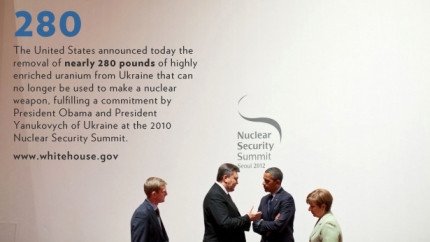
Number of the Day: 280 (March 27, 2012)

Two years ago, President Obama welcomed leaders from nearly 50 countries to Washington, DC to discuss nuclear weapons and lay out a framework for reducing their threat to global security.

Yesterday, in South Korea, the President said that the world has made significant progress in achieving that initial set of goals:

We are fulfilling the commitments we made in Washington. We are improving security at our nuclear facilities. We are forging new partnerships. We are removing nuclear materials, and in some cases, getting rid of these materials entirely. And as a result, more of the world's nuclear materials will never fall into the hands of terrorists who would gladly use them against us.

And today, we saw another bit of tangible evidence of that success when the United States announced that more than 280 pounds of highly enriched uranium from the Ukraine have been transferred to Russia, where it will be downblended into low enriched uranium -- which can't be used to make a nuclear weapon.

President Obama’s Bilateral Meeting with Prime Minister Gilani of Pakistan

March 27, 2012 | 4:10 | Public Domain

President Obama and Prime Minister Yousaf Raza Gilani of Pakistan speak to the press before a bilateral meeting on areas of mutual interest such as combating terrorism internationally and in their respective countries, economic development, and national security.

Download mp4 (40MB) | mp3 (9MB)

Read the Transcript

Remarks by President Obama and Prime Minister Gilani of Pakistan before Bilateral Meeting

Coex Center
Seoul, Republic of Korea


5:16 P.M. KST


PRESIDENT OBAMA:  Well, I want to say how much I appreciate the opportunity to meet once again with Prime Minister Gilani and his delegation. 

Obviously, the United States and Pakistan have a host of mutual interests.  We’re both interested in combating terrorism, both internationally and in our respective countries. We both are interested in economic development.  We’re both interested in nuclear security, as evidenced by our presence here today.  And we have been working together because we’re both interested in a stable and secure Afghanistan and a stable and secure region that will benefit not only Pakistan but also the entire world.

I want to express my appreciation to Prime Minister Gilani for the work that he’s done in trying to strengthen the relationship between our two countries.  There have been times -- I think we should be frank -- over the last several months where those relations have experienced strains.  But I welcome the fact that the parliament in Pakistan is reviewing, after some extensive study, the nature of this relationship.  I think that it’s important for us to get it right.  I think it’s important for us to have candid dialogue to work through these issues in a constructive fashion and a transparent fashion. 

And my expectation is, is that as a consequence of the review that’s taking place in Pakistan as well as the work that we’re doing on the American side, that we can achieve the kind of balanced approach that respects Pakistan’s sovereignty, but also it respects our concerns with respect to our national security and our needs to battle terrorists who have targeted us in the past.

I also want to express to the Prime Minister my appreciation for his recognition that it’s in both of our interests and indeed in all of our interests to see an Afghan-led reconciliation process that needs to take place.  And I appreciate the Prime Minister’s statement in that regard. 

And finally, I want to express my thanks for his participation in this conference, because I think that we all agree that given the threats that have been directed in Pakistan, the terrorism that has taken place on their own soil, and obviously our experiences with terrorism, we can’t afford to have non-state actors, terrorists, get their hands on nuclear weapons that could end up destroying our cities or harming our citizens. 
So, Mr. Prime Minister, of course, I very much appreciate you being here.  And, please.

PRIME MINISTER GILANI:  Thank you so much.  First of all, I want to thank Mr. President for sparing this opportunity to meet me and my delegation in Seoul.

And we are committed to fight against extremism and terrorism.  It is in the interest of Pakistan for a stable, peaceful, prosperous, independent, sovereign Afghanistan.  We want stability in Afghanistan.  If there is a stability in Afghanistan it's a stability in Pakistan, and peace for Afghanistan and Pakistan.  We want to work together with you to have all the peace, prosperity and progress of the whole world.  And we want to work together. 

I appreciate that you have said good words about Pakistan, that you want to respect the sovereignty of our country.  So we are picking that up at our parliamentary session and we are -- and we are to go into that Sunday to the parliament.

PRESIDENT OBAMA:  Save travels.

PRIME MINISTER GILANI:  Thank you.

Thank you, everybody.

END
5:20 P.M. KST 

Close Transcript

The White House

Office of the Press Secretary

Statement by the Press Secretary on Clashes along the Border of Sudan and South Sudan

The United States is alarmed by the fighting in Southern Kordofan, Sudan, and along a disputed area of the border between Sudan and South Sudan. Both sides must exert the greatest restraint in this situation.

It is critical that the two countries proceed with plans for meetings of the Joint Political Security Mechanism and the Abyei Joint Operations Committee in late March and the presidential summit on April 3. Only through direct contact and negotiations over fundamental issues of security and border management in Southern Kordofan, Blue Nile, and Abyei can Sudan and South Sudan avoid further fighting, achieve vitally needed economic cooperation, and coexist in peace. We also urge Darfur armed movements and the Sudan People’s Liberation Movement–North to exercise restraint and cooperate fully with restoration of peace.

Achieving humanitarian access and protection of the civilian population must be the priority of all those concerned for the people of Southern Kordofan and Blue Nile.

The White House

Office of the Press Secretary

Readout of the President’s Discussion with President Yanukovych

The President and Ukrainian President Yanukovych spoke today at the Nuclear Security Summit in Seoul, South Korea.  President Obama expressed appreciation to President Yanukovych and the  Ukrainian people for the complete removal of highly enriched uranium from their country as a sign of Ukraine’s continuing courageous leadership on nuclear security.  The leaders  agreed this is an important step towards securing all vulnerable nuclear materials and is an important milestone for global security.  The President underscored the importance of  demonstrating the vitality of Ukrainian democracy by ensuring free, fair, and transparent parliamentary elections in October.  The President also raised U.S. concerns about selective prosecutions of the political opposition.

The White House

Office of the Press Secretary

Remarks by President Obama and Prime Minister Gilani of Pakistan before Bilateral Meeting

Coex Center
Seoul, Republic of Korea

5:16 P.M. KST

PRESIDENT OBAMA:  Well, I want to say how much I appreciate the opportunity to meet once again with Prime Minister Gilani and his delegation. 

Obviously, the United States and Pakistan have a host of mutual interests.  We’re both interested in combating terrorism, both internationally and in our respective countries. We both are interested in economic development.  We’re both interested in nuclear security, as evidenced by our presence here today.  And we have been working together because we’re both interested in a stable and secure Afghanistan and a stable and secure region that will benefit not only Pakistan but also the entire world.

I want to express my appreciation to Prime Minister Gilani for the work that he’s done in trying to strengthen the relationship between our two countries.  There have been times -- I think we should be frank -- over the last several months where those relations have experienced strains.  But I welcome the fact that the parliament in Pakistan is reviewing, after some extensive study, the nature of this relationship.  I think that it’s important for us to get it right.  I think it’s important for us to have candid dialogue to work through these issues in a constructive fashion and a transparent fashion. 

And my expectation is, is that as a consequence of the review that’s taking place in Pakistan as well as the work that we’re doing on the American side, that we can achieve the kind of balanced approach that respects Pakistan’s sovereignty, but also it respects our concerns with respect to our national security and our needs to battle terrorists who have targeted us in the past.

I also want to express to the Prime Minister my appreciation for his recognition that it’s in both of our interests and indeed in all of our interests to see an Afghan-led reconciliation process that needs to take place.  And I appreciate the Prime Minister’s statement in that regard. 

And finally, I want to express my thanks for his participation in this conference, because I think that we all agree that given the threats that have been directed in Pakistan, the terrorism that has taken place on their own soil, and obviously our experiences with terrorism, we can’t afford to have non-state actors, terrorists, get their hands on nuclear weapons that could end up destroying our cities or harming our citizens. 
So, Mr. Prime Minister, of course, I very much appreciate you being here.  And, please.

PRIME MINISTER GILANI:  Thank you so much.  First of all, I want to thank Mr. President for sparing this opportunity to meet me and my delegation in Seoul.

And we are committed to fight against extremism and terrorism.  It is in the interest of Pakistan for a stable, peaceful, prosperous, independent, sovereign Afghanistan.  We want stability in Afghanistan.  If there is a stability in Afghanistan it's a stability in Pakistan, and peace for Afghanistan and Pakistan.  We want to work together with you to have all the peace, prosperity and progress of the whole world.  And we want to work together. 

I appreciate that you have said good words about Pakistan, that you want to respect the sovereignty of our country.  So we are picking that up at our parliamentary session and we are -- and we are to go into that Sunday to the parliament.

PRESIDENT OBAMA:  Save travels.

PRIME MINISTER GILANI:  Thank you.

Thank you, everybody.

END
5:20 P.M. KST 

President Obama Makes a Trilateral Announcement with the Presidents of Russia and Kazakhstan

March 27, 2012 | 15:50 | Public Domain

President Obama, President Dmitry Medvedev of Russia, and President Nursultan Nazarbayev of Kazakhstan make a statement at the National Security Summit in South Korea about progress the three countries have made together toward making sure that loose nuclear material is not vulnerable to smuggling or to potential terrorist plots.

Download mp4 (151MB) | mp3 (36MB)

Read the Transcript

Remarks by President Obama, President Medvedev of Russia, and President Nazarbayev of Kazakstan at Trilateral Announcement

Coex Center
Seoul, Republic of Korea

12:00 P.M. KST
 
PRESIDENT NAZARBAYEV:  (As interpreted.)  Well, probably as all of you know that Semipalatinsk nuclear test site was one of the largest nuclear test sites in the world, together with Nevada.  And about 500 nuclear tests have been carried out on this test site, 70 of them in the open air. 
 
And the polygon was closed by my first decree as the President of Kazakhstan 20 years ago, and since then, together with Russia and the United States, we have been working to rehabilitate the territory around the Semipalatinsk test site.  And since 2004, we were able to rehabilitate from radiation about 3,000 square kilometers of the polygon.  The total polluted area is about 40,000 square kilometers.  And as a result of tests in the past, about 1.5 million people have been radiated.
 
And this is a very good example of close collaboration when all three countries also work on getting rid of the military infrastructure on the polygon.  And you probably know that about 1,100 warheads have been deployed on military missiles on the territory of the polygon in military launching shafts.  And we closed that also, together with the help of Russian and American partners.  And we are very grateful, the people of Kazakhstan are very grateful for that assistance, and we hope that we'll be able to work together in the future for a safer world on nuclear non-proliferation.
 
PRESIDENT OBAMA:  Well, I'm going to just make a very brief statement here.  We wanted to do this brief appearance to highlight one of the most significant examples of what we've been doing through this Nuclear Security Summit, and what our three countries have been able to accomplish through some painstaking cooperation over the last several years.
 
As President of Kazakhstan indicated, this was a major site for nuclear operations during the Cold War.  There was a lot of loose nuclear material that was vulnerable to potential smugglers, to potential infiltration.  And as a consequence of extraordinary cooperation between our three countries that actually predates my administration, but was accelerated as a consequence of this Nuclear Security Summit, we've been able to effectively lock down and secure all this vulnerable material.
 
So we have been able to do this in part because of the outstanding leadership of President Nazarbayev and the people of Kazakhstan.  We've also been able to do it because the United States and Russia over the last several years have shown ourselves to have a mutual interest in making sure that nuclear materials are secured and that they do not fall into the wrong hands.
 
And so this kind of multilateral cooperation is being duplicated as a consequence of this Nuclear Security Summit.  And it gives you a specific example of the kind of progress that we're making.  We're going to need to make more progress over the next several years.  But I am confident that we can actually meet the goal that we set in the first Washington summit, which is in four years to have made extraordinary progress in making sure that loose nuclear material is not vulnerable to smuggling or to potential terrorist plots.
 
PRESIDENT MEDVEDEV:  (As interpreted.)  Summits are held not only to conduct meetings, not only to shake hands, not only to declare good goals, but it is also held to demonstrate examples
concrete examples of cooperation.  I believe that this is precisely one of such concrete examples. 
 
From 2004, the three countries -- United States, Kazakhstan and Russia -- have been cooperating to eliminate the remnants of the past activities within the territory of the Semipalatinsk test site.  We were all aware of the threat coming from the test site.  And at the moment, now, we can state with confidence that all the threats have been liquidated, and that the Semipalatinsk test site can now develop in a new capacity.  The country of Kazakhstan can look into the future.  So I believe that this is a good example of practical cooperation that should be highlighted.
 
I would like to thank my partners, in particular President of Kazakhstan Nazarbayev, for his proactive stance and for creating favorable conditions to accomplish those goals.  The Russian Federation and the United States are precisely those countries which have a special responsibility for ensuring nuclear security of the world, and they managed to join efforts in this good example of cooperation. 
 
Although we're aware that the situation we had was the result of the mindset of the past that countries had, we managed to show this good example of cooperation, and such example I believe should multiply, should be reproduced, and should also lead other countries to ensure nuclear security.
 
PRESIDENT OBAMA:  Thank you very much.
 
Q    Mr. President, can I ask you quickly about the open mic?  Can you clarify what you meant by having flexibility on missile defense in a second term, what you wanted to have passed on to Mr. Putin?  And isn't it presumptuous to be talking about a second term?
 
PRESIDENT OBAMA:  First of all, are the mics on?  (Laughter.)  Look, what I said yesterday, Ben, is I think something that everybody in this room understands, which is -- I'll just go ahead and then you can translate at the end.
 
Arms control is extraordinarily complex, very technical, and the only way it gets done is if you can consult and build a strong basis of understanding both between countries as well as within countries.  And when you think about the New Start Treaty that Dmitry and I were able to hammer out and ultimately get ratified, that was a painstaking two-year process.  I don't think it's any surprise that you can't start that a few months before a presidential and congressional elections in the United States, and at a time when they just completed elections in Russia and they're in the process of a presidential transition where a new president is going to be coming in in a little less than two months.
 
So it was a very simple point, and one that essentially I repeated when I spoke to you guys yesterday, which is that we're going to spend the next nine, 10 months trying to work through some of the technical aspects of how we get past what is a major point of friction -- one of the primary points of friction between our two countries, which is this whole missile defense issue.  And it involves a lot of complicated issues.  If we can get our technical teams to clear out the underbrush, then hopefully, in 2013, there's a foundation to actually make some significant progress on this and a lot of other bilateral issues.
 
So I think everybody understands that -- if they haven't they haven't been listening to my speeches -- I want to reduce our nuclear stockpiles.  And one of the barriers to doing that is building trust and cooperation around missile defense issues.  And so this is not a matter of hiding the ball, I'm on record.  I made a speech about it to a whole bunch of Korean university students yesterday.  I want to see us, over time, gradually, systematically, reduce reliance on nuclear weapons.
 
And as Dmitry said, the United States and Russia, because of our history and because we are nuclear superpowers, have a special obligation.  That doesn't make it easy, because both countries are committed to their sovereignty and their defense.
 
And last point I'll make -- the only way I get this stuff done is if I'm consulting with the Pentagon, if I'm consulting with Congress, if I've got bipartisan support.  And frankly, the current environment is not conducive to those kinds of thoughtful consultations.  I think the stories you guys have been writing over the last 24 hours is probably pretty good evidence of that. I think we'll do better in 2013.
 
All right.  Thanks, guys.
 
END                    
12:16 P.M. KST
 

Close Transcript