President Obama’s Bilateral Meeting with President Medvedev of Russia

March 26, 2012 | 21:22 | Public Domain

President Obama and President Dmitry Medvedev of Russia speak to the press after a bilateral meeting in Seoul.

Download mp4 (204MB) | mp3 (49MB)

Read the Transcript

Remarks by President Obama and President Medvedev of Russia After Bilateral Meeting

Millennium Seoul Hilton Hotel
Seoul, Republic of Korea

1:01 P.M. KST
 
PRESIDENT MEDVEDEV:  (As interpreted.)  So I would like to start by saying, once again, that together with my friend and colleague Barack Obama, we had a very substantial discussion of different issues of our agenda of bilateral cooperation between the United States and Russia.
 
I told Barack that despite the fact that reset that has been largely debated over the past three years get different assessments, I still believe that it was an extremely useful exercise, and we probably enjoyed the best level of relations between the United States and Russia during those three years than ever during the previous decades.  And we managed to achieve a lot in various areas.  First and foremost, that was the New START Treaty that was signed.  And we also managed to establish close cooperation on the most sensitive international issues.
 
And I would like to especially thank the U.S. President for his huge work and huge support in Russia's accession to the WTO.  In my view, that was an extremely important topic, and I hope that we will be able to achieve similar successes in resolving remaining issues, such as the revoke of Jackson-Vanik amendment.
 
Lots remains to be done, of course, in terms of trade and economic relations.  We need to bring them to the new level through increasing the volume of trade and raising the general level and pace of cooperation.  And I believe that it would serve the interests of the U.S. companies and the U.S. citizens, especially now that the global economy is experiencing the turbulent times.
 
We, of course, as usual, discussed various international issues, including the most difficult ones, such as Syria.  Yesterday, I had a very good meeting with the special envoy of the U.N. Secretary General, Mr. Annan, and like I told the U.S. President, we believe that his mission is very good and we hope that he will be able to reach good results, and to somewhat appease, at least initially, the situation, and would help to establish communication between various public groups and forces that exist in Syria.  And yesterday, I expressed my every support to Mr. Annan.
 
Anyways, we need to make sure that we not end up in greater problems than we already have, and that the threat of the civil war is averted, that it does not become reality, and that this mission would lead to dialogue between all the groups that exist in the country and government authorities.
 
Of course, we also spoke about the situation in the Middle East.  We touched upon the Iranian nuclear program, the North Korean nuclear program, other sensitive issues -- Afghanistan cooperation.  So I guess we touched upon all main issues and gave all main positions.
 
Of course, we also spoke about the missile defense.  I believe we still have time; time hasn't run out.  And now we need to discuss and cooperate on various aspects on European missile defense.  I believe such discussion could be more active.  Now, in my view, time has come for discussions between technical aspects and, of course, we remain at our own positions, both the United States and Russian Federation.  But I believe we still have time to agree on a balanced solution, and I believe that the good experience Barack and myself have gained while working on the START Treaty will help us and be very useful when finding solution to this very difficult problem.
 
And of course, Barack, I would like to take the opportunity to say how much I enjoyed the cooperation we had with you.  And I believe that it really was the highlight of the previous years.  And due to the high level of cooperation, we managed to resolve various complicated issues bilaterally -- national agenda.  And I hope that the same high level of our relations will remain between the United States of America and the Russian Federation when the new President steps in office. 
 
And I would like to -- I already invited you to visit Russia.  I understand that this year will be difficult for you, since it's an election year.  But still, I hope that you will be able to come.  I already invited you to my hometown, St. Petersburg, so I would like to take the occasion to reiterate my invitation on behalf of myself and President-elect Vladimir Putin.
 
PRESIDENT OBAMA:  Thank you.  Well, first of all, let me just say that the last three years of my work with President Medvedev has been extremely productive.  And he listed some of the achievements that has resulted from this work -- the New START Treaty reduces our nuclear stockpiles in ways that can help create greater peace and security not just for our countries but for the world, and is consistent with our obligations under the Non-Proliferation Treaty.
 
Russia's ascension into the WTO can open up trade and commerce between our two countries that can create jobs and economic growth for both Russians and Americans.  And as Dmitry mentioned, we think it's going to be very important for us to address Jackson-Vanik so that American businesses can fully take advantage of an open and liberalized Russian market.
 
It is true that there have been times where we have had to manage tensions between our countries, and that's to be expected.  Obviously, there are always tensions between countries, and that's certainly true given the long history of the Cold War between our two countries.  But what I think we've been able to do is to ensure that rather than look backwards, we've been looking forwards.
 
Sorry, translator, I forgot you were there.  (Laughter.)  I got on a roll.
 
Moving forward, we've got more work to do between our two countries.  Dmitry identified some areas of continued friction
-- missile defense being an example.  And what we've agreed to is to make sure that our teams, at a technical level, are in discussions about how some of these issues can be resolved.
 
The bilateral presidential commission that was chaired by Foreign Minister Lavrov and Secretary of State Clinton, will be working actively around a number of the trade and commercial issues, not only with respect to WTO but how we can more vigorously expand the kind of investment and the kind of cooperation on the economic front that can benefit both Russia and the United States. 
 
On the international front, we agreed that, as two of the world’s leading powers, it’s absolutely critical that we communicate effectively and coordinate effectively in responding to a wide range of situations that threaten world peace and security. 
 
So on Syria, although there had been some differences over the last several months, we both agree that we should be supportive of Kofi Annan’s efforts to try to end some of the bloodshed that’s taking place within Syria and move towards a mechanism that would allow for the Syrian people ultimately to have a representative and legitimate government that serves their interest.
 
On Iran, we agree that the P5-plus-1 talks with Iran that should be announced soon offer us an opportunity to resolve diplomatically the critical issue of ensuring that Iran is abiding by its international obligations, that will allow it to rejoin the community of nations, and have peaceful uses of nuclear energy while not developing nuclear weapons.
 
And with respect to North Korea, we are going to be both sending messages to North Korea that they should not go forward with this missile launch, which would violate existing U.N. Security Council resolutions.  And our hope is, is that we can resolve these issues diplomatically.
 
So let me just say that at a time of great challenges around the world, cooperation between the United States and Russia is absolutely critical to world peace and stability.  And I have to say that I could not have asked for a better partner in forging that strong relationship than Dmitry.  I am confident that in his new role he is going to continue to have an outstanding influence in world affairs and help to continue to deepen and improve the relationship between our two countries. 
 
I wish him all the best.  And I would love to visit St. Petersburg.  He is absolutely right that my next visit to Russia will undoubtedly be after my election.  (Laughter.) 
 
Good luck, my friend.
 
END  
1:23 P.M. KST
 

Close Transcript

Ask President Obama


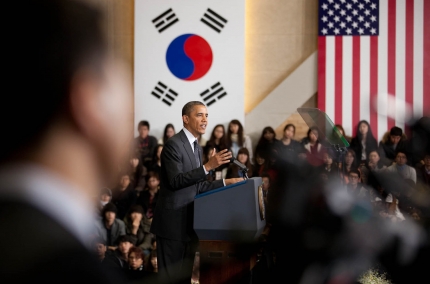
President Barack Obama delivers remarks at Hankuk University in Seoul

President Barack Obama delivers remarks at Hankuk University of Foreign Studies in Seoul, Republic of Korea, March 26, 2012. (Official White House Photo by Pete Souza)

The U.S. Embassy in Seoul held a competition inviting South Koreans to submit questions via social media for President Obama. The top three most interesting questions received written responses from President Obama – those questions, and the President’s answers, are below.  

Yoo-il Lee, CEO of a Korean trade company: WHAT IS KOREA TO YOU?

You mentioned Korea more often than any other countries in your official speeches. It is not easy for the citizens of the Republic of Korea to accurately look back at themselves. At the same time, I feel proud whenever you mention Korea in your speeches. At the beginning of a new year, many Koreans wonder how many times you will mention Korea throughout the year. To you, what is Korea that you mention it so often in your official speeches? What are your thoughts on the Korean people?

I mention the Republic of Korea often in my speeches because it is both a strong ally for the United States, and an extraordinary example to the world. Because our two countries have stood together, the people of South Korea were able to build a democratic and economic miracle out of the ruins of war. And today, the Republic of Korea is more than an ally of the United States – it is one of our largest trading partners, which supports prosperity on both sides of the Pacific. 

The Republic of Korea sets a powerful example to the world in how to build a strong and thriving democracy, while standing up for freedom and security on the Korean peninsula and beyond. Our two countries have fought together in war, and stood together in peace, and now we coordinate closely on a range of issues – from nuclear security and non-proliferation, to our efforts in Afghanistan and Haiti, to our work supporting development and humanitarian assistance around the globe. And in the face of unprovoked attacks on your citizens, South Koreans have shown great strength and resilience. 

Korea’s success is a tribute to the sacrifices and tenacity of the Korean people. You show what can be achieved when people come together, educate their children, stand up for their values, and pursue a positive vision for their country. I think the Korean story is an important one, and that’s why I will continue to speak about it. 

Related Topics: Foreign Policy

President Obama Speaks at Hankuk University

March 26, 2012 | 29:37 | Public Domain

President Obama speaks to faculty, staff and students of Hankuk University in Seoul about global progress toward nuclear non-proliferation.

Download mp4 (283MB) | mp3 (68MB)

The White House

Office of the Press Secretary

Belgium-France-Netherlands-United States Joint Statement: Minimization of HEU and the Reliable Supply of Medical Radioisotopes

Gathered in Seoul on the occasion of the second Nuclear Security Summit, leaders of Belgium, France, the Netherlands and the United States reaffirm their commitment to minimize the use of Highly Enriched Uranium (HEU) for civilian purposes, where technically and economically feasible, in order to advance the goal of nuclear security, as stated in the Washington Final Communiqué and Work Plan. Belgium, France, the Netherlands, and the United States have committed to a set of activities designed to concurrently minimize the use of HEU and ensure a reliable supply of medical isotopes for patients worldwide in need of vital medical diagnostic treatments. 

Currently, in some facilities, HEU is still indispensable to produce medical radioisotopes used for radiopharmaceutical products. Belgium, France, and the Netherlands, as leading European countries involved in producing isotopes, have a special responsibility to ensure their reliable supply, for the benefit of the international medical community and patients worldwide. They have demonstrated their ability to find solutions for temporary shortages by prompt redirection of medical radioisotope production during the recent supply crises.

The four countries acknowledge that HEU, which can be directly used for the manufacture of nuclear explosive devices, is particularly sensitive and requires special precautions. For this reason, Belgium, France, the Netherlands, and the United States underscore the importance of activities to continue to ensure that security measures employed at all facilities using HEU, including medical isotope production facilities, provide protection at least comparable to commitments in international treaties and to the recommendations set forth in International Atomic Energy Agency information circular INFCIRC/225 as revised.

In this context, Belgium, the Netherlands, and France, in cooperation with the United States, reaffirm their determination to support conversion of European production industries to non-HEU-based processes by 2015, subject to regulatory approvals, to reach a sustainable medical isotope production for the benefit of patients in Europe, the United States and elsewhere. As a result, in the longer term, the use of HEU will be completely eliminated for medical isotopes that are produced in Belgium, France, and The Netherlands and used in those countries and in the United States.

At the same time, with the objective of HEU minimization and with a view to an overall effective decrease of HEU-amounts, Belgium, France, and the Netherlands will deal in a responsible manner with existing large amounts of scrap HEU resulting from past activities by recycling or disposing them, with the support of the United States and other partners.

In light of these efforts and until this conversion has taken place, the United States is  prepared to supply the three countries with the necessary HEU target material to ensure uninterrupted production of medical isotopes urgently needed for diagnosing heart disease, cancer, and studying organ structure and function, while achieving the goal of HEU minimization.

The White House

Office of the Press Secretary

Remarks by President Obama and President Nursultan Nazarbayev of the Republic of Kazakhstan Before Bilateral Meeting

Grand Hyatt
Seoul, Republic of Korea

2:27 P.M. KST
 
PRESIDENT OBAMA:  It is wonderful to see once again President Nazarbayev from Kazakhstan.  And I want to first of all congratulate him on his leadership for the issues that are going to be discussed over the next two days.
 
Twenty years ago, Kazakhstan made a decision not to have nuclear weapons.  And not only has that led to growth and prosperity in his own country, but he has been a model in efforts around the world to eliminate nuclear materials that could fall into the wrong hands.  So I very much appreciate his leadership.
 
In fact, one of the major deliverables that will take place at the summit is a outstanding effort to deal with nuclear materials that were carried over from the Soviet era.  Working with Russia and the United States, Kazakhstan has been able to secure those materials, and that makes us all safer.
 
I know that we’ll have an opportunity during this bilateral meeting to also discuss some of the other efforts that Kazakhstan has made when it comes to highly-enriched uranium, plutonium, their efforts at helping to develop a international fuel bank that can lessen the need for countries to pursue their own enrichment capabilities.
 
So across the board, Kazakhstan has been a key leader on these issues and is appropriately going to be featured during the next two days at this nuclear security summit.
 
The close relationship between our two countries extends beyond just the nuclear security issue, so this meeting will give us an opportunity to discuss the cooperation that we have built over the last several years with respect to Afghanistan and the help we've received in supplying our troops and helping to assist the Afghan government. 
 
We obviously have commercial tie as well, and we’ll be discussing how we can deepen those.  I’ll be interested in discussing with the President efforts to further expand democracy and human rights within Kazakhstan, which will help to lead to further growth and prosperity in the future.
 
And so I very much appreciate his leadership and his efforts.  And I look forward to continuing to strengthen the relationship between our two countries. 
 
PRESIDENT NAZARBAYEV:  (As interpreted.)  Well, I'm very grateful for this opportunity to participate in this important summit in Seoul.  We are discussing a very crucial issue of nuclear security.  And I am very grateful to you, Mr. President, for the invitation to participate at the Washington summit, and now we are here in Seoul to discuss a very important issue.
 
Mr. President, I support your call to all nations to struggle for a nuclear-free world and we fully support the nuclear strategy of the United States, and we say that all the countries that support the Non-Proliferation Treaty will get the support of nuclear powers and will never be threatened by any nuclear state.  And I think this is very important.
 
You discussed in detail your plan -- the joint work that we carry out between our nations.  And Kazakhstan 20 years ago was the first country to close its nuclear test site -- in Semipalatinsk we voluntarily renounced our nuclear arsenal.  And you know very well that at that time, on the territory of Kazakhstan, there was 1,100 warheads were deployed on the intercontinental missiles. 
 
And in the last years we have worked closely -- Russia, the United States and Kazakhstan -- to demolish the infrastructure that was left over on the polygon, and we did a lot to rehabilitate the part of the Kazakhstan territory that was radiated.  And the people of Kazakhstan who suffered a lot and who lost many lives in that tragedy, they appreciate that effort very much.
 
And we work very closely with the United States, and we have achieved a lot.  We work jointly on many projects.  About $20 billion U.S. dollars have been invested in the Kazakhstan economy so far.  And 80 percent of all foreign investments that were directed to Central Asia ended up in Kazakhstan.  And I always show this collaboration as a very shining and proud example of good collaboration.  And I talk to all the nuclear powers and those who are threshold countries, and I talked to the leaders of Iran and I explained that they can get better collaboration with the two countries and start to peace.
 
And of course we work very closely on stopping terrorism, on Afghanistan, and the issues of transportation and transit through the territory of Kazakhstan that we discussed two years ago.
 
And, Mr. President, we hope that the good and strong relations between us and the United States will strengthen further in the future, especially in economics and politics.  And we're ready to work shoulder to shoulder on this particular issue of nuclear safety and in other -- all of the issues that we believe that will involve our part of the world.
 
PRESIDENT OBAMA:  Thank you, everybody.
 
END
2:39 P.M. KST
 

The White House

Office of the Press Secretary

Italy Fact Sheet: Nuclear Security Summit 2012

Between the 1960s and mid-1980s, Italy had an ambitious nuclear power research program which included heavy water, boiling water, light water, and fast reactors.  In 1979, Italy signed the Non-Proliferation Treaty (NPT) which reaffirmed its commitment to be nuclear weapons free.
 
• In 1987, through a referendum, Italy announced the end of its nuclear energy program, and the Società Gestione Impianti Nucleari (SOGIN) was created in 2001 to decommission and clean up nuclear facilities.
 
• At the 2012 Nuclear Security Summit, Italy has announced it will work jointly with the United States to eliminate its excess highly enriched uranium (HEU) and plutonium.
 
• SOGIN has been working closely for the past year with the U.S. Department of Energy’s National Nuclear Security Administration’s Global Threat Reduction Initiative (GTRI), to identify materials that can be transferred to the United States for disposition.
 
• Italy and the United States will continue to work together to complete the removal of this material in connection with the Nuclear Security Summit in 2014.

The White House

Office of the Press Secretary

Remarks by President Obama and President Hu Jintao of the People's Republic of China Before Bilateral Meeting

Coex Center
Seoul, Republic of Korea

3:31 P.M. KST

PRESIDENT HU:  (As interpreted.)  A month ago, Vice President Xi Jinping made a successful visit to the United States.  I asked him to hand to the President my reply to earlier letter, and I want to thank the American side for the warm hospitality and for all the arrangements made for his visit.
 
Now I'd like to talk to President Obama.
 
PRESIDENT OBAMA:  Well, Mr. President, first of all, I’d like to say -- (inaudible) -- you and your delegation.  And I think that the fact that we have met 11 times during the course of my presidency is an indication of the importance that both of us place on strong U.S.-China relations.
 
I am very pleased to hear that Vice President Xi had a wonderful visit.  We very much enjoyed hosting him in the United States, and he did deliver your letter, which I appreciated very much.
 
I think this is an excellent opportunity for us to discuss a wide range of issues.  First of all, the fact that we are at a nuclear security summit, following up on our discussions in Washington two years ago, shows the progress that the international community has made in preventing nuclear proliferation and making sure that we’ve secured nuclear materials.  And I know that’s in the interest of both the United States and China.
 
I think this is also an opportunity to build on the excellent cooperation and dialogue across all the dimensions of our relationship that we’ve been able to establish over the last three years.  So I’m looking forward to discussing economic and commercial issues, how we can continue to expand trade and make sure that there is strong mutual understanding about the potential benefits of commerce between our two nations, in accordance with the international rules and norms.
 
It also gives us an opportunity to talk about a wide range of international issues.  Obviously of great importance to us and I know to you as well, the situation in North Korea and the situation in Iran -- we both have an interest in making sure that international norms surrounding non-proliferation and preventing destabilizing nuclear weapons is very important; issues like Sudan, where we both have an interest in ensuring peace and stability and development in a previously war-torn region of the world; the situation in the Middle East.  In all of these issues, I think cooperation and coordination between the United States and China is very important not only to the interest of our two countries but to the interest of the world.
 
And so I’m looking forward as always to a constructive, frank, and productive meeting that can ultimately benefit both the peoples of China and the peoples of the United States.
 
END
3:36 P.M. KST
 

The White House

Office of the Press Secretary

Remarks by President Obama and President Medvedev of Russia After Bilateral Meeting

Millennium Seoul Hilton Hotel
Seoul, Republic of Korea

1:01 P.M. KST
 
PRESIDENT MEDVEDEV:  (As interpreted.)  So I would like to start by saying, once again, that together with my friend and colleague Barack Obama, we had a very substantial discussion of different issues of our agenda of bilateral cooperation between the United States and Russia.
 
I told Barack that despite the fact that reset that has been largely debated over the past three years get different assessments, I still believe that it was an extremely useful exercise, and we probably enjoyed the best level of relations between the United States and Russia during those three years than ever during the previous decades.  And we managed to achieve a lot in various areas.  First and foremost, that was the New START Treaty that was signed.  And we also managed to establish close cooperation on the most sensitive international issues.
 
And I would like to especially thank the U.S. President for his huge work and huge support in Russia's accession to the WTO.  In my view, that was an extremely important topic, and I hope that we will be able to achieve similar successes in resolving remaining issues, such as the revoke of Jackson-Vanik amendment.
 
Lots remains to be done, of course, in terms of trade and economic relations.  We need to bring them to the new level through increasing the volume of trade and raising the general level and pace of cooperation.  And I believe that it would serve the interests of the U.S. companies and the U.S. citizens, especially now that the global economy is experiencing the turbulent times.
 
We, of course, as usual, discussed various international issues, including the most difficult ones, such as Syria.  Yesterday, I had a very good meeting with the special envoy of the U.N. Secretary General, Mr. Annan, and like I told the U.S. President, we believe that his mission is very good and we hope that he will be able to reach good results, and to somewhat appease, at least initially, the situation, and would help to establish communication between various public groups and forces that exist in Syria.  And yesterday, I expressed my every support to Mr. Annan.
 
Anyways, we need to make sure that we not end up in greater problems than we already have, and that the threat of the civil war is averted, that it does not become reality, and that this mission would lead to dialogue between all the groups that exist in the country and government authorities.
 
Of course, we also spoke about the situation in the Middle East.  We touched upon the Iranian nuclear program, the North Korean nuclear program, other sensitive issues -- Afghanistan cooperation.  So I guess we touched upon all main issues and gave all main positions.
 
Of course, we also spoke about the missile defense.  I believe we still have time; time hasn't run out.  And now we need to discuss and cooperate on various aspects on European missile defense.  I believe such discussion could be more active.  Now, in my view, time has come for discussions between technical aspects and, of course, we remain at our own positions, both the United States and Russian Federation.  But I believe we still have time to agree on a balanced solution, and I believe that the good experience Barack and myself have gained while working on the START Treaty will help us and be very useful when finding solution to this very difficult problem.
 
And of course, Barack, I would like to take the opportunity to say how much I enjoyed the cooperation we had with you.  And I believe that it really was the highlight of the previous years.  And due to the high level of cooperation, we managed to resolve various complicated issues bilaterally -- national agenda.  And I hope that the same high level of our relations will remain between the United States of America and the Russian Federation when the new President steps in office. 
 
And I would like to -- I already invited you to visit Russia.  I understand that this year will be difficult for you, since it's an election year.  But still, I hope that you will be able to come.  I already invited you to my hometown, St. Petersburg, so I would like to take the occasion to reiterate my invitation on behalf of myself and President-elect Vladimir Putin.
 
PRESIDENT OBAMA:  Thank you.  Well, first of all, let me just say that the last three years of my work with President Medvedev has been extremely productive.  And he listed some of the achievements that has resulted from this work -- the New START Treaty reduces our nuclear stockpiles in ways that can help create greater peace and security not just for our countries but for the world, and is consistent with our obligations under the Non-Proliferation Treaty.
 
Russia's ascension into the WTO can open up trade and commerce between our two countries that can create jobs and economic growth for both Russians and Americans.  And as Dmitry mentioned, we think it's going to be very important for us to address Jackson-Vanik so that American businesses can fully take advantage of an open and liberalized Russian market.
 
It is true that there have been times where we have had to manage tensions between our countries, and that's to be expected.  Obviously, there are always tensions between countries, and that's certainly true given the long history of the Cold War between our two countries.  But what I think we've been able to do is to ensure that rather than look backwards, we've been looking forwards.
 
Sorry, translator, I forgot you were there.  (Laughter.)  I got on a roll.
 
Moving forward, we've got more work to do between our two countries.  Dmitry identified some areas of continued friction
-- missile defense being an example.  And what we've agreed to is to make sure that our teams, at a technical level, are in discussions about how some of these issues can be resolved.
 
The bilateral presidential commission that was chaired by Foreign Minister Lavrov and Secretary of State Clinton, will be working actively around a number of the trade and commercial issues, not only with respect to WTO but how we can more vigorously expand the kind of investment and the kind of cooperation on the economic front that can benefit both Russia and the United States. 
 
On the international front, we agreed that, as two of the world’s leading powers, it’s absolutely critical that we communicate effectively and coordinate effectively in responding to a wide range of situations that threaten world peace and security. 
 
So on Syria, although there had been some differences over the last several months, we both agree that we should be supportive of Kofi Annan’s efforts to try to end some of the bloodshed that’s taking place within Syria and move towards a mechanism that would allow for the Syrian people ultimately to have a representative and legitimate government that serves their interest.
 
On Iran, we agree that the P5-plus-1 talks with Iran that should be announced soon offer us an opportunity to resolve diplomatically the critical issue of ensuring that Iran is abiding by its international obligations, that will allow it to rejoin the community of nations, and have peaceful uses of nuclear energy while not developing nuclear weapons.
 
And with respect to North Korea, we are going to be both sending messages to North Korea that they should not go forward with this missile launch, which would violate existing U.N. Security Council resolutions.  And our hope is, is that we can resolve these issues diplomatically.
 
So let me just say that at a time of great challenges around the world, cooperation between the United States and Russia is absolutely critical to world peace and stability.  And I have to say that I could not have asked for a better partner in forging that strong relationship than Dmitry.  I am confident that in his new role he is going to continue to have an outstanding influence in world affairs and help to continue to deepen and improve the relationship between our two countries. 
 
I wish him all the best.  And I would love to visit St. Petersburg.  He is absolutely right that my next visit to Russia will undoubtedly be after my election.  (Laughter.) 
 
Good luck, my friend.
 
END  
1:23 P.M. KST
 

The White House

Office of the Press Secretary

Joint Statement by the United States, Chile, Poland, Nigeria, Morocco, Thailand, and the Republic of Korea on the Nuclear Security Summit Outreach Efforts

In order to promote the goals of the 2010 Nuclear Security Communique to secure nuclear material and prevent nuclear terrorism, and specifically its call to strengthen global nuclear security through dialogue and cooperation with all states, the governments of Chile, Poland, Nigeria and Thailand, and Morocco hosted regional outreach meetings as a forum to collaboratively discuss nuclear security challenges in each of their particular regions.  The United States and the Republic of Korea, as hosts of the 2010 Summit and the 2012 Summit, have convened informational meetings at the International Atomic Energy Agency and the United Nations as part of Summit Outreach efforts.

We strongly welcome and promote the continuation of these outreach efforts as we continue to implement the 2010 Communique and Work Plan, the 2012 Communique, and as we prepare for the 2014 Nuclear Security Summit.

The White House

Office of the Press Secretary

Readout by Deputy National Security Advisor for Strategic Communications Ben Rhodes on President Obama and President Medvedev's Bilateral Meeting

Grand Hyatt Hotel
Seoul, Republic of Korea

1:53 P.M. KST
 
MR. RHODES:  This was President Obama's final bilateral meeting with President Medvedev in his current role as President of Russia.  I think as you saw from their remarks, there was a very positive tone to it.  President Medvedev and President Obama began by recounting the things that they'd been able to achieve together -- the New START Treaty, the Russian accession to the WTO, the Northern Distribution Network, and cooperation on a number of global security issues.
 
I think President Medvedev said the same thing in the spray that he said in the meeting, which was that in his view this was the most productive three years in U.S.-Russia relations, certainly since the end of the Cold War.
 
Beyond that, they discussed a number of civic issues.  On the economic front, both leaders expressed their interest in taking advantage of the progress made on the WTO accession to further U.S.-Russian economic cooperation, and President Obama reaffirmed his commitment to make sure that U.S. businesses are able to gain access to Russian markets.  And in that vein, of course, he is pursuing addressing the Jackson-Vanik law in a way that allows U.S. businesses to gain access to Russian markets, and said that we'd be continuing to work with Congress to move forward on that priority.
 
On Syria, the two leaders discussed the differences that the United States and Russia have had on the issue of Syria over the course of the last several months.  However, they did agree that they could find common ground in support for the mission that Kofi Annan has undertaken as a U.N. and Arab League representative.  President Obama made clear his belief that part of the transition envisioned in Kofi Annan's initiative would have to involve President Assad leaving power so that there can be a government that's responsive to the Syrian people.  But the two leaders had expressed an interest in working together going forward in a way that strengthens Kofi Annan and stops the violence in Syria and enables a transition to take place that is, again, far preferable to the type of conflict that we've seen and the potential for even further civil war.
 
On Iran, the two leaders discussed the upcoming P5-plus-1 talks with the Iranian government that are being worked out.  They both agreed that there is a window of opportunity here to pursue diplomacy and that it's essential for both the world and the Iranian government to take advantage of that opportunity.  President Obama again reiterated I think many of the things he's been saying in his bilateral meetings with other leaders and that he's said publicly, which is that, again, we need to move forward with a sense of urgency as we move into these negotiations.  However we do have an opportunity here for the Iranian government to take steps to build the confidence of the international community going forward.
 
On missile defense, I think the two leaders acknowledged that there have been differences on the issue of missile defense. However, I think as was represented in their public comments, they did agree that we should continue to be working on this issue at the technical level; that there are steps that can be taken on both sides to gain better understanding of the U.S. and Russian positions.  And so they directed their respective administrations to continue that type of technical work.  I think President Medvedev cited in the public comments what he said privately, which is that the New START Treaty had indicated that a lot of technical work, a lot of consultation over time at all levels of government can allow for a better understanding and allow for resolution of difficult issues, and that that experience would be relevant for continued technical consultations on missile defense.
 
And then finally, on North Korea, the two leaders, again, agreed that the proposed missile launch that the North Koreans have indicated they are going to pursue would be in violation of existing U.N. Security Council resolutions.  President Obama made clear I think what he said in his speech today, which is that the new leadership in North Korea has to understand that only by abandoning this type of provocative behavior will they gain the respect of the international community and the future that their people deserve.  And I think there's agreement that provocative acts like this will only increase North Korea's isolation going forward.
 
So those were the main topics.  I'd be happy to take any questions.
 
Q    What was the invitation and how did that go down?
 
MR. RHODES:  Well, President Medvedev has for some time indicated to President Obama that he'd like him to visit, particularly visit his hometown of St. Petersburg.  So I think he was simply reiterating that invitation.  President Obama has said that he very much would like to visit St. Petersburg and go to Russia again.  Obviously our travel schedule is going to be fairly light between -- over the course of the next several months, so I think it's something he looks forward to doing after November.
 
Q    Was Medvedev referring to anything in particular from the meeting when he said something about he knows agreement would be hard in an election year?
 
MR. RHODES:  Well, I think we -- look, we acknowledge the fact that they, too -- the Russians are going through a transition from the Medvedev government to the Putin government, just as we're going to be undergoing an election year here in the United States.  However, I think their point was that that shouldn’t disrupt work that can be done at the technical level to build confidence, to gain understanding over a period of time so that we can continue to pursue some type of agreement on this in the future. 
 
So that they very much both wanted to signal that they want to keep the door open to potential cooperation on missile defense and agree on missile defense -- I think President Obama said, for instance, in his speech today very clearly that he is interested in pursuing additional reductions in nuclear stockpiles.  We would very much like those discussions about future reductions to include tactical nuclear weapons and non-deployed nuclear weapons.  Whenever we have that discussion with the Russians they obviously want to talk about missile defense because they see it as related to strategic stability even though we don’t.
 
So, again, I think the general view of both leaders was let’s keep the door open here and let’s continue to work at this problem because it’s tied to many other priorities that we have and it’s worth the effort.
 
Q    Were there any messages either to or from Mr. Putin that were conveyed during the meeting, and what were they?
 
MR. RHODES:  Both leaders at the beginning of the bilateral meeting underscored that the call between President Obama and President-elect Putin had gone well.  President Obama said that he looked forward to continuing the type of cooperation we’ve had with Russia under President Medvedev with President-elect Putin. 
 
And I think it is -- I’m confident saying that President Medvedev very much indicated that that was President-elect Putin’s view as well, and that Russia was committed to continuing to pursue the type of cooperation that we’ve had on areas of mutual interest, even as we’re going to have differences along the way. 
 
So it was discussed briefly, and I think the view of both leaders was there's no reason that the cooperation we’ve had shouldn’t continue under President Putin as well.
 
Q    And can you put any meat on the bone in terms of what the President talked about in his speech today about tactical, as well as strategic, and that that was something that he would continue pressing the Russians to do, that it would be -- that that would be something that hadn’t happened before?  Is that something he and Medvedev talked about, or have they agreed to postpone that until Putin?
 
MR. RHODES:  They’ve had some discussion about that over the course of their relationship.  President Obama and President Medvedev agreed on the New START Treaty, which, again, set historic lows in terms of the deployed weapons and launchers that the United States and Russia have levels that we haven’t been at since the 1950s.  However, as he said in his speech, even with those reductions, President Obama very much believes that we can go further, that --
 
Q    The Russians don't?
 
MR. RHODES:  Well, the Russians -- when we've have that conversation with the Russians, when we’ve had those types of preliminary discussions with them, we are very much -- in order to achieve future reductions you have to address things like non-deployed nuclear weapons and tactical nuclear weapons, which were not part of the New START Treaty and had not been part of those negotiations over the previous couple of decades.  So in terms of pursuing our interest in future nuclear stockpile reductions -- which we believe is important to U.S. national security but also to the global non-proliferation regime, because it’s a foundation of the NPT that we’d be moving in the direction, reducing our weapons -- we believe we have to get after those categories of weapons as well.
 
The Russians consistently raise the issue of missile defense because they believe that in the absence of a discussion on missile defense -- just to step back here -- you all know this, but basically our position to them is, our missile defense system is not aimed at you, it’s aimed at threats like North Korea and Iran.  However, the Russians have been skeptical of that, and have said that if there's a missile defense system that upsets strategic stability they’re going to have a difficult time moving forward on a range of issues, including these sets of discussions.
 
So, inevitably, missile defense becomes a part of that discussion.  But I think what the President was signaling in his speech and in his meeting today is that we want to move forward on these; we don’t want to stop where we are.  We want to move forward with reductions.  We want to move forward with cooperation with the Russians.  And we want to move forward in discussing missile defense cooperation in a way that will allow us to continue to make progress.
 
Q    On Iran, did they talk about a specific date for the P5-plus-1?  And can you get into a little bit more into the tone? Because I think the Russians have sort of expressed concern that these talks not be viewed as a last chance that would then sort of lead to an escalation.  Was there a discussion about what might follow additional sanctions?
 
MR. RHODES:  In terms of date, I think that the P5-plus-1 and in particular Cathy Ashton has been working within the
P5-plus-1 and with the Iranians to structure talks going forward, and that would include finalizing the date and location of the first round of those talks.  So that’s not done yet, but I think there’s a sense that we believe we’ll be moving into discussions with the Iranians in the near future.
 
In terms of the tone in the meeting, I think the point that President Obama made very clear to President Medvedev is that there are a range of factors that heighten the sense of urgency around the Iranian nuclear program right now, both in terms of the fact that they are enriching uranium up to 20 percent, that they are moving forward in going with their enrichment program.  There’s obviously tensions in the region between Israel and Iran. But in particular, the fact that Iran has continued to enrich and has continued to enrich up to 20 percent, all of that adds to the sense urgency around talks. 
 
We made clear that there is time and space for diplomacy, but people also have to understand that that time is not unlimited, and therefore this particular round of talks that we’re entering into needs to make progress.  And I think the Russians understand that.  And frankly, they very much want to see diplomatic resolution to this as well, and they expressed their interest in doing that.
 
Q    Just to follow on that, did Medvedev ask about the conversations that Obama -- the President had with Prime Minister Netanyahu?  Did he seek some sense of where the Israelis were on a strike?
 
MR. RHODES:  No.  I think he -- no, I think that there was an understanding, though, of Israel’s position, that the Russians certainly understand Israel’s position.
 
Q    Thanks.
 
Q    Oh, I did want to ask you about Syria.  But I know there are still differences.  Did you move the ball at all beyond the --
 
MR. RHODES:  We think we did, because the focus has been very much on the differences, but what Annan does is it provides a framework for cooperation with the Russians.
 
END   
2:09 P.M. KST