President Obama Discusses Domestic Energy Production in New Mexico

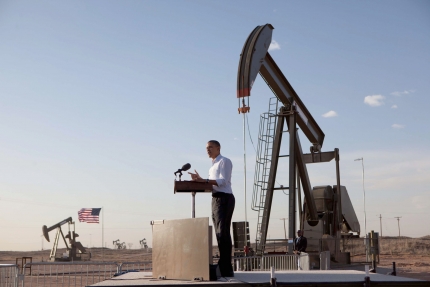
President Barack Obama delivers remarks outside of Maljamar, New Mexico (March 21, 2012)

President Barack Obama delivers remarks highlighting the Administration’s commitment to expanding domestic oil and gas production, at the Maljamar Cooperative Association located on federal lands outside of Maljamar, New Mexico, March 21, 2012. (Official White House Photo by Lawrence Jackson)

The second stop of President Obama's energy tour this week was a set of oil and gas production fields located on federal lands outside of Maljamar, New Mexico. It's currently home to more than 70 active drilling rigs.

He told people in New Mexico:

I’m here to talk about what we’re calling an all-of-the-above energy strategy -- a strategy that relies on producing more oil and gas here in America, but also producing more biofuels in America, more fuel-efficient cars in America, more wind power in America, and more solar power in America.  I believe this all-of-the-above approach is the only way we can continue to reduce our dependence on foreign oil, and ultimately put an end to some of these gas spikes that we’re going through right now and that obviously hurt a lot of families all across the country.

The President's commitment to expanding oil and gas production is very real. Domestic production has increased each year he has been in office. Domestic oil production is currently at an eight year high -- up 13 percent on federal lands alone in the last three years.

The White House

Office of the Press Secretary

Remarks by the President on American-Made Energy

Cushing Pipe Yard
Cushing, Oklahoma

10:22 A.M. CDT

THE PRESIDENT:  Hello, Oklahoma!  (Applause.)  Well, it's good to be here.  Everybody, have a seat.  Have a seat. 

AUIDENCE MEMBER:  I love you, Mr. President!

THE PRESIDENT:  I love you back.  It's wonderful to see you.

It is good to be back in Oklahoma.  I haven’t been back here since the campaign, and everybody looks like they're doing just fine.  (Laughter.)  Thank you so much for your hospitality.  It is wonderful to be here. 

Yesterday, I visited Nevada and New Mexico to talk about what we're calling an all-of-the-above energy strategy.  It’s a strategy that will keep us on track to further reduce our dependence on foreign oil, put more people back to work, and ultimately help to curb the spike in gas prices that we're seeing year after year after year.

So today, I’ve come to Cushing, an oil town -- (applause) -- because producing more oil and gas here at home has been, and will continue to be, a critical part of an all-of-the-above energy strategy.  (Applause.)

Now, under my administration, America is producing more oil today than at any time in the last eight years.  (Applause.)  That's important to know.  Over the last three years, I’ve directed my administration to open up millions of acres for gas and oil exploration across 23 different states.  We’re opening up more than 75 percent of our potential oil resources offshore.  We’ve quadrupled the number of operating rigs to a record high.  We’ve added enough new oil and gas pipeline to encircle the Earth and then some.

So we are drilling all over the place -- right now.  That’s not the challenge.  That's not the problem.  In fact, the problem in a place like Cushing is that we’re actually producing so much oil and gas in places like North Dakota and Colorado that we don’t have enough pipeline capacity to transport all of it to where it needs to go -- both to refineries, and then, eventually, all across the country and around the world.  There’s a bottleneck right here because we can’t get enough of the oil to our refineries fast enough.  And if we could, then we would be able to increase our oil supplies at a time when they're needed as much as possible.

Now, right now, a company called TransCanada has applied to build a new pipeline to speed more oil from Cushing to state-of-the-art refineries down on the Gulf Coast.  And today, I'm directing my administration to cut through the red tape, break through the bureaucratic hurdles, and make this project a priority, to go ahead and get it done.  (Applause.)

Now, you wouldn't know all this from listening to the television set.  (Laughter.)  This whole issue of the Keystone pipeline had generated, obviously, a lot of controversy and a lot of politics.  And that’s because the original route from Canada into the United States was planned through an area in Nebraska that supplies some drinking water for nearly 2 million Americans, and irrigation for a good portion of America's croplands.  And Nebraskans of all political stripes -- including the Republican governor there -- raised some concerns about the safety and wisdom of that route. 

So to be extra careful that the construction of the pipeline in an area like that wouldn’t put the health and the safety of the American people at risk, our experts said that we needed a certain amount of time to review the project.  Unfortunately, Congress decided they wanted their own timeline -- not the company, not the experts, but members of Congress who decided this might be a fun political issue, decided to try to intervene and make it impossible for us to make an informed decision.

So what we’ve said to the company is, we’re happy to review future permits.  And today, we’re making this new pipeline from Cushing to the Gulf a priority.  So the southern leg of it we're making a priority, and we're going to go ahead and get that done. The northern portion of it we're going to have to review properly to make sure that the health and safety of the American people are protected.  That’s common sense. 

But the fact is that my administration has approved dozens of new oil and gas pipelines over the last three years -– including one from Canada.  And as long as I’m President, we’re going to keep on encouraging oil development and infrastructure and we’re going to do it in a way that protects the health and safety of the American people.  We don’t have to choose between one or the other, we can do both.  (Applause.)

So if you guys are talking to your friends, your neighbors, your coworkers, your aunts or uncles and they’re wondering what’s going on in terms of oil production, you just tell them anybody who suggests that somehow we’re suppressing domestic oil production isn’t paying attention.  They are not paying attention.  (Applause.) 

What you also need to tell them is anybody who says that just drilling more gas and more oil by itself will bring down gas prices tomorrow or the next day or even next year, they’re also not paying attention.  They’re not playing it straight.  Because we are drilling more, we are producing more.  But the fact is, producing more oil at home isn’t enough by itself to bring gas prices down. 

And the reason is we’ve got an oil market that is global, that is worldwide.  And I’ve been saying for the last few weeks, and I want everybody to understand this, we use 20 percent of the world’s oil; we only produce 2 percent of the world’s oil.  Even if we opened every inch of the country -- if I put a oil rig on the South Lawn -- (laughter) -- if we had one right next to the Washington Monument, even if we drilled every little bit of this great country of ours, we’d still have to buy the rest of our needs from someplace else if we keep on using the same amount of energy, the same amount of oil. 

The price of oil will still be set by the global market.  And that means every time there’s tensions that rise in the Middle East -- which is what’s happening right now -- so will the price of gas.  The main reason the gas prices are high right now is because people are worried about what’s happening with Iran.  It doesn’t have to do with domestic oil production.  It has to do with the oil markets looking and saying, you know what, if something happens there could be trouble and so we’re going to price oil higher just in case.

Now, that’s not the future that we went.  We don’t want to be vulnerable to something that’s happening on the other side of the world somehow affecting our economy, or hurting a lot of folks who have to drive to get to work.  That’s not the future I want for America.  That's not the future I want for our kids.  I want us to control our own energy destiny.  I want us to determine our own course.

So, yes, we’re going to keep on drilling.  Yes, we’re going to keep on emphasizing production.  Yes, we’re going to make sure that we can get oil to where it’s needed.  But what we’re also going to be doing as part of an all-of-the-above strategy is looking at how we can continually improve the utilization of renewable energy sources, new clean energy sources, and how do we become more efficient in our use of energy.  (Applause.)

That means producing more biofuels, which can be great for our farmers and great for rural economies.  It means more fuel-efficient cars.  It means more solar power.  It means more wind power -- which, by the way, nearly tripled here in Oklahoma over the past three years in part because of some of our policies.

We want every source of American-made energy.  I don’t want the energy jobs of tomorrow going to other countries.  I want them here in the United States of America.  (Applause.)  And that’s what an all-of-the-above strategy is all about.  That’s how we break our dependence on foreign oil.  (Applause.)

Now, the good news is we’re already seeing progress.  Yesterday, I went, in Nevada, to the largest solar plant of its kind anywhere in the country.  Hundreds of workers built it.  It’s powering thousands of homes, and they’re expanding to tens of thousands of homes more as they put more capacity online.

After 30 years of not doing anything, we finally increased fuel-efficiency standards on cars and trucks, and Americans are now designing and building cars that will go nearly twice as far on the same gallon of gas by the middle of the next decade.  And that's going to save the average family $8,000 over the life of a car.  (Applause.)  And it’s going to save a lot of companies a lot of money because they’re hurt by rising fuel costs, as well.

All of these steps have helped put America on the path to greater energy independence.  Since I took office, our dependence on foreign oil has gone down every single year.  Last year, we imported 1 million fewer barrels per day than the year before.  Think about that.  (Applause.)  America, at a time when we’re growing, is actually importing less oil from overseas because we’re using it smarter and more efficiently.  America is now importing less than half the oil we use for the first time in more than a decade.

So the key is to keep it going, Oklahoma.  We’ve got to make sure that we don't go backwards, that we keep going forwards.  If we’re going to end our dependence on foreign oil, if we’re going to bring gas prices down once and for all, as opposed to just playing politics with it every single year, then what we’re going to have to do is to develop every single source of energy that we’ve got, every new technology that can help us become more efficient. 

We’ve got to use our innovation.  We’ve got to use our brain power.  We've got to use our creativity.  We've got to have a vision for the future, not just constantly looking backwards at the past.  That's where we need to go.  That's the future we can build. 

And that's what America has always been about, is building the future.  We've always been at the cutting-edge.  We're always ahead of the curve.  Whether it's Thomas Edison or the Wright Brothers or Steve Jobs, we're always thinking about what's the next thing.  And that's how we have to think about energy.  And if we do, not only are we going to see jobs and growth and success here in Cushing, Oklahoma, we're going to see it all across the country.

All right?  Thank you very much, everybody.  God bless you.  God bless the United States of America.  (Applause.)

END
10:32 A.M. CDT

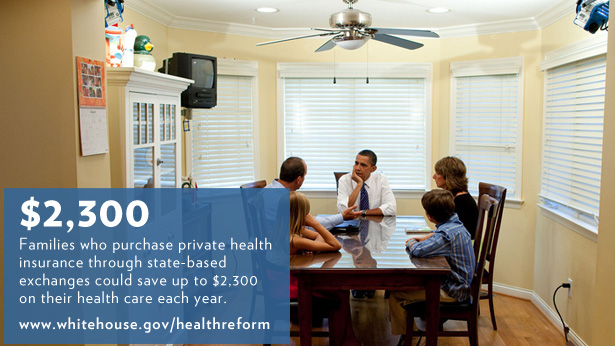
By the Numbers: $2,300

The Affordable Care Act is already helping small business owners with the costs of providing health insurance for their employees, and many Americans now have access to care they didn’t before, including children with pre-exsiting conditions and young adults who can now stay on their parents' plan until age 26. Millions more have access to free preventive services, and seniors are getting help paying for the medications they need.

But, there are provisions in President Obama’s health reform law that don’t take effect until 2014 and will do even more to make health insurance cheaper and easier to obtain for millions of Americans. For example, families who purchase private health insurance through state-based exchanges that come online in 2014 could save up to $2,300 each year on their health care spending.

Exchanges will be a single market where families or individuals can purchase and enroll in an affordable health insurance plan that meets their needs. They’ll be able to compare health plans, get answers to questions about their insurance options, and find out if they are eligible for tax credits for private insurance or health programs like the Children’s Health Insurance Program.

Related Topics: Economy, Health Care

The White House

Office of the Press Secretary

Presidential Memorandum -- Expediting Review of Pipeline Projects from Cushing, Oklahoma, to Port Arthur, Texas, and Other Domestic Pipeline Infrastructure Projects

March 22, 2012

MEMORANDUM FOR THE HEADS OF EXECUTIVE DEPARTMENTS AND AGENCIES

SUBJECT: Expediting Review of Pipeline Projects from Cushing, Oklahoma, to Port Arthur, Texas, and Other Domestic Pipeline Infrastructure Projects

In an economy that relies on oil, rising prices at the pump affect all of us.  With crude oil prices controlling about three-quarters of gasoline prices, the most important driver of the price here at home is the world oil price -- making our economy vulnerable to events halfway around the globe.  There are no quick fixes to this problem.  In the long run we need to reduce America's dependence on oil -- which is why my Administration is implementing historic fuel economy standards for cars and trucks, launching new programs to improve energy efficiency in our buildings, and facilitating the safe and responsible development of our natural gas resources.

But for the foreseeable future, we will continue to rely on oil to help fuel our transportation system.  As a result, we must safely and responsibly develop our oil resources here at home, as part of an all-of-the-above energy strategy to grow our economy and make us more secure.

Because of rising oil production, more efficient cars and trucks, and a world-class refining sector that last year was a net exporter of petroleum products for the first time in 60 years, we have cut net imports by a million barrels a day in the last year alone.  By reducing our dependence on foreign oil, we will make our Nation more secure and improve our trade balance -- creating jobs and supporting domestic industry.

In order to realize these potential benefits, we need an energy infrastructure system that can keep pace with advances in production.  To promote American energy sources, we must not only extract oil -- we must also be able to transport it to our world-class refineries, and ultimately to consumers.

The need for infrastructure is particularly acute right now.  Because of advances in drilling technology that allow us to tap new oil deposits, we are producing more oil from unconventional sources -- places like the Eagle Ford Shale in South Texas, where production grew by more than 200 percent last year, or the Bakken formation of North Dakota and Montana, where output has increased tenfold in the last 5 years alone.  In States like North Dakota, Montana, and Colorado, rising production is outpacing the capacity of pipelines to deliver the oil to refineries.

Cushing, Oklahoma, is a prime example.  There, in part due to rising domestic production, more oil is flowing in than can flow out, creating a bottleneck that is dampening incentives for new production while restricting oil from reaching state-of-the-art refineries on the Gulf Coast.  Moving forward on a pipeline from Cushing to Port Arthur, Texas, could create jobs, promote American energy production, and ultimately benefit consumers.

Although expanding and modernizing our Nation's pipeline infrastructure will not lower prices right away, it is a vital part of a sustained strategy to continue to reduce our reliance on foreign oil and enhance our Nation's energy security.  Therefore, as part of my Administration's broader efforts to improve the performance of Federal permitting and review processes, we must make pipeline infrastructure a priority, ensuring the health, safety, and security of communities and the environment while supporting projects that can contribute to economic growth and a secure energy future.  In doing so, the Federal Government must work in partnership with State, local, and tribal governments, which play a central role in the siting and permitting of pipelines; and, we must protect our natural resources and address the concerns of local communities.

Section 1Expedited Review of Pipeline Projects from Cushing to Port Arthur and Other Domestic Pipeline Infrastructure Projects.  (a)  To address the existing bottleneck in Cushing, as well as other current or anticipated bottlenecks, agencies shall, to the maximum extent practicable and consistent with available resources and applicable laws (including those relating to public safety, public health, and environmental protection), coordinate and expedite their reviews, consultations, and other processes as necessary to expedite decisions related to domestic pipeline infrastructure projects that would contribute to a more efficient domestic pipeline system for the transportation of crude oil, such as a pipeline from Cushing to Port Arthur.  This subsection shall be implemented consistent with my Executive Order of March 22, 2012 (Improving Performance of Federal Permitting and Review of Infrastructure Projects), and applicable projects shall have their status tracked on the online Federal Infrastructure Projects Dashboard referenced therein.

(b)  In expediting reviews pursuant to subsection (a) of this section, agencies shall, to the maximum extent practicable and consistent with applicable law, utilize and incorporate information from prior environmental reviews and studies conducted in connection with previous applications for similar or overlapping infrastructure projects so as to avoid duplicating effort.

Sec. 2General Provisions.  (a)  Nothing in this memorandum shall be construed to impair or otherwise affect:

(i)   the authority granted by law to a department or agency, or the head thereof; or

(ii)  the functions of the Director of the Office of Management and Budget related to budgetary, administrative, or legislative proposals.

(b)  This memorandum shall be implemented consistent with applicable law and subject to the availability of appropriations.

(c)  This memorandum is not intended to, and does not, create any right or benefit, substantive or procedural, enforceable at law or in equity by any party against the United States, its departments, agencies, or entities, its officers, employees, or agents, or any other person.

(d)  The Director of the Office of Management and Budget is hereby authorized and directed to publish this memorandum in the Federal Register.

BARACK OBAMA

The White House

Office of the Press Secretary

Executive Order -- Improving Performance of Federal Permitting and Review of Infrastructure Projects

EXECUTIVE ORDER

- - - - - - -

IMPROVING PERFORMANCE OF FEDERAL PERMITTING
AND REVIEW OF INFRASTRUCTURE PROJECTS

By the authority vested in me as President by the Constitution and the laws of the United States of America, and in order to significantly reduce the aggregate time required to make decisions in the permitting and review of infrastructure projects by the Federal Government, while improving environmental and community outcomes, it is hereby ordered as follows:

Section 1. Policy. (a) To maintain our Nation's competitive edge and ensure an economy built to last, the United States must have fast, reliable, resilient, and environmentally sound means of moving people, goods, energy, and information. In a global economy, we will compete for the world's investments based in significant part on the quality of our infrastructure. Investing in the Nation's infrastructure provides immediate and long-term economic benefits for local communities and the Nation as a whole.

The quality of our Nation's infrastructure depends in critical part on Federal permitting and review processes, including planning, approval, and consultation processes. These processes inform decision-makers and affected communities about the potential benefits and impacts of proposed infrastructure projects, and ensure that projects are designed, built, and maintained in a manner that is consistent with protecting our public health, welfare, safety, national security, and environment. Reviews and approvals of infrastructure projects can be delayed due to many factors beyond the control of the Federal Government, such as poor project design, incomplete applications, uncertain funding, or multiple reviews and approvals by State, local, tribal, or other jurisdictions. Given these factors, it is critical that executive departments and agencies (agencies) take all steps within their authority, consistent with available resources, to execute Federal permitting and review processes with maximum efficiency and effectiveness, ensuring the health, safety, and security of communities and the environment while supporting vital economic growth.

To achieve that objective, our Federal permitting and review processes must provide a transparent, consistent, and predictable path for both project sponsors and affected communities. They must ensure that agencies set and adhere to timelines and schedules for completion of reviews, set clear permitting performance goals, and track progress against those goals. They must encourage early collaboration among agencies, project sponsors, and affected stakeholders in order to incorporate and address their interests and minimize delays.

They must provide for transparency and accountability by utilizing cost-effective information technology to collect and disseminate information about individual projects and agency performance, so that the priorities and concerns of all our citizens are considered. They must rely upon early and active consultation with State, local, and tribal governments to avoid conflicts or duplication of effort, resolve concerns, and allow for concurrent rather than sequential reviews. They must recognize the critical role project sponsors play in assuring the timely and cost-effective review of projects by providing complete information and analysis and by supporting, as appropriate, the costs associated with review. And, they must enable agencies to share priorities, work collaboratively and concurrently to advance reviews and permitting decisions, and facilitate the resolution of disputes at all levels of agency organization.

Each of these elements must be incorporated into routine agency practice to provide demonstrable improvements in the performance of Federal infrastructure permitting and review processes, including lower costs, more timely decisions, and a healthier and cleaner environment. Also, these elements must be integrated into project planning processes so that projects are designed appropriately to avoid, to the extent practicable, adverse impacts on public health, security, historic properties and other cultural resources, and the environment, and to minimize or mitigate impacts that may occur. Permitting and review process improvements that have proven effective must be expanded and institutionalized.

(b) In advancing this policy, this order expands upon efforts undertaken pursuant to Executive Order 13580 of July 12, 2011 (Interagency Working Group on Coordination of Domestic Energy Development and Permitting in Alaska), Executive Order 13563 of January 18, 2011 (Improving Regulation and Regulatory Review), and my memorandum of August 31, 2011 (Speeding Infrastructure Development Through More Efficient and Effective Permitting and Environmental Review), as well as other ongoing efforts.

Sec. 2. Steering Committee on Federal Infrastructure Permitting and Review Process Improvement. There is established a Steering Committee on Federal Infrastructure Permitting and Review Process Improvement (Steering Committee), to be chaired by the Chief Performance Officer (CPO), in consultation with the Chair of the Council on Environmental Quality (CEQ).

(a) Infrastructure Projects Covered by this Order. The Steering Committee shall facilitate improvements in Federal permitting and review processes for infrastructure projects in sectors including surface transportation, aviation, ports and waterways, water resource projects, renewable energy generation, electricity transmission, broadband, pipelines, and other such sectors as determined by the Steering Committee.

(b) Membership. Each of the following agencies (Member Agencies) shall be represented on the Steering Committee by a Deputy Secretary or equivalent officer of the United States:
(i) the Department of Defense;

(ii) the Department of the Interior;
(iii) the Department of Agriculture;
(iv) the Department of Commerce;
(v) the Department of Transportation;
(vi) the Department of Energy;
(vii) the Department of Homeland Security;
(viii) the Environmental Protection Agency;
(ix) the Advisory Council on Historic Preservation;
(x) the Department of the Army; and
(xi) such other agencies or offices as the CPO may invite to participate.

(c) Projects of National or Regional Significance. In furtherance of the policies of this order, the Member Agencies shall coordinate and consult with each other to select, submit to the CPO by April 30, 2012, and periodically update thereafter, a list of infrastructure projects of national or regional significance that will have their status tracked on the online Federal Infrastructure Projects Dashboard (Dashboard) created pursuant to my memorandum of August 31, 2011.

(d) Responsibilities of the Steering Committee. The Steering Committee shall:

(i) develop a Federal Permitting and Review Performance Plan (Federal Plan), as described in section 3(a) of this order;

(ii) implement the Federal Plan and coordinate resolution of disputes among Member Agencies relating to implementation of the Federal Plan; and

(iii) coordinate and consult with other agencies, offices, and interagency working groups as necessary, including the President's Management Council and Performance Improvement Councils, and, with regard to use and expansion of the Dashboard, the Chief Information Officer (CIO) and Chief Technology Officer to implement this order.

(e) Duties of the CPO. The CPO shall:

(i) in consultation with the Chair of CEQ and Member Agencies, issue guidance on the implementation of this order;

(ii) in consultation with Member Agencies, develop and track performance metrics for evaluating implementation of the Federal Plan and Agency Plans; and

(iii) by January 31, 2013, and annually thereafter, after input from interested agencies, evaluate and report to the President on the implementation of the Federal Plan and Agency Plans, and publish the report on the Dashboard.

(f) No Involvement in Particular Permits or Projects. Neither the Steering Committee, nor the CPO, may direct or coordinate agency decisions with respect to any particular permit or project.

Sec. 3. Plans for Measurable Performance Improvement. (a) By May 31, 2012, the Steering Committee shall, following coordination with Member Agencies and other interested agencies, develop and publish on the Dashboard a Federal Plan to significantly reduce the aggregate time required to make Federal permitting and review decisions on infrastructure projects while improving outcomes for communities and the environment. The Federal Plan shall include, but not be limited to, the following actions to implement the policies outlined in section 1 of this order, and shall reflect the agreement of any Member Agency with respect to requirements in the Federal Plan affecting such agency:

(i) institutionalizing best practices for: enhancing Federal, State, local, and tribal government coordination on permitting and review processes (such as conducting reviews concurrently rather than sequentially to the extent practicable); avoiding duplicative reviews; and engaging with stakeholders early in the permitting process;

(ii) developing mechanisms to better communicate priorities and resolve disputes among agencies at the national and regional levels;

(iii) institutionalizing use of the Dashboard, working with the CIO to enhance the Dashboard, and utilizing other cost-effective information technology systems to share environmental and project-related information with the public, project sponsors, and permit reviewers; and

(iv) identifying timeframes and Member Agency responsibilities for the implementation of each proposed action.

(b) Each Member Agency shall:

(i) by June 30, 2012, submit to the CPO an Agency Plan identifying those permitting and review processes the Member Agency views as most critical to significantly reducing the aggregate time required to make permitting and review decisions on infrastructure projects while improving outcomes for communities and the environment, and describing specific and measurable actions the agency will take to improve these processes, including:

(1) performance metrics, including timelines or schedules for review;

(2) technological improvements, such as institutionalized use of the Dashboard and other information technology systems;

(3) other practices, such as pre-application procedures, early collaboration with other agencies, project sponsors, and affected stakeholders, and coordination with State, local, and tribal governments; and

(4) steps the Member Agency will take to implement the Federal Plan.

(ii) by July 31, 2012, following coordination with other Member Agencies and interested agencies, publish its Agency Plan on the Dashboard; and

(iii) by December 31, 2012, and every 6 months thereafter, report progress to the CPO on implementing its Agency Plan, as well as specific opportunities for additional improvements to its permitting and review procedures.

Sec. 4. General Provisions. (a) Nothing in this order shall be construed to impair or otherwise affect:

(i) the authority granted by law to an executive department, agency, or the head thereof; or

(ii) the functions of the Director of the Office of Management and Budget relating to budgetary, administrative, or legislative proposals.

(b) This order shall be implemented consistent with applicable law and subject to the availability of appropriations.

(c) This order shall be implemented consistent with Executive Order 13175 of November 6, 2000 (Consultation and Coordination with Indian Tribal Governments) and my memorandum of November 5, 2009 (Tribal Consultation).

(d) This order is not intended to, and does not, create any right or benefit, substantive or procedural, enforceable at law or in equity by any party against the United States, its departments, agencies, or entities, its officers, employees, or agents, or any other person.

BARACK OBAMA

President Obama Speaks on Expanding Oil and Gas Pipelines

March 22, 2012 | 11:40 | Public Domain

President Obama announces an order to expedite a pipeline project that will help move oil more quickly and efficiently from Cushing, Oklahoma to refineries in the Gulf of Mexico. Encouraging oil development and infrastructure in a way that protects the health and safety of the American people is part of President Obama’s all-of-the-above energy strategy to develop every available source of American energy.

Download mp4 (111MB) | mp3 (27MB)

The White House

Office of the Press Secretary

Statement by the Press Secretary on Mali

The United States strongly condemns the violence initiated by elements of the armed forces of Mali.  We call for the immediate restoration of constitutional rule in Mali, including full civilian authority over the armed forces and respect for the country’s democratic institutions and traditions.  The United States stands by the people of Mali and the legitimately elected government of President Amadou Toumani Touré.  We welcome the strong statements by the African Union and the Economic Community of West African States condemning this unconstitutional seizure of power.

Checking in: Health Reform Across the Country

March 22, 2012 | 4:32 | Public Domain

On the 2 year anniversary of the Affordable Care Act we take a look at what reform means for so many folks across the country.

In September of 2009 We met Nathan and his son, Thomas. Thomas was born with hemophilia, and he hit lifetime limits on his health coverage with two different insurance companies before he turned seven years old. Two years ago, Nathan was hopeful about what the Affordable Care Act would mean.

Last week we spoke with them again and they made it clear: health reform has improved their quality of life. It means they can focus on making sure Thomas has the best possible care. It's changing their lives for the better.

Download mp4 (107MB)

The White House

Office of the Press Secretary

Remarks by the President on Energy

Maljamar, New Mexico

6:16 P.M. MDT

THE PRESIDENT:  Hello, New Mexico!  (Applause.)  It's great to be here!  Everybody have a seat.  I know it's a little windy out here, but you guys are used to it.  It is wonderful to be back in New Mexico.

I want to acknowledge a couple of folks who are here -- well, first, mainly I want to thank Concho Resources and the Southwest New Mexico ConocoPhillips team for helping to set this up.  (Applause.)  Thank you.  Good job, everybody.  (Applause.) 

It was a wonderful trip over here.  We took the helicopter. We landed in Roswell.  I announced to people when I landed that I had come in peace.  (Laughter.)  Let me tell you, there are more 9- and 10-year-old boys around the country -- when I meet them, they ask me, "Have you been to Roswell, and is it true what they say?"  (Laughter.)  And I tell them, "If I told you I'd have to kill you."  So -- and their eyes get all big.  (Laughter.)  So we're going to keep our secrets here.   

I’m here to talk about what we’re calling an all-of-the-above energy strategy -- a strategy that relies on producing more oil and gas here in America, but also producing more biofuels in America, more fuel-efficient cars in America, more wind power in America, and more solar power in America.  I believe this all-of-the-above approach is the only way we can continue to reduce our dependence on foreign oil, and ultimately put an end to some of these gas spikes that we’re going through right now and that obviously hurt a lot of families all across the country.

Now, you wouldn’t know it from listening to some of these folks who are running for office -- I won't mention their names, you know who they are -- but producing more oil here in our own country has been, and will continue to be, a key part of my energy strategy.  Under my administration, America is producing more oil today than at any time in the last eight years.  That’s a fact.  That is a fact.  (Applause.)  We’ve approved dozens of new oil and gas pipelines, and we've announced our support for more -- including one that I'm going to be visiting tomorrow in Oklahoma. 

And we’ve quadrupled the number of operating oil rigs to a record high.  More than 70 of those rigs are right here in this area.  And I had a chance to see them all, I think, as I was flying over here.  (Laughter.)  In fact, business is so good that today the biggest problem is finding enough qualified truck drivers to move all the oil that's coming out of these wells down to the refinery.  Too much oil -- that’s a good problem to have. 
Now, this is public land that’s been leased to the oil companies by the federal government.  And over the last three years, I’ve directed my administration to open up millions of acres just like this for oil and gas exploration in 23 different states.  Let me repeat that -- millions of acres in 23 different states.  That’s just onshore.  Offshore, I’ve directed my administration to open up more than 75 percent of our potential oil resources.  And that includes an area in the Gulf of Mexico that we opened up a few months ago that could produce more than 400 million barrels of oil -- about 38 million acres in the Gulf.

And I want to thank my Secretary of the Interior, Ken Salazar, who is here, because he helped make it happen.  Where did Ken go?  He’s right over here.  (Applause.)

Now, I make this point so that if you hear anybody on TV saying that somehow we’re somehow against drilling for oil then you’ll know that they either don’t know what they’re talking about or they’re not telling you the truth.  We’re drilling all over the place.  That’s one of the reasons we’ve been able to reduce our dependence on foreign oil every year since I took office.  In 2010, it was under 50 percent for the first time in 13 years.  And you have my word that we will keep drilling everywhere we can -- and we’ll do it while protecting the health and safety of the American people.  That’s a commitment that I’m making.  (Applause.) 

Now, there’s no contradiction to say that we’re going to keep on producing American oil and American gas, and also saying drilling can’t be the only part of our energy strategy.  A recent independent analysis showed that over the last 36 years, there has been no connection between the amount of oil that we drill in this country and the price of gasoline.  There’s no connection.  And the reason is that we’ve got a worldwide oil market.  And so even if we produce more, the fact of the matter is we use 20 percent of the world’s oil.  And even if drilled But even if we drilled every square inch of this country, we’d still only have 2 or 3 or 4 percent of the world’s known oil reserves. 

So what ends up happening is the price is impacted not just by us, but by everybody, in the amount of oil that’s used worldwide.  And that means if we don’t develop new sources of energy along with oil and gas, and if we don’t develop technologies to use less energy for the same amount of output, we're always going to depend on other countries for our energy needs. 

If we do nothing, every time there’s instability in the Middle East, we will feel it at the pump even if we're drilling nonstop here in New Mexico and across the country.  If we only drill for our 2 percent of the world’s oil reserves, the price of gas will continue to rise.  Part of the reason is because China and India, they're growing.  China added 10 million cars in 2010 -- 10 million cars just in this one country.  And they're just going to keep on going, which means they're going to use more and more oil.  That’s not a future I want for America. 

In this country, we control our own destiny.  We control our own resources.  We control our own economy.  We chart our own course.  I don’t want to be subject to the whim of somebody somewhere else.  And that’s why we need an all-of-the-above energy strategy.  (Applause.) 

So we're going to develop every possible source of American-made energy.  Oil and gas, wind power, solar power, biofuels, fuel-efficient cars and trucks that get more miles to the gallon -- that’s our future.  And the good news is we're already seeing progress.

I just came from Boulder City, Nevada, which is home to the nation’s largest solar plant -– a plant that was built by hundreds of American workers and that’s now powering tens of thousands of homes.  I've been visiting universities and factories where American workers are building cars that get more miles per gallon because after 30 years of not doing anything, we put in place some of the toughest fuel economy standards in our history.  And now, by the middle of the next decade, our cars will average nearly 55 miles per gallon, which is going to save the average family about $8,000 during the life of that car.  I know you can use $8,000.  (Applause.)  Absolutely.  (Laughter.)  I don’t know anybody who can't.  (Applause.) 

We've got to continue down this path.  And that means we've got to make some important choices for our future.  The oil companies that are drilling here in New Mexico and all over the country are making record profits.  And like I said, as long as we drill safely and responsibly, I’m committed to making sure that we open more acres to gas and oil exploration.  I want American oil companies to do well.  I have said, though, it doesn’t make sense for us be providing a $4 billion subsidy when oil and gas are doing plenty well on their own.  Oil companies are making record profits, and that's good.  But we don't need to subsidize them.  Four billion dollars is a lot of money, and we've been subsidizing them for a hundred years.

So my attitude is, let's make sure that we use that money in smarter ways to develop a whole range of new energy sources, since the oil industry is mature and has already taken off.  Instead of investing tax dollars in profitable companies, let's invest in our future.  Let's tell Congress to get their act together, let's allocate these subsidies in a smart kind of way. (Applause.)
 
Because if we're going to end our dependence on foreign oil and bring gas prices down once and for all, we've got to develop every single source of American energy.  We've got to develop new technologies that help use less energy in our cars, our homes, our buildings, our businesses.  That's where we need to go.  That's what's at stake right now.  And with your help, we're going to build that future. 

So we're going to keep on seeing this incredible part of America's legacy, this incredible natural resource that we have, but we're also going to use our ingenuity and our brainpower to develop new sources of energy.  That's going to be the key to our future.  That's how we're going to build an economy that lasts.  And I'm going to need your help, New Mexico, to make it happen.

Thank you very much, everybody.  Appreciate you.  God bless you.  God bless New Mexico and the United States of America.  Thank you.  (Applause.)

END
6:26 P.M. MDT

President Obama Speaks on Domestic Energy Production

March 21, 2012 | 10:11 | Public Domain

Domestic oil and gas production, which has increased each year President Obama has been in office, is part of his all-of-the-above strategy to develop every available source of American energy.

Download mp4 (97MB) | mp3 (23MB)