Weekly Address: Expanding Opportunity for the American People

February 08, 2014 | 3:22 | Public Domain

In this week’s address, President Obama says he will do everything he can to make a difference for the middle class and those working to get into the middle class, so that we can expand opportunity for all and build an economy that works for the American people.

Download mp4 (122MB) | mp3 (7MB)

The White House

Office of the Press Secretary

President Obama Announces Presidential Delegation to the 2014 Paralympic Winter Games

President Barack Obama today announced the designation of a Presidential Delegation to the 2014 Paralympic Winter Games in Sochi, Russian Federation. 

Presidential Delegation to the Sochi 2014 Paralympic Winter Games

The Opening Ceremony of the 2014 Paralympic Winter Games in Sochi, Russian Federation will be held on March 7, 2014. 

The delegation will attend athletic events, meet with U.S. athletes, and attend the Opening Ceremony.

The Honorable Tammy Duckworth, Member of the United States House of Representatives (IL-08), will lead the delegation.

Members of the Presidential Delegation:

The Honorable Kathy Martinez, Assistant Secretary for Disability Employment Policy, U.S. Department of Labor.

The Honorable Dr. Celeste A. Wallander, Special Assistant to the President and Senior Director, Russia and Central Asia, National Security Council Staff, The White House.

The Honorable Anthony Robles, Member of the President’s Council on Fitness, Sports and Nutrition.

Ms. Sandra Dukat, U.S. three-time Paralympian bronze medalist.

Mr. Brian Mosteller, Director, Oval Office Operations, The White House.

President Obama Speaks on the Farm Bill and the Economy

February 07, 2014 | 23:04 | Public Domain

President Obama says that the farm bill is not just about helping farmers -- it's also a jobs bill, an innovation bill, an infrastructure bill, a research bill, a conservation bill.

Download mp4 (851MB) | mp3 (56MB)

Read the Transcript

Remarks by the President at Signing of the Farm Bill -- MI

Michigan State University
East Lansing, Michigan

2:16 P.M. EST

THE PRESIDENT:  Hello, Spartans!  (Applause.)  Go, Green! 

AUDIENCE:  Go, White! 

THE PRESIDENT:  Thank you so much.  Everybody have a seat here. 

It’s good to be at Michigan State.  Thank you, Ben, for that wonderful introduction.  Give Ben a big round of applause.  (Applause.)  He’s got his beautiful family right here.  How did dad do?  Was he pretty good?  Yes, there he is.  He did good?  I thought he did great. 

It is good to be in East Lansing.  It’s good to be with all of you here today.  I’m here because I’ve heard about all the great things that you’re doing.  And I want to thank Mayor Triplett and President Simon for hosting us. 

I am also here to do some scouting on my brackets.  (Laughter and applause.)  I just talked to Coach Izzo -- Spartans are looking pretty good.  I know things were a little wild for a while, had some injuries.  But the truth is that Coach Izzo, he always paces so that you peak right at the tournament.  (Applause.)  That’s a fact.  Then I got a chance to meet Mark Dantonio.  (Applause.)  So you’ve already got a Rose Bowl victory.  (Applause.)  You guys, you’re greedy.  (Laughter.)  You want to win everything. 

But it’s wonderful to be here.  I love coming to Michigan.  Mainly I love coming to Michigan because of the people.  But I also love coming here because there are few places in the country that better symbolize what we’ve been through together over these last four, five years. 

The American auto industry has always been the heartbeat of the Michigan economy and the heart of American manufacturing.  So when that heartbeat was flat-lining, we all pulled together, all of us -- autoworkers who punched in on the line, management who made tough decisions to restructure, elected officials like Gary Peters and Mark Schauer who believed that -- (applause) -- folks who believed that rescuing America’s most iconic industry was the right thing to do. 

And today, thanks to your grit and your ingenuity and dogged determination, the American auto industry’s engines are roaring again and we are building the best cars in the world again.  And some plants are running three shifts around the clock -- something that nobody would have imagined just a few years ago.  (Applause.) 

I just had lunch with Detroit’s new Mayor, Mike Duggan.  (Applause.)  He told me if there’s one thing that he wants everybody to know, it’s that Detroit is open for business.  And I have great confidence that he’s going to provide the leadership that we need.  (Applause.)  Really proud of him.  The point is we’ve all had to buckle down.  We’ve all had to work hard.  We’ve had to fight our way back these past five years.  And in a lot of ways, we are now better positioned for the 21st century than any other country on Earth. 

This morning, we learned that our businesses in the private sector created more than 140,000 jobs last month, adding up to about 8.5 million new jobs over the past four years.  (Applause.)  Our unemployment rate is now the lowest it’s been since before I was first elected.  Companies across the country are saying they intend to hire even more folks in the months ahead.  And that’s why I believe this can be a breakthrough year for America. 

And I’ve come here today to sign a bill that hopefully means folks in Washington feel the same way -- that instead of wasting time creating crises that impede the economy, we’re going to have a Congress that’s ready to spend some time creating new jobs and new opportunities, and positioning us for the future and making sure our young people can take advantage of that future.

And that’s important, because even though our economy has been growing for four years now, even though we’ve been adding jobs for four years now, what’s still true -- something that was true before the financial crisis, it’s still true today -- is that those at the very top of the economic pyramid are doing better than ever, but the average American’s wages, salaries, incomes haven’t risen in a very long time.  A lot of Americans are working harder and harder just to get by -- much less get ahead -- and that’s been true since long before the financial crisis and the Great Recession. 

And so we’ve got to reverse those trends.  We’ve got to build an economy that works for everybody, not just a few.  We’ve got to restore the idea of opportunity for all people -- the idea that no matter who you are, what you look like, where you came from, how you started out, what your last name is, you can make it if you’re willing to work hard and take responsibility.  That’s the idea at the heart of this country. That’s what’s at stake right now.  That’s what we’ve got to work on.  (Applause.) 

Now, the opportunity agenda I laid out in my State of the Union address is going to help us do that.  It’s an agenda built around four parts.  Number one:  More new jobs in American manufacturing, American energy, American innovation, American technology.  A lot of what you’re doing here at Michigan State helps to spur on that innovation in all sorts of areas that can then be commercialized into new industries and to create new jobs. 

Number two:  Training folks with the skills to fill those jobs -- something this institution does very well. 

Number three:  Guaranteeing access to a world-class education for every child, not just some.  That has to be a priority.  (Applause.)  That means before they even start school, we’re working on pre-K that’s high quality and gets our young people prepared, and then takes them all the way through college so that they can afford it, and beyond. 

Number four:  Making sure our economy rewards honest work with wages you can live on, and savings you can retire on, and, yes, health insurance that is there for you when you need it.  (Applause.)

Now, some of this opportunity agenda that I put forward will require congressional action, it’s true.  But as I said at the State of the Union, America does not stand still; neither will I.  And that’s why, over the past two weeks, I’ve taken steps without legislation, without congressional action, to expand opportunity for more families.  We’ve created a new way for workers to start their own retirement savings.  We’ve helped to make sure all of our students have high-speed broadband and high-tech learning tools that they need for this new economy.

But I’ve also said I’m eager to work with Congress wherever I can -- because the truth of the matter is, is that America works better when we’re working together.  And Congress controls the purse strings at the federal level and a lot of the things that we need to do require congressional action. 

And that is why I could not be prouder of our leaders who are here today.  Debbie in particular, I could not be prouder of your own Debbie Stabenow, who has done just extraordinary work.  (Applause.)  We all love Debbie for a lot of reasons.  She’s been a huge champion of American manufacturing but really shepherded through this farm bill, which was a very challenging piece of business.  She worked with Republican Senator Thad Cochran, who I think was very constructive in this process.  We had Representatives Frank Lucas, a Republican, working with Collin Peterson, a Democrat.  We had a terrific contribution from our own Secretary of Agriculture, Tom Vilsack, who deserves a big round of applause.  (Applause.)

And so Congress passed a bipartisan farm bill that is going to make a big difference in communities all across this country.  And just so they don’t feel left out, I want to recognize one of your congressmen, who’s doing an outstanding job -- Dan Kildee.  (Applause.)  And somebody who was just a wonderful mentor to me when I was in the Senate and has been just a great public servant, not just for your state, but for the entire country -- Carl Levin.  (Applause.)  He’s always out there, especially when it comes to our men and women in uniform.  We’re very proud of him.  (Applause.)

     And while we’re at it, we got a couple of out-of-towners -- Pat Leahy from Vermont -- there are a lot of dairy farms up there, so he had something to do with it.  (Applause.)  Amy Klobuchar from Minnesota.  (Applause.)  All that cold air is blowing from Minnesota down into -- (laughter).

Now, despite its name, the farm bill is not just about helping farmers.  Secretary Vilsack calls it a jobs bill, an innovation bill, an infrastructure bill, a research bill, a conservation bill.  It’s like a Swiss Army knife.  (Laughter.)  It’s like Mike Trout -- for those of you who know baseball.  (Laughter.)  It’s somebody who’s got a lot of tools.  It multitasks.  It’s creating more good jobs, gives more Americans a shot at opportunity.  And there are two big ways in which it does so.

First, the farm bill lifts up our rural communities.  Over the past five years, thanks to the hard work and know-how of America’s farmers, the best in the world, we’ve had the strongest stretch of farm exports in our history.  And when I’m traveling around the world, I’m promoting American agriculture.  And as a consequence, we are selling more stuff to more people than ever before.  Supports about 1 million American jobs; what we grow here and that we sell is a huge boost to the entire economy, but particularly the rural economy.  

Here at Michigan State, by the way, you are helping us to do even more.  So I just got a tour of a facility where you’re working with local businesses to produce renewable fuels.  You’re helping farmers grow crops that are healthier and more resistant to disease.  Some students are even raising their own piglets on an organic farm.  When I was in college, I lived in a pig sty -- (laughter) -- but I didn't work in one.  So I’m impressed by that.  (Laughter.)  That's no joke, by the way.  (Laughter and applause.)  Your hygiene improves as you get older.  (Laughter.) 

So we’re seeing some big advances in American agriculture.  And today, by the way, I’m directing my administration to launch a new “Made in Rural America” initiative to help more rural businesses expand and hire and sell more products stamped “Made in the USA” to the rest of the world -- because we’ve got great products here that need to be sold and we can do even more to sell around the world.  (Applause.)

But even with all this progress, too many rural Americans are still struggling.  Right now, 85 percent of counties experience what’s called “persistent poverty.”  Those are in rural areas.  Before I was elected President, I represented Illinois, home of a couple of your Big Ten rivals, but also a big farming state.  And over the years, I’ve seen how hard it can be to be a farmer.  There are a lot of big producers who are doing really well, but there are even more small farms, family farms, where folks are just scratching out a living and increasingly vulnerable to difficulties in financing and all the inputs involved -- farmers sometimes having to work off the farm, they’ve got a couple of jobs outside the farm just to get health care, just to pay the bills, trying to keep it in the family, and it’s very hard for young farmers to get started.

And in these rural communities, a lot of young people talk about how jobs are so scarce, even before the recession hit, that they feel like they’ve got to leave in order to have opportunity.  They can't stay at home, they’ve got to leave.

So that's why this farm bill includes things like crop insurance, so that when a disaster like the record drought that we’re seeing across much of the West hits our farmers, they don’t lose everything they’ve worked so hard to build.  This bill helps rural communities by investing in hospitals and schools, affordable housing, broadband infrastructure -- all the things that help attract more businesses and make life easier for working families. 

This bill supports businesses working to develop cutting-edge biofuels -- like some of the work that's being done here at Michigan State.  That has the potential to create jobs and reduce our dependence on foreign oil.  It boosts conservation efforts so that our children and grandchildren will be able to enjoy places like the Mississippi River Valley and Chesapeake Bay. 

It supports local food by investing in things like farmers markets and organic agriculture -- which is making my wife very happy.  And when Michelle is happy, I don't know about everybody being happy, but I know I'm happy.  (Laughter and applause.)  And so it's giving smaller producers, local producers, folks like Ben, the opportunity to sell more of their products directly, without a bunch of processing and distributors and middlemen that make it harder for them to achieve.  And it means that people are going to have healthier diets, which is, in turn, going to reduce incidents of childhood obesity and keep us healthier, which saves us all money.

It does all this while reforming our agricultural programs, so this bill helps to clamp down on loopholes that allowed people to receive benefits year after year, whether they were planting crops or not.  And it saves taxpayers hard-earned dollars by making sure that we only support farmers when disaster strikes or prices drop.  It's not just automatic.

So that’s the first thing this farm bill does -- it helps rural communities grow; it gives farmers some certainty; it puts in place important reforms.

The second thing this farm bill does -- that is huge -- is help make sure America’s children don’t go hungry.  (Applause.)   And this is where Debbie’s work was really important.  One study shows that more than half of all Americans will experience poverty at some point during their adult lives.  Now, for most folks that's when you're young and you're eating ramen all the time.  But for a lot of families, a crisis hits, you lose your job, somebody gets sick, strains on your budget -- you have a strong work ethic, but it might take you six months, nine months, a year to find a job.  And in the meantime, you’ve got families to feed. 

That’s why, for more than half a century, this country has helped Americans put food on the table when they hit a rough patch, or when they’re working hard but aren’t making enough money to feed their kids.  They’re not looking for a handout, these folks, they’re looking for a hand up -- (applause) -- a bridge to help get them through some tough times.  (Applause.) 

And we sure don't believe that children should be punished when parents are having a tough time.  As a country, we’re stronger when we help hardworking Americans get back on their feet, make sure that children are getting the nutrition that they need so that they can learn what they need in order to be contributing members of our society.

That’s the idea behind what’s known as the Supplemental Nutrition Assistance Program, or SNAP.  A large majority of SNAP recipients are children, or the elderly, or Americans with disabilities.  A lot of others are hardworking Americans who need just a little help feeding their families while they look for a job or they’re trying to find a better one.  And in 2012, the SNAP program kept nearly 5 million people -- including more than 2 million children -- out of poverty.  (Applause.)  Think about that -- 5 million people.

That’s why my position has always been that any farm bill I sign must include protections for vulnerable Americans, and thanks to the good work of Debbie and others, this bill does that.  (Applause.)  And by giving Americans more bang for their buck at places like farmers markets, we’re making it easier for working families to eat healthy foods and we're supporting farmers like Ben who make their living growing it.  So it’s creating new markets for produce farmers, and it means that people have a chance to directly buy from their farmers the kind of food that’s going to keep them healthy.

And the truth is a lot of folks go through tough times at some points in their lives.  That doesn’t mean they should go hungry.  Not in a country like America.  So investing in the communities that grow our food, helping hardworking Americans put that food on the table -- that’s what this farm bill does, all while reducing our deficits through smart reforms. 

It doesn’t include everything that I’d like to see.  And I know leaders on both sides of the aisle feel the same way.  But it’s a good sign that Democrats and Republicans in Congress were able to come through with this bill, break the cycle of short-sighted, crisis-driven partisan decision-making, and actually get this stuff done.  (Applause.)  That's a good sign.

And that’s the way you should expect Washington to work.  That’s the way Washington should continue to work.  Because we’ve got more work to do.  We’ve got more work to do to potentially make sure that unemployment insurance is put in place for a lot of folks out there who need it.  (Applause.)  We’ve got more work to do to pass a minimum wage.  We’ve got more work to do to do immigration reform, which will help farmers like Ben.  (Applause.) 

So let’s keep the momentum going here.  And in the weeks ahead, while Congress is deciding what’s next, I’m going to keep doing everything I can to strengthen the middle class, build ladders of opportunity in the middle class.  And I sure hope Congress will join me because I know that’s what you’re looking for out of your elected officials at every level.  (Applause.)

So thank you, everybody.  God bless you.  I’m now going to sign this farm bill.  (Applause.)

Hold on a second, I forgot to mention Marcia Fudge is here.  I wasn’t sure whether she came to the event.  I knew she flew in with me.  She does great work -- (applause) -- out of the great state of Ohio. 

(The bill is signed.)  (Applause.)  

END
2:39 P.M. EST

Close Transcript

The White House

Office of the Press Secretary

Gaggle aboard Air Force One en route Michigan

Aboard Air Force One
En Route East Lansing, Michigan

11:45 A.M. EST

MR. CARNEY:  Welcome aboard Air Force One.  Thank you for joining us as we make our way to the great state of Michigan and to Michigan State University, where, as you know, the President will be signing the bipartisan farm bill that recently passed Congress and has arrived for his signature.

I have with me, back by popular demand, the Secretary of Agriculture, Tom Vilsack, who earlier this week he talked to you about the climate hubs that are being established around the country.  Today he is going to talk to you about the farm bill, why it was so important that Democrats and Republicans come together not in pursuit of everything that each individual or each party wanted, but in pursuit of a compromise that could be broadly supported.

So, as we do in these cases, Secretary Vilsack will give you a little topper, take questions on subjects that he has some expertise on, and then I will remain for questions on other subjects. 

Secretary Vilsack.

SECRETARY VILSACK:  Thanks, Jay.  The last five years have been the best five years in agriculture in the history of the country.  Record farm exports, record investment in conservation, record investment in the expansion of domestic markets through local and regional food systems, record expansion of bio-based product production, and the result is record farm income.

Obviously, we want to continue that momentum and that required the passage of a farm bill.  This farm bill does a couple of key things.  It helps create the framework for a revitalized and renewed rural economy by making a major increased investment in local and regional food systems -- farmers markets, food hubs, farm-to-school programs -- that create opportunities for smaller and mid-sized operators to have markets. 

It provides for the first time ever the ability of the USDA to invest economic development resources in bio-based product manufacturing, which is going to bring jobs to rural communities and small towns, taking crop residue, livestock waste and converting it into chemicals, plastics, new materials that are not petroleum-based.

It makes a new and innovative investment in research and innovation through the development of a research foundation that’s going to allow us to leverage significant research dollars to create new products, to protect agriculture from a changing climate and the consequences of that.

It continues to promote exports so that we can build on the record that's been established the last five years.  It provides for an opportunity for beginning farmers that -- sometimes difficult to get started in this business, this bill creates new opportunities for credit, new opportunities for less expensive crop insurance.   

It resumes and restores disaster assistance, which is going to be extremely important to livestock producers throughout the United States.  And it contains a substantial reform in the way in which we currently provide a safety net to producers through the elimination of direct payments and the development of a stronger and more stable and secure crop insurance effort.

On balance, this bill, I believe, is one of the most significant bills that’s happened for rural America in quite some time.  And I think it’s reflected in the strong bipartisan vote in both the House and the Senate to pass it. 

We will begin implementation immediately.  I can show you the sheet of rules and regulations that will have to be instituted, and we will begin as soon as the ink is dry today. We're excited about this opportunity and excited to come to the first land-grant university in the country at Michigan State.

Q    Can I follow up on what you said the other day at the White House on food stamps?  I wasn’t really clear -- do you think that this bill is going to have a noticeable impact on recipients of food stamps?  Can you kind of explain to them, will they see a change, or do you think you're going to be able to provide a safety net for all of them?

SECRETARY VILSACK:  First of all, this administration has done a good job of outreach, so now we're reaching an historic number of people who are eligible for the food stamp program who heretofore weren’t getting the benefits of the program.  This farm bill doesn’t change that.  It could have changed it if the House version was passed, but it wasn’t. 

It does two things -- three things, actually.  Number one, it creates an opportunity for us to pilot with states a better way of connecting people who are able-bodied, in need of work and in search of work with jobs that state economic development officials are aware are being created; allows us resources to incent a better connection between SNAP beneficiaries and job opportunities.  That's really critical.  That's going to be beneficial to SNAP beneficiaries.

Secondly, it does raise the bar for LIHEAP, for qualifying automatically.  But in doing so, it probably makes the program even more legitimate than it was.  And to the extent that it impacts and effects people who would otherwise be qualified for SNAP, we can do the job of making sure that they apply through the normal process, and they won’t lose their benefits.  So I would expect and anticipate not a significant impact on the overall availability of SNAP.

And then, finally, it provides a new incentive to encourage SNAP beneficiaries to be able to access fruits and vegetables through farmers’ markets.  We’ve, this administration has basically instituted and installed in over 3,000 farmers’ markets, the electronic benefit transfer machinery that allows SNAP benefits to be redeemed.  This now will allow for every dollar someone spends at one of those farmers’ markets, they’ll get an extra dollar of SNAP benefits by virtue of this, so it will encourage more fruit and vegetable purchases, which is a good thing.

Q    Mr. Secretary, as you said, it’s a bipartisan bill.  Why are there no Republican members of Congress on the flight today with you and the President to celebrate the signing of the bill?

SECRETARY VILSACK:  Well, I have not had a chance to speak to any member of the committee.  I know that invitations were extended.

Q    To Republicans?

SECRETARY VILSACK:  Yes.  And for whatever reason, they chose or are unable to come here.  But I think it clearly is -- was a bipartisan effort, had to obviously be a bipartisan effort because of how the House and the Senate split.  And I think there was a good relationship between the chairwoman, Chairwoman Stabenow, and then Chairman Lucas.  They worked very closely together.  I think the ranking members Collin Peterson and Thad Cochran assisted, as well.  It was a good bipartisan effort, and I’m proud of the work that we did at USDA to provide technical assistance, creative ideas that got this bill to where it is today, the President signing.

Q    How much support in the farm bill is there for the bio-based companies or projects that you were talking about?

SECRETARY VILSACK:  So the energy title of the farm bill and the commitment of mandatory money is $800 million -- $80 million a year.  Now this money can be leveraged several times, because it’s in the form of loan guarantees.  So that $80 million can probably be lent out three or four times, so it will have a $300-million- to $400-million-a-year impact on small manufacturing facilities and bio refineries and bio processing.

This is an amazing new opportunity.  Ford Motor Company, every single car they now manufacture in North America has seats made from soy foam made from soybean.  Coca-Cola is now using plastic bottles that are made in part from corn cobs.  I was in a facility in Ohio last week that basically every time you get an envelope that's got one of those clear windows, that can be made and is being made now from bio-based products, moving away from a reliance on petroleum and fossil-fuel-based petroleum.  It’s just an amazing opportunity here to bring manufacturing back; 14 percent of all the manufacturing jobs in the United States are connected to agriculture.  I think this is going to increase that number.

Q    Can I ask you about the Subway controversy and the bread.  Is that chemical something that is okay for Americans to eat in their food?  Is it safe?

SECRETARY VILSACK:  We are -- at USDA, let me be very clear about this, our responsibility in terms of food safety is meat, poultry and processed eggs.  The Food and Drug Administration has to make decisions on every other aspect of food.

I’m reasonably confident that FDA is doing its job.  I know we’re doing our job.  And Subway has obviously made a decision from a marketing perspective, and it’s probably a good thing for them to do from a marketing perspective.  But I don't think the folks who have been eating foot-long Subway sandwiches have had anything to really be concerned about.  But it’s a marketing move on their part, and I think it’s probably a good one.

Q    Can I ask you a trade question?  I’m just wondering if there have been any developments on that corn by Syngenta that China is blocking, I wrote it down, MI-162.

SECRETARY VILSACK:  Well, this is a biological event or trait in corn that has not been approved by China’s regulatory process.  And the reality is that we have been working with the Chinese to try to get their regulatory process to be more accepting of biotechnology.  There are two reasons why I don’t think it is today.  One, it is that their regulatory processes are not as mature as ours in terms of examining the safety of various products.  And, two, I think there’s a pushback in China, the belief that some of this technology is an effort by the Western influences to gain a foothold in China.  We’re trying to educate the Chinese on the fact that this is in the long-term best interest of their own producers and their own people. 

We face an enormous challenge here as a people.  We have to increase food production in the next 40 years by roughly 70 percent to be able to feed 9 billion people.  We’re going to do that with more intense weather patterns, with changing climates, with less water, with more water in some places, more intense storms.  To do that, you’re going to have to embrace science.  In fact, the science you have to embrace is so significant that in the next 40 years, that science equals the science in agriculture for the preceding 10,000 years.

So there’s an enormous effort on our part to get them to do a regulatory process that will allow these new technologies to get into China.  This particular one, I think there’s an issue involving the Chinese officials and the company.  But we just recently saw the Chinese approve a number of renewals allowing other corn products and other soy products into the country.

Q    So are you anticipating the U.S. corn containing trace elements of that corn will continue to be blocked for the foreseeable future?

SECRETARY VILSACK:  Until China basically makes the decision to approve it, they may not accept it.  But that corn is also being sold in a number of other venues, and I’ve been told and I’ve been advised that they basically have sold out –- Syngenta has basically got commitments for the entire crop.

Q    On the “Made in Rural America” initiative that the President is announcing today, you mentioned that farm exports are at an all-time high, so what’s the need for this program? 

SECRETARY VILSACK:  Well, this program is not limited just to agricultural products.  This program is also going to focus on the fact that in rural America there’s a lot of manufacturing, a lot of small manufacturing.  And we need to do a better job of creating new market opportunities for those small manufacturing facilities so they can add jobs and expand, just in the way agriculture has seen an expansion.

So the forums that will be jointly sponsored by Commerce, USDA, the trade representative’s office, the Export-Import Bank will do a better job of educating people in rural America about the opportunities.  The ability for us to have an invested rural conference is really about drawing more capital into rural America and equating people with the opportunities.  Let me just give you some examples.

Because of the farm bill, this administration has invested in over 3,700 water projects that impact and affect over 20 million Americans with clean water.  Those are infrastructure projects the private sector ought to be thinking about investing in as well.  We did over 6,200 community facilities -- schools, hospitals, fire stations, police stations -- infrastructure that the private sector could be interested as well.

The demand is out there.  The fact is that folks in investment banks are not fully aware of those opportunities.  This investment conference will give them a chance to learn about those as well as the bio-based product manufacturing, the bio refinery opportunities to invest in. 

So it’s just enormously helpful to have the President’s focus on this, because it’s going to reawaken the need for small business to think globally.  It’s going to allow us to get information out about various programs that this administration has launched, including an insurance program that the Ex-Im bank has that basically says to the small manufacturer, look, don’t worry about selling something overseas -- you don’t need to be concerned about not being paid, we’ll guarantee you payment, we’ll assume the risk of nonpayment, it’s going to make it a lot easier for small businesses to export and that’s going to create jobs.

Thanks, folks.

MR. CARNEY:  I’d like to thank Secretary Vilsack for again joining me in in my briefing.  I don’t have any other -- well, I do have one announcement to make.  It’s related to exports and that is that 50 years ago today, the United States received a British export in the form of four young men from Liverpool, and I think many Americans remain eternally grateful for that to our friends in Great Britain.  And I would also note something that a lot of people don’t know, which is that when you get on the Amtrak and head north, a few blocks out from Union Station on the east side, you pass a building with a domed roof that is the first place -- then known as the Washington Coliseum -- that the Beatles played in the United States on February 11th, 1964.  Pretty cool piece of history.

With that, I take your questions.

Q    Jay, the Vice President said on CNN this morning, talking about the immigration bill, that a bill without a pathway to citizenship is clearly “not our preference,” his quote, but he didn’t close the door on that.  Is it increasingly looking to the administration like the best you’re going to get out of the House this year is a bill without a pathway to citizenship?

MR. CARNEY:  No, our principles remain exactly as they have been spelled out for many years now and as they are reflected in the bill that passed with bipartisan support through the United States Senate, and that includes a pathway to citizenship.  The President’s view is that we should not have a society with two classes of people, and he strongly supports a pathway to citizenship. 

The fact is we don’t have legislation from the House.  We have standards or principles that House leaders put forward last week and as was noted yesterday in my briefing, the Speaker of the House spoke yesterday about the difficulty of even moving forward with that.  In an odd bit of diversion, he suggested that the internal problems in the Republican Party are the President’s fault when it comes to the challenges that the GOP faces in dealing with immigration reform. 

I would note that if it were an issue of trust, why did the Republicans block immigration reform in 2006 when the occupant of the White House was Republican President George W. Bush?  Was it because they didn’t trust him?  I think no.  I think the issue is because of the well-known and documented challenges that dealing with this issue presents the Republican Party.  Having said all that, we remain hopeful and optimistic that the progress we’ve seen in the House and overall in the Congress will continue, and that we can get a comprehensive immigration reform bill through Congress and signed by the President this year.

Q    Can I follow up on something the Secretary said?  He said that invitations were extended to Republican members of the conference committee today.  Can you confirm that, and did you get what were the responses back?

MR. CARNEY:  Fifty members of Congress were invited to the signing -- approximately 50, a bipartisan group.  And everyone invited has to speak for himself or herself about their decision to attend or not attend.

Q    Was the President disappointed that there were no Republicans there?

MR. CARNEY:  This was a bipartisan effort.  And everyone involved in it deserves credit.  The President is happy to share the credit for that.  The members who are on board today were deeply involved in helping this come about, and the President is very glad to have them join him on this trip to Michigan where he will sign the farm bill.

Q    And on the jobs report, just another week -- month.  Did the President speak too soon in talking about a breakthrough year?  Was he overly optimistic in his recent economic speeches?

MR. CARNEY:  I think the report we saw today reflects two things.  One, that we continue to make steady progress -- 8.5 million jobs now in the private sector have been created in the last 47 months.  But there is still more work to do.  And the report elucidates the challenges that we face.  It’s also the case that the unemployment rate in the household survey is at its lowest level now in five years.  And what we know is that there are things that we can do to keep the progress moving and to accelerate that progress.  And that includes extending unemployment insurance so that those who are actively in the job market looking for work are able to put food on the table and continue to look for work. 

It’s unconscionable that Republicans again blocked a bill in the Senate that would extend those benefits in the way that they were extended five times under President George W. Bush.  So raising the minimum wage is another way that we can expand opportunity and security for the middle class.
 
So the job report today, again, reflects the progress we’ve made but the challenges we still face, which is why we have to make sure that this is a year in which we continue the growth, expand it, and solidify the economic foundation that we’ve been building over these past five years.

Q    On the Ukraine leak yesterday, you had mentioned in the briefing that Russia, the Russian government had tweeted it out.  Are you certain that it was Russia that did the eavesdropping in that conversation, was involved in that?

MR. CARNEY:  I explicitly said I was not saying that.  I was saying a statement of fact, which is that Russian officials went to Twitter to publicize and draw attention to the leaked call.  Assistant Secretary Nuland gave a press conference earlier today in Ukraine and addressed that issue, and our support for a stable, democratic Ukraine and our support for a peaceful resolution to this crisis and for the government and the opposition to come together to resolve the crisis. 

Q    Does the President plan to offer any new help with Detroit --

MR. CARNEY:  Well, the President will receive an update on the ongoing efforts to ensure that the federal government is an active partner in Detroit’s revitalization.  But that role that the federal government plays has not changed.  We’re not making a change to them.

Q    On the possibility of extending non-confined insurance policies for the next three years, Boehner had said that House Republicans didn’t trust that this administration would implement immigration reform the way they wanted to.  So how does that bring the President any closer to gaining that kind of trust?

MR. CARNEY:  That’s a very angular approach.  First of all, there have been no decisions about extending that ability for people to stay on their previous plans.  Back in November, I think CMS said that this would be reviewed as to whether or not an extension was -- another extension was necessary. 

Again, I think, as many have noted, it doesn’t hold up to scrutiny to suggest that the well-documented, well-known, amply covered conflict within the Republican Party about immigration reform is the President’s responsibility.  Again, if that were the case, why did Republicans block comprehensive immigration reform in 2006 when there was a Republican President?  We all know the answer.  Now, so that’s just setting the record straight.

We still believe that there is an opportunity here, and that not because President Obama insists that we should pass comprehensive immigration reform, but so many stakeholders across the country insist that we should, including business, including law enforcement, faith communities and labor.  So we’re hopeful that those voices will be heard within the Republican conference in the House and among Republican leaders. 

Q    Thanks, Jay. 

Q    One more, is he going to watch the Opening Ceremony tonight of the Olympics?

MR. CARNEY:  I haven’t asked him.  He’s a pretty avid sports fan, so I wouldn’t be surprised if he did.

Q    Thanks, Jay.

END   
12:10 P.M. EST
The White House

Office of the Press Secretary

Remarks by the President at Signing of the Farm Bill -- MI

Michigan State University
East Lansing, Michigan

2:16 P.M. EST

THE PRESIDENT:  Hello, Spartans!  (Applause.)  Go, Green! 

AUDIENCE:  Go, White! 

THE PRESIDENT:  Thank you so much.  Everybody have a seat here. 

It’s good to be at Michigan State.  Thank you, Ben, for that wonderful introduction.  Give Ben a big round of applause.  (Applause.)  He’s got his beautiful family right here.  How did dad do?  Was he pretty good?  Yes, there he is.  He did good?  I thought he did great. 

It is good to be in East Lansing.  It’s good to be with all of you here today.  I’m here because I’ve heard about all the great things that you’re doing.  And I want to thank Mayor Triplett and President Simon for hosting us. 

I am also here to do some scouting on my brackets.  (Laughter and applause.)  I just talked to Coach Izzo -- Spartans are looking pretty good.  I know things were a little wild for a while, had some injuries.  But the truth is that Coach Izzo, he always paces so that you peak right at the tournament.  (Applause.)  That’s a fact.  Then I got a chance to meet Mark Dantonio.  (Applause.)  So you’ve already got a Rose Bowl victory.  (Applause.)  You guys, you’re greedy.  (Laughter.)  You want to win everything. 

But it’s wonderful to be here.  I love coming to Michigan.  Mainly I love coming to Michigan because of the people.  But I also love coming here because there are few places in the country that better symbolize what we’ve been through together over these last four, five years. 

The American auto industry has always been the heartbeat of the Michigan economy and the heart of American manufacturing.  So when that heartbeat was flat-lining, we all pulled together, all of us -- autoworkers who punched in on the line, management who made tough decisions to restructure, elected officials like Gary Peters and Mark Schauer who believed that -- (applause) -- folks who believed that rescuing America’s most iconic industry was the right thing to do. 

And today, thanks to your grit and your ingenuity and dogged determination, the American auto industry’s engines are roaring again and we are building the best cars in the world again.  And some plants are running three shifts around the clock -- something that nobody would have imagined just a few years ago.  (Applause.) 

I just had lunch with Detroit’s new Mayor, Mike Duggan.  (Applause.)  He told me if there’s one thing that he wants everybody to know, it’s that Detroit is open for business.  And I have great confidence that he’s going to provide the leadership that we need.  (Applause.)  Really proud of him.  The point is we’ve all had to buckle down.  We’ve all had to work hard.  We’ve had to fight our way back these past five years.  And in a lot of ways, we are now better positioned for the 21st century than any other country on Earth. 

This morning, we learned that our businesses in the private sector created more than 140,000 jobs last month, adding up to about 8.5 million new jobs over the past four years.  (Applause.)  Our unemployment rate is now the lowest it’s been since before I was first elected.  Companies across the country are saying they intend to hire even more folks in the months ahead.  And that’s why I believe this can be a breakthrough year for America. 

And I’ve come here today to sign a bill that hopefully means folks in Washington feel the same way -- that instead of wasting time creating crises that impede the economy, we’re going to have a Congress that’s ready to spend some time creating new jobs and new opportunities, and positioning us for the future and making sure our young people can take advantage of that future.

And that’s important, because even though our economy has been growing for four years now, even though we’ve been adding jobs for four years now, what’s still true -- something that was true before the financial crisis, it’s still true today -- is that those at the very top of the economic pyramid are doing better than ever, but the average American’s wages, salaries, incomes haven’t risen in a very long time.  A lot of Americans are working harder and harder just to get by -- much less get ahead -- and that’s been true since long before the financial crisis and the Great Recession. 

And so we’ve got to reverse those trends.  We’ve got to build an economy that works for everybody, not just a few.  We’ve got to restore the idea of opportunity for all people -- the idea that no matter who you are, what you look like, where you came from, how you started out, what your last name is, you can make it if you’re willing to work hard and take responsibility.  That’s the idea at the heart of this country. That’s what’s at stake right now.  That’s what we’ve got to work on.  (Applause.) 

Now, the opportunity agenda I laid out in my State of the Union address is going to help us do that.  It’s an agenda built around four parts.  Number one:  More new jobs in American manufacturing, American energy, American innovation, American technology.  A lot of what you’re doing here at Michigan State helps to spur on that innovation in all sorts of areas that can then be commercialized into new industries and to create new jobs. 

Number two:  Training folks with the skills to fill those jobs -- something this institution does very well. 

Number three:  Guaranteeing access to a world-class education for every child, not just some.  That has to be a priority.  (Applause.)  That means before they even start school, we’re working on pre-K that’s high quality and gets our young people prepared, and then takes them all the way through college so that they can afford it, and beyond. 

Number four:  Making sure our economy rewards honest work with wages you can live on, and savings you can retire on, and, yes, health insurance that is there for you when you need it.  (Applause.)

Now, some of this opportunity agenda that I put forward will require congressional action, it’s true.  But as I said at the State of the Union, America does not stand still; neither will I.  And that’s why, over the past two weeks, I’ve taken steps without legislation, without congressional action, to expand opportunity for more families.  We’ve created a new way for workers to start their own retirement savings.  We’ve helped to make sure all of our students have high-speed broadband and high-tech learning tools that they need for this new economy.

But I’ve also said I’m eager to work with Congress wherever I can -- because the truth of the matter is, is that America works better when we’re working together.  And Congress controls the purse strings at the federal level and a lot of the things that we need to do require congressional action. 

And that is why I could not be prouder of our leaders who are here today.  Debbie in particular, I could not be prouder of your own Debbie Stabenow, who has done just extraordinary work.  (Applause.)  We all love Debbie for a lot of reasons.  She’s been a huge champion of American manufacturing but really shepherded through this farm bill, which was a very challenging piece of business.  She worked with Republican Senator Thad Cochran, who I think was very constructive in this process.  We had Representatives Frank Lucas, a Republican, working with Collin Peterson, a Democrat.  We had a terrific contribution from our own Secretary of Agriculture, Tom Vilsack, who deserves a big round of applause.  (Applause.)

And so Congress passed a bipartisan farm bill that is going to make a big difference in communities all across this country.  And just so they don’t feel left out, I want to recognize one of your congressmen, who’s doing an outstanding job -- Dan Kildee.  (Applause.)  And somebody who was just a wonderful mentor to me when I was in the Senate and has been just a great public servant, not just for your state, but for the entire country -- Carl Levin.  (Applause.)  He’s always out there, especially when it comes to our men and women in uniform.  We’re very proud of him.  (Applause.)

     And while we’re at it, we got a couple of out-of-towners -- Pat Leahy from Vermont -- there are a lot of dairy farms up there, so he had something to do with it.  (Applause.)  Amy Klobuchar from Minnesota.  (Applause.)  All that cold air is blowing from Minnesota down into -- (laughter).

Now, despite its name, the farm bill is not just about helping farmers.  Secretary Vilsack calls it a jobs bill, an innovation bill, an infrastructure bill, a research bill, a conservation bill.  It’s like a Swiss Army knife.  (Laughter.)  It’s like Mike Trout -- for those of you who know baseball.  (Laughter.)  It’s somebody who’s got a lot of tools.  It multitasks.  It’s creating more good jobs, gives more Americans a shot at opportunity.  And there are two big ways in which it does so.

First, the farm bill lifts up our rural communities.  Over the past five years, thanks to the hard work and know-how of America’s farmers, the best in the world, we’ve had the strongest stretch of farm exports in our history.  And when I’m traveling around the world, I’m promoting American agriculture.  And as a consequence, we are selling more stuff to more people than ever before.  Supports about 1 million American jobs; what we grow here and that we sell is a huge boost to the entire economy, but particularly the rural economy.  

Here at Michigan State, by the way, you are helping us to do even more.  So I just got a tour of a facility where you’re working with local businesses to produce renewable fuels.  You’re helping farmers grow crops that are healthier and more resistant to disease.  Some students are even raising their own piglets on an organic farm.  When I was in college, I lived in a pig sty -- (laughter) -- but I didn't work in one.  So I’m impressed by that.  (Laughter.)  That's no joke, by the way.  (Laughter and applause.)  Your hygiene improves as you get older.  (Laughter.) 

So we’re seeing some big advances in American agriculture.  And today, by the way, I’m directing my administration to launch a new “Made in Rural America” initiative to help more rural businesses expand and hire and sell more products stamped “Made in the USA” to the rest of the world -- because we’ve got great products here that need to be sold and we can do even more to sell around the world.  (Applause.)

But even with all this progress, too many rural Americans are still struggling.  Right now, 85 percent of counties experience what’s called “persistent poverty.”  Those are in rural areas.  Before I was elected President, I represented Illinois, home of a couple of your Big Ten rivals, but also a big farming state.  And over the years, I’ve seen how hard it can be to be a farmer.  There are a lot of big producers who are doing really well, but there are even more small farms, family farms, where folks are just scratching out a living and increasingly vulnerable to difficulties in financing and all the inputs involved -- farmers sometimes having to work off the farm, they’ve got a couple of jobs outside the farm just to get health care, just to pay the bills, trying to keep it in the family, and it’s very hard for young farmers to get started.

And in these rural communities, a lot of young people talk about how jobs are so scarce, even before the recession hit, that they feel like they’ve got to leave in order to have opportunity.  They can't stay at home, they’ve got to leave.

So that's why this farm bill includes things like crop insurance, so that when a disaster like the record drought that we’re seeing across much of the West hits our farmers, they don’t lose everything they’ve worked so hard to build.  This bill helps rural communities by investing in hospitals and schools, affordable housing, broadband infrastructure -- all the things that help attract more businesses and make life easier for working families. 

This bill supports businesses working to develop cutting-edge biofuels -- like some of the work that's being done here at Michigan State.  That has the potential to create jobs and reduce our dependence on foreign oil.  It boosts conservation efforts so that our children and grandchildren will be able to enjoy places like the Mississippi River Valley and Chesapeake Bay. 

It supports local food by investing in things like farmers markets and organic agriculture -- which is making my wife very happy.  And when Michelle is happy, I don't know about everybody being happy, but I know I'm happy.  (Laughter and applause.)  And so it's giving smaller producers, local producers, folks like Ben, the opportunity to sell more of their products directly, without a bunch of processing and distributors and middlemen that make it harder for them to achieve.  And it means that people are going to have healthier diets, which is, in turn, going to reduce incidents of childhood obesity and keep us healthier, which saves us all money.

It does all this while reforming our agricultural programs, so this bill helps to clamp down on loopholes that allowed people to receive benefits year after year, whether they were planting crops or not.  And it saves taxpayers hard-earned dollars by making sure that we only support farmers when disaster strikes or prices drop.  It's not just automatic.

So that’s the first thing this farm bill does -- it helps rural communities grow; it gives farmers some certainty; it puts in place important reforms.

The second thing this farm bill does -- that is huge -- is help make sure America’s children don’t go hungry.  (Applause.)   And this is where Debbie’s work was really important.  One study shows that more than half of all Americans will experience poverty at some point during their adult lives.  Now, for most folks that's when you're young and you're eating ramen all the time.  But for a lot of families, a crisis hits, you lose your job, somebody gets sick, strains on your budget -- you have a strong work ethic, but it might take you six months, nine months, a year to find a job.  And in the meantime, you’ve got families to feed. 

That’s why, for more than half a century, this country has helped Americans put food on the table when they hit a rough patch, or when they’re working hard but aren’t making enough money to feed their kids.  They’re not looking for a handout, these folks, they’re looking for a hand up -- (applause) -- a bridge to help get them through some tough times.  (Applause.) 

And we sure don't believe that children should be punished when parents are having a tough time.  As a country, we’re stronger when we help hardworking Americans get back on their feet, make sure that children are getting the nutrition that they need so that they can learn what they need in order to be contributing members of our society.

That’s the idea behind what’s known as the Supplemental Nutrition Assistance Program, or SNAP.  A large majority of SNAP recipients are children, or the elderly, or Americans with disabilities.  A lot of others are hardworking Americans who need just a little help feeding their families while they look for a job or they’re trying to find a better one.  And in 2012, the SNAP program kept nearly 5 million people -- including more than 2 million children -- out of poverty.  (Applause.)  Think about that -- 5 million people.

That’s why my position has always been that any farm bill I sign must include protections for vulnerable Americans, and thanks to the good work of Debbie and others, this bill does that.  (Applause.)  And by giving Americans more bang for their buck at places like farmers markets, we’re making it easier for working families to eat healthy foods and we're supporting farmers like Ben who make their living growing it.  So it’s creating new markets for produce farmers, and it means that people have a chance to directly buy from their farmers the kind of food that’s going to keep them healthy.

And the truth is a lot of folks go through tough times at some points in their lives.  That doesn’t mean they should go hungry.  Not in a country like America.  So investing in the communities that grow our food, helping hardworking Americans put that food on the table -- that’s what this farm bill does, all while reducing our deficits through smart reforms. 

It doesn’t include everything that I’d like to see.  And I know leaders on both sides of the aisle feel the same way.  But it’s a good sign that Democrats and Republicans in Congress were able to come through with this bill, break the cycle of short-sighted, crisis-driven partisan decision-making, and actually get this stuff done.  (Applause.)  That's a good sign.

And that’s the way you should expect Washington to work.  That’s the way Washington should continue to work.  Because we’ve got more work to do.  We’ve got more work to do to potentially make sure that unemployment insurance is put in place for a lot of folks out there who need it.  (Applause.)  We’ve got more work to do to pass a minimum wage.  We’ve got more work to do to do immigration reform, which will help farmers like Ben.  (Applause.) 

So let’s keep the momentum going here.  And in the weeks ahead, while Congress is deciding what’s next, I’m going to keep doing everything I can to strengthen the middle class, build ladders of opportunity in the middle class.  And I sure hope Congress will join me because I know that’s what you’re looking for out of your elected officials at every level.  (Applause.)

So thank you, everybody.  God bless you.  I’m now going to sign this farm bill.  (Applause.)

Hold on a second, I forgot to mention Marcia Fudge is here.  I wasn’t sure whether she came to the event.  I knew she flew in with me.  She does great work -- (applause) -- out of the great state of Ohio. 

(The bill is signed.)  (Applause.)  

END
2:39 P.M. EST

This is “Not Your Father’s Farm Bill”

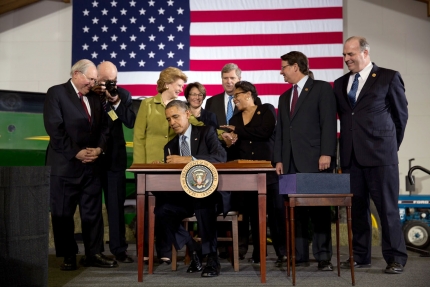
President Barack Obama signs the Farm Bill at Michigan State University in East Lansing, Michigan

President Barack Obama signs the Farm Bill at Michigan State University in East Lansing, Michigan, Feb. 7, 2014. (Official White House Photo by Pete Souza)

Today, in East Lansing Michigan, on the campus of one of our nation’s first land grant colleges, President Obama signed into law the Agricultural Act of 2014, also known as the Farm Bill, or as Secretary Vilsack likes to call it – the Jobs Bill, the Research Bill, the Food Bill, etc.

Related Topics: Economy, Rural, Michigan

The President Signs the Farm Bill: "A Jobs Bill, an Innovation Bill, a Research Bill, and a Conservation Bill"

Today, President Obama traveled to Michigan State University's equine performance center in East Lansing to deliver remarks on and sign into law the Agriculture Act of 2014 -- also known as the Farm Bill, which Congress passed earlier this week.

It's a bill whose reach extends far beyond our farms -- it includes smart reforms to reduce our deficit, and the investments it makes in our rural communities will help strengthen our economy across the board.

To see exactly what that looks like, take a look at five ways the Farm Bill strengthens our economy -- and if you learn something new, pass it on.

In his remarks, the President detailed how the Farm Bill makes key investments in rural communities across the board -- from funding for hospitals, schools, and affordable housing to support for businesses working to develop cutting-edge biofuels -- all the while cutting down on loopholes that used to allow people to receive benefits year after year, whether they farmed anything or not.

Besides keeping our rural communities thriving, the President said, the Farm Bill helps vulnerable families keep food on the table by providing funding for the Supplemental Nutrition Assistance Program, or SNAP. In 2012, SNAP kept nearly 5 million people -- including more than 2 million children -- out of poverty.

Related Topics: Economy, Michigan

The White House

Office of the Press Secretary

Statement by the Press Secretary on H.R. 2642

On Friday, February 7, 2014, the President signed into law:

H.R. 2642, the “Agriculture Act of 2014,” which extends, expands, or modifies Federal agriculture and nutrition programs, including farm income support, crop insurance, conservation, credit assistance, trade, research, international food assistance, rural development, and other programs through the fiscal year 2018 crop year.

The White House

Office of the Press Secretary

President Obama Announces More Key Administration Posts

WASHINGTON, DC – Today, President Barack Obama announced his intent to nominate the following individuals to key Administration posts:

  • Bob Work – Deputy Secretary of Defense, Department of Defense
  • Cassandra Q. Butts – Ambassador to the Commonwealth of The Bahamas, Department of State
  • Matthew T. McGuire – United States Executive Director, International Bank for Reconstruction and Development

President Obama said, “I am pleased to announce that these experienced and committed individuals have agreed to join this Administration, and I look forward to working with them in the months and years ahead.”

President Obama announced his intent to nominate the following individuals to key Administration posts:

Bob Work, Nominee for Deputy Secretary of Defense, Department of Defense

Bob Work is Chief Executive Officer of the Center for a New American Security, a position he has held since 2013.  Mr. Work served as the Under Secretary of the Navy from 2009 to 2013.  In 2008, Mr. Work served on President Obama’s Department of Defense Transition Team.  At the Center for Strategic and Budgetary Assessments (CSBA) from 2002 to 2009, Mr. Work was the Senior Fellow for Maritime Affairs and later the Vice President for Strategic Studies.  While serving at CSBA, Mr. Work was also an adjunct professor at George Washington University, where he taught Defense Analysis and Roles and Missions of the Armed Forces.  Prior to that, he served in the U.S. Marine Corps for 27 years in various assignments, including Military Assistant and Senior Aide to the 71st Secretary of the Navy, Richard J. Danzig.  Mr. Work received a B.S. from the University of Illinois, an M.S. from the University of Southern California, an M.S. from the Naval Postgraduate School, and an M.A. from the Johns Hopkins School of Advanced International Studies. 

Cassandra Q. Butts, Nominee for Ambassador to the Commonwealth of The Bahamas, Department of State

Cassandra Q. Butts is currently a Senior Advisor to the CEO of the Millennium Challenge Corporation, where she chairs the Investment Management Committee.  Prior to that, she served as Deputy White House Counsel to President Obama and General Counsel to the Obama-Biden Transition Project.  From 2004 to 2008, Ms. Butts served as Senior Vice President for Domestic Policy at the Center for American Progress.  From 2002 to 2004, she served as Counsel and Policy Director to House Democratic Leader Richard A. Gephardt and as Deputy Executive Director of the Democratic Policy Committee in the U.S. House of Representatives from 1996 to 2002.  She has worked as an Associate Counsel for the National Association for the Advancement of Colored People Legal Defense Fund, as a Legislative Assistant for U.S. Senator Harris Wofford, and as a Fellow for the National Health Law Program in Washington, D.C.  She is a member of the Board of Visitors of the University of North Carolina at Chapel Hill, and a past recipient of the Georgetown Women’s Law and Public Policy Fellowship.  Ms. Butts received a B.A. from the University of North Carolina at Chapel Hill and a J.D. from Harvard Law School.

Matthew T. McGuire, Nominee for United States Executive Director,  International Bank for Reconstruction and Development

Matthew T. McGuire is currently Director of the Office of Business Liaison at the Department of Commerce.  Prior to joining the Department of Commerce, Mr. McGuire was a Vice President at Citadel Asset Management from 2010 to 2011 and a Principal at Origami Capital Partners from 2009 to 2011.  Mr. McGuire was the Vice President of Institutional Marketing and Client Services at Ariel Investments from 2003 to 2009 after having worked as an Investment Officer at the New York State Common Retirement Fund from 2000 to 2001.  Mr. McGuire received a B.A. from Brown University and a Ph.D. from Harvard University.

The White House

Office of the Press Secretary

President Obama Announces Another Key Administration Post

WASHINGTON – Today, President Barack Obama announced his intent to nominate the following individual to a key Administration post:

  • Mark Green – Member, Board of Directors of the Millennium Challenge Corporation

President Obama announced his intent to nominate the following individual to a key Administration post:

Ambassador Mark Green, Nominee for Member, Board of Directors of the Millennium Challenge Corporation

Ambassador Mark Green is the President of the International Republican Institute (IRI), a position he has held since January 2014.  Prior to joining IRI, Ambassador Green was President and CEO of the Initiative for Global Development.  From 2010 to 2013, Ambassador Green was a Member of the Board of Directors of the Millennium Challenge Corporation.  From 2011 to 2013, Ambassador Green was Senior Director of the U.S. Global Leadership Coalition.  From 2007 to 2009, he served as U.S. Ambassador to the United Republic of Tanzania.  Ambassador Green served four terms representing Wisconsin’s eighth congressional district in the U.S. House of Representatives.  Among his committee assignments, he served as a member of the House Committee on International Relations.  He received a B.A. from the University of Wisconsin – Eau Claire and a J.D. from the University of Wisconsin School of Law.