The White House

Office of the Press Secretary

Message -- Continuation of the National Emergency with respect to Côte d’Ivoire

TO THE CONGRESS OF THE UNITED STATES:

Section 202(d) of the National Emergencies Act (50 U.S.C. 1622(d)) provides for the automatic termination of a national emergency, unless, within 90 days prior to the anniversary date of its declaration, the President publishes in the Federal Register and transmits to the Congress a notice stating that the emergency is to continue in effect beyond the anniversary date. In accordance with this provision, I have sent to the Federal Register for publication the enclosed notice stating that the national emergency declared in Executive Order 13396 of February 7, 2006, with respect to the situation in or in relation to Côte d'Ivoire is to continue in effect beyond February 7, 2014.

The situation in or in relation to Côte d'Ivoire, which has been addressed by the United Nations Security Council in Resolution 1572 of November 15, 2004, and subsequent resolutions, has resulted in the massacre of large numbers of civilians, widespread human rights abuses, significant political violence and unrest, and fatal attacks against international peacekeeping forces.

Since the inauguration of President Alassane Ouattara in May 2011, the Government of Côte d'Ivoire has made progress in advancing democratic freedoms and economic development. While the Government of Côte d'Ivoire and its people continue to make progress towards peace and prosperity, the situation in or in relation to Côte d'Ivoire continues to pose an unusual and extraordinary threat to the national security and foreign policy of the United States. For these reasons, I have determined that it is necessary to continue the national emergency and related measures blocking the property of certain persons contributing to the conflict in Côte d'Ivoire.

BARACK OBAMA

The White House

Office of the Press Secretary

Statement by the President

Today, in a strong bipartisan vote, the U.S. Senate came together to pass a comprehensive Farm Bill – legislation that will build on the historic economic gains in rural America over the past five years, create new jobs and opportunities, and protect the most vulnerable Americans.  This bill provides certainty to America’s farmers and ranchers, and contains a variety of commonsense reforms that my Administration has consistently called for, including reforming and eliminating direct farm subsidies and providing assistance for farmers when they need it most.  It will continue reducing our deficits without gutting the vital assistance programs millions of hardworking Americans count on to help put food on the table for their families.  And it will support conservation of valuable lands, spur the development of renewable energy, and incentivize healthier nutrition for all Americans.   As with any compromise, the Farm Bill isn’t perfect – but on the whole, it will make a positive difference not only for the rural economies that grow America’s food, but for our nation.

The White House

Office of the Press Secretary

Statement from the President on the Retirement of Congressman Rob Andrews

In his twenty-three years in the United States Congress, Rob Andrews has served the people of southern New Jersey with tenacity and skill.  He helped put into place key workplace protections for hardworking Americans, pushed to improve education for American students, and fought for clean energy programs to foster America’s energy independence.  More recently, Rob was an original author of the Affordable Care Act and has been a vital partner in its passage and implementation.   The grandson of shipyard workers and the first in his family to attend college, Rob has worked hard to preserve the American Dream for future generations. Michelle and I thank Congressman Andrews for his service and partnership, and we wish him, his wife Camille, and their two daughters the very best.

The White House

Office of the Press Secretary

Statement by the President on the Accelerated Medicine Partnership

Today, my Administration is taking action to accelerate the development of life-saving drugs and to help identify new treatments and cures for diseases like Alzheimer’s and diabetes.  This new public-private partnership – the Accelerating Medicines Partnership – combines the considerable resources of America’s government with the innovation of our private sector companies in an effort to find new answers to today’s domestic and global public health challenges.

--

More information on this initiative can be found HERE, from the National Institutes of Health.

The White House

Office of the Press Secretary

Remarks by the President on ConnectED

Buck Lodge Middle School
Adelphi, Maryland

11:37 A.M. EST

THE PRESIDENT:  Hello, everybody.  (Applause.)  Thank you so much.  Well, can everybody please give Nelson a big round of applause for the outstanding job that he did?  (Applause.)  So Nelson just told me backstage he plans on being a Navy SEAL.  So I was really nice to him now so he doesn’t mess with me later.  (Laughter.)  We are very proud of him, proud of all the students who are here today.

I want to thank Principal Richardson for the great job that he’s doing.  (Applause.)  And I want to thank all the wonderful teachers who are here at Buck Lodge Middle School.  Go, Vikings!  (Applause.) 

I brought along some people who very much care about the future of these young people.  We've got America’s Secretary of Education, Arne Duncan, in the house.  (Applause.)  We've got the FCC Chairman Tom Wheeler and two of his fellow commissioners who are here, doing great work.  (Applause.)  Congressman Steny Hoyer is in the house.  (Applause.)  County Executive Rushern Baker is here.  (Applause.)  And we've got some business leaders who’ve made some very big commitments today -- because they know that your education is the very best investment that all of us can make in America.

Now, last week, in my State of the Union address, I spent some time talking about opportunity for everybody, which is at the heart of this country -- the idea that no matter who you are, no matter what you look like -- if you have a chair feel free to sit down.  (Laughter.)  That wasn’t actually my line, but I thought -- (laughter.)  But at the core of America, the essence of it, what makes us exceptional is this idea, no matter what you look like, where you come from, what your last name is, if you're willing to work hard, if you're willing to live up to your responsibilities, you can make it here in America.

But each generation has to work hard to make sure that dream of opportunity stays alive for the next generation.  And the opportunity agenda that I laid out last week will help us do that.  It’s focused on four areas:  Number one, more new jobs; number two, training folks with the skills to fill those jobs;  number three, making sure our economy rewards hard work with decent wages and economic security; and number four, the piece I’m here to talk about today -- guaranteeing every child access to a world-class education.  Every child.  Not just some, but everybody.  (Applause.)

Now, I’m only standing here today because my education gave me a chance.  I’m not so different than a lot of these young people.  I was raised by a single mom, with the help of my grandma and my grandpa.  We didn’t have a lot of money, and for a while my mother was working and going to school at the same time as she was raising a couple of kids.  And there were times where times were tight.  But with a family who loved me, and with some hard work on my part -- although it wasn’t always consistent -- as my mother and my grandparents would point out.  And then, ultimately, with the help of scholarships and student loans, I was able to go to college.  I was able to go to law school.  And entire worlds of opportunity opened up to me that might not otherwise have been available. 

So the country invested in me.  My parents invested in me, my grandparents invested in me, but my country invested in me.  And I want America to now invest in you -- because in the faces of these students, these are future doctors and lawyers and engineers, scientists, business leaders.  We don’t know what kinds of products, services, good work that any of these students may do.  But I’m betting on them, and all of us have to bet on them.

So five years ago, we set out to change the odds on all of our kids.  Our Race to the Top challenge has helped raise expectations and performance in states all across the country.  Our high school graduation rate is the highest that it’s been in more than 30 years.  (Applause.)  That’s an achievement.  The dropout rate among Latino students has been cut in half since 2000 -- a really big deal.  (Applause.)  We reformed our student loan programs, so that more young people are able to afford to go to college, and now we’ve got more young people earning a college degree than ever before. 

Teachers and principals across the country are working hard to prepare students like you with the skills you need for a new economy -- not just the basics of reading and writing and arithmetic, but skills like science and technology, engineering, critical thinking, creativity -- asking, what do you think about that idea, and how would you do things differently.

Now, we still have more work to do to reach more kids and reach them faster.  And some of the ideas that I’ve presented will require Congress to act.  But while Congress decides what it’s going to do, I said at the State of the Union -- and I want to repeat here today -- I will act on my own.  Wherever I have the opportunity to expand opportunity for more young people, wherever I have a chance to make a difference in their lives, I’m going to act.  I’m going to act.  (Applause.) 

So in this Year of Action, we’re going to work with states and communities to help them make high-quality pre-K available to more young children.  We know it’s a good investment.  (Applause.)  We want to keep working to partner high schools with colleges and employers to offer real-world education experiences that can lead directly to jobs and careers.  And we want to do more to make sure no middle-class kid is priced out of a college education and, obviously, no poor kid is priced out of a college education.  That’s got to be a priority for us.  (Applause.)  

But today, we’re here to announce some big strides that we’re making to put the world and outer space at every child’s fingertips -- whether they live in a big city or a quiet suburb or in rural America.

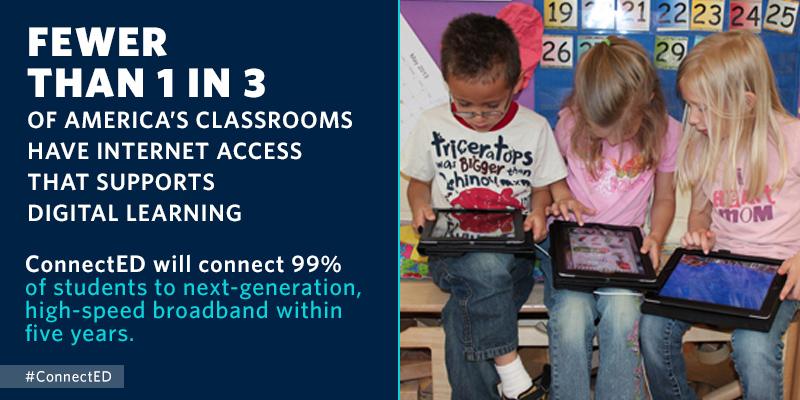
Last year, I launched something called ConnectED -- a new initiative to close the technology gap in our schools and connect 99 percent of America’s students to high-speed broadband Internet within five years.  Now, this is something we can do without waiting for Congress.  We do need some help, though.  So we picked up the phone and we started asking some outstanding business leaders to help bring our schools and libraries into the 21st century.  Today, thanks to the leadership of some of these companies, we’ve got some big announcements to make.

But first, I want you to know why it matters that we make sure technology is available to every child.  Technology is not the entire answer, by the way, when it comes to educational excellence.  We’ve got to make sure we’ve got outstanding teachers.  (Applause.)  We’ve got to make sure that parents are doing what they need to do.  (Applause.)  We need young people to make the effort and to have high expectations for themselves.  (Applause.)  But technology can help; t’s a tool, it’s just one more tool.

So today, the average American school has about the same Internet bandwidth as the average American home, but it serves 200 times as many people.  Think about it.  So you’ve got the same bandwidth, but it’s a school -- it’s not your house.  Only around 30 percent of our students have true high-speed Internet in the classroom.  In countries like South Korea, that’s 100 percent.  We shouldn’t give that kind of competitive advantage over to other countries.  We want to make sure our young people have the same advantages that some child in South Korea has right now.  In a country where we expect free Wi-Fi with our coffee, we should definitely demand it in our schools.  (Applause.) 

Now, here at Buck Lodge, you are showing how we can use technology to teach our young people in innovative ways.  And by the way, the principal told me that part of how this got started was some of the stimulus dollars that we put in place almost five years ago now.  But every student here has access to their own iPad.  And you don’t just write papers or take tests; they’re animating movies, they’re designing blogs, they’re collaborating on multimedia projects.  In the word of an 8th grader, Annie Gomez, she says, “You can learn even more, you can take in more, and then you know more about the world.”

And new technologies are helping teachers.  So in Mr. Jeter’s science class, students take quizzes on their tablets; he then can check the answers in real time and he can figure out who needs extra help. In Ms. Galinat’s language arts class, students learn vocabulary not just with flashcards, but with online video. In Ms. Stover’s math class -- I was just over with Ms. Stover -- students bring their tablets home to watch lectures about concepts like ratios and rational numbers, and then use the next day’s classroom time applying those concepts to the real world.  So technology allows teachers here to spend more time being creative, less time teaching to the test, giving continual feedback, being able to pinpoint where a young person is having trouble because they’re able to see their work right away in a pretty efficient way. 

And I will say, I was just in a classroom -- there was a lesson plan that was organized around the Curiosity Rover on Mars.  And the young people there were doing some amazing stuff  -- making their own iBooks with video and multimedia.  And as I was walking out, I was talking to Steny Hoyer about how I remember using gluesticks -- (laughter) -- and scissors to cut stuff out and it didn’t look very good.  (Laughter.)  These guys were making books you could publish.  (Laughter.) 

But it makes learning exciting, it makes it interesting.  If you’re studying science and you are actually seeing the engineers who built Rover talk about what it is -- or the Curiosity Rover  -- talking about what they’re doing and how they did it, and being able to see the Rover on the Martian landscape, it makes vivid and real math and science in a way that is more interesting to students, which means that they’re more likely to be engaged and can potentially do better.

And this is how it should be for every student and every teacher at every school and library in the country.  That’s how it should be for everbody, not just some.  (Applause.)

Today, almost eight months after we launched ConnectED, we can announce some very big commitments that are going to go a long way towards realizing that vision where every child has the access to the technology that they can use to help them learn.  So, under Tom Wheeler’s leadership, the FCC is announcing a down payment of $2 billion to connect more than 15,000 schools and 20 million students to high-speed broadband over the next two years -- (applause) -- 15,000 schools, 20 million students.  (Applause.)  It won’t require a single piece of legislation from Congress.  It won’t add a single dime to the deficit.

And even better, some of America’s biggest tech companies have decided to join this effort, with commitments worth more than three-quarters of a billion dollars.  So let me just give you some examples. 

Apple will donate $100 million worth of iPads, MacBooks, and other products to schools across the country.  (Applause.)  That’s an enormous commitment.
Sprint will provide free wireless service for up to 50,000 low-income high school students over the next four years, so their 21st century education isn’t confined to the classroom.  (Applause.)

AT&T will donate over $100 million worth of wireless service to middle-school students, so that they can continue to do homework when they get home.  (Applause.)

Autodesk will make its 3D-design software available for free to every high school in the country.  (Applause.)

Microsoft will offer products like Windows to students and teachers at a deep discount, and provide 12 million free copies of Office to our schools.  (Applause.)

O’Reilly Media and Safari Books Online will donate more than $100 million worth of eBooks that will help students learn technology skills like coding and web design.  (Applause.)

And finally, because no technology will ever be as important as a great teacher, Verizon will expand a program to help train educators to use all these new tools in all 50 states.  (Applause.)

So I want to thank all the business leaders who are here today for stepping up.  Why don’t you stand up?  Let’s give them a big round of applause.  (Applause.)  We’re very proud of them. Thank you.  (Applause.)

Now, this is an extraordinary commitment by these business leaders, but they’re business leaders, so they’re not just doing it out of the goodness of their heart.  They want the country to do well, but they also understand that they want educated customers.  They want customers who are able to get good jobs, who are going to be using these tools in the future.  They want that next young architect coming out of here to be familiar with using that iPad so that they’re designing buildings and using their products. 

They know that the entire economy will be lifted if more of our young people are doing better.  So they’re doing good, but it will also help them succeed from a bottom-line perspective by this kind of participation.  They are united in their support of young people like you, even though sometimes they compete against each other -- because all of us have a stake in your education and in your future.

And that’s why we have to build on this progress together.  Later this year, I’m going to ask Congress to do its part and give teachers using cutting-edge technologies the training they deserve.  (Applause.)  Because it’s important -- as I said before, technology is not a silver bullet.  It’s only as good as the teachers who are there using it as one more tool to help inspire and teach and work through problems. 

And although I’ve noticed that these days when I visit schools, most teachers are much younger than I am -- (laughter)  -- I’m getting on in years, obviously, which means that I’m not always as familiar with iPads and technology as I need to be.  We want every teacher in every school to understand from soup to nuts how you can potentially use this technology.  And that oftentimes requires a training component that makes sure that the technology is not just sitting there, but is actually used and incorporated in the best way possible.

So I’m going to ask every business leader across America to join us in this effort.  Ask yourself what you can do to help us connect our students to the 21st century.  Ask yourselves what you can do to support our teachers and our parents and give every young people every shot at success. 

And we can make this happen.  And just imagine what it will mean for our country when we do.  Imagine what it could mean for a girl growing up on a farm to be able to take AP Biology or AP Physics even if her school is too small to offer it, because she’s got the access to technology that allows her to take those classes online.  Imagine what it means for a boy with an illness that confines him sometimes to home where he can join his classmates for every lesson with FaceTime or Skype.  Imagine what it means for educators to spend less time grading tests and papers, more time helping young people learn.  Imagine more businesses starting here and hiring here, because they know for a fact that the young people here are going to be equipped with the skills that are better than anybody else on Earth. 

That’s the future we’re building.  That’s what these companies are investing in.  And if America pulls together now -- if we do our part to make sure every young person can go as far as their passion and their hard work will take them, whether it’s to Mars or to the bottom of the ocean or to anywhere on this planet where you’ve got an Internet connection -- if we commit ourselves to restoring opportunity for everybody, then we can keep the American Dream alive for generations to come. 

That’s our main project.  That’s our main obligation.  That’s why I ran for President.  That’s what I’m going to be working on for the next three years.  (Applause.)  

Thank you for all the work that you’re doing here at this outstanding school.  God bless you.  God bless America.  Thank you.  (Applause.)

END
12:04 P.M. EST

The White House

Office of the Press Secretary

Statement by the Press Secretary on Today’s CBO Report and the Affordable Care Act

Since the Affordable Care Act passed into law in March 2010 the private sector has added 8.1 million jobs. That is the strongest 45 month job growth since the late 1990s and contrasts with the 3.8 million private sector jobs lost in the decade before the Affordable Care Act passed.

Claims that the Affordable Care Act hurts jobs are simply belied by the facts in the CBO report. CBO’s findings are not driven by an assumption that ACA will lead employers to eliminate jobs or reduce hours, in fact, the report itself says that there is “no compelling evidence that part-time employment has increased as a result of the ACA.”

While many factors affect job growth, the actual performance of businesses refutes those who predicted that the Affordable Care Act would dramatically hurt the economy.

What the CBO report does find is one key immediate effect of the Affordable Care Act is to “induce some employers to hire more workers or to increase the hours of current employees” during the 2014-16 period. Over the longer run, CBO finds that because of this law, individuals will be empowered to make choices about their own lives and livelihoods, like retiring on time rather than working into their elderly years or choosing to spend more time with their families. At the beginning of this year, we noted that as part of this new day in health care, Americans would no longer be trapped in a job just to provide coverage for their families, and would have the opportunity to pursue their dreams. This CBO report bears that out, and the Republican plan to repeal the ACA would strip those hard-working Americans of that opportunity.

In addition, the CBO itself confirms that this analysis of the implications of the ACA on the labor force is incomplete, does not take into account the impact that ACA’s slowing health care cost growth which experts have estimated that slower growth in health costs due to the ACA will cause the economy to add an additional 250,000 to 400,000 jobs per year by the end of the decade. Moreover, CBO does not take into account positive impacts on worker productivity due to the ACA’s role in improving workers’ health, including reduced absenteeism.

Finally, as it has since the enactment of the ACA, CBO continues to confirm that the ACA is projected to reduce the deficit by more than $1 trillion over the next two decades.

Making Progress on ConnectED

Today, President Obama visited Buck Lodge Middle School in Adelphi, Maryland to announce major progress on the ConnectED initiative, designed to enrich K-12 education for every student in America. ConnectED empowers teachers with the best technology and the training to make the most of it, and empowers students through individualized learning and rich, digital content.

Preparing America’s students with the skills they need to get good jobs and compete with countries around the world relies increasingly on interactive, personalized learning experiences driven by new technology. Yet fewer than 30% of America’s schools have the broadband they need to connect to today’s technology. Under ConnectED, however, 99% of American students will have access to next-generation broadband by 2017. That connectivity will help transform the classroom experience for all students, regardless of income.

Related Topics: Education, Maryland

The White House

Office of the Press Secretary

FACT SHEET: Opportunity For All – Answering the President’s Call to Enrich American Education Through ConnectED

Year of Action: Making Progress Through Executive Action

Today, following up on his call to action, the President is announcing major progress toward realizing the ConnectED goal to get high-speed Internet connectivity and educational technology into classrooms, and into the hands of teachers trained on its advantages. The FCC and private sector are taking key steps to answer the President’s call, including through:

  • Over $750 million in private-sector commitments to deliver cutting-edge technologies to classrooms, including devices, free software, teacher professional development, and home wireless connectivity.
    • American companies are answering the President’s challenge to “dig deep” in support of ConnectED to enrich K-12 education, expand opportunities for students, and train, a 21st century workforce.  These commitments include:
      • Apple – Pledged $100 million in iPads, MacBooks, and other products along with content and professional development tools to enrich learning in disadvantaged schools.
      • AT&T – Pledged over $100 million to provide middle-school students free Internet connectivity for educational devices over their wireless network for three years.
      • Autodesk – Pledged to expand the company’s “Design the Future” program to be available to every secondary school in the country – offering for free over $250 million in value.
      • Microsoft – Committed to launch a substantial affordability program open to all U.S. public schools by deeply discounting the price of its Windows operating system, which will substantially bring down the cost of Windows-based devices.
      • O’Reilly Media – Partnering with Safari Books Online to make over $100 million in educational content and tools available, for free, to every school in America.
      • Sprint – Committed to offer free wireless service for up to 50,000 low-income high school students over the next four years, valued at $100 million.
      • Verizon – Announced a multi-year program to support the ConnectED vision through up to $100 million in cash and in-kind commitments.
  • A $2 billion down-payment by the FCC’s E-Rate program to connect 20 million more students to next-generation broadband and wireless, beginning in 2014.
  • An additional commitment to rural schools with over $10 million in distance learning grants from the U.S. Department of Agriculture.

These announcements will help realize next-generation connectivity to 99% of American students within five years, and begin this transformation of American classrooms immediately.

FURTHER DETAIL ON ANSWERING THE PRESIDENT’S CALL TO
ENRICH AMERICAN EDUCATION THROUGH CONNECTED

In his State of the Union address, President Obama set an ambitious agenda to make 2014 a year of action: using his pen and his phone to take steps that increase prosperity and opportunity for America’s middle class – including helping more kids prepare for college, gain career-ready skills, and compete in a global economy.

Last June, the President traveled to Mooresville, NC to announce ConnectED, an initiative designed to enrich K-12 education for every student in America – empowering teachers with the best technology and the training to make the most of it, and empowering students though individualized learning and rich, digital content.  At the center of that program was a challenge to connect 99% of students to next-generation connectivity within five years, as a foundation for a transformation in the classroom.

Today, fewer than 30% of schools have the broadband they need to teach using today’s technology; under ConnectED, 99% of American students will have access to next-generation broadband by 2017.  That connectivity will be the bedrock of a transformation in the classroom experience for all students, regardless of income.  As the President said in June, “In a Nation where we expect free WiFi with our coffee, why shouldn’t we have it in our schools?”   

The President challenged the FCC, Federal agencies, Congress, the private sector, and communities to rise to this challenge and deliver connectivity, professional development for teachers, low-cost learning devices, high-quality educational software, and home access.

Private Sector Commitments to Deliver Next-Generation Teaching and Learning

American companies are answering the President’s challenge to support the enriched K-12 education, expanded opportunity, and the better-trained workforce that ConnectED can help deliver.  These commitments amount to over $750 million in direct commitments, and many times more in discounted products and services for America’s students and teachers.

ConnectED is about more than wires and wireless; it’s about getting tablets and laptops into students’ hands, loading them with high-quality educational software and content, training educators on how to use technology to enrich the classroom experience, and ensuring students can continue this learning at home through wireless connectivity. 

These commitments will help deliver the ConnectED vision more quickly to more classrooms around the country — particularly those serving low-income students.  They will also help make the most of the government and investment in broadband infrastructure by ensuring it is put to the best educational use.

$750 Million in New Private-Sector Commitments: Today, the President highlighted some of the most impressive examples of companies rising to meet this challenge, including:

  • Apple – In an unprecedented commitment for the company, Apple has pledged $100 million in iPads, MacBooks, and other products along with content and professional development to enrich learning in disadvantaged schools, including interactive learning tools and ongoing support that can have a profound impact for students and teachers in the communities that need it most.
  • AT&T – To ensure that when schools embrace the ConnectED vision, the learning does not stop at the school walls, AT&T is committing to provide $100 million in mobile broadband services over three years to enable educational access for middle school students and related teacher professional development to help them implement technology into the classroom.
  • Autodesk – Autodesk, a designer of leading advanced software products in design, drafting, and engineering, has committed to expand the company’s “Design the Future” program to be available to every secondary school in the country in 2014.  The program, which offers free 3D design software, project-based curricula, training, and certification, will help secondary school teachers teach critical problem-solving and technical skills in demand, in high-paying STEM fields like engineering and architecture – offering for free over $250 million in value to American schools.
  • Microsoft – Microsoft Corp. is committing to a substantial affordability program open to all U.S. public schools by deeply discounting the price of its signature Windows operating system, which will substantially bring down the cost of Windows-based devices, and by increasing access to a range of software and services tailored for education, including Bing for Schools, Office 365 Education (making more than 12 million copies of Office available to students for free at qualifying institutions), and Microsoft’s Partners in Learning teacher training resources.  For the roughly 2000 at-risk designated schools in the U.S., Microsoft will give away Microsoft’s IT Academy program and training – and will donate over $1 million to cover certification exams for students from these schools.
  • O’Reilly Media – Through a partnership with Safari Books Online, O’Reilly Media will commit to making over $100 million in educational content and tools such as technology books and publications available, for free, to every school in America. This commitment can provide students at a range of grade levels with the technological skills they need to be prepared in a globalized, digital economy.
  •  Sprint – Sprint is committing to offer free wireless service for up to 50,000 low-income high school students over the next four years using schools’ existing or new educational devices provided by other partners.  Sprint will begin providing these services beginning with the 2014-2015 school year and provide up to 3 GB per month on the Sprint network per student on its most advanced network platforms.
  • Verizon – The Verizon Foundation announced a multi-year program to support the ConnectED vision through up to $100 million in cash and in-kind commitments, significantly expanding existing and launching new digital learning initiatives.  These include expanding the Innovative Learning Schools program to all fifty states, the creation of an Innovative App Challenge to drive more development in underserved curricular areas, and new professional development opportunities for teachers.

Connecting Over 20 Million Students with a Major Down-payment by the FCC: The Federal Communications Commission is announcing a new plan to direct $2 billion over the next two years to dramatically expand its investment in high-speed connectivity for America’s school and libraries.  That investment will begin flowing to schools in 2014, and will focus specifically on the broadband connection and Wi-Fi that too many schools lack, and will be the foundation of the ConnectED transformation of schools.  This is an essential down-payment on reaching the President’s goal of connecting 99% of students to high-speed broadband and wireless over the next five years.

Investing in Next-Generation Professional Development: To support teachers as they use new technology to improve learning enabled by ConnectED, the President will request new funding in his FY2015 Budget for school districts and schools to provide high-quality professional development as they transition to digital learning and high-speed connectivity.  This funding will enable more school districts to support teachers with tools including instructional coaches, high-quality digital content, blended learning models, and online communication and collaboration.  In addition, today the Department of Education is releasing guidance to states, school districts, and schools on ways that existing federal funds can be best leveraged immediately to support schools and educators in the transition to digital learning in support of the President's ConnectED Initiative.  Specifically, the guidance letter outlines ways in which current federal education funding available to states and school districts can be used to provide professional development, access to high-quality digital content, and devices for learning.

About Buck Lodge Middle School

The President made these announcements at Buck Lodge Middle School, a diverse school “on the move” that is on the path to realize the President’s ConnectED vision.

In 2011, Buck Lodge Middle School was selected as one of four Prince Georges County Public Schools to integrate tablets into the classroom through a program called the Transforming Education through Digital Learning project.  Each student receives a tablet as a learning tool to allow access to digital instructional content.  The school also leverages two computer labs to round out its technology education. 

Every class uses technology every day and lessons are designed around integration of technology to help students create and collaborate using the highest level of technology.  Teachers receive training on how to integrate the technology into their classroom instruction, including through a summer academy workshop.  Principal James Richardson was named an Apple Distinguished Educator for his work integrating technology at Buck Lodge.

The White House

Office of the Press Secretary

Statement by the President and First Lady on the Passing of Joan Mondale

Michelle and I send our deepest condolences to former Vice President Walter Mondale and his family on the passing of Joan Adams Mondale.  America first came to know Joan through her husband; she was his devoted partner in public service, from Minnesota to Washington.  A lifelong patron of the arts, Joan filled the Vice Presidential mansion with works by dozens of artists, including many unknowns, and later did the same at the U.S. embassy in Japan during her husband’s tenure as ambassador.  Through her contributions to the Federal Council on the Arts and Humanities and the Kennedy Center, she passionately advocated for the role of art in the life of our nation and the promotion of understanding worldwide.  Our thoughts and prayers are with Vice President Mondale and his family today as we remember with gratitude “Joan of Art” and her service to our nation. 

The White House

Office of the Press Secretary

Readout of the President’s Call with Prime Minister Jomaa of Tunisia

President Obama called Prime Minister Mehdi Jomaa of Tunisia today to congratulate him and the Tunisian people on the ratification of their new constitution and on the inauguration of PM Jomaa’s independent government to lead the country to elections.  The President commended the efforts of all of Tunisia’s parties to work together to secure the gains made since the start of Tunisia’s revolution, which inspired people around the world.  The President invited the Prime Minister to visit Washington later this year to continue to build the U.S.-Tunisian relationship.  The United States will continue to be a friend and partner to Tunisia to support its democratic transition, to bolster security, and to promote a more peaceful and prosperous future.