President Obama Travels the Country to Promote Opportunity for All

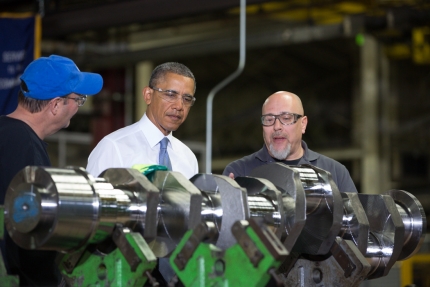
President Barack Obama tours General Electric's Waukesha Gas Engines Facility in Milwaukee, Wis., Jan. 30, 2014.

President Barack Obama tours General Electric's Waukesha Gas Engines Facility in Milwaukee, Wis., Jan. 30, 2014. (Official White House Photo by Amanda Lucidon)

Following his fifth State of the Union address Tuesday night, President Obama is traveling around the country to talk more about the importance of opportunity for all.

Earlier today, President Obama visited a General Electric gas engines facility in Waukesha, Wisconsin and McGavock High School in Nashville. At both stops, he detailed the four parts of the opportunity agenda he put forward in Tuesday’s address: 1) create more new jobs; 2) train Americans with the skills to fill those jobs; 3) guarantee every child access to a world-class education; and 4) make sure hard work pays off.

The White House

Office of the Press Secretary

Remarks by the President on a World-Class Education

McGavock Comprehensive High School
Nashville, Tennessee

4:45 P.M. CST

THE PRESIDENT:  Hello, everybody.  (Applause.)  It is good to be in Nashville!  (Applause.)  And it’s good to be here at Big Mac.  (Applause.)  

I want to thank Reverend Sinkfield for your words of prayer. I want to thank Ronald for the great introduction.  We are very proud of him.  (Applause.)  He’s going somewhere.  And he looks very sharp in that bow-tie.  (Laughter.) 

I want to thank the Mayor of Nashville, Karl Dean, for having us here today.  (Applause.)  Mr. Mayor.  You’ve got two outstanding members of Congress who are here -- Steve Cohen and Jim Cooper.  (Applause.)  And I want to acknowledge one of the finest public servants that we've ever had, and a native of -- proud native of Tennessee -- Mr. Al Gore is here as well.  (Applause.)

To the Superintendent and your outstanding principal, and all the teachers, and most importantly, the students -- (applause) -- as well as all the parents who are doing an outstanding job -- (applause) -- I just want to say thank you. 

I wanted to come here today because I’ve heard great things about this high school and all of you.  But I also recognize the past couple days have been hard and have tested people’s spirits. Some of you lost a good friend.  So I wanted you to know that Michelle and I have been praying for all of you and the community.  And I know that all of us are sending prayers to those families that have been so directly impacted.  It’s been heartbreaking.   

I’d been planning to come to this school for a while because you’ve made great strides.  (Applause.)  You’ve made great strides, and the reason you’ve made great strides is because you’ve worked hard together.

AUDIENCE MEMBER:  That's right.

THE PRESIDENT:  And by the way, those of you who have seats feel free to sit down.  (Laughter.)  Those of you who don't, don't.  (Laughter.) 

You’ve been there for each other.  In the weeks and months ahead, I hope you keep being there for each other, help each other through challenges and difficulties.  This community cares about you.  This country cares about you.  And we want to celebrate what you’ve achieved, because the message I want to send here today is we want every child to have every chance in life, every chance at happiness, every chance at success.  (Applause.)

On Tuesday, I delivered my State of the Union address.  (Applause.)  Now, what I was going to say right at the top was “the state of the Union is cold.”  (Laughter.)  But what I instead focused on is a very simple but profound idea -- the idea of opportunity.  It’s at the heart of who we are as Americans.  It means that no matter who you are, no matter what you look like, no matter where you come from, if you work hard, if you live up to your responsibilities, you can make it in America.  (Applause.)

And that’s the chance that this country gave me.  I’m not very different than a lot of the students who are here -- except probably I was more irresponsible.  (Laughter.)  I was raised by a single mom, with the help of my grandmother and my grandfather. We didn’t have a lot of money and sometimes my mom was struggling because she was raising two kids and also trying to go to school herself. 

We lived overseas for a time, but my mother emphasized even then, even when I was six, seven, eight years old, that your ticket is an education.  And because I was living overseas she was worried that I'd fall behind.  So she used to wake me up before sunrise to do my correspondence courses, to make sure I was keeping up with my American schooling, before I went to school over there. 

And if you're seven and eight and you're waking up at 4:30 a.m.-5:00 a.m. in the morning, you don't feel real good.  You're not happy.  (Laughter.)  And so I'd grumble and complain.  And she’d say, “Listen, this is no picnic for me either, buster.”  (Laughter.)  But she understood that if her son, and later her daughter, my sister, got a good education, even if we didn’t have a lot, then the world would open up to us. 

And with that support structure that started at home, but then extended to teachers and communities and a country that was willing to give scholarships, and folks who were willing to give me a helping hand and sometimes give me second chances when I made mistakes -- through all of that I was able to go to some of the best colleges in the country, even though we didn’t have a lot of money. 

Michelle, my wife, the daughter of a blue-collar worker and a secretary, was able to go to some of the best schools in the country.  And we were able to achieve things that our parents and our grandparents could have never imagined, could have never dreamed of.  And I want every young person in America to have that same chance.  Every single one. 

And that’s why, in my speech on Tuesday night, I laid out an agenda where we need to grow our economy for everybody, we need to strengthen the middle class, we've got to make it easier for folks to work their way into the middle class -- an opportunity agenda that has four parts:  More new jobs.  Making sure folks have the skills to fill those jobs.  Making sure that we are rewarding hard work with a living wage and incomes.  And the thing that I'm here to talk about right here -- guaranteeing every young person access to a world-class education.  (Applause.)  Every single one.

Now, sometimes we only hear the bad news.  So I just want to report on some good news.  We have made progress when it comes to education in America.  (Applause.)  Right now our high school graduation rate is the highest that it’s been in 30 years.  (Applause.)  The dropout rate has been falling and, for example, the Latino dropout rate has been cut in half over the last 10 years.  (Applause.)  

When I came into office, we took on a financial aid system running through the banks that was good for the banks but wasn’t good for students.  We reformed it, providing billions more dollars to millions more students.  And now we've got more young people graduating from college than ever before.  (Applause.) 

And then, to spark reform, five years ago we started a competition that we call Race to the Top to promote innovation and reform in America’s schools.  Tennessee was one of the first states to win that competition.  (Applause.)  And because of that commitment, bringing together educators and parents and businesses and elected officials at state and federal levels -- because of all that, you are actually the fastest-improving state in the nation.  (Applause.)

You’ve given teachers more support.  You’ve found new ways to identify and reward the best teachers.  You’ve made huge strides in helping young people learn the skills they need for a new economy -- skills like problem-solving and critical thinking, science, technology, engineering, math.  In Nashville alone, you’ve boosted graduation rates by almost 20 percent in about a decade.  That's something you should be very proud of.  (Applause.) 

So I want us to take the lessons we've learned and are learning in terms of what’s working and make sure more schools are able to do some of the things you're doing.  I want to build on what works.  But to do that, we’ve got to reach more kids -- and we’ve got to do it faster.  Because my attitude is there’s no child that we should let slip simply because of politics or because adults can't get their act together.  (Applause.)  We've got to make sure that we're reaching every single one of them as fast as we can.  And right now we're not doing that. 

So here’s where we should start.  Research shows that high-quality early education is one of the best investments we can make in a child’s life.  We know that.  (Applause.)  And not only is it good for the child, it’s a smart investment.  Every dollar you put into early childhood education, the government will -- taxpayers will save seven dollars because you have fewer dropouts, fewer teen pregnancies, fewer --

AUDIENCE MEMBER:  Incarcerations.

THE PRESIDENT:  -- incarcerations -- thank you.  (Laughter.) Folks will get better jobs, pay more taxes.  So it's a win-win for everybody

And last year I asked Congress, help states make high-quality pre-kindergarten available to every four-year-old in America.  (Applause.)  Now, the good news is 30 states have decided to raise some pre-K funding on their own.  And school districts like this one have plans to open dedicated pre-K centers with space for hundreds of young kids.  And we did get a little help from Congress earlier this month.  But while we got a little help, we need more help.  Because even with the efforts of your superintendent and folks who are working hard in this school district, there are still going to be some kids who could use the help but aren't getting it. 

So Congress -- I'd like to see them act more boldly than they are.  But while Congress decides if it’s willing to give every child that opportunity, I’m not waiting.  (Applause.)  So we're going to bring business leaders from all across the country and philanthropists from all across the country who are willing to help work with school districts, mayors, governors to make sure more young people every single year are getting access to the high-quality pre-K that they need.  That’s going to be a project over the next three years. 

We also need to give students access to the world's information.  Technology is not the sole answer for a child's education.  Having a good teacher is what is most important, and having great parents is even more important than that.  (Applause.)  But in this modern, 21st-century economy, technology helps.  It can be a powerful tool to leverage good teaching.

So last year I pledged to connect 99 percent of our students to high-speed broadband over five years.  (Applause.)  And with help of the Federal Communications Commission, the FCC, we’re making a down payment on that goal by connecting more than 15,000 schools, 20 million students over the next two years, so that there is wireless in every classroom. 

And we are going to hit that goal of -- there's not going to be a child in a school in America that does not have the kind of wireless connection that allows them to stream in the information they need that can power their education.  That’s going to be a priority.  (Applause.)  And I want to acknowledge, by the way -- we've got companies like Apple, Microsoft, Sprint, Verizon -- they're going to help students and teachers use the latest tools to accelerate learning.

Now, we also need to encourage more schools to rethink not just what they teach, but how they teach it.  (Applause.)  And that’s where what you're doing here is so important.  If you’re a student here, your experience is a little different from students at other high schools.  Starting in 10th grade, you get to choose from one of four “academies” that allow you to focus on a specific subject area.  Local businesses are doing their part by giving students opportunities to connect the lessons you learn in the classroom with jobs that are actually out there to be filled. 

So students in the Academy of Business and Finance, they're operating their own credit union here at the school, and doing some work in a real one over the summer.  (Applause.)  If you choose Digital Design and Communication -- (applause) -- you get to spend time in a TV studio designed by a local business partner.  If you choose the Aviation and Transportation Academy

-- (applause) -- you get to learn how to operate a 3D printer, and work on your very own airplane.  That’s pretty cool.  I didn’t get my own plane until I was 47 years old.  (Laughter.) 

AUDIENCE MEMBER:  And it's big.

THE PRESIDENT:  Yes, it's a nice plane, but I've got to give it back.  (Laughter.)  That’s the only thing.  It's a rental.  (Laughter.)   

But the idea is simple but powerful:  Young people are going to do better when they're excited about learning, and they're going to be more excited if they see a connection between what they're doing in the classroom and how it is applied.  If they see a connection between -- all right, the math that I'm doing here, this connects to the business that’s going on out there.  The graphic design I'm doing here, I am learning now what that means in terms of marketing or working for a company that actually gets paid to do this, which means I might get paid to do it.  And I'm seeing people who may open up for me entire new career options that I didn’t even realize. 

So that makes words on a pate exciting and real and tangible.  And then schools like this one teach you everything you need to succeed in college, but because of that hands-on experience, you're able to create pathways to make sure that folks also are able, if they choose not to go to a four-year institution, potentially get a job sooner. 

And it’s working.  Over the past nine years, the graduation rate here has gone up 22 percent -- 22 percent.  (Applause.)  Last year, attendance across the district, which includes 12 academy high schools, was higher than ever.  Thousands of students are getting a head start on their future years before many of their peers do.  And it's great for businesses because they're developing a pool of workers who already have the skills that they’re looking for. 

Now, every community is different, with different needs, different approaches.  But if Nashville can bring schools and teachers and businesses and parents together for the sake of our kids, then other places can.  (Applause.)  That’s why my administration is already running a competition to redesign high schools through employer partnerships that combine a quality education with real-world skills and hands-on learning. 

I want to encourage more high schools to do what you are doing.  (Applause.)  That’s why we’re also in the process of shaking up our system of higher education so that when you graduate from high school ready to succeed in college, it’s easier to afford college.  And we’re also working to help more students pay off their student loan debt once they graduate.  (Applause.)  A quality education shouldn’t be something that those other kids get; it's something that all kids get.

AUDIENCE MEMBER:  Including DREAMers.

THE PRESIDENT:  Absolutely. 

Now, the other day, I heard the story of a recent graduate here named Sara Santiago.  Where is Sara?  There's Sara right here.  (Applause.)  I want to -- I hope I'm not embarrassing Sara.  I'm going to tell her story. 

Sara's parents came to America from Guatemala, and she struggled her freshman year -- I think she'll admit it.  In her own words, she was “one of the bad kids.”  Now, she doesn’t look that bad.  (Laughter.)  I promise you, I was bad.  (Laughter.)  You might not have been that bad, but probably you weren't taking your studies that seriously.  And then she took a broadcasting class with a teacher named Barclay Randall.  (Applause.)  There's Mr. Randall right back there.  Go ahead and wave, Mr. Randall.  That’s Mr. Randall.  (Applause.)  Mr. Randall is over there with the press right now because some of his students are covering this event, they're doing some reporting.  (Applause.) 

But when Sara was in Mr. Randall's class he helped her discover this passion for filmmaking.  And pretty soon, Sara’s grades started to improve.  She won the school’s “best editing” award.  Then she got an internship with Country Music Television –- one of your business partners.  (Applause.)  And then she was accepted to the prestigious Savanna College of Art and Design.  (Applause.)  And she gives credit to Mr. Randall for this.  She says, “Mr. Randall gave me a second chance.  He saw things I never saw in myself.  He’s the person who helped me change.”  (Applause.) 

Now, giving every student that chance -- that’s our goal.  That’s what America is all about.  We work and study hard and chase our individual success, but we are also pulling for each other, and we've got each other's backs.  And as a nation, we make the investment in every child as if they're our children.  Because we're saying to ourselves, if every child is successful, then the world my child grows up in will be more successful.  The America that my child grows up in will be more successful.  (Applause.) 

So there are some lessons that we've got to absorb as a nation.  Where we can, we've got to start early.  Get to kids when they're three, four years old, because not every parent has got the same resources and we've got to help them get that good start for that child.  We've got to make sure that we are supporting our teachers, because they are the most critical ingredient in a school.  (Applause.)  And we've got to show them how important they are -- which means giving them the professional development they need, giving them the support that they need -- and giving them the pay that they need.  (Applause.) 

We've got to make sure that our high schools engage our children.  And not every child is going to go on the same path at the same speed, but we can restructure how our high schools operate to make sure every child is engaged.  And the more we can link them to real hands-on experience, the more likely they are to be engaged. 

And we've got to make college affordable for every young person in America.  But we can do all that -- we'll still be missing something if we don’t capture the spirit that Mr. Randall showed with Sara.  That investment in our children -- nothing is more important.  And it doesn’t cost any money, the initial spirit.  The spirit then can express itself by us putting more resources into schools that need it. 

But that spirit that every child matters -- that’s something that we can all embrace.  We help each other along in good times and bad.  And if America pulls together now around our young people, if we do our part to make sure every single child can go as far as their passions and hard work will take them, then we will keep the American Dream alive not just for your generation, but for generations to come. 

That’s my goal.  I hope it is yours, too.

Thank you, Nashville, for the great job.  Thank you, Riders.  I appreciate you.  God bless you.  (Applause.)

END
5:10 P.M. CST

President Obama Speaks on Education from Nashville, TN

January 30, 2014 | 24:19 | Public Domain

President Obama says that guaranteeing every young person access to a world-class education is one part of the opportunity agenda he outlined in his 2014 State of the Union address to grow our economy for everybody, strengthen the middle class, and make it easier for folks to work their way into the middle class.

Download mp4 (1085MB) | mp3 (58MB)

President Obama Speaks on Training Workers for In-Demand Jobs

January 30, 2014 | 24:19 | Public Domain

As part of the opportunity agenda he announced in his 2014 State of the Union address to make America a magnet for middle class jobs and business investment., President Obama says that he acting on a set of specific, concrete proposals that will make sure American workers have the skills that they need for in-demand jobs of today and the jobs of tomorrow.

Download mp4 (1085MB) | mp3 (58MB)

The White House

Office of the Press Secretary

Presidential Nominations and Withdrawals sent to the Senate

NOMINATIONS SENT TO THE SENATE:

Miranda A. A. Ballentine, of the District of Columbia, to be an Assistant Secretary of the Air Force, vice Terry A. Yonkers, resigned.

Norman C. Bay, of New Mexico, to be a Member of the Federal Energy Regulatory Commission for the term expiring June 30, 2018, vice Jon Wellinghoff, resigned.

L. Reginald Brothers, Jr., of Massachusetts, to be Under Secretary for Science and Technology, Department of Homeland Security, vice Tara Jeanne O'Toole, resigned.

William P. Doyle, of Pennsylvania, to be a Federal Maritime Commissioner for a term expiring June 30, 2018.  (Reappointment)

Ann Elizabeth Dunkin, of California, to be an Assistant Administrator of the Environmental Protection Agency, vice Malcolm D. Jackson.

Manuel H. Ehrlich, Jr., of New Jersey, to be a Member of the Chemical Safety and Hazard Investigation Board for a term of five years, vice John S. Bresland, resigned.

Mileydi Guilarte, of the District of Columbia, to be United States Alternate Executive Director of the Inter-American Development Bank, vice Jan E. Boyer, resigned.

Suzan G. LeVine, of Washington, to be Ambassador Extraordinary and Plenipotentiary of the United States of America to the Swiss Confederation, and to serve concurrently and without additional compensation as Ambassador Extraordinary and Plenipotentiary of the United States of America to the Principality of Liechtenstein.

Michael J. McCord, of Ohio, to be Under Secretary of Defense (Comptroller), vice Robert F. Hale.

Brian P. McKeon, of New York, to be a Principal Deputy Under Secretary of Defense, vice Kathleen H. Hicks, resigned.

Christine E. Wormuth, of Virginia, to be Under Secretary of Defense for Policy, vice James N. Miller, Jr., resigned.

WITHDRAWALS SENT TO THE SENATE:

Leslie Berger Kiernan, of Maryland, to be Representative of the United States of America to the United Nations for U.N. Management and Reform, with the rank of Ambassador, which was sent to the Senate on January 6, 2014.

Leslie Berger Kiernan, of Maryland, to be Alternate Representative of the United States of America to the Sessions of the General Assembly of the United Nations, during her tenure of service as Representative of the United States of America to the United Nations for U.N. Management and Reform, which was sent to the Senate on January 6, 2014.

The White House

Office of the Press Secretary

President Obama Announces More Key Administration Posts

WASHINGTON, DC – Today, President Barack Obama announced his intent to nominate the following individuals to key Administration posts:

  • Miranda A. A. Ballentine – Assistant Secretary of the Air Force for Installations, Environment, and Logistics, Department of Defense
  • Norman C. Bay – Commissioner, Federal Energy Regulatory Commission, and upon appointment to be designated Chairman
  • Reggie Brothers – Under Secretary for Science and Technology, Department of Homeland Security
  • William P. Doyle – Commissioner, Federal  Maritime Commission
  • Ann Dunkin – Assistant Administrator for Environmental Information, Environmental Protection Agency
  • Manny Ehrlich – Member, Chemical Safety and Hazard Investigation Board
  • Mileydi Guilarte – United States Alternate Executive Director, Inter-American Development Bank
  • Suzi LeVine – Ambassador to the Swiss Confederation and the Principality of Liechtenstein, Department of State
  • Michael McCord – Under Secretary of Defense (Comptroller), Department of Defense
  • Brian P. McKeon – Principal Deputy Under Secretary of Defense for Policy, Department of Defense
  • Christine E. Wormuth – Under Secretary of Defense for Policy, Department of Defense 

President Obama also announced his intent to appoint the following members to key administration posts:

  • Theodore B. Olson – Member, President’s Commission on White House Fellowships
  • Nathalie Rayes – Member, Board of Trustees of the Woodrow Wilson International Center for Scholars 

President Obama said, “I am honored that these talented individuals have decided to join this Administration and serve our country.  I look forward to working with them in the months and years to come.”

President Obama announced his intent to nominate the following individuals to key Administration posts:

Miranda A. A. Ballentine, Nominee for Assistant Secretary of the Air Force for Installations, Environment, and Logistics, Department of Defense

Miranda A. A. Ballentine is the Director of Sustainability, Renewable Energy, Sustainable Facilities, and Stakeholder Engagement for Walmart Stores, Inc., a position she has held since 2008.  Previously, she was Vice President of Investor Analysis, Chief Operating Officer, and Senior Consultant for David Gardiner and Associates from 2003 to 2008.  In 2004, she served as the Director of Operations, Assistant Treasurer, and a Member of the Board of Environment2004.  She was the Operations Director for Solar Electric Light Fund from 2001 to 2004.  Since 2001, she has served as a guest lecturer at Duke University, George Washington University, and Kenan-Flagler School of Business.  She received a B.S. from Colorado State University and an M.B.A from George Washington University.

Norman C. Bay, Nominee for Commissioner, Federal Energy Regulatory Commission, and upon appointment to be designated Chairman

Norman C. Bay is the Director of the Office of Enforcement at the Federal Energy Regulatory Commission (FERC), a position he has held since 2009.  Prior to this, Mr. Bay was a Professor of Law at the University of New Mexico from 2002 to 2009.  From 2000 to 2001, Mr. Bay was the United States Attorney for the District of New Mexico.  He was an Assistant U.S. Attorney from 1989 to 2000, an Attorney-Adviser at the United States Department of State from 1988 to 1989, and a Law Clerk for the Honorable Otto R. Skopil, Jr. of the U.S. Court of Appeals for the Ninth Circuit from 1986 to 1987.  Mr. Bay received a B.A. from Dartmouth College and a J.D. from Harvard Law School.

Dr. Reggie Brothers, Nominee for Under Secretary for Science and Technology, Department of Homeland Security

Dr. Reggie Brothers is the Deputy Assistant Secretary of Defense for Research, a position he has held since 2011.  From 2009 to 2011, Dr. Brothers was a BAE Systems Director for Mission Applications and Technical Fellow.  From 2007 to 2011, he was a BAE Systems Director for Advanced Programs and Technology.  From 2003 to 2007, Dr. Brothers was a Program Manager for the Defense Advanced Research Projects Agency.  From 2001 to 2003, he was a Group Leader for the Charles Draper Laboratory, and from 1999 to 2001 he was Chief Architect for Envoy Networks.  Dr. Brothers was Assistant Group Leader and Member of the Technical Staff at MIT Lincoln Laboratory from 1988 to 1999.  Prior to 1988, Dr. Brothers was a Program Manager, Microwave Design Engineer, and Analog-Digital Design Engineer for Texas Instruments.  Dr. Brothers received a B.S. from Tufts University, an M.S. from Southern Methodist University, and a Ph.D. from the Massachusetts Institute of Technology.

William P. Doyle, Nominee for Commissioner, Federal Maritime Commission

William P. Doyle currently serves as a Commissioner on the Federal Maritime Commission (FMC).  Prior to joining the FMC, from 2011 to 2013, Mr. Doyle served as the Chief-of-Staff for the Marine Engineers’ Beneficial Association from 2011 to 2013.  From 2008 to 2011, Mr. Doyle was the Director of Permitting, Scheduling, and Compliance at the Office of the Federal Coordinator for Alaska Natural Gas Transportation Projects from 2008 to 2011, and was the Deputy General Counsel and Director of Government and Legislative Affairs for the Marine Engineers’ Beneficial Association from 2002 to 2008.  Mr. Doyle received a B.S. from Massachusetts Maritime Academy and a J.D. from Widener University School of Law.

Ann Dunkin, Nominee for Assistant Administrator for Environmental Information, Environmental Protection Agency

Ann Dunkin is the Chief Technology Officer for the Palo Alto Unified School District, a position she has held since 2012.  Prior to this, Ms. Dunkin was the Director of Technology for the Palo Alto Unified School District from 2009 to 2012.  She held a number of positions at the Hewlett-Packard Company including Senior R&D Program Manager from 2006 to 2008, IT Director and Senior Manager from 2001 to 2005 and IT Operations Director from 1999 to 2001.  Since 2012, she has served on the Consortium on School Networking (CoSN) SmartIT Advisory Board and the CoSN CTO Council since 2013.  Ms. Dunkin received a B.S. in Industrial Engineering and an M.S. from the Georgia Institute of Technology. 

Manny Ehrlich, Nominee for Member, Chemical Safety and Hazard Investigation Board

Manny Ehrlich is the Principal at ESP Consulting, a position he has held since 2002.  Mr. Ehrlich was a Site General Manager for Pitt Penn Corporation from 2007 to 2009.  He served as the General Manager of the Emergency Response Training Center from 2006 to 2007 and was the Vice President of Health, Safety, and Labor Relations at International Specialty Products from 1998 to 2003.  He served as the Director of Emergency Response at BASF Corporation from 1989 to 1998 and the Assistant Plant Manager at BASF’s Geismar Electrolytics Plant from 1980 to 1981. From 1976 to 1980, Mr. Ehrlich was the Assistant Site Manager at Wyndotte Electrolytics under the BASF Corporation.  He received a B.S. from the Drexel Institute of Technology and an Ed.M. and M.A. from Columbia University.

Mileydi Guilarte, Nominee for United States Alternate Executive Director, Inter-American Development Bank

Mileydi Guilarte serves as an International Cooperation Specialist in the Bureau for Latin America and the Caribbean at the United States Agency for International Development (USAID), a position she has held since 2011.  From 2010 to 2011, she was the Special Assistant to the Assistant Administrator in the Bureau for Democracy, Conflict, and Humanitarian Assistance at USAID.  Ms. Guilarte held numerous positions at the United Nations from 2007 to 2010, including Special Assistant to the Resident Representative in the Republic of the Maldives and Human Rights Officer on Economic, Social and Cultural Rights in East Timor.  From 2004 to 2007, Ms. Guilarte held a number of assignments in the Social Development Department and in the Civil Society Team of the Latin America and the Caribbean Region at the World Bank.  She worked as a contractor for the International Monetary Fund from 2003 to 2004.  Ms. Guilarte received a B.A. from the University of Florida and an M.A. from American University.

Suzi LeVine, Nominee for Ambassador to the Swiss Confederation and the Principality of Liechtenstein, Department of State

Suzi LeVine was Director of Strategic Partnerships for Student Developers and Director of Communications for Education at Microsoft Corporation in Redmond, Washington from 2009 to 2012.  Prior to that, she served as Vice President of Marketing and Sales for Expedia’s luxury travel division from 2003 to 2005 and Director of Marketing at Expedia, Inc. from 1998 to 2002, and Product Manager at Microsoft from 1993 to 1999.  She co-founded and serves as Chair of the Advisory Board for the Institute for Learning and Brain Sciences at the University of Washington in Seattle.  She co-founded and served as President of the Kavana Cooperative in Seattle and was a member of the Obama for America National Finance Committee, Co-Chair for Tech for Obama and Women for Obama, and the Northwest Regional Co-Chair.  Ms. LeVine received an A.B. and an Sc.B. from Brown University. 

Michael McCord, Nominee for Under Secretary of Defense (Comptroller), Department of Defense

Michael McCord is the Principal Deputy Under Secretary of Defense (Comptroller), a position he has held since 2009.  From 1987 to 2004, Mr. McCord served in a number of roles in the Senate Armed Service Committee, including as a professional staff member.  As majority staff lead, Mr. McCord served as lead analyst for both the overall defense budget and the Quadrennial Defense Review.  As minority staff lead, Mr. McCord was responsible for oversight of over $100 billion in annual DOD operation maintenance funding and related policy matters.  In 2003, he served as the Budget Analyst for defense and veterans issues for the Committee on the Budget in the U.S. House of Representatives.  From 1985 to 1986, Mr. McCord was an Assistant Analyst in the Budget Analysis Division of the Congressional Budget Office.  He received a B.A. from the Ohio State University and an M.A. from the University of Pennsylvania.

Brian P. McKeon, Nominee for Principal Deputy Under Secretary of Defense for Policy, Department of Defense

Brian P. McKeon is Deputy Assistant to the President, Executive Secretary of the National Security Council, and Chief of Staff for the National Security Staff at the White House, a position he has held since 2012.  He served as the Deputy National Security Advisor to the Vice President from 2009 to 2012.  Mr. McKeon was on the Presidential Transition’s State Department Agency Review Team, and served as the Deputy Staff Director and Chief Counsel at the Senate Foreign Relations Committee from 1997 to 2009, serving under then Senator Joe Biden.  Mr. McKeon was previously a law clerk to U.S. District Judge Robert Doumar and also worked on the Clinton-Gore 1996 campaign.  Earlier in his career, Mr. McKeon served in Senator Biden’s personal office in various capacities from 1985 to 1995, including seven years as a Legislative Assistant for Foreign Policy and Defense.  Mr. McKeon received a B.A. from the University of Notre Dame and a J.D. from the Georgetown University Law Center.

Christine E. Wormuth, Nominee for Under Secretary of Defense for Policy, Department of Defense

Christine E. Wormuth is Deputy Under Secretary of Defense (Strategy, Plans, and Forces) at the Department of Defense (DOD), a position she has held since 2012.  Prior to this, she was Special Assistant to the President for National Security Affairs and Senior Director for Defense Policy on the National Security Staff from 2010 to 2012.  Previously, she served as Principal Deputy Assistant Secretary of Defense for Homeland Defense and Americas’ Security Affairs in the Office of the Secretary of Defense from 2009 to 2010.  Before joining the Administration, she was a Senior Fellow in the International Security Program at the Center for Strategic and International Studies from 2004 to 2009.  Ms. Wormuth was a Principal at DFI Government Services, managing homeland and defense policy contracts for clients from 2002 to 2004.  She served as Country Director for France, Belgium, the Netherlands and Luxembourg in the Office of European Policy in the Office of the Assistant Secretary of Defense for International Security Policy at DOD from 2001 to 2002.  She was the Special Assistant to the Under Secretary of Defense for Policy for Programs and Legislation from 2000 to 2001.  Prior to this, she served as Senior Assistant for Strategy Development in the Office of the Assistant Secretary of Defense for Strategy and Threat Reduction from 1998 to 2000.  She was a Presidential Management Intern in the Office of the Secretary of Defense from 1996 to 1997 and a Senior Research Assistant at the Henry L. Stimson Center in 1995.  Ms. Wormuth received a B.A. from Williams College and a M.P.P. from the School of Public Affairs, University of Maryland.

President Obama announced his intent to appoint the following individuals to key Administration posts:

Theodore B. Olson, Appointee for Member, President’s Commission on White House Fellowships

Theodore B. Olson is a partner at Gibson, Dunn & Crutcher's Washington, D.C. office, a firm he first joined in 1965.  He is Co-Chair of the firm’s Appellate and Constitutional Law Group and its Crisis Management Team.  He is also a member of the firm’s Executive Committee.  Mr. Olson served as Solicitor General of the United States from 2001 to 2004, and was Assistant Attorney General for the Office of Legal Counsel at the U.S. Department of Justice from 1981 to 1984.  He was appointed by President Obama as a Member of the Council of the Administrative Conference of the United States in 2010.  Mr. Olson is a member of the Board of Trustees of the Ronald Reagan Presidential Foundation and the Board of Directors of the National Center for State Courts.  In 2010, he was selected by Time as one of the 100 most influential people in the world.  Mr. Olson received a B.A. from the University of the Pacific and a J.D. from the University of California, Berkeley.

Nathalie Rayes, Appointee for Member, Board of Trustees of the Woodrow Wilson International Center for Scholars

Nathalie Rayes is currently the U.S. National Public Relations Director for Azteca America, a Grupo Salinas Company, where she has worked since 2006.  She is also Executive Director of Fundación Azteca America, the company’s philanthropic arm.  Previously, Ms. Rayes served as Deputy Chief of Staff to Los Angeles Mayor James K. Hahn, and as a Senior Policy Advisor to Los Angeles Councilmember Mike Feuer.  In 1998, she was a Department of State Fellow in the Economic/Political Section of the United States Embassy in Cairo, Egypt.  She serves on the Advisory Board of the Congressional Hispanic Caucus Institute and on the Boards of Directors of the Congressional Hispanic Leadership Institute, Los Angeles Universal Preschool, and the U.S. – Mexico Chamber of Commerce, and is a founding member of the Public Policy Alumni Council at the University of California, Los Angeles.  Ms. Rayes received an A.A. from Santa Monica College, and a B.A. and M.P.P. from the University of California, Los Angeles.

The White House

Office of the Press Secretary

Press Gaggle aboard Air Force One en route WI, 1/30/14

Aboard Air Force One
En Route Wisconsin 

10:13 A.M. EST

MR. CARNEY:  Good morning.  Welcome aboard Air Force One.  Glad to have you with us as we make our way to the Badger State, the great state of Wisconsin.  The President, as you know, is traveling to Wisconsin today to discuss job-driven training and to continue to expand on the themes of his State of the Union address, discussing new ways to build economic security for the middle class and to expand opportunity for all so that every American can get ahead.

While in Wisconsin, the President will visit General Electric’s Gas Engines Facility located in Waukesha -- is that how we pronounce it? -- for more than 100 years, and acquired by GE in 2011.  The facility produces engines designed and built to perform in oil and gas fields, factories and utilities worldwide. And GE Energy works with the -- GE Energy, rather, works with the Wisconsin Regional Training Partnership/BIG STEP, a workforce program that brings together employers, colleges, labor unions and other community-based organizations to develop training systems that shrink skills gaps in advanced manufacturing, construction and other industries.  Since 1990, GE Energy, previously Waukesha Motors, has relied on WRTP/BIG STEP for training its new and incumbent workforce.  The President looks forward very much to that visit.

Then, as you know, we’re going to Nashville where he will discuss the need to continue to make progress in education because getting an education, more than ever, is a ticket to the middle class.

With that, I will take your questions.

Q    Jay, what’s the White House’s response to Senator Reid yesterday on the trade promotion authority?

MR. CARNEY:  Leader Reid has always been clear on his position on this particular issue.  As the President said in the State of the Union address, he will continue to work to enact bipartisan trade promotion authority to protect our workers and environment and to open markets to new goods stamped “Made in the USA.”  And we will not cede this important opportunity for American workers and businesses to our competitors.

Q    How big of a stumbling block is that to getting the two trade deals that the administration is working on?

MR. CARNEY:  Again, Darlene, Leader Reid has always been clear on his position on this issue.  The President’s commitment was made clear again in the State of the Union address.  It’s a very important opportunity to expand trade, to not cede this territory to our competitors, and the President will continue to press to get it done.

Q    Leader Reid is obviously a very powerful figure in the Senate and a Democrat.  How does this affect the President’s desire to do this?

MR. CARNEY:  Well, the President’s commitment is --

Q    The President’s ability, is the word I should have said.

MR. CARNEY:  How does it affect his desire?  It does not change his desire --

Q    I’m correcting myself to “ability,” Jay.

MR. CARNEY:  And Leader Reid, his position on this issue has been long expressed.  

Q    That's not my question.

MR. CARNEY:  Right, so you’re saying how does his position

--

Q    No, how does that affect the White House’s ability to get this through?

MR. CARNEY:  Well, it doesn’t affect it because Leader Reid has long expressed his position on this issue and --

Q    How could it not affect it if he controls the agenda?

MR. CARNEY:  -- and we'll continue to press to get it done.

Q    Okay.  What did he mean when he said people should be  -- would be wise not to push it now?  Was that waiting until after November?

MR. CARNEY:  Asking me what somebody else meant that I don’t work for -- I would refer you to Senator Reid.

Q    How did you interpret his message?  It’s a message to you.  How did you interpret it?

MR. CARNEY:  Again, we’re not going to cede this important opportunity for American workers and businesses to our competitors, Peter.  Obviously Leader Reid’s views on this issue are well known, and we, of course, take that into account.

Q    On the skills training that the President will be talking about today, the Republicans released a letter talking about a skills bill that was passed in the House and also about a GAO report that they say would answer the questions that the President has asked Joe Biden to look into.  What’s the White House’s view on those two things?

MR. CARNEY:  Well, you’re referring to the letter from the Speaker?  Obviously the President, as he has made clear, welcomes the credible input from anybody who wants to work with him to expand opportunity and to keep our economy growing, and we welcome that. 

The President is not going to -- let me back up.  The President will, as he said, work with Congress on a whole host of areas where Congress demonstrates its willingness to try to find bipartisan compromises and cooperate, but he will also continue to pursue his agenda through the use of his executive authority, through the use of his pen and phone.  And that is I think something that we’re highlighting this week and will continue to highlight in the days and weeks ahead.

Q    Regarding the executive authority, some analysts and other Republicans and critics are saying that these actions will not have a big impact.  What’s your overall strategy to make it more impactful?

MR. CARNEY:  So Republican critics, who --

Q    And nonpartisan critics.

MR. CARNEY:  -- it is fair to say, have helped drive Congress’s approval rating to 13 percent and sometimes into the single digits through their obstructionism, are suggesting that the President -- or this President or any President should not use every tool in his toolbox to advance an agenda that expands opportunity because alone that authority does not get the entire job done.  I think the President obviously recognizes that.  That’s why he works with Congress and presses Congress to take action on a whole host of issues, including raising the federal minimum wage, including comprehensive immigration reform -- two items that would go a long way toward rewarding hard work and responsibility, and to expanding economic growth and innovation. So he’s going to keep doing that.

But what he won’t do is let Congress get in the way of him doing his job.  And he will use the authority he has as President and the influence he has because of the office to take action wherever he can.  You’ve seen that -- you saw it yesterday and the other night in the State of the Union address with signing an executive order to raise the minimum wage for new contracts, federal contractors, and you’ve seen it again and again, and you’ll see it again today.

Q    -- for the President to actually sign a memorandum to get the Vice President to do a review?  Why is a memorandum even necessary?

MR. CARNEY:  We’ll have to get you some more information about the process.  The fact is -- I think we’ve provided you a lot of information.  I’m happy to go through it with you about it -- about what the Vice President is doing at the President’s request, why it’s important.  And if you look at the event the President is having today, there is an enormous opportunity here to engage businesses, mayors, state legislatures, governors in an effort to -- and colleges and universities, including community colleges -- in an effort to create job-driven training and education so that Americans out there getting an education are learning the skills they need for the jobs that are available that help sustain a middle-class life.

Q    Jay, on the House bill that Jeff was talking about, the skills act, or whatever, is there anything the White House finds objectionable in it?

MR. CARNEY:  I don't have an analysis of that bill.  I think we have put out statements and views on the bill in the past, but I don’t have anything -- any update for you on it.

Q    Can we get those, because obviously the --

Q    There’s been a lot of focus on the Olympics, but we also have the Super Bowl coming up.  Has the President been briefed on any security preparations? And also, what are his plans for watching the Super Bowl?

MR. CARNEY:  On the second question, as you know, the President, as has become the tradition, is giving an interview to Bill O'Reilly, in this case, because FOX is broadcasting the Super Bowl this year.  So he'll be in the White House and I think he is just going to watch it at the White House.

Q    Is he inviting anybody?

MR. CARNEY:  I don't have any updates on the President's weekend schedule. 

On the question of security around the Super Bowl, it's an excellent question, because I think as I and others have noted when we've been discussing the Sochi Olympics, major sporting events, especially in the post-9/11 era, present unique security challenges.  And this is something that our -- here in the United States, obviously, our law enforcement agencies work very hard on.  I don't have any details.  The President is always kept up to date around events like this. 

On the Sochi Olympics, we continue to maintain regular communication with Russian authorities about the security situation in Sochi.  The State Department issued a travel advisory on January 10th that continues to be a statement of our views about security for Americans looking to travel to Sochi, recommending that they take the kinds of precautions that are contained in the advisory, and that they register with the State Department so that they can be provided information very quickly, should it be needed.  But it is not a recommendation to not go to Sochi.

As more information becomes available, we will make it available.  And we continue to work with the Russians to get as much information as we can.  We also have the view that Russia believes that it is absolutely in its interest to have a safe and secure Olympic Games, and is taking every step to achieve that.

Q    Can you trust Russia to work on arms control if they're having missile tests that violate the INF treaty, as apparently, (inaudible) notified NATO?

MR. CARNEY:  I can point you to what my colleague over at the State Department, Jen Psaki, said about that story.  We take questions about compliance with arms control treaties including the INF Treaty very seriously.  When compliance questions arise, we work to resolve them with our treaty partners, and we'll continue to do so.  This is something that is under review and something that we monitor very closely. 

Q    Does the President still want to negotiate further arms cuts with Russia?  Can Russia be trusted? 

MR. CARNEY:  The U.S. is committed to maintaining strategic stability between the United States and Russia, and supports continuing its dialogue aimed at fostering a more stable, resilient and transparent security relationship.  And that includes the New START Treaty; it includes the INF Treaty, and it includes continued negotiations with the Russians on the implementation of previous treaties and other efforts we can undertake to increase the stability of that relationship.

Q    Can we go back to the job-training review the Vice President is going to do?  In what way will that be different from what the GAO did several years ago?

MR. CARNEY:  -- the GAO’s report.  What I can tell you is it is often noted that a demonstration of a White House's commitment to an issue is reflected in the kind of action the President took by putting Joe Biden, the Vice President, in charge of an effort like this.  So as I know from having worked with him, and the President knows from the experience they've had together, when the Vice President is put in charge of an effort like this it gets done and it will be effective.  And that's what the President expects.

Q    Jay, we're on our way to Milwaukee now and Governor Walker says he will be there to greet the President on the tarmac.  But Mary Burke, the Democratic challenger to Governor Walker, will not be there.  Allyson Schwartz was not in Pittsburg yesterday.  Kay Hagan didn’t appear with the President earlier this month.  Is the President concerned that Democratic candidates don't want to appear with him at public events?

MR. CARNEY:  The President is out there advancing an agenda designed to expand opportunity for the American people.  That's an agenda that should be welcomed by Americans across the country, regardless of how they vote, their political affiliation.  That's what the President is focused on.

He obviously supports Democratic candidates, both incumbents and challengers, across the country.  And I think we've amply demonstrated that support already, and he will continue to do so.

Q    Has he endorsed any of these candidates?

MR. CARNEY:  I’d have to refer you to the DNC or others.  I just don't have that information.

Q    Jay, back to jobs for a bit.  You're having an event at the White House tomorrow.  Are you in a position to preview that a little bit?  It has to do with the long-term unemployed and CEOs.

MR. CARNEY:  I can tell you that the President will be having this event as we've announced and that it’s designed to focus, again, on what he can do using his unique powers and authority as President to bring together stakeholders around this challenge. 

As I think I mentioned earlier in the week from the podium, the unemployment level for those who have been unemployed for 26 weeks or less is now consistent with the past, so that the elevated level of unemployment that we still have at 6.7 percent is entirely, by this analysis, attributable to the persistent problem of long-term unemployed. 

And the President has spoken a lot about this.  It’s something he’s spoken about in the context of the urgent need for the Congress to extend emergency unemployment insurance, which the Congress, unfortunately, allowed to lapse.  But it’s also something that we need to work together on.  So the President will be bringing stakeholders together on Friday to demonstrate that we can tackle a problem like this that expands opportunity, that reduces unemployment, that deals with the specific problem of long-term unemployment not necessarily using legislation -- although in the case of extending unemployment insurance benefits, legislation is required. 

Q    Is he basically soliciting things from the CEOs on this?  And could there be an executive order coming out of this?

MR. CARNEY:  We'll have more information for you on it as we get closer to the event.

Q    On Syria, is the United States concerned about evidence that Syria is not progressing as fast as it should be in terms of getting chemical weapons out of the country?  And how do you plan to hold Assad accountable for that?

MR. CARNEY:  The international community is poised and ready to destroy Syria’s chemical weapons as soon as the chemicals have reached the Syrian port of Latakia.  It is the Assad regime’s responsibility to transport those chemicals safely to facilitate their removal.  We expect them to meet their obligations to do so.

We join the OPCW in calling on the Assad regime to intensify its efforts to ensure that its international obligations and commitments are met so that these materials may be removed from Syria as quickly and safely as possible.  We continue to work to meet the OPCW’s milestone for all chemicals to be destroyed by June 30, 2014.  We obviously recognize that there’s a lot of work that remains to be done.  The OPCW has set ambitious milestones for the destruction of Syria’s chemical weapons and we continue to work to meet those milestones, including, importantly, the June 30th target date.

On the question of compliance, it is the Assad regime’s responsibility to ensure that those chemicals are delivered to Latakia.

Q    Jay, Angela Merkel yesterday said the United States can't be trusted because of the NSA surveillance.  Do you have a response?

MR. CARNEY:  Peter, as you know, we've been engaged directly with the Germans on this issue.  The President and Chancellor have spoken on several occasions.  And we continue to work on this issue through diplomatic channels. 

As you heard the President describe in his speech on our signal intelligence the other day -- or the other week -- on the matter of the kinds of surveillance specifically on heads of state, we've taken action, and we continue to work with our partners, including Germany, on this matter.

Q    She seemed unsatisfied by that.

MR. CARNEY:  All I can tell you is that we continue to have discussions.  There’s no question that the disclosures have -- especially -- specifically the disclosures themselves and often the context around them has caused tensions in relations with a number of countries, and we work very aggressively -- and have worked very aggressively through diplomatic channels to address concerns that countries have.

Q    Can you respond to the IG report on Afghanistan questioning that all the money that's gone directly to the government has been siphoned off for corruption?

MR. CARNEY:  I don't have a specific response to that.  I can tell you that we continue to have, and will continue to have beyond 2014, an important relationship with Afghanistan.  And that relationship is important because it’s related to the essential need to prevent Afghanistan from becoming a haven for core al Qaeda. 

That’s the reason why we’re there.  That was the reason for the President’s review of our Afghanistan policy and the reason why he insisted on, in that review, that we narrowed and clarified our objectives -- first and foremost, the objective number one being disrupting, dismantling and ultimately defeating core al Qaeda.  And we’ve made significant progress towards that objective, but that effort continues.

I don’t have a specific response on the matter of the aid that you’re describing except that we continue to address concerns about these kinds of issues directly with the Afghan government.

Q    Jay, Chrysler and Fiat are merging, and there’s a good chance that the headquarters will be in Europe.  Everyone is smiling.  Does the White House have any position on where the headquarters is given the fact that the United States bailed out Chrysler?  Are you encouraging Fiat’s bosses to make the headquarters in the United States?

MR. CARNEY:  Actually, I haven’t heard any discussion about that specific issue related to headquarters.  What I can tell you is the action that was taken by the administration, while widely criticized and widely viewed as politically unpopular at the time, effectively saved the American automobile industry -- Chrysler and GM specifically, but overall the American automobile industry -- because if those companies had gone under, the impact because of suppliers on the rest of the industry would have been dramatic.

 So what we’ve seen since those initiatives were undertaken is a remarkable revival of the American automobile industry, an industry that’s now producing excellent cars, more fuel-efficient cars, and equally importantly, expanding its operations and its workforce, as has been noted quite frequently over the last couple of years.

Q    Do you know if the President been made aware of a fatal shooting involving two students at the school he’s going to speak at later today?

MR. CARNEY:  He is aware of that, and it’s a tragedy, a terrible tragedy.  The President will obviously speak about matters of education at the event, but I think you can expect he will have something to say about the tragedy at the top of his remarks.

Q    -- you might have for a number on this minimum wage federal contract, or how many might be affected?  I don’t know if you ever got a chance to check and see if there’s one.

MR. CARNEY:  Here is what I have on that.  While we are still working -- we are still working, rather, on the executive order so we won’t be able to give a specific estimate.  Our goal is to affect as many people as possible, and our best guess at this time is a couple hundred thousand will be covered when it is fully implemented.  This is an estimate, however, because the decisions some contractors make will affect the number, and the data collected in this area is imprecise. 

The point is we are acting where we can.  But as I said yesterday, this executive action is not a substitute for action at the state or federal level.  It reflects the President’s commitment to use the authority he has to expand opportunity and to reward hard work and responsibility.

Q    Is there an estimate of what that will do to the federal contracting costs?  The President has talked about reform in that area.  Will the unintended consequence of this be rising contractor cost payments by the federal government?

MR. CARNEY:  I haven’t seen any analysis along those lines. I think that what we’ve seen overall in economists’ analysis about the impact of raising the minimum wage, whether in states or across the country, is that it does not have the impact that you describe.  In fact, it has obviously contributed to elevating the circumstances of those making the minimum wage, and in the case of our objective here, of raising the minimum wage to $10.10 an hour, lifting hardworking individuals and families out of poverty when they work full-time, and having the resulting effect of creating more demand in the economy because minimum wage workers will be making more.

Q    Thank you.

MR. CARNEY:  All right.

END
10:39 A.M. EST

The White House

Office of the Press Secretary

Statement from the President on the Retirement of Representative Henry Waxman

Early in the 20th Century, Henry Waxman’s grandparents came to America, the land of opportunity, and found a place where they could build a better life for themselves and their families.  Over the course of 40 years in Congress, their grandson has fought to give every American family that same chance.  Thanks to Henry’s leadership, Americans breathe cleaner air, drink cleaner water, eat safer food, purchase safer products, and, finally, have access to quality, affordable healthcare.  Today, he continues to advocate tirelessly on behalf of Los Angeles and California as he leads efforts to address a changing climate and make sure every American has the economic security that comes with health insurance.  Henry will leave behind a legacy as an extraordinary public servant and one of the most accomplished legislators of his or any era.  Michelle and I wish him, his wife Janet, and his family all the best as they begin the next chapter of their lives.

The White House

Office of the Press Secretary

Remarks by the President on Opportunity for All and Skills for America's Workers

GE Energy Waukesha Gas Engines Facility
Waukesha, Wisconsin

11:27 A.M. EST

THE PRESIDENT:  Thank you!  (Applause.)  Hello, hello, hello!  (Applause.)  Well, it's good to be in Wisconsin!  (Applause.)  It’s good to be in Waukesha.  (Applause.)  Now, I’ve always appreciated the hospitality that Packer Country gives a Bears fan.  (Laughter.)  I remember when I was up here campaigning the first time and there were some “Cheeseheads for Obama” -- (laughter) -- and I felt pretty good about that.  Neither of us feel that good about our seasons, but that's okay. There's always next year.   

We have three of your outstanding elected officials with us here today.  We've got Congresswoman Gwen Moore.  (Applause.)  We've got the Mayor of Milwaukee, Tom Barrett.  (Applause.)  And we have Milwaukee County Executive, Chris Abele.  (Applause.)  And we've got your former Governor, Jim Doyle.  (Applause.)  And it's also good to see -- I had a chance to see backstage somebody who was a huge part of my economic team before she became Chancellor of the University of Wisconsin-Madison -- Dr. Becky Blank is here.  And we just want to give Becky a big round of applause.  (Applause.)  She said she missed Washington, but she doesn't really.  (Laughter.)  She was just saying that to be nice. 

I'm so proud of Reggie, and I'm grateful for the terrific introduction.  I want to thank Jim for showing me around the plant. 

I have come here to talk with you about something that I spent a lot of time on in my State of the Union address on Tuesday -- the idea that no matter who you are, if you are willing to work hard, if you're willing to take on responsibility you can get ahead -- the idea of opportunity here in America.

Now, we’re at a moment where businesses like GE have created 8 million new jobs over the past four years.  (Applause.)  And that's good news.  Our unemployment rate is the lowest that it’s been in more than five years.  Our deficits have been cut in half.  Housing is rebounding.  Manufacturing is adding jobs for the first time since the 1990s.  We sell more of what we make here in America to other countries than we ever have before. 

Today, we learned that in the second half of last year our economy grew by 3.7 percent.  We still have more work to do, but that's pretty strong.  And our businesses led the way.  Over the past year, the private sector grew faster than at any time in over a decade.
And that’s why I believe this can be a breakthrough year for America.  After five years of hard work, digging ourselves out of the worst recession of our lifetimes, we are now better positioned in the 21st century than any other country on Earth.  We've got all the ingredients we need to make sure that America thrives.  And the question for folks in Washington is whether they're going to help or they're going to hinder that progress; whether they're going to waste time creating new crises that slow things down, or they're going to spend time creating new jobs and opportunity.

Because the truth is -- and you know this in your own lives, and you see it in your neighborhoods among your friends and family -- even though the economy has been growing for four years, even though corporate profits have been doing very well, stock prices have soared, most folks’ wages haven’t gone up in over a decade.  The middle class has been taking it on the chin even before the financial crisis -- too many Americans working harder than ever just to get by, let alone get ahead.  And then, there are too many Americans who still are out of work here in Wisconsin and around the country.  So we've got to reverse those trends if we're going to be serious about giving opportunity to everybody.

And that’s why, on Tuesday, I laid out some new steps that we can take right now to speed up economic growth and strengthen the middle class, and build ladders of opportunity into the middle class. 

Some of the ideas I presented I'm going to need Congress for.  But America cannot stand still, and neither will I.  So wherever I can take steps to expand opportunity, to help working families, that's what I’m going to do with or without Congress.  (Applause.)  I want to work with them, but I can't wait for them. We've got too much work to do out there, because the defining project of our generation -- what he have to tackle right now, what has driven me throughout my presidency and what will drive me until I wave goodbye is making sure that we're restoring opportunity to every single person in America. 

Now, this opportunity agenda that I put forward has four parts.  The first part is creating more new jobs -- jobs in American manufacturing, American exports, American energy, American innovation.  And, by the way, this plant represents all those things.  You've seen new jobs being built in part because we've had this amazing energy boom in this country.  And the engines that are built here, a lot of them are being utilized in that new energy production.  We're exporting a whole bunch of these engines overseas. 

The manufacturing that's taking place here isn't just good for this plant.  It has spillover effects throughout the economy. And what's also true is, is that manufacturing jobs typically pay well.  We want to encourage more of them.  And there's also innovation going on at this plant.  So the engines that were built 25 years ago aren't the same as the engines we're building today. 

So the first thing is let's create more new jobs.  Number two, we've got to train Americans with the skills to fill those jobs.  (Applause.)  Americans like Reggie, we've got to get them ready to take those jobs.  (Applause.) 

Number three, we've got to guarantee every child access to a world-class education, because that's where the foundation starts for them to be able to get a good job.  (Applause.)
 
And then, number four, we've got to make sure hard work pays off.  If you work hard, you should be able to support a family.  You may not end up being wildly rich, but you should be able to pay your mortgage, your car note, look after your family, maybe take a vacation once in a while -- especially when it's kind of cold.  (Laughter.)  At the State of the Union, I was going to start out by saying the state of the union is cold.  (Laughter.) But I decided that was not entirely appropriate.  (Laughter.)  

So on Tuesday, I talked about what it will take to attract more good-paying jobs to America -- everything from changing our tax code so we're rewarding companies that invest here in the United States instead of folks who are parking profits overseas to boosting more natural gas production.  But in this rapidly changing economy, we also have to make sure that folks can fill those jobs.  And that’s why I'm here today.

I know some folks in Wisconsin can remember a time, a few decades ago, when finding a job in manufacturing wasn’t hard at all.  If you basically wanted a job, you showed up at a factory, you got hired.  If you worked hard, you could stay on the job.  But our economy is changing.  Not all of today’s good jobs need a four-year degree, but the ones that don’t need a college degree do need some specialized training.  We were looking at some of the equipment here -- it's $5 million worth of equipment.  GE is going to be a little nervous if they just kind of put you there on the first day and say, here, run this thing -- (laughter) -- because if you mess up, you mess up.  (Laughter.)

So that’s a challenge for workers, and it’s a challenge for companies who want to build things here and want to bring jobs back from overseas.  As one of the top executives here put it, Brian White, “If we’re going to have a manufacturing base in this country, we’ve got to find a way to have manufacturing employees.”

Now, the good news is that folks across Wisconsin have set out to do just that.  This plant is a great example of that.  That's why we're here -- in addition to just you seem like very nice people.  (Laughter.)  But we're here because you're doing some really good stuff that everybody else needs to pay attention to.  Together with a local high school, you started a youth apprenticeship program.  So students spend four hours a day in the classroom, four hours on the shop floor; after two years they leave with both a high-school diploma and a technical certificate. 

Then, you set up an adult apprenticeship program, so that folks can earn while they learn.  You’re working with partners from the Wisconsin Regional Training Partnership, to Mayor Barrett’s manufacturing partnership, to more than 50 other employers big and small across the region in order to spot job openings months in advance and then design training programs specifically for the openings.  You even helped set up a “schools to skills” program with a local business alliance to bring kids to factories and help inspire them to pursue careers in manufacturing. 

And I just want to make a quick comment on that.  A lot of parents, unfortunately, maybe when they saw a lot of manufacturing being offshored, told their kids you don't want to go into the trades, you don't want to go into manufacturing because you'll lose your job.  Well, the problem is that what happened -- a lot of young people no longer see the trades and skilled manufacturing as a viable career.  But I promise you, folks can make a lot more, potentially, with skilled manufacturing or the trades than they might with an art history degree.  Now, nothing wrong with an art history degree -- I love art history.  (Laughter.)  So I don't want to get a bunch of emails from everybody.  (Laughter.)  I'm just saying you can make a really good living and have a great career without getting a four-year college education as long as you get the skills and the training that you need.  (Applause.)

So back to what you guys are doing.  All this work has paid off.  It’s one of the reasons why, over the past four years, you’ve grown your manufacturing workforce by nearly half.  So what you’re doing at this plant, and across this region, can be a model for the country -- which is why I've asked Congress to fund more reliably proven programs that connect more ready-to-work Americans with ready-to-be-filled jobs.  (Applause.)  That's what we'd like to see from Congress.  

Of course, there are a lot of folks who do not have time to wait for Congress.  They need to learn new skills right now to get a new job right now.  (Applause.)  So that's why here today at GE, I'm making it official:  Vice President Biden, a man who was raised on the value of hard work and is tenacious, is going to lead an across-the-board review of America’s training programs.  (Applause.)  We’ve got a lot of programs, but not all of them are doing what they should be doing to get people filled for jobs that exist right now.  And we've got to move away from what my Labor Secretary, Tom Perez, calls “train and pray” -- you train workers first and then you hope they get a job.  We can't do that, partly because it costs money to train folks, and a lot of times young people they take out loans, so they're getting into debt, thinking they’ve been training for a job, and then, suddenly, there's no job there. 

What we need to do is look at where are the jobs and take a job-driven approach to training.  And that's what you're doing here in Wisconsin.  So we've got to start by figuring out which skills employers are looking for.  Then we've got to engage the entire community.  We've got to help workers earn the skills they need to do the job that exists.  And then we've got to make sure that we're continually following up and upgrading things, because companies are constantly shifting their needs.

So what we're going to do is we're going to review all of federal job training programs, soup to nuts.  And then we're also going to be supporting local ones.  I've asked Vice President Biden and top officials in the federal government to reach out to governors, mayors, business leaders, labor leaders, Democratic and Republican members of Congress -- let's find what programs are working best and let's duplicate them and expand them. 

And later this year, I'm going to ask Tom Perez, my Secretary of Labor, to apply those lessons as we conduct the next round of a national competition we're going to set up, challenging community colleges to partner with local employers and national industries to design job-driven training programs.  And we're going to have at least one winner from every state.  And we’re going to invest nearly $500 million in the partnerships that show the most potential.  So we're putting some real money behind this.  (Applause.) 

Now, we know that we’ve got to start training our younger workers better and that a worker’s first job can set them on an upward trajectory for life.  So we should do something as a country that you’re doing right here, and that is create more apprenticeship opportunities that put workers on a path to the middle class.  Part of the problem for a lot of young people is they just don't know what's out there.  If you've never worked on a plant floor, you don't know what's involved, you don't know what it is.  If you don't have a dad or a mom or an uncle or somebody who gives you some sense of that, you may not know how interesting the work is and how much you can advance.  

So while we redouble our efforts to train today’s workforce, we've got to make sure that we're doing everything we can to expand apprenticeships.  And I'm going to call on American companies all across the country, particularly manufacturers, to set up more apprenticeship programs. 

And we've got to make sure that once folks are through training, once they get a job that the hard work pays off for every single American.  I talked about this in my State of the Union.  Incomes, wages have not gone up as fast as corporate profits and the stock market have gone up.  And that's a problem for the economy as a whole, because if all the gains are just at the top, ordinary folks aren't doing better, then they're not shopping.  They're not buying new cars.  They're not buying new appliances.  They're not buying the new home.  And that depresses the entire economy.  When there's money in the pockets of ordinary folks, everybody does better, including businesses. 

Now, today, women make up half our workforce.  They're making 77 cents for every dollar a man earns.

AUDIENCE MEMBER:  That’s wrong!

THE PRESIDENT:  That's wrong.  Who said that?  It's wrong. (Applause.)  It’s an embarrassment.  So I mentioned on Tuesday, women deserve equal pay for equal work.  (Applause.)  Women deserve to have a baby without sacrificing her job, and should be able to get a day off when the kid gets sick.  Dad's need that too.  (Applause.) 

We've got to give women every opportunity that she deserves. As I said on Tuesday, when women succeed, America succeeds. (Applause.)  And, by the way, when women succeed, men succeed.  (Applause.)  Because -- I don't know about all the guys here, but when Michelle is doing good and happy, I'm happy, too.  (Laughter and applause.)  I'm just saying. 

But also, just the economics of it, because we now live in a society where if you've got two breadwinners, that sure helps make ends meet.  So if a woman is getting cheated, that's a family issue for the whole family, not just for her.  (Applause.)  
Now, women hold a majority of lower-wage jobs.  But they're not the only ones who are getting stifled by stagnant wages.  As Americans, we all understand some folks are going to make more money than others.  And we don't actually envy their success.  When they're worked hard, they make a lot of money, that's great. Michelle and I were talking -- Michelle's dad was a blue-collar worker, worked at a water filtration plant down in Chicago.  Mom was a secretary.  My mom was a single mom.  They never made a lot of money.  They weren't worrying about what rich and famous were doing.  They weren't going around saying, I don't have a fur coat and a Ferrari.  They just wanted to make sure that if they were working hard, they could look after their family. 

And that’s how I think most Americans -- that’s how we all feel.  Americans overwhelmingly agree nobody who works fulltime should ever have to raise a family in poverty.  They shouldn’t have to do it.  (Applause.) 

So this is why I’ve been spending some time talking about the minimum wage.  Right now, the federal minimum wage doesn’t even go as far as it did back in 1950.  We’ve seen states and cities raising their minimum wages on their own -- and I support these efforts, including the one that’s going on right here in Wisconsin.  (Applause.)  As a chief executive, I’m going to lead by example.  I talked about this on Tuesday.  I’m going to issue an executive order requiring federal contractors to pay the federally funded employees a fair wage of at least $10.10 an hour -- (applause) -- because if you’re a cook or washing dishes for our troops on a base, you shouldn’t have to live in poverty. 

Of course, to reach millions more people, Congress is going to need to catch up with the rest of the country.  There’s a bill in Congress right now to raise the federal minimum wage to $10.10 -- the 10.10 bill.  It’s easy to remember:  10.10.  And they should say yes to it.  Give America a raise.

Making work pay also means access to health care that’s there when you get sick.  The Affordable Care Act means nobody is going to get dropped from their insurance or denied coverage because of a preexisting condition like back pain or asthma.  (Applause.)  You can’t be charged more if you’re a woman.  Those days are over.  More Americans are signing up for private health insurance every day.  (Applause.)  So if you know somebody who isn’t covered, the great thing about this shop is because of strong union leadership and GE is a great company, most of the folks who work here, they’ve got good health insurance.  But you’ve got friends, family members, maybe kids who are older than 26 -- because if they’re younger than 26 they should be able to stay on your plan, thanks to the law that we passed.  (Applause.) But if they don’t have health insurance right now, call them up, sit them down, help them get covered at healthcare.gov by March 31st.

So these things are all going to help advance opportunity, restore some economic security:  More good jobs.  Skills that keep you employed.  Savings that are portable.  Health care that’s yours and can’t be canceled or dropped if you get sick.  A decent wage to make sure if you’re waking hard, it pays off.  These are real, practical, achievable solutions to help shift the odds back in favor of more working families. 

That’s what all of you represent, just like the Americans who are on this stage.  Several of these folks graduated from one of your training program last year, including Reggie.  And as you heard Reggie say, he feels like he “won the Super Bowl of life.” (Applause.)  But just like the real Super Bowl, success requires teamwork.  So as they earned the skills that put them on the path to the middle class, Reggie and folks in the program had to look out for each other.  They had to help each other out.  Sometimes if one of them slipped, they had to come together and make sure nobody missed a beat. 

And that’s the attitude it’s going to take for all of us to build the world’s best-trained workforce.  That’s the attitude it’s going to take to restore opportunity for everybody who’s willing to work hard.  And it won’t be easy.  And sometimes some folks will slip.  But if we come together and push forward, everybody as a team, I’m confident we’re going to succeed.  We’ve seen it here in Wisconsin.  We can make sure it happens all across the country.

Thank you.  God bless you.  God bless America.  (Applause.) Thank you.  (Applause.)  And now I’m going to sign this executive order to make sure we’ve got everybody trained out there.  (Applause.)

END
11:52 A.M. CST

The White House

Office of the Press Secretary

Presidential Memorandum -- Job-Driven Training for Workers

MEMORANDUM FOR THE SECRETARY OF LABOR

THE SECRETARY OF COMMERCE

THE SECRETARY OF EDUCATION

SUBJECT: Job-Driven Training for Workers

Giving workers the opportunity to acquire the skills that they need to pursue in-demand jobs and careers is critical to growing our economy, ensuring that everyone who works hard is rewarded, and building a strong middle class. Despite recent employment growth, far too many hard-working individuals still have not been able to find a job or increase their earnings, and many businesses report difficulty hiring workers with the right skills for jobs that they want to fill.

It is critical that the Federal Government ensure that its policies and programs in the workforce and training system are designed to equip the Nation's workers with skills matching the needs of employers looking to hire. To achieve this goal, employers must identify the skills and credentials required for in-demand jobs and help develop training programs; workers and job seekers must have access to education and training that meets their unique needs and the requirements for good jobs and careers; and employers must have easy ways to find workers who have or can acquire those skills. We must take steps to ensure that all relevant Federal programs follow such a job-driven approach to training, and that these programs are accountable for getting Americans into good jobs and careers as quickly as possible. That is why I have asked the Vice President to lead a Government-wide review of relevant Federal programs.

Therefore, as part of the overall review process led by the Vice President, I hereby direct as follows:

Section 1. Job-Driven Reform of Federal Employment and Training Programs. (a) Within 180 days of the date of this memorandum and in coordination with the Office of the Vice President, the National Economic Council, the Domestic Policy Council, the Council of Economic Advisers, the Office of Science and Technology Policy, and the Office of Management and Budget, the Secretaries of Labor, Commerce, and Education (Secretaries), in consultation with other executive departments and agencies as appropriate, shall develop a specific action plan, to be provided to me through the Vice President, to make the workforce and training system more job-driven, integrated, and effective.

(b) The action plan shall identify concrete steps to make Federal workforce and training programs and policies more focused on imparting relevant skills with job-market value, more easily accessed by employers and job seekers, and more accountable for producing positive employment and earning outcomes for the people they serve. Such steps shall be consistent with the following job-driven training principles:

(i) promoting more active engagement with industry, employers and employer associations, and worker representatives to identify the skills and supports workers need, and to make sure those skills are better communicated to education and training providers, workforce leaders, job seekers, and policy makers;

(ii) providing support for secondary and post-secondary education and training entities to equip individuals with the skills, competencies, and credentials necessary to help them obtain jobs, increase earnings, and advance their careers;

(iii) making available to workers, job seekers, and employers the best information regarding job demand, skills matching, supports, and education, training, and career options, as well as innovative approaches to training using learning science and advanced technology;

(iv) improving accountability for the outcomes of training programs, including employment and earnings outcomes;

(v) ensuring better alignment across secondary, post-secondary, and adult education, and workforce training, including coordinating Federal programs and promoting foundational skill development for employability, on-the-job training, and apprenticeship options; and

(vi) encouraging effective regional partnerships among industry, educators, worker representatives, nonprofits, and the workforce system to prepare, support, and train youth, unemployed workers, low-skilled employed adults, and others for career path employment and advancement.

(c) In developing the action plan, the Secretaries shall consult with industry, employers and employer associations, State and local leaders, economic development organizations, worker representatives, education and training providers, workforce leaders, and relevant nonprofit organizations.

(d) In developing the action plan, the Secretaries shall review existing evidence of the job training strategies that most effectively achieve the goals of this memorandum, determine what information is lacking, and identify future research and evaluation that can be undertaken to ensure that Federal programs invest in effective practices.

Sec. 2. General Provisions. (a) Nothing in this memorandum shall be construed to impair or otherwise affect:

(i) the authority granted by law to a department or agency, or the head thereof; or

(ii) the functions of the Director of the Office of Management and Budget relating to budgetary, administrative, or legislative proposals.

(b) This memorandum shall be implemented consistent with applicable law and subject to the availability of appropriations.

(c) This memorandum is not intended to, and does not, create any right or benefit, substantive or procedural, enforceable at law or in equity by any party against the United States, its departments, agencies, or entities, its officers, employees, or agents, or any other person.

(d) The Secretary of Labor is authorized and directed to publish this memorandum in the Federal Register.

BARACK OBAMA