The White House

Office of the Press Secretary

Statement by the Press Secretary on the Visit of His Majesty King Abdullah II of Jordan

President Obama will meet with His Majesty King Abdullah II of Jordan on February 14 at Sunnylands, the Walter and Leonore Annenberg Estate in Rancho Mirage, California.  The United States and the Hashemite Kingdom of Jordan are close friends and historic partners that have worked together to promote peace, prosperity, and reform.  The President looks forward to discussing with King Abdullah opportunities to strengthen the U.S.-Jordan strategic partnership and how to advance our political, economic, and security cooperation.   The two leaders will also continue consultations on regional developments, including Middle East peace and Syria.

The White House

Office of the Press Secretary

Press Gaggle by Press Secretary Jay Carney and Treasury Secretary Jack Lew Aboard AF1 en route Pittsburgh, PA

Aboard Air Force One
En Route Pittsburgh, Pennsylvania 

11:35 A.M. EST

MR. CARNEY:  Good morning, everyone.  Welcome aboard Air Force One as we make our way to the great city of Pittsburgh in the great state of Pennsylvania.

I'm sure you all heard the President deliver his State of the Union address last night.  This morning he had a terrific event at Costco in Lanham, Maryland, where he highlighted the need for hardworking Americans to receive a living wage, and highlighted the action he’s taking through executive order to lift the minimum wage for new contracts under federal contractors to $10.10 an hour, and calling on Congress to reward hard work and responsibility by raising the minimum wage across the country.

Now we're headed to do an event where the President will talk about his proposal for a new, simple, safe retirement account -- MyRA.  And to discuss that with you today, I have the 76th Secretary of the Treasury, Mr. Jack Lew.  Here he is.

SECRETARY LEW:  Thanks, Jay.  And good to be with you this morning.  Let me just go through a few of the details of what MyRA is.  MyRA is going to be a very simple, very safe retirement account that will, we believe, bring people who are now not participating in any kind of retirement savings into a place where they are.  It’s got a very low threshold for participation -- takes $25 to open an account; minimum contributions per pay period are $5.  It fills a niche which gets people who have not yet participated in to a place where they’re both comfortable doing it because their principal is protected and guaranteed, and it’s easy for them to do at the workplace on each pay check having just a little bit come out.

When you look at the landscape of the retirement savings market, this is really a space that's not well served right now. It’s hard for people to participate for the first time.  They need something that's simple, that's provided in a way that they can do that requires -- has very little friction.  It needs to be in a small-dollar amount, and I think the safety feature, the fact that the principal is protected, will give people who are not accustomed to saving the comfort that they should do this, can do it.

And what we've learned is that when people start saving they get into the habit of saving and they ultimately save more and for longer.  So this is something that is, I think, going to lead into a natural transition for people to participate in more traditional 401(k) kinds of savings, IRA kind of savings.  But you’ve got to get started; this is a great place to get started.

It is modeled on the Roth IRA, so the contributions to it will be after taxes.  The income will be tax-free until you retire.  It will be something that rolls over at $15,000 into a vehicle of your choice -- it’s capped at $15,000.  It’s not meant to be a replacement for, it’s really a bridge to the other aspects of retirement savings. 

It is not the entirety of what we believe we ought to do on retirement policy.  We have had proposals over the years.  We think there are other things like the proposal the President has had over the years to have the opt-out instead of the opt-in feature.  But we think this fills a space which, very importantly, we can do by our own authority.  It’s something that we have the authority at Treasury, the same authority that's used to issue savings bonds, where we can make this product available. And it’s something that we're going to have in place by the end of the year, and we're very excited about it.

Why don't I stop there and take questions?

Q    The return -- we got a fact sheet that says the return is modeled on the federal plan.  Can you tell me what that return is like?

SECRETARY LEW:  It’s the same structure as the G Fund in the Thrift Savings Plan, so it’s the average of yields that are above four years.  And it’s something that we're very familiar with because most federal employees have a Thrift Savings Plan and it’s really the same mechanism.

Q    What was the yield maybe in a recent year?

SECRETARY LEW:  I'd have to go back and check.  Obviously rates have been very modest recently, but it is the safest and most guaranteed investment product.  It will fluctuate as interest rates go up and down, but it’s a rock-solid, safe contribution.  The principal is never at risk and it will be at the rate of Treasury bills.

Q    Is the main difference the threshold where people will participate?  Is the main difference then between this and other vehicles the threshold which people will participate?

SECRETARY LEW:  Well, it’s a challenge to get people into a retirement product.  That's one of the reasons that in the past we've proposed taking away frictions for people who opt out instead of opt in.  This is something that if you're an employer and you offer the option for someone to get in, it’s like a savings bond plan at work.  It’s very easy, very simple, very small contribution levels.  And we think that it is important for building the nest egg, $15,000 is obviously not enough for most people to retire on -- but you have to start with something.  And if you can graduate from this kind of a program to being in the habit of savings, people over a career will be much more secure at the point when they reach retirement.

Q    I'm sorry, I'm trying to understand.  When people say what’s the difference between this and other things you can already do, the difference is the low threshold?

SECRETARY LEW:  Well, the product itself, the guaranteed federal bond fund is new.  That's available to federal workers through the G Fund, but that's something that’s new.  The fact that it’s designed to be at a very low contribution level --  frankly, it’s a part of the market that the private sector is not served very aggressively because it’s something that they have not considered to be that attractive a market.  They’re very interested in products that would be the kind of next-step products.  So if this gets people to save and they save $15,000, there’s a world of options out there that they could graduate into.  So this actually fills a niche that we think is a very important one to fill.

Q    Mr. Secretary, you mentioned on the $15,000 -- is that per year, or the life of the program?

SECRETARY LEW:  That's cumulative.

Q    Cumulative.  Do you have an estimate as to how many people might sign up or enroll in this?

SECRETARY LEW:  Well, we're going to roll it out by the end of the year.  We're going to work with employers of various sizes -- small, medium and large -- to get a good mix of employers in there.  And we want this program to be up and running at the end of the year, beginning of next year, and then take off from there. 

So I'm not going to give you an exact number, but --

Q    A range?

SECRETARY LEW:  No, we know that there are millions of people who are not now saving for retirement.  This is a product that we want to get established and then grow it as fast as we can.

Q    This can obviously be created just by the stroke of a pen, you don't need any congressional help for it?

SECRETARY LEW:  That's correct.  We have the authority to issue this product.

Q    And where will the accounts be housed?

SECRETARY LEW:  There will be a fiscal agent that manages the account, much as we do with other programs now.  We're going out as soon as the program is launched and going to go through a competitive bid.

Q    Will you have to encourage employers to participate?

SECRETARY LEW:  We are reaching out to employers.  I think we're seeing interest in it and I think it’s something that is going to be compatible with plans that employers already have that will help provide something to employees who are not participating now.  And for those employers who don't have a plan, it will be a very simple, low-administrative barrier for them to put a plan in place.

Obviously for employers who offer matching and other incentives, there are good incentives for a lot of individuals already.  But we still have many, many people who are not eligible for plans or who are not participating in plans, and we want to get them started.

Q    Is there any chance that -- right now, as proposed, it limits it to one choice, government bonds.  Is there any chance that you would expand the choice?

SECRETARY LEW:  I think at the moment, we see this very simple, very safe product as being -- that's part of what makes this so attractive, that there is nothing as safe as a federal bond fund where your principal is guaranteed.  And we think that that's the right way to start this program.  Obviously when people graduate and roll into a different kind of investment fund they’ll have a world of choices, and that's something that we look forward to people making those kinds of choices.

Q    Mr. Secretary, one thing you can't do with executive order is raise the debt ceiling.  Is the timetable for that still what you have said before, end of February?  And how are things going with Republicans in Congress on that issue?

SECRETARY LEW:  I've tried to be very clear throughout that we will share information as we have it.  I wrote to Congress last week.  What I told them was that we reach the debt limit on February 7th, as they know, that our extraordinary measures will run out at the end of February in all likelihood, and that they needed to act in that window because it was the only responsible thing to do.

I think they have accepted the deadline.  All the discussions that I’ve had and the things that I’ve read show that they understand that they need to do something by the end of February.  And I think they also understand that there’s not going to be any kind of a negotiation or a ransom paid for Congress to do what it needs to do, which is pay the bills that it’s already committed to.

Just to remind everyone, the budget agreement at the end of the year set a frame for two years of spending.  Just a few days ago, Congress passed an appropriations bill that actually spends money.  All the debt limit does is it gives us the ability to pay the bills that are already incurred.  And since 1789, Congress has always done the right thing and they need to do it again.

Q    Can you explain the confusion as some, even Democratic lawmakers had about the extraordinary measures going well into the spring?

SECRETARY LEW:  I don’t think there’s any confusion now.  I think that there are various people who do estimates of when extraordinary measures will run out.  Ours are the ones that are based on the best data, the most current understanding.  They’re the authoritative ones.  I don’t think there’s any ambiguity now.

Q    Mr. Secretary, can you talk a little bit more about the automatic IRA, the piece that you would like Congress to act on? It’s something you’ve proposed before, but just to go over it again.

SECRETARY LEW:  Obviously, we need legislation to do that, so while we’re doing today something we think that’s very important to fill an important space, we know from many studies that if you make saving for retirement easier, if there’s no friction, more people will do it.  That’s why we think the MyRA is going to trigger a lot of interest. 

But we also know that if you are an employer and you set up a plan so that people are in it unless they choose to opt out of it, more of them will stay in it.  Since we so firmly believe that it’s important for people to start saving early and save for the duration of their careers to have a safe and secure retirement, we continue to believe that that would be a good proposal.

Today, we’re doing what we can by putting MyRA in place.  And frankly, they’re not one instead of the other.  This is a different niche.  For someone who it’s a step to put the $25 in and then $5 a pay period, we need to get them started.  And this instrument that we’ve designed, that the President announced yesterday, that he’ll be speaking more about this morning is really a special opportunity where by our own authority we can create an incentive to make it easy for people to get in.  We would love to do more and we remain open and willing to working  with Congress on more.  But this is a very important first step.

Q    And the proposal with the automatic IRAs is that employers would then have to offer this, right?

SECRETARY LEW:  It would make it a default.

Q    If they had a 401(k) program -- that the default is that you --

SECRETARY LEW:  Yes.  And obviously anyone could opt out of it.  It wouldn’t be required that you stay in it. 

Q    Mr. Secretary, you’ve been in multiple administrations and you just talked about one of the virtues of this being that you can do it without Congress.  Can you talk about this larger approach for the next three years, how much you feel like using executive authority is going to be satisfying to various priorities that you and the President have?

SECRETARY LEW:  Look, I think that we have from the beginning looked to see what we can do to address the problems that the country and the American people face.  We’ve done it through executive action; we’ve done it through legislative action.  I think what the President said last night is that we continue to be ready to work with Congress, but we’re also going to continue to use the tools we have.  And today’s announcement of MyRA is a perfect example.  It’s a great idea.  It’s something that we don’t need legislation for.  We should be doing it.  And we should still try to do more things working with Congress.

Q    Do you think there will be examples coming up that will be broader in scope and more --

SECRETARY LEW:  In my current role, I would be happy to offer my opinion, but I’ll let Jay speak more broadly.

Q    Can I ask you one other question about your current role?  Argentina just made some changes to its currency rules. There’s been a lot of fluctuation in emerging markets recently.  Are you guys concerned about that?  Are you talking to your G7 counterparts about it?

SECRETARY LEW:  I talk to my counterparts all the time, both when we’re in meetings and when we’re not.  And I’m not going to comment on kind of day-to-day movements in markets.  But I will say that we’re seeing a lot of differentiation in the marketplace and we’re seeing the countries that have taken tough actions and managed well are having a different experience.  I’ll leave it at that.

MR. CARNEY:  Thank you, Mr. Secretary. 

Just to pick up where Secretary Lew left off, in answer to Peter’s question, the President is not President of Washington -- he’s the President of America.  And there’s a lot of activities happening around the country that is moving this country forward, that’s expanding opportunity, and that creates the possibility of further rewarding hard work and responsibility.  And the President is embracing that and pushing forward in any way he can. 

As Jack said, it’s not a question of only pursuing actions through his executive authority or the power of the office and not pursuing legislation -- he’s doing both.  As he made clear last night, there are a wide array of things that the President believes he and Congress can work together on and he spelled those out last night.  He also made clear that there are a number of things, whether it’s raising the minimum wage for federal contractors, or creating simple, safe, new retirement accounts for the American people, that he can do on his own using his authority.  And he’s going to put every tool he has to work on behalf of the American people.

Q    Jay, how many people will the executive order to raise the minimum wage for federal contractors with new contractors affect?

MR. CARNEY:  It’s for new contracts, as you know.  I don’t have a figure related to that.  I find it extraordinary that people are dismissive about the possibility of helping those Americans who will be affected, and obviously there will be a growing number of Americans affected as new contracts take effect. 

This is a perfect example of the President using his authority to help as many Americans as he can, and in calling on Congress to do the job of helping even more Americans.  And that’s what he did last night.  He’s using the authority he has to lift the minimum wage for federal contractors and he’s calling on Congress, as he did last year, to pass legislation that would raise the minimum wage across the country.

Q    Is there a reason you can’t give a ballpark figure?

MR. CARNEY:  I’m not an economist.  I don’t have the data --

Q    But no one in the White House is, and certainly they have the data.

MR. CARNEY:  No one in the White House is an economist?

Q    No one in the White House is giving us a figure.

MR. CARNEY:  I don’t have a figure.  I think if the point is that it’s a portion of the population smaller than everybody working for the minimum wage, that’s accurate.  And it’s even, obviously, because it’s new contracts, it’s a building population that grows as new contracts are established.  But the point is the President can take this action to raise the minimum wage using the authority he has, as he calls on Congress to fulfill its responsibility to the American people and give America a raise.

Q    Jay, you don’t have a figure or the White House hasn’t bothered to look at it?  The President just announced a policy and he doesn’t know how many people --

MR. CARNEY:  I haven't seen a figure, Peter.

Q    Valerie said yesterday a couple hundred thousand.

MR. CARNEY:  I don't know if that’s the figure or not.  What I know is what stands to reason is that if you’re talking about federal contractors and you’re talking about new contracts -- because there are obviously some contracts that are in place now and some of them expire sooner rather than later, et cetera, et cetera -- that the population affected directly by the order to raise the minimum wage will continue to grow as new contracts are drawn up and take effect.

Q    Shouldn’t somebody have done the research knowing how this would affect people before it was announced?

MR. CARNEY:  You can keep asking me if I have a figure.  I don’t have a figure.

Q    No, I’m asking whether the White House did any research on this.

MR. CARNEY:  I'll have to take your question.  I'm sure that the point that you and the Speaker of the House are making that the number is relatively small is understood.  But I don’t think the American people believe the President should not take action to help those Americans who need help and then call on Congress to help the rest.

Q    That's actually not my point.  My point was just asking for the factual number.

MR. CARNEY:  Yes, and like I said, I don't have it and we'll get it to you -- I'll check and see what we can get to you.  I haven't seen that number.

Q    Jay, the House passed the farm bill this morning.  The Senate is supposed to do so this afternoon.  Will the President be signing it?

MR. CARNEY:  We are pleased by the progress that we've seen. As you know, the President made clear last fall that this was something that he believed Congress needed to and could act in a bipartisan way to get done.  Obviously we're not there yet.  Final legislation has not reached his desk.  So we await that happening and hope it does.  If the bill as it is currently designed reaches his desk he would sign it.

Q    And on this broad question again of using executive authority, are there particular sectors where you think -- having done this assessment -- where you think it will be most effective?  I mean, obviously you're very focused on a couple of economic initiatives now, but beyond that, can you just give us a sense of where are the areas where you think the President has the most leverage to do it?

MR. CARNEY:  Well, it depends on what kind of use of the pen and the phone you're asking about.  When it comes to executive orders like the one to raise the minimum wage for federal contracts, that depends obviously on analysis of where he has the authority to do things.  He has a much broader capacity to lift up and rally support around issues like the need to expand educational opportunity, access to education, or the need to connect skills training to employers.

You saw that with the summit a few weeks ago.  You’ve seen it, another use of his authority in the establishment of manufacturing institutes, and he said last night that he intends to create four by the end of the year.  And that obviously has enormous beneficial impact on the continued revival of manufacturing in this country.

So I think the opportunities are pretty broad.  But we shouldn’t look at what a President can do simply through the prism of what legislation can get passed, nor should we look at what a President can do using the power of his office only through the ability to sign executive orders or presidential memoranda, because another aspect of his office and the authority is not specific to those issues.  I want to be clear.  This is not -- I'm not foreshadowing anything.  But obviously, the President did not enumerate everything he wants done and everything he supports in his State of the Union address.  No President ever has. 

When it comes to the Employment Non-discrimination Act, he is fiercely supportive of that effort, enormously gratified by the fact the Senate took action and very hopeful that the House will follow suit.  Because as I've said many times, reflecting his opinion, members of the House who block this are being left at the station as the train moves forward on what would obviously be an America where equal rights are extended to all Americans.  So I think his record on LGBT rights is crystal-clear, his position is crystal-clear, and he continues to press Congress to take action on ENDA.

More broadly, there is a great opportunity -- greater in 2014 than we've ever seen -- to pass comprehensive immigration reform in a way that meets the principles the President laid out, that reflects the support of one of the most diverse coalitions you’ve ever seen behind legislation, including business and labor, law enforcement, faith communities, Republicans and Democrats around the country.  And we are hopeful and optimistic that the House will follow the Senate’s lead and this year pass comprehensive immigration reform.

The President has made clear that the way to address this issue is through a bill that takes action on security, on making sure everybody is playing by the same set of rules, on reforming our legal immigration system to make sure that all those super-smart people from around the world who come and study in our universities are able to stay here and start businesses in America so that the jobs of the future are here, and that creates a process by which the 11 million undocumented people in America are able to get in line and attain citizenship.

So we remain, as the President said, hopeful and optimistic that there is progress on this important matter.  I think Congress will act.

Q    Can you just preview very briefly tomorrow in terms of -- we know where we're going, but is there something you could say about what the theme is tomorrow?

MR. CARNEY:  I don't have anything more on that.  If I do by the end of the day, I'll come back and give it to you.

Q    Why a steel mill for the retirement piece?

MR. CARNEY:  Why a steel mill for the retirement piece?  I think in this case these are workers who have exceptional or strong retirement benefits and I think the point the President will be making is we need to make sure that opportunity is out there for Americans across the country.        

But we’ll have more detail.  I’m sure we’ll have more data for you.

Q    I had another question on the Earned Income Tax Credit. Last night, the President mentioned Senator Rubio and his proposal.  Does he want the minimum wage and an Earned Income Tax Credit expansion, or if it came down to choosing between one or the other, which --

MR. CARNEY:  I don’t think he suggested he wanted to choose between one or the other.  I think he thinks both are important. I think what he said about Senator Rubio is that the Senator also acknowledged and recognized the fact that the Earned Income Tax Credit does not benefit in the same way it does other single Americans who are not with children -- custodians of children.  And there’s an opportunity here to expand the benefits of the EITC to more Americans.

Q    Thank you.

END
12:02 P.M. EST

The White House

Office of the Press Secretary

Remarks by the President on Retirement

2:05 P.M. EST

THE PRESIDENT:  Hey, hello, everybody.  (Applause.)  Well, thank you, Mario, for that great introduction and your leadership.  You just don’t come to the Steel City without coming to U.S. Steel.  I just got a great tour and had a chance to see a little bit about how you guys build America every single day.  And I could not be prouder to be here. 

I brought a few friends with me.  We've got America’s Treasury Secretary, Jack Lew.  (Applause.)  We've got a couple of guys who wake up and go to bat for Pennsylvania workers every single day, Senator Bob Casey and Congressman Mike Doyle.  (Applause.)  We've got the Mayor of West Mifflin, Chris Kelly, in the house.  (Applause.)  Pittsburgh’s new Mayor, Bill Peduto is here.  (Applause.)  And we've got Allegheny County Executive, Rich Fitzgerald.  (Applause.)  And then, we’ve got one of my good buddies who is always in my ear about working people -- and I love this guy -- the International President of the United Steelworkers, Leo Gerard, is here.  (Applause.)  And I also brought along our great friend, our former ambassador to Ireland and, most importantly, Chairman of the Pittsburgh Steelers, Dan Rooney in the house.  (Applause.) 

And most of all, it’s great to be here with the men and women of U.S. Steel.  This company helped build America, and over a hundred years later, you’re still at it.  You forge the pipes that transport cleaner-burning natural gas.  You manufacture the lightweight alloys that our automakers use to build fuel-efficient cars.  You’re part of one of the great turnaround stories of this economic recovery, the rebound of the American steel industry.  And, look, just every time I go to a steel plant, I remember being a steelworker is hard work.  But every single one of you is doing your part to make the country stronger. 

Because of your efforts, businesses like U.S. Steel have now created 8 million new jobs over the past four years -- 9,000 new jobs in the steel industry alone.  Our unemployment rate is the lowest it’s been in more than five years.  Our deficits have been cut in half.  Housing is rebounding.  Manufacturing is adding jobs -- not shrinking jobs -- for the first time since the 1990s.  We sell more of what we make here in America to other parts of the world than ever before.  Business leaders are starting to realize that China is no longer the best place to invest and create jobs, America is -- the U.S. of A -- (applause) -- which is why I said last night I believe this can be a breakthrough year for America. 

After five years of hard work, after everything we did to dig ourselves out of the worst recession of our lifetimes, we’re better positioned in this 21st century than any other country on Earth.  And the question I posed to Congress yesterday is whether folks in Washington are going to help or they're going to hinder the progress we've been making, whether they’re going to waste time creating new crises that slow down our economy or they're going to spend time creating new jobs and new opportunities?  (Applause.)  

And I don't know what their plans are, but I choose a year of action.  Because too many Americans are working harder than ever just to get by, let alone get ahead.  They still have the scars of the recession.  But the truth is the middle class have been taking it on the chin since way before the financial crisis hit.  You know that.  The economy now has been growing for four years.  Corporate profits, stock prices they've gone up, but folks’ wages haven’t risen in over a decade. 

That’s why, last night, I laid out new steps we can take right now to speed up economic growth, strengthen the middle class and build new ladders of opportunity into the middle class.  It's an opportunity agenda, because opportunity is what America is all about.  And the agenda has four parts.  Number one, more new jobs:  jobs in American manufacturing, jobs in American energy, jobs in American innovation and technology.  (Applause.)   Number two, we've got to train more Americans with the skills that we need to fill those jobs.  Number three, we've got to guarantee every child in America a world-class education.  (Applause.)  And number four, we've got to make sure hard work pays off.

Now, some of these ideas that I presented last night are going to require Congress to pass legislation.  But America doesn’t stand still.  U.S. Steel hasn't stood still.  I'm not going to stand still.  So wherever I can take steps to expand opportunity for more families, regardless of what Congress does, that’s what I’m going to do -- (applause) -- because I am determined to work with all of you and citizens all across this country on the defining project of our generation, and that is to restore opportunity for every single person who is willing to work hard and take responsibility in this country.  That's what I'm committed to doing.  (Applause.)

I’ve come to U.S. Steel today because I want to talk about the fourth part of that opportunity agenda, making hard work pay off for every single American:  making sure jobs pay good wages, making sure affordable health care is there when you need it, making sure that after a lifetime of hard work you can retire with some dignity.

Today, women make up about half our workforce, but they still make 77 cents for every dollar a man makes.  As I said last night, that's wrong.  In 2014, it’s an embarrassment.  Women deserve equal pay for equal work.  They deserve to be able to have a baby without sacrificing a job.  (Applause.)  Moms and dads deserve to be able to take a day off for a sick kid or a sick parent.  We've got to get rid of some of these workplace policies that belong back in the '50s, back in a “Mad Men” episode, I said.  (Laughter.)  We've got to give every woman the opportunity she deserves, because when women succeed, America succeeds.  (Applause.)  And I'm really proud that there's a woman who is heading up this plant and doing some amazing work.  So I was really glad to see that.

But women hold the majority of lower-wage jobs.  And they're not the only ones who have been stifled by stagnant wages.  The truth is wages and incomes for the average working American haven't gone up.  Even though the economy is more productive, even though it's grown over the last two decades, the average person's salary -- what they're taking home, their paycheck -- it hasn't really grown.  Now, Americans understand, we all understand some people are going to earn more money than others.  And we don’t envy anybody who achieves success through their hard work.  That's what we want for our kids.

Michelle and I were talking.  Michelle's dad was a blue-collar worker, worked at a water filtration plant in Chicago.  Her mom was a secretary.  My mom was a single mom.  When we were growing up, we weren't worrying about what rich people were doing.  We weren't going around saying, oh, man, we don't have caviar for lunch -- (laughter) -- and we're not vacationing down in some fancy place.  We don't begrudge success to other folks. But we did expect -- and I think most Americans still expect -- that if you work hard, you should be able to make it.  You don't have to make it the way some folks make it, but everybody should have enough to feel some security. 

And Americans overwhelmingly agree that nobody who works full-time should ever have to raise a family in poverty.  (Applause.)  If you're doing your responsibilities and working hard, you should be able to pay the rent, buy food and look after your family.  

Now, today, the federal minimum wage doesn’t go as far as it did even in the 1950s.  That’s why some states and cities are raising their minimum wages on their own.  And I support their efforts.  And as I mentioned last night, as chief executive, I’m going to lead by example.  In the coming weeks, I'm issuing an executive order requiring federal contractors, folks doing business with the federal government, to pay your federally funded employees a fair wage of at least $10.10 an hour, because if you cook our troops’ meals or you wash their dishes, you shouldn’t have to live in poverty.  (Applause.) 

Of course, if we're going to reach millions more, then Congress is going to have to get on board.  There’s a bill in Congress right now to raise that minimum wage to $10.10.  And I told Congress, say yes to that.  Give America a raise. 

But that's not all we have to do to grow our middle class.  Making work pay also means access to health care that’s there for you when you get sick.  Now, the good news is if you work here at U.S. Steel, I know you've got good benefits.  And that's why I'm a strong supporter of unions, because they fought for those benefits.  (Applause.) 

But as everybody here knows -- and I'll bet you've got friends and family who haven't been so lucky and don't have those benefits.  And what the Affordable Care Act means is that no one can ever again be dropped or denied coverage for a preexisting condition like asthma or cancer.  You can’t be charged more if you’re a woman.  You can’t be charged more just because forging steel might hurt your back, make it hurt sometimes.  And if you don't have health insurance on the job, you can actually get affordable health insurance. 

So the days when folks are just on their own, out of luck, those days are over.  More Americans are signing up for new private health insurance plans every day.  (Applause.)  We're signing folks up for Medicaid.  And if you know somebody who isn’t covered, call them up, sit them down, help them get covered at healthcare.gov by March 31st.  We are going to get all of America covered.  That's one of my commitments.  (Applause.)  

And, finally -- and that's what this little desk here is about -- there's another thing we can all agree on.  If you've worked hard all your life, you deserve a secure retirement.  Some of the folks I met before I came here on the tour, some of these folks have been on the job 15 years, 20 years.  I think your roller has been on the job 38 years.  Let me tell you something, if you work 38 years, at the end of it you should feel like you're going to retire with some security.   

And a retirement used to be a three-legged stool, used to have a pension.  Then you had your Social Security.  Then you had your own private savings.  And you put that all together, and you could retire.  But today, most workers don’t have a pension in America.  Just half work for an employer that offers any kind of retirement plan.  A Social Security check is critical, but oftentimes that monthly check, that's not enough.  And while the stock market has doubled over the last five years, that doesn’t help somebody if you don't have a 401(k).

So what I’ve asked Congress to do is work with me to give more people more retirement security.  Let's fix an upside-down tax code that right now gives the wealthiest Americans big tax breaks to save, but does almost nothing for middle-class folks, doesn't give them the same kinds of tax advantages.  That's not fair.  And we need to give every American access to an automatic IRA on the job, so they can save at work.

Now, I’m hoping that Congress goes along with this, but I'm not going to wait for Congress.  I could do more with Congress, but I'm not going to not do anything without Congress, not when it’s about the basic security and dignity of American workers.  So here's what I'm going to do today.  This is what this little table is set up for.  I'm going to sign a presidential memorandum that directs the U.S. Treasury Secretary, Jack Lew, to create a new way for working Americans to start their own retirement savings.  (Applause.)  And as soon as I sign this, Jack Lew will get the memo.  He is right here.  So I'm going to be able to just -- here, here's your memo. 

And we're calling it “MyRA.”  Not IRA -- MyRA.  And what it is, it's a new type of savings bond that we can set up without legislation that encourages Americans to begin to build a nest egg.  And it’s simple.  Workers can contribute through automatic deductions in their paychecks, just like those of you who have an employer-sponsored pension fund can do.  They can keep the same account even if they change jobs, so they can carry it over.  It’s safe.  These account balances will never go down in value.  They’re backed by the full faith and credit of the United States government.  And it’s affordable.  So you can open an account with as little as $25.  You can contribute as little as $5 at a time. 

But what that means is for those of you who don't have a 401(k) on the job, don't have a pension on the job, don't have a mechanism to start saving -- especially younger workers -- you can get started now.  And in an emergency, you can withdraw contributions without paying a penalty.  So it's a pretty good deal.  (Applause.)  And what I'm hoping is that working Americans will take a look, because I want more people to have the chance to save for retirement through their hard work.  And this is just one step that we can take to help more people do that. 

So this is the opportunity agenda that's going to help restore some sense of economic security in this 21st century economy.  We want jobs that are more plentiful.  We want skills that keep you employable.  We want savings that are portable.  We want health care that’s yours and that's not going to be canceled when you really need it.  We want every American who works hard and takes responsibility to retire with dignity after decades of honest work.  These are real, practical, achievable solutions to help shift the odds back a little bit in favor of more working and middle-class Americans, so that if they work hard, they can get ahead and they can leave something for the next generation.

And that's something that U.S. Steel knows a little bit about.  For over a hundred years, people throughout the Mon Valley and across this country have been punching in at plants just like this one.  You’ve been keeping the furnaces blasting, keeping the cold mill rolling, carrying on the tradition of hard work and determination.  We've got two, three-generation steel workers at this plant right here.  And I know for a lot of you, this is more than a job.  This is a team.  This is a family that you're proud to be a part of. 

Robin Birk is with me today.  Decades ago, her granddad worked for Union Switch and Signal in Pittsburgh, making parts for railroads.  Her dad worked for U.S. Steel for over 30 years, rising to plant manager.  Robin’s been a safety manager here for 23 years.  And I want to share something Robin said.  She said, “When I was growing up, I would think about what my grandfather and father did for a living, and I always thought my brother would be the one who got to work here.  But it ended up being me.  Women before me maybe didn’t have that opportunity.”
 
Now, Robin’s dad, Bernard, who just passed away a little more than a year ago, he was full of pride for this company.  He used to say, “When we bleed, we bleed blue” -- the color of U.S. Steel. 

So that pride has run across generation.  That's the pride that built this company.  And that's the pride that built America.  That’s the spirit we all need today.  That's the resilience, the grit, the determination, and the optimism that keeps the American Dream alive not just for this generation, but for future generations to come. 

That's what I'm going to be fighting for this year, just like I was for the last five years and for the next three years.  And I expect all of you to join me in making sure that we deliver that promise to the next generation.  (Applause.)

And now, I'm going to sign this bill.  Thank you.  God bless you.  God bless the United States of America. 

END
2:26 P.M. EST

The White House

Office of the Press Secretary

Remarks by the President on Minimum Wage -- Lanham, MD

Costco
Lanham, Maryland

10:15.M. EST

THE PRESIDENT:  Hello, Maryland!  (Applause.)  It’s good to see you.  I love getting outside the Beltway, even if it is just a few hundred feet away.  (Laughter.) 

Well, first of all, give Teressa a great big round of applause for the great job she did.  (Applause.)  It is good to be here with all of you.  I want to acknowledge a champion for working families right here in Maryland -- Governor Martin O’Malley.  (Applause.)  Some folks who go to bat for working people every single day:  Senator Ben Cardin is here.  (Applause.)  Congresswoman Donna Edwards is here.  (Applause.)   And all of you are here.  (Applause.)

Teressa’s story proves that treating workers well is not just the right thing to do -- it is an investment.  And Teressa’s 27 years of hard work at Costco proves that investment pays off.

I talked a little bit about this last night in my State of the Union address.  Now, I only finished 12 hours ago, so these remarks will be quicker.  (Laughter.)  And I needed some time to pick up a snow shovel and one of those 50-pound bags of dog food for Bo and Sunny.  (Applause.)  I was told I'd get a big-screen TV, too, for the Super Bowl coming up -- 80-inch.  (Laughter.)   So 60 is not enough?  Got to go 80.  (Laughter.)

It is funny, though -- I was looking -- you can buy a sofa, chocolate chip cookies and a snorkel set all in the same -- (laughter and applause.)  The sofa didn’t surprise me, but the snorkel set -- (laughter) -- that was impressive.  Although I do want to ask, who’s snorkeling right now?  (Laughter.)  How many of those are you guys selling?  You never know.  (Laughter.)

But what I talked about last night was a simple but profound idea -- and it’s an idea that’s at the heart of who we are as Americans:  Opportunity for everybody.  Giving everybody a fair chance.  If they’re willing to work hard, take responsibility, give them a shot.  The idea that no matter who you are, where you come from, what you look like, what your last name is, if you work hard, you live up to your responsibilities, you can succeed; you can support a family.  (Applause.)  That's what America should be about.  Nobody is looking for a free lunch, but give people a chance.  If they’re working hard, make sure they can support a family.

Now, we’re at a moment where businesses all across the country, businesses like Costco have created 8 million new jobs over the last four years.  Our unemployment rate is the lowest it’s been in more than five years.  Our deficits have been cut in half.  Housing is rebounding.  Manufacturing is adding jobs for the first time since the ‘90s.  We sell more of what we make here in America to other places than ever before.  Business leaders are deciding that China’s not the best place to invest and create jobs -- America is. 

So this could be a breakthrough year for America.  After five years of hard work, overcoming the worst recession in our lifetimes, we're better-positioned for this young century than anybody else.  But the question for folks in Washington is whether they’re going to help that progress or hinder that progress; whether they’re going to waste time creating new crises for people and new uncertainty -- like the shutdown -- or are we going to spend time creating new jobs and new opportunities.

And I know what I'm choosing to do because it’s what you do -- I'm choosing this to be a year of action.  (Applause.)   Because too many Americans are working harder than ever just to get by, much less get ahead.  The scars of the recession are real.  The middle class has been taking it on the chin since before the recession.  The economy has been growing for four years now, and corporate profits, stock prices have all soared.  But the wages and incomes of ordinary people haven’t gone up in over a decade. 

So that’s why last night, I laid out some steps that we can take, concrete, common-sense proposals to speed up economic growth, strengthen the middle class, build new ladders of opportunity into the middle class. 

And this opportunity agenda has four parts.  Number one, we need more new jobs.  Number two, we need to train more Americans with the skills that they need to fill those jobs.  Number three, we should guarantee every child access to a world-class education.  (Applause.)  And number four, let’s make sure hard work pays off.  (Applause.)

Now, some of my ideas I’ll need Congress.  But America can't just stand still if Congress isn’t doing anything.  I’m not going to stand still either.  Wherever I can take steps to expand opportunity for more families, I’m going to do it -- with or without Congress.  (Applause.)  Because the defining project of our time, of our generation, is to restore opportunity for everybody.

And so I’m here at Costco today to talk about the fourth part of the opportunity agenda, and that is making hard work pay off for every single American.

Five years ago I signed my first bill into law.  I didn't have any gray hair.  (Laughter.)  You think it’s distinguished?  Okay.  (Laughter.)  That's the guy with the gray beard saying -- (Laughter).  So this first bill that I signed was called the Lilly Ledbetter Fair Pay Act.  (Applause.)  Lilly was at my speech last night.  And it’s a law to help protect a woman’s right to fair pay.  But at a time when women make up about half of the workforce, but still make 77 cents for every dollar a man earns -– we’ve got to finish the job and give women the tools they need to fight for equal pay.  Women deserve equal pay for equal work.  (Applause.)  They deserve -- if they're having a baby, they shouldn’t have to sacrifice their job.  A mom deserves a day off to care for a sick child or a sick parent -– and a father does, too.

As I said last night, we got to get rid of some of these workplace policies that belong in a “Mad Men” episode, belong back in the ‘50s.  We’ve got to give every woman the opportunity she deserves.  Because when women succeed, America succeeds.  (Applause.)

Now, women happen to hold a majority of lower-wage jobs in America.  But they’re not the only ones who are stifled when wages aren’t going up.  As Americans, we understand some people are going to earn more than other people, and we don’t resent those who because they work hard, because they come up with a new idea, they achieve incredible success.  We want our kids to be successful.

And it’s funny -- Michelle and I sometimes talk -- Michelle’s dad was a blue-collar worker; her mom was a secretary. I was raised by a single mom.  We didn't go around when we were growing up being jealous about folks who had made a lot of money -- as long as if we were working hard, we could have enough.

So Americans overwhelmingly agree nobody who works full-time should ever have to raise a family in poverty.  (Applause.)  And that is why I firmly believe it’s time to give America a raise.  (Applause.)

A hundred years ago, Henry Ford started Ford Motor Company. Model T -- you remember all that?  Henry Ford realized he could sell more cars if his workers made enough money to buy the cars. He had started this -- factories and mass production and all that, but then he realized, if my workers aren’t getting paid, they won’t be able to buy the cars.  And then I can't make a profit and reinvest to hire more workers.  But if I pay my workers a good wage, they can buy my product, I make more cars.  Ultimately, I’ll make more money, they’ve got more money in their pockets -- so it’s a win-win for everybody.

And leaders today, business leaders today, some of them understand this same concept.  Costco’s CEO, Craig Jelinek, he understands this.  He feels the same way.  He knows that Costco is going to do better, all our businesses do better when customers have more money to spend.  And listen, Craig is a wonderful guy, but he’s not in this for philanthropy.  He’s a businessman.  He’s looking at the bottom line.  But he sees that if he’s doing right by Costco’s workers, then they can buy that 80-inch TV, too.  (Laughter and applause.)  Right? 

Profitable corporations like Costco see higher wages as a smart way to boost productivity and to reduce turnover.  So entry-level employees here -– stock associates, cashiers –- start out at $11.50 an hour.  (Applause.)  Start at $11.50. 

AUIDENCE MEMBER:  Mr. President, we love you! 

THE PRESIDENT:  Thank you.

The average hourly wage is more than $20, not including overtime or benefits.  And Costco’s commitment to fairness doesn’t stop at the checkout counter; it extends down the supply chain, including to many of the farmworkers who grow the product -- the produce that you sell.  (Applause.) 

Now, what this means is that that Costco has some of the lowest employee turnover in your industry.  So you’re not constantly retraining folks because they quit.  You got people like Teressa who has been here 27 years -- because it’s a company that's looking out for workers.

And I got to tell you, when I walk around, just -- I had a little tour of the produce section, the bakery -- you could just tell people feel good about their job and they feel good about the company, and you have a good atmosphere, and the managers and people all take pride in what you do.

Now, folks who work at Costco understand that, but there are a lot of Americans who don’t work somewhere like Costco, and they’re working for wages that don’t go as far as they once did. Today, the minimum wage -- the federal minimum wage doesn’t even go as far as it did back in the 1950s.  And as the cost of living goes up, the value of the minimum wage goes down over time.  Just last year alone, workers earning the minimum wage basically got the equivalent of a $200 pay cut because the minimum wage stayed the same but costs of everything else are going up. 

I don’t need to tell you this.  You go shopping.  (Laughter.)  So you’re like, mm-hmm.  (Laughter.)  For a typical minimum-wage worker, that’s a month’s worth of groceries.  It’s two months of electricity.  It’s a big deal to a lot of families.

So I brought a guy here today who knows a little bit about this -- Tom Perez is America’s Secretary of Labor -- (applause)  -- works for working families every day.  I stole him from Governor O’Malley.  (Laughter.)  He came here from Maryland.  But when he was Governor O’Malley’s labor secretary here in Maryland, he helped implement the country’s first statewide living wage law.  And that helped a lot of Maryland families.  But there are more families in Maryland and across the country who put in long days, they’ve got hard jobs -- they deserve higher wages. 

In the year since I first asked Congress to raise the federal minimum wage, five states have passed laws to raise theirs.  Governor O’Malley is trying to do it here in Maryland, and lift the minimum wage to $10.10.  He says, “We all do better when we’re all doing better.”  He’s right.  Prince George’s County, Montgomery County are banding together with D.C. to raise the regional minimum wage.  And I'm here to support your efforts. (Applause.)  I’m here to support your efforts.  And as I said last night, to every governor, mayor, state legislator out there, if you want to take the initiative to raise your minimum wage laws to help more hardworking Americans make ends meet, then I’m going to be right there at your side.

While Congress decides whether it’s going to raise the minimum wage or not, people outside Washington are not waiting for Congress.  And I’m not, either.  So as a chief executive, I’m going to lead by example.  In the coming weeks, I will issue an executive order requiring federal contractors to pay their federally funded employees on new contracts a fair wage of at least $10.10 an hour.  (Applause.)  Because if you cook our troops’ meals and wash their dishes, you shouldn’t have to live in poverty.

So there’s some steps businesses are taking on their own.  There are steps that certain states and counties and cities are taking on their own.  There are steps I’m going to take as President.  But ultimately, Congress does have to do its part to catch up to the rest of the country on this. 

And there’s a reason why a wide majority of Americans support increasing the minimum wage.  Look, most Americans who are working make more than the minimum wage.  So it’s interesting that the overwhelming number of Americans support raising the minimum wage.  It’s not that it’s going to necessarily affect them personally right now; it’s that they know, they understand the value behind the minimum wage.  If you work hard, you should be able to pay your rent, buy your groceries, look after your kids.  (Applause.)  If you put in a hard day’s work, you deserve decent pay for it.  That’s a principle everybody understands, everybody believes.

So right now in Congress, there’s a bill that would lift the federal minimum wage to $10.10 an hour -- 10.10 -- 10.10, it’s easy.  It will give more businesses more customers with more money to spend.  I guarantee you, if workers have a little more money in their pocket, they’ll spend more at Costco.  (Applause.) And if Costco is seeing more customers, they’ll hire some more folk.  Everybody does better. 

And the thing about it is raising the minimum wage doesn’t require new spending by the federal government.  It doesn’t require a big bureaucratic program.  It would help a lot of Americans make ends meet.

So I need everybody here and everybody who’s going to be watching, tell Congress to make this happen.  Give America a raise.  Making work pay means doing more to help Americans all across this country, but it also means improving the economy -- because one of the things that’s been holding our economy back is wages and incomes being flat, which means consumers aren’t spending as much, which means businesses don’t have as many customers, which means they don’t hire as much and they don’t invest as much, and we don’t get that liftoff on the economy that we could. 

If we want to make work pay, we also have to help Americans save for retirement -- and I’m going to be flying up to Pittsburgh this afternoon to talk about that.  (Applause.)  Making work pay means access to health care that’s there when you get sick.  And the Affordable Care Act means nobody can ever be dropped or denied coverage for a preexisting condition like asthma or cancer.  (Applause.)  You can’t be charged more if you’re a woman.  You can’t be charged just because your job makes your back hurt sometimes.  Those days are over.  (Laughter.) 

More Americans are signing up for new private health insurance plans every day.  Already 3 million people have signed up.  So if you know somebody who isn’t covered, who doesn’t have health insurance, call them up, sit them down, help them get covered at healthcare.gov by March 31st.

So this is the opportunity agenda that I’m going to be talking about this year.  I don’t know -- I hope Congress will be talking about it, too.  But I’m not going to wait.  Because we’ve got to restore some economic security in a 21st century economy, and that means jobs that are more plentiful, skills that are more employable, savings that are more portable, health care that’s yours and can’t be canceled if you get sick. 

I just focused on one piece of that opportunity agenda today -- raising the minimum wage.  But these are real, practical, achievable solutions that can help shift the odds back in favor of working and middle-class Americans who haven’t been seeing some of the benefits of growth that we’ve seen over the last four years.

And before I grab a 10-pound barrel of pretzels and -- (laughter) -- 500 golf balls -- (laughter) -- let me just leave you with something I heard from Costco’s founder, Jim Sinegal, who’s been a great friend of mine and somebody who I greatly admire.  And Jim is rightly proud of everything he’s accomplished.  “But,” he said, “here’s the thing about the Costco story.  We did not build our company in a vacuum.  We built it in the greatest country on Earth.  We built our company in a place where anyone can make it with hard work, a little luck, and a little help from their neighbors and their country.” 

That’s what Jim said -- a place where anyone can make it.  That’s who we are.  That’s our story.  If we pull together, work together, put our shoulder to the wheel, keep moving forward, that’s going to be our future as well, and the future for our kids and grandkids. 

Thanks so much, everybody.  God bless you.  God bless America.  (Applause.)

END   
10:34 A.M. EST

The White House

Office of the Press Secretary

FACT SHEET: Opportunity for All: Securing a Dignified Retirement for All Americans

Creating the “myRA” – a Simple, Safe, and Affordable Starter Savings Account to Help Millions of Americans Start Saving for Retirement

 * Year of Action: Making Progress Through Executive Action *

To build lasting economic security, the President will act on a set of specific, concrete proposals to expand opportunity for all Americans. In the State of the Union, the President announced that he will use his executive authority to direct the Department of the Treasury to create “myRA” – a new simple, safe and affordable “starter” retirement savings account that will be offered through employers and will ultimately help millions of Americans begin to save for retirement.

  • Starter Savings Account: Making It Easier to Start Saving for Retirement. This new product will be targeted to the many Americans who currently lack access to workplace retirement savings plans, which is usually the most effective way to save for retirement. Starting to save is just the first step towards a secure retirement, and the President wants to help more Americans save for their future.
  • Safe and Secure: Principal Protection So Savers’ Account Balance Will Never Go Down. The product will be offered via a familiar Roth IRA account, and savers will benefit from principal protection, so the account balance will never go down in value. The security in the account, like all savings bonds, will be backed by the U.S. government. Contributions can be withdrawn tax free at any time.
  • User-Friendly for Savers: Portable Account with Contributions that Are Voluntary, Automatic, and Small. Initial investments could be as low as $25 and contributions that are as low as $5 could be made through easy-to-use payroll deductions.  Savers have the option of keeping the same account when they change jobs and can roll the balance into a private-sector retirement account at any time. 
  • Favorable Investment Return: Same Secure Investment Return Available to Federal Employees. Savers will earn interest at the same variable interest rate as the federal employees’ Thrift Savings Plan (TSP) Government Securities Investment Fund. 
  • Widely Available: Available to Millions of Middle Class Americans Through Their Employer. This saving opportunity would be available to the millions of low- and middle-income households earning up to $191,000 a year.  These accounts will be offered through an initial pilot program to employees of employers who choose to participate by the end of 2014.  The accounts are little to no cost and easy for employers to use, since employers will neither administer the accounts nor contribute to them.   Participants could save up to $15,000, or for a maximum of 30 years, in their accounts before transferring their balance to a private sector Roth IRA.

*  Continuing to Work With Congress on the President’s Existing Proposals to

Make Sure That All Americans Can Have a Dignified Retirement  *

The President remains committed to working with Congress to help secure a dignified retirement for all Americans. While Social Security is and must remain a rock-solid, guaranteed progressive benefit that every American can rely on, the most secure retirement requires a three-legged stool that includes savings and pensions. That’s why the President is using his executive authority to create the “myRA” and has already proposed to work with Congress on the following proposals to help Americans save for their retirement:

  • Giving Every Employee Access to Easy, Payroll-Based Savings Through the Auto-IRA. About half of all American workers do not have access to employer-sponsored retirement plans like 401(k)s, which puts the onus on individuals to set up and invest in an Individual Retirement Account (IRA). Up to 9 out of 10 workers automatically enrolled in a 401(k) plan through their employer make contributions, even years later, while fewer than 1 out of 10 workers eligible to contribute to an IRA voluntarily do so. The President’s budget will propose to establish automatic enrollment in IRAs (or “auto-IRAs”) for employees without access to a workplace savings plan, in keeping with a plan that he has proposed in every budget since he took office. Employers that do not provide any employer-sponsored savings plan would be required to connect their employees with a payroll deduction IRA.  This proposal could provide access to one-quarter of all workers, according to a recent study.

-----  Making Sure the Auto-IRA Works for Workers and Small Businesses. Workers would not be required to contribute and are free to opt out. Employers would also not contribute. The plan would also help defray the minimal administrative costs of establishing auto-IRAs for small businesses, including through tax incentives.

  • Removing Inefficient Retirement Tax Breaks for the Wealthiest While Improving Them for the Middle Class.  The Auto-IRA will spread the tax benefits for retirement savings to millions more middle-class Americans.  Current retirement tax subsidies disproportionately benefit higher-income households, many of whom would have saved with or without incentives. An estimated two-thirds of tax benefits for retirement saving go to the top 20% of earners, with one-third going to the top 5 percent of earners. Our tax incentives for retirement can be designed more efficiently.   According to one 2012 study, additional tax expenditures are a comparatively inefficient way to generate additional saving. The President has proposed to limit the benefits of tax breaks, including retirement tax preferences, for high income households to a maximum of 28 percent.  The President has also proposed to limit contributions to tax-preferred savings accounts once balances are about $3.2 million, large enough to fund a reasonable pension in retirement.

* Importance of Securing a Dignified Retirement for All Americans *

  • Many Americans lack access to workplace retirement savings plans – usually the most effective and generous means of saving for retirement.  About half of all workers and 75 percent of part-time workers lack access to employer-sponsored retirement plans.

  • The financial crisis dealt a severe blow to the retirement outlook for many families, wiping out more than $12 trillion dollars in household wealth. While financial markets have returned to their pre-crisis levels, median household wealth has only recovered 45 percent of the losses during the recession.

  • The risk of an insecure retirement is especially great for women, minorities, and low-income Americans. Women continue to be less prepared for retirement than men and comprise 63 percent of the elderly living below the poverty line. White households have six times the wealth, including retirement savings, of African Americans or Hispanics. And low-wage and part-time workers are just one-third as likely as high-wage and full-time workers to participate in an employer-based retirement plan.


The White House

Office of the Press Secretary

Message to Congress -- Transmitting the Third Amendment to the Agreement for Co-operation Between the United States of America and the International Atomic Energy Agency

TO THE CONGRESS OF THE UNITED STATES:

I am pleased to transmit to the Congress, pursuant to sections 123 b. and 123 d. of the Atomic Energy Act of 1954, as amended (42 U.S.C. 2153(b), (d)) (the "Act"), the text of a proposed Third Amendment to the Agreement for Co-operation Between the United States of America and the International Atomic Energy Agency (IAEA) (the "Amendment"). I am also pleased to transmit my written approval, authorization, and determination concerning the Amendment, and an unclassified Nuclear Proliferation Assessment Statement (NPAS) concerning the Amendment. (In accordance with section 123 of the Act, as amended by title XII of the Foreign Affairs Reform and Restructuring Act of 1998 (Public Law 105-277), a classified annex to the NPAS, prepared by the Secretary of State in consultation with the Director of National Intelligence, summarizing relevant classified information, will be submitted to the Congress separately.) The joint memorandum submitted to me by the Secretaries of State and Energy and a letter from the Chairman of the Nuclear Regulatory Commission stating the views of the Commission are also enclosed. An addendum to the NPAS pursuant to section 102A of the National Security Act of 1947 (50 U.S.C. 403-1), as amended, is being submitted separately by the Director of National Intelligence.

The proposed Amendment has been negotiated in accordance with the Act and other applicable law. In my judgment, it meets all applicable statutory requirements and will advance the nonproliferation and other foreign policy interests of the United States.

Pursuant to the proposed Amendment, the Agreement for Co-operation Between the United States of America and the International Atomic Energy Agency, signed at Vienna May 11, 1959, as amended and extended February 12, 1974, and January 14, 1980 (the "Agreement"), would continue to provide a comprehensive framework for peaceful nuclear cooperation with the IAEA and facilitate our mutual objectives related to nonproliferation and the peaceful uses of nuclear energy. The primary purposes of the Agreement are to enable exports from the United States of nuclear material and equipment to IAEA Member States for research reactors and, in certain cases, for power reactors, and to enable transfers from the United States of small samples of nuclear material to the IAEA for safeguards and research purposes.

Under the proposed Amendment, the term of the Agreement will be extended an additional 40 years for a total term of 95 years.

The Agreement permits the transfer of material, equipment (including reactors), and facilities for nuclear research and nuclear power production. It does not permit transfers of

Restricted Data, sensitive nuclear facilities, or major critical components of such facilities, or, unless specifically provided for in a supply agreement or an amendment thereto, transfers of sensitive nuclear technology. In the event of termination of the Agreement, key nonproliferation conditions and controls continue with respect to material, equipment, and facilities subject to the Agreement.

A more detailed discussion of the IAEA's nuclear nonproliferation and peaceful uses activities is provided in the NPAS and in a classified annex to the NPAS submitted to you separately.

I have considered the views and recommendations of the interested agencies in reviewing the proposed Amendment to the Agreement and have determined that its performance will promote, and will not constitute an unreasonable risk to, the common defense and security. Accordingly, I have approved the Amendment and authorized its execution and urge that the Congress give it favorable consideration.

This transmission shall constitute a submittal for purposes of both sections 123 b. and 123 d. of the Act. My Administration is prepared to begin immediately the consultations with the Senate Foreign Relations Committee and the House Foreign Affairs Committee as provided in section 123 b. Upon completion of the 30 days of continuous session review provided for in section 123 b., the 60 days of continuous session review provided for in section 123 d. shall commence.

BARACK OBAMA

The White House

Office of the Press Secretary

Readout of National Security Advisor Susan E. Rice’s Meetings with Pakistani National Security and Foreign Affairs Advisor Sartaj Aziz at the White House

National Security Advisor Susan E. Rice hosted Pakistani National Security and Foreign Affairs Advisor Sartaj Aziz yesterday for a meeting at the White House.  During the meeting, they reaffirmed both countries’ commitment to strengthening the U.S.-Pakistan relationship and advancing shared interests in a stable, secure, and prosperous Pakistan.  They discussed ways to increase the effectiveness of counterterrorism cooperation, and reiterated the importance of combating extremism and promoting peace and stability throughout the region.  They also reiterated their support for an Afghan-led peace process and acknowledged the importance of advancing Afghan peace and reconciliation.  They discussed ways to deepen and enhance the U.S.-Pakistan partnership based on the common recognition that this partnership is vital to regional and international security and discussed their countries’ shared dedication to nuclear security.  The United States will continue to work with the Government of Pakistan to advance development, promote security, and help create lasting peace and prosperity for all Pakistanis.

The 2014 State of the Union Address (Enhanced Version)

January 29, 2014 | 1:05:14 | Public Domain

President Obama delivers the 2014 State of the Union address to Congress and the nation.

Download mp4 (2888MB) | mp3 (652MB)

Read the Transcript

President Obama's 2014 State of the Union Address

[[nid:255431]]

Tonight, President Obama delivered the 2014 State of the Union Address to Congress and the nation.

If you missed it, be sure to watch the enhanced broadcast of his address, featuring charts, graphs, and images that help explain the policies and issues he discussed. You can also read his full remarks here.

Have questions about the speech? Tomorrow, the Obama Administration is hosting its first-ever virtual “Big Block of Cheese Day,” during which dozens of White House officials will take to social media for a day long 'open house' to answers questions from everyday Americans in real-time on Twitter Facebook,  Tumblr,  Instagram and via Google+ Hangout. Learn more and find out how to participate here.

Then, on Friday, January 31 President Obama will take a virtual road trip via Google+ Hangouts to discuss the State of the Union with citizens across the country. Find out more and learn how to join the road trip here.

Check out the slides from tonight's address:

Close Transcript

President Obama's 2014 State of the Union Address

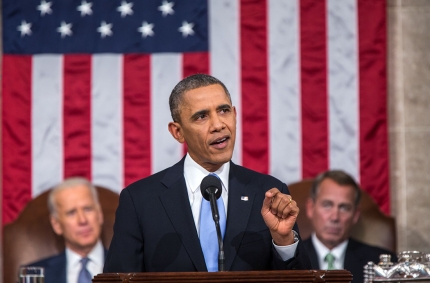
President Barack Obama delivers the State of the Union address in the House Chamber at the U.S. Capitol in Washington, D.C., Jan. 28, 2014.

President Barack Obama delivers the State of the Union address in the House Chamber at the U.S. Capitol in Washington, D.C., Jan. 28, 2014. (Official White House Photo by Pete Souza)

Tonight, President Obama delivered the 2014 State of the Union Address to Congress and the nation.

If you missed it, be sure to watch the enhanced broadcast of his address, featuring charts, graphs, and images that help explain the policies and issues he discussed. You can also read his full remarks here.

Have questions about the speech? Tomorrow, the Obama Administration is hosting its first-ever virtual “Big Block of Cheese Day,” during which dozens of White House officials will take to social media for a day long 'open house' to answers questions from everyday Americans in real-time on Twitter Facebook,  Tumblr,  Instagram and via Google+ Hangout. Learn more and find out how to participate here.

Related Topics: State of the Union

The 2014 State of the Union Address

January 29, 2014 | 1:05:17 | Public Domain

President Obama delivers the 2014 State of the Union address to Congress and the nation.

Download mp4 (2468MB) | mp3 (157MB)

Read the Transcript

President Obama's 2014 State of the Union Address

[[nid:255431]]

Tonight, President Obama delivered the 2014 State of the Union Address to Congress and the nation.

If you missed it, be sure to watch the enhanced broadcast of his address, featuring charts, graphs, and images that help explain the policies and issues he discussed. You can also read his full remarks here.

Have questions about the speech? Tomorrow, the Obama Administration is hosting its first-ever virtual “Big Block of Cheese Day,” during which dozens of White House officials will take to social media for a day long 'open house' to answers questions from everyday Americans in real-time on Twitter Facebook,  Tumblr,  Instagram and via Google+ Hangout. Learn more and find out how to participate here.

Then, on Friday, January 31 President Obama will take a virtual road trip via Google+ Hangouts to discuss the State of the Union with citizens across the country. Find out more and learn how to join the road trip here.

Check out the slides from tonight's address:

Close Transcript