The White House

Office of the Press Secretary

President Obama Nominates Two to Serve as U.S. Attorneys

WASHINGTON, DC - Today, President Obama nominated Deirdre M. Daly and James Walter Frazer Green to serve as U.S. Attorneys. 

“These fine attorneys have extensive legal experience and a shared commitment to public service,” President Obama said.  “I am thrilled that they will continue their service by pursuing justice on behalf of the American people as United States Attorneys.”

Deirdre M. Daly: Nominee for United States Attorney for the District of Connecticut
Deirdre M. Daly has served as the First Assistant United States Attorney in the District of Connecticut since 2010 and as the Acting United States Attorney since May 2013.  Previously, Daly was a partner with the Connecticut law firm Daly & Pavlis LLC from 2001 to 2010 and with the New York law firm Gage & Pavlis from 1997 to 2001.  She served as an Assistant United States Attorney in the Southern District of New York from 1985 to 1997 and began her law career as a law clerk for Judge Lloyd F. MacMahon of the United States District Court for the Southern District of New York from 1984 to 1985.  Daly received her J.D. in 1984 from Georgetown University Law Center and her B.A. in 1981 from Dartmouth College.

James Walter Frazer Green: Nominee for United States Attorney for the Middle District of Louisiana
James Walter Frazer Green has served as First Assistant United States Attorney in the Middle District of Louisiana since 2010 and as the Acting United States Attorney since July 2013.  Previously, Green served as Deputy Criminal Chief in the Middle District of Louisiana from 2002 to 2010 and as an Assistant United States Attorney in the District of Nevada from 1998 to 2000.  He has also been a member of the United States Marine Corps Reserve since 1989, where he currently holds the rank of Colonel and serves as the Officer-in-Charge of the Environmental Services Division.  He has also served as a United States Marine Corps Judge Advocate since 1994.  Green received his J.D. in 1993 from Tulane Law School and his B.A. in 1989 from Louisiana State University.

The White House

Office of the Press Secretary

President Obama Nominates John W. deGravelles to Serve on the United States District Court for the Middle District of Louisiana

WASHINGTON, DC – Today, President Barack Obama nominated John W. deGravelles to serve on the United States District Court for the Middle District of Louisiana.

“I am honored to put forward John W. deGravelles for the federal bench,” President Obama said.  “He will be a distinguished public servant and a valuable addition to the United States District Court.”

John W. deGravelles:  Nominee for the United States District Court for the Middle District of Louisiana
John W. deGravelles has been a partner at deGravelles, Palmintier, Holthaus & Frugé LLP (and its predecessor firms) for more than 25 years.  He was a solo practitioner from 1986 to 1987, and from 1974 to 1986, deGravelles worked at the law firm of Dué, Dodson, deGravelles, Robinson & Caskey (and its predecessor firms), where he became a partner in 1976.  During his entire legal career, deGravelles has handled a wide variety of civil litigation in both federal and state courts.  He received his J.D. in 1974 from the Louisiana State University Paul M. Hebert Law Center and his B.A. in 1971 from Louisiana State University. 

The White House

Office of the Press Secretary

Presidential Memorandum -- Updating and Modernizing Overtime Regulations

March 13, 2014

MEMORANDUM FOR THE SECRETARY OF LABOR

SUBJECT: Updating and Modernizing Overtime Regulations

The Fair Labor Standards Act (the "Act"), 29 U.S.C. 201 et seq., provides basic rights and wage protections for American workers, including Federal minimum wage and overtime requirements. Most workers covered under the Act must receive overtime pay of at least 1.5 times their regular pay rate for hours worked in excess of 40 hours per week.

However, regulations regarding exemptions from the Act's overtime requirement, particularly for executive, administrative, and professional employees (often referred to as "white collar" exemptions) have not kept up with our modern economy. Because these regulations are outdated, millions of Americans lack the protections of overtime and even the right to the minimum wage.

Therefore, I hereby direct you to propose revisions to modernize and streamline the existing overtime regulations. In doing so, you shall consider how the regulations could be revised to update existing protections consistent with the intent of the Act; address the changing nature of the workplace; and simplify the regulations to make them easier for both workers and businesses to understand and apply.

This memorandum is not intended to, and does not, create any right or benefit, substantive or procedural, enforceable at law or in equity by any party against the United States, its departments, agencies, or entities, its officers, employees, or agents, or any other person.

Nothing in this memorandum shall be construed to impair or otherwise affect the authority granted by law to a department or agency, or the head thereof.

You are hereby authorized and directed to publish this memorandum in the Federal Register.

BARACK OBAMA

The White House

Office of the Press Secretary

Remarks by the President On Overtime Pay

East Room

2:27 P.M. EDT

THE PRESIDENT:  Thank you, everybody, thank you.  (Applause.)  Thank you so much.  Please.  Thank you, guys.  Please have a seat. 

Well, welcome to the White House.  Before I get started, I just want to acknowledge somebody who is working so hard on behalf of America’s workers each and every day, our outstanding Secretary of Labor, Tom Perez.  So give him a big round of applause.  (Applause.)  There you go.  Tom must have brought some of his family with him.  (Laughter.)

We’ve got a lot of honored guests here.  We’ve got middle-class workers who rely on overtime pay.  We’ve got business owners who believe in treating their employees right both because it’s the right thing to do but also because it’s good for business.  And thanks to the hard work and resilience of Americans like the ones who are here today, our economy has been growing for a number of years now. 

Our businesses have created more than 8.5 million new jobs over the last four years.  The unemployment rate is at the lowest it’s been in over five years.  But in many ways, the trends that have really battered middle-class families for decades have gotten worse, not better.  Those at the top are doing better than ever, but for the average family, wages have barely budged.  And too many Americans are working harder and harder just to get by.

So we’ve got to reverse those trends.  We’ve got to build an economy that works for everybody, not just for a few.  And we’ve got to restore the basic notion of opportunity that is at the heart of the American experience:  Opportunity for everyone; the belief that here in America, it doesn’t matter where you started, if you are willing to work hard and act responsibly, you’ve got a chance to get ahead.

So at my State of the Union at the beginning of the year I laid out an opportunity agenda to give more Americans a chance to succeed.  It’s got four parts.  Number one, making sure we’re creating more good jobs that pay good wages.  Number two, making sure that we’re training more Americans with the skills that are needed to fill those jobs.  Number three, making sure every child in America gets a world-class education.  And number four, which is what I’m going to be focusing on today, making sure that our economy rewards the hard work of every American.  

Now, making work pay means making sure women earn equal pay for equal work.  (Applause.)  It means giving women the chance to have a baby without sacrificing jobs, or a day off to care for a sick child or parent without worrying about making ends meet.  It means making sure every American has access to quality, affordable health care that’s there when you need it.  So if there’s somebody out there that you know that doesn’t have health insurance, make sure they go on healthcare.gov -- (laughter) -- before March 31st.  That’s a priority.  (Applause.)  And it means wages and paychecks that help to support a family.

Profitable corporations like Costco see paying higher wages as way to reduce turnover and boost productivity.  And I’ve asked business owners to do what they can to give their employee a raise.  As some of you saw, I was at The Gap yesterday -- or the day before yesterday in Manhattan -- and fortunately Malia and Sasha liked the sweaters I bought them.  (Laughter.)  But part of what I wanted to highlight was the fact that, on its own, The Gap decided to give a raise to 64,000 employees across the country. 

I’ve now called on Congress to give America a raise by raising the minimum wage to $10.10 an hour.  (Applause.)  And in this year of action, while Congress decides what it’s going to do -- whether it’s going to do anything about this issue -- and I hope that it does, and I know Democrats are pushing hard to get minimum wage legislation passed -- I’m going to do what I can on my own to raise wages for more hardworking Americans.  So a few weeks ago I signed an executive order requiring federal contractors to pay their employees a fair wage of at least $10.10 an hour.  Today, I’m going to use my pen to give more Americans the chance to earn the overtime pay that they deserve.

Overtime is a pretty simple idea:  If you have to work more, you should get paid more.  And if you want to know why it’s so important, just ask some of the folks here who are behind me.  Nancy Minor works at an oil refinery in Pennsylvania -- Nancy, raise your hand.  There you go.  Yes, give Nancy a big round of applause.  (Applause.)  So for the last 16 years, Nancy has been a single mom raising and educating four kids on her own, and that is not easy, as you might imagine.  She’s been able to do it, though, thanks in part to her overtime pay. 

For more than 75 years, the 40-hour workweek and the overtime that comes with it have helped countless workers like Nancy get ahead.  And it means that when she’s asked to makes significant sacrifices on behalf of her company -- which she’s happy to do -- they’re also looking out for her, recognizing that that puts a strain on her family and -- having to get a babysitter and all kinds of things, adjustments that she has to make.  It’s just fair.  It’s just the right thing to do. 

Unfortunately, today, millions of Americans aren’t getting the extra pay they deserve.  That’s because an exception that was originally meant for high-paid, white-collar employees now covers workers earning as little as $23,660 a year.  So if you’re making $23,000, typically, you’re not high in management.  If your salary is even a dollar above the current threshold, you may not be guaranteed overtime.  It doesn't matter if what you do is mostly physical work like stocking shelves, it doesn't matter if you’re working 50 or 60 or 70 hours a week -- your employer doesn't have to pay you a single extra dime.

And I think that’s wrong.  It doesn’t make sense that in some cases this rule actually makes it possible for salaried workers to be paid less than the minimum wage.  It’s not right when business owners who treat their employees fairly can be undercut by competitors who aren’t treating their employees right.  If you’re working hard, you’re barely making ends meet, you should be paid overtime.  Period.  Because working Americans have struggled through stagnant wages for too long. 

Every day, I get letters from folks who just feel like they’re treading water.  No matter how hard they’re working -- they’re putting in long hours, they’re working harder and harder just to get by, but it’s always, at the end of the month, real tight.  Workers like the ones with me here today, they want to work hard.  They don’t expect a free lunch and they don’t expect to be fabulously wealthy, they just want a chance to get ahead.

So today, I’m taking action to help give more workers that chance.  I’m directing Tom Perez, my Secretary of Labor, to restore the common-sense principle behind overtime:  If you go above and beyond to help your employer and your economy succeed, then you should share a little bit in that success.  And this is going to make a real difference in the lives of millions of Americans, from managers in fast food and retail to office workers, cargo inspectors.   

And we’re going to do this the right way -- we’re going to consult with both workers and businesses as we update our overtime rules.  We’re going to work to simplify the system to it’s easier for employers and employees alike.  With any kind of change like this, not everybody is going to be happy, but Americans have spent too long working more and getting less in return.

So wherever and whenever I can make sure that our economy rewards hard work and responsibility, that it makes sure that it’s treating fairly the workers who are out there building this economy every day, that’s what I’m going to do.  What every American wants is a paycheck that lets them support their families, experience a little bit of economic security, pass down some hope and optimism to their kids.  That’s what we’re going to be fighting for.  That’s what I’m going to be fighting for as long as I’m President of the United States. 

And with that, I’m going to sign this memo.  And I want to thank everybody for being here, especially the folks standing behind me.  (Applause.) 

END  
2:27 P.M. EDT

The White House

Office of the Press Secretary

Statement by the Press Secretary on S. 23

On Thursday, March 13, 2014, the President signed into law:

S. 23, the "Sleeping Bear Dunes National Lakeshore Conservation and Recreation Act," which designates approximately 32,557 acres of Federal land and inland water within the Sleeping Bear Dunes National Lakeshore in Michigan, as the Sleeping Bear Dunes Wilderness.

The White House

Office of the Press Secretary

FACT SHEET: Opportunity for All: Rewarding Hard Work by Strengthening Overtime Protections

After weathering the Great Recession and through five years of hard work and determination, America is creating jobs and rebuilding our economy. But as a result of shifts that have taken hold over more than three decades, too many Americans are working harder than ever just to get by, let alone to get ahead. 

President Obama believes that, in America, if you work hard and take responsibility, you should have the opportunity to succeed. That’s why he has pledged to make 2014 a year of action, working with Congress where they’re willing, but using his phone and his pen wherever he can to build real, lasting economic security for the middle class and those working hard to become a part of the middle class. 

As part of that effort, today, President Obama is directing the Secretary of Labor to begin the process of addressing overtime pay protections to help make sure millions of workers are paid a fair wage for a hard day's work and rules are simplified for employers and workers alike.

Basic Overtime Protections Have Eroded

The overtime rules that establish the 40-hour workweek, a linchpin of the middle class, have eroded over the years.  As a result, millions of salaried workers have been left without the protections of overtime or sometimes even the minimum wage. For example, a convenience store manager or a  fast food shift supervisor or an office worker may be expected to work 50 or 60 hours a week or more, making barely enough to keep a family out of poverty, and not receive a dime of overtime pay. It’s even possible for employers to pay workers less than the minimum wage per hour.

The overtime and minimum wage rules are set in the Fair Labor Standards Act, originally passed by Congress in 1938, and apply broadly to private-sector workers. However, there are some exceptions to these rules, which the Department of Labor has the authority to define through regulation. One of the most commonly used exemptions is for “executive, administrative and professional” employees, the so-called “white collar” exemption.

Workers who are paid hourly wages or who earn below a certain salary are generally protected by overtime regulations, while those above the threshold who perform executive, professional or administrative duties are not.  That threshold has failed to keep up with inflation, only being updated twice in the last 40 years and leaving millions of low-paid, salaried workers without these basic protections. Specifically:

  • In 1975 the Department of Labor set the threshold below which white collar workers were entitled to overtime pay at $250 per week.
  • In 2004 that threshold was set at $455 per week (the equivalent of $561 in today's dollars). This is below today’s poverty line for a worker supporting a family of four, and well below 1975 levels in inflation adjusted terms.

Today, only 12 percent of salaried workers fall below the threshold that would guarantee them overtime and minimum wage protections (compared with 18 percent in 2004 and 65 percent in 1975).  Many of the remaining 88 percent of salaried workers are ineligible for these protections because they fall within the white collar exemptions.  Many recognize that these regulations are outdated, which is why states like New York and California have set higher salary thresholds.

At the same time, employers and workers alike have difficulty navigating the existing regulations, and many recognize that the rules should be modernized to better fit today’s economy.

Details of the Presidential Memorandum

Improving the overtime regulations consistent with the Memorandum the President will sign today could benefit millions of people who are working harder but falling further behind. The Fair Labor Standards Act protects over 135 million workers in more than 7.3 million workplaces nationwide.

The Presidential Memorandum instructs the Secretary of Labor to update regulations regarding who qualifies for overtime protection. In so doing, the Secretary shall consider how the regulations could be revised to:

  •  Update existing protections in keeping with the intention of the Fair Labor Standards Act.
  • Address the changing nature of the American workplace.
  • Simplify the overtime rules to make them easier for both workers and businesses to understand and apply.

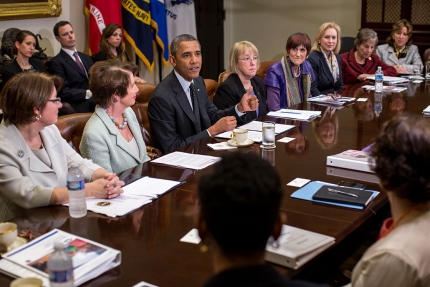
President Obama Meets with Women Members of Congress

March 12, 2014 | 9:04 | Public Domain

President Obama drops by a meeting with women Members of Congress to discuss the administration's economic agenda and minimum wage efforts.

Download mp4 (332MB) | mp3 (9MB)

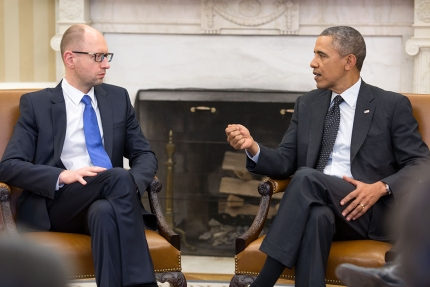
President Obama's Bilateral Meeting with Prime Minister Yatsenyuk of Ukraine

March 12, 2014 | 15:26 | Public Domain

The President Obama and Prime Minister Arseniy Yatsenyuk of Ukraine speak to the press after a bilateral meeting to discuss finding a peaceful resolution to Russia's ongoing military intervention in Crimea that would respect Ukrainian sovereignty and territorial integrity. The leaders also discussed support the international community can provide to help Ukraine confront its economic challenges, and the importance of uniting Ukraine and working to fulfill the aspirations of the Ukrainian people as they prepare for May presidential elections.

Download mp4 (567MB) | mp3 (15MB)

Read the Transcript

Remarks by President Obama and Ukraine Prime Minister Yatsenyuk after Bilateral Meeting

Oval Office

3:30 P.M. EDT

PRESIDENT OBAMA:  It is a pleasure to welcome Prime Minister Yatsenyuk to the Oval Office, to the White House. 

I think all of us have seen the courage of the Ukrainian people in standing up on behalf of democracy and on the desire that I believe is universal for people to be able to determine their own destiny.  And we saw in the Maidan how ordinary people from all parts of the country had said that we want a change.  And the Prime Minister was part of that process, showed tremendous courage, and upheld the principles of nonviolence throughout the course of events over the last several months.

Obviously, the Prime Minister comes here during a very difficult time for his country.  In the aftermath of President Yanukovych leaving the country, the parliament, the Rada, acted in a responsible fashion to fill the void, created a inclusive process in which all parties had input, including the party of former President Yanukovych.  They have set forward a process to stabilize the country, take a very deliberate step to assure economic stability and negotiate with the International Monetary Fund, and to schedule early elections so that the Ukrainian people, in fact, can choose their direction for the future.  And the Prime Minister has managed that process with great skill and great restraint, and we’re very much appreciative of the work that he has done. 

The most pressing challenge that Ukraine faces at the moment, however, is the threat to its territorial integrity and its sovereignty.  We have been very clear that we consider the Russian incursion into Crimea outside of its bases to be a violation of international law, of international agreements of which Russia is a signatory, and a violation of the territorial integrity and sovereignty of Ukraine.  And we have been very firm in saying that we will stand with Ukraine and the Ukrainian people in ensuring that that territorial integrity and sovereignty is maintained. 

I think we all recognize that there are historic ties between Russia and Ukraine, and I think the Prime Minister would be the first one to acknowledge that.  And I think the Prime Minister and the current government in Kyiv has recognized and has communicated directly to the Russian Federation their desire to try to manage through this process diplomatically.  But what the Prime Minister I think has rightly insisted on is, is that they cannot have a country outside of Ukraine dictate to them how they should arrange their affairs.  And there is a constitutional process in place and a set of elections that they can move forward on that, in fact, could lead to different arrangements over time with the Crimean region, but that is not something that can be done with the barrel of a gun pointed at you.

And so Secretary Kerry is in communications with the Russian government and has offered to try to explore with his counterpart, Foreign Minister Lavrov, a diplomatic solution to this crisis.  We are in close communication with the Ukrainian government in terms of how we might proceed going forward.  But we will continue to say to the Russian government that if it continues on the path that it is on then not only us, but the international community -- the European Union and others -- will be forced to apply a cost to Russia’s violations of international law and its encroachments on Ukraine. 

There’s another path available, and we hope that President Putin is willing to seize that path.  But if he does not, I’m very confident that the international community will stand strongly behind the Ukrainian government in preserving its unity and its territorial integrity.

Let me just make two final points.  Obviously, because of the political turmoil, the economic situation in Ukraine has become more challenging, not less.  And that’s why I’m very proud that not only as critical members of the International Monetary Fund, the IMF, we are working with the Prime Minister and his team in a package that can help to institute necessary reforms inside of the Ukraine, but also help to stabilize the situation so that people feel confident that in their daily lives they can meet their basic necessities.

We’re also asking Congress to act promptly to deliver on an aid package, including a $1 billion loan guarantee that can help smooth the path for reform inside of Ukraine and give the Prime Minister and his government the capacity to do what they need to do as they are also organizing an election process.  So I would just ask both Democrats and Republicans, who I know are unified in their support of Ukraine, to move quickly to give us the support that we need so that we can give the Ukrainian people the support that they need.

And then, finally, Mr. Prime Minister, I would ask that you deliver a message on behalf of the American people to all the Ukrainian people, and that is that we admire their courage; we appreciate their aspirations.  The interests of the United States are solely in making sure that the people of Ukraine are able to determine their own destiny.  That is something that here in the United States we believe in deeply.  I know it’s something that you believe in deeply as well.  And you can rest assured that you will have our strong support as you move forward during these difficult times. 

Thank you.

PRIME MINISTER YATSENYUK:  Thank you, Mr. President.  And we highly appreciate the support that you have given to the Ukrainian people.  And my country feels that the United States stands by the Ukrainian people. 

Mr. President, it’s all about the freedom.  We fight for our freedom.  We fight for our independence.  We fight for our sovereignty.  And we will never surrender. 

My country has faced a number of challenges.  The military one is a key challenge today, and we urge Russia to stick to its international obligations, to pull back its military into barracks, and to start the dialogue with no guns, with no military, with no tanks, but with the diplomacy and political tools.

On behalf of my government, I would like to reiterate that we are absolutely ready and open for talks with the Russian Federation.  We adhere to all international obligations.  And we as the state of Ukraine will fulfill all bilateral and multilateral international treaties. 

On the economic side, Mr. President, we highly appreciate the support of the United States and the decision to guarantee $1 billion loan for the Ukrainian economy.  You know that we resumed talks with the IMF.  We do understand that these are tough reforms, but these reforms are needed for the Ukrainian state.  And we are back on track in terms of delivering real reforms in my country. 

As I already informed you, probably in the nearest future, next week or in 10 days, Ukraine is to sign a political part of  -- association agreement with the European Union, and we want to be very clear that Ukraine is and will be a part of the Western world, and our Russian partners have to realize that we are ready to make a new type or to craft a new type of our relationship where Ukraine is a part of the European Union, but Ukraine is a good friend and partner of Russia.

So much will depend on whether Russia wants to have this talk and whether Russia wants to have Ukraine as a partner or as a subordinate.  As I already indicated, we will never surrender and we will do everything in order to preserve peace, stability, and independence of my country.  And we appreciate your personal support, the support of your government, support of the American people to the Ukrainian people. 

Thank you, Mr. President.

PRESIDENT OBAMA:  Mr. Prime Minister, thank you very much.

Q    (Inaudible.)

PRESIDENT OBAMA:  Julie, we completely reject a referendum patched together in a few weeks with Russian military personnel basically taking over Crimea.  We reject its legitimacy.  It is contrary to international law.  It is contrary to the Ukrainian constitution. 

I know that we've heard from the Russian Federation this notion that these kinds of decisions are often made in other places, and they’ve even analogized it to Scotland or other situations of that sort.  In each of those cases that they’ve cited, decisions were made by a national government through a long, lengthy, deliberative process.  It's not something that happens in a few days, and it's not something that happens with an outside army essentially taking over the region.

As you just heard the Prime Minister indicate, the people of Ukraine recognize historic ties with the people of Russia.  The Prime Minister you just heard say, repeat what he said often, which is they’re prepared to respect all international treaties and obligations that they are signatories to, including Russian basing rights in Crimea.  The issue now is whether or not Russia is able to militarily dominate a region of somebody else’s country, engineer a slapdash referendum, and ignore not only the Ukrainian constitution but a Ukrainian government that includes parties that are historically in opposition with each other -- including, by the way, the party of the previous President.

So we will not recognize, certainly, any referendum that goes forward.  My hope is, is that as a consequence of diplomatic efforts over the next several days that there will be a rethinking of the process that's been put forward. 

We have already put in place the architecture for us to apply financial and economic consequences to actions that are taken.  But our strong preference is to resolve this diplomatically.  And as you heard the Prime Minister say, this idea that somehow the Ukrainian people are forced to choose between good relations with the West or good relations with Russia, economic ties with the West or economic ties with Russia, is the kind of zero-sum formulation that in the 21st century, with a highly integrated, global economy, doesn’t make any sense and is not in the interests of the Ukrainian people. 

I actually think, in the end, it's not in the interests of Russia either.  Russia should be thinking about how can it work with Ukraine to further strengthen its economic ties and trade and exchanges with Europe.  That will make Russia stronger, not weaker.  But obviously Mr. Putin has some different ideas at this point. 

We do not know yet what our diplomatic efforts will yield, but we'll keep on pressing.  In the meantime, the main message I want to send is that we are highly supportive of a government in Kyiv that is taking on some very tough decisions, is committed to law and order, inclusivity, committed to the rights of all Ukrainian people, and is committed to fair and free elections that should settle once and for all any questions that there may be about what’s transpired since former President Yanukovych left the country. 

And the most important thing to remember is this is up to the Ukrainian people.  It's not up to the United States.  It's not up to Russia.  It's up to the Ukrainian people to make a decision about how they want to live their lives.  That's what all of us should support.  And certainly that's the reason why I'm so pleased to have the Prime Minister here today. 

                     END            3:46 P.M. EDT       

Close Transcript

President Obama: "When Women Succeed, America Succeeds"

President Barack Obama meets with women Members of Congress in the Roosevelt Room of the White House, March 12, 2014

President Barack Obama meets with women Members of Congress in the Roosevelt Room of the White House, March 12, 2014. (Official White House Photo by Lawrence Jackson)

Today, the President hosted a meeting with women members of Congress to discuss the 2014 women's economic agenda, and the administration's plan to expand opportunity for every American.

In advance of that meeting, the White House Council of Economic Advisers released new economic data that laid out exactly why — in spite of the substantial gains women have made in the workforce — we've still got work to do to close the gender gap and promote opportunity.

The President has made clear that he'll continue working with Congress wherever they are willing, but he isn't going to wait to take action on behalf of the American people. And he announced today that he will host the White House Summit on Working Families on June 23, 2014 alongside the Department of Labor and Center for American Progress to continue the conversation about issues facing the 21st-century workplace.

Here's a look at the state of the workforce for women — featuring charts from today's meeting with representatives. Take a look, and pass it on.

Related Topics: Economy, Equal Pay

President Obama Meets with Prime Minister Yatsenyuk of Ukraine

President Barack Obama holds a bilateral meeting with Prime Minister Arseniy Yatsenyuk of Ukraine in the Oval Office

President Barack Obama holds a bilateral meeting with Prime Minister Arseniy Yatsenyuk of Ukraine in the Oval Office, March 12, 2014. (Official White House Photo by Pete Souza)

Today, President Obama held a bilateral meeting with Prime Minister Arseniy Yatsenyuk of Ukraine.

In their meeting, the President and Prime Minister Yatsenyuk discussed how to find a peaceful resolution to Russia’s ongoing military intervention in Crimea that would respect Ukrainian sovereignty and territorial integrity. They also discussed support the international community can provide to help Ukraine confront its economic challenges, and the importance of uniting Ukraine and working to fulfill the aspirations of the Ukrainian people as they prepare for May presidential elections.