President Obama's Bilateral Meeting with Prime Minister Kenny of Ireland

March 14, 2014 | 6:19 | Public Domain

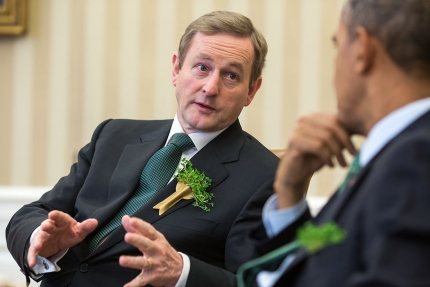
President Obama and Prime Minister Enda Kenny of Ireland speak to the press before a bilateral meeting in the Oval Office.

Download mp4 (230MB) | mp3 (6MB)

Read the Transcript

Remarks by President Obama and Prime Minister Kenny of Ireland after Bilateral Meeting

Oval Office

11:15 A.M. EDT

PRESIDENT OBAMA:  Well, it is wonderful to have Taoiseach Kenny back here in the Oval Office.  This is one of my favorite times of year because I'm able to join with our friends from Ireland to celebrate the incredible bond that exists between our two countries.  I think it's fair to say that there are very few countries around the world where the people-to-people ties are so strong.

And in addition to sharing values and sharing a commitment to democracy, we also share these family ties that go back generations.  And I want to once again thank the people of Ireland for the incredible hospitality that they showed me and Michelle and the girls each time that we've had an opportunity to visit Ireland. 

I started the meeting today congratulating Taoiseach Kenny on the economic progress that's been made over the last several years in Ireland.  Obviously Ireland was hit hard by the financial crisis and problems with its banking system.  It required some very tough decisions that Taoiseach Kenny was willing to take.  But what we've now seen is Ireland emerge from its assistance program in a much stronger position on the global stage and in global markets.  And as a consequence, I think it's really well positioned to start building for the future and attracting businesses with a highly skilled and well-educated workforce. 

And there is tremendous investment by U.S. companies in Ireland.  There’s tremendous investment here in the United States by Irish companies.  We're an example of the mutually beneficial trade that can take place across the Atlantic.  And that's why we appreciate Taoiseach Kenny being a strong leader as we move forward on the Transatlantic trade agreement that is currently being negotiated between the United States and the EU.

We had an opportunity to discuss a range of global affairs.  Obviously on our minds right now is the situation in Ukraine.  Ireland has been a strong voice in the European Council for the need to send a clear message of support for Ukrainian democracy and self-determination, and a strong message to Russia that it should not violate the integrity and the sovereignty of its neighbor.  We continue to hope that there’s a diplomatic solution to be found, but the United States and Europe stand united not only in its message about Ukrainian sovereignty but also that there will be consequences if, in fact, that sovereignty continues to be violated.

We had an opportunity to discuss the fact that Ireland does tremendous work around the world on a whole range of issues.  It punches above its weight when it comes to humanitarian efforts.  We very much appreciate that. 

Closer to home, we both share an interest in seeing Northern Ireland continue to take the next steps that are necessary to finally bring an end to what so often has been a tragic history. I was disappointed, the U.S. government was disappointed that the All-Party Talks did not arrive at a final conclusion and agreement.  But we're urging the parties to continue to work and negotiate.  And I know that the good influence coming from Dublin will help to encourage that to move out of the past and get the kind of history that -- or the kind of future that Northern Ireland so richly deserves.

So I greatly appreciate, Taoiseach, your visit.  We look forward to a good lunch and I suspect some good Irish music.  And we will have a wonderful St. Patrick’s Day reception this afternoon.  The Taoiseach, I understand, has brought his children here this time, so they’ll be able to celebrate alongside us.  And to you and your delegation, thank you again for your friendship and support.

PRIME MINISTER KENNY:  Let me just say it's a privilege to be here in the Oval Office with the President to continue these traditions and discussions that we've had between our two countries.  I might say that on this occasion we did not have to have a detailed discussion about Ireland’s economy.  I was able to report to the President the progress our country has made in the last couple years.

The President spoke about the issues that we did discuss.  In addition to that, we also discussed the question of immigration reform, which is an issue for Ireland and for many other countries, and we hope to pursue those discussions down at the Capitol building later on with a number of other representatives.

So it's a privilege to be here.  It’s a great occasion for us.  And I've given the President a review of the attitude and the happenings at the European Council meeting, particularly in relation to the situation in Ukraine.  And we hope that the entirety of message and strength of feeling can prevent very difficult circumstances arising there.

I explained to him the European Council meeting presentation by the Ukrainian President, the discussion with the EPP Congress with Prime Minister Cameron in Downing Street earlier this week and our hopes that this matter can be resolved.

So, again, my privilege to be here on behalf of the Irish people to wish the President, the First Lady and his family every success in their onerous responsibilities with so many places around the world requiring the assistance of the United States.

PRESIDENT OBAMA:  Thank you.

Thank you, everybody.

Q    Will Vice President Biden come to Ireland?

PRESIDENT OBAMA:  You know, Biden wants to come to Ireland  -- he lobbies me every week to go to Ireland.  So I guarantee you he'll get there.  He'll get there.

Thank you, everybody.

Q    Will you come back to join us again?

PRESIDENT OBAMA:  Oh, I'd love -- tell everybody in Moneygall I said hi.

END 
11:22 A.M. EDT

Close Transcript

The White House

Office of the Press Secretary

Presidential Proclamation -- National Poison Prevention Week, 2014

NATIONAL POISON PREVENTION WEEK, 2014

- - - - - - -

BY THE PRESIDENT OF THE UNITED STATES OF AMERICA

A PROCLAMATION

Over the past four decades, America has seen a steep decline in childhood deaths from accidental poisonings -- thanks in part to improved safety measures and increased public awareness. During National Poison Prevention Week, we do our part to remain vigilant, ask our loved ones to use common-sense precautions, and learn about the potentially life-saving action we can take in case of emergency.

While we have made great strides, unintentional poisoning still takes the lives of about 30 American children every year and sends tens of thousands to the hospital. Because the vast majority of these accidents occur in the home, it is essential for parents and caregivers to keep potentially harmful products -- including cleaning supplies and medication -- out of their children's reach and sight. If you ever suspect a child, family member, or anyone has been poisoned, quick action may prevent serious injury or death. You should immediately call the toll-free Poison Help Line at 1-800-222-1222.

Earlier this year, I signed the Poison Center Network Act, which supports the hotline, a poison prevention grant program, and an awareness campaign. As my Administration promotes safe practices across our country, each of us can make our homes and communities more secure. To safeguard against carbon monoxide, a deadly, colorless, odorless gas, every American should have heating systems inspected each year and install carbon monoxide alarms in their homes. And because prescription drug overdose remains the most common cause of fatal poisoning, we must properly store and dispose of medications. I encourage Americans to visit www.DEAdiversion.USDOJ.gov to read about safe prescription drug disposal and learn how to participate in the National Prescription Drug Take-Back Day on April 26. For information on preventing accidents and helping victims of poisoning, go to PoisonHelp.HRSA.gov.

To encourage Americans to learn more about the dangers of accidental poisonings and to take appropriate preventative measures, the Congress, by joint resolution approved September 26, 1961, as amended (75 Stat. 681) has authorized and requested the President to issue a proclamation designating the third week of March each year as "National Poison Prevention Week."

NOW, THEREFORE, I, BARACK OBAMA, President of the United States of America, do hereby proclaim March 16 through March 22, 2014, as National Poison Prevention Week. I call upon all Americans to observe this week by taking actions to protect their families from hazardous household materials and misuse of prescription medicines.

IN WITNESS WHEREOF, I have hereunto set my hand this fourteenth day of March, in the year of our Lord two thousand fourteen, and of the Independence of the United States of America the two hundred and thirty-eighth.

BARACK OBAMA

The White House

Office of the Press Secretary

Remarks by President Obama, Vice President Biden, and Prime Minister Kenny of Ireland at St. Patrick's Day Reception

East Room

5:12 P.M. EDT
 
THE VICE PRESIDENT:  Hey, everyone, how are you?  Welcome to the White House.  (Applause.)  And happy St. Patrick’s Day Week. 
 
In 1963, President Kennedy addressed the Irish Parliament and he said, and I quote, “Our two nations, divided by distance, have been united by history.”  And that is obvious to every one of you in this room today.  And nothing exemplifies that bond more than this building.  It was designed by an Irishman named James Hoban -- Hoban.  Any Hobans in the room?  (Laughter.)  I lived across the street from a guy named Johnny Hoban -- anyway, it’s a long story.  (Laughter.)  And it’s been occupied by 19 Presidents of Irish descent -- (applause) -- and the remaining were despondent they could not make that claim.
 
So it’s wonderful to be here today in the White House with all of you.  And I’m reminded of a New Yorker article that Pat Moynihan, God bless him, put on my desk on a St. Patrick’s Day back in the early ’90s.  There was a New Yorker article that had Pat and Mike sitting in a pub in New York, and Pat looks at Mike and says, “Mike, don’t you wish you were in Dublin in a pub wishing you were in New York?”  (Laughter.)  At least the Irish Catholic family I came from, that’s kind of it.  (Applause.)  As I said today, we Irish are the only people I know who are nostalgic about the future.  (Laughter.)  Think about that; you’ll know it’s true.
 
So my mom, who passed away a couple of years ago, Catherine Eugenia Finnegan Biden -- used to say -- and I mean this sincerely -- her notion was, she said, Joey, to be Irish is about family, it’s about faith, but most of all, it’s about courage, for without courage, you cannot love with abandon.  And I think that’s one of the defining elements of -- that’s the Irish of it, that passion that built both our nations and continues to run through the bloodstream of all Irish Americans. 
 
The history of the journey of this great country, in my view, has always been about promise -- the promise that anything is possible.  It’s about possibilities.  And Barack and I -- the President and I occasionally talk about that.  We’re both here in the White House, coming from where we came from -- the idea that would happen in any other country is unlikely.
 
You know, no one embodies the possibilities and promise of our two nations like the leaders you’re about to hear from.  There’s an old Irish expression:  A good friend is like a four-leaf clover -- hard to find and lucky to have.  Ladies and gentlemen, let me introduce to you four of my good friends -- and I mean that seriously -- the President of the United States and Michelle Obama, and the Taoiseach and Fionnuala Kenny.  (Applause.)
 
PRESIDENT OBAMA:  Hello, everybody.  (Applause.)  We'll, welcome to the White House.  (Applause.)  Once again, today is not technically St. Patrick’s Day.  (Laughter.)  And once again, none of you seem particularly bothered by this.  (Laughter.)  At least you’ll have a weekend to recover.  (Laughter.)
 
I want to start by welcoming Taoiseach Kenny and his lovely wife, Fionnuala, who are not just joining us here today, but more importantly, bringing their children.  And we won’t embarrass them by pointing them out.  (Laughter.)  But we’re thrilled to have them here.  I’m especially grateful that they’re here at a time when the rest of Ireland is focused on the final round of the Six Nations Rugby Tournament.  (Applause.)  And the last match of the legendary Brian O’Driscoll.  (Applause.)  I know everyone wants to talk to the Kennys tonight, but let me make sure they have plenty of voice left to cheer on Ireland tomorrow.
 
Finally, I want to extend a special welcome to Anne Anderson, the newest Ambassador of Ireland to the United States.  (Applause.)  Anne is the first woman to hold this esteemed position -- (applause) -- which means that they might finally get it right.  (Laughter.)  
 
One of Ireland’s greatest poets, Patrick Kavanagh, once wrote, “When I wandered over my own hills and talked again to my own people, I looked into the heart of this life and saw that it was good.”  That’s what St. Patrick’s Day is all about.  It’s about remembering the hills from where so many of us came and the people without whom so many of us would not be here today.  And it is about recognizing how much we owe to the Irish men and women who, to borrow a line from James Joyce, lived and laughed and loved and left.

It’s also about appreciating how much of our American character has Irish roots.  When the first large wave of Irish immigrants set sail for the New World, many of them were already tired, hungry and desperately poor.  And life wasn’t always easier in America.  Many jobs were closed to Irish immigrants -- with signs announcing “No Irish Need Apply” -- and many of the ones that were available involved long and dirty and thankless tasks that made life difficult and often too short.  
 
But the Irish worked hard.  And they persevered.  And they supported each other in tight-knit communities, united by faith, where doors were always open and hands were always extended in hard times.  Or, to adapt a quote from the author Finley Peter Dunne, there wasn’t one struggling family in this world that wasn’t carrying three others on its back.  And together, they were driven by that most American of ideas -- that with enough effort, anybody can build a decent life for their families and leave a better life for their children. 
 
And eventually, that’s exactly what happened.  In Newburyport, Massachusetts in the early 20th century, two-thirds of Irish-Americans were members of the working class, just one third in the middle class.  But if you looked at the third generation alone -- the grandchildren of Irish immigrants -- the numbers were reversed.  A majority had broken into the middle class.
 
So the American Dream has always been the Irish-American Dream.  And that’s why so many of you have been working with us to fix our broken immigration system.  Under today’s laws, many of your parents and grandparents may not have made it here.  And too many men and women who want to contribute to our economy are being denied that chance.  There’s no reason why we can’t do for this generation of immigrants what was done for a previous generation, to give them that chance.  (Applause.)
 
Because like millions of immigrants, the sons and daughters of Erin have always lived by the words of the great Seamus Heaney, who passed away last year: “Believe that further shore is reachable from here.  Believe in miracles.” 
 
And before the G8 summit last June, Michelle and I got a chance to visit Belfast.  We saw firsthand the tremendous progress that’s been made in Northern Ireland since the Good Friday Agreement was signed 16 years ago, as well as the long road that still lies ahead. 
 
And before my speech at the Waterfront, Michelle was introduced by a 16-year-old girl named Hannah Nelson.  (Applause.)  And Hannah is here -- there she is, right there. Hey, Hannah.  Hannah is a member of the first generation of Northern Irish to grow up knowing the possibilities of peace.  (Applause.)  And in her introduction she said, “Often in Northern Ireland we hear about our past…But truthfully, we should not let the past pull us apart and stop us moving forward…We need to listen to each other and we need to compromise.  Most importantly, we need to clearly value each other.” 
 
And so if Hannah and that generation reflects such wisdom, I think their elders, all of us, need to pay attention, follow their advice.  Young people like Hannah give us hope for the future because they’re driven by the same optimism, the same belief in miracles that drove their ancestors.  But they also benefit from something that didn’t exist for members of the previous generation -- and that’s a hard-won peace that is theirs to nurture and advance.  They have an example of what’s possible.
 
So, to the people of Ireland and Northern Ireland, I’ll close by paraphrasing Seamus Heaney again.  The Ireland you now inhabit is one that your contemporaries have helped imagine.  But the Ireland that you will inhabit is one your children are helping to build -- one that’s more just, and more peaceful, and more tolerant, and more fair.
 
And with that, I want to propose a toast.  And I’m going to -- this is the best that I can do -- water.  (Laughter.)  Clearly, they had the wrong day.  (Laughter.)  May our children continue to enjoy the bonds we share tonight -- of family, faith, friendship, and hope for the future.  “So fill to me the parting glass; Good night and joy be with you all.”
 
And now it is my pleasure to introduce my good friend, Taoiseach Kenny.  (Applause.)
 
PRIME MINISTER KENNY: (Speaks in Gaelic.)  Welcome, everybody, here to the White House.  Mr. President and First Lady Michelle, Mr. Vice President, Dr. Biden, ladies and gentlemen:  Fionnuala and I are delighted to be with you here at the White House to celebrate the Feast of St. Patrick.  Thank you for your warm hospitality in honor of Ireland and of the Irish people. 
 
Thank you for the toast, Mr. President.  I didn’t think that austerity was biting that far into the White House.  (Laughter and applause.)
 
As we make strides in our own economic recovery, it is wonderful to know that our country still occupies such a special place in the heart and the mind of the United States of America. 
 
Mr. President, in June last year, we met at the G8 summit in Fermanagh.  Next day, Dublin came out with a warm summer welcome for Michelle and Malia and Sasha.  And tonight, sir, I just want to make something very clear:  I have heard what I regard the insider speculation surrounding your attributed desire to keep your Vice President off our island has been wholly without foundation.  (Laughter.)  And at the same time, summoning the persuasive spirit of St. Patrick, I did put in a word for Joe this morning -- (laughter.)  His work is invaluable.  His listening ear is critical.  Thank you, Mr. President, for authorizing him to travel to Ireland.  (Applause.)  We have a golf date. 
 
So I look forward to welcoming him home with Jill to the land of our forebears, to the land of his people and of our people, together, as we say, Oileán ár sinsear -- the island of our ancestors -- where five million of us live, and 70 million call home.  And home and our sense of it is what makes us who we are as Irish people.
 
Just as the Forbes Magazine recently was declaring Ireland to be the best country in the world for business, out there in the Atlantic east of here, storms Hercules and Darwin were making a declaration of their own, through the awesome power of nature, gifting us remnants of Neolithic settlements, ghosts of drowned oak forests, 7,000-years-old remnants uncovered on our beaches and land near sea.
 
So, Mr. President, these are excavations not just of our history, but of life on our island, the geology of our heart.  And they signal our tradition and our capacity to endure and to adapt, to survive and to thrive; to know fear, to know loss, and yet to conscript new generations to courage and vision and a brilliant future across the millenia. 
 
That’s why, today, we have the most adaptable workforce in the world and the youngest workforce in the European Union.  That’s why in no other country in the world do U.S. multinationals and U.S. emerging companies have as big a presence as they have in our country. 
 
And according to the received wisdom of it’s not being enough to do well but to do good, so I’m proud to say that despite our difficulties, we are the most generous people in Europe in our giving to those in need, and every day since the United Nations was founded, the Irish are somewhere on the globe involved in peacekeeping or humanitarian duties.  And as we are, Mr. President, we are ever mindful of the kindness that America, in turn, has shown to us and to our people.
 
This evening, as we celebrate St. Patrick, who was himself an immigrant, Mr. President, I am heartened by your words, and I thank you for all you are doing and others in this great country are doing to help our men and women living here undocumented.  We know America will sort this out.  (Applause.) 
 
I’m thrilled you mentioned young Hannah.  I saw her deliver her words last year on television -- congratulations.  And from you to Mark Pollack, whom I see here in front of me, without sight, without the capability of walking, yet he has done extraordinary things in a sense of his vision and his courage of what we can do with our shared humanity.  (Applause.)
 
So, sir, as we take our leave here this evening, we do remember absent friends whom you’ve mentioned -- in particular, he who documented the dream -- the farmer’s son, the known blood relative of the gods, Seamus Heaney.  And in his memory, and in honor of St. Patrick, let us do as he asks when he said, go beyond what’s reliable and recollect how bold you were when I visited you first, with departures you cannot go back on.
 
So, Mr. President, First Lady, Ireland has made its departure.  There is no going back.  Tonight, then, let our two nations, our two countries, Ireland and the United States, heed and live the last words of Seamus Heaney texted to his wife before he left, “Noli timere,” “Do not be afraid.” 
 
Thank you.  (Applause.) 
 
END
5:29 P.M. EDT

The White House

Office of the Press Secretary

Readout of the President's Meeting With Organizations Committed to Passing Bipartisan Immigration Reform

This afternoon the President, Secretary of Homeland Security Jeh Johnson, and senior White House officials met with organizations committed to passing bipartisan commonsense immigration reform.  The leaders of these organizations shared their concerns for the families facing the separation that comes from our broken immigration system.  The President reiterated the deep concern he has for the pain these families face and that he has asked Secretary Johnson to do an inventory of the Department’s current practices to see how it can conduct enforcement more humanely within the confines of the law. Secretary Johnson reemphasized his shared commitment to ensure our immigration laws are enforced effectively, sensibly, and in line with our nation’s traditions as a nation of laws and a nation of immigrants. The President reiterated his commitment to maintaining consistent and sustained pressure on Congressional Republicans to take action on immigration reform as soon as possible. The President continues to believe that the only permanent solution to fixing the broken immigration system is through meaningful comprehensive legislation.

List of Participants:

  • Jeh Johnson, Secretary of Homeland Security
  • John Podesta, Counselor to the President
  • Valerie Jarrett, Senior Advisor to the President
  • Cecilia Munoz, Director of Domestic Policy Council
  • Katie Beirne Fallon, Director of Legislative Affairs
  • Deepak Bhargava, Center for Community Change
  • Eddie Carmona, PICO
  • Mary Kay Henry, SEIU
  • Marielena Hincapie, National Immigration Law Center
  • Angie Kelley, Center for American Progress
  • Eliseo Medina, Fast for Families
  • Mee Moua, Asian American Justice Center
  • Janet Murguia, National Council of la Raza
  • Karen Narasaki, CAMBIO
  • Ali Noorani, National Immigration Forum
  • Lorella Praeli, United We Dream
  • Arturo Rodriguez, United Farm Workers
  • Angelica Salas, CHIRLA
  • Gabriel Salguero, NALEC
  • Frank Sharry, America’s Voice
  • Gustavo Torres, Casa de Maryland
  • Richard Trumka, AFL-CIO

President Obama and Prime Minister Kenny Celebrate the "Incredible Bond" Between the U.S. and Ireland

President Barack Obama holds a bilateral meeting with Prime Minister Enda Kenny of Ireland in the Oval Office, March 14, 2014.

President Barack Obama holds a bilateral meeting with Prime Minister Enda Kenny of Ireland in the Oval Office, March 14, 2014. (Official White House Photo by Pete Souza)

This morning, President Obama held a bilateral meeting with Irish Prime Minister Enda Kenny in the Oval Office, before heading to the Capitol for a St. Patrick's Day lunch. The President explained that this is one of his favorite times of the year, joining with "our friends from Ireland to celebrate the incredible bond that exists between our two countries."

President Obama discussed the economic progress in Ireland over the past several years, remarking that Ireland has "emerge[d] from its assistance program in a much stronger position on the global stage and in global markets," and noting that there is "tremendous investment by U.S. companies in Ireland."

Related Topics: Foreign Policy

The White House

Office of the Press Secretary

FACT SHEET: U.S. Support for Peace and Prosperity in Northern Ireland

For decades, the United States has supported the efforts of the people and leaders of Northern Ireland to realize a prosperous, lasting peace. 

Promoting Peace and Prosperity

The United States has always stood with the people of Northern Ireland and will continue to do so as they continue to build a strong society, vibrant economy, and enduring peace.  We remain fully committed to promoting a lasting peace, advancing prosperity for all, and supporting Northern Ireland’s institutions.  The United States is proud of all that Northern Ireland has achieved, including the 1998 Good Friday Agreement and 2007 St. Andrews Agreement.  We encourage the political parties of Northern Ireland to renew their efforts on the all-party talks to tackle sensitive issues such as parades, flags/symbols, and matters dealing with the past. 

Collaborating on Conflict Resolution and Reconciliation

From 1986 to 2014, the United States has provided over $500 million in assistance through the International Fund for Ireland (IFI) to promote economic and social development in areas of Northern Ireland and the border counties of Ireland most affected by the conflict.  This assistance has supported a wide variety of youth, economic, and community development programs.  One hundred twenty-seven community organizations have completed the IFI-funded Community Leadership Program for training community groups and organizations.  Women of Northern Ireland have a particularly important role to play in promoting peace and developing local economies, and IFI funding also works to empower them.  This year the IFI’s Peace Impact Program provided young women in the greater Londonderry/Derry area of Northern Ireland training in employable skills and conflict resolution.

The U.S. Consulate in Belfast also implements an active outreach and engagement program.  Each year, a range of U.S. speakers disseminates best practices and exchanges ideas about civic engagement, urban regeneration, community cohesion, and marginalizing extremism.  A key component of the Consulate’s outreach, the Danesfort Dialogues, facilitates a series of constructive formal discussions among key civil society members on important local issues.  Through a series of small grants, the Consulate assists local organizations deliver positive change to their communities through sports diplomacy, youth entrepreneurship, and democratic engagement.   

Partnering for Economic Growth and Innovation

The United States is an important economic partner for Northern Ireland.  To promote economic opportunity, we support U.S. investment, and we have encouraged innovators and entrepreneurs as they translate their ideas into businesses.  Over the last 15 years, U.S. individuals and companies have invested over $2 billion in foreign direct investment (FDI) in Northern Ireland.  In the past six years alone, more than 50 U.S. investments worth more than $1 billion have created thousands of new jobs in Northern Ireland.  At the October 2013 Northern Ireland investment conference following the G-8 Summit in Lough Erne, 44 U.S. companies’ representatives travelled to Belfast to build the investment linkages needed to create jobs for Americans and the people of Northern Ireland.

Through the U.S.-Ireland Research and Development Partnership, we also engage in scientific research together, which drives economic development.  The partnership encourages collaboration among scientists from the United States, Ireland, and Northern Ireland in five priority areas:  health, sensor technology, nanotechnology, telecommunications, and energy and sustainability.  This project accelerates commercialization of innovations by fostering private sector coordination with the research teams.

The United States continues to increase investment linkages and partnerships that promote educational, professional, and entrepreneurial opportunities for Northern Ireland’s young people.  The State Department’s Special Representative for Global Partnerships Andrew O’Brien led a delegation of U.S. investors, entrepreneurs, philanthropists, members of the Irish diaspora, and representatives from academia and civil society to Limerick, Ireland and Belfast, Northern Ireland January 28-31.  The Belfast visit developed cross-sectoral partnership opportunities to boost science, technology, environment, and mathematics education, promote entrepreneurship, and promote economic growth. 

Encouraging Northern Ireland’s Young Leaders

Hundreds of students and scholars from the United States and Northern Ireland have participated in the Fulbright Program.  U.S. scholars have benefitted from the Fulbright-Northern Ireland Governance and Public Policy Award and the Northern Ireland Assembly Award, and senior public sector employees from Northern Ireland have benefitted from the Fulbright Northern Ireland Public Sector Award.  In addition, hundreds of Northern Ireland civil society leaders, including legislators, artists, and activists, have participated in U.S. government-funded professional exchange programs.  Thanks to the goodwill of 140 U.S. academic institutions, which waived $40 million in tuition costs over the past 20 years, 1,800 Northern Ireland students have benefited from an academic year abroad in the United States.

This year, the U.S. Department of State awarded a $665,000 grant to the Irish Institute at Boston College for a professional exchange on the rule of law for some 20 governance professionals from Northern Ireland and Ireland and approximately eight U.S. participants.  Through individually tailored, four-week fellowships in advocacy organizations, legal think tanks, law firms, and court offices in the Boston area, followed by a week in Washington, D.C., fellows will have direct exposure to U.S. government policy-making and civil society advocacy.  Working with counterparts, the eight U.S. fellows will then spend two weeks in Ireland and Northern Ireland to implement reciprocal projects.  The participants from Ireland and Northern Ireland will return to Washington, D.C., in June and again in November for a networking event for 200 exchange participants from more than 40 countries.

The Department of State’s “Collaboratory” brought educational technology specialists from Northern Ireland and Ireland on an exchange to the United States in January and will connect them virtually with disadvantaged youth throughout Ireland and peers from Africa.  They will collaborate on ideas to develop their ideal educational systems and help create their own futures, while extending their horizons with engagement with young people in Africa.

The White House

Office of the Press Secretary

Remarks by the First Lady at The Partnership for a Healthier America’s Building a Healthier Future Summit

Hilton Hotel
Washington, D.C.

1:41 P.M. EDT

MRS. OBAMA:  Yay to everyone!  (Applause.)  Thank you so much.  You all, rest yourselves.  It is a pleasure to be here with all of you today. 

Let me start by thanking Larry, not just for his very kind introduction but for his outstanding leadership at PHA, as well as the entire staff of PHA, the board, Jim Gavin -- all of you deserve a huge round of applause for your outstanding work.  I’m so proud of you all.  Thank you so much.  (Applause.)  PHA is doing critically important work to engage partners across the private sector, and over the past two days we’ve seen the fruits of their efforts.

And I am thrilled about the extraordinary commitments that have been announced at this summit, so I want to take a moment to recognize Dannon, Del Monte, Knowledge Universe, Kwik Trip, Nutri Ventures, and Sodexo.  So let’s give them another huge round of applause.  (Applause.)  These are major steps to making sure our families can lead healthier lives, and we are extremely grateful.

And of course, I want to thank all of you, the advocates and experts who’ve been working on the issue of childhood obesity long before it came into the national spotlight.  You all are truly our brain trust on this issue.  You know better than anyone where we’ve been and where we need to go.  And that’s really what I want to talk about today.  I want to talk about how much we’ve achieved, but more importantly, how much more we have left to do.

So let’s start with the good news:  Because of what we have all done together, today, 32 million kids are getting healthier school meals.  Tens of thousands of schools are removing junk food ads from their classroom.  Fifteen thousand childcare centers will be providing healthier snacks and getting those cute little kids up and moving.  Food and beverage companies have cut 6.4 trillion calories from their products.  We will soon have better nutrition labels on 700,000 food items.  Hundreds of new or renovated grocery stores are reaching millions of people in underserved communities -- I could go on.  These are just a few of the highlights.  Absolutely amazing.  (Applause.) 

And today, slowly but surely, healthy habits are becoming the new norm in this country.  Today, according to a recent CDC report that I know you have all discussed, obesity rates have fallen by 43 percent among children ages two to five years old.  And I think we should all be very proud of what we are achieving together, because in a fight this hard, we should celebrate every small victory we can get. 

But that’s really what the CDC report represents.  Yes, it is an important achievement, but in light of the magnitude of this challenge, it is a small achievement.  It’s just a hint of the progress that’s possible on this issue.  So it is a very good thing that we have got so much momentum right now, because we still have a long way to go to solve this problem, particularly among our older children.

So now is not the time to take our foot off the gas and congratulate ourselves on a job well done -- just the opposite.  Now is the time to fight even harder, because we now know it is possible to make a difference on this issue.  We know that our strategies are beginning to work. 

So through Let’s Move, we plan to keep attacking this problem from every angle, because we know there is no one magic bullet.  So we plan to keep building healthier schools.  We plan to keep bringing fresh food into our communities.  We plan to keep urging businesses to provide healthy products and market them responsibly to our kids.  But we also need to keep innovating.  We need to keep pushing the envelope.  We need to find new ideas from every sector to help families make manageable, affordable changes that can transform our children’s health. 

And today, I just want to talk briefly to give an example of one of those changes.  It’s a simple idea which will be a key focus of Let’s Move over the next year, but it is an idea that can help families create healthier new habits.  And the idea is to help families start cooking again.

Now, I know this might not seem like an earth-shattering notion -- though neither was planting a garden in the White House, I will remind you.  (Laughter.)  But research clearly shows that home-cooking is one of the single most impactful ways for families to improve their health. 

One study shows that home-cooking is actually a better predictor of how well families eat than their income.  And that’s not surprising, because food prepared at home is lower in saturated fat, sodium, cholesterol and calories than food prepared away from home.  Because when you cook at home, you’re in control of your nutrition.  You decide the ingredients to use.  You decide the portion sizes.  You decide whether there’s a vegetable on the plate or not.  

But unfortunately, for many families, home-cooking has fallen by the wayside.  And many folks feel like they just don’t have the time to cook, or they don’t know how.  Some think it’s more expensive to prepare balanced home-cooked meals, so they don’t do it.  But it hasn’t always been that way. 

See, back in the day -- for you young people, the day is, like, when I was young -- (laughter) -- folks used to cook all the time.  That was certainly true in my family growing up.  My mother had a strict food budget, and every Saturday she wrote out her list for the week, headed to the grocery down the street.  And she had every meal planned out for the week -– that roast beef for Sunday dinner would be sandwiches for Monday and Tuesday lunches.  Wednesday night was liver night -- it was a very sad night in our household, by the way.  (Laughter.)  Thursday might be spaghetti; Friday, fish.   And once in great a while, we’d order a pizza or pick up a burger at the drive-through, but we usually couldn’t afford to eat out so those were exceptions.

My grandmother had done the same thing for her family, and she worked full-time for most of her life.  See, back then, unless you were rich, cooking was a matter of survival.  It was a way of life.  But like a lot of folks in my generation, I found that by the time I grew up and went off to school and started my career, things had changed. 

I remember one Saturday afternoon as a young lawyer working crazy hours, I was talking to my grandmother over the phone, and the first thing she asked me, she said, “what are you cooking?”  I was like, “Grandma, really?  I am a lawyer.  I do not cook.”  (Laughter.) 

You see, my parents urged me to focus on my studies and career above all else.  They had worked hard to support my dreams, so they didn’t want me to worry about traditional things like cooking.  They felt like I could always learn to cook later.  And that was all well and good for a while, until I had a family of my own.

And I was fine when my kids were little, because we went from breastfeeding straight to what Barack and I called the “jar stage” -- when an entire meal for a baby came in a single jar.  Barack and I, we loved the “jar stage.”  (Laughter.)  We were masters of the “jar stage.”  Providing a balanced meal was so easy -- chicken and rice?  In a jar.  Peas and spinach?  Jar.  Peaches, bananas?  Jar -- big jar.  No need to cook, boil, bake, it was all there for us in those marvelous little baby food jars.  It was heaven. 

But then our babies outgrew the “jar stage,” and suddenly we were faced with the reality that we might actually have to use the appliances in our kitchen to feed our children.  And we slowly figured it out.  We started with the basics like broiled chicken and rice, and steamed broccoli, scrambled eggs -- that’s really all Barack would do, the eggs.  (Laughter.)  And we did our best to cook regularly at home.  But like so many working parents, we both had demanding jobs, we were always exhausted.  And over time, we started giving in and popping things into the microwave, or spending way too much of our monthly budget ordering takeout, which, in turn, resulted in less than optimal health outcomes for our kids.

So as my story hopefully illustrates, while we often frame this cooking problem as a time problem or a budget problem, for many folks it’s actually a skills problem.  Because when you don’t have those basic cooking and budgeting skills that my mother and grandmother had, everything takes longer and costs much more. 

You don’t know how to plan a full week of meals, so you go back and forth to the grocery store.  You don’t know how to cut a whole chicken yourself, so you pay more for the pre-cut parts.  You’ve never learned the basics of cooking, so even simple dishes take longer to prepare.  And today, a lot of folks think it’s quicker and cheaper to just grab some fast food. 

But the fact is that with the right recipes and a few basic skills, there are countless recipes that families can prepare in less than 30 minutes –- meals that actually cost less than going to the drive-through.  For example, a fast food meal for a family of four could cost as much as $20, $25 or more.  But for less than $15, a family can cook a full chicken dinner complete with sides. 

And cooking isn’t just good for our budgets or our physical health, it’s also good for our kids’ emotional health.  Research shows that when families share meals together, kids actually perform better in school, and they get along better with their peers.  And let’s not forget that cooking together can actually be fun.  

So the benefits of cooking couldn’t be more clear.  The question is how do we help families start cooking again, even if it’s just one or two meals a week?  Can we work with supermarkets to do more to distribute recipes on how to cook, and do demonstrations?  Can we develop the home-ec class of the future that will give kids -- both girls and boys –- the basic skills they need to feed themselves on a budget?  Can we inspire chefs to offer affordable cooking classes in their restaurants?

I mean, the possibilities here are endless.  And in the coming months, as we continue our existing efforts, we will be announcing some new initiatives along these lines. 

But really, this is just one example of a very simple, creative approach that doesn’t require new legislation but can fundamentally change the way families take control of their own health.  And I know, looking around this room, that all of you have some great ideas of your own; many innovative, creative things to keep moving this issue forward.

And that’s why today, more than ever before, we need you all with us in this effort.  We need everyone in this room to keep tackling this problem from every angle, because we are just beginning to get traction on this issue.  After decades of struggle, we are just beginning to make some progress.  And I am proud of what we’ve achieved together.

But when one in three children in this country are still overweight or obese, when millions of kids are still on track to develop devastating illnesses like diabetes and heart disease, then we still have to do a gut check.  We need to ask ourselves, have we really done all that we can for our children?  Have we given them our very best?

And of course, the answer is, not really.  The truth is that right now, the biggest risk to our success is our own impatience, our desire to want big changes overnight.  Just think back to our first PHA Summit four years ago -- I don’t know how many of you were there -- I was there.  (Laughter.)  And I still remember all the excitement and determination we were feeling that day.  We didn’t listen to the skeptics who said we could never solve a problem this big and entrenched.  Instead, we all committed ourselves to one clear goal, and that was to solve the problem of childhood obesity within a generation so that kids born today will grow up healthy. 

Now, this wasn’t a five-year goal or a ten-year goal.  It was a generational goal, because it took decades for this childhood-obesity crisis to develop and we knew it would take decades to fix it.  And today, just four years later, studies are beginning to show that our youngest kids –- kids born two to five years ago -- are growing up healthier.

So we’re on track to achieve our goal, we are.  (Applause.)  We are on track.  But if we back down now, if we don’t keep innovating and pushing forward, I guarantee you that we will go right back to where we started.  And that’s not who we are.  That’s not what we do in this country. 

We don’t just walk away when things get hard, especially when it comes to our children’s future.  And we cannot walk away from this issue until obesity rates drop for children of every age and every background.  We cannot walk away until every child in this country has a shot at a healthy life.  And that’s why I’m in this for the long haul -- and I mean long after I leave the White House.  Because I believe in finishing what I start, and I know that you all do too.  (Applause.) 

So now is the time for all of us to truly double down.  Now is the time to commit more effort, more innovation, more energy, more dollars, and more leadership to solving this problem.  That’s what I plan on doing, and if you continue to join me in this effort, if you keep on digging deep and pushing forward, then I know we can raise healthier kids who will become healthier adults, who will raise healthier families of their own.

And that’s how we make real and lasting change in this country.  That’s how we create a better future for generations to come.  So I look forward to working with all of you to create that future that we know we can achieve in the months and years ahead. 

So thank you all.  Thank you for everything you’ve done.  Thank you for everything you continue to do.  I am so proud of you all.  God bless.  (Applause.)

END
1:58 P.M. EDT

The White House

Office of the Press Secretary

Remarks by President Obama and Prime Minister Kenny of Ireland after Bilateral Meeting

Oval Office

11:15 A.M. EDT

PRESIDENT OBAMA:  Well, it is wonderful to have Taoiseach Kenny back here in the Oval Office.  This is one of my favorite times of year because I'm able to join with our friends from Ireland to celebrate the incredible bond that exists between our two countries.  I think it's fair to say that there are very few countries around the world where the people-to-people ties are so strong.

And in addition to sharing values and sharing a commitment to democracy, we also share these family ties that go back generations.  And I want to once again thank the people of Ireland for the incredible hospitality that they showed me and Michelle and the girls each time that we've had an opportunity to visit Ireland. 

I started the meeting today congratulating Taoiseach Kenny on the economic progress that's been made over the last several years in Ireland.  Obviously Ireland was hit hard by the financial crisis and problems with its banking system.  It required some very tough decisions that Taoiseach Kenny was willing to take.  But what we've now seen is Ireland emerge from its assistance program in a much stronger position on the global stage and in global markets.  And as a consequence, I think it's really well positioned to start building for the future and attracting businesses with a highly skilled and well-educated workforce. 

And there is tremendous investment by U.S. companies in Ireland.  There’s tremendous investment here in the United States by Irish companies.  We're an example of the mutually beneficial trade that can take place across the Atlantic.  And that's why we appreciate Taoiseach Kenny being a strong leader as we move forward on the Transatlantic trade agreement that is currently being negotiated between the United States and the EU.

We had an opportunity to discuss a range of global affairs.  Obviously on our minds right now is the situation in Ukraine.  Ireland has been a strong voice in the European Council for the need to send a clear message of support for Ukrainian democracy and self-determination, and a strong message to Russia that it should not violate the integrity and the sovereignty of its neighbor.  We continue to hope that there’s a diplomatic solution to be found, but the United States and Europe stand united not only in its message about Ukrainian sovereignty but also that there will be consequences if, in fact, that sovereignty continues to be violated.

We had an opportunity to discuss the fact that Ireland does tremendous work around the world on a whole range of issues.  It punches above its weight when it comes to humanitarian efforts.  We very much appreciate that. 

Closer to home, we both share an interest in seeing Northern Ireland continue to take the next steps that are necessary to finally bring an end to what so often has been a tragic history. I was disappointed, the U.S. government was disappointed that the All-Party Talks did not arrive at a final conclusion and agreement.  But we're urging the parties to continue to work and negotiate.  And I know that the good influence coming from Dublin will help to encourage that to move out of the past and get the kind of history that -- or the kind of future that Northern Ireland so richly deserves.

So I greatly appreciate, Taoiseach, your visit.  We look forward to a good lunch and I suspect some good Irish music.  And we will have a wonderful St. Patrick’s Day reception this afternoon.  The Taoiseach, I understand, has brought his children here this time, so they’ll be able to celebrate alongside us.  And to you and your delegation, thank you again for your friendship and support.

PRIME MINISTER KENNY:  Let me just say it's a privilege to be here in the Oval Office with the President to continue these traditions and discussions that we've had between our two countries.  I might say that on this occasion we did not have to have a detailed discussion about Ireland’s economy.  I was able to report to the President the progress our country has made in the last couple years.

The President spoke about the issues that we did discuss.  In addition to that, we also discussed the question of immigration reform, which is an issue for Ireland and for many other countries, and we hope to pursue those discussions down at the Capitol building later on with a number of other representatives.

So it's a privilege to be here.  It’s a great occasion for us.  And I've given the President a review of the attitude and the happenings at the European Council meeting, particularly in relation to the situation in Ukraine.  And we hope that the entirety of message and strength of feeling can prevent very difficult circumstances arising there.

I explained to him the European Council meeting presentation by the Ukrainian President, the discussion with the EPP Congress with Prime Minister Cameron in Downing Street earlier this week and our hopes that this matter can be resolved.

So, again, my privilege to be here on behalf of the Irish people to wish the President, the First Lady and his family every success in their onerous responsibilities with so many places around the world requiring the assistance of the United States.

PRESIDENT OBAMA:  Thank you.

Thank you, everybody.

Q    Will Vice President Biden come to Ireland?

PRESIDENT OBAMA:  You know, Biden wants to come to Ireland  -- he lobbies me every week to go to Ireland.  So I guarantee you he'll get there.  He'll get there.

Thank you, everybody.

Q    Will you come back to join us again?

PRESIDENT OBAMA:  Oh, I'd love -- tell everybody in Moneygall I said hi.

END 
11:22 A.M. EDT

Watch President Obama’s Interview with WebMD Readers

President Obama Participates in an Affordable Care Act interview with WebMD

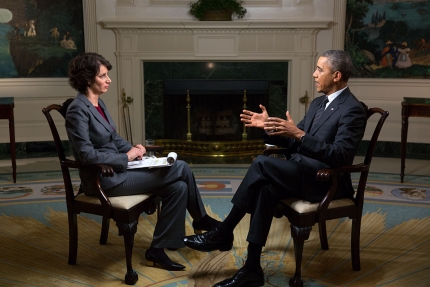
President Barack Obama participates in an Affordable Care Act interview with Lisa Zamosky for WebMD in the Diplomatic Reception Room of the White House. March 12, 2014. (Official White House Photo by Lawrence Jackson)

This week, President Obama sat down for an interview with WebMD to answer questions from consumers and discuss the importance of signing up for health insurance by March 31. In the days leading up to the interview, WebMD readers – from young adults to seniors representing all 50 states – submitted thousands of questions for the President. Now, you can watch the full Q&A.

“My most important recommendation is for people to go to the website healthcare.gov and look for themselves at what plans are being provided,” said the President. During the conversation with the site’s health care reform expert Liza Zamosky, the President discussed health care costs, access to care, Medicaid expansion, and more.

Watch the full video of the interview at WebMD.com/AskObama and below, or jump to the question that you're most interested in below.

Related Topics: Health Care

West Wing Week 03/14/14 or "What's Up, Captain America?"

March 13, 2014 | 6:31

This week, the Vice President and Dr. Biden traveled to Chile to attend the President's inauguration, while this President worked on improving access to college for students, raising the minimum wage, and negotiating a peaceful settlement to the conflict in Ukraine. He also got out the word about this year's March 31st deadline for health insurance applications, congratulated NCAA champs, and designated a new national monument.

Download mp4 (225MB)