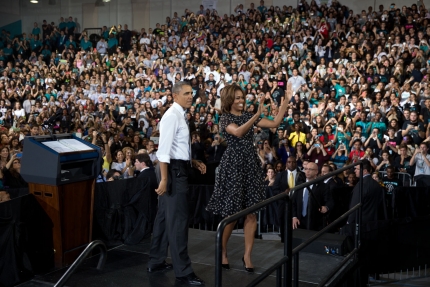
Remarks by the President on Preparing for College
Coral Reef Senior High School
Miami, Florida
3:05 P.M. EST
THE PRESIDENT: Hello, Miami! (Applause.) Hello, Cuda Nation! (Applause.) Hello! It is good to be here at Coral Reef Senior High. (Applause.) You guys are just happy because it’s warm down here all the time. (Laughter.) I don’t know if you’re aware of this, but the rest of the country is cold. (Laughter.) Listen, Michelle and I are so grateful for the warm welcome. It is great to be here. I want to thank some people who are doing outstanding work.
First of all, your superintendent, Superintendent Carvalho, is doing great work. We’re really proud of him. (Applause.) Your principal, Principal Leal, is doing great work. (Applause.) All the Coral Reef teachers and staff, you guys are all doing a great job. (Applause.) And you’re doing what is necessary to help young people get ready for college and careers. So that’s why we’re here. We are proud of what’s being done at this school.
I want to mention a few other folks who are here who are fighting on behalf of the people of South Florida every day. We’ve got Congressman Joe Garcia is here. (Applause.) We’ve got Congresswoman Frederica Wilson here. (Applause.) We’ve got Miami-Dade County Mayor Carlos Gimenez. Your former Governor Charlie Crist is here. (Applause.)
And most of all, I want to thank the people that Michelle and I came all the down here to see, and that is the students of Coral Reef. (Applause.) We had heard great things about your school. We had heard great things about the students. We wanted to come down here and just see what was going on. (Applause.) And Michelle and I just had a chance to visit with some of your classmates who are going through some of the scholarship applications, and we had a chance to talk to them and hear what their plans were. And first of all, Michelle and I looked and we said, these must be actors playing students, because they were all smart and good-looking and organized. (Laughter.) And I asked them, what are you going to do? And they’re -- well, I’m going to be applying to business school, and then I’m going to start a company, and then I -- when I was your age, I didn’t know what I was doing. I was lucky if I had gotten out of bed on time. (Laughter.) So you guys are ahead of the game.
And we’re here to tell you that you’ve got to keep up the good work, because by working hard every single day, every single night, you are making the best investment there is in your future. And we want to make sure you’ve got everything, all the tools you need to succeed. We want every young person to have the kinds of teachers and the kind of classes and the kind of learning experiences that are available to you here at Coral Reef. (Applause.) Because that’s the best investment we can make in America’s future. (Applause.)
Now, keep in mind, Michelle and I, we’re only here today because of the kind of education that we got. That was our ticket to success. We grew up a lot like many of you. I was raised by a single mom; she was a teenager when I was born. We moved around a lot, we did not have a lot of money, but the one thing she was determined to see was that my sister and I would get the best education possible.
And she would press me. Sometimes she’d make me wake up, do my lessons before I even went to school. She was not going to let me off the hook. And at the time, I wasn’t happy about it, but now I’m glad she pressed me like that. Because, thanks to my mother and my grandparents, and then great teachers and great counselors who encouraged me, and a country that made it possible for me to afford a higher education, I was able to go to college and law school.
And then when I met Michelle, I saw that -- (applause) --there were a couple of things I noticed. I noticed she was smart. (Applause.) I noticed she was funny -- she’s funny, she’s funnier than I am. (Laughter.) Obviously, I noticed she was cute, yes. (Applause.) But one of the things I also realized was, even though we had grown up in very different places, her story was a lot like mine. Her dad worked at a city water plant. He didn’t go to college. He was a blue-collar worker. Michelle’s mom -- my mother-in-law, who I love to death -- she was a secretary. No one in her family had gone to college. But because she had worked hard and her parents understood the value of education, and she had great teachers and great opportunities, and because the country was willing to invest to make sure that she was able to pay for college, she ended up going to some of the best universities in the country. (Applause.)
So the point is she and I have been able to achieve things that our parents, our grandparents would have never dreamed of. And that’s the chance this country should give every young person. That’s the idea at the heart of America. (Applause.)
What makes this country great, what makes it special when you look around, and Miami is a great example of it, you’ve got people coming from everywhere, every background, every race, every faith. But what binds us together is this idea that if you work hard, you can make it -- that there’s opportunity for all. The belief that no matter who you are, no matter where you come from, no matter what your last name is, if you are responsible and put in the effort, you can succeed. There’s no limit to what you can do. That’s what America is all about. (Applause.)
Opportunity is what drew many of your parents and grandparents to America. And we’ve got to restore that idea for your generation, so that everybody has the same chance Michelle and I did. That’s why we’re working on what we call an opportunity agenda to create more jobs and train more workers with new skills; to make sure hard work is rewarded with a paycheck that supports a family; to make sure that everybody can get health care when they need it, so that nobody has to get into financial trouble because somebody in the family gets sick. (Applause.)
And for the students here, a lot of you, you may not think about these issues all the time. You’re spending a lot of time on homework and sports, and this and that. But you also oftentimes see your own family struggling and you worry about it. And one of the single-most important parts of our opportunity agenda is making sure that every young person in America has access to a world-class education -- a world-class education. (Applause.) So that’s why we are here.
I believe we should start teaching our kids at the earliest ages. So we’re trying to help more states make high-quality preschool and other early learning programs available to the youngest kids. (Applause.) I believe that our K-12 system should be the best in the world. So we started a competition called Race to the Top, to encourage more states like Florida to raise expectations for students like you, because when we set high expectations, every single one of you can meet them. (Applause.) You’re recruiting and preparing the best teachers. You are turning around low-performing schools. You’re expanding high-performing ones. You’re making sure every student is prepared for college or a career.
I believe that every student should have the best technology. So we launched something we called ConnectED to connect our schools to high-speed Internet. And I want to congratulate Miami-Dade and your superintendent, because you have achieved your goal of installing wi-fi in every single one of your schools. (Applause.)
So the good news is, in part because of some of these reforms we’ve initiated, when you add it all up our nation’s high school graduation rate is the highest on record. The drop-out rate has been dropping, and among Latino students has been cut in half since 2000. (Applause.) Miami-Dade’s graduation rate is higher than it’s ever been. That’s all because of the efforts of so many people, including the parents and students who have been putting in the effort. It’s because of the teachers and administrators and staff who are doing such a great job. You should be proud. We’re making progress -- we’re making progress. (Applause.)
Yes, you guys -- by the way, you can all sit down. I didn’t realize everybody was still standing up. Sit down. Take a load off. You guys can’t sit down though, because you don’t have chairs, although bend your knees so you don’t faint. (Laughter.)
But here’s the key thing, Coral Reef: We still have more work to do, all of us -- elected officials, principals, teachers, parents, students. Because, as Michelle says, education is a two-way street. Folks like us have to work hard to give you the best schools and support that you need. But then, you’ve got to hold up your end of the bargain by committing to your education. That means you’ve got to stretch your minds. You’ve got to push through subjects that aren’t always easy. And it means continuing your education past high school, whether that’s a two-year or a four-year college degree or getting some professional training.
So I want to talk about an easy step that high school students like you can take to make college a reality. And it’s something you already know here at Coral Reef, but I’m speaking to all the young people out there who may be watching. It’s called FAFSA, the Free Application for Federal Student Aid.
It is a simple form. It used to be complicated; we made it simple. It doesn’t cost anything -- that’s why the word “free” is right there in the name. (Laughter.) It does not take a long time to fill out. Once you do, you’re putting yourself in the running for all kinds of financial support for college -- scholarships, grants, loans, work-study jobs.
For the past five years, we’ve been working to make college more affordable. We took on a college loan system that gave billions of dollars of taxpayer money to big banks to manage the student loan system. We said, we don’t need the banks, let’s give the money directly to students, we can help more students. (Applause.) We can help more students that way. So we expanded the grants that help millions of students from low-income backgrounds pay for college. We’re offering millions of people the chance to cap their student loan payments at 10 percent of their incomes once they graduate.
Today, more young people are earning college degrees than ever before. That’s a great thing. (Applause.) That is a great thing. But we still need to do more to help rein in the rising cost of tuition. We need to do more to help Americans who feel trapped by student loan debt -- because no striving, hardworking, ambitious, young American should ever be denied a college education just because they can’t afford it -- nobody. (Applause.)
Unfortunately, there are still a lot of young people all across the country who say the cost of college is holding them back. Some of you may have sat around the kitchen table with your parents wondering about whether you’ll be able to afford it. So FAFSA is by far the easiest way to answer that question. And I know the Barracudas know all about FAFSA. (Applause.) Last year, you had the second-highest completion rate of any large high school in the state. (Applause.) You should be proud of that. Your teachers and parents should be proud of that.
But last year, almost half of high school graduates in Florida didn’t fill out the FAFSA form.
AUDIENCE: Booo --
THE PRESIDENT: That ain’t right. (Laughter.) Not only is it not right, but it also ain’t right. (Laughter.) And as a result, they lost out on over $100 million in Pell grants. Think about that -- $100 million that could have helped Florida students help pay for college was just left on the table. That’s just in Florida. Nationwide, over one million high school students did not fill out the FAFSA form. That happens every year.
So my challenge today to every high school student in America: Fill out the form. Even if you think you might not qualify for financial aid, fill out the form. You might qualify.
And we’re making it easier than ever. We put the FAFSA form online. We made it shorter. It takes about half an hour to fill out. And it could change the rest of your life. We’ve updated it to save your parents a lot of hassle as well. And today, I’m announcing another improvement.
Today, I’m directing the Department of Education to tell every governor that, starting today, they can, if they choose, confidentially let high school administrators know which students have filled out the FAFSA form and which haven’t. So that way, if Principal Leal wants to check in with the seniors --
AUDIENCE: Wooo --
THE PRESIDENT: I know, everybody is like, wow. (Laughter.) I know she’s already on top of stuff, but this way, she could check and seniors who had not filled it out, she could then help them answer the questions and figure out what’s holding her back -- what’s holding them back.
Anybody will be able to go online and find out the number of students who have filled out the form at each high school, so we can track it. So if you want to have a friendly competition with Palmetto High or Miami Killian -- (applause) -- to see who can get a higher completion rate on your FAFSA, you can do that. (Applause.) You achieved the second-highest rate in the state, but I mean if you want to settle for number two, that's okay -- you might be able to get number one. (Applause.) Huh? I’m just saying you could go for number one. (Applause.)
So these are things I can do on my own, but I’m here to also tell you I need -- I could use some help from folks in Washington. There are some things I don’t need Congress’s permission for, and in this year of action, whenever I see a way to act to help expand opportunity for young people I’m just going to go ahead and take it. I’m just going to go ahead and do it. (Applause.)
So earlier this year, Michelle and I hosted a College Opportunity Summit, where over 150 colleges and universities and nonprofits made commitments to help more low-income students get to college and graduate from college. (Applause.) But I’m also willing to work with anybody in Congress -- Democrat, Republican, don't matter -- to make sure young people like you have a shot to success.
So a few days ago, I sent my budget to Congress. And budgets are pretty boring -- but the stuff inside the budgets are pretty important. And my budget focuses on things like preschool for all; like redesigning high schools so students like you can learn real-world skills that businesses want -- (applause) -- like preparing more young people for careers in some of the fields of the future -- in science and technology and engineering and math to discover new planets and invent robots and cure diseases -- all the cool stuff that we adults haven’t figured out yet. (Laughter.)
These are not just the right investments for our schools; they’re the right priorities for our country. You are our priority. We’ve got to make sure we have budgets that reflect that you are the most important thing to this country’s success. If you don't succeed, we don't succeed. (Applause.)
We’ve got to make sure all of you are prepared for the new century, and we’ve got to keep growing our economy in other ways: attracting new high-tech jobs, reforming our immigration system -- something Congressman Garcia is fighting for. (Applause.) And the rest of Congress needs to stop doing nothing, do right by America’s students, America’s teachers, America’s workers. Let’s get to work. Let’s get busy. (Applause.) We’ve got work to do. All of us have work to do -- teachers, school counselors, principals, superintendents, parents, grandparents.
We all have work to do, because we want to see you succeed, because we’re counting on you, Barracudas. (Applause.) And if you keep reaching for success -- and I know you will, just based on the small sampling we saw of students here -- if you keep working as hard as you can and learning as much as you can, and if you’ve got big ambitions and big dreams, if you don’t let anybody tell you something is out of your reach, if you are convinced that you can do something and apply effort and energy and determination and persistence to that vision, then not only will you be great but this country will be great. (Applause.) Our schools will be great. (Applause.)
I want us to have the best-educated workforce in America. And I want it to be the most diverse workforce in the world. That’s what I’m fighting for. That’s what your superintendent and your principal are fighting for, and I hope that’s what you fight for yourselves. (Applause.) Because when I meet the students here at Coral Reef, I am optimistic about the future. Michelle and I walked out of that classroom, and we said, you know what, we’re going to be in good hands, we’re going to do okay. (Applause.) Because these young people are coming, and nobody is going to stop them.
Thank you, everybody. God bless you. God bless America. (Applause.)
END
3:25 P.M EST
Close Transcript