The White House

Office of the Press Secretary

Executive Order -- Blocking Property of Certain Persons Contributing to the Situation in Ukraine

EXECUTIVE ORDER 

- - - - - - - 

BLOCKING PROPERTY OF CERTAIN PERSONS CONTRIBUTING TO THE SITUATION IN UKRAINE 

By the authority vested in me as President by the Constitution and the laws of the United States of America, including the International Emergency Economic Powers Act (50 U.S.C. 1701 et seq.) (IEEPA), the National Emergencies Act (50 U.S.C. 1601 et seq.) (NEA), section 212(f) of the Immigration and Nationality Act of 1952 (8 U.S.C. 1182(f)), and section 301 of title 3, United States Code, 

I, BARACK OBAMA, President of the United States of America, find that the actions and policies of persons -- including persons who have asserted governmental authority in the Crimean region without the authorization of the Government of Ukraine -- that undermine democratic processes and institutions in Ukraine; threaten its peace, security, stability, sovereignty, and territorial integrity; and contribute to the misappropriation of its assets, constitute an unusual and extraordinary threat to the national security and foreign policy of the United States, and I hereby declare a national emergency to deal with that threat. I hereby order: 

Section 1. (a) All property and interests in property that are in the United States, that hereafter come within the United States, or that are or hereafter come within the possession or control of any United States person (including any foreign branch) of the following persons are blocked and may not be transferred, paid, exported, withdrawn, or otherwise dealt in: any person determined by the Secretary of the Treasury, in consultation with the Secretary of State: 

(i) to be responsible for or complicit in, or to have engaged in, directly or indirectly, any of the following: 

(A) actions or policies that undermine democratic processes or institutions in Ukraine; 

(B) actions or policies that threaten the peace, security, stability, sovereignty, or territorial integrity of Ukraine; or 

(C) misappropriation of state assets of Ukraine or of an economically significant entity in Ukraine;

(ii) to have asserted governmental authority over any part or region of Ukraine without the authorization of the Government of Ukraine; 

(iii) to be a leader of an entity that has, or whose members have, engaged in any activity described in subsection (a)(i) or (a)(ii) of this section or of an entity whose property and interests in property are blocked pursuant to this order; 

(iv) to have materially assisted, sponsored, or provided financial, material, or technological support for, or goods or services to or in support of, any activity described in subsection (a)(i) or (a)(ii) of this section or any person whose property and interests in property are blocked pursuant to this order; or 

(v) to be owned or controlled by, or to have acted or purported to act for or on behalf of, directly or indirectly, any person whose property and interests in property are blocked pursuant to this order. 

(b) The prohibitions in subsection (a) of this section apply except to the extent provided by statutes, or in regulations, orders, directives, or licenses that may be issued pursuant to this order, and notwithstanding any contract entered into or any license or permit granted prior to the effective date of this order. 

Sec. 2. I hereby find that the unrestricted immigrant and nonimmigrant entry into the United States of aliens determined to meet one or more of the criteria in subsection 1(a) of this order would be detrimental to the interests of the United States, and I hereby suspend entry into the United States, as immigrants or nonimmigrants, of such persons. Such persons shall be treated as persons covered by section 1 of Proclamation 8693 of July 24, 2011 (Suspension of Entry of Aliens Subject to United Nations Security Council Travel Bans and International Emergency Economic Powers Act Sanctions). 

Sec. 3. I hereby determine that the making of donations of the type of articles specified in section 203(b)(2) of IEEPA (50 U.S.C. 1702(b)(2)) by, to, or for the benefit of any person whose property and interests in property are blocked pursuant to section 1 of this order would seriously impair my ability to deal with the national emergency declared in this order, and I hereby prohibit such donations as provided by section 1 of this order. 

Sec. 4. The prohibitions in section 1 of this order include but are not limited to: 

(a) the making of any contribution or provision of funds, goods, or services by, to, or for the benefit of any person whose property and interests in property are blocked pursuant to this order; and 

(b) the receipt of any contribution or provision of funds, goods, or services from any such person.

Sec. 5. (a) Any transaction that evades or avoids, has the purpose of evading or avoiding, causes a violation of, or attempts to violate any of the prohibitions set forth in this order is prohibited. 

(b) Any conspiracy formed to violate any of the prohibitions set forth in this order is prohibited. 

Sec. 6. For the purposes of this order: 

(a) the term "person" means an individual or entity; 

(b) the term "entity" means a partnership, association, trust, joint venture, corporation, group, subgroup, or other organization; and 

(c) the term "United States person" means any United States citizen, permanent resident alien, entity organized under the laws of the United States or any jurisdiction within the United States (including foreign branches), or any person in the United States. 

Sec. 7. For those persons whose property and interests in property are blocked pursuant to this order who might have a constitutional presence in the United States, I find that because of the ability to transfer funds or other assets instantaneously, prior notice to such persons of measures to be taken pursuant to this order would render those measures ineffectual. I therefore determine that for these measures to be effective in addressing the national emergency declared in this order, there need be no prior notice of a listing or determination made pursuant to section 1 of this order. 

Sec. 8. The Secretary of the Treasury, in consultation with the Secretary of State, is hereby authorized to take such actions, including the promulgation of rules and regulations, and to employ all powers granted to the President by IEEPA, as may be necessary to carry out the purposes of this order. The Secretary of the Treasury may redelegate any of these functions to other officers and agencies of the United States Government consistent with applicable law. All agencies of the United States Government are hereby directed to take all appropriate measures within their authority to carry out the provisions of this order. 

Sec. 9. The Secretary of the Treasury, in consultation with the Secretary of State, is hereby authorized to submit the recurring and final reports to the Congress on the national emergency declared in this order, consistent with section 401(c) of the NEA (50 U.S.C. 1641(c)) and section 204(c) of IEEPA (50 U.S.C. 1703(c)). 

Sec. 10. This order is not intended to, and does not, create any right or benefit, substantive or procedural, enforceable at law or in equity by any party against the United States, its departments, agencies, or entities, its officers, employees, or agents, or any other person. 

BARACK OBAMA

The White House

Office of the Press Secretary

Remarks by the President at a DNC Dinner

Artists for Humanity Epicenter
Boston, Massachusetts

7:48 P.M. EST

THE PRESIDENT:  Thank you.  Hello!  (Applause.)  Everybody, have a seat.  Have a seat.  (Applause.)  First of all, I love Deval Patrick.  And Massachusetts has been extraordinarily fortunate to have him as your governor.  (Applause.)  And I believe that.  And I'm fortunate to have him as a friend.  And if you look at the track record of what’s happened in Massachusetts, then it's a testimony in terms of jobs and growth and infrastructure and progress on schools.  It's all a testimony to Deval’s ability to bring people together and get them working on behalf of the Commonwealth.

You are also lucky to have an outstanding young new mayor, replacing an outstanding older mayor -- I don't think Tom would object to me characterizing him that way -- but all reports are Marty Walsh is doing just a great job.  So congratulations for your efforts.  (Applause.) 

A couple of former public servants who have not given up engaging in public service, one of them a great friend and a great governor, who is actually an import but did extraordinary work in Ohio -- is teaching here now at Harvard -- but very proud to call him a friend -- Ted Strickland is here, former governor of Ohio.  (Applause.) 

And somebody who I’ve known for a long time, is just a good, kind man who cares deeply about all people -- and some of that, frankly, is inherited and some of it is just unique to who he is, and he’s got just an extraordinary family -- former congressman Patrick Kennedy.  (Applause.)  Where’s Patrick?  There he is over there.  (Holds up his toddler-age son.)  Yes!  The newest member -- some new members of the Kennedy clan, right there.  (Laughter.)  When are you running?  Isn't that how that works?  (Laughter.)  Absolutely. 

So Deval said it well and I want to spend most of my time in conversation as opposed to just giving a long speech.  We are in this remarkable, tumultuous time, and because the world is changing rapidly in almost every respect, it can be scary and it can make folks anxious.  But I am so extraordinarily hopeful about this country of ours.

When I took office, we were in the midst of crisis.  We've now seen over four years of economic growth.  We've seen 8.5 million new jobs created.  We've seen the housing market bounce back.  We've seen an auto industry that has come roaring back.  We've seen manufacturing return for the first time since the 1990s.  There has been an extraordinary energy boom both in traditional energy sources and clean energy, at the same time as we've reduced our carbon emissions more than any other nation on Earth during this period. 

We've made progress on school reform.  We have made sure that every American is able to get access to health insurance, something that Presidents from both parties have fought for, for almost 100 years.  (Applause.)  And the country has moved decisively in the direction of justice when it comes to the LGBT community.  We've gone more to do, but the trends are inexorable. (Applause.)

We see in our children and in our grandchildren greater tolerance, greater willingness to work with other people, desire for service.  We've got the best universities in the world.  We've got the best workforce in the world.  We've got the best scientists in the world.  We have all the ingredients to make sure the 21st century is an American Century just like the 20th.

And yet folks are anxious -- because in the midst of all this there’s also great change.  And what I've tried to do as President -- the President of all people, but also as the leader of the party, as a Democrat -- is to make sure that we're translating old, tried and true values into policies that meet the challenges of this time of change.

And at the heart of it, the heart of who we are as Americans but also who we are as Democrats, as the party of Jefferson and FDR and JFK, is the simple premise that everybody in this country, if they work hard, can get ahead; that everybody has a chance to live out their dreams; that opportunity is there for the taking if you work hard, if you are responsible.  It doesn’t matter the circumstances into which you are born.  It doesn’t matter if you’re born on the South Side of Chicago and your grandpa was a janitor, or if you’re born in Hawaii to a teenage mom who ends up raising you without a dad.  It doesn’t matter.  You’ve got a shot if you’re willing to work hard.  And we as a society are going to create a platform and provide the tools to make sure people can succeed.

That's the idea.  That's what makes me a proud American and an proud Democrat.  And part of the change that has made folks anxious is they’re not sure whether that still holds true, whether the trend lines are going to allow us to sustain that.  And so what I've been talking about since I was first elected to this office, what I talked about in getting reelected, and what I talked about in this year’s State of the Union, and what I talked about today and what I'm going to be talking about tomorrow and for the next three years of my presidency is how do we make sure we're advancing policies that assure those ideals are alive and well not just now, but for future generations.

So whether it's creating more good jobs, or making sure our workers are trained for those jobs, or making sure that every child is getting a world-class education, or making sure that work pays in this society, or making sure that people are not discriminated against on the basis of race or religion or sexual orientation, or making sure that we have an immigration system that is just and can advance our economy, or making sure that we have an energy policy that is visionary and doesn’t just look to the past but looks to the future, and also make sure that we are good stewards of this planet -- all these policies come down to me insisting that it is within our means, within our power to pass on this wonderful gift, this idea of opportunity for all to the next generation.

And it turns out most of these ideas garner majority support out in the country.  When I talk about minimum wage, not only is it good policy but the majority of the country, including half of Republicans, agree with it.  You go into a room -- I don't care how conservative a county -- and you ask, do you want your daughters to be treated the same on the job as your sons, everybody is going to say yes. 

But our political system is not reflecting that consensus, and that’s what we are fighting for.  And that's why these midterms are so important, as Deval said.  I won't go through a litany of the challenges we've had with a certain set of Republicans in Congress that have then set the tone for the entire party, because it's not uniform.  When you talk to them privately, there are still folks in that party who long to get stuff done and work in a bipartisan basis, but they’re intimidated by the “say no” crowd. 

But we have to recognize that part of it is up to us.  It's not just on them.  In the midterms, Democrats too often don't vote.  Too often, when there’s not a presidential election we don't think it's sexy, we don't think it's interesting.  People tune out.  And because the electorate has changed, we get walloped.  It's happened before and it could happen again if we do not fight on behalf of the things we care about in this election -- not keeping our eye to the next election.  And nobody is going to be more invested than me in having a Democrat succeed me, to consolidate and solidify the gains that we've made during my presidency.  But right now, we've got to make sure we're fighting in this election.

And the DNC helps.  The DNC can make sure that instead of restricting the franchise for people all across the country, it's expanded.  The DNC can make sure that the message we're talking about on minimum wage or equal pay or immigration reform gets out there and people hear it and they recognize how that can have an impact on their own lives.

So I'm going to need you.  I'm going to put Deval to work -- (laughter) -- and I'm going to be asking the Mayor to perhaps travel to some places.  But most importantly, we're going to need a lot of young people who are out there fanning all across the country, working hard, just like they did in 2008; just like they did in 2012.  And your efforts make a huge difference.

So I hope that just because I'm not on the ballot that people aren’t going to take it easy this time.  Because the ideas I care about and am fighting for are on the ballot.  The progress we've made is on the ballot.  The things that Deval has fought for here in Massachusetts are on the ballot.  The things that Ted Strickland fought for when he was in Ohio, and Patrick Kennedy fought for when it comes to mental health services -- those things, they’re all on the ballot.  This counts.  And I'm going to need you guys to step up, send a message to your friends and people who profess to care about these ideas -- they better get involved this time out.

All right.  Thanks, everybody.  (Applause.)

The White House

Office of the Press Secretary

Statement by NSC Spokesperson Caitlin Hayden on National Security Advisor Susan E. Rice’s Travel to Israel

Coming out of the very productive consultations between Prime Minister Netanyahu and President Obama during their bilateral meeting this week, President Obama has asked National Security Advisor Susan Rice to travel to Israel in May to lead the U.S. delegation to the U.S.-Israel Consultative Group.  Ambassador Rice looks forward to her first visit to Israel as National Security Advisor to continue our strategic consultations on a wide range of bilateral and regional issues.

President Obama Speaks at Café Beauregard in Connecticut

March 05, 2014 | 1:27 | Public Domain

President Obama delivers short remarks at a small business that pays its employees more than the minimum wage.

Download mp4 (50MB) | mp3 (1MB)

Read the Transcript

Remarks by the President to the Traveling Press at Café Beauregard -- New Britain, CT

Café Beauregard
New Britain, Connecticut

THE PRESIDENT:  I’ll have a chance to talk to everybody a little bit later, but obviously part of the reason that we’re here is because we’ve got a group of outstanding Democratic governors here in the Northwest [sic] that are committed to making sure that work pays.
 
And we were just talking to the owners of this establishment, who pay their employees more than the minimum wage because, as the owner put it, he knows what’s it like to work all his life and understands that if people are working hard, they shouldn’t be in poverty and that we should be able to do everything we can to make sure that happens.
 
And Dan Malloy here in Connecticut is making this a top priority.  I know Pete Shumlin, Lincoln Chafee, and Deval Patrick are all -- are working with Tom Perez, our Secretary of Labor.  And this is an important tool for us to help create more pathways into the middle class and make sure that if you work hard in this country, you can succeed.
 
There are other tools that are reflected in my budget like the Earned Income Tax Credit expansion that we’ve proposed that will also make a difference.  But I’m just very proud of these governors for the work they're doing.  So thank you.
 
All right, so with that, let me eat.
 
END

Close Transcript

President Obama Speaks on Raising the Minimum Wage

March 05, 2014 | 29:54 | Public Domain

President Obama says that it's time to raise the minimum wage because nobody who works full-time should ever have to raise a family in poverty.

Download mp4 (1126MB) | mp3 (29MB)

Read the Transcript

Remarks by the President on Opportunity For All: Making Work Pay and the Minimum Wage

Central Connecticut State University
New Britain, Connecticut

2:20 P.M. EST

THE PRESIDENT:  Hello, Connecticut!  (Applause.)  Go Blue Devils!  (Applause.)  It is good to be back in Connecticut.  (Applause.)  I want to thank your wonderful Governor, Dan Malloy, for that introduction.  (Applause.)  I want to thank your President, Jack Miller, for inviting me here today.  (Applause.) 

We’ve got members of your student government behind me.  (Applause.)  I couldn’t help but notice your Student Government Association logo, which has a gavel –- and a pitchfork, which is pretty intense.  (Laughter.)  And I wish some folks in Congress used the gavel more.  (Laughter.)  Less pitchfork.  (Laughter.)

We also have some members of your non-student government.  One of our finest members of our Cabinet, who just cares so much about working families and is working tirelessly every single day, Secretary of Labor, Tom Perez, is here.  (Applause.)  We’ve got all five of Connecticut’s representatives in Congress -- including CCSU alum John Larson, in the house.  (Applause.)  Another proud CCSU alum, Erin Stewart, your mayor, is here.  (Applause.)  Along with Mayor Segarra and the other mayors and legislators from all across Connecticut. 

And today, we’re doing something a little different than usual.  Usually, when I hit the road and talk with folks like all of you, I’ve got a governor with me.  But you are special.  (Applause.)  So we decided one governor wasn’t enough.  (Laughter.)  So in addition to Governor Malloy, we’ve got Lincoln Chafee of Rhode Island, Deval Patrick of Massachusetts, Peter Shumlin of Vermont.  (Applause.)  This is like a governor supergroup.  (Laughter.)  It’s like the Justice League of governors.  (Laughter.)  I’d call them the New England Patriots, but that name is already taken.  (Laughter.)

STUDENT:  We love you, Mr. President!

THE PRESIDENT:  I love you back!  I love you.  (Applause.)  But we can’t just spend the whole day talking about how we love each other.  (Laughter.)  That’s not why I came.  We are here today -- we’re here today because each of us cares deeply about creating new jobs and new opportunities for all Americans.  And we’re at this interesting moment in our economy -- our economy has been growing, our businesses have created about eight and a half million new jobs over the past four years.  The unemployment rate is the lowest it’s been in over five years.  (Applause.)  Those are all things that we should be proud of. 

But there are some trends out there that have been battering the middle class for a long, long time -- well before this Great Recession hit.  And in some ways, some of those trends have gotten worse, not better.  The nature of today’s economy with technology and globalization means that there are folks at the top who are doing better than ever, but average wages have barely budged.  Average incomes have not gone up.  Too many Americans are working harder than ever just to keep up.

So as I said at my State of the Union address, we’ve got to reverse those trends.  It is a central task for all of us to build an economy that works for everybody, not just for some.  (Applause.)  That’s what every one of these governors and Tom Perez believes in -- that’s what we got into public service for.  I hope Dan and Peter don’t mind me sharing this -- while we were driving over here, they were talking about the fact that when they were growing up, both of them had dyslexia.  And because of the incredible fierce love of their parents but also because there were some folks there to help them, they achieved -- made these extraordinary achievements.  Now, I wasn’t in the car with Deval, but Deval is a close friend of mine.  He’s got a similar story -- grew up on the South Side of Chicago.  (Audience member cheers.) South Side! (Laughter and applause.)  And came from a very modest background.  But somebody gave him a chance.  (Applause.)  Me, Tom Perez -- so many of us understand that at the heart of America, the central premise of this country is the chance to achieve your dreams if you work hard, if you take responsibility; that it doesn’t matter where you start -- it’s where you finish.  (Applause.) 

And in America, we believe in opportunity for all.  We believe that our success shouldn’t be determined by the circumstances of our birth.  It’s determined by each of us.  But also by a society that's committed to everybody succeeding.  So that it doesn’t matter what you look like, where you come from, what your last name is, who you love -- what matters is the strength of your work ethic; and the power of your dreams; and your willingness to take responsibility for yourself but also for the larger society.  That’s what makes America the place that it is, why it continues to be a beacon, attracting people from all around the world, the idea that you can make it here if you try.

Now, there’s been a lot of news about foreign affairs around the world over the last several days, but also for the last couple years.  And one of the things that you see, a trend you see -- it doesn't matter whether it’s in Central Europe or in the Middle East or Africa -- individuals want a chance to make it if they try.  And what makes us special is we already do that when we’re at our best.  But we’ve got some work to do to match up our ideals with the reality that's happening on the ground right now.

And the opportunity agenda that I’ve laid out is designed to help us restore that idea of opportunity for everybody for this generation, the generation of young people who are studying here and are about to enter the workforce.  And it’s got four parts.  Part one is something that I know the seniors here are very interested in, which is more good jobs that pay good wages.  (Applause.)

We can’t be satisfied with just recovering the jobs that were lost during the recession.  We’ve got to rebuild our economy so it’s creating a steady supply of good jobs today and well into the future -– jobs in high-tech manufacturing, and in energy, and in exports, and in American innovation.  So that's job number one.

Job number two is training more Americans with the skills they need to fill those good jobs, so that our workforce is prepared for the jobs of tomorrow. 

Part three:  guaranteeing every young person in this country access to a world-class education -– from pre-K all the way to a college education like the one you’re getting here.  (Applause.)

And that's why over the past five years, working with the outstanding congressional delegation from Connecticut, we’ve been able to make sure that grant dollars are going farther than before.  We took on a student loan system that gave billions of taxpayer dollars to the big banks, and we said let’s use those to give more students directly the help they need to afford to go to college.  (Applause.)

That's why -- that's why we’re offering millions of young people the chance to cap their monthly student loan payments at 10 percent of their income.  So you need to check that out.  (Laughter.)  Go to the website of the Department of Education and find out how you may be eligible for that.

And today, more young people are earning college degrees than ever before.  (Applause.)  Of course -- and I know your president won’t disagree with this -- we’ve also got to do more to rein in the soaring cost of college and help more Americans who are trapped by student loan debt.  (Applause.)

The bottom line though is whether it’s technical training, community college, or four-year university, no young person should be priced out of a higher education.  Shouldn’t happen. (Applause.)

Now, there is a fourth part of this agenda.  By the way, I just noticed, if you’ve got chairs, feel free to sit down.  (Laughter.)  I know the folks here don't have chairs, but I don't want you -- and if you’re standing up, make sure to bend your knees so you don't faint.  (Laughter.)  All right, I just wanted to check on you.  (Laughter and applause.)

Now, point number four, the fourth component of this opportunity agenda is making sure that if you are working hard -- if you’re working hard, then you get ahead.  And that means making sure women receive equal pay for equal work.  (Applause.)  When women succeed, America succeeds.  (Applause.)  I believe that.  You happy with that, Rosa?  Rosa agrees with that.  (Laughter.)

It means making sure that you can save and retire with dignity.  It means health insurance that’s there when you’re sick and you need it most.  (Applause.)  And you guys are doing a great job implementing the Affordable Care Act here in Connecticut.  If any of you know a young person who is uninsured, help them get covered at healthcare.gov.  The website works just fine now.  (Laughter.)  They’ve got until March 31st to sign up, and in some cases it’s going to cost less than your cellphone bill.  So check it out, healthcare.gov.

And making work pay means wages and paychecks that let you support a family.  (Applause.)  A wage, a paycheck that lets you support a family.  (Applause.)

Now, I want to be clear about this because sometimes in our debates with our friends on the other side of the political spectrum, this may not be clear, so let me just repeat it once again, as Americans, we understand that some folks are going to earn more than others.  We don’t resent success; we are thrilled with the opportunities that America affords.  Somebody goes out there, starts a business, invents a new product, provides a new service, that's what drives our economy.  That's why this free-market economy is the most dynamic on Earth.  We’re thrilled with that.  Everybody agrees on that.  But what we also believe is that nobody who works full-time should ever have to raise a family in poverty.  (Applause.)  That violates a basic sense of who we are.  And that’s why it’s time to give America a raise.   (Applause.)  It is time to give America a raise.  Now is the time.  Now is the time.  (Applause.)

A year ago I asked Congress to raise the minimum wage, the federal minimum wage.  Since that time six states have passed laws to raise theirs, including right here in Connecticut.  (Applause.)

On January 1st, tens of thousands of folks across this state got a raise –- and Governor Malloy is working to lift their wages even higher.  (Applause.)  Hawaii, Illinois, Maryland, Minnesota, Washington State, other states, counties, cities across the country are working to raise their minimum wage as we speak.

The governors here today –- Governor Chafee of Rhode Island;, Governor Malloy; Governor Patrick of Massachusetts; Governor Shumlin of Vermont; and a Governor who couldn’t be here today, Maggie Hassan of New Hampshire –- all are fighting to give hardworking folks in these great New England states a raise of their own.  And they’ve formed a regional coalition to raise the minimum wage.  If they succeed in their efforts, New England will have some of the highest minimum wages in the country.  (Applause.)

And they’re not stopping there -– these four governors are here in support of raising America’s minimum wage, the federal minimum wage, to $10.10 an hour -- $10.10 an hour.  (Applause.)

Now, raising wages is not just a job for elected officials.  In my State of the Union address, I asked more business leaders to do what they can to raise their workers’ wages -– because profitable companies like Costco have long seen higher wages as good business.  It’s a smart way to boost productivity, to reduce turnover, to instill loyalty in your employees.  And, by the way, they do great.  Their stocks do great.  They are highly profitable.  It’s not bad business to do right by your workers, it’s good business.  (Applause.)  It’s good business.  (Applause.)

Two weeks ago, the Gap decided to raise its base wages, and that's going to boost wages for 65,000 workers in the United States.  (Applause.)  Last week, I read about Jaxson’s, it’s an ice cream parlor in Florida that’s been in business since 1956.  They just announced they would lift workers’ wages to at least $10.10 an hour, without cutting back on hiring.  (Applause.)  Two weeks ago, an Atlanta small business owner named Darien Southerland wrote me to share a lesson his Granny taught him:  If you treat your employees right, they’ll treat you right.  (Applause.)  Vice President Biden paid Darien’s business a visit just yesterday.  You got to listen to your grandmother.  (Laughter.)  That is some wise advice.

And I agree with these business leaders as well.  So what I did as President, I issued an executive order requiring federal contractors -- if you’re doing business with the federal government -- pay your employees a fair wage of at least $10.10 an hour, which will be good for America’s bottom line.  (Applause.)

And let me tell you who was affected.  When I was signing the bill, or the executive order, we had some of the workers who were going to be affected.  You’ve got folks who are cooking the meals of our troops, or washing their dishes, or cleaning their clothes.  This country should pay those folks a wage you can live on.  (Applause.)

So this is good for business, it is good for America.  Because even though we’re bringing manufacturing jobs back to the United States, creating more good jobs in education and health care and business services, there will always be airport workers, there are always going to be fast-food workers, there are always going to be hospital workers, there are going to be retail salespeople, hospitality workers -- people who work their tails off every day.  (Applause.)  People working in nursing homes, looking after your grandparents or your parents.  (Applause.)  Folks who are doing all the hard jobs that make our society work every single day.  They don’t have anything flashy out there.  And you know what, they’re not expecting to get rich, but they do feel like if they’re putting in back-breaking work every day, then at least at the end of the month they can pay their bills.  (Applause.)  They deserve an honest day’s pay for an honest day’s work.

Working Americans have struggled through stagnant wages for too long, so my goal is -- and the goal of everybody on this stage -- is to help lift wages, help lift take-home pay in any way I can.  And that’s why I’ve done everything I can to lift wages for hardworking federal contractors, it’s why I’ve asked business owners to raise their wages, it’s why I’m supporting elected officials at the local level, governors.  What every American wants is a paycheck that lets them support their families, know a little economic security, pass down some hope and optimism to their kids.  And that’s worth fighting for.  (Applause.)

But I want to make one last point.  If we’re going to finish the job, Congress has to get on board.  (Applause.)  Congress has to get on board.  And this is interesting -- this should not be that hard, you’d think.  (Laughter.)  Because nearly three in four Americans, about half of all Republicans, support raising the minimum wage.  The problem is, Republicans in Congress oppose raising the minimum wage -- now I don’t know if that’s just because I proposed it.  (Laughter.)  Maybe I should say I oppose raising the minimum wage and they’d be for it, that’s possible.  (Laughter.)

But right now, there’s a bill in front of both the House and the Senate that would boost America’s minimum wage to $10.10.  It’s easy to remember -- $10.10 -- ten dollars, ten cents an hour.  Just passing this bill would help not only minimum wage workers; it would lift wages for about 200,000 people just right here in Connecticut.  (Applause.)  It would lift wages for about one million New Englanders.  (Applause.)  It would lift wages for nearly 28 million Americans across this country.  (Applause.)  It would immediately raise millions of people out of poverty.  It would help millions more work their way out of poverty, and it doesn’t require new taxes, doesn’t require new spending, doesn’t require some new bureaucracy.  And here’s one last point.  It turns out -- what happens if workers got a little more money in their pockets?

AUDIENCE:  They spend it!

THE PRESIDENT:  They spend a little more money, which means that suddenly businesses have more customers, which means they make more profits, which means they can hire more workers, which means you get a virtuous cycle --

AUDIENCE MEMBER:  It’s common sense!

THE PRESIDENT:  It’s common sense -- that’s what I’m trying to say.  (Laughter and applause.)  Common sense, exactly.  It’s just common sense -- that’s all it is.  It’s common sense.  (Applause.)  Common sense.  It’s just common sense.  (Applause.)  That’s all I’m saying.  (Laughter.)

Now, right now, Republicans in Congress don’t want to vote on raising the minimum wage.  Some have actually said they just want to scrap the minimum wage.  One of them said, “I think it’s outlived its usefulness…I’d vote to repeal the minimum wage.”  One of them said it’s never worked.  Some even said it only helps young people, as if that’s a bad thing.  I think we should want to help young people.  (Laughter and applause.)  I’d like to see them try putting themselves through college on a low wage work-study job.  (Applause.)  But actually -- or I’d like to see them supporting a family, making less than $15,000 a year. 

But here’s the truth about who it would help.  Most people who would get a raise if we raise the minimum wage are not teenagers on their first job -- their average age is 35.  A majority of lower-wage jobs are held by women.  These Americans are workiong full-time, often supporting families, and if the minimum wage had kept pace with our economy’s productivity, they’d already be earning well over $10 an hour today.  Instead, it’s stuck at $7.25.  Every time Congress refuses to raise it, it loses value because the cost of living goes higher, minimum wage stays the same.  Right now, it’s worth 20 percent less than it was when Ronald Reagan took office.  And over the last year, since I asked Congress to do something and they didn’t do it, that was an equivalent of a $200 pay cut for the average minimum wage worker, because it didn’t keep pace with inflation.  That’s a month of groceries for the average minimum wage worker.  That’s two months’ worth of electricity.  This is not a small thing, this is a big deal.  It makes a big difference in the lives of a lot of families.  (Applause.) 

So members of Congress have a choice to make, it is a clear choice:  Raise workers’ wages, grow our economy -- or let wages stagnate further, give workers what amounts to another pay cut. 

Fortunately, folks in Connecticut have really good delegations, so your senators and representatives are already on board.  (Applause.)  They’re all on board.  They’re fighting the good fight.  (Applause.)  But anybody who is watching at home, you deserve to know where your elected official stands.  So just ask them, “Do you support raising the minimum wage to $10.10 an hour?”  If they say yes, say, “thanks.”  (Laughter.)  “Great job.”  We need encouragement too, elected officials.  (Laughter.)  If they say no, you should be polite -- (laughter) -- but you should say, “why not?”  Ask them to reconsider.  Ask them to side with the majority of Americans.  Instead of saying no, for once, say yes.  It’s time for $10.10.  It’s time to give America a raise.  (Applause.)

I want to close by sharing a story of a guy named Doug Wade, who is here today.  Where’s Doug?  I’m going to embarrass Doug.  Stand up.  This is Doug, right here.  (Applause.)

Doug had a chance to meet Secretary Perez in Hartford last week.  Doug is the president of Wade’s Dairy down in Bridgeport.  (Applause.)  His great-grandfather, Frank -- is that right?  Frank? -- started the family business in 1893 -- 1893.  One of the secrets to their success is that they treat their employees like part of the family.  So Doug pays his own workers fairly. 

But he goes a step further than that -- he writes editorials, he talks to fellow business leaders, he meets with elected officials to make the case for a higher minimum wage for everybody.  And keep in mind, Doug spent most of his life as a registered Republican.  This is not about politics.  This is about common sense.  (Applause.)  It’s about business sense.  (Applause.)  And Doug, we were talking backstage, Doug showed me a paystub because it describes his own story.  When he was flipping burgers back in 1970, his employer paid him the minimum wage -- but it went 25 percent farther than it does today.   So Doug speaks from experience when he says that, “Things like the minimum wage raise the bar for everybody.”  And he’s still got that paycheck.  And it looks like the paycheck I got when I was working at Baskin-Robbins.  (Laughter and applause.)

The point that Doug and his family, and his business represents is we believe in hard work, we believe in responsibility, we believe in individual initiative, but we also come together to raise the bar for everybody; to make sure our fellow citizens can pursue their own dreams as well; that they can look after their kids and lift them up.  We look out for each other.  That’s who we are.  That is our story.  (Applause.)

There are millions of Americans like Doug, and like all of you, who are tired of old political arguments, ready to raise the bar a little higher.  Let’s move this country forward.  Let’s move it up.  Let’s go further.  That’s what I’m going to do as President as long as I have the honor of serving in this office, and I need your help.  Let’s go out there and give America a raise.

God bless you.  God bless the United States of America.  (Applause.)

END   
2:50 P.M. EST

Close Transcript

The White House

Office of the Press Secretary

Press Gaggle by Press Secretary Jay Carney and Labor Seretary Tom Perez en route Hartford, CT, 3/5/2014

Aboard Air Force One
En Route Hartford, Connecticut

11:45 A.M. EST

MR. CARNEY:  Good morning, everyone.  Thank you for joining us on our trip today to Connecticut and Massachusetts.  As you can see, I have with me the Secretary of Labor, Tom Perez, who can provide for you at the top information about today’s event with governors in the region, focusing on the need to raise the minimum wage so that Americans who work full-time take responsibility for themselves and their families don’t have to live in poverty.

I will ask that you address your questions to Secretary Perez at the top, related to those subjects, and I will remain to take questions on other subjects.

Mr. Secretary.

SECRETARY PEREZ:  Great.  Good morning.  As Jay said, a central pillar of the President’s opportunity agenda is that we should reward hard work with a fair wage, because nobody who works a full-time job should have to live in poverty.  That’s why the President has spent so much time urging Congress to pass an increase in the minimum wage and give Americans a raise.  And that’s why the President practiced what he preached when he issues the executive order directing federal contractors to pay the minimum wage.

But as the President made clear in his State of the Union address, he’s not going to wait for Congress to act on behalf of the American people.  And the President and a growing coalition of governors and business leaders from across the country believe that raising the minimum wage is the right thing to do and is the smart thing to do for businesses, for workers and for our economy.

I was in San Francisco yesterday speaking to the senior leadership of The Gap, who recently announced that they’re raising the wage of their workers to $10 an hour, setting the trend for the retail sector.  They said that it was the right thing to do and it was the smart thing to do, and it was a smart business decision.

And today, in Connecticut, the President will be joined by Governors Malloy, Patrick, Shumlin, and Chafee, who have endorsed the President’s call and are working in their states to give a raise to at least $10.10 an hour.  Governor Hassan would like to be here, very supportive of the effort, but she’s detained with state business.  These governors understand the importance of raising the minimum wage for their states’ economies, for the middle-class families they represent, as well as those striving to get into the middle class.  Increasing the minimum wage to $10.10 will lift wages up for about a million New Englanders, as well as -- including 200,000 people in Connecticut alone. 

These are people, like the person I met in Hartford just a week ago, who said to me, I have to choose between buying a gallon of milk and a gallon of gas; and the other person who said, I need to choose between taking my kid to the dentist or paying the electric bills.  Nobody should make these choices in America in the year 2014.  And that’s why these governors are leading by example to take steps to raise the minimum wage in their states and across the country.  Other states are doing the same.  Since the State of the Union, six states have already acted to raise the minimum wage, and more are contemplating the same.

And we will continue these efforts not only in Congress, but working with state and local governments, supporting business leaders who are doing the right thing, because Americans in deed deserve a raise.

Q    What’s the total number of states that have now acted?

SECRETARY PEREZ:  Twenty-two states and the District of Columbia.

Q    But that’s all different minimum wage increases, correct?

SECRETARY PEREZ:  Different minimum wage increases.  The state of Washington has the country’s currently highest minimum wage at $9.32, although California’s will go up to $10.  Other states are following the $10.10 lead.

MR. CARNEY:  Okay.  I thought I might have a little more time to prepare.  Fire away.
   
 Q    Jay, on Ukraine, the President spoke with Russian President Putin for over an hour and a half on Saturday.  That conversation, did it move the process forward?  Did it help in our relations in what the U.S. is planning to do or asking Russia to do, or did it actually hurt?  Because yesterday Putin actually accused the U.S. of being the part of the reason for the underlying issues going on in Ukraine.

MR. CARNEY:  Well, it is true that the President spoke with President Putin for about an hour and a half, and expressed our deep concerns to President Putin about Russia’s clear violation of Ukraine’s territorial integrity and in violation of international law, and in violation of agreements that Russia is party to.

I think an evaluation of events since then would suggest that what you’ve seen is broad international support for the legitimate government of Ukraine; broad condemnation of Russia’s actions in violation of Ukraine’s sovereignty and territorial integrity; efforts underway both unilaterally and multilaterally to support the new Ukrainian government and to support Ukraine in this difficult time economically; and multilateral and bilateral and unilateral efforts to consider actions to respond to Russia’s actions.

As was noted yesterday, President Putin has indicated a pause in some of the activities of Russian military units, and we are closely monitoring the situation in Crimea and Eastern Ukraine and broadly across Ukraine.  I think it’s, as I said yesterday, fair to -- I mean, obvious to point out that the suggestion by Russian officials that they are acting, again, in violation of international law, in violation of their own commitments, in order to protect ethnic Russians in Ukraine runs against every verifiable account we have seen about what’s happening in Ukraine.

And there is an easy way out for Russia, there is an easy off-ramp, which is to embrace an effort to bring U.N. or OSCE monitors to Crimea so that they can independently assess the situation on the ground, assess the status of ethnic Russians, and ensure that their rights are being protected -- because we and many others have made clear that it is very important for the Ukrainian government to assure that the rights of all Ukrainian citizens are protected.  But again, there is an easy way out here for Russia, and we certainly hope they take it.

Q    Jay, Ukraine’s new leader said in an AP interview that while Crimea must stay part of Ukraine, that he’s exploring options for Crimea to have more autonomy, which seems to be a recognition that the stepped-up Russian influence in this area is not likely to go away any time soon.  Would that be an acceptable outcome to the United States?

MR. CARNEY:  Well, it is not for us or any state besides Ukraine to decide what the relationship of any of its regions is to the rest of Ukraine or the capital.  That is for Ukraine to decide, for the Ukrainian people, for the Ukrainian parliament, for the Ukrainian government.  So I don't have a view to express on that.

It is obviously the case that, as we have noted, that Russia has interests in Crimea and Ukraine.  Russia has a military base that it established there through an agreement between the Russian government and the Ukrainian government.  And we are simply, with our allies and partners, calling on Russia to ensure that its military forces are returned to their bases and that Russia comply with the agreement it has with Ukraine as to the status of its military presence in Crimea.

But there’s no question that there are ethnic Russians in Crimea, there are ethnic Russians in other parts of Ukraine.  And it’s an important part of our view in is that Ukraine needs to -- the Ukrainian government needs to make sure that the rights of ethnic Russians are protected.  I would say that there’s no indication that those rights have not been protected, and, in fact, the Ukrainian government has -- the new Ukrainian government has behaved very responsibly since it came into office.

Q    Do you have information for us on the status of Ukraine observers -- observers proceeding in Ukraine, or the status of IMF loans and the EU’s commitment?  Any calls to read out, any updates on Ukraine?

MR. CARNEY:  Well, I can tell you a few things.  As you know, Secretary Kerry was in Kyiv yesterday and is in Paris today talking with the Ukrainians, our allies and partners, and the Russians.  He also worked with the United Kingdom and Ukraine to hold a meeting of the signatories of the Budapest Memorandum, to which Russia was invited but chose not to attend.  As you know, that document reaffirms the obligation set out in the U.N. charter that signatories respect the territorial integrity and sovereignty of Ukraine.

And I expect Secretary Kerry -- either has just or will be, or is scheduled to meet with Foreign Minister Lavrov as well separately in Paris.  The President obviously has been in regular contact with allies and partners, as have other members of his national security team.  And we are working, as we noted yesterday, on a package of assistance to Ukraine that would complement an IMF effort.  But beyond the details we released yesterday, I don’t have anything new on that.  When it comes to the question of further action, sanctions and the like, we’re considering a range of options, but that work is still ongoing.

Q    Is that why Jake Sullivan is on the plane?

MR. CARNEY:  Jake Sullivan is a member of the national security team, a member of the President’s national security [team] advisor.  He’s the Vice President’s national security advisor.  And he’s traveling because it’s important to have a senior member of the national security team on board.

Q    Okay, switching topics, could I quickly ask --

Q    Can I --

MR. CARNEY:  Sorry, same topic?

Q    Sort of.  One on that same topic, and then Israel is saying that they intercepted a shipment of arms that was headed to Gaza coming from Iran.  Does the White House have any comment on that?  And does this complicate negotiations with Iran over a long-term nuclear agreement?

MR. CARNEY:  I can confirm the reports that the Israeli government interdicted a suspected shipment of illicit Iranian arms.  The United States and Israel have had routine communications about this issue through intelligence and military channels, as well as through our national security advisors.  Soon after becoming aware of the imminent movement of [the] suspected vessel, the White House directed the Department of Defense to monitor the vessel and to develop concepts of operation for a range of options to be prepared to take unilateral steps if necessary.  This is part of the robust presence that the President has directed that we continue to maintain in and around the Gulf.

Throughout this time, our intelligence and military activities were closely coordinated with our Israeli counterparts who ultimately chose to take the lead in interdicting the shipment of illicit arms.  Even as we continue efforts to resolve our concerns over Iran’s nuclear program through diplomacy, we will continue to stand up to Iran’s support for destabilizing activities in the region, in coordination with our partners and allies, and made clear that these illicit actions are unacceptable to the international community and in gross violation of Iran’s U.N. Security Council obligations.

Q    How can you continue to have nuclear negotiations with them when it looks like they’re actively continuing to sponsor terrorism against Israel?

MR. CARNEY:  Josh, we’ve noted on multiple occasions that we are pursuing potential resolution of an enormous challenge, which is the challenge posed by Iran’s pursuit of a nuclear weapon, and we are doing that through the P5-plus-1 process. 

We continue to have enormous issues with Iran, its sponsorship of terrorist organizations, its bad behavior in the region that manifests itself in many ways.  And we continue to take all the necessary steps to address those challenges.  But it’s entirely appropriate to continue to pursue the possibility of reaching a resolution on the nuclear program.

Q    Jay, a couple news organizations had articles today about the CIA monitoring Senate aides regarding this report that the Senate is putting together about torture.  The White House didn’t comment prior to the stories being run; I’m wondering what you can say about that now.  It looks like some senators have come out and sort of talked about it today publicly.

MR. CARNEY:  Yes, for some time the White House has made clear to the Chairman of the Senate Select Committee on Intelligence that a summary of the findings and conclusions of the final RDI report should be declassified with any appropriate redactions necessary to protect national security.  And as you know, the President has made clear that the program that is  the subject of the committee’s work is inconsistent with our values as a nation.  One of the President’s first acts in office was to sign an executive order, which brought an end to the program and prohibited so-called enhanced interrogation techniques.

Q    And is the White House okay with the CIA perhaps spying on the Senate Intel Committee, or has the White House given the CIA any instructions in light of some of these allegations and revelations?

MR. CARNEY:  I would say a couple of things.  Regarding some of the allegations, I’d refer you to the Department of Justice on any questions regarding a “criminal referral,” which was one of the subjects reported on.  And as a general matter, we are in touch with the committee and have made clear that we believe that a summary of the findings, as I said, and conclusions of the final report should be declassified.

Q    But you’re not saying -- you’re not commenting on the CIA’s actions, then, regarding --

MR. CARNEY:  I don’t have anything further on the report in the newspaper.  What I can say is that regarding some of the issues and allegations, I’d refer you to the Department of Justice --

Q    May I ask you one last one on Ukraine?

MR. CARNEY:  -- and CIA, obviously, and the committee.

Q    When you say that Putin indicated a pause in escalation here, does that almost mean that the administration is pausing on its drive towards sanctions?

MR. CARNEY:  We’ve made clear that it is an absolute clear-cut violation of Ukraine’s territorial integrity to take the steps that Russia has taken, and that’s why we urge Russia to very quickly and immediately begin a dialogue with the government of Ukraine, pull back Russia’s military forces to their bases, restore Ukraine’s territorial integrity, and allow for the urgent deployment of observers and human rights monitors, and that they resist making more threats and issuing more distortions.

The fact of what’s been described as a pause reflects some of what we’ve seen on the ground and certainly what President Putin described in his press conference.

Q    Prime Minister Harper has asked for a G7 meeting on this.  What does the White House think of that idea?  Is it open to that?

MR. CARNEY:  Well, we’re coordinating very closely with all members of the G7.  As you know, collectively, we’ve suspended participation and preparations for the G8 in Sochi, and we’ll continue to work with members of the G7 going forward. 

I don’t have any announcements to make about potential meetings of the G7. 

Q    Are you concerned at all that the Europeans seem less interested in sanctions, and that the U.S., if it were to go down that route, might find itself isolated?

MR. CARNEY:  I would say that we have worked very closely and continue to work closely with our European partners and allies on this matter.  We have issued -- I mean, NATO has issued a statement, the G7 partners have issued statements, and all sounding the same notes of condemnation and concern, and urging Russia to roll back what it’s done and to avail itself of the way out, if you will, by allowing monitors into Crimea and other parts of Ukraine.

We are working with our European partners on actions that can be taken in response to this, and feel very good about the efforts that are undertaken in a cooperative way with the European partners.

Q    Jay, both of Pennsylvania’s senators have now opposed the President’s pick of Debo Adegbile to head the Civil Rights Division at DOJ.  They’re concerned about this person’s advocacy on behalf of a convicted cop killer in Philadelphia.  Does the White House have any reaction to those concerns?

MR. CARNEY:  Debo Adegbile is enormously qualified for the post of which he’s been nominated, and we urge the Senate to confirm him right away.

END
12:01 P.M. EST

President Obama: It's Time to Give America a Raise

President Barack Obama delivers remarks on the minimum wage, at Central Connecticut State University

President Barack Obama delivers remarks on the minimum wage, at Central Connecticut State University in New Britain, Connecticut, March 5, 2014. The President is joined by Gov. Dannel Malloy of Connecticut; Labor Secretary Thomas Perez, Gov. Peter Shumlin of Vermont, Gov. Lincoln Chafee of Rhode Island, and Gov. Deval Patrick of Massachusetts. (Official White House Photo by Pete Souza)

Today, President Obama traveled to Central Connecticut State University in New Britain, Connecticut to speak about the importance of raising the minimum wage.

Joined by Secretary of Labor Tom Perez, along with Connecticut Governor Dan Malloy, Rhode Island Governer Lincoln Chafee, Massachusetts Governor Deval Patrick, and Vermont Governor Peter Shumlin, the President addressed a crowd filled with students to dicsuss his plan to expand opportunity for all Americans.

He detailed the four parts of his opporuntity agenda: 1) create more new jobs; 2) train Americans with the skills to fill those jobs; 3) guarantee every young person access to a world-class education; and 4) make sure hard work pays off.

Ensuring that hard work pays off means that women should receive equal pay for equal work, that Americans can save and retire with dignity, that people have health insurance when they need it most, and that the wage you make is enough to support yourself and your family.

"Nobody who works full-time should ever have to raise a family in poverty. That violates a basic sense of who we are.  And that’s why it’s time to give America a raise," said President Obama. "What every American wants is a paycheck that lets them support their families, know a little economic security, pass down some hope and optimism to their kids. And that’s worth fighting for."

That's why President Obama isn't waiting for Congress to take action. Last month, he used his pen to sign an executive order requiring federal contractors to pay their employees a fair wage of at least $10.10 an hour. 

Add Your Name: It's Time to Raise the Wage

This afternoon, Secretary Tom Perez sent the message below to the White House email list, asking people to add their name in support of raising the federal minimum wage. 

Didn't get the email? Make sure you sign up for updates from the President and other White House officials.


Several weeks ago, I met Semethia and Anna.

Semethia's a 36-year-old single mom. Her son hopes to go to college one day. Her daughter wants to take gymnastics lessons. But with a service job that pays just $8.25 an hour, Semethia relies on food stamps and help from friends and family just to keep food on the table -- much less build the future she'd like for her kids.

Anna works as a tip server at two local D.C. restaurants. She doesn't yet have to support a family, but she still struggles to make ends meet when she's relying on tips to get by -- and she sees the tough decisions her colleagues make every day. One of her coworkers recently missed her son's birthday party in order to cover a shift -- that's how badly she needed the money to support her family.

You see, when we talk about the kind of folks whose lives will be made better by raising the minimum wage, we're not talking about a couple teenagers earning extra spending money to supplement their allowance. We're talking about providers and breadwinners. Working Americans with bills to pay and mouths to feed.

And right now, millions of them are trying to do that on just $7.25 an hour.

We can change that. We can raise the federal minimum wage to $10.10 an hour, we can do it right now, and we should. If you agree that it's high time we do -- that America's workers deserve a raise -- then add your name right here.

Related Topics: Economy

The White House

Office of the Press Secretary

Remarks by the President on Opportunity For All: Making Work Pay and the Minimum Wage

Central Connecticut State University
New Britain, Connecticut

2:20 P.M. EST

THE PRESIDENT:  Hello, Connecticut!  (Applause.)  Go Blue Devils!  (Applause.)  It is good to be back in Connecticut.  (Applause.)  I want to thank your wonderful Governor, Dan Malloy, for that introduction.  (Applause.)  I want to thank your President, Jack Miller, for inviting me here today.  (Applause.) 

We’ve got members of your student government behind me.  (Applause.)  I couldn’t help but notice your Student Government Association logo, which has a gavel –- and a pitchfork, which is pretty intense.  (Laughter.)  And I wish some folks in Congress used the gavel more.  (Laughter.)  Less pitchfork.  (Laughter.)

We also have some members of your non-student government.  One of our finest members of our Cabinet, who just cares so much about working families and is working tirelessly every single day, Secretary of Labor, Tom Perez, is here.  (Applause.)  We’ve got all five of Connecticut’s representatives in Congress -- including CCSU alum John Larson, in the house.  (Applause.)  Another proud CCSU alum, Erin Stewart, your mayor, is here.  (Applause.)  Along with Mayor Segarra and the other mayors and legislators from all across Connecticut. 

And today, we’re doing something a little different than usual.  Usually, when I hit the road and talk with folks like all of you, I’ve got a governor with me.  But you are special.  (Applause.)  So we decided one governor wasn’t enough.  (Laughter.)  So in addition to Governor Malloy, we’ve got Lincoln Chafee of Rhode Island, Deval Patrick of Massachusetts, Peter Shumlin of Vermont.  (Applause.)  This is like a governor supergroup.  (Laughter.)  It’s like the Justice League of governors.  (Laughter.)  I’d call them the New England Patriots, but that name is already taken.  (Laughter.)

STUDENT:  We love you, Mr. President!

THE PRESIDENT:  I love you back!  I love you.  (Applause.)  But we can’t just spend the whole day talking about how we love each other.  (Laughter.)  That’s not why I came.  We are here today -- we’re here today because each of us cares deeply about creating new jobs and new opportunities for all Americans.  And we’re at this interesting moment in our economy -- our economy has been growing, our businesses have created about eight and a half million new jobs over the past four years.  The unemployment rate is the lowest it’s been in over five years.  (Applause.)  Those are all things that we should be proud of. 

But there are some trends out there that have been battering the middle class for a long, long time -- well before this Great Recession hit.  And in some ways, some of those trends have gotten worse, not better.  The nature of today’s economy with technology and globalization means that there are folks at the top who are doing better than ever, but average wages have barely budged.  Average incomes have not gone up.  Too many Americans are working harder than ever just to keep up.

So as I said at my State of the Union address, we’ve got to reverse those trends.  It is a central task for all of us to build an economy that works for everybody, not just for some.  (Applause.)  That’s what every one of these governors and Tom Perez believes in -- that’s what we got into public service for.  I hope Dan and Peter don’t mind me sharing this -- while we were driving over here, they were talking about the fact that when they were growing up, both of them had dyslexia.  And because of the incredible fierce love of their parents but also because there were some folks there to help them, they achieved -- made these extraordinary achievements.  Now, I wasn’t in the car with Deval, but Deval is a close friend of mine.  He’s got a similar story -- grew up on the South Side of Chicago.  (Audience member cheers.) South Side! (Laughter and applause.)  And came from a very modest background.  But somebody gave him a chance.  (Applause.)  Me, Tom Perez -- so many of us understand that at the heart of America, the central premise of this country is the chance to achieve your dreams if you work hard, if you take responsibility; that it doesn’t matter where you start -- it’s where you finish.  (Applause.) 

And in America, we believe in opportunity for all.  We believe that our success shouldn’t be determined by the circumstances of our birth.  It’s determined by each of us.  But also by a society that's committed to everybody succeeding.  So that it doesn’t matter what you look like, where you come from, what your last name is, who you love -- what matters is the strength of your work ethic; and the power of your dreams; and your willingness to take responsibility for yourself but also for the larger society.  That’s what makes America the place that it is, why it continues to be a beacon, attracting people from all around the world, the idea that you can make it here if you try.

Now, there’s been a lot of news about foreign affairs around the world over the last several days, but also for the last couple years.  And one of the things that you see, a trend you see -- it doesn't matter whether it’s in Central Europe or in the Middle East or Africa -- individuals want a chance to make it if they try.  And what makes us special is we already do that when we’re at our best.  But we’ve got some work to do to match up our ideals with the reality that's happening on the ground right now.

And the opportunity agenda that I’ve laid out is designed to help us restore that idea of opportunity for everybody for this generation, the generation of young people who are studying here and are about to enter the workforce.  And it’s got four parts.  Part one is something that I know the seniors here are very interested in, which is more good jobs that pay good wages.  (Applause.)

We can’t be satisfied with just recovering the jobs that were lost during the recession.  We’ve got to rebuild our economy so it’s creating a steady supply of good jobs today and well into the future -– jobs in high-tech manufacturing, and in energy, and in exports, and in American innovation.  So that's job number one.

Job number two is training more Americans with the skills they need to fill those good jobs, so that our workforce is prepared for the jobs of tomorrow. 

Part three:  guaranteeing every young person in this country access to a world-class education -– from pre-K all the way to a college education like the one you’re getting here.  (Applause.)

And that's why over the past five years, working with the outstanding congressional delegation from Connecticut, we’ve been able to make sure that grant dollars are going farther than before.  We took on a student loan system that gave billions of taxpayer dollars to the big banks, and we said let’s use those to give more students directly the help they need to afford to go to college.  (Applause.)

That's why -- that's why we’re offering millions of young people the chance to cap their monthly student loan payments at 10 percent of their income.  So you need to check that out.  (Laughter.)  Go to the website of the Department of Education and find out how you may be eligible for that.

And today, more young people are earning college degrees than ever before.  (Applause.)  Of course -- and I know your president won’t disagree with this -- we’ve also got to do more to rein in the soaring cost of college and help more Americans who are trapped by student loan debt.  (Applause.)

The bottom line though is whether it’s technical training, community college, or four-year university, no young person should be priced out of a higher education.  Shouldn’t happen. (Applause.)

Now, there is a fourth part of this agenda.  By the way, I just noticed, if you’ve got chairs, feel free to sit down.  (Laughter.)  I know the folks here don't have chairs, but I don't want you -- and if you’re standing up, make sure to bend your knees so you don't faint.  (Laughter.)  All right, I just wanted to check on you.  (Laughter and applause.)

Now, point number four, the fourth component of this opportunity agenda is making sure that if you are working hard -- if you’re working hard, then you get ahead.  And that means making sure women receive equal pay for equal work.  (Applause.)  When women succeed, America succeeds.  (Applause.)  I believe that.  You happy with that, Rosa?  Rosa agrees with that.  (Laughter.)

It means making sure that you can save and retire with dignity.  It means health insurance that’s there when you’re sick and you need it most.  (Applause.)  And you guys are doing a great job implementing the Affordable Care Act here in Connecticut.  If any of you know a young person who is uninsured, help them get covered at healthcare.gov.  The website works just fine now.  (Laughter.)  They’ve got until March 31st to sign up, and in some cases it’s going to cost less than your cellphone bill.  So check it out, healthcare.gov.

And making work pay means wages and paychecks that let you support a family.  (Applause.)  A wage, a paycheck that lets you support a family.  (Applause.)

Now, I want to be clear about this because sometimes in our debates with our friends on the other side of the political spectrum, this may not be clear, so let me just repeat it once again, as Americans, we understand that some folks are going to earn more than others.  We don’t resent success; we are thrilled with the opportunities that America affords.  Somebody goes out there, starts a business, invents a new product, provides a new service, that's what drives our economy.  That's why this free-market economy is the most dynamic on Earth.  We’re thrilled with that.  Everybody agrees on that.  But what we also believe is that nobody who works full-time should ever have to raise a family in poverty.  (Applause.)  That violates a basic sense of who we are.  And that’s why it’s time to give America a raise.   (Applause.)  It is time to give America a raise.  Now is the time.  Now is the time.  (Applause.)

A year ago I asked Congress to raise the minimum wage, the federal minimum wage.  Since that time six states have passed laws to raise theirs, including right here in Connecticut.  (Applause.)

On January 1st, tens of thousands of folks across this state got a raise –- and Governor Malloy is working to lift their wages even higher.  (Applause.)  Hawaii, Illinois, Maryland, Minnesota, Washington State, other states, counties, cities across the country are working to raise their minimum wage as we speak.

The governors here today –- Governor Chafee of Rhode Island;, Governor Malloy; Governor Patrick of Massachusetts; Governor Shumlin of Vermont; and a Governor who couldn’t be here today, Maggie Hassan of New Hampshire –- all are fighting to give hardworking folks in these great New England states a raise of their own.  And they’ve formed a regional coalition to raise the minimum wage.  If they succeed in their efforts, New England will have some of the highest minimum wages in the country.  (Applause.)

And they’re not stopping there -– these four governors are here in support of raising America’s minimum wage, the federal minimum wage, to $10.10 an hour -- $10.10 an hour.  (Applause.)

Now, raising wages is not just a job for elected officials.  In my State of the Union address, I asked more business leaders to do what they can to raise their workers’ wages -– because profitable companies like Costco have long seen higher wages as good business.  It’s a smart way to boost productivity, to reduce turnover, to instill loyalty in your employees.  And, by the way, they do great.  Their stocks do great.  They are highly profitable.  It’s not bad business to do right by your workers, it’s good business.  (Applause.)  It’s good business.  (Applause.)

Two weeks ago, the Gap decided to raise its base wages, and that's going to boost wages for 65,000 workers in the United States.  (Applause.)  Last week, I read about Jaxson’s, it’s an ice cream parlor in Florida that’s been in business since 1956.  They just announced they would lift workers’ wages to at least $10.10 an hour, without cutting back on hiring.  (Applause.)  Two weeks ago, an Atlanta small business owner named Darien Southerland wrote me to share a lesson his Granny taught him:  If you treat your employees right, they’ll treat you right.  (Applause.)  Vice President Biden paid Darien’s business a visit just yesterday.  You got to listen to your grandmother.  (Laughter.)  That is some wise advice.

And I agree with these business leaders as well.  So what I did as President, I issued an executive order requiring federal contractors -- if you’re doing business with the federal government -- pay your employees a fair wage of at least $10.10 an hour, which will be good for America’s bottom line.  (Applause.)

And let me tell you who was affected.  When I was signing the bill, or the executive order, we had some of the workers who were going to be affected.  You’ve got folks who are cooking the meals of our troops, or washing their dishes, or cleaning their clothes.  This country should pay those folks a wage you can live on.  (Applause.)

So this is good for business, it is good for America.  Because even though we’re bringing manufacturing jobs back to the United States, creating more good jobs in education and health care and business services, there will always be airport workers, there are always going to be fast-food workers, there are always going to be hospital workers, there are going to be retail salespeople, hospitality workers -- people who work their tails off every day.  (Applause.)  People working in nursing homes, looking after your grandparents or your parents.  (Applause.)  Folks who are doing all the hard jobs that make our society work every single day.  They don’t have anything flashy out there.  And you know what, they’re not expecting to get rich, but they do feel like if they’re putting in back-breaking work every day, then at least at the end of the month they can pay their bills.  (Applause.)  They deserve an honest day’s pay for an honest day’s work.

Working Americans have struggled through stagnant wages for too long, so my goal is -- and the goal of everybody on this stage -- is to help lift wages, help lift take-home pay in any way I can.  And that’s why I’ve done everything I can to lift wages for hardworking federal contractors, it’s why I’ve asked business owners to raise their wages, it’s why I’m supporting elected officials at the local level, governors.  What every American wants is a paycheck that lets them support their families, know a little economic security, pass down some hope and optimism to their kids.  And that’s worth fighting for.  (Applause.)

But I want to make one last point.  If we’re going to finish the job, Congress has to get on board.  (Applause.)  Congress has to get on board.  And this is interesting -- this should not be that hard, you’d think.  (Laughter.)  Because nearly three in four Americans, about half of all Republicans, support raising the minimum wage.  The problem is, Republicans in Congress oppose raising the minimum wage -- now I don’t know if that’s just because I proposed it.  (Laughter.)  Maybe I should say I oppose raising the minimum wage and they’d be for it, that’s possible.  (Laughter.)

But right now, there’s a bill in front of both the House and the Senate that would boost America’s minimum wage to $10.10.  It’s easy to remember -- $10.10 -- ten dollars, ten cents an hour.  Just passing this bill would help not only minimum wage workers; it would lift wages for about 200,000 people just right here in Connecticut.  (Applause.)  It would lift wages for about one million New Englanders.  (Applause.)  It would lift wages for nearly 28 million Americans across this country.  (Applause.)  It would immediately raise millions of people out of poverty.  It would help millions more work their way out of poverty, and it doesn’t require new taxes, doesn’t require new spending, doesn’t require some new bureaucracy.  And here’s one last point.  It turns out -- what happens if workers got a little more money in their pockets?

AUDIENCE:  They spend it!

THE PRESIDENT:  They spend a little more money, which means that suddenly businesses have more customers, which means they make more profits, which means they can hire more workers, which means you get a virtuous cycle --

AUDIENCE MEMBER:  It’s common sense!

THE PRESIDENT:  It’s common sense -- that’s what I’m trying to say.  (Laughter and applause.)  Common sense, exactly.  It’s just common sense -- that’s all it is.  It’s common sense.  (Applause.)  Common sense.  It’s just common sense.  (Applause.)  That’s all I’m saying.  (Laughter.)

Now, right now, Republicans in Congress don’t want to vote on raising the minimum wage.  Some have actually said they just want to scrap the minimum wage.  One of them said, “I think it’s outlived its usefulness…I’d vote to repeal the minimum wage.”  One of them said it’s never worked.  Some even said it only helps young people, as if that’s a bad thing.  I think we should want to help young people.  (Laughter and applause.)  I’d like to see them try putting themselves through college on a low wage work-study job.  (Applause.)  But actually -- or I’d like to see them supporting a family, making less than $15,000 a year. 

But here’s the truth about who it would help.  Most people who would get a raise if we raise the minimum wage are not teenagers on their first job -- their average age is 35.  A majority of lower-wage jobs are held by women.  These Americans are workiong full-time, often supporting families, and if the minimum wage had kept pace with our economy’s productivity, they’d already be earning well over $10 an hour today.  Instead, it’s stuck at $7.25.  Every time Congress refuses to raise it, it loses value because the cost of living goes higher, minimum wage stays the same.  Right now, it’s worth 20 percent less than it was when Ronald Reagan took office.  And over the last year, since I asked Congress to do something and they didn’t do it, that was an equivalent of a $200 pay cut for the average minimum wage worker, because it didn’t keep pace with inflation.  That’s a month of groceries for the average minimum wage worker.  That’s two months’ worth of electricity.  This is not a small thing, this is a big deal.  It makes a big difference in the lives of a lot of families.  (Applause.) 

So members of Congress have a choice to make, it is a clear choice:  Raise workers’ wages, grow our economy -- or let wages stagnate further, give workers what amounts to another pay cut. 

Fortunately, folks in Connecticut have really good delegations, so your senators and representatives are already on board.  (Applause.)  They’re all on board.  They’re fighting the good fight.  (Applause.)  But anybody who is watching at home, you deserve to know where your elected official stands.  So just ask them, “Do you support raising the minimum wage to $10.10 an hour?”  If they say yes, say, “thanks.”  (Laughter.)  “Great job.”  We need encouragement too, elected officials.  (Laughter.)  If they say no, you should be polite -- (laughter) -- but you should say, “why not?”  Ask them to reconsider.  Ask them to side with the majority of Americans.  Instead of saying no, for once, say yes.  It’s time for $10.10.  It’s time to give America a raise.  (Applause.)

I want to close by sharing a story of a guy named Doug Wade, who is here today.  Where’s Doug?  I’m going to embarrass Doug.  Stand up.  This is Doug, right here.  (Applause.)

Doug had a chance to meet Secretary Perez in Hartford last week.  Doug is the president of Wade’s Dairy down in Bridgeport.  (Applause.)  His great-grandfather, Frank -- is that right?  Frank? -- started the family business in 1893 -- 1893.  One of the secrets to their success is that they treat their employees like part of the family.  So Doug pays his own workers fairly. 

But he goes a step further than that -- he writes editorials, he talks to fellow business leaders, he meets with elected officials to make the case for a higher minimum wage for everybody.  And keep in mind, Doug spent most of his life as a registered Republican.  This is not about politics.  This is about common sense.  (Applause.)  It’s about business sense.  (Applause.)  And Doug, we were talking backstage, Doug showed me a paystub because it describes his own story.  When he was flipping burgers back in 1970, his employer paid him the minimum wage -- but it went 25 percent farther than it does today.   So Doug speaks from experience when he says that, “Things like the minimum wage raise the bar for everybody.”  And he’s still got that paycheck.  And it looks like the paycheck I got when I was working at Baskin-Robbins.  (Laughter and applause.)

The point that Doug and his family, and his business represents is we believe in hard work, we believe in responsibility, we believe in individual initiative, but we also come together to raise the bar for everybody; to make sure our fellow citizens can pursue their own dreams as well; that they can look after their kids and lift them up.  We look out for each other.  That’s who we are.  That is our story.  (Applause.)

There are millions of Americans like Doug, and like all of you, who are tired of old political arguments, ready to raise the bar a little higher.  Let’s move this country forward.  Let’s move it up.  Let’s go further.  That’s what I’m going to do as President as long as I have the honor of serving in this office, and I need your help.  Let’s go out there and give America a raise.

God bless you.  God bless the United States of America.  (Applause.)

END   
2:50 P.M. EST
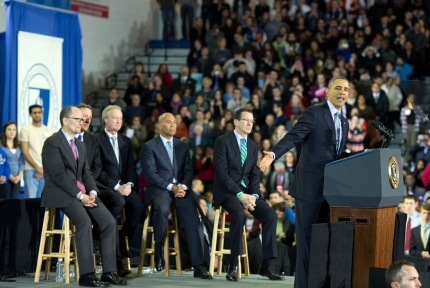
The White House

Office of the Press Secretary

Readout of the President’s Call with Prime Minister Cameron of the United Kingdom

As part of our continuing close consultations on shared security challenges, the President spoke to Prime Minister Cameron today regarding the events unfolding in Ukraine  The leaders expressed their grave concern over Russia’s clear violation of Ukrainian sovereignty and territorial integrity, and both noted that the current circumstances are unacceptable.  Russia has already started to pay a cost for its actions, such as reducing investor confidence in Russia. The two leaders welcomed the military observer mission being undertaken by Organization for Security and Cooperation in Europe at the request of the Government of Ukraine.   They also discussed support for the government of Ukraine as it works to stabilize its economy and makes preparations for elections in May.  The leaders agreed to stay in close contact in the days ahead.