President Obama Nominates Maria Contreras-Sweet to Lead the Small Business Administration

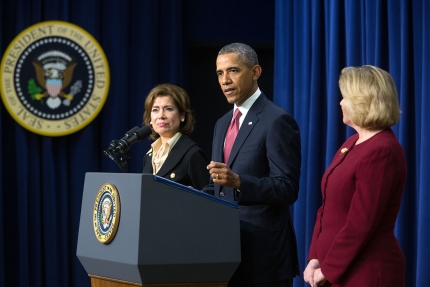
President Barack Obama announces the nomination of Maria Contreras-Sweet, left, as Administrator of the Small Business Administration

President Barack Obama announces the nomination of Maria Contreras-Sweet, left, as Administrator of the Small Business Administration, in the Eisenhower Executive Office Building South Court Auditorium, Jan. 15, 2014. At right is Acting SBA Administrator Jeanne Hulit. (Official White House Photo by Chuck Kennedy)

America’s small businesses are on the front lines when it comes to creating jobs and new opportunities. They are the cornerstones of our communities, and can help lead the way as we continue to grow the economy and add jobs in the coming year.

“They’re part of the pact that America makes -- the idea that if you work hard, if you take responsibility, then you can build something new,” President Obama said today.

“And that’s the dream that brought generations of hardworking immigrants to our shores, and that’s the idea that drives small business owners to create new products and expand their businesses every single day.” 

Maria Contreras-Sweet, who President Obama announced this afternoon as his nominee to lead the Small Business Administration, knows first hand what it means to start a small business, and has a proven track record of helping other small businesses succeed.

The White House

Office of the Press Secretary

President Obama Announces Presidential Delegation to Honduras to Attend the Inauguration of His Excellency, Juan Orlando Hernández Alvarado, President-elect of the Republic of Honduras, on January 27, 2014

President Barack Obama today announced the designation of a Presidential Delegation to Honduras to attend the inauguration of His Excellency, Juan Orlando Hernández Alvarado, President-elect of the Republic of Honduras. 

The Honorable Thomas E. Perez, Secretary of Labor, will lead the delegation.

Members of the Presidential Delegation:

The Honorable Lisa Kubiske, United States Ambassador to the Republic of Honduras

The Honorable Roberta S. Jacobson, Assistant Secretary of State for Western Hemisphere Affairs

The Honorable Ricardo Zuniga, Special Assistant to the President and Senior Director for Western Hemisphere Affairs, NSC staff

President Obama Nominates Maria Contreras-Sweet as SBA Administrator

January 15, 2014 | 11:09 | Public Domain

President Obama announces that he is nominating Maria Contreras-Sweet to lead the Small Business Administration.

Download mp4 (409MB) | mp3 (27MB)

Read the Transcript

Remarks by the President in Nominating Maria Contreras-Sweet as Administrator of the SBA

South Court Auditorium

3:46 P.M. EST

THE PRESIDENT:  Thank you.  (Applause.)  Thank you so much. Well, welcome to the White House.  And I am pleased to be joined by many of the people on the front lines when it comes to creating jobs and new opportunities -- America’s small business owners.  And I want to thank all of them for the hard work and the sacrifice of these entrepreneurs, as well as the workers and the families across the country that have helped us pull ourselves out of one of the worst recessions in our history.

Now what we're seeing is businesses having created more than 8 million new jobs since we hit bottom.  Manufacturing is growing, led by a booming auto industry.  Our investments have helped bring about new technologies, more affordable energy, and our slowing health care costs, all of which are making America even more attractive for investors.  And we're starting to see a lot of the jobs that had left our shores in manufacturing, for example, starting to come back, because we put ourselves in a much more competitive position.

And so all the pieces are there to bring back even more new jobs to America this year, but it’s not going to happen by itself.  This has to be a year of action.  We got to keep our economy growing.  We got to make sure that our working families are sharing in growth and increasing success.  We’ve got to make sure that we're creating more good jobs that pay good wages and provide families with some measure of security.  We’ve got to make sure that the recovery doesn’t leave anybody behind.

And that’s where our small businesses can help lead the way -- because small businesses are the lifeblood of our economy.  They create most of the country’s new jobs.  They’re cornerstones of our communities.  And they’re part of the pact that America makes -- the idea that if you work hard, if you take responsibility, then you can build something new.  You can make something of yourself.  You can leave something behind for your children.  And that’s the dream that brought generations of hardworking immigrants to our shores, and that’s the idea that drives small business owners to create new products and expand their businesses every single day. 

And that’s one of the reasons why I made small business a priority from day one when I took this office.  It’s why we cut taxes for small business owners not once but twice -- not once or twice, but 18 times in my first term.  Small business owners had a real tough time in the financial crisis.  When lending froze, they were the ones who were getting hit the hardest.  So my administration supported record amounts of lending to small businesses through the SBA -- more than $130 billion to more than 225,000 small businesses during the course of five years. 

We made it easier for small business to compete for and win federal contracts by eliminating unnecessary paperwork and cutting red tape, and accelerating payments to small business contractors through the “QuickPay” program so that they can maintain the cash flow that they need to grow their businesses and create more jobs.  And so in my first term, nearly $380 billion in federal contracts went to small business.  That’s almost $50 billion more than in the four years before I took office. 

So I deeply believe in small businesses that can help to drive and continue the growth that we've already seen.  And I elevated the role of the Small Business Administrator to Cabinet level -- to give small businesses a seat at the table when we are talking about our economic agenda.  I searched for an exceptional person to serve as the next leader of the SBA.  I wanted somebody with a proven track record of helping small businesses succeed; somebody who had firsthand experience both in the private sector and the public sector who can work with us and work with me to increase growth and expand opportunity.  I wanted somebody who understands entrepreneurs, and it would be even better if that somebody had actually started a business of her own. 

And that’s why I’m so proud to nominate Maria Contreras-Sweet to be the next Administrator of the Small Business Administration. 

Maria knows how hard it is to get started on a business -- the grueling hours, the stress, the occasional self-doubt -- although I have not yet seen self-doubt out of Maria.

(Laughter.)  She knows it herself.  She’s the founder of ProAmérica Bank, the first Latino-owned business bank in California in over 30 years.  Its focus is small and medium-sized businesses in Latino neighborhoods.  So not only did she start small businesses, but those have also been her customers, and she understands all too often that the lack of access to capital means a lack of opportunity. 

As Secretary of the California Business, Transportation and Housing Agency, Maria was the driving force behind major job creation and major public investments in infrastructure and in housing.  As a consultant, she helped companies expand into the Latino market.  She’s a champion of women-owned and family-owned businesses.  When she started her bank, she said she wanted the bank to be a place where families would come for help, “because when family businesses thrive” -- and I’m quoting -- “the community thrives and the economy thrives.”  And as someone who moved to California from Mexico as a young girl, and whose mother worked long hours to support Maria and her five siblings, she knows firsthand the challenges that working families and recent immigrants are facing. 

So she understands the needs of small business owners like herself.  She knows how they can lift entire communities, and ultimately how they lift our country.  So as we work to keep our economy growing, Maria will be charged with looking for more ways to support small businesses -– to help them get that good idea off the ground, to expand, to hire, to sell their products and ideas not only in our domestic markets, but also overseas.  And I’m absolutely confident that she is going to do an outstanding job as our Small Business Administrator. 

So I want to thank her for accepting this position and the challenge, and I know that she’s going to be up to the task.  (Applause.)  And I want to thank her husband Ray and her three outstanding children -– because jobs like this turn out to be family affairs -- and I know that Ray is very supportive and is going to be a great partner with her in this task.  

Now, Maria follows in the footsteps of two extraordinary leaders –- Karen Mills, who served as Administrator of the SBA in my first term, and Jeanne Hulit, who has graciously agreed to serve as Acting Administrator after Karen stepped down last year. Together, they made it easier and faster for entrepreneurs to get loans, to win contracts, to hire more people -- and the results are thriving small businesses across the country. 

Some of those entrepreneurs are here today.  Twenty years ago, Deb and Dan Carey wanted so bad to start their own brewing company that they sold their house to help pay for it.  And with a little help from the SBA, they rented an old appliance factory, set up their equipment, they got to work.  Today, the New Glarus Brewing Company is one of the top craft beer-makers in Wisconsin, with more than 80 full-time employees.  So Deb and Dan, where are you?  They’re around here somewhere.  There they are, right there.  Good to see you again.  (Applause.)

There’s another success story here -- the team behind Taylor Gourmet, a hoagie shop with locations all over D.C., including one just half a block from the White House.  (Laughter.)  If you’re wondering why I know about this, the staff are steady customers at Taylor Gourmet and I have tasted those tasty sandwiches.  When Casey Patten and Dave Mazza moved to D.C., they looked everywhere for hoagies like the ones they’d grown up with in Philly.  And when they couldn’t find any, they thought, we should make them ourselves.  And with the help of the SBA, they opened eight shops in D.C., Maryland and Virginia.  And so not only are they providing great sandwiches, but they’re also creating jobs here in the area.

That’s the power of small business.  That’s the charge of the SBA.  That’s the extraordinary work that Jeanne has done and, before her, Karen, to help advance the agenda of people who just have a dream and are willing to put in all the blood, sweat and tears that they need to do in order to achieve that dream.  And so when we think about our small businesses, just remember that’s what keeps our communities and our country strong, and we should be doing everything in our power to help them succeed.  If here in America, you’re willing to work hard and dream big, you should have your shot at success. 

Jeanne has understood that and, in fact, she’s going to be going back into the private sector and helping small businesses back in Maine.  I told her she might have wanted to stay here until the winter is over -- (laughter) -- but she’s eager to get back and she’s already stayed longer than she originally intended. 

And I know this is something that Maria understands.  Maria, on the way in, told me a wonderful story about how her grandmother, back in Mexico who was a migrant worker, said to her that if she worked hard, studied, stayed in school, that someday she’d be able to work in an office as a secretary and really make her proud.  And she ended up being the Secretary of Business Development and Transportation in California.  And now she’s going to be helping the folks who are following behind her achieve their dreams.  That’s what America is all about. 

So Maria is fulfilling the vision of her grandma in ways that maybe are not entirely expected.  And I’m confident that she’s going to put her heart and soul into making sure that all the other people who are out there striving and trying to achieve their dreams can succeed as well.  That’s what this administration is about and I’m looking forward to working with her. 

So thank you very much.  Give them a big round of applause.  (Applause.)

END
3:57 P.M. EST

Close Transcript

President Obama Speaks on the National Network for Manufacturing Innovation

January 15, 2014 | 18:46 | Public Domain

At North Carolina State University, President Obama announces new steps with the private sector to strengthen the manufacturing sector, boost advanced manufacturing, and attract good jobs with good wages that a growing middle class requires.

Download mp4 (691MB) | mp3 (45MB)

Read the Transcript

Remarks by the President on the National Network for Manufacturing Innovation

J.W. Isenhour Tennis Center
North Carolina State University
Raleigh, North Carolina 

1:14 P.M. EST

THE PRESIDENT:  Hello, Raleigh!  (Applause.)  Thank you so much.  Thank you.  (Applause.)  Well, it is good to be back in North Carolina.  (Applause.)  If you have a seat, go ahead and have a seat.  Now, if you don't have a seat, don't.  (Laughter.) 

It is good to be here at the home of the Wolfpack.  (Applause.)  I want to thank your chancellor, Randy Woodson, for the introduction and the great work that he’s doing on behalf of students all across the system.  I want to recognize my Secretary of Energy, Ernie Moniz, who is here.  Give him a big round of applause -- he’s doing good work.  (Applause.)  Your Governor, Pat McCrory, is here.  (Applause.)  The Mayor of Raleigh, Nancy McFarlane.  (Applause.)  The Mayor of Chapel Hill, Mark Kleinschmidt.  (Applause.)  The Mayor of Durham, Bill Bell.  (Applause.)  And we've got Congressman Mike McIntyre doing great work.  (Applause.)  Your Senator, Kay Hagan, couldn't be here, but I wanted to thank her publicly for the great work she’s doing.  (Applause.)  

And I want to thank all the students for coming out.  We’re doing this event nice and early so it doesn’t run up against the Wake game.  (Applause.)  I’ve learned a few things as President, and one of them is not to compete with college basketball down here on Tobacco Road.  You don't do that.  (Applause.)

Now, this is actually my second stop in Raleigh-Durham.  I just took a tour of a company called Vacon, where workers design the drives that power everything from elevators to the giant fans that help cool buildings like this one -- although I think we're kind of saving money on this -- (laughter) -- which is the smart thing to do. 

So this company is making these engines and these systems more efficient, saving businesses big bucks on energy costs, improving the environment.  Those savings get passed on to customers, puts money in people’s pockets.  And growing companies that need the products that Vacon makes, they’re benefitting enormously.  So it’s a good-news story.  But in a global economy, that company, just like every company in America, has to keep inventing and innovating in order to stay on the cutting edge.  And that’s where all of you come in.

Here at NC State, you know something about innovation.  You’ve got one of the largest undergraduate engineering programs in the country.  That's worth cheering for.  (Applause.)  I'm a lawyer by training, and that is nice.  But we need more engineers.  (Applause.)   

Companies like Cisco and IBM, they come to this school when they’re looking to hire because of the quality of the engineering program.  And over at Centennial Campus -- (applause) -- some very smart people experiment in state-of-the-art facilities to figure out everything from how to design better fireproof fabrics to how to better protect our computer systems. 

So the reason I came here today is because we've got to do more to connect universities like NC State with companies like Vacon to make America the number-one place in the world to open new businesses and create new jobs.  We want to do that here in North Carolina, and we want to do this all across America.  (Applause.)   

Now, it’s been more than five years since a devastating recession cost this country millions of jobs, and it hurt North Carolina pretty tough.  But everyone here knows that even before the recession hit, the middle class had been hitting -- getting hit on the chin for years before that.  Here in North Carolina, factories were shutting their doors, jobs were getting shipped overseas.  Wages and incomes were flat-lining, so even if you had a job you didn’t see your standard of living going up very much. Meanwhile the cost of everything from college tuition to groceries did go up. 

So when I took office, we decided to focus on the hard work of rebuilding our economy on a new foundation for growth and prosperity, and to make sure that everybody had a chance to get ahead.  And thanks to the hard work and sacrifice of the American people, the good news is the economy is growing stronger.  (Applause.)  Our businesses have now created more than 8 million new jobs since we hit bottom.  Because of an all-of-the-above strategy for American energy, for the first time in nearly two decades we produce more oil here in the United States than we buy from the rest of the world.  That hasn't happened in a very long time.  (Applause.)  We now generate more renewable energy than ever before, more natural gas than anybody on the planet.  (Applause.)  We're lowering energy costs, reducing pollution. 

Health care costs are growing at their slowest rate in 50 years.  For the first time since the 1990s, health care costs eat up a smaller chunk of our economy, and part of that, yes, has to do with the Affordable Care Act.  (Applause.)  And so over time, that means bigger paychecks for middle-class families, bigger savings for companies that are looking to hire.  And along with all this, since I took office we've cut our deficits by more than half.  (Applause.) 

So we've made progress.  And that’s what I mean when I say this can be a breakthrough year for America.  The pieces are all there to start bringing back more of the jobs that we've lost over the past decade.  A lot of companies around the world are starting to talk about bringing jobs back to the United States, bringing jobs back to places like North Carolina -- partly because we got cheap energy costs, we’ve got the best workers in the world, we’ve got the best university systems in the world -- (applause) -- and we’ve got the largest market in the world.

So the pieces are there to restore some of the ground that the middle class has lost in recent decades, start raising wages for American families.  But it requires us to take action.  This has to be a year of action.

And here in North Carolina, you’re doing your part to create good jobs that pay good wages.  Congress has to do its part, too -- because restoring the American Dream of opportunity for everyone who’s willing to work for it is something that should unite the country.  That shouldn’t divide the country.  That's what we should be aspiring to -- that everybody has a shot if they're willing to work hard and take responsibility.  (Applause.)

So in the short term, one thing Congress could do is listen to the majority of the American people and restore the unemployment insurance for Americans who need it.   (Applause.)  And let me just make an aside here.  North Carolina still has a higher-than-average unemployment rate, so this is important to this state.  Folks aren’t looking for a handout.  They're not looking for special treatment.  There are a lot of people who are sending our resumes every single day, but the market -- the job market is still tough in pockets around the country, and people need support, a little help, so they can look after their families while they’re looking for a new job.  (Applause.)  So Congress should do the right thing and extend this vital lifeline for millions of Americans. 

Of course, that's just short term.  Long term, the challenge of making sure everybody who works hard can get ahead in today’s economy is so important that we can't wait for Congress to solve it.  Where I can act on my own without Congress, I’m going to do so.

And today, I’m here to act -- to help make Raleigh-Durham, and America, a magnet for the good, high-tech manufacturing jobs that a growing middle class requires and that are going to continue to keep this country on the cutting edge.  (Applause.)  

So we’ve already got some success to build on.  Manufacturing is a bright spot in this economy.  For decades we’d been losing manufacturing jobs.  But now our manufacturers have added over the last four years more than 550,000 new jobs, including almost 80,000 manufacturing jobs in the last five months alone.  So we want to keep that trend going.  We want to build on the kind of work that's being done in places like NC State to develop technology that leads to new jobs and entire new industries. 

So a little over a year ago, we launched America’s first manufacturing innovation institute in Youngstown, Ohio.  And what it was is a partnership; it includes companies and colleges.  They came up with a joint plan.  They were focusing on developing 3D printing technology and training workers with the skills required to master that technology. 

Now, that was a great start.  We got one going and some of the folks from Youngstown are here today, and we congratulate them on the great work they’re doing.  But here’s the problem:  We created one; in Germany, they’ve already got about 60 of these manufacturing innovation hubs.  So we’ve got some catching up to do.  I don’t want the next big job-creating discovery, the research and technology to be in Germany or China or Japan.  I want it to be right here in the United States of America.  I want it to be right here in North Carolina.  (Applause.) 

So what I said was in my State of the Union address last year, I said to Congress, let’s set up a network of at least 15 of these manufacturing hubs all across America, focusing on different opportunities where we can get manufacturing innovation going, create jobs, make sure that the research is tied to businesses that are actually hiring, and those synergies are going to grow the economy regionally and ultimately across the whole country. 

And last summer, as part of our push to create middle-class jobs, I said, you know what, let’s not settle on 15, let’s just go ahead and do 45.  Republicans and Democrats in the House and the Senate introduced bills that would get this going -- that’s good.  But they haven’t passed the bills yet.  So I want to encourage them to continue to pass the bills that would create 45 of these manufacturing hubs.  In the meantime, I’m directing my administration to move forward where we can on our own.

So today, after almost a year of competition, I’m pleased to announce America’s newest high-tech manufacturing hub -- which is going to be focused on the next generation of power electronics  -- is going to be based right here in Raleigh, North Carolina.  (Applause.)  That’s good news.  That’s good news.  (Applause.)   That's good news.  It’s great.  (Applause.) 

So just like the hub in Youngstown, what we’re calling the Next Generation Power Electronics Innovation Institute is bringing together leading companies, universities, and federal research all together under one roof.  Folks at this hub are going to develop what are called “wide bandgap semiconductors.” 

Now, I was just schooled on all this.  (Laughter.)  I’m not sure that I’m fully qualified to describe the technical elements of this.  Raise your hand if you know what that is.  (Laughter.) See, we’ve got some.  (Laughter.)  For all you non-engineers out there, here’s what it means in the simplest terms.  Semiconductors, obviously, are at the heart of every piece of the electronics that we use every day -- your smartphone, your television set, these days everything.  Public research helped develop them decades ago, and then that research allowed commercialization, new products, new services, and obviously not only improved the economy, but greatly enhanced our lives.  So we want companies to run with the ball also, but first we’ve got to make sure that we’re also doing the research and linking it up to those companies. 

Wide bandgap semiconductors, they’re special because they lose up to 90 percent less power; they can operate at higher temperatures than normal semiconductors.  So that means they can make everything from cell phones to industrial motors to electric cars smaller, faster, cheaper.  There are going to be still applications for the traditional semiconductors, but these can be focused on certain areas that will vastly improve energy efficiency, vastly improve the quality of our lives.  And the country that figures out how to do this first, and the companies that figure how to do this best, they’re the ones that are going to attract the jobs that come with it.

So this manufacturing hub, right here, focused in North Carolina --

AUDIENCE MEMBER:  GoPack!

THE PRESIDENT:  GoPack!  (Laughter and applause.)  This hub is going to make it easier for these wide bandgap semiconductors to go from the drawing board to the factory floor to the store shelves -- or not necessarily the store shelves, because what I just saw, for example, were these really big pieces of equipment that are attached to utility companies or help windmills translate the power they’re generating actually get transmitted to where they’re going to be finally used.  It’s going to bring together chip designers and manufacturers with companies like Vacon and Delphi that stand to benefit from these new technologies.  And this will help big companies, but it’s also going to help small companies, because they’re going to be able to use equipment they otherwise wouldn’t be able to afford to test and prototype new products.  And of course, American workers will be able to come right here, to North Carolina, to learn the skills that companies are looking for.  And the next generation of manufacturing will be an American revolution.

So in the coming weeks, we’re going to be launching two more of these innovation hubs; we’ve already got them all planned out. One is going to focus on digital design and manufacturing; another is going to be developing lightweight metals that could transform everything from wind turbines to military vehicles.  And together, they’re going to help build new partnerships in areas that show potential.  They’ll help to lift up our communities.  They’ll help spark the technology and research that will create the new industries, the good jobs required for folks to punch their ticket into the middle class. 

And that’s what America is all about.  We have always been about research, innovation, and then commercializing that research and innovation so that everybody can benefit.  And then we start selling our stuff all around the world, we start exporting it.  And we create good jobs, and middle-class families then are able to buy the products that result from this innovation.  And you get a virtuous cycle where everybody is doing better, and nobody is left behind.  And that’s what we can do if we pull together the way those companies and universities have pulled together as part of this bid. 

Now, this is going to be a long haul.  We're not going to turn things around overnight.  A lot of jobs were lost in the textile industry and furniture-making.  But the great news is, is that ultimately, because our people are good and smart and hardworking and willing to take risks, we are going to be able to start bringing those jobs back to America.  And that’s what we do.  (Applause.)  When times get tough, we don’t give up.  We get up.  We innovate.  We adapt.  We keep going.  We look to the future.  (Applause.) 

And I want all of you to know, North Carolina, that as long as we keep working together and fighting together and doing what it takes to widen the circle of opportunity for more Americans so nobody is left behind -- if you work hard, if you are responsible, then you can go out there, get a skill, train yourself, find a job, support a family.  If we work together, and that’s our focus, there’s nothing we can’t achieve.  (Applause.) There’s no limit to how far we can go.

So congratulations, North Carolina State.  Congratulations, Raleigh.  Let’s get to work.  God bless you.  God bless America. (Applause.)

END
1:31 P.M. EST

Close Transcript

RELIGIOUS FREEDOM DAY, 2014

-------

BY THE PRESIDENT OF THE UNITED STATES OF AMERICA

A PROCLAMATION

In 1786, the Virginia General Assembly affirmed an ideal that has long been central to the American journey. The Virginia Statute for Religious Freedom, penned by Thomas Jefferson, declared religious liberty a natural right and any attempt to subvert it "a departure from the plan of the Holy Author of our religion, who being Lord both of body and mind, yet chose not to propagate it by coercions on either." The Statute inspired religious liberty protections in the First Amendment, which has stood for almost two and a quarter centuries.

Today, America embraces people of all faiths and of no faith. We are Christians and Jews, Muslims and Hindus, Buddhists and Sikhs, atheists and agnostics. Our religious diversity enriches our cultural fabric and reminds us that what binds us as one is not the tenets of our faiths, the colors of our skin, or the origins of our names. What makes us American is our adherence to shared ideals -- freedom, equality, justice, and our right as a people to set our own course.

America proudly stands with people of every nation who seek to think, believe, and practice their faiths as they choose. In the years to come, my Administration will remain committed to promoting religious freedom, both at home and across the globe. We urge every country to recognize religious freedom as both a universal right and a key to a stable, prosperous, and peaceful future.

As we observe this day, let us celebrate America's legacy of religious liberty, embrace diversity in our own communities, and resolve once more to advance religious freedom in our time.

NOW, THEREFORE, I, BARACK OBAMA, President of the United States of America, by virtue of the authority vested in me by the Constitution and the laws of the United States, do hereby proclaim January 16, 2014, as Religious Freedom Day. I call on all Americans to commemorate this day with events and activities that teach us about this critical foundation of our Nation's liberty, and show us how we can protect it for future generations at home and around the world.

IN WITNESS WHEREOF, I have hereunto set my hand this fifteenth day of January, in the year of our Lord two thousand fourteen, and of the Independence of the United States of America the two hundred and thirty-eighth.

BARACK OBAMA

North Carolina Is Home to America’s Newest High-Tech Manufacturing Hub

Watch on YouTube

President Obama made two stops during his trip to Raleigh today: the first to tour a company called Vacon, where workers design the drives that power everything from elevators to the giant fans that help cool buildings, and the second to deliver remarks at North Carolina State University, home of one of the largest undergraduate engineering programs in the country.

“The reason I came here today is because we've got to do more to connect universities like NC State with companies like Vacon to make America the number-one place in the world to open new businesses and create new jobs,” President Obama explained.

And, to help make Raleigh-Durham a magnet for the good, high-tech manufacturing jobs that we need to grow the middle class and keep this country on the cutting edge, President Obama announced today that the area will be home to the nation’s newest manufacturing innovation hub.

Like the hub launched in Ohio last year to develop and train workers in 3-D printing technology, the Next Generation Power Electronics Innovation Institute in North Carolina will bring leading companies, universities, and federal research together under one roof to help develop the next generation of power electronics. 

“Folks at this hub are going to develop what are called ‘wide bandgap semiconductors,’” President Obama said.

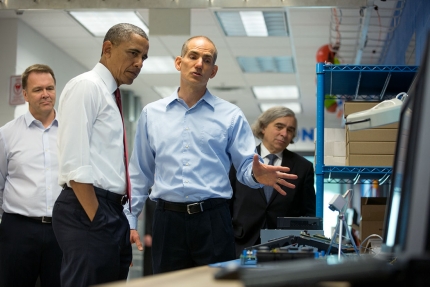
President Barack Obama tours Vacon USA

President Barack Obama tours Vacon USA with Energy Secretary Ernest Moniz, right, Vacon Vice President Dan Isaksson, left, and Vacon engineer Rod Washington, in Durham, N.C., Jan. 15, 2014. Vacon is a company that manufactures AC drives, which are used to control the speed of electric motors to maximize energy efficiency. (Official White House Photo by Lawrence Jackson)

“For all you non-engineers out there,” he said, “here’s what it means in the simplest terms.”

Semiconductors, obviously, are at the heart of every piece of the electronics that we use every day -- your smartphone, your television set, these days everything … Wide bandgap semiconductors, they’re special because they lose up to 90 percent less power; they can operate at higher temperatures than normal semiconductors. 

So that means they can make everything from cell phones to industrial motors to electric cars smaller, faster, cheaper. 

“And the country that figures out how to do this first, and the companies that figure how to do this best,” President Obama said, “they’re the ones that are going to attract the jobs that come with it.”

Expanding College Opportunity

Tomorrow, December 16, college and university presidents and leadersfrom nonprofits, foundations, state governments, and the private sector will join President Obama and First Lady Michelle Obama at the White House to discuss expanding college opportunity.

The day-long event will feature remarks from the President, First Lady, and senior administration officials, as well as a series of panel discussions.

Additional information is available at wh.gov/college-opportunity, so check back to learn more. You can also tune in to whitehouse.gov/live to watch the event, starting at 9:00 am ET.  

The White House

Office of the Press Secretary

Presidential Proclamation -- Commonwealth of the Northern Mariana Islands

RESERVING CERTAIN SUBMERGED LANDS IN THE COMMONWEALTH OF THE NORTHERN MARIANA ISLANDS

-------

BY THE PRESIDENT OF THE UNITED STATES OF AMERICA

A PROCLAMATION

The submerged lands surrounding the islands of Farallon de Pajaros (Uracas), Maug, and Asuncion in the Commonwealth of the Northern Mariana Islands are among the most biologically diverse in the Western Pacific, with relatively pristine coral reef ecosystems that have been proclaimed objects of scientific interest and reserved for their protection as the Islands Unit of the Marianas Trench Marine National Monument (marine national monument) by Proclamation 8335 of January 6, 2009. Certain submerged lands adjacent to the land leased by the United States of America on the islands of Tinian and Farallon de Medinilla under the Lease Agreement Made Pursuant to the Covenant to Establish a Commonwealth of the Northern Mariana Islands in Political Union with the United States of America, dated January 6, 1983, as amended (Lease) are essential for ensuring that United States forces forward deployed to the Western Pacific are adequately trained and ready to respond immediately and effectively to orders from the National Command Authority, and for ensuring the safety of citizens of the Commonwealth of the Northern Mariana Islands.

Certain of these submerged lands will be conveyed by the United States to the Government of the Commonwealth of the Northern Mariana Islands on January 16, 2014, pursuant to section 1(a) of Public Law 93-435, as amended by section 1 of Public Law 113-34 (the "Act"), unless the President designates otherwise pursuant to section 1(b)(vii) of the Act.

NOW, THEREFORE, I, BARACK OBAMA, President of the United States of America, by virtue of authority vested in me by section 1(b)(vii) of the Act, do hereby proclaim that the lands hereinafter described are excepted from transfer to the Government of the Commonwealth of the Northern Mariana Islands under section 1(a) of the Act:

the submerged lands adjacent to the islands of Farallon de Pajaros (Uracas), Maug, and Asuncion permanently covered by tidal waters up to the mean low water line and extending three geographical miles seaward from the mean high tide line; and

the submerged lands adjacent to the islands of Tinian and Farallon de Medinilla permanently or periodically covered by tidal waters up to the line of mean high tide and extending seaward to a line three geographical miles distant from those areas of the coastline that are adjacent to the leased lands described in the Lease.2

Nothing in this proclamation is intended to affect the authority of the Secretary of the Interior (Secretary) under section 1(b) of the Act to subsequently convey the submerged lands adjacent to the islands of Farallon de Pajaros (Uracas), Maug, and Asuncion when the Secretary, the Secretary of Commerce, and the Government of the Commonwealth of the Northern Mariana Islands have entered into an agreement for coordination of management that ensures the protection of the marine national monument within the excepted area described above. Furthermore, nothing in this proclamation is intended to affect the authority of the Secretary under section 1(b) of the Act to subsequently convey the submerged lands adjacent to the land leased by the United States on the islands of Tinian or Farallon de Medinilla when the Secretary of the Navy and the Government of the Commonwealth of the Northern Mariana Islands have entered into an agreement that ensures protection of military training within the excepted area.

IN WITNESS WHEREOF, I have hereunto set my hand this fifteenth day of January, in the year of our Lord two thousand fourteen, and of the Independence of the United States of America the two hundred and thirty-eighth.

BARACK OBAMA

The White House

Office of the Press Secretary

Remarks by the President in Nominating Maria Contreras-Sweet as Administrator of the SBA

South Court Auditorium

3:46 P.M. EST

THE PRESIDENT:  Thank you.  (Applause.)  Thank you so much. Well, welcome to the White House.  And I am pleased to be joined by many of the people on the front lines when it comes to creating jobs and new opportunities -- America’s small business owners.  And I want to thank all of them for the hard work and the sacrifice of these entrepreneurs, as well as the workers and the families across the country that have helped us pull ourselves out of one of the worst recessions in our history.

Now what we're seeing is businesses having created more than 8 million new jobs since we hit bottom.  Manufacturing is growing, led by a booming auto industry.  Our investments have helped bring about new technologies, more affordable energy, and our slowing health care costs, all of which are making America even more attractive for investors.  And we're starting to see a lot of the jobs that had left our shores in manufacturing, for example, starting to come back, because we put ourselves in a much more competitive position.

And so all the pieces are there to bring back even more new jobs to America this year, but it’s not going to happen by itself.  This has to be a year of action.  We got to keep our economy growing.  We got to make sure that our working families are sharing in growth and increasing success.  We’ve got to make sure that we're creating more good jobs that pay good wages and provide families with some measure of security.  We’ve got to make sure that the recovery doesn’t leave anybody behind.

And that’s where our small businesses can help lead the way -- because small businesses are the lifeblood of our economy.  They create most of the country’s new jobs.  They’re cornerstones of our communities.  And they’re part of the pact that America makes -- the idea that if you work hard, if you take responsibility, then you can build something new.  You can make something of yourself.  You can leave something behind for your children.  And that’s the dream that brought generations of hardworking immigrants to our shores, and that’s the idea that drives small business owners to create new products and expand their businesses every single day. 

And that’s one of the reasons why I made small business a priority from day one when I took this office.  It’s why we cut taxes for small business owners not once but twice -- not once or twice, but 18 times in my first term.  Small business owners had a real tough time in the financial crisis.  When lending froze, they were the ones who were getting hit the hardest.  So my administration supported record amounts of lending to small businesses through the SBA -- more than $130 billion to more than 225,000 small businesses during the course of five years. 

We made it easier for small business to compete for and win federal contracts by eliminating unnecessary paperwork and cutting red tape, and accelerating payments to small business contractors through the “QuickPay” program so that they can maintain the cash flow that they need to grow their businesses and create more jobs.  And so in my first term, nearly $380 billion in federal contracts went to small business.  That’s almost $50 billion more than in the four years before I took office. 

So I deeply believe in small businesses that can help to drive and continue the growth that we've already seen.  And I elevated the role of the Small Business Administrator to Cabinet level -- to give small businesses a seat at the table when we are talking about our economic agenda.  I searched for an exceptional person to serve as the next leader of the SBA.  I wanted somebody with a proven track record of helping small businesses succeed; somebody who had firsthand experience both in the private sector and the public sector who can work with us and work with me to increase growth and expand opportunity.  I wanted somebody who understands entrepreneurs, and it would be even better if that somebody had actually started a business of her own. 

And that’s why I’m so proud to nominate Maria Contreras-Sweet to be the next Administrator of the Small Business Administration. 

Maria knows how hard it is to get started on a business -- the grueling hours, the stress, the occasional self-doubt -- although I have not yet seen self-doubt out of Maria.

(Laughter.)  She knows it herself.  She’s the founder of ProAmérica Bank, the first Latino-owned business bank in California in over 30 years.  Its focus is small and medium-sized businesses in Latino neighborhoods.  So not only did she start small businesses, but those have also been her customers, and she understands all too often that the lack of access to capital means a lack of opportunity. 

As Secretary of the California Business, Transportation and Housing Agency, Maria was the driving force behind major job creation and major public investments in infrastructure and in housing.  As a consultant, she helped companies expand into the Latino market.  She’s a champion of women-owned and family-owned businesses.  When she started her bank, she said she wanted the bank to be a place where families would come for help, “because when family businesses thrive” -- and I’m quoting -- “the community thrives and the economy thrives.”  And as someone who moved to California from Mexico as a young girl, and whose mother worked long hours to support Maria and her five siblings, she knows firsthand the challenges that working families and recent immigrants are facing. 

So she understands the needs of small business owners like herself.  She knows how they can lift entire communities, and ultimately how they lift our country.  So as we work to keep our economy growing, Maria will be charged with looking for more ways to support small businesses -– to help them get that good idea off the ground, to expand, to hire, to sell their products and ideas not only in our domestic markets, but also overseas.  And I’m absolutely confident that she is going to do an outstanding job as our Small Business Administrator. 

So I want to thank her for accepting this position and the challenge, and I know that she’s going to be up to the task.  (Applause.)  And I want to thank her husband Ray and her three outstanding children -– because jobs like this turn out to be family affairs -- and I know that Ray is very supportive and is going to be a great partner with her in this task.  

Now, Maria follows in the footsteps of two extraordinary leaders –- Karen Mills, who served as Administrator of the SBA in my first term, and Jeanne Hulit, who has graciously agreed to serve as Acting Administrator after Karen stepped down last year. Together, they made it easier and faster for entrepreneurs to get loans, to win contracts, to hire more people -- and the results are thriving small businesses across the country. 

Some of those entrepreneurs are here today.  Twenty years ago, Deb and Dan Carey wanted so bad to start their own brewing company that they sold their house to help pay for it.  And with a little help from the SBA, they rented an old appliance factory, set up their equipment, they got to work.  Today, the New Glarus Brewing Company is one of the top craft beer-makers in Wisconsin, with more than 80 full-time employees.  So Deb and Dan, where are you?  They’re around here somewhere.  There they are, right there.  Good to see you again.  (Applause.)

There’s another success story here -- the team behind Taylor Gourmet, a hoagie shop with locations all over D.C., including one just half a block from the White House.  (Laughter.)  If you’re wondering why I know about this, the staff are steady customers at Taylor Gourmet and I have tasted those tasty sandwiches.  When Casey Patten and Dave Mazza moved to D.C., they looked everywhere for hoagies like the ones they’d grown up with in Philly.  And when they couldn’t find any, they thought, we should make them ourselves.  And with the help of the SBA, they opened eight shops in D.C., Maryland and Virginia.  And so not only are they providing great sandwiches, but they’re also creating jobs here in the area.

That’s the power of small business.  That’s the charge of the SBA.  That’s the extraordinary work that Jeanne has done and, before her, Karen, to help advance the agenda of people who just have a dream and are willing to put in all the blood, sweat and tears that they need to do in order to achieve that dream.  And so when we think about our small businesses, just remember that’s what keeps our communities and our country strong, and we should be doing everything in our power to help them succeed.  If here in America, you’re willing to work hard and dream big, you should have your shot at success. 

Jeanne has understood that and, in fact, she’s going to be going back into the private sector and helping small businesses back in Maine.  I told her she might have wanted to stay here until the winter is over -- (laughter) -- but she’s eager to get back and she’s already stayed longer than she originally intended. 

And I know this is something that Maria understands.  Maria, on the way in, told me a wonderful story about how her grandmother, back in Mexico who was a migrant worker, said to her that if she worked hard, studied, stayed in school, that someday she’d be able to work in an office as a secretary and really make her proud.  And she ended up being the Secretary of Business Development and Transportation in California.  And now she’s going to be helping the folks who are following behind her achieve their dreams.  That’s what America is all about. 

So Maria is fulfilling the vision of her grandma in ways that maybe are not entirely expected.  And I’m confident that she’s going to put her heart and soul into making sure that all the other people who are out there striving and trying to achieve their dreams can succeed as well.  That’s what this administration is about and I’m looking forward to working with her. 

So thank you very much.  Give them a big round of applause.  (Applause.)

END
3:57 P.M. EST

The White House

Office of the Press Secretary

Press Gaggle by Press Secretary Jay Carney Aboard AF1 en route Raleigh, NC, 1/15/2014

Aboard Air Force One
En Route Raleigh, North Carolina

10:25 A.M. EST

MR. CARNEY:  Good morning, ladies and gentlemen.  Welcome aboard Air Force One for the first outing of the New Year.  I hope you look forward to it as I do.  I just wanted to say a couple of things about where we’re going and the event the President will participate in.

Today the President will visit Vacon, a company that manufactures AC drives, which are used to control the speed of electric motors to maximize energy efficiency.  At 11:35 a.m. the President will tour the R&D facility, accompanied by Dan Isaksson, Vacon vice president, and Secretary Moniz.  At 1:00 p.m. at North Carolina State University, the President will announce new steps with the private sector to strengthen the manufacturing sector, boost advanced manufacturing, and attract good jobs with good wages that a growing middle class requires.

The President will announce the selection of a North Carolina headquartered consortium of businesses and universities led by North Carolina State University to lead a manufacturing innovation institute for next generation power electronics.

President Obama has declared the year 2014 a “Year of Action.”  And while he will continue to work with Congress on new measures to create jobs and grow the economy, he will also use his executive authority to get things done.  After shedding jobs for a decade, our manufacturers have added 568,000 jobs over the past nearly four years, including 80,000 over the past five months.  Manufacturing production has grown since the end of the recession at its fastest pace in over a decade.  The President is committed to building on that progress. 

With that, I’ll take your questions.

Q:    Could you respond to some of the criticisms that Judge Bates made of recommendations regarding surveillance?  He objects, for example, to the appointment of a special advocate to a rigorous procedure for national security letters, and so on.

MR. CARNEY:  Mark, as you know, we are in the final stages of wrapping up the administration’s review of our signals intelligence programs.  As we’ve been saying, we’re not going to discuss decisions and outcomes while the review is ongoing, and we wouldn’t discuss observations or assessments by others about recommendations that the President himself is considering as he makes final decisions prior to his remarks at the Justice Department on Friday.

Q:    What about the New York Times story today that the NSA is using radio waves to tap into computers around the world and monitor them?

MR. CARNEY:  As you know, I won’t discuss specific tools or processes.  But the NSA operates under heavy oversight and is focused on discovering and developing intelligence about valid and foreign intelligence targets, such as terrorists, human traffickers, and drug smugglers.  They are not interested in the personal information about ordinary Americans, nor do they use foreign intelligence capabilities to steal the trade secrets of foreign companies on behalf of, or give intelligence that we collect to U.S. companies to enhance their international competitiveness or increase their bottom line.

Q:    Do you have anything to add to your statement last night about the unemployment insurance?  Who is to blame for this?

MR. CARNEY:  I think if you look at my statement, we’re very disappointed that Republicans blocked a common-sense, compromise solution that would have extended unemployment insurance benefits to the 1.3 million Americans and their families who have been cut off from this emergency assistance.

It’s very frustrating when, again, the previous President, a Republican, signed similar extensions five times without offsets.  And Majority Leader Senator Reid has gone quite a distance to try to accommodate the concerns of Republicans who have shown a desire and an interest in extending these benefits when it comes to offsets and when it comes to offering amendments. 

So we’re going to continue to work with congressional leaders, with Senate leaders to move this forward.  The need is urgent.  It should not be tied up in ideological or partisan debate.  The Americans who need this assistance are Republicans, they're Democrats, they're independents, they're unaffiliated -- they're Americans.  And Congress should act.

Q:   Will the President address the vote or the lack of votes in the Senate in his remarks today?

MR. CARNEY:  He might bring it up in his remarks, but it’s certainly not the focus of his remarks.

Q:    Agenda for his meeting with Senate Democrats?  What’s at the top of the agenda?

MR. CARNEY:  Well, it’s basically to sync our watches on the policy agenda that the President has been putting forward and will add to in his State of the Union address.  So there will be a broad array of topics, including -- as you heard him say yesterday at the Cabinet meeting -- efforts we’re undertaking to work with Congress legislatively to move the country forward and efforts that he can undertake using the unique authorities and powers that a President has to make advances on behalf of the middle class and the American economy.  And today’s event in North Carolina is a perfect example of the President using that power and that authority.

Q:    Jay, speaking of today’s event, these manufacturing institutes, as you know, were an initiative announced at the State of the Union last year, and here we are two weeks before this year’s State of the Union.  Is there any frustration that it’s taken him close to a year to announce the establishment of the first one of what’s supposed to eventually be 45 of these institutes?

MR. CARNEY:  Not at all.  I mean, I think if we had announced everything in a week, you would have said it wasn’t serious, it wasn’t real, and the assessments made about where to launch these initiatives weren’t vigorous and substantive.

I think that we have seen extremely positive growth in our manufacturing sector.  We’ve seen areas with huge potential for further growth, especially in advanced manufacturing, in technologies and businesses that the United States can dominate, and by doing so can create high-paying jobs that support middle-class families here at home.

This is something the President is very committed to, and he’s very excited about today’s event.

Q:    “Year of Action” -- his economic issues can we see -- expect action on more health care actions, immigration, other issues on the President’s domestic agenda?

MR. CARNEY:  The answer is, yes.  I think the point that the President has been making and others have made on his behalf is that in many ways the American economy, as it has emerged from the recovery, has grown steadily and created 8.2 million jobs, is on a precipice of even greater strides forward.  And we want to do everything we can, using our authorities, the President's authorities to take action through the executive and through the power of the pen and the power of the phone, as well as take action through and with Congress legislatively on immigration reform and so many other issues that we can work together on.

It bears notice that, despite all of our differences, despite our disappointment and frustration with the decision by Republicans to block UI benefits thus far, that there has also been steady progress on the omnibus legislation that is the product of a bipartisan compromise on a budget deal.  And that omnibus legislation, that funding bill protects some of the President's key priorities, including in manufacturing, SelectUSA, including in early childhood education and others. 

So there's a lot of positive things that can happen and are happening on behalf of the economy and the middle class and the American people, and we just need to keep moving forward.  So the President is going to talk a lot about, in the days ahead and in the State of the Union address, ways that we can use all the tools available to us to grow the economy and create jobs that middle-class families can depend on.

Q:    Can you talk about the significance of the phrase “Year of Action” compared to previous years, which seemed were also years of action?  Why are you pointing out that this year is a year of action? 

MR. CARNEY:  Well, that’s a profound question, Zack.  The fact of the matter is this President has throughout his time in office utilized the tools available to him.  But we're going to reinvigorate that process.  We're going to continue to look for creative and innovative ideas to do things like advance the cause of developing high-tech and other advanced manufacturing centers across the country; to expand access to early childhood education; to move forward with rebuilding our infrastructure. 

One other positive outcome of the omnibus legislation that’s moving through the Congress now is that it provides significant funds for TIGER investments -- for TIGER grants.  And that goes right to the infrastructure needs that we have in this country.  And as you know, investment in infrastructure, as had been recognized by both Democrats and Republicans over the years, provide an immediate jolt to the economy, immediate job creation, as well as long-term positive benefits because of improved infrastructure. 

Q:    Jay, can I ask about Iran?  As you know and have reacted to, Iran's foreign minister laid a wreath at the grave of a Hezbollah leader who was involved in a terrorist attack against Americans.  And we spoke yesterday about these reports of a Russian-Iran oil-for-goods deal.  You’ve made the case repeatedly of why you think Congress should wait and give diplomacy a chance.  Are you concerned that events like these, which you can't control, could have a negative effect and sort of weaken the argument that you're making with folks on the Hill that, look, you need to give us a window of time to try to get a deal done?

MR. CARNEY:  Well, I’d say a couple things.  On the matter of the Iranian foreign minister honoring Imad Mugniyah, the United States condemns the decision taken by the Iranian foreign minister to place a wreath at the grave of a former leader of the Lebanese Hezbollah responsible for heinous acts of terrorism that killed hundreds of innocent people, including Americans.  The inhumane violence that Mugniyah perpetrated and that Lebanese Hezbollah continues to perpetrate in a region with Iran’s financial and materiel support has had profoundly destabilizing and deadly effects for Lebanon and the region.

The decision to commemorate an individual who has participated in such vicious acts and whose organization continues to actively support terrorism worldwide sends the wrong message and will only exacerbate tensions in the region.

Now, I think this speaks to the fact that through the P5-plus-1 and the agreements that have been negotiated, and the process moving forward, we are addressing with our international partners the profound and important challenge of ensuring that Iran does not develop and obtain a nuclear weapon.  There are a host of vital national security interests at stake here, as well as the national security interests of our allies and friends.

Even as we pursue that and do it in a way that demands transparency and verifiability from the Iranians, we do not let up in our views and our positions when it comes to other activities, including the support of terrorist organizations that Iran engages in.

On the matter of the reports about the oil-for-goods deal with Iran that Russia may be engaged in, we've been very clear that we're concerned about that.  When we saw those reports, press reports, it was immediately raised at the highest levels by Secretary Kerry, with Foreign Minister Lavrov.  And I can tell you that if that deal moves forward it would raise serious concerns as it would be inconsistent with the terms of the P5-plus-1 agreement with Iran and could potentially trigger U.S. sanctions against the entities and individuals involved in any such transactions.

So our disposition has not changed on these matters.  And that's why it’s so important to be clear that the actions that Iran takes, the steps it takes to either comply with or not comply with commitments it makes are what we judge Iran by -- not by statements meant for a domestic audience or by promises rather than action.  So we’re going to press forward. 

When it comes to the need to implement the Joint Plan of Action and engage in negotiations through the P5-plus-1 with the Iranians, it is absolutely the right thing to do to test whether or not we can resolve the challenge posed by Iran’s nuclear program peacefully.

The President retains all options, including military options, to fulfill his policy goal.  But it is absolutely preferable to him, to the American people, and to all those who demand that Iran forsake nuclear weapons that this be resolved peacefully.

Q:    The Senate Intelligence Committee has released a declassified report on Benghazi that found that -- or concluded that the attacks there were preventable and based on known security shortfalls, and the explanations for what caused the attack were -- inaccurately referred to the protests without sufficient eyewitness accounts or intelligence to base that on.  Is there any response to those findings today?

MR. CARNEY:  Well, you know the administration has made extraordinary efforts to work with seven different congressional committees investigating what happened before, during, and after the Benghazi attacks, including testifying at 13 congressional hearings, participating in 50 staff briefings, and providing over 25,000 pages of documents. 

Today’s report largely reaffirms the findings reached by the independent Benghazi Accountability Review Board, and a number of the recommendations are consistent with the work the State Department has taken to improve diplomatic security, including upgrading security cameras, improving fire-protective equipment, and increasing Marine security guard presence. 

I’d refer you to the State Department for the status on implementing each of those recommendations.  But as you know, the administration is focused on two pieces:  bringing to justice those responsible for the deaths of four Americans; and making sure that we take the steps necessary to improve the security at vulnerable facilities so that our men and women serving overseas in diplomatic positions are -- rather, to improve their security, as I said.

So I think this reinforces what other investigations have found, which is that there was not enough security to protect the four Americans who lost their lives and that there are things that we must do and that we are doing to ensure that we do everything we can to protect the security of Americans serving overseas, often in difficult circumstances and dangerous circumstances.

Q:    Jay, any details on the First Lady's 50th birthday party?

MR. CARNEY:  No, I don’t have anything on that.  I’d refer you to the East Wing. 

Q:    No Jay-Z, Beyoncé dance party?  (Laughter.)

Q:    Are you going?

MR. CARNEY:  Again, I'd refer you to the East Wing.

Q:    Have you been invited?

MR. CARNEY:  I'd refer you to the East Wing.  (Laughter.) 

Q:    Do you dance?

MR. CARNEY:  I do.  Anybody else?

Q:    One other thing.  Can you confirm that the President is going to nominate Maria Contreras-Sweet to head the SBA?

MR. CARNEY:  I can.  The President will do that this afternoon --

Q:    In his remarks?

MR. CARNEY:  No, upon return to the White House.  And I think if you look at her remarkable career, you will see that she is an excellent candidate for this position.  And the President is grateful that he will be able to nominate her today. 

Q:    One more for you.  What do the lobbying efforts look like from the White House on the fast-track TPA bill?

MR. CARNEY:  It’s a priority of the President’s, his entire trade agenda, and we’re working with Congress to move that forward.

Q:    Thank you.

MR. CARNEY:  Thanks.

END
10:55 A.M. EST