Five Facts About a National Infrastructure Bank

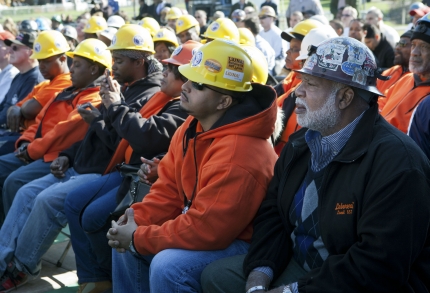
20111102 Construction workers listen as the President speaks at the Key Bridge

Construction workers listen as President Barack Obama delivers remarks at Georgetown Waterfront Park in Washington, D.C., regarding the infrastructure piece of the American Jobs Act, Nov. 2, 2011. (Official White House Photo by Pete Souza)

Yesterday, with the Key Bridge, which connects Washington, DC with Arlington, Virginia, as a backdrop, President Obama discussed the ways that the American Jobs Act will invest in the nation's highways, airports, roads, and bridges -- and create new jobs for construction workers.

Today, the Senate is set to take up one idea that the President touted -- the creation of a national infrastructure bank.

Here's how it would work:

1) Congress would appropriate an initial $10 billion in startup money to capitalize the bank.

2) The new bank would identify transportation, energy, and water infrastructure projects that lack funding, offer a clear benefit for taxpayers, and are worth at least $100 million or $25 million for rural projects.

3) Loans made by the bank would then be matched by private sector investments or money from local governments -- so that the infrastructure bank provides half or less than half the total funding.

4) Each project would generate its own revenues to help ensure repayment of the loan.

5) Decisions would be made by a seven-person board of governors -- of whom, no more than four could be from the same political party -- and a CEO chosen by the President.

One bonus fact: The legislation that would create the bank has serious bipartisan backing -- and the support of both the U.S. Chamber of Commerce and the AFL-CIO.

Related Topics: Economy, Virginia

The White House

Office of the Press Secretary

Remarks by President Obama and President Nicolas Sarkozy of France in a Joint Statement

Convention Center
Cannes, France

10:38 A.M. CET

PRESIDENT OBAMA: Well, it is wonderful to be back in France. And I want to thank my excellent friend and colleague, Nicolas Sarkozy, for his hospitality. He and I obviously have worked together on a wide range of issues since I've been President, and I always welcome his frank and honest assessment of the situations here.

It's also nice to be back visiting in France -- the last time I was in the south of France -- or the first time, rather, was as a college student, and I've never forgotten the extraordinary hospitality of the French people and the extraordinary views that are available here.

This morning, President Sarkozy and I reaffirmed our strong and enduring ties, and I've said on many occasions that France is not only our oldest ally, but also one of our closest, and I consider Nicolas to be an outstanding and trusted partner on the world stage.

I think it's no surprise that we spent most of our conversation focused on strengthening the global economic recovery so that we are creating jobs for our people and stabilizing the financial markets around the world. The most important aspect of our task over the next two days is to resolve the financial crisis here in Europe. President Sarkozy has shown extraordinary leadership on this issue. I agree with him that the EU has made some important steps towards a comprehensive solution, and that would not have happened without Nicolas's leadership. But here at the G20 we're going to have to flesh out more of the details about how the plan will be fully and decisively implemented.

And we also discussed the situation in Greece and how we can work to help resolve that situation as well. And the United States will continue to be a partner with the Europeans to resolve these challenges.

We had the opportunity to also talk about a range of security issues. One in particular that I want to mention is the continuing threat posed by Iran's nuclear program. The IAEA is scheduled to release a report on Iran's nuclear program next week and President Sarkozy and I agreed on the need to maintain the unprecedented international pressure on Iran to meet its obligations.

And finally, I'm looking forward to joining Nicolas and service members from both of our countries tomorrow to celebrate the alliance between our two countries, which spans more than 200 years -- from Yorktown to Libya.

And finally, I want to make mention that this is our first meeting since the arrival of the newest Sarkozy, and so I want to congratulate Nicolas and Carla on the birth of Giulia. And I informed Nicolas on the way in that I am confident that Giulia inherited her mother’s looks rather than her father’s -- (laughter) -- which I think is an excellent thing. And so now we share one of the greatest challenges and blessings of life, and that is being fathers to our daughters.

So again, Nicolas, thank you for your friendship. Thank you for our partnership. And thank you for your gracious hospitality.

PRESIDENT SARKOZY: (As interpreted.) Well, you see Barack Obama's tremendous influence. For four years now, he's been explaining to me that to be a father to daughters is a fantastic experience -- he who has two daughters. So I have listened to him. As a matter of fact, I followed his example.

I must tell you that we had a heavy agenda because there is no lack of subjects for our concern. We need the leadership of Barack Obama. We need the solidarity and the support of the United States of America. We need joint common analysis as to the way we can put the world back on the path of growth and stability.

Together, President Obama and myself are trying to build the unity of the G20. And I wish to pay tribute to the United States for understanding about all the issues we’ll be discussing over the next 48 hours, and in particular, the issue of the Greek crisis -- the difficulty that the euro is facing, the need to be hand-in-glove with the United States on the language of the final communiqué.

Again, I want to thank President Obama for his understanding on all matters, including that of a levy or a tax on financial transactions, where I think we found common ground, at least common analysis, mainly that the world of finance must contribute to solving the crisis that we are all facing today.

I also want to say how delighted I am that President Obama has agreed to stay a few hours after the end of the summit in order to participate in ceremonies to pay tribute to American and French troops who have fought together so many times throughout the course of our joint histories. And I'm delighted to have the opportunity to join President Obama in a television interview, because he is much loved and much liked here in France.

So we have a very heavy agenda ahead of us, and we'll have many opportunities to see you again and explain to you what decisions we've been led to take.

PRESIDENT OBAMA: Thank you very much.

END
10:53 A.M. CET

The White House

Office of the Press Secretary

Remarks by President Obama and Chancellor Angela Merkel of Germany Before Bilateral Meeting

Intercontinental Carlton Cannes Hotel
Cannes, France

11:05 A.M. CET

PRESIDENT OBAMA: It’s wonderful to be back together with my good friend, Angela Merkel. I think that the last time we were in Washington, D.C. together we presented her with the Medal of Freedom, and that indicated the high esteem that not only I, but the United States, hold her and her leadership.

This is going to be a very busy two days. Central to our discussions at the G20 is how do we achieve greater global growth and put people back to work. That means we’re going to have to resolve the situation here in Europe. And without Angela’s leadership we would not have already made the progress that we’ve seen at the EU meeting on October 27th.

We are now, having seen some progress, looking forward to working together to figure out how we can implement this in an effective way to make sure that not only is the eurozone stable, but the world financial system is stable as well. And hopefully during our bilateral meeting we'll also have the ability to discuss a wide range of other issues, including security issues that are so important to both our countries.

But I just want to say, once again, how much I enjoy working with Angela. She exhibits the kind of practical common sense that I think has made her a leader not only in Germany but around the world.

So thank you very much.

Hold on, hold on, hold on -- translation. (Laughter.) All the Americans reporters speak German, but just in case. (Laughter.)

CHANCELLOR MERKEL: (As interpreted.) Thank you very much, and let me say that I'm delighted that we have the opportunity for this meeting here. And mainly, the G20 will afford us an opportunity, during these two days of meeting, not only to talk about European matters but also about global matters that matter to both of us and that are of common interest.

And let me say, again, that I very fondly remember the evening in the White House and the award.

Thank you.

PRESIDENT OBAMA: Thank you, everybody.

END
11:08 A.M. CET

President Obama Speaks on Investing in Our Infrastructure

November 02, 2011 | 16:03 | Public Domain

The President urges Congress to pass the infrastructure piece of the American Jobs Act.

Download mp4 (153MB) | mp3 (15MB)

Read the Transcript

Remarks by the President Urging Congress to Pass the Infrastructure Piece of the American Jobs Act

Georgetown Waterfront Park
Washington, D.C.

11:24 A.M. EDT

THE PRESIDENT:  Hello, everybody.  (Applause.)  All right.  Thank you so much, everybody.  Please, have a seat on this beautiful day.  It is good to see all these construction workers out.  (Applause.) 

Of all the industries hammered by the economic downturn, construction has been among the hardest hit.  Since the housing bubble burst, millions of construction workers have had to look for a job.  So today, I’m joining many of these workers to say that it makes absolutely no sense when there’s so much work to be done that they’re not doing the work.  (Applause.)  Not when there are so many roads and bridges and runways waiting to be repaired and waiting to be rebuilt.

One of these potential projects is behind me, just a few miles from the Capitol Building.  It’s the Key Bridge, one of the five major bridges that connect the Commonwealth of Virginia to Washington, D.C.  Two of these five bridges are rated “structurally deficient,” which is a fancy way of saying that you can drive on them but they need repair.  Nearly 120,000 vehicles cross these two bridges every single day, carrying hundreds of thousands of commuters and families and children. 

They are deficient roads, and there are deficient bridges like this all across the country.  Our highways are clogged with traffic.  Our railroads are no longer the fastest and most efficient in the world.  Our air traffic congestion is the worst in the world.  And we’ve got to do something about this, because our businesses and our entire economy are already paying for it.

Give you an example.  Last month, I visited a bridge in Cincinnati on one of the busiest trucking routes in America.  More than 150,000 vehicles cross it every single day.  But it is so outdated that it’s been labeled functionally obsolete.  It worked fine when it opened 50 years ago.  But today, it handles twice the traffic it was designed for, and it causes mile-long backups.  That means that big shipping companies like UPS or FedEx are tempted to change routes, but it turns out that would cost them even more to take the long way.  So their trucks, their vans, are just sitting there, bleeding money, bleeding time.

Smaller businesses, they don’t have a choice.  They have to go across these bridges.  When a major bridge that connects Kentucky and Indiana was recently closed for safety reasons, one small business owner whose shop is nearby watched his sales fall 40 percent in just two weeks.  Farmers, they can lose five cents a bushel when a rural bridge closes.

So all told, our aging transportation infrastructure costs American businesses and families about $130 billion a year.  That’s a tax on our businesses; that’s a tax on our consumers.  It is coming out of your pocket.  It’s a drag on our overall economy.  And if we don’t act now, it could cost America hundreds of billions of dollars and hundreds of thousands of jobs by the end of the decade.

So you’re paying already for these substandard bridges.  You’re paying for these substandard roads.  You could be paying to make sure that workers were rebuilding these roads and you would save money in the long term if you did.  I’m speaking to all the American people right now.  (Applause.)

Building a world-class transportation system is one of the reasons that America became an economic superpower in the first place.  Today, as a share of our economy, Europe invests more than twice what we do in infrastructure; China, more than four times as much.  Think about that.  Europe invests, as a percentage of its overall economy, twice as much in roads and bridges and airports and ports; China, four times as much. 

How do we sit back and watch China and Europe build the best bridges and high-speed railroads and gleaming new airports, and we’re doing nothing?  At a time when we’ve got more than a million unemployed construction workers who could build them right here in America right now?  (Applause.) 
    
We’re better than that.  We are smarter than that.  We’ve just got to get folks in Congress to share the same sense of national urgency that mayors and governors and the American people do all across the country.  I’ve got to say, we’ve got some members of Congress here who get it.  Amy Klobuchar, from Minnesota, she gets it.  She’s seen a bridge fall apart in her state.  Senator Whitehouse from Rhode Island, he gets it.  Congressman Larson from Connecticut gets it.  I know the mayor of Washington, D.C., gets it.  But we’ve got to have everybody on Capitol Hill get it.   

Last month, Republicans in the Senate blocked a jobs bill that would have meant hundreds of thousands of private sector construction jobs repairing bridges like this one.  It was the kind of idea that, in the past at least, both parties have voted for, both parties have supported.  It was supported by the overwhelming majority of the American people.  It was paid for.  And yet, they said no.

The truth is, the only way we can attack our economic challenges on the scale that’s needed is with bold action by Congress.  They hold the purse strings.  It’s the only way we’re going to put hundreds of thousands of people back to work right now -- not five years from now, not 10 years from now, but right now.  It’s the only way that we’re going to rebuild an economy that’s not based on financial bubbles, but on hard work –- on building and making things right here in the United States of America.  (Applause.) 

That’s the deal that every American is looking for -- that we have an economy where everybody who works hard has the chance to get ahead; where the middle class regains some sense of security that has been slipping away for over a decade now.

So that’s why I’m going to keep on pushing these senators and some members of the House of Representatives to vote on common-sense, paid-for jobs proposals.  In the meantime, while I’m waiting for them to act, we’re going to go ahead and do what we can do to help the American people find jobs.  We’re not going to wait for them and do nothing.  I’ve said that I’ll do everything in my power to act on behalf of the American people -- with or without Congress.  (Applause.)    

We can’t wait for Congress to do its job.  If they won’t act, I will.  (Applause.)  And that’s why today, I’m announcing that we are actually going to expedite loans and competitive grants for new projects all across the country that will create thousands of new jobs for workers like these.  (Applause.)  If there’s money already in the pipeline, we want to get it out faster.  And this comes on the heels of our recent efforts to cut red tape and launch several existing projects faster and more efficiently.  See, construction workers, they want to do their jobs.  We need Congress to do theirs.

But here’s the good news:  Congress has another chance.  They already voted once against this thing; they’ve got another chance.  This week, they’ve got another chance to vote for a jobs bill that will help private sector companies put hundreds of thousands of construction workers back on the job rebuilding our roads, our airports, our bridges and our transit systems.

And this bill, by the way, is one that will begin to reform the way we do projects like this.  No more earmarks.  No more bridges to nowhere.  We’re going to stop the picking of projects based on political gain, and start picking them based on two criteria:  how badly they’re needed out there, and how much good they’ll do for our economy.  And by the way, that’s an idea -- (applause) -- that’s an idea that came from the good work of a Texas Republican and a Massachusetts Democrat, because infrastructure shouldn’t be a partisan issue.

My Secretary of Transportation, who is here, Ray LaHood, a great man from Peoria -- (applause) -- he’s the pride of Peoria -- he spent a long time in Congress.  He’s a Republican, member of my Cabinet.  He knows how badly we need to act on this issue.  The other members of Congress here, they understand that this is important to their states.  I can’t imagine that Speaker Boehner wants to represent a state where nearly one in four bridges is classified as substandard.  I’m sure that the Speaker of the House would want to have bridges and roads in his state that are up to par.

When the Senate Republican Leader Mitch McConnell visited that closed bridge in Kentucky that I was talking about, he admitted, look, “roads and bridges are not partisan in Washington.”  That’s a quote from him.  Paul Ryan, the Republican in charge of the budget process, recently said, “You can’t deny that infrastructure does create jobs.”  Okay, so if the Speaker of the House, the Republican Leader in the Senate, all the Democrats all say that this is important to do, why aren’t we doing it?  What’s holding us back?  Let’s get moving and put America back to work.  (Applause.)

The ideas in this legislation are supported by the leading organizations of Republican mayors, supported by Mayor Gray, who’s here.  The idea would be a big boost for construction and is therefore supported by America’s largest business organization and America’s largest labor organization -- the Chamber of Commerce and the AFL-CIO think this is a good idea to move forward on.  And they don’t agree on a lot.

And when 72 percent of the American people support the ideas in this bill -- 72 percent of Americans agree with this -- Republicans, Democrats and independents -- there’s no excuse for 100 percent of Washington Republicans to say no.  That means that the Republicans in Washington are out of touch with Republican voters.  (Applause.)

We’ve got to make this happen.  Now, if you don’t want to take my word for it, take it from one of my predecessors.  It’s one of the previous Presidents.  He said that -- and I’m quoting here -- “the bridges and highways we fail to repair today will have to be rebuilt tomorrow at many times the cost.”  He went on to say that “rebuilding our infrastructure is common sense” --that’s a quote -- and “an investment in tomorrow that we must make today.”  That President was Ronald Reagan.  We just put up a statue of him at the airport.

Since when do we have Republicans voting against Ronald Reagan’s ideas?  (Laughter.)  There’s no good reason to oppose this bill -- not one.  And members of Congress who do, who vote no, are going to have to explain why to their constituencies.

The American people are with me with this.  (Applause.)  And it’s time for folks running around spending all their time talking about what’s wrong with America to spend some time rolling up their sleeves to help us make it right.  There’s nothing wrong in this country that we can’t fix.  There are no challenges that we can’t meet, especially when it comes to building things in America.  It was in the middle of the Civil War that Lincoln built the Transcontinental Railroad.  It was during the Great Depression that we built the Hoover Dam that brought electricity to rural America. 

We have built things even in the toughest of times -- especially in the toughest of times because it helps us improve our economy.  It gets us going.  It taps into that can-do American spirit.  It gives us pride about what we can accomplish.  Now it’s our turn to forge the future.

Everybody here -- we are Americans.  We’re not people who sit back and watch things happening.  And if Congress tells you they don’t have time -- they’ve got time to do it.  We’ve been -- in the House of Representatives, what have you guys been debating?  John, you’ve been debating a commemorative coin for baseball?  (Laughter.)  You had legislation reaffirming that “In God We Trust” is our motto?  That’s not putting people back to work.  I trust in God, but God wants to see us help ourselves by putting people back to work.  (Applause.) 

There’s work to be done.  There are workers ready to do it.  The American people are behind this.  Democrats, Republicans, independents believe in this.  These are ideas that have been supported by all those groups in the past.  There’s no reason not to do it this time.  I want you to make sure your voice is heard in the halls of Congress.  I want us to put people back to work, get this economy growing again, and remind the entire world just why it is that America is the greatest country on Earth.

God bless you.  And God bless the United States of America.  (Applause.)

END
11:40 A.M. EDT

Close Transcript

The White House

Office of the Press Secretary

Presidential Nominations Sent to the Senate

NOMINATIONS SENT TO THE SENATE:

Kristine Gerhard Baker, of Arkansas, to be United States District Judge for the Eastern District of Arkansas, vice James M. Moody, retired.

Andrew David Hurwitz, of Arizona, to be United States Circuit Judge for the Ninth Circuit, vice Mary M. Schroeder, retiring.

The White House

Office of the Press Secretary

President Obama Nominates Justice Andrew David Hurwitz to Serve on the United States Court of Appeals

WASHINGTON, DC - Today, President Obama nominated Justice Andrew David Hurwitz to serve on the United States Court of Appeals for the Ninth Circuit.

President Obamasaid, “Justice Hurwitz has proven himself to be not only a first-rate legal mind but a faithful public servant.  It is with full confidence in his ability, integrity, and independence that I nominate him to the bench of the United States Court of Appeals.”

Justice Andrew David Hurwitz:  Nominee for the United States Court of Appeals for the Ninth Circuit
Justice Andrew David Hurwitz has served as Justice of the Arizona Supreme Court since 2003 and as Vice Chief Justice since 2009.  He also serves as an adjunct professor of law at the Sandra Day O’Connor College of Law at Arizona State University, where he has taught regularly over the past three decades.  Justice Hurwitz was born in New York City.  He attended Princeton University, where he received his A.B. cum laude in 1968.  After graduating from Princeton, Justice Hurwitz attended Yale Law School and obtained his J.D. in 1972.  In 1969, Justice Hurwitz began his four-year service with the Connecticut Army National Guard, after which he served in the United States Army Reserve from 1973 to 1975.  Upon graduation from law school, Justice Hurwitz began the first of three federal clerkships for Judge Jon O. Newman of the United States District Court for the District of Connecticut.  Later that same year, he clerked for Judge J. Joseph Smith of the United States Court of Appeals for the Second Circuit.  He then clerked for Justice Potter Stewart of the Supreme Court of the United States from 1973 to 1974.  In 1974, Justice Hurwitz joined the Arizona law firm of Martori Meyer Hendricks & Victor (now known as Osborn Maledon), becoming a shareholder in the firm in 1977.  He left the firm in 1980 to spend three years serving as chief of staff to Arizona Governor Bruce Babbitt.  In 1983, Justice Hurwitz returned to his prior law firm and spent the next twenty years there, specializing in appellate work and complex civil litigation.  During that time, he argued two matters before the Supreme Court of the United States.  For a brief period in 1988, Justice Hurwitz served as chief of staff to Arizona Governor Rose Mofford.  In 2003, Justice Hurwitz was appointed to the Arizona Supreme Court.  He has recently chaired both the Arizona Judicial Council’s Commission on Technology and the Arizona Courts Ad Hoc Committee on the Rules of Evidence and was a member of the Federal Rules of Evidence Advisory Committee from 2004 to 2010.

The White House

Office of the Press Secretary

President Obama Nominates Kristine Gerhard Baker to United States District Court

WASHINGTON, DC - Today, President Obama nominated Kristine Gerhard Baker to the United States District Court for the Eastern District of Arkansas. 

“I am proud to nominate Kristine Gerhard Baker to serve on the United States District Court,” said President Obama.  “I am confident she will serve on the federal bench with distinction.” 

Kristine Gerhard Baker:  Nominee for the United States District Court for the Eastern District of Arkansas
Kristine Gerhard Baker is a partner at the law firm Quattlebaum, Grooms, Tull & Burrow PLLC in Little Rock, Arkansas, where she specializes in commercial, employment, and First Amendment litigation.  Baker joined the firm as an associate in 2000 and became a partner in 2002.  She previously worked at the law firm Williams & Anderson LLP from 1998 to 2000.  Baker began her legal career as a law clerk to the Honorable Susan Webber Wright of the United States District Court for the Eastern District of Arkansas from 1996 to 1998.  She received her J.D. with high honors in 1996 from the University of Arkansas School of Law and her B.A. summa cum laude in 1993 from Saint Louis University.

The White House

Office of the Press Secretary

President Obama Announces More Key Administration Posts

WASHINGTON, DC – Today, President Barack Obama announced his intent to appoint the following individuals to key Administration posts:

  • Jerry L. Johnson  - Member, Advisory Group on Prevention, Health Promotion, and Integrative and Public Health
  • Jacob Lozada - Member, Advisory Group on Prevention, Health Promotion, and Integrative and Public Health
  • Dean Ornish - Member, Advisory Group on Prevention, Health Promotion, and Integrative and Public Health
  • Herminia Palacio- Member, Advisory Group on Prevention, Health Promotion, and Integrative and Public Health
  • Kent A. Salazar– Member, Board of Directors of the Valles Caldera Trust

President Obamasaid, “I am honored that these talented individuals have decided to join this Administration and serve our country.  I look forward to working with them in the months and years ahead.”

President Obama announced his intent to appoint the following individuals to key Administration posts:

Jerry L. Johnson, Appointee for Member, Advisory Group on Prevention, Health Promotion, and Integrative and Public Health
Jerry L. Johnson currently serves as a principal partner for Heffler, Radetick & Saitta, LLP, a certified public accounting and consulting firm.  He is also the founder and co-chairman of ESmith Legacy, Inc. and chairman of Auxum Partners, LLC, positions he has held since 2007 and 2000 respectively.  From 2002 to 2006, Mr. Johnson served as the President of eMoney Advisory, Inc.  Prior to joining eMoney, he was an Executive Vice President at Safeguard Scientifics, Inc., a position he held from 1995 to 2002.  He currently serves on the boards of Bryn Mawr Trust Company, Savanna Inc., Coriell Institute, Arthur Ashe Youth Tennis and Education and the Union League of Philadelphia. He previously served as Vice Chairman of PWRT Services, Inc.  In 2010, Mr. Johnson was awarded the Distinguished Community Leadership Award from Operation Understanding. He was previously named by Black Enterprise Magazine as one of the Top 40 Most Powerful Executives in Corporate America.  Mr. Johnson holds a B.S. in Education from Truman University, a M.S. in Management from Massachusetts Institute Technology, and a M.A. in counseling and guidance from Northern Illinois University. 

Dr. Jacob Lozada, Appointee for Member, Advisory Group on Prevention, Health Promotion, and Integrative and Public Health
Dr. Jacob Lozada currently serves as Member of the Board of Directors of the American Association of Retired Persons, the National Medical Music Group, the Budget Committee of Andrews Federal Credit Union, and he is a Fellow of the American College of Healthcare Executives.  Dr. Lozada previously served as a Senior Advisor for Diversity Strategies at the U.S. Office of Personnel Management (OPM), where he managed the Interagency Task Force on Hispanic Employment from 2003 to 2005.  Prior to his work at OPM, Dr. Lozada was the Assistant Secretary of Human Resources and Administration at the Department of Veterans Affairs from 2001 to 2003.  He was awarded the VA Exceptional Service Award and LULAC’s Presidential Citation Award for his extraordinary service.  He has also worked as a Principal at Booz Allen & Hamilton’s Healthcare Practice, a Consultant at Electronic Data Systems, an Adjunct Assistant Professor at The George Washington University, Principal at the Council for Excellence in Government, and a Colonel for the U.S. Army Medical Department.  Dr. Lozada holds a B.A. in Science from the University of Puerto Rico, an M.A. in Health Administration from Baylor University and a Ph.D. in Education from Walden University.

Dr. Dean Ornish, Appointee for Member, Advisory Group on Prevention, Health Promotion, and Integrative and Public Health
Dr. Dean Ornish is the founder and president of the non-profit Preventive Medicine Research Institute and Clinical Professor of Medicine at the University of California, San Francisco, positions he has held since 1995.  Dr. Ornish is the author of six books, including The Spectrum.  He serves on the board of directors for a number of non-profits, including the San Francisco Food Bank, and was previously appointed to the White House Commission on Complementary and Alternative Medicine Policy during the Clinton Administration.  During his career, Dr. Ornish has received numerous awards and honors, including being selected as a “National Public Health Hero” by the University of California, Berkeley, “one of the 125 most extraordinary University of Texas alumni in the past 125 years,” “one of the fifty most influential members of his generation” by LIFE magazine, and one of the “TIME 100” in integrative medicine.  He was a Clinical Fellow in Medicine at Harvard Medical School and completed his residency in internal medicine at the Massachusetts General Hospital from 1981 to 1984.  Dr. Ornish received a B.A. in Humanities from the University of Texas in Austin in 1975 and his M.D. in 1980 from Baylor College of Medicine in Houston.

Dr. Herminia PalacioAppointee for  Member, Advisory Group on Prevention, Health Promotion, and Integrative and Public Health
Dr. Herminia Palacio currently serves as the Executive Director of Harris County Public Health and Environmental Services, a local health department assisting approximately 2 million people.  Dr. Palacio is also an adjunct faculty member of the Baylor College of Medicine and the University of Texas School of Public Health.  Dr. Palacio previously served as Special Policy Advisor to the Director for the San Francisco Department of Public Health; and before that, she worked as an attending physician in various departments of San Francisco General Hospital. She has served on the advisory committee of the Centers for Disease Control and Prevention (CDC) Preparedness and Emergency Response Research Center at UC Berkeley, the CDC Advisory Committee to the Director, and the Institute of Medicine’s Committee on Prepositioned Medical Countermeasures for the Public.  Dr. Palacio has served on the Boards of the National Association of County and City Health Officials, the Leland National Urban Air Toxics Research Center, the Texas Association of Local Health Officials, and the Harris County Healthcare Alliance.  She was awarded the Excellence in Health Administration Award by the American Public Health Association in 2007.  Dr. Palacio received her M.D. from Mount Sinai School of Medicine, her M.P.H. from the University of California, Berkeley School of Public Health and her B.A. from Barnard College, Columbia University.

Kent A. Salazar, Appointee for Member, Board of Directors of the Valles Caldera Trust
Kent A. Salazar has owned and run Kent Salazar Co., a small business focused on environmental consulting, since 2002.  Additionally, Mr. Salazar is serving his second term as a regional director for the National Wildlife Federation Board.  In the past he has been appointed by the New Mexico Congressional Delegation and State Governors to represent New Mexico on several environmental and conservation task forces and commissions, including the New Mexico State Game and Fish commission.  After serving as a division manager for twenty years, Mr. Salazar retired from the City of Albuquerque Environmental Health Department in 1996.  He has a B.S. in Biology from the University of New Mexico.

The White House

Office of the Press Secretary

Presidential Memorandum -- New START Treaty

November 2, 2011

MEMORANDUM FOR THE SECRETARY OF STATE
THE DIRECTOR OF NATIONAL INTELLIGENCE

SUBJECT: Delegation of Authority to Submit the Certification and Reports Specified in the Resolution of Advice and Consent to Ratification of the Treaty between the United States of America and the Russian Federation on Measures for the Further Reduction and Limitation of Strategic Offensive Arms (the "New START Treaty")

By the authority vested in me as President by the Constitution and the laws of the United States of America, including section 301 of title 3, United States Code, I hereby authorize and direct the Secretary of State to make the annual certification specified in section (a)(2)(A) of the Resolution of Advice and Consent to Ratification of the New START Treaty, and I hereby authorize and direct the Director of National Intelligence to prepare the report specified in that section. The Secretary of State shall submit the certification along with the report prepared by the Director of National Intelligence to the Senate.

I also hereby authorize and direct the Secretary of State to submit the reports specified in section (a)(10) and section (a)(12)(B) of the Resolution to the Committees on Foreign Relations and Armed Services of the Senate.

The Secretary of State is authorized and directed to publish this memorandum in the Federal Register.

BARACK OBAMA

The White House

Office of the Press Secretary

Remarks by the President Urging Congress to Pass the Infrastructure Piece of the American Jobs Act

Georgetown Waterfront Park
Washington, D.C.

11:24 A.M. EDT

THE PRESIDENT:  Hello, everybody.  (Applause.)  All right.  Thank you so much, everybody.  Please, have a seat on this beautiful day.  It is good to see all these construction workers out.  (Applause.) 

Of all the industries hammered by the economic downturn, construction has been among the hardest hit.  Since the housing bubble burst, millions of construction workers have had to look for a job.  So today, I’m joining many of these workers to say that it makes absolutely no sense when there’s so much work to be done that they’re not doing the work.  (Applause.)  Not when there are so many roads and bridges and runways waiting to be repaired and waiting to be rebuilt.

One of these potential projects is behind me, just a few miles from the Capitol Building.  It’s the Key Bridge, one of the five major bridges that connect the Commonwealth of Virginia to Washington, D.C.  Two of these five bridges are rated “structurally deficient,” which is a fancy way of saying that you can drive on them but they need repair.  Nearly 120,000 vehicles cross these two bridges every single day, carrying hundreds of thousands of commuters and families and children. 

They are deficient roads, and there are deficient bridges like this all across the country.  Our highways are clogged with traffic.  Our railroads are no longer the fastest and most efficient in the world.  Our air traffic congestion is the worst in the world.  And we’ve got to do something about this, because our businesses and our entire economy are already paying for it.

Give you an example.  Last month, I visited a bridge in Cincinnati on one of the busiest trucking routes in America.  More than 150,000 vehicles cross it every single day.  But it is so outdated that it’s been labeled functionally obsolete.  It worked fine when it opened 50 years ago.  But today, it handles twice the traffic it was designed for, and it causes mile-long backups.  That means that big shipping companies like UPS or FedEx are tempted to change routes, but it turns out that would cost them even more to take the long way.  So their trucks, their vans, are just sitting there, bleeding money, bleeding time.

Smaller businesses, they don’t have a choice.  They have to go across these bridges.  When a major bridge that connects Kentucky and Indiana was recently closed for safety reasons, one small business owner whose shop is nearby watched his sales fall 40 percent in just two weeks.  Farmers, they can lose five cents a bushel when a rural bridge closes.

So all told, our aging transportation infrastructure costs American businesses and families about $130 billion a year.  That’s a tax on our businesses; that’s a tax on our consumers.  It is coming out of your pocket.  It’s a drag on our overall economy.  And if we don’t act now, it could cost America hundreds of billions of dollars and hundreds of thousands of jobs by the end of the decade.

So you’re paying already for these substandard bridges.  You’re paying for these substandard roads.  You could be paying to make sure that workers were rebuilding these roads and you would save money in the long term if you did.  I’m speaking to all the American people right now.  (Applause.)

Building a world-class transportation system is one of the reasons that America became an economic superpower in the first place.  Today, as a share of our economy, Europe invests more than twice what we do in infrastructure; China, more than four times as much.  Think about that.  Europe invests, as a percentage of its overall economy, twice as much in roads and bridges and airports and ports; China, four times as much. 

How do we sit back and watch China and Europe build the best bridges and high-speed railroads and gleaming new airports, and we’re doing nothing?  At a time when we’ve got more than a million unemployed construction workers who could build them right here in America right now?  (Applause.) 
    
We’re better than that.  We are smarter than that.  We’ve just got to get folks in Congress to share the same sense of national urgency that mayors and governors and the American people do all across the country.  I’ve got to say, we’ve got some members of Congress here who get it.  Amy Klobuchar, from Minnesota, she gets it.  She’s seen a bridge fall apart in her state.  Senator Whitehouse from Rhode Island, he gets it.  Congressman Larson from Connecticut gets it.  I know the mayor of Washington, D.C., gets it.  But we’ve got to have everybody on Capitol Hill get it.   

Last month, Republicans in the Senate blocked a jobs bill that would have meant hundreds of thousands of private sector construction jobs repairing bridges like this one.  It was the kind of idea that, in the past at least, both parties have voted for, both parties have supported.  It was supported by the overwhelming majority of the American people.  It was paid for.  And yet, they said no.

The truth is, the only way we can attack our economic challenges on the scale that’s needed is with bold action by Congress.  They hold the purse strings.  It’s the only way we’re going to put hundreds of thousands of people back to work right now -- not five years from now, not 10 years from now, but right now.  It’s the only way that we’re going to rebuild an economy that’s not based on financial bubbles, but on hard work –- on building and making things right here in the United States of America.  (Applause.) 

That’s the deal that every American is looking for -- that we have an economy where everybody who works hard has the chance to get ahead; where the middle class regains some sense of security that has been slipping away for over a decade now.

So that’s why I’m going to keep on pushing these senators and some members of the House of Representatives to vote on common-sense, paid-for jobs proposals.  In the meantime, while I’m waiting for them to act, we’re going to go ahead and do what we can do to help the American people find jobs.  We’re not going to wait for them and do nothing.  I’ve said that I’ll do everything in my power to act on behalf of the American people -- with or without Congress.  (Applause.)    

We can’t wait for Congress to do its job.  If they won’t act, I will.  (Applause.)  And that’s why today, I’m announcing that we are actually going to expedite loans and competitive grants for new projects all across the country that will create thousands of new jobs for workers like these.  (Applause.)  If there’s money already in the pipeline, we want to get it out faster.  And this comes on the heels of our recent efforts to cut red tape and launch several existing projects faster and more efficiently.  See, construction workers, they want to do their jobs.  We need Congress to do theirs.

But here’s the good news:  Congress has another chance.  They already voted once against this thing; they’ve got another chance.  This week, they’ve got another chance to vote for a jobs bill that will help private sector companies put hundreds of thousands of construction workers back on the job rebuilding our roads, our airports, our bridges and our transit systems.

And this bill, by the way, is one that will begin to reform the way we do projects like this.  No more earmarks.  No more bridges to nowhere.  We’re going to stop the picking of projects based on political gain, and start picking them based on two criteria:  how badly they’re needed out there, and how much good they’ll do for our economy.  And by the way, that’s an idea -- (applause) -- that’s an idea that came from the good work of a Texas Republican and a Massachusetts Democrat, because infrastructure shouldn’t be a partisan issue.

My Secretary of Transportation, who is here, Ray LaHood, a great man from Peoria -- (applause) -- he’s the pride of Peoria -- he spent a long time in Congress.  He’s a Republican, member of my Cabinet.  He knows how badly we need to act on this issue.  The other members of Congress here, they understand that this is important to their states.  I can’t imagine that Speaker Boehner wants to represent a state where nearly one in four bridges is classified as substandard.  I’m sure that the Speaker of the House would want to have bridges and roads in his state that are up to par.

When the Senate Republican Leader Mitch McConnell visited that closed bridge in Kentucky that I was talking about, he admitted, look, “roads and bridges are not partisan in Washington.”  That’s a quote from him.  Paul Ryan, the Republican in charge of the budget process, recently said, “You can’t deny that infrastructure does create jobs.”  Okay, so if the Speaker of the House, the Republican Leader in the Senate, all the Democrats all say that this is important to do, why aren’t we doing it?  What’s holding us back?  Let’s get moving and put America back to work.  (Applause.)

The ideas in this legislation are supported by the leading organizations of Republican mayors, supported by Mayor Gray, who’s here.  The idea would be a big boost for construction and is therefore supported by America’s largest business organization and America’s largest labor organization -- the Chamber of Commerce and the AFL-CIO think this is a good idea to move forward on.  And they don’t agree on a lot.

And when 72 percent of the American people support the ideas in this bill -- 72 percent of Americans agree with this -- Republicans, Democrats and independents -- there’s no excuse for 100 percent of Washington Republicans to say no.  That means that the Republicans in Washington are out of touch with Republican voters.  (Applause.)

We’ve got to make this happen.  Now, if you don’t want to take my word for it, take it from one of my predecessors.  It’s one of the previous Presidents.  He said that -- and I’m quoting here -- “the bridges and highways we fail to repair today will have to be rebuilt tomorrow at many times the cost.”  He went on to say that “rebuilding our infrastructure is common sense” --that’s a quote -- and “an investment in tomorrow that we must make today.”  That President was Ronald Reagan.  We just put up a statue of him at the airport.

Since when do we have Republicans voting against Ronald Reagan’s ideas?  (Laughter.)  There’s no good reason to oppose this bill -- not one.  And members of Congress who do, who vote no, are going to have to explain why to their constituencies.

The American people are with me with this.  (Applause.)  And it’s time for folks running around spending all their time talking about what’s wrong with America to spend some time rolling up their sleeves to help us make it right.  There’s nothing wrong in this country that we can’t fix.  There are no challenges that we can’t meet, especially when it comes to building things in America.  It was in the middle of the Civil War that Lincoln built the Transcontinental Railroad.  It was during the Great Depression that we built the Hoover Dam that brought electricity to rural America. 

We have built things even in the toughest of times -- especially in the toughest of times because it helps us improve our economy.  It gets us going.  It taps into that can-do American spirit.  It gives us pride about what we can accomplish.  Now it’s our turn to forge the future.

Everybody here -- we are Americans.  We’re not people who sit back and watch things happening.  And if Congress tells you they don’t have time -- they’ve got time to do it.  We’ve been -- in the House of Representatives, what have you guys been debating?  John, you’ve been debating a commemorative coin for baseball?  (Laughter.)  You had legislation reaffirming that “In God We Trust” is our motto?  That’s not putting people back to work.  I trust in God, but God wants to see us help ourselves by putting people back to work.  (Applause.) 

There’s work to be done.  There are workers ready to do it.  The American people are behind this.  Democrats, Republicans, independents believe in this.  These are ideas that have been supported by all those groups in the past.  There’s no reason not to do it this time.  I want you to make sure your voice is heard in the halls of Congress.  I want us to put people back to work, get this economy growing again, and remind the entire world just why it is that America is the greatest country on Earth.

God bless you.  And God bless the United States of America.  (Applause.)

END
11:40 A.M. EDT