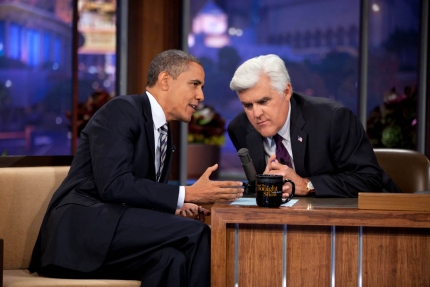
President Obama on the Tonight Show

President Barack Obama talks with Jay Leno

President Barack Obama talks with Jay Leno during an interview on “The Tonight Show with Jay Leno” at the NBC Studios in Burbank, Calif., Oct. 25, 2011 (Official White House Photo by Chuck Kennedy)

Yesterday, President Obama stopped by the Tonight Show to sit down for an interview with Jay Leno. The two talked about Libya, the withdrawal of troops from Iraq, and reality television -- including a show on C-SPAN called Congress.

Watch!


Related Topics: Additional Issues, California

The White House

Office of the Press Secretary

Statement by the President on the Observance of Diwali

Today, here in America and around the world, Hindus, Jains, Sikhs and some Buddhists will celebrate the holiday of Diwali – the festival of lights.  Many who observe this holiday do so by lighting the Diya, or lamp, which symbolizes the victory of light over darkness and knowledge over ignorance.  I was proud to be the first President to mark Diwali and light the Diya at the White House, and last year Michelle and I were honored to join in Diwali celebrations during our visit to India.

Diwali is a time for gathering with family and friends and—as we experienced in India—celebrating with good food and dancing.  It is also a time for contemplation and prayer that serves as a reminder of our obligations to our fellow human beings, especially the less fortunate.  To all who are observing this sacred holiday here and around the world, Happy Diwali and Saal Mubarak. 

The White House

Office of the Press Secretary

Remarks by the President at a Campaign Event

Pepsi Center
Denver, Colorado

7:36 P.M. MDT

THE PRESIDENT:  Hello, hello, hello!  (Applause.)  Thank you.  It's good to see you.  (Applause.)  You know, I don't know if I'm supposed to do this -- I'm going to move this out of here. This looks a little formal here.  (Laughter.)  You guys look safe to me.  (Laughter.) 

Everybody, please have a seat, have a seat. 

AUDIENCE MEMBER:  You, too.  (Laughter.) 

THE PRESIDENT:  No, I think I'm just fine right now.  I just want to, first of all, say thanks to all of you -- everybody who participated, everybody who helped to organize this extraordinary event.  It is great to be back in Denver.  I've got some fond memories here.  (Applause.)  If I'm not mistaken, I think it was a little darker that day.  (Laughter.)  But right after I gave my convention speech I think I came down here to say thank you to a whole bunch of folks, and some of you were there.  And it is a thrill to be here.

If I'm not mistaken, we've got a few luminaries that I want to make sure to acknowledge.  First of all, I just had a chance to meet your outstanding lieutenant governor, Joe Garcia.  So he is right here.  (Applause.)  John Hickenlooper rode over with me, had to leave.  But on the ride over from the airport, he was -- all he could talk about was how outstanding Garcia was and how cool he was.  (Laughter.)  So I'm making him blush, but that's because he's not a politician so he's not used to folks talking about him all the time.  But we're very proud of the great work that he's done.

Are our senators here?  They were here earlier.  Did they have to -- is Bennet here?  He just went upstairs.  Well, you kow I'm telling the truth because I'm going to say it behind their backs -- (laughter) -- Mark Udall and Michael Bennet are doing outstanding work on behalf of the people of Colorado.  (Applause.)  We could not be prouder of all the work that they are doing, and I want to make sure that I'm not -- oh, I think I'd better mention the mayor of the city of Denver -- Michael Hancock -- who is doing outstanding work as well.  (Applause.)

So in these kinds of formats what I want to do is not give a long speech, but rather just have a conversation.  So I'm just going to make a few remarks at the top. 

I just came from Las Vegas and then Los Angeles and San Francisco, but I want to talk about what was going on in Las Vegas.  We were in Las Vegas to announce a new approach to housing refinancing.  Some of you may have read about it.  That's ground zero in terms of what's happening in housing all across the country.  And about 50 percent of the homes in Nevada are underwater.  Foreclosure rates are sky high.  And there are entire subdivisions that are just being emptied out and foreclosed.  And we had a chance to make this announcement in front of the home of Jose and Lissette Bonilla. 

Jose came here 26 years ago as an undocumented worker, and Lissette he met here, also didn’t have legal status.  They were able to take advantage of the pathway to citizenship that was created the last time that we had an immigration reform measure out there.  He started out sweeping streets in a supermarket, and ended up working his way up to become a manager at this supermarket. 

They raised three beautiful kids for 17 years in a one-bedroom apartment.  And because of a program that we had initiated as part of the Recovery Act, where we took foreclosed homes that had been boarded up and gutted and put folks to work rehabbing them, they finally had their first home 26 years after he had arrived. 

And for most of his children -- their children’s childhood, they had slept in the living room, because they only had a one-bedroom apartment, and the kids all slept in the one bedroom.  And now, each of them have their own room.  And this is a small, modest place.  But it was clean and it was -- they had pictures of all the kids and their family along the mantle. 

And he said to me, you know, I’m not finished yet.  This is part of the American Dream, but I’m not going to be finished with the American Dream until I know that my kids have gotten through college, and they have a home of their own and they’re able to provide a better life for their children the same way that I’ve been able to provide a better life for mine.  And I can’t thank America enough for giving me these opportunities.

And so after this conversation we went out and we made the announcement about the refinancing.  And I’ve been thinking about that story ever since, because it captures the essence of who we are.  Most people here -- that progression maybe happened 50 years ago or 25 years ago or 100 years ago -- but all of us benefited from a combination of parents and grandparents who -- and great-grandparents -- who were willing to defy the odds and take great risks, and fight through discrimination and fight through difficulties and challenges, and also a society that said, you know what, if you’re willing to work hard and take responsibility, then you’ll get a fair shake.

And that, of course, required everybody in the society to do their fair share.  And somehow, then, the middle class grew, and people at the bottom had ladders into the middle class, but people at the top also did well because the folks at the bottom and the middle were doing well also.

And that idea of America is what has inspired the world.  And for about a decade, that’s what people felt had been slipping away -- even before this financial crisis, even before the recession -- that sense that the stack was increasingly -- the deck was increasingly stacked against them and that that same progression -- where each successive generation is doing better and the middle class is growing stronger, and if you do your part you can succeed -- people have begun to doubt that.  And, obviously, the financial crisis and the great recession that we’ve gone through has made it even worse. 

So for the last three years, what we’ve been trying to do is to rebuild that compact that we had with each other as Americans from the ground up.  And it’s hard -- because a lot of problems were neglected for years, and we got distracted, and we made some bad decisions. 

And when I ran in 2008, what I was committed to was making sure that those ideals and those values that helped me get to where I am, that they live out not just in communities all across America, but they’re also reflected in our politics in Washington.  And you guys, a lot of you got involved in the campaign because you had those same values and same ideals and same hope and same faith in the possibility that we could have a government that was responsive to the people.  And so, three years later we can look back and say, there are a whole bunch of changes that we’ve made that haven’t all paid off yet, but are laying the groundwork for a better America. 

We passed health care reform, and that means 30 million people are going to have health insurance that didn’t have it before.  (Applause.)  And we’ve got a million young people who already have health insurance.  And we’re going to start making our health care system smarter and more responsive and higher quality at lower cost.  (Applause.)

We passed Wall Street reform to make sure that we don’t go through the same kinds of nonsense that we went through three years ago; and that consumers are protected from unscrupulous dealings and mortgage brokers who are peddling wares that aren’t going to be any good; and credit card companies who were charging hidden fees; and having a consumer watchdog who is going to be looking after ordinary folks in their financial transactions. 

We ended “don’t ask, don’t tell,” because we’re a country that makes sure that anybody who loves this country are going to be able to serve this country.  (Applause.)  And we ended the war in Iraq as we promised, because it was time for us to bring our troops home and focus on rebuilding America.  (Applause.)

And on student loans and school reform and on a whole host of issues that don’t get a lot of attention -- on doubling fuel efficiency standards on cars and trucks to not only free ourselves from dependence on foreign oil, but also to start reducing carbon in the atmosphere and making us more competitive, to saving the auto industry -- I keep a checklist in my desk of stuff that I promised to do and we're through about 60 percent of it -- (laughter) -- which isn’t bad for three years.  (Applause.) 

So we know change is possible.  It’s hard and it’s messy, and sometimes it’s frustrating, but we know it’s possible.  But here’s the thing.  There are a lot of people who are still hurting and there's still a lot more work to do.  And so that other 40 percent that is not done, I’m going to need you because I need five more years.  I need five more years to get it done.  (Applause.)

And, frankly, this next year the American people are going to have a choice about alternative visions for where they want to take the country.  And we’re seeing that reflected in the debate we’re having about the jobs bill right now.  We’ve put forward a jobs bill that reflects ideas that traditionally have gotten support from Democrats and Republicans -- rebuilding our infrastructure -- our roads and our bridges, and airports and schools; putting construction workers back to work all across the country, to make sure that we’re moving products and services and people faster and more efficiently -- a huge boost to the economy -- traditionally, hasn’t been a Democratic issue, it’s been a bipartisan issue.  But they’ve said no.
 
We’ve said let’s give tax cuts to small businesses.  You guys are the party of tax cuts -- let’s give tax cuts to small businesses and ordinary folks, not just those at the very top.  So far, they’ve said no.    

We said let’s get teachers back in the classroom.  We know that in the 21st century nothing is going to be more important than our ability to educate our kids and give them the skills they need to compete.  They’ve said no.

And so we’re going to keep on putting pressure on them, but in the meantime we’re saying we can't wait for Congress, and we’re going to go ahead and do everything we can through executive actions -- whether it’s this refinancing program, or tomorrow I’m going to be talking about making college more affordable for young people -- we’re not going to wait for Congress.  But we are going to have to mobilize the American people and have them make a choice about the direction of the country that they want to see us go in.

And I’m confident they're going to make the right choice.  I believe that -- I am confident that they -- (applause) -- I’m confident they want to see a big and bold and generous America, not a cramped vision that says that the only way that we can compete is by gutting regulations, and breaking our commitments to the poor and the vulnerable and our seniors, and that all we do is just cut taxes for folks who don't need tax cuts and weren’t even asking for them, and that somehow is going to be the path to prosperity. 

I don't believe America is going to compete in the 21st century just by having the cheapest labor and the dirtiest air and the dirtiest water, and the worst infrastructure, and that somehow that's going to allow us to succeed.  And I don't think the American people are going to buy it either.

But because things are tough, because folks are struggling, because the unemployment rate is still way too high, a lot of folks out there have lost confidence in Washington’s ability to act.  And so we’re going to have an uphill battle.  This is going to be a different campaign than it was in 2008 -- because I didn't have gray hair then.  (Laughter.)  I was new and fresh.  (Laughter.)  And everybody had "Hope" posters.  (Laughter.)  You know. 

AUDIENCE MEMBER:  We still do.  (Laughter and applause.)

THE PRESIDENT:  So I guess my main message -- and then I’m going to stop -- is I’m going to need you to muster up just as much enthusiasm, just as much fire, just as much tenacity as you did in 2008. 

This campaign has never been just about me.  This presidency has never been about me.  It’s been about you, and your capacity to bring about change in America.  And I believe in you.  That's why I’m running.  That's why I’m still here.  I have confidence in you, and I hope you have confidence in each other. 

Thank you very much, everybody.  (Applause.) 

END
7:51 P.M. MDT

The White House

Office of the Press Secretary

President Obama Announces Presidential Delegation to the Kingdom of Saudi Arabia to Offer Condolences for the Passing of Crown Prince Sultan bin Abd al-Aziz Al Saud

President Barack Obama today announced the designation of a Presidential Delegation to the Kingdom of Saudi Arabia to offer condolences to the Custodian of the Two Holy Mosques, King Abdullah bin Abd al-Aziz Al Saud, on the passing of the Crown Prince and Deputy Premier and Minister of Defense and Aviation and Inspector General, HRH Prince Sultan bin Abd al-Aziz Al Saud.

The Honorable Joseph R. Biden Jr., Vice President of the United States, will lead the delegation on October 27, 2011.

Members of the Presidential Delegation:

The Honorable James B. Smith, United States Ambassador to the Kingdom of Saudi Arabia

The Honorable John S. McCain, Ranking Member of the Senate Armed Services Committee

The Honorable William Cohen, Former Secretary of Defense

The Honorable Ray Mabus, Secretary of the Navy

The Honorable David H. Petraeus, Director of the Central Intelligence Agency

General James N. Mattis, Commander of the United States Central Command

Keeping First Responders on the Job

Tyrone Booth and Jesse Carpenter are police officers in Flint, Michigan -- where Vice President Biden visited earlier this month. Because of budget cuts, they've seen their department shrink since the start of the recession. In fact, at various times in recent years, each has been laid off from the force. Both are keenly aware of the ways in which these reductions have put public safety at risk.

Officer Booth says the Flint police must now prioritize the calls to which they respond. A shooting or an assault must come before a break-in or a burglary, which can be hard for citizens affected. "When someone's home has been burglarized, it's a very sensitive and serious offense to them,” he said. “And we're just unable to get there in a timely manner."

Watch:

Download Video: mp4 (39.6MB)
 
Download Video: mp4 (44.2MB)

Keeping Americans safe is a top priority for President Obama, which is why the American Jobs Act will provide $5 billion to help states and local communities keep first responders on the job. Earlier, Secretary of Homeland Security Janet Napolitano and Attorney General Eric Holder spoke at a gathering of the International Association of Chiefs of Police and discussed the Administration's support for the nation's fire fighters and police officers.

Read more here.


Related Topics: Economy, Michigan

The White House

Office of the Press Secretary

White House Announces Secretary Ken Salazar as Administration's Senior Official Responsible for Oversight of Implementation of Extractive Industries Transparency Initiative

President Obama is pleased to announce that the Secretary of the Interior Ken Salazar will be the senior individual responsible for oversight of U.S. implementation of the Extractive Industries Transparency Initiative (EITI).  As part of the United States Open Government National Action Plan released in September, the President announced that the United States, a long-time champion of EITI, would itself implement EITI in order to ensure that taxpayers receive every dollar due for extraction of our natural resources. Secretary Salazar and his staff will work with industry and civil society to develop a sensible plan to disclose relevant information about revenues from oil, gas, and mining assets, and to enhance the accountability and transparency of our revenue collection efforts.  Under Secretary Salazar’s leadership, the Department of Interior has a strong record of partnering with industry and citizens to make important strides in reforming the management of our natural resources, and EITI is just the latest in a long series of steps designed to make the U.S. government more open and more accountable to the American people.

The White House

Office of the Press Secretary

Presidential Proclamation -- African Growth and Opportunity Act

BY THE PRESIDENT OF THE UNITED STATES OF AMERICA

A PROCLAMATION

  1. Section 506A(a) (1) of the Trade Act of 1974, as amended (the "1974 Act") (19 U.S.C. 2466a(a)(1)), as added by section 111(a) of the African Growth and Opportunity Act (title I of Public Law 106-200) (AGOA), authorizes the President to designate a country listed in section 107 of the AGOA (19 U.S.C. 3706) as a "beneficiary sub-Saharan African country" if the President determines that the country meets the eligibility requirements set forth in section 104 of the AGOA (19 U.S.C. 3703), as well as the eligibility criteria set forth in section 502 of the 1974 Act (19 U.S.C. 2462).
  2. Section 104 of the AGOA authorizes the President to designate a country listed in section 107 of the AGOA as an "eligible sub-Saharan African country" if the President determines that the country meets certain eligibility requirements.
  3. Section 112(c) of the AGOA, as added in section 6002 of the Africa Investment Incentive Act of 2006 (Division D, title VI of Public Law 109-432) (19 U.S.C. 3721(c)), provides special rules for certain apparel articles imported from "lesser developed beneficiary sub-Saharan African countries."
  4. Pursuant to section 104 of the AGOA and section 506A(a)(1) of the 1974 Act, I have determined that the Republic of Côte d'Ivoire (Côte d'Ivoire), the Republic of Guinea (Guinea), and the Republic of Niger (Niger) meet the eligibility requirements set forth or referenced therein, and I have decided to designate Côte d'Ivoire, Guinea, and Niger as eligible sub Saharan African countries and as beneficiary sub Saharan African countries.
  5. Côte d'Ivoire, Guinea, and Niger each satisfy the criterion for treatment as a "lesser developed beneficiary sub Saharan African country" under section 112(c) of the AGOA.
  6. Section 604 of the 1974 Act (19 U.S.C. 2483), as amended, authorizes the President to embody in the Harmonized Tariff Schedule of the United States (HTS) the substance of relevant provisions of that Act, or other acts affecting import treatment, and actions taken thereunder.

NOW, THEREFORE, I, BARACK OBAMA, President of the United States of America, by virtue of the authority vested in me by the Constitution and the laws of the United States of America, including but not limited to section 104 of the AGOA

(19 U.S.C. 3703), and title V and section 604 of the 1974 Act (19 U.S.C. 2461-67, 2483), do hereby proclaim that:

(1) Côte d'Ivoire, Guinea, and Niger are designated as eligible sub-Saharan African countries and as beneficiary sub Saharan African countries.

(2) In order to reflect this designation in the HTS, general note 16(a) to the HTS is modified by inserting in alphabetical sequence in the list of beneficiary sub-Saharan African countries "Republic of Côte d'Ivoire", "Republic of Guinea", and "Republic of Niger".

(3) For purposes of section 112(c) of the AGOA, Côte d'Ivoire, Guinea, and Niger are lesser developed beneficiary sub Saharan African countries.

IN WITNESS WHEREOF, I have hereunto set my hand this twenty-fifth day of October, in the year of our Lord two thousand eleven, and of the Independence of the United States of America the two hundred and thirty-sixth.

BARACK OBAMA

The White House

Office of the Press Secretary

Message -- Continuation of the National Emergency with Respect to the Situation in or in Relation to the Democratic Republic of the Congo

TO THE CONGRESS OF THE UNITED STATES:

Section 202(d) of the National Emergencies Act (50 U.S.C. 1622(d)) provides for the automatic termination of a national emergency unless, prior to the anniversary date of its declaration, the President publishes in the Federal Register and transmits to the Congress a notice stating that the emergency is to continue in effect beyond the anniversary date. In accordance with this provision, I have sent to the Federal Register for publication the enclosed notice stating that the national emergency with respect to the situation in or in relation to the Democratic Republic of the Congo and the related measures blocking the property of certain persons contributing to the conflict in that country are to continue in effect beyond October 27, 2011.

The situation in or in relation to the Democratic Republic of the Congo, which has been marked by widespread violence and atrocities that continue to threaten regional stability, continues to pose an unusual and extraordinary threat to the foreign policy of the United States. For this reason, I have determined that it is necessary to continue the national emergency to deal with that threat and the related measures blocking the property of certain persons contributing to the conflict in that country.

BARACK OBAMA

THE WHITE HOUSE,
         October 25, 2011.

The White House

Office of the Press Secretary

Notice -- Continuation of the National Emergency with Respect to the Situation in or in Relation to the Democratic Republic of the Congo

On October 27, 2006, by Executive Order 13413, the President declared a national emergency with respect to the situation in or in relation to the Democratic Republic of the Congo and, pursuant to the International Emergency Economic Powers Act (50 U.S.C. 1701-1706), ordered related measures blocking the property of certain persons contributing to the conflict in that country. The President took this action to deal with the unusual and extraordinary threat to the foreign policy of the United States constituted by the situation in or in relation to the Democratic Republic of the Congo, which has been marked by widespread violence and atrocities that continue to threaten regional stability.

Because this situation continues to pose an unusual and extraordinary threat to the foreign policy of the United States, the national emergency declared on October 27, 2006, and the measures adopted on that date to deal with that emergency, must continue in effect beyond October 27, 2011. Therefore, in accordance with section 202(d) of the National Emergencies Act (50 U.S.C. 1622(d)), I am continuing for 1 year the national emergency declared in Executive Order 13413.

This notice shall be published in the Federal Register and transmitted to the Congress.

BARACK OBAMA

THE WHITE HOUSE,
         October 25, 2011.

The White House

Office of the Press Secretary

Remarks by the President at a Campaign Event

Private Residence
Los Angeles, California

8:27 P.M. PDT

THE PRESIDENT: Hello, everybody! Well, it is good to be here tonight. Everybody please have a seat. Make yourselves comfortable.

Although some of them have already been acknowledged, I just want to say, first of all, thank you to Eva. She is just a powerhouse. I don’t know how much -- (applause) -- I couldn’t say no if she had called me. (Laughter.) So -- and between her and Giselle and all the folks who helped to make this Futuro Fund possible, I am grateful.

To Melanie and Antonio -- could not be more gracious hosts, and their beautiful family. Thank you so much. (Applause.) We are grateful to you.

We have some great guests. Somebody who -- daughter of a Teamster, fighting for working people every single day, and one of my favorite people, just a great member of my Cabinet, Hilda Solis. We are so proud of her. (Applause.)

There are two of my majors -- two -- there are two of my favorite mayors as well: Mayor Villaraigosa and Mayor Castro. They work hard every single day on behalf of their constituents. So we’re proud of them. (Applause.)

One of the finest senators we have in the country, Bob Mendendez of New Jersey is here in the house. (Applause.) And a personal hero of mine, Dolores Huerta is here. (Applause.) Where’s Dolores at? Where is she? There she is back there. We love her.

Before I came to Los Angeles today, I was in Las Vegas. And I think as many of you know, Las Vegas has been hit as hard as any part of the country as a consequence of a housing bubble that burst. Unemployment is higher than it is any place in the country. There are more homes that are underwater than just about any place in the country.

And we went to announce a new program that we have for refinancing of mortgages, because so many people are having difficulty refinancing, taking advantage of these low rates. Their mortgages are now higher than what the homes are being valued for, and as a consequence the banks won’t refinance. And so we took some executive action to try to get this fixed.

But what was interesting was the setting. We went into this subdivision and we visited the home of the Bonillas -- Jose and Lissette. And their story is a classic American story. Jose had come here 26 years ago as an undocumented worker. And he got a job sweeping floors in a supermarket.

He met Lissette, who was also undocumented, and was a housekeeper. And when the amnesty program came, they were able to get legal status here in this country. They had three beautiful children, and for 17 years they lived in a one-bedroom apartment -- all three, the three kids in bunk beds in one room and Jose and Lissette slept in the living room. And that’s how they raised their family. But they worked incredibly hard, they saved. Eventually each of them got U.S. citizenship. And Jose rose up through the ranks until he was finally a manager at this supermarket. But they still didn’t have enough money for a home. And then a program that we had set up, that we’re now trying to replicate all across the country, took homes that were vacant, that had been foreclosed on, and converted them. And so they finally got their first home.

And they invited in the President of the United States, after apologizing to their neighbors for blocking the streets -- (laughter) -- to their home, and we sat around the dining room table and talked about their life and their experience and what was happening to their friends and neighbors and those who had lost their homes and those whose families had been separated. And at one point in the conversation, Jose says, “Understand our dream is not complete. Our dream will not be complete until my children have all gone to college, and they have a home of their own, and everybody here in this country understands that they are full-fledged Americans.” (Applause.)

Now, what struck me in this conversation was not how unique their story is but how typical their story is of what built this country -- that spirit of being willing to take enormous risks, of coming to a new land, of charting a new course, of starting at the bottom and working your way up, of putting your blood, sweat and tears into this distant vision for the future. That’s what built this country. That’s the essence of America; that’s its foundation. And when I ran for President I ran not because of the title, not because of a pursuit of power, but because I so deeply believed in those ideals and those values -- (applause) -- that helped to propel this country forward and made it a beacon for all the world.

That’s what America is. That’s why all around the world even today people still think about this country differently than they think about other countries, no matter how critical they may be sometimes, no matter how frustrated they may be. The American ideal, the American creed is one that animates the entire world. And I ran for President because I want to make sure that this country remains that beacon and remains that ideal. (Applause.) And that the hopes of the Joses and the Lissettes, people all across the country, regardless of their station, regardless of what they look like, regardless of where they come from, that they’re going to be able to have that piece of the American Dream.

Now, part of the reason that I ran was because too many people felt that dream slipping away. For a decade, we saw that dream neglected. And so even though some of us were extraordinarily fortunate, those of us at the very top were doing very well, the average family saw their wages flatline, their incomes flatline -- even as the cost of everything from a college education to their health care to their groceries to their gas was going up. More and more people felt like they were working harder just to stay in the same place, or not to fall behind.

We had a health care system that was broken. We have an energy policy that leaves us subject to the whims of the world oil market. We had a Washington that seemed less and less responsive to those values and ideals that we believe in so deeply. And this was all before the worst economic crisis and the worst financial crisis since the Great Depression.

And so we came in knowing that those problems hadn’t been created overnight; they weren’t going to be solved overnight. But what we were determined to do was to start realigning Washington to our best selves, not our worst; to start pushing to make sure that folks’ voices were heard and that we went back to a system in which everybody has a fair shake, everybody gets a shot, that if they’re willing to try they can make it in this country; and where we ask a fair share from everybody. And that’s what we’ve been working on over the last three years. And it hasn’t always been easy; the other side has been fighting us every step of the way.

But despite that, we brought about change. Despite that, we got health care passed, and 30 million Americans are going to have health care in this country. (Applause.) And a million young people already have health care now that didn’t have it before. Despite the resistance we were able to not only prevent this country from going into a Great Depression, and stabilized the financial system, but were also able to pass financial reform so that we never have the same kinds of irresponsibility on Wall Street again. (Applause.) And we have consumers protected, and people, including in places right here in this city, are protected from unscrupulous mortgage brokers and from credit card companies that are charging hidden fees and taking advantage of families. (Applause.)

Despite the resistance, we were able to make sure that anybody can serve this country that they love -- (applause) -- put an end to “don’t ask, don’t tell.” Despite their resistance, we were able to bring about an end to a war and start bringing our troops home. (Applause.) Despite that resistance, we were able to stop sending $60 billion to banks for the student loan program and start sending that $60 billion to students and expand the Pell Grant programs -- (applause) -- and expand access to college.

And all this has made a incredible difference to people all across the country. And that’s before you even get into the amazing work that the Cabinet has done -- of people like Hilda Solis making sure that workers are treated fairly and not exploited by their employers -- (applause) -- and working in concert with people like Bob Menendez, making progress across a whole range of issues.

So we’ve seen change. We know what it looks like. We know what it takes. But we’ve got so much more work to do. And I keep a checklist in my desk, and I kind of see, all right, I made a bunch of these promises during the campaign -- (laughter) -- and let me see, yes, I got that done -- (laughter) -- and that one, yes. No, that one’s not done yet. (Laughter.)

So we’ve got about 60 percent done in three years but -- (applause) -- so I’m pretty confident we can get the other 40 percent done in the next five years. (Applause.) But to do that, I’m going to need your help. To do that I am going to need your help, because this campaign, this presidency was never about me; it was about you. It was about the commitments you made to each other. It was about giving voice to the aspirations and the hopes and the dreams of your friends and your neighbors and your family. It’s about folks in this room, all of whom have been incredibly successful, remembering that we’re successful because somebody allowed us to be successful, because our parents worked hard.

Just meeting Eva’s parents, from San Antonio, and I thought how proud they must be, but also the sacrifices they made. Remembering that the history of this country is, is that we have always have had to make investments in the future -- in our kids, in our grandkids. And those are commitments that you made to each other when you signed on to this campaign those three or four years ago.

So we’ve got more work to do, because the economy is still hurting right now. I’ve been spending the last month trying to get Congress to do something about jobs in this country. We’ve put together a jobs proposal that contains the best Democratic and Republican ideas. Historically, these are things that both sides support: putting construction workers back to work rebuilding our roads and our bridges and our hospitals so we’ve got the best infrastructure in the world. (Applause.) Rebuilding our schools -- we’ve got kids in trailers all across the country. They’ve got science labs that were built in the 1960s. What are we doing? We’re in the 21st century. Put those folks back to work. Put teachers back in the classroom. (Applause.) We can’t be laying off teachers. We’ve got to be hiring teachers right now so our kids are doing better than any other kids around the world in terms of math and science and technology.

Giving tax breaks to small businesses so they can excel and hire more people. Giving them tax breaks for hiring our veterans. (Applause.) We ask these incredible men and women in uniform to put the pause button on their careers, to leave their families, to put themselves at risk. They shouldn’t have to fight for a job when they come home. We should be doing everything we can to put them back to work, right now. And yet 100 percent of Republican senators so far have said no. Maybe it’s just because I proposed it. (Laughter.) Because the American people support it. It’s paid for. Economists say it would create almost 2 million jobs.

So that’s what we’re up against. We’re going to have to fight for jobs. We’re going to have to fight to have the kind of energy policy that makes sure that we’re freeing ourselves from dependence on foreign oil. We are going to have to fight to make sure that we’re continuing to improve our schools all across the country. And yes, we are going to have to fight to make sure that immigration reform is a reality in this country. (Applause.)

I want to make a special point about this, because Giselle, she -- (laughter) -- she’s opinionated, so she comes up to me and -- before we come out, and she’s like, “Barack, we got to” -- I won’t tell exactly what she said, because there’s still press here, and it would have to be edited out. (Laughter.) She said, “That’s true.” She said, “Yes, that’s true.” (Laughter.)

But I want to be clear: I believe this is a nation of laws, and this is a nation of immigrants. And those two things don’t contradict each other. We have a system that is broken, and we are doing everything we can administratively to try to lessen the pain and the hardship that it’s causing. Yes, to make sure our borders are secure, but also to say that families like the Bonillas, who are here, they are building this country, they are making it better, they are making it stronger, and we’ve got to give them opportunities. (Applause.)

And it makes no sense -- it makes no sense for us, at a time when we’re competing with talent all around the world, to have kids here who are excelling in school, who want to go to universities, who want to get an engineering degree or get a business degree and start some enterprise that could end up growing into the next Apple and the next Google, and we want to send them away? These American kids? These kids who grew up alongside our children? It makes no sense.

But again, I’m going to need your help. Because we’re not going to be able to get this done by ourselves. We’re going to have to mobilize and we’re going to have to organize, and we’ve got to tap into those best instincts of the American people in order to make it happen. But we’re going to get it done. (Applause.) We are going to get it done. Have no doubt -- (applause) -- that we’re going to get it done.

But here’s my final point: In order to get it done, we’ve got to have the same determination, the same focus, the same hard-headedness, the same passion that that family I saw in Las Vegas today has; the same determination that our parents and our grandparents or great-grandparents had. We’ve been through tougher times before in this country. We’ve been through slavery and Jim Crow and a Civil War and two World Wars and a Great Depression. And there have been times where most of the folks in this room wouldn’t have had opportunity of the sort we have today. We’ve been through tougher times.

But somewhere along the way, somebody said it doesn’t have to be like that. We can imagine something better. We are determined to create a better future. That’s what the Futuro Fund is all about. And that’s what this campaign has always been about. This campaign has never been about glitz and glory, or just the blind pursuit of power. That’s not why we got involved. That’s not why you guys signed up back in 2007, 2008. You supported a candidate named Barack Hussein Obama; the odds were not in your favor. (Applause.) The odds were not in your favor.

You knew it wasn’t going to be easy. (Laughter.) If you thought it was going to be easy you would have signed up for somebody else. You knew it wasn’t going to be easy, but you also knew that if we pulled it off, it would be worth it. And so I was joking with some folks -- well, not joking, really -- I’m a lot grayer now than I was then. (Laughter.) And these president years are dog years. (Laughter and applause.) And so there’s not the same excitement, it’s not quite as cool as it was. Nobody -- folks, I don’t know if you guys still have those “Hope” posters; they’re all kind of –- (applause) –- all kind of dog-eared.

But here’s the message I want to deliver to you today -- is, don’t get weary. (Laughter.) Don’t get tired. Because I’m not tired. I may be gray, but I’m not tired. (Applause.) My passion is still there. My commitment is still there. (Applause.) My vision for this country is still there. (Applause.) And if you’re still there, then we’re going to win this election, and we are going to create the kind of America that our children and our grandchildren deserve.

God bless you. God bless the United States of America. (Applause.)

END
8:51 P.M. PDT