The White House

Office of the Press Secretary

President Obama to Travel to North Carolina and Virginia on Second Day of American Jobs Act Bus Tour

WASHINGTON – On Tuesday, October 18th, President Obama will travel to North Carolina and Virginia on the second day of his American Jobs Act bus tour where he will discuss jobs and the economy. On the second day of the tour, the President will make stops in Jamestown, North Carolina, Emporia, Virginia, and overnight in Hampton, Virginia. Additional details about President Obama’s trip will be released as they become available.

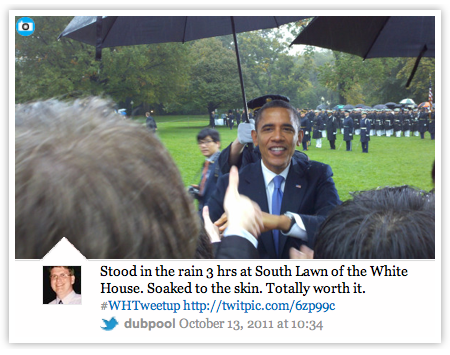
White House Tweetup: South Korea Arrival Ceremony or "Totally worth it."

Today, we hosted the largest White House Tweetup to date -- a chance for hundreds of our facebook fans and twitter followers to attend the Republic of Korea Arrival Ceremony on the South Lawn of the White House and tweet all about it. The event was nearly moved to a smaller space inside the White House due to heavy rain. Thankfully, the rain lightened up just in time to hold the ceremony outside as planned and accommodate "tweeps" from across the country.

Read about their experience and follow the story of the White House Tweetup below or on Storify.

The White House

Office of the Press Secretary

President Obama Announces More Key Administration Posts

WASHINGTON – Today, President Barack Obama announced his intent to nominate the following individuals to key Administration posts:

  • Grande Lum – Director, Community Relations Service, Department of Justice
  • Kamilah Oni Martin-Proctor– Member, National Council on Disability
  • Sharon “Shari” Villarosa– Ambassador to the Republic of Mauritius and the Republic of Seychelles, Department of State

President Obama said, “It gives me great confidence that such dedicated and capable individuals have agreed to join this Administration to serve the American people.  I look forward to working with them in the months and years to come.”

President Obama announced his intent to nominate the following individuals to key Administration posts:

Grande Lum, Nominee for Director, Community Relations Service, Department of Justice

Grande Lum is currently Director of the Historically Underutilized Business Zones (HUBZone) Program at the U.S. Small Business Administration, a position he has held since 2010.  Prior to joining the Small Business Administration, Mr. Lum was a clinical professor at the University of California Hastings College of the Law and Director of its Center for Negotiation and Dispute Resolution from 2008 to 2010.  Additionally, Mr. Lum was the Managing Director of Accordence Inc., a dispute resolution training firm he founded in 2005.  Prior to founding Accordence, Mr. Lum served as a principal of ThoughtBridge, a mediation firm, and a partner with the consulting firm Conflict Management Inc. He was also an adjunct professor at U.C. Berkeley School of Law and a co-manager of the Alternative Dispute Resolution externship program at Stanford Law School.  Mr. Lum currently serves on the Board of Overseers of the Baldrige Performance Excellence Program, an initiative of the U.S. Department of Commerce.  He previously served on the board of directors of the Peninsula Conflict Resolution Center and the Center for Asian American Media.  In addition, Mr. Lum was a member of the California State Bar Association Committee on Alternative Dispute Resolution.  Mr. Lum received his B.A. from the University of California at Berkeley and his J.D. from Harvard Law School.

Kamilah Oni Martin-Proctor, Nominee for Member, National Council on Disability

Kamilah Oni Martin-Proctor is the founder and Executive Director of the Martin Multiple Sclerosis Alliance Foundation (MMSAF).  Ms. Martin-Proctor was diagnosed with Multiple Sclerosis when she was sixteen.  She founded the MMSAF in 2004  in an effort to promote symptom awareness and education about Multiple Sclerosis in historically under represented and underserved populations. Prior to this, she was a Program Administrator for the Charles B. Rangel International Affairs Program at Howard University since 2003.  Ms. Martin-Proctor worked for the District of Columbia’s Government Neighborhood Services Initiative from 2000 until 2002.  She has worked as a Staff Assistant and Legislative Correspondent for Congresswoman Shelia Jackson Lee and also as an Executive Assistant in Senator Robert Menendez’s office.   Ms. Martin-Proctor received a B.A. in Political Science and an M.A. in Organizational and Cultural Communication from Howard University.

Sharon “Shari” Villarosa, Nominee for Ambassador to the Republic of Mauritius and the Republic of Seychelles, Department of State

Sharon “Shari” Villarosa, a career member of the Senior Foreign Service, currently serves as Deputy Coordinator for Regional Affairs in the Office of the Coordinator for Counterterrorism at the Department of State.   From 2005 to 2008, she served as the Chief of Mission at the U.S. Embassy in Rangoon.  Previously, Ms. Villarosa served as Director of Philippines, Malaysia, Brunei, and Singapore Affairs in the Department of State’s East Asia and Pacific Bureau; Economic Counselor at the U.S. Embassy in Jakarta; and Chargé d’Affaires of the U.S. Embassy in Dili.   Other overseas assignments have included: Songkhla, Thailand; Brasilia, Brazil; Quito, Ecuador; and Bogota, Colombia.  Ms. Villarosa holds a B.A. from the University of North Carolina at Chapel Hill and a J.D. from William and Mary School of Law.

President Obama and President Lee Press Availability

October 13, 2011 | 37:40 | Public Domain

President Obama and President Lee of South Korea hold a joint press availability in the East Room of the White House.

Download mp4 (360MB) | mp3 (35MB)

Read the Transcript

Remarks by President Obama and President Lee of the Republic of Korea in a Joint Press Conference

East Room

12:22 P.M. EDT

PRESIDENT OBAMA:  Please, everybody have a seat.  Good afternoon.  Once again, it is a great honor to welcome my good friend and partner, President Lee, back to the White House.  We had a wonderful dinner last night at one of our outstanding local Korean restaurants.  Michelle and I are looking forward to hosting the President and First Lady Kim at tonight’s state dinner.  And today President Lee will address Congress -- a high honor reserved for America’s closest friends.

This state visit reflects the fact that the Republic of Korea is one of our strongest allies.  Because we’ve stood together, the people of South Korea, from the ruins of war, were able to build an economic miracle and become one of our largest trading partners, creating jobs and opportunity for both our peoples.  Because we stood together, South Koreans were able to build a strong and thriving democracy and become a steady partner in preserving security and freedom not only on the Korean peninsula, but beyond. 

As I said this morning, this visit also recognizes South Korea’s emergence as one of our key global partners.  South Koreans have served bravely with us in Afghanistan and Iraq.  South Korean forces have partnered with us to prevent piracy off the shores of Africa and stem the spread of weapons of mass destruction.  Once a recipient of aid, South Korea has become a donor nation, supporting development from Asia to Africa.  And under President’s personal leadership, Seoul served as host to the G20 summit last year and will host the next Nuclear Security Summit next year.

South Korea’s success is a tribute to the sacrifices and tenacity of the Korean people.  It’s also a tribute to the vision and commitment of President Lee. 

Mr. President, you have shown how the international community should work in the 21st century -- more nations bearing the responsibility of meeting global challenges.  In the face of unprovoked attacks on your citizens, you and the South Korean people have shown extraordinary strength, restraint and resolve.

And I'd add that in all of our dealings, President Lee has shared my focus on what matters most -- the security and prosperity of our citizens.  And that, again, has been our focus today.

We agreed to move ahead quickly with the landmark trade agreement that Congress passed last night -- and which I’ll sign in the coming days.  It’s a win for both our countries.  For our farmers and ranchers here in the United States, it will increase exports of agricultural products.  From aerospace to electronics, it will increase American manufacturing exports, including those produced by our small businesses.  It will open Korea’s lucrative services market, and I’m very pleased that it will help level the playing field for American automakers. 

As a former executive, President Lee will understand when I say that just as Americans buy Hyundais and Kias, I hope that South Koreans will buy more Fords, Chryslers and Chevys.  And tomorrow, President Lee and I will be visiting with autoworkers in Michigan -- some of the many Americans who are going to benefit from this agreement.

In short, this agreement will boost American exports by up to $11 billion and support some 70,000 American jobs.  It has groundbreaking protections for labor rights, the environment and intellectual property -- so that trade is free and fair.  It will promote green jobs and clean energy, another area where we’re deepening our cooperation.  And it keeps us on track to achieve my goals of doubling American exports. 

So, President Lee, I thank you for your partnership in getting this deal done, a deal that will also be good for Korean businesses and Korean jobs.  I look forward to working with you to bring it into force as quickly as possible.  

As we expand our economic cooperation, we’re also deepening our security cooperation.  Guided by our joint vision for the alliance, we agreed to continue strengthening our capabilities to deter any threat.  I can never say it enough:  The commitment of the United States to the defense and security of the Republic of Korea will never waver.  And as we have for decades, the United States will maintain our strong presence in the Asia Pacific, which is a foundation for security and prosperity in Asia in the 21st century. 

In this regard, we discussed North Korea, which continues to pose a direct threat to the security of both our nations.  On this, President Lee [and I] are entirely united.  Together, we've succeeded in changing the equation with the North, by showing that its provocations will be met -- not with rewards but with even stronger sanctions and isolation.  So the choice is clear for North Korea.  If Pyongyang continues to ignore its international obligations, it will invite even more pressure and isolation.  If the North abandons its quest for nuclear weapons and moves toward denuclearization, it will enjoy greater security and opportunity for its people.  That's the choice that North Korea faces. 

Given the global nature of alliances, President Lee and I discussed the full range of challenges to our security and prosperity.  I thanked the President for South Korea’s continued support for reconstruction in Afghanistan and I updated him on the transition that is underway towards full Afghan responsibility for security.  We agreed to continue our support for democratic transitions in the Middle East and North Africa, including Libya. 

We’ve agreed to coordinate more closely on the development that lifts -- that can lift people and nations out of poverty.  I appreciated hearing the President’s plans for next year’s Nuclear Security Summit, which I look forward to attending.  And as we approach the G20 and APEC summits next month, we agreed on the need for coordinated global action that focuses on growth and creates jobs for our workers.

Finally, we’re strengthening the ties between our people.  South Korea is one of the top sources of international students studying in the United States.  And the number of American students who are studying in Korea has been soaring.  So we’ve directed our teams to sustain this momentum and expand educational exchanges between our people -- not unlike the one that once brought a visiting scholar named Lee Myung-bak to an American university just blocks from here.

So, again, Mr. President, I thank you for your partnership and your friendship.  And because of the progress we’ve made today, I’m confident that your visit will mark a turning point in the enduring alliance between our two nations. 

Thank you very much.

PRESIDENT LEE:  (As interpreted.)  Thank you, Mr. President.  First of all, I thank President Obama again for inviting me to make a state visit to the United States.  My thanks goes out to the Madam First Lady as well.  I am pleased to have had the chance to reaffirm once again the strong partnership and friendship between our two countries.

I met with President Obama six times over the last three years.  Our meetings were always constructive, allowing us to reaffirm the strength of our alliance, an alliance that is firmly based upon shared values and mutual trust.  This alliance guarantees peace, stability and prosperity on the Korean Peninsula, the Asia Pacific region and beyond.  We will continue to strengthen what is already a powerful and far-reaching alliance.

I was privileged to have spent many hours with President Obama during my visit to Washington, D.C. this time, discussing and sharing views on a wide array of issues, such as security on the Korean Peninsula and the Northeast Asia region; trade and economic cooperation between our two countries; situation in the Middle East, including what is unfolding in Libya; various international security issues; and, of course, the global economy and the challenges that we face today.

In particular, we welcome the ratification of the Korea-U.S. Free Trade Agreement by the United States Congress.  I am confident that the Korea National Assembly will soon ratify this very important agreement in the near future.

I take this opportunity to sincerely thank President Obama, the congressional leadership and the members of Congress, for their support and commitment.  The Korea-U.S. Free Trade Agreement is a historic achievement that will become a significant milestone in our 130-year relationship.  It is a win-win agreement that will benefit both of our countries in countless ways.  This agreement will create more jobs, generate more trade, and stimulate our economies.

This free trade agreement will bring numerous benefits to our workers, our companies, our small businesses and our consumers alike.  Furthermore, mutual investments will increase and our economic partnership will become stronger.  And the KORUS FTA will bring benefits beyond Korea and the United States.  It will be a gateway to enhancing ties between North America and Asia.  It will allow us to get ahead and stay ahead in the global markets.

As we all know, the global economy is undergoing many challenges.  The Korea-U.S. Free Trade Agreement will demonstrate to the world that we can create good-quality jobs and stimulate growth through open and fair trade.  This is a good example.  The passage of the KORUS FTA has opened up a new chapter in our partnership, in our alliance.

For the last 60 years we have maintained a strong political, military alliance.  Now the KORUS FTA signals the beginning of an economic alliance.  This alliance will strengthen and elevate our military and political alliance to a whole new level.  Our alliance is evolving into a future-oriented partnership and it will become stronger. 

When President Obama and I adopted a joint vision for the future of the alliance in 2009, we agreed to expand the depth and scope of our strategic alliance.  Today, we reaffirmed our common commitment to a common future -- a future of ensuring peace and stability on the Korean Peninsula and beyond, including the Northeast Asian region.  Our alliance will continue to play a pivotal role in overcoming the many global challenges that we face today.

Recently, we were deeply shocked when we read the reports on the attempt to harm the Saudi envoy here in Washington D.C.  I and the Korean people strongly condemned all forms of terrorism. And as you can see already, our two countries are working to bring peace and ensure stability around the world.  We are partners in Iraq and Afghanistan.  We are safeguarding our vital sea lanes off the coast of Somalia.

Today, we also talked about the rebuilding of Libya and bringing democracy and economic prosperity to a region wracked by violence and instability.  We also agreed to continue our work towards promoting universal values such as human rights, democracy and freedom across the world. 

In particular, we agreed that Korea and the United States will contribute to the economic development and administrative capacity-building in Libya, provide vocational training for its young people, provide medical care, and rebuild and reinvest in its infrastructure.  We will coordinate our joint efforts with the United Nations support mission in Libya and the Friends of Libya meetings, and our international partners. 

We also talked about the worrying state of the global economy and how to overcome the perils that emanated from the eurozone.  The situation in Europe is a source of grave concern. We agreed to strengthen international cooperation through the G20 so that the fiscal situation does not endanger the recovery of our real economies.  In particular, our two countries agreed to work together to bring back stability to our financial markets similar to what we did back in 2008.

As we have done for the past three years, President Obama and I will remain in complete agreement when dealing with North Korea.  Our principled approach will remain steadfast.  We agreed that North Korea’s continued pursuit of nuclear weapons poses a serious threat to peace and stability of the Korean Peninsula and the world.  We will continue to work towards denuclearization of the peninsula.

The second Nuclear Security Summit will be held next March in Seoul.  During the summit, we will review the progress made since the first summit in 2010, which was convened under the initiative of President Obama.  The leaders will have one goal, and that is to achieve our collective vision of a world free of nuclear weapons.

I thank President Obama and his able team for giving us their full support in the preparations of the summit, and, of course, we’ll continue to work with them.  And I look forward to welcoming President Obama and Mrs. Obama in Seoul next year.

Thank you very much.

PRESIDENT OBAMA:  All right.  We’re going to start off with Ed Henry.  Where’s Ed?

Q    Thank you, Mr. President.  I appreciate it. 

President Lee, I wanted to start with you, one question each.  First, when you mentioned North Korea, what concrete steps do you think the Obama administration has helped to contain Kim Jong Il?

And, President Obama, I wanted to get your first reaction to the Iranian terror plot.  Your Secretary of State called it a dangerous escalation.  What specific steps will you take to hold Iran accountable, especially when Mitt Romney charged last week, “If you do not want America to be the strongest nation on Earth, I am not your President -- you have that President today”?

PRESIDENT OBAMA:  Well, I didn't know that you were the spokesperson for Mitt Romney.  (Laughter.)  But let me just talk about the plot in particular.  We have a situation here where the Attorney General has laid out a very specific set of facts.  What we know is that an individual of Iranian-American descent was involved in a plot to assassinate the ambassador to the United States from Saudi Arabia.  And we also know that he had direct links, was paid by and directed by individuals in the Iranian government.

Now, those facts are there for all to see.  And we would not be bringing forward a case unless we knew exactly how to support all the allegations that are contained in the indictment. 

So we have contacted all our allies, the international community; we’ve laid the facts before them.  And we believe that after people have analyzed them, there will not be a dispute that this is, in fact, what happened. 

This is a -- not just a dangerous escalation; this is part of a pattern of dangerous and reckless behavior by the Iranian government.  One of the principles of international behavior is that our diplomats -- we send them around the world -- that they are going to be protected, they are not targets for threats or physical violence.  And for Iran to have been involved in a plot like this indicates the degree to which it has been outside of accepted norms of international behavior for far too long.  This is just one example of a series of steps that they’ve taken to create violence and to behave in a way that you don’t see other countries doing. 

So with respect to how we respond, our first step is to make sure that we prosecute those individuals that have been named in the indictment.  And I will leave to the Attorney General the task of describing how that will proceed.

The second thing that we’re going to continue to do is to apply the toughest sanctions and continue to mobilize the international community to make sure that Iran is further and further isolated and that it pays a price for this kind of behavior. 

Keep in mind that when I came into office I think Iran saw itself as being able to play various countries against each other and avoid the kind of isolation that it deserved.  Since that time, what we’ve seen, whether it relates to its nuclear program or its state-sponsored terrorism, that more and more countries have been willing to speak out in forceful ways, whether through the United Nations or through other avenues, to say this is not acceptable behavior.  And it is having an impact.  I mean, what we’ve seen is Iran’s economy is in a much more difficult state now than it was several years ago, in part because we’ve been able to unify the international community in naming Iran’s misbehavior and saying that it's got to stop and there are going to be consequences to its actions.

Now, we don’t take any options off the table in terms of how we operate with Iran.  But what you can expect is that we will continue to apply the sorts of pressure that will have a direct impact on the Iranian government until it makes a better choice in terms of how it’s going to interact with the rest of the international community.

There is great similarity between how Iran operates and how North Korea operates -- a willingness on their part to break international rules, to flout international norms, to not live up to their own commitments.  And each time they do that the United States will join with its partners and allies in making sure that they pay a price. 

And I think that -- I have to emphasize that this plot was not simply directed at the United States of America.  This is a plot that was directed against the Saudi ambassador.  And I think that what you’re going to see is folks throughout the Middle East region questioning their ability to work effectively with Iran.  This builds on the recognition within the region that Iran in fact has been hypocritical when it comes to dealing with the Arab Spring, given their own repressive activities inside their country, their willingness to prop up the Syrian regime at a time when they’re killing their own citizens. 
This is a pattern of behavior that I think increasingly the international community is going to consider out of bounds and is going to continue to punish Iran for.  Unfortunately, the Iranian people are the ones that probably suffer the most from this regime’s behavior.  And we will continue to work to see how we can bring about a Iranian government that is actually responsive to its people but also following the rules of the road that other countries in the international community follow.

PRESIDENT LEE:  (As interpreted.)  Thank you.  To answer your question about North Korea, first of all, President Obama and I, for the last three years, we have maintained very close cooperation and coordination when it comes to North Korea policy. We have consistently applied our principled approach towards North Korea.

For North Korea, the only way to ensure happiness for its people and to embark on that path to development is to abandon its nuclear ambitions.  And so we have tried through peaceful means, through diplomatic means, to strongly urge North Korea to abandon its nuclear ambitions.

And in this day and age, we realize that no single country can be effective in achieving its diplomatic or economic aims on its own.  We know that cooperation is vital in order for a country to become a responsible member of the international community, which is something that we want for North Korea.  And so we would, of course, want North Korea to abandon its nuclear ambitions.  And, of course, Korea and the United States will continue to consistently apply a principled approach so that we can achieve our strategic objective.

And when it comes to cooperation between our two governments, we speak with one voice, and we will continue to speak with one voice.  And it was a chance for me to reaffirm this today.

Q    I know that President Lee is talking about a South Korea-North Korea-Russia trilateral gas pipeline project.  But North Korea is also under a lot of sanctions from the international community and the United States and other countries.  But having said that, if this gas line project proceeds as planned, then we would have to provide or compensate North Korea with a substantial amount of money or other forms of compensation.  So in your opinion, President Lee, do you think that the gas line pipe project will be able to proceed without resolving the North Korean nuclear issue?

PRESIDENT LEE:  (As interpreted.)  Yes, thank you.  And I don't know if that’s a question that I should be answering here in the United States, but since you asked a question I will try to answer that.

In the Far East, we have been discussing this issue for quite some time in trying to import Russian gas into the Republic of Korea.  Now, we’re discussing, right now with the North Koreans, whether the Russian gas -- which is quite affordable -- can travel through North Korea and be imported and be used in South Korea. 

This is beneficial, first of all, for Russians because they can sell their natural resource.  For North Korea it is beneficial because they could use this natural resource, and also beneficial for South Korea as well.  But let me just remind you that South Korea, North Korea and Russia haven’t yet come together to discuss this issue in any detail.  But from an economic standpoint of view, it is beneficial for all parties involved.  But I understand that this issue is not just economics alone.  This issue, inevitably, involves security matters, which we will consider very closely. 

And, also, let me remind you that this project will not be implemented anytime soon.  Of course we are mindful of the progress that we are making with regards to the North Korean nuclear issue as well.

Q    Thank you, Mr. President.  First, briefly, to follow on Ed, if I may.  On the Iran alleged terror plot, do you have knowledge or do you believe that the nation’s Supreme Leader and President had knowledge of the plot?  And if so, do you not see that as an act of war?

And, if I could turn to the economy, yesterday in a campaign video you said that you will force Congress to take up individual pieces of the American Jobs Act.  Which pieces would you like to see them take up first?  And given that, so far, you’ve been unable to force Congress to do an up or down vote on entire bill, and that new unemployment filings are not falling, why not, now, sit down with members of Congress to see if you can’t reach compromise on something that could pass now and create jobs quickly?

PRESIDENT OBAMA:  Okay.  First of all, on the Iranian issue, the Attorney General has put forward the facts with respect to the case, and I’m going to let him comment on the details of those facts.  What we can say is that there are individuals in the Iranian government who are aware of this plot.  And had it not been for the outstanding intelligence work of our intelligence officials, this plot could have gone forward and resulted not only in the death of the Saudi ambassador, but also innocent civilians here in the United States.

We believe that even if at the highest levels there was not detailed operational knowledge, there has to be accountability with respect to anybody in the Iranian government engaging in this kind of activity. 

And so we will continue the investigation.  We will continue to put forward all the facts that we have available to us.  But the important thing is for Iran to answer the international community why anybody in their government is engaging in these kinds of activities -- which, as I indicated before, are I think out of bounds for not just a country like Iran that historically has been engaging in these kinds of activities, but violates basic principles of how diplomats are dealt with for centuries.

Now, with respect to the jobs bill, I have said repeatedly that the single most important thing we can do for the economy right now is put people back to work right now.  And we have put forward a jobs bill that independent economists -- not my team, not my administration -- have said would grow the economy substantially and put up to 1.9 million people back to work. These are proposals that historically have been supported not just by Democrats, but also by Republicans.  As I’ve said as I’ve traveled around the country, I don’t know when rebuilding our roads and bridges that are decaying suddenly became a partisan issue. 

And I was at a Jobs Council meeting up in Pittsburgh with CEOs from companies across the board, many of whom have been traditional supporters of the Chamber of Commerce and the Business Roundtable and other organizations that the Republican Party has claimed a lot of support for.  And they said, for example, when it came to infrastructure this is something that anybody in Washington should agree to.

The Republicans haven’t given a good answer as to why they have not agreed to wanting to rebuild our roads and our bridges and our schools.  They have not given us a good reason as to why they don't want to put teachers back in the classroom.  And so what we’re going to do is we’re going to break each of these bills apart.  We’re going to say, let’s have a vote on putting teachers back in the classroom.  Let’s have a vote on rebuilding our infrastructure.  Let’s have a vote on making sure that we are keeping taxes low for small businesses and businesses that are willing to hire veterans, provide tax breaks for further investment that can create jobs.  And each time we’re going to ask Republicans to support the bill.  And if they don't want to support the bill, they’ve got to answer not just to us, but also the American people as to why they wouldn’t.

Now, I think this trade deal that we just passed -- the Korea Free Trade Act -- shows that we are happy to work with Republicans where they are willing to put politics behind the interest of the American people and come up with proposals that are actually going to create jobs.  The Korea Free Trade Act we believe will create up to 70,000 jobs.  It’s a good deal.  We got good, strong bipartisan support.

Frankly, we have not seen a lot of ideas coming forward from Republicans that would indicate that same kind of commitment to job creation.  If they do -- if Senator McConnell or Speaker Boehner say to me, you know what, we want to get some infrastructure built in this country, we think that putting construction workers back to work is important -- I’ll be right there.  We’ll be ready to go.  If they are willing to renew the payroll tax as we worked on together in December, I’ll be ready to go. 

I don’t think the problem here, Jessica, is that I have not been unwilling to negotiate with Republicans.  I've shown repeatedly my willingness to work overtime to try to get them to do something to deal with this high unemployment rate.  What we haven’t seen is a similar willingness on their part to try to get something done.  And we’re not going to wait around and play the usual political games here in Washington, because the American people are desperate for some relief right now.

Q    Will you invite them to the White House to negotiate on the jobs bill?

PRESIDENT OBAMA:  I think that anytime and anyplace that they are serious about working on putting people back to work we’ll be prepared to work with them.  But we’re not going to create a lot of theater that then results in them engaging in the usual political talking points but don’t result in action. 

People want action.  And I’m prepared to work with them. But, again, the last time I was here at a press conference I said -- I asked you guys to show us the Republican jobs plan that independent economists would indicate would actually put people back to work.  I haven’t yet seen it.  And so, eventually, I’m hoping that they actually put forward some proposals that indicate that they feel that sense of urgency about people -- needing to put people back to work right now.

All right, Jessica, you can’t have four follow-ups.  One is good.

Q    I have two questions to President Obama.  Yesterday, U.S. Congress ratified the Korea-U.S. FTA.  But Korean National Assembly didn’t pass it yet.  And Korean opposition party is requesting renegotiation on the FTA.  What is your opinion and prospect on the future of the Korea-U.S. FTA? 

And my second question is about Libya and North Korea.  In Libya, there was a people’s uprising and they changed their government.  And do you think such an event will be possible in North Korea in the near future?  Thank you.

PRESIDENT OBAMA:  Well, first of all, President Lee assures me that the KORUS FTA will pass through the National Assembly.  I have great confidence in his leadership, and my expectation is that it will get done -- because it’s good for both countries.  And businesses will be able to prosper here in the United States as a consequence of lowering many of these trade barriers; the same will be true in Korea.  Our workers will benefit, and we can learn from each other.  And I think this is one more sign of the close cooperation and friendship between our two peoples.

You’re absolutely right that what we’ve seen in the Arab Spring -- in Libya, in Tunisia, in Egypt -- is this deep longing on the part of people for freedom and opportunity.  And although the path from dictatorship to democracy is always uncertain and fraught with danger, what we’ve seen also is that human spirit eventually will defeat repressive governments.

So I don’t want to predict when that might happen.  I think that obviously the people of North Korea have been suffering under repressive policies for a very long time, and none of us can look at a crystal ball and know when suddenly that type of government collapses on itself. 

What we know, though, is, is that what people everywhere -- whether it’s in Korea or the United States or Libya or Africa -- what people everywhere are looking for is the ability to determine their own destiny; to know that if they work hard that they will be able to be rewarded; that they can speak their mind, they can practice their religion in freedom; that they can enjoy the free flow of information that increasingly characterizes the 21st century.  And I don’t think that the people of North Korea are any exception. 

And I think when they see the extraordinary success and progress that’s been made in South Korea, I think, inevitably, that leads them to recognize that a system of markets and democracy and freedom is going to give their children and their grandchildren more opportunity than the system that they’re currently under.

All right, thank you very much, everybody.  (Applause.) 

END
1:00 P.M. EDT

Close Transcript

South Korea State Visit Arrival Ceremony

South Korea State Visit Arrival Ceremony

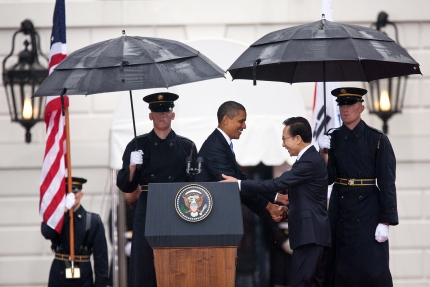
President Barack Obama and President Lee Myung-bak of the Republic of Korea shake hands after President Obama's remarks welcoming the Republic of Korea leader during the State Visit Arrival Ceremony on the South Lawn of the White House, Oct. 13, 2011. (Official White House Photo by Samantha Appleton)

This morning amidst a light rain, President Obama and First Lady Michelle Obama welcomed President Lee Myung-bak and First Lady Kim Yoon-ok of the Republic of Korea to the White House. During the Arrival Ceremony on the South Lawn, President Obama spoke about the strength of the relationship between our two nations:  

Today we celebrate an alliance rooted in the shared values of our people -- our service members who have fought and bled and died together for our freedom, our students and workers and entrepreneurs who work together to create opportunity and prosperity, and our families, bound by the generations, including many who are here today -- proud and patriotic Korean Americans.

President Lee, our two nations have stood together for more than 60 years. Over the past two years we’ve deepened our cooperation. Today, I'm proud to say that the alliance between the United States and the Republic of Korea is stronger than it has ever been.

President Lee Myung-bak also spoke of the historic friendship between the Korean people and Americans. Reflecting on visiting the Korean War Memorial yesterday to pay respects to the 37,000 American soldiers who lost their lives, he said:

It is written on a wall at that memorial that these American soldiers, “answer the call to defend a country they never knew and a people they never met.”  The simple yet poignant words describe how brace and good they were.

Mr. President, Madam First Lady, ladies and gentlemen, the Korean people have never forgotten what these fallen soldiers and their families gave up.  We will always remain grateful to all of them. 

Our alliance is the bedrock of stability, peace and progress, and our relationship is evolving.  Our two countries are working together to fight disease and poverty, climate change and natural disasters.  We are addressing the issues of energy security and eradicating terrorism and extremism, and stopping the proliferation of weapons of mass destruction.

The White House

Office of the Press Secretary

Remarks by President Obama and President Lee of the Republic of Korea in a Joint Press Conference

East Room

12:22 P.M. EDT

PRESIDENT OBAMA:  Please, everybody have a seat.  Good afternoon.  Once again, it is a great honor to welcome my good friend and partner, President Lee, back to the White House.  We had a wonderful dinner last night at one of our outstanding local Korean restaurants.  Michelle and I are looking forward to hosting the President and First Lady Kim at tonight’s state dinner.  And today President Lee will address Congress -- a high honor reserved for America’s closest friends.

This state visit reflects the fact that the Republic of Korea is one of our strongest allies.  Because we’ve stood together, the people of South Korea, from the ruins of war, were able to build an economic miracle and become one of our largest trading partners, creating jobs and opportunity for both our peoples.  Because we stood together, South Koreans were able to build a strong and thriving democracy and become a steady partner in preserving security and freedom not only on the Korean peninsula, but beyond. 

As I said this morning, this visit also recognizes South Korea’s emergence as one of our key global partners.  South Koreans have served bravely with us in Afghanistan and Iraq.  South Korean forces have partnered with us to prevent piracy off the shores of Africa and stem the spread of weapons of mass destruction.  Once a recipient of aid, South Korea has become a donor nation, supporting development from Asia to Africa.  And under President’s personal leadership, Seoul served as host to the G20 summit last year and will host the next Nuclear Security Summit next year.

South Korea’s success is a tribute to the sacrifices and tenacity of the Korean people.  It’s also a tribute to the vision and commitment of President Lee. 

Mr. President, you have shown how the international community should work in the 21st century -- more nations bearing the responsibility of meeting global challenges.  In the face of unprovoked attacks on your citizens, you and the South Korean people have shown extraordinary strength, restraint and resolve.

And I'd add that in all of our dealings, President Lee has shared my focus on what matters most -- the security and prosperity of our citizens.  And that, again, has been our focus today.

We agreed to move ahead quickly with the landmark trade agreement that Congress passed last night -- and which I’ll sign in the coming days.  It’s a win for both our countries.  For our farmers and ranchers here in the United States, it will increase exports of agricultural products.  From aerospace to electronics, it will increase American manufacturing exports, including those produced by our small businesses.  It will open Korea’s lucrative services market, and I’m very pleased that it will help level the playing field for American automakers. 

As a former executive, President Lee will understand when I say that just as Americans buy Hyundais and Kias, I hope that South Koreans will buy more Fords, Chryslers and Chevys.  And tomorrow, President Lee and I will be visiting with autoworkers in Michigan -- some of the many Americans who are going to benefit from this agreement.

In short, this agreement will boost American exports by up to $11 billion and support some 70,000 American jobs.  It has groundbreaking protections for labor rights, the environment and intellectual property -- so that trade is free and fair.  It will promote green jobs and clean energy, another area where we’re deepening our cooperation.  And it keeps us on track to achieve my goals of doubling American exports. 

So, President Lee, I thank you for your partnership in getting this deal done, a deal that will also be good for Korean businesses and Korean jobs.  I look forward to working with you to bring it into force as quickly as possible.  

As we expand our economic cooperation, we’re also deepening our security cooperation.  Guided by our joint vision for the alliance, we agreed to continue strengthening our capabilities to deter any threat.  I can never say it enough:  The commitment of the United States to the defense and security of the Republic of Korea will never waver.  And as we have for decades, the United States will maintain our strong presence in the Asia Pacific, which is a foundation for security and prosperity in Asia in the 21st century. 

In this regard, we discussed North Korea, which continues to pose a direct threat to the security of both our nations.  On this, President Lee [and I] are entirely united.  Together, we've succeeded in changing the equation with the North, by showing that its provocations will be met -- not with rewards but with even stronger sanctions and isolation.  So the choice is clear for North Korea.  If Pyongyang continues to ignore its international obligations, it will invite even more pressure and isolation.  If the North abandons its quest for nuclear weapons and moves toward denuclearization, it will enjoy greater security and opportunity for its people.  That's the choice that North Korea faces. 

Given the global nature of alliances, President Lee and I discussed the full range of challenges to our security and prosperity.  I thanked the President for South Korea’s continued support for reconstruction in Afghanistan and I updated him on the transition that is underway towards full Afghan responsibility for security.  We agreed to continue our support for democratic transitions in the Middle East and North Africa, including Libya. 

We’ve agreed to coordinate more closely on the development that lifts -- that can lift people and nations out of poverty.  I appreciated hearing the President’s plans for next year’s Nuclear Security Summit, which I look forward to attending.  And as we approach the G20 and APEC summits next month, we agreed on the need for coordinated global action that focuses on growth and creates jobs for our workers.

Finally, we’re strengthening the ties between our people.  South Korea is one of the top sources of international students studying in the United States.  And the number of American students who are studying in Korea has been soaring.  So we’ve directed our teams to sustain this momentum and expand educational exchanges between our people -- not unlike the one that once brought a visiting scholar named Lee Myung-bak to an American university just blocks from here.

So, again, Mr. President, I thank you for your partnership and your friendship.  And because of the progress we’ve made today, I’m confident that your visit will mark a turning point in the enduring alliance between our two nations. 

Thank you very much.

PRESIDENT LEE:  (As interpreted.)  Thank you, Mr. President.  First of all, I thank President Obama again for inviting me to make a state visit to the United States.  My thanks goes out to the Madam First Lady as well.  I am pleased to have had the chance to reaffirm once again the strong partnership and friendship between our two countries.

I met with President Obama six times over the last three years.  Our meetings were always constructive, allowing us to reaffirm the strength of our alliance, an alliance that is firmly based upon shared values and mutual trust.  This alliance guarantees peace, stability and prosperity on the Korean Peninsula, the Asia Pacific region and beyond.  We will continue to strengthen what is already a powerful and far-reaching alliance.

I was privileged to have spent many hours with President Obama during my visit to Washington, D.C. this time, discussing and sharing views on a wide array of issues, such as security on the Korean Peninsula and the Northeast Asia region; trade and economic cooperation between our two countries; situation in the Middle East, including what is unfolding in Libya; various international security issues; and, of course, the global economy and the challenges that we face today.

In particular, we welcome the ratification of the Korea-U.S. Free Trade Agreement by the United States Congress.  I am confident that the Korea National Assembly will soon ratify this very important agreement in the near future.

I take this opportunity to sincerely thank President Obama, the congressional leadership and the members of Congress, for their support and commitment.  The Korea-U.S. Free Trade Agreement is a historic achievement that will become a significant milestone in our 130-year relationship.  It is a win-win agreement that will benefit both of our countries in countless ways.  This agreement will create more jobs, generate more trade, and stimulate our economies.

This free trade agreement will bring numerous benefits to our workers, our companies, our small businesses and our consumers alike.  Furthermore, mutual investments will increase and our economic partnership will become stronger.  And the KORUS FTA will bring benefits beyond Korea and the United States.  It will be a gateway to enhancing ties between North America and Asia.  It will allow us to get ahead and stay ahead in the global markets.

As we all know, the global economy is undergoing many challenges.  The Korea-U.S. Free Trade Agreement will demonstrate to the world that we can create good-quality jobs and stimulate growth through open and fair trade.  This is a good example.  The passage of the KORUS FTA has opened up a new chapter in our partnership, in our alliance.

For the last 60 years we have maintained a strong political, military alliance.  Now the KORUS FTA signals the beginning of an economic alliance.  This alliance will strengthen and elevate our military and political alliance to a whole new level.  Our alliance is evolving into a future-oriented partnership and it will become stronger. 

When President Obama and I adopted a joint vision for the future of the alliance in 2009, we agreed to expand the depth and scope of our strategic alliance.  Today, we reaffirmed our common commitment to a common future -- a future of ensuring peace and stability on the Korean Peninsula and beyond, including the Northeast Asian region.  Our alliance will continue to play a pivotal role in overcoming the many global challenges that we face today.

Recently, we were deeply shocked when we read the reports on the attempt to harm the Saudi envoy here in Washington D.C.  I and the Korean people strongly condemned all forms of terrorism. And as you can see already, our two countries are working to bring peace and ensure stability around the world.  We are partners in Iraq and Afghanistan.  We are safeguarding our vital sea lanes off the coast of Somalia.

Today, we also talked about the rebuilding of Libya and bringing democracy and economic prosperity to a region wracked by violence and instability.  We also agreed to continue our work towards promoting universal values such as human rights, democracy and freedom across the world. 

In particular, we agreed that Korea and the United States will contribute to the economic development and administrative capacity-building in Libya, provide vocational training for its young people, provide medical care, and rebuild and reinvest in its infrastructure.  We will coordinate our joint efforts with the United Nations support mission in Libya and the Friends of Libya meetings, and our international partners. 

We also talked about the worrying state of the global economy and how to overcome the perils that emanated from the eurozone.  The situation in Europe is a source of grave concern. We agreed to strengthen international cooperation through the G20 so that the fiscal situation does not endanger the recovery of our real economies.  In particular, our two countries agreed to work together to bring back stability to our financial markets similar to what we did back in 2008.

As we have done for the past three years, President Obama and I will remain in complete agreement when dealing with North Korea.  Our principled approach will remain steadfast.  We agreed that North Korea’s continued pursuit of nuclear weapons poses a serious threat to peace and stability of the Korean Peninsula and the world.  We will continue to work towards denuclearization of the peninsula.

The second Nuclear Security Summit will be held next March in Seoul.  During the summit, we will review the progress made since the first summit in 2010, which was convened under the initiative of President Obama.  The leaders will have one goal, and that is to achieve our collective vision of a world free of nuclear weapons.

I thank President Obama and his able team for giving us their full support in the preparations of the summit, and, of course, we’ll continue to work with them.  And I look forward to welcoming President Obama and Mrs. Obama in Seoul next year.

Thank you very much.

PRESIDENT OBAMA:  All right.  We’re going to start off with Ed Henry.  Where’s Ed?

Q    Thank you, Mr. President.  I appreciate it. 

President Lee, I wanted to start with you, one question each.  First, when you mentioned North Korea, what concrete steps do you think the Obama administration has helped to contain Kim Jong Il?

And, President Obama, I wanted to get your first reaction to the Iranian terror plot.  Your Secretary of State called it a dangerous escalation.  What specific steps will you take to hold Iran accountable, especially when Mitt Romney charged last week, “If you do not want America to be the strongest nation on Earth, I am not your President -- you have that President today”?

PRESIDENT OBAMA:  Well, I didn't know that you were the spokesperson for Mitt Romney.  (Laughter.)  But let me just talk about the plot in particular.  We have a situation here where the Attorney General has laid out a very specific set of facts.  What we know is that an individual of Iranian-American descent was involved in a plot to assassinate the ambassador to the United States from Saudi Arabia.  And we also know that he had direct links, was paid by and directed by individuals in the Iranian government.

Now, those facts are there for all to see.  And we would not be bringing forward a case unless we knew exactly how to support all the allegations that are contained in the indictment. 

So we have contacted all our allies, the international community; we’ve laid the facts before them.  And we believe that after people have analyzed them, there will not be a dispute that this is, in fact, what happened. 

This is a -- not just a dangerous escalation; this is part of a pattern of dangerous and reckless behavior by the Iranian government.  One of the principles of international behavior is that our diplomats -- we send them around the world -- that they are going to be protected, they are not targets for threats or physical violence.  And for Iran to have been involved in a plot like this indicates the degree to which it has been outside of accepted norms of international behavior for far too long.  This is just one example of a series of steps that they’ve taken to create violence and to behave in a way that you don’t see other countries doing. 

So with respect to how we respond, our first step is to make sure that we prosecute those individuals that have been named in the indictment.  And I will leave to the Attorney General the task of describing how that will proceed.

The second thing that we’re going to continue to do is to apply the toughest sanctions and continue to mobilize the international community to make sure that Iran is further and further isolated and that it pays a price for this kind of behavior. 

Keep in mind that when I came into office I think Iran saw itself as being able to play various countries against each other and avoid the kind of isolation that it deserved.  Since that time, what we’ve seen, whether it relates to its nuclear program or its state-sponsored terrorism, that more and more countries have been willing to speak out in forceful ways, whether through the United Nations or through other avenues, to say this is not acceptable behavior.  And it is having an impact.  I mean, what we’ve seen is Iran’s economy is in a much more difficult state now than it was several years ago, in part because we’ve been able to unify the international community in naming Iran’s misbehavior and saying that it's got to stop and there are going to be consequences to its actions.

Now, we don’t take any options off the table in terms of how we operate with Iran.  But what you can expect is that we will continue to apply the sorts of pressure that will have a direct impact on the Iranian government until it makes a better choice in terms of how it’s going to interact with the rest of the international community.

There is great similarity between how Iran operates and how North Korea operates -- a willingness on their part to break international rules, to flout international norms, to not live up to their own commitments.  And each time they do that the United States will join with its partners and allies in making sure that they pay a price. 

And I think that -- I have to emphasize that this plot was not simply directed at the United States of America.  This is a plot that was directed against the Saudi ambassador.  And I think that what you’re going to see is folks throughout the Middle East region questioning their ability to work effectively with Iran.  This builds on the recognition within the region that Iran in fact has been hypocritical when it comes to dealing with the Arab Spring, given their own repressive activities inside their country, their willingness to prop up the Syrian regime at a time when they’re killing their own citizens. 
This is a pattern of behavior that I think increasingly the international community is going to consider out of bounds and is going to continue to punish Iran for.  Unfortunately, the Iranian people are the ones that probably suffer the most from this regime’s behavior.  And we will continue to work to see how we can bring about a Iranian government that is actually responsive to its people but also following the rules of the road that other countries in the international community follow.

PRESIDENT LEE:  (As interpreted.)  Thank you.  To answer your question about North Korea, first of all, President Obama and I, for the last three years, we have maintained very close cooperation and coordination when it comes to North Korea policy. We have consistently applied our principled approach towards North Korea.

For North Korea, the only way to ensure happiness for its people and to embark on that path to development is to abandon its nuclear ambitions.  And so we have tried through peaceful means, through diplomatic means, to strongly urge North Korea to abandon its nuclear ambitions.

And in this day and age, we realize that no single country can be effective in achieving its diplomatic or economic aims on its own.  We know that cooperation is vital in order for a country to become a responsible member of the international community, which is something that we want for North Korea.  And so we would, of course, want North Korea to abandon its nuclear ambitions.  And, of course, Korea and the United States will continue to consistently apply a principled approach so that we can achieve our strategic objective.

And when it comes to cooperation between our two governments, we speak with one voice, and we will continue to speak with one voice.  And it was a chance for me to reaffirm this today.

Q    I know that President Lee is talking about a South Korea-North Korea-Russia trilateral gas pipeline project.  But North Korea is also under a lot of sanctions from the international community and the United States and other countries.  But having said that, if this gas line project proceeds as planned, then we would have to provide or compensate North Korea with a substantial amount of money or other forms of compensation.  So in your opinion, President Lee, do you think that the gas line pipe project will be able to proceed without resolving the North Korean nuclear issue?

PRESIDENT LEE:  (As interpreted.)  Yes, thank you.  And I don't know if that’s a question that I should be answering here in the United States, but since you asked a question I will try to answer that.

In the Far East, we have been discussing this issue for quite some time in trying to import Russian gas into the Republic of Korea.  Now, we’re discussing, right now with the North Koreans, whether the Russian gas -- which is quite affordable -- can travel through North Korea and be imported and be used in South Korea. 

This is beneficial, first of all, for Russians because they can sell their natural resource.  For North Korea it is beneficial because they could use this natural resource, and also beneficial for South Korea as well.  But let me just remind you that South Korea, North Korea and Russia haven’t yet come together to discuss this issue in any detail.  But from an economic standpoint of view, it is beneficial for all parties involved.  But I understand that this issue is not just economics alone.  This issue, inevitably, involves security matters, which we will consider very closely. 

And, also, let me remind you that this project will not be implemented anytime soon.  Of course we are mindful of the progress that we are making with regards to the North Korean nuclear issue as well.

Q    Thank you, Mr. President.  First, briefly, to follow on Ed, if I may.  On the Iran alleged terror plot, do you have knowledge or do you believe that the nation’s Supreme Leader and President had knowledge of the plot?  And if so, do you not see that as an act of war?

And, if I could turn to the economy, yesterday in a campaign video you said that you will force Congress to take up individual pieces of the American Jobs Act.  Which pieces would you like to see them take up first?  And given that, so far, you’ve been unable to force Congress to do an up or down vote on entire bill, and that new unemployment filings are not falling, why not, now, sit down with members of Congress to see if you can’t reach compromise on something that could pass now and create jobs quickly?

PRESIDENT OBAMA:  Okay.  First of all, on the Iranian issue, the Attorney General has put forward the facts with respect to the case, and I’m going to let him comment on the details of those facts.  What we can say is that there are individuals in the Iranian government who are aware of this plot.  And had it not been for the outstanding intelligence work of our intelligence officials, this plot could have gone forward and resulted not only in the death of the Saudi ambassador, but also innocent civilians here in the United States.

We believe that even if at the highest levels there was not detailed operational knowledge, there has to be accountability with respect to anybody in the Iranian government engaging in this kind of activity. 

And so we will continue the investigation.  We will continue to put forward all the facts that we have available to us.  But the important thing is for Iran to answer the international community why anybody in their government is engaging in these kinds of activities -- which, as I indicated before, are I think out of bounds for not just a country like Iran that historically has been engaging in these kinds of activities, but violates basic principles of how diplomats are dealt with for centuries.

Now, with respect to the jobs bill, I have said repeatedly that the single most important thing we can do for the economy right now is put people back to work right now.  And we have put forward a jobs bill that independent economists -- not my team, not my administration -- have said would grow the economy substantially and put up to 1.9 million people back to work. These are proposals that historically have been supported not just by Democrats, but also by Republicans.  As I’ve said as I’ve traveled around the country, I don’t know when rebuilding our roads and bridges that are decaying suddenly became a partisan issue. 

And I was at a Jobs Council meeting up in Pittsburgh with CEOs from companies across the board, many of whom have been traditional supporters of the Chamber of Commerce and the Business Roundtable and other organizations that the Republican Party has claimed a lot of support for.  And they said, for example, when it came to infrastructure this is something that anybody in Washington should agree to.

The Republicans haven’t given a good answer as to why they have not agreed to wanting to rebuild our roads and our bridges and our schools.  They have not given us a good reason as to why they don't want to put teachers back in the classroom.  And so what we’re going to do is we’re going to break each of these bills apart.  We’re going to say, let’s have a vote on putting teachers back in the classroom.  Let’s have a vote on rebuilding our infrastructure.  Let’s have a vote on making sure that we are keeping taxes low for small businesses and businesses that are willing to hire veterans, provide tax breaks for further investment that can create jobs.  And each time we’re going to ask Republicans to support the bill.  And if they don't want to support the bill, they’ve got to answer not just to us, but also the American people as to why they wouldn’t.

Now, I think this trade deal that we just passed -- the Korea Free Trade Act -- shows that we are happy to work with Republicans where they are willing to put politics behind the interest of the American people and come up with proposals that are actually going to create jobs.  The Korea Free Trade Act we believe will create up to 70,000 jobs.  It’s a good deal.  We got good, strong bipartisan support.

Frankly, we have not seen a lot of ideas coming forward from Republicans that would indicate that same kind of commitment to job creation.  If they do -- if Senator McConnell or Speaker Boehner say to me, you know what, we want to get some infrastructure built in this country, we think that putting construction workers back to work is important -- I’ll be right there.  We’ll be ready to go.  If they are willing to renew the payroll tax as we worked on together in December, I’ll be ready to go. 

I don’t think the problem here, Jessica, is that I have not been unwilling to negotiate with Republicans.  I've shown repeatedly my willingness to work overtime to try to get them to do something to deal with this high unemployment rate.  What we haven’t seen is a similar willingness on their part to try to get something done.  And we’re not going to wait around and play the usual political games here in Washington, because the American people are desperate for some relief right now.

Q    Will you invite them to the White House to negotiate on the jobs bill?

PRESIDENT OBAMA:  I think that anytime and anyplace that they are serious about working on putting people back to work we’ll be prepared to work with them.  But we’re not going to create a lot of theater that then results in them engaging in the usual political talking points but don’t result in action. 

People want action.  And I’m prepared to work with them. But, again, the last time I was here at a press conference I said -- I asked you guys to show us the Republican jobs plan that independent economists would indicate would actually put people back to work.  I haven’t yet seen it.  And so, eventually, I’m hoping that they actually put forward some proposals that indicate that they feel that sense of urgency about people -- needing to put people back to work right now.

All right, Jessica, you can’t have four follow-ups.  One is good.

Q    I have two questions to President Obama.  Yesterday, U.S. Congress ratified the Korea-U.S. FTA.  But Korean National Assembly didn’t pass it yet.  And Korean opposition party is requesting renegotiation on the FTA.  What is your opinion and prospect on the future of the Korea-U.S. FTA? 

And my second question is about Libya and North Korea.  In Libya, there was a people’s uprising and they changed their government.  And do you think such an event will be possible in North Korea in the near future?  Thank you.

PRESIDENT OBAMA:  Well, first of all, President Lee assures me that the KORUS FTA will pass through the National Assembly.  I have great confidence in his leadership, and my expectation is that it will get done -- because it’s good for both countries.  And businesses will be able to prosper here in the United States as a consequence of lowering many of these trade barriers; the same will be true in Korea.  Our workers will benefit, and we can learn from each other.  And I think this is one more sign of the close cooperation and friendship between our two peoples.

You’re absolutely right that what we’ve seen in the Arab Spring -- in Libya, in Tunisia, in Egypt -- is this deep longing on the part of people for freedom and opportunity.  And although the path from dictatorship to democracy is always uncertain and fraught with danger, what we’ve seen also is that human spirit eventually will defeat repressive governments.

So I don’t want to predict when that might happen.  I think that obviously the people of North Korea have been suffering under repressive policies for a very long time, and none of us can look at a crystal ball and know when suddenly that type of government collapses on itself. 

What we know, though, is, is that what people everywhere -- whether it’s in Korea or the United States or Libya or Africa -- what people everywhere are looking for is the ability to determine their own destiny; to know that if they work hard that they will be able to be rewarded; that they can speak their mind, they can practice their religion in freedom; that they can enjoy the free flow of information that increasingly characterizes the 21st century.  And I don’t think that the people of North Korea are any exception. 

And I think when they see the extraordinary success and progress that’s been made in South Korea, I think, inevitably, that leads them to recognize that a system of markets and democracy and freedom is going to give their children and their grandchildren more opportunity than the system that they’re currently under.

All right, thank you very much, everybody.  (Applause.) 

END
1:00 P.M. EDT
The White House

Office of the Press Secretary

Remarks by President Obama and President Lee of the Republic of Korea in Arrival Ceremony

South Lawn

9:25 A.M. EDT

PRESIDENT OBAMA: Good morning, everybody. (Applause.) I hope everybody is enjoying the weather. (Applause.)

I am told there is a Korean proverb, which says, “Words have no wings, but they can fly a thousand miles.” President Lee, First Lady Kim, I hope my words today will be felt in the hearts of all South Koreans when I say to our allies, our partners, our dear friends, please accept our warmest welcome. Hwangyong hamnida. (Applause.)

Today we welcome a leader whose remarkable life embodies the rise of his nation, from an impoverished child who drank water to fill his hungry stomach, to the student who cleaned the streets to pay his tuition, to the activist sent to jail for protesting dictatorship, to the leader guiding his country to new heights --my good friend and partner, President Lee.

Today we celebrate an alliance rooted in the shared values of our people -- our service members who have fought and bled and died together for our freedom, our students and workers and entrepreneurs who work together to create opportunity and prosperity, and our families, bound by the generations, including many who are here today -- proud and patriotic Korean Americans.

President Lee, our two nations have stood together for more than 60 years. Over the past two years we’ve deepened our cooperation. Today, I'm proud to say that the alliance between the United States and the Republic of Korea is stronger than it has ever been.

Our alliance reflects a broader truth. The United States is a Pacific nation, and America is leading once more in the Asia Pacific. And with our landmark trade agreement, we will bring our nations even closer, creating new jobs for both our people, and preserving our edge as two of the most dynamic economies in the world.

Mr. President, your visit thus marks a new chapter in our alliance, because in South Korea the United States has a global partner that is embracing the responsibilities of leadership in the 21st century. As we go forward, let us draw strength from the same sense of solidarity that I’ve seen during my visit to Korea, in our brave -- our very brave armed forces. Katchi kapshida -- we go together. (Applause.)

We will go together, investing in our societies and the education and skills of our people. We will go together, reaffirming that alliance between the United States and the Republic of Korea is unbreakable. And we will go together, as we partner to meet our global responsibilities, so that our citizens -- and people around the world -- may live in security and prosperity.

President Lee, First Lady Kim, members of the Korean delegation -- on behalf of Michelle and myself, on behalf of the American people, welcome to the United States. (Applause.)

PRESIDENT LEE: Good morning, everybody.

AUDIENCE: Good morning.

PRESIDENT LEE: (As translated.) Mr. President, whom I consider one of my closest friends; Madam First Lady; ladies and gentlemen. First of all, thank you for your warm welcome extended to me, my wife, and my delegation. It is always a great pleasure visiting this great country. I would also like to convey the warm greetings from your friends back in Korea, Mr. President and Madam First Lady.

The journey of our alliance began 60 years ago -- a journey that brought together two peoples from different sides of the Pacific. What brought us together more than anything was the value that all of us here hold so dear: freedom.

Yesterday, I paid tribute at the Korean War Memorial just a short distance away from here. There, I was able to pay my respect to the 37,000 American soldiers who fought and died defending this value. It is written on a wall at that memorial that these American soldiers, “answer the call to defend a country they never knew and a people they never met.” The simple yet poignant words describe how brace and good they were.

Mr. President, Madam First Lady, ladies and gentlemen, the Korean people have never forgotten what these fallen soldiers and their families gave up. We will always remain grateful to all of them.

Our alliance is the bedrock of stability, peace and progress, and our relationship is evolving. Our two countries are working together to fight disease and poverty, climate change and natural disasters. We are addressing the issues of energy security and eradicating terrorism and extremism, and stopping the proliferation of weapons of mass destruction.

We are also working together to promote universal values, such as democracy and human rights. We face these challenges both as a nation and as a partner. We will prevail until we overcome these challenges. We will come out stronger. Our two countries will ensure peace and stability of the peninsula and beyond.

Last night the United States Congress ratified the Korea-U.S. Free Trade Agreement. This historic achievement will open a new chapter in our relationship. And I would like to take this opportunity to thank President Obama for his steadfast leadership. This agreement will create more jobs. It will expand mutual investments into both of our countries. It will become a new engine of growth that will propel our economies forward. Ladies and gentlemen, it will be a win for both of our countries.

Our two peoples walked alongside together, armed with common values, pursuing the same ideals and achieving common goals. And this is making our security and economic alliance stronger. It is bringing our people closer together. We are true partners and close friends, and we will remain as such in the 21st century. Our alliance that was born of out of the trenches of war will continue to blossom. It will become stronger.

Mr. President, Madam First Lady, ladies and gentlemen, Korea and the United States are global partners now. We are a force for good. I look forward to a constructive, as well as an enjoyable time here in Washington, D.C. with President Obama and the First Lady. My aim is to further strengthen our common values and our partnership.

Once again, thank you, Mr. President, Madam First Lady, people of America, for this warm reception. (Applause.)

END
9:40 A.M. EDT

South Korea Official Visit Arrival Ceremony

October 13, 2011 | 20:08 | Public Domain

President Obama, joined by First Lady Michelle Obama, and Vice President Joe Biden, welcomes Lee Myung-Bak, President of the Republic of Korea to the White House for an official visit.

Download mp4 (192MB) | mp3 (19MB)

The White House

Office of the Press Secretary

Remarks by President Obama and President Lee of the Republic of Korea in an Exchange of Toasts at State Dinner

East Room

PRESIDENT OBAMA:  (In progress) -- representing one of America’s strongest allies and global partners, the Republic of Korea.  (Applause.) 

I also want to acknowledge two guests in particular.  Another son of Korea dedicated to peace and security, the Secretary General Ban Ki-moon, is here -- (applause) -- and our first Korean-American ambassador to the Republic of Korea, confirmed by the Senate today, Ambassador Sung Kim.  (Applause.)

I’m going to be very brief tonight because President Lee has had a very full day and a very wet day -- (laughter) -- as well as extended meetings and press conferences, a State Department banquet, and an address to the Congress, which I understand went extraordinarily well.  There is a reason why people call him “The Bulldozer.”  He is unstoppable.  (Laughter.)

Mr. President, today you have spoken with great eloquence about what America and our alliance has meant to your life and the life of your country.  This evening, I want you and your countrymen to know what Korea and its people have meant to America.     

The essence of our alliance, I think, is embodied in a concept that is uniquely Korean.  It doesn’t translate that easily.  But it reflects the deep affection, the bonds of the heart that cannot be broken and that grow stronger with time.  Our Korean friends know it well -- jeong.   

In our country, we’ve felt this jeong in our vibrant Korean American communities, including in Hawaii where I grew up -- a melting pot of cultures that made me who I am, and that taught me we can all live together in mutual trust and respect.

I felt this jeong during my visit to Korea, on Veterans Day, the 60th anniversary of the Korean War, when our proud veterans of that war, both Korean and American, came together to celebrate a shared legacy -- a free, democratic and prosperous Republic of Korea.

And I felt this jeong in my friendship with President Lee.  Mr. President, your life story -- from crushing poverty to the presidency -- is an inspiration.  Your success, Korea’s success, speaks to the truth that, with education and hard work, anything is possible.  It’s a spirit our countries share.  You’ve described it in Korean, and in English, it translates as:  "Yes, we can."  (Laughter and applause.)  It sounds good in Korean, too.  (Laughter.)

Finally, I would note that in our lives President Lee and I have both been blessed to find our better halves -- leaders in their own right, advocates for women and young people, who we are proud to call our First Ladies.  Mr. President, as we say in America, we both married up.  (Laughter.)

And so I want to propose a toast -- I believe this is mine -- to our friends, President Lee and First Lady Kim, and to their delegation, most of all to the enduring alliance between our nations, a partnership of the heart that will never be broken.  Cheers.  Gun-bae. 

(A toast is offered.)

PRESIDENT LEE:  (As translated) First of all, Mr. President, Madam First Lady, distinguished guests, please allow me to thank you from the bottom of my heart for this warm reception extended to me, my wife and my delegation.  Thank you very much.

And Mr. President and Madam First Lady, my visit to you in Washington, D.C. this time is especially special because before you are the President of the United States of America, you are a great, close friend of mine.  And this is how I consider you as well as the Madam First Lady.  So this visit is very, very special for all of us.

Ladies and gentlemen, the President just spoke about the Korean emotion that we call jeong in Korea.  I think indeed President Obama knows that deep inside his heart he understands the essence of what we call jeong.  Jeong can be explained in many different aspects, but one aspect of that is an individual that is humble and very strong inside.  And I think President Obama exemplifies this trait of what we call jeong, and that is why we have a very special tie that we feel whenever I think about President Obama.  Ladies and gentlemen, I’m a very, very honest guy -- (laughter) -- so what I say, I really mean it. 

And also, Mr. President, I must thank you for one thing, because you have spoken so highly of the outstanding educational system of Korea, the dedication of its teachers and the determination of our Korean parents when it comes to educating their children.  You have so many new teacher fans in Korea.  (Laughter.)  And I have to be very honest with you.  I think there's quite a number of them who like you more than they like me.  (Laughter and applause.)

Mr. President, seriously, you do have a lot of teacher fans in Korea.  But the real reason, when we look deep down inside, the reason why you are so popular among many Koreans is because everyone, including myself, are deeply impressed by your endless passion for learning and that this is very much a -- very much reflected in your life story. 

Mr. President, Madam First Lady, ladies and gentlemen, whenever I think about the United States and the people of America, I also have a very personal story in mind, which I would like to share with you briefly tonight.  As you know, 60 years ago Korea used to be one of the poorest countries in the world, and my family was exceptionally poor, and we really had nothing to eat, nothing to wear.  We had to rely on foreign aid for many, many years.  And I remember -- I think I was about nine or 10 years old -- in my village there came an American missionary lady with boxes and containers full of used clothes that she would come to my village and hand out.

So, being a boy whose only wish at that time was to own and wear a pair of blue jeans, I decided to stand in line, along with many people.  But I was a very small and shy boy -- hard to imagine -- (laughter) -- so a lot of people were pushing and they were jostling about.  So I ended up way at the end of the line.  When my turn came, I went up to the American missionary lady and I asked for a pair of blue jeans, to which she said -- she just looked at me and said, "Well, I'm sorry, I'm all out of blue jeans."  And of course I was devastated.  I was heartbroken.  And this kind American missionary lady takes one look at me and, out of sympathy, she hands me something out of the box.  She handed me a small rubber ball.  Now, this did little to console the boy who was crushed, because, after all, what was I going to do with a rubber ball?

And so, to this day -- and I shared this story with President Obama -- and I -- when I finished the story I remember the President laughing a bit nervously, but -- (laughter) -- I told him, I said, "Mr. President, as you can see, I do not owe the United States anything, except" -- (laughter) -- "except maybe for a rubber ball."  (Laughter and applause.)

So, ladies and gentlemen, Mr. President, Madam First Lady, although half-jokingly I say that I do not owe the United States anything, but in reality my country and my people owe you tremendously.  Which other country -- no country came to aid the Republic of Korea 60 years ago when my country was being attacked by communists.  No country sacrificed more than 37,000 lives defending freedom for the people of my country.  So for that, for many, many years onwards, we will always, always be grateful to the American people.  (Applause.)

Mr. President, ladies and gentlemen, just last night, the United States Congress passed and ratified the Korea-U.S. Free Trade Agreement.  I've said this before, but please allow me to say it again:  I am deeply appreciative and grateful to the leadership of Congress, to all the members of the United States Congress who supported this measure, and especially to the steadfast leadership of President Obama for pushing this through.  (Applause.)

And also, Mr. President, ladies and gentlemen, I know that there are those in the United States Congress who did not vote "yea" for this very important agreement.  I think I see a few faces here who -- (laughter) -- but I'm very, very confident, ladies and gentlemen, that in one year or even less that these people who may be a little bit critical of this important agreement will say that they made a mistake, because they will see the visible results of this very important agreement.  (Applause.)

And the thing that I want to prove the most, ladies and gentlemen, with the KORUS FTA is that many of those critics who were saying that the KORUS FTA was somehow going to make people lose their jobs -- but really the KORUS FTA is going to create a lot of good, decent jobs for the people of America.  And this is a point that I want to prove by implementing this agreement.

And, ladies and gentlemen, you see Mr. King seated at the head table here.  As I was receiving guests, and when he came up to me and I was shaking hands, I thought to myself, this is my chance to explain to Mr. King that the KORUS FTA is going to create a lot of good jobs for his people and the members of his union.  (Applause.)

Well, the fact that Mr. King accepted the invitation to be here tonight just goes to show that he believes in the essence and the core values of the KORUS FTA, so I have no worries.  (Laughter.)

Mr. President, Madam First Lady, ladies and gentlemen, our relationship between our two countries began 130 years ago.  Sixty years ago, our mutual defense treaty began what is considered to be one of the strongest military and political alliance that the world has ever known.  Of course, we are here today to celebrate our journey of the last 60 years, one that has been -- always been marked by triumphs, sometimes heartache, but always full of hope.  And we are gathered here to reaffirm our friendship and to renew our common commitment towards our shared goals.  I know that our relationship will go strong; it will become more mature and complete.

Mr. President, as we talked about over the last few days, we have many, many challenges that are facing us as a nation and as a member of the international community.  We do not know when, what type of form or how it is going to strike us.  There is a lot of uncertainty out there.  But I believe in our friendship, because if we are faced with challenges, I know that we will overcome them and even come out stronger.

I just want to emphasize once again our alliance between the Republic of Korea and the United States.  It ensures us that we are not alone -- neither is Korea alone or the United States.  So we can have confidence that we will be able to overcome any challenges that may face us.

Well, ladies and gentlemen, I see the guests today, and I think a lot of you are people who are very much liked by the President and the Madam First Lady.  I also see a few of you who I always wanted to see, and so I'm very happy that I have the chance to see and meet with you tonight.

So once again, Mr. President, Madam First Lady, thank you so much for this honor, and thank you for your invitation.  (Applause.)

(In English)  Now I'm going to propose a toast -- for us.  (Laughter.)

(As translated)  Ladies and gentlemen, please join me now in a toast:  First of all, for the health and well-being of President Obama and Madam First Lady, and, of course, for our everlasting friendship between our two countries.

(A toast is offered.)

END

Watch Live: South Korea State Visit

This morning, President Obama and First Lady Michelle Obama will welcome President Lee Myung-bak and First Lady Kim Yoon-ok of the Republic of Korea to the White House. Tune in to see events from the State Visit throughout the day beginning with the South Korea Arrival Ceremony at 9 a.m. EDT on WhiteHouse.gov/live.

Following the arrival ceremony, President Obama and Vice President Biden will hold a bilateral meeting with President Lee in the Oval Office. Meanwhile, the First Lady will visit a high school in Virginia with the Republic of Korea’s First Lady Kim Yoon-ok. The school, Annandale High, is home to one of the largest Korean-American communities in the area and has students derive from nearly 90 countries and speak over 50 languages. 

In the afternoon, President Obama will hold a joint press conference with President Lee. Later, the President and the First Lady will host a State Dinner in honor of President Lee, featuring produce from the White House kitchen garden fall harvest. During the dinner, President Obama and President Lee will each give a toast. Afterwards, the President and the First Lady will attend the State Dinner reception with President Lee in the State Dining Room.