The White House

Office of the Press Secretary

President Obama Announces More Key Administration Posts

WASHINGTON – Today, President Barack Obama announced his intent to nominate the following individuals to key Administration posts:

  • Gina Abercrombie-Winstanley – Ambassador to the Republic of Malta, Department of State
  • Julissa Reynoso – Ambassador to the Oriental Republic of Uruguay, Department of State
  • Wendy Spencer – Chief Executive Officer, Corporation for National and Community Service
  • Robert E. Whitehead – Ambassador to the Togolese Republic, Department of State

The President also announced his intent to appoint the following individuals to key Administration posts:

  • Robert L. Blazs – United States Commissioner, Canadian River Commission
  • Jayne D. Greenberg – Member, President’s Council on Fitness, Sports, and Nutrition

President Obama said, “These dedicated individuals bring a wealth of experience and talent to their new roles and I am proud to have them serve in this Administration.  I look forward to working with them in the months and years to come.

President Obama announced his intent to nominate the following individuals to key Administration posts:

Gina Abercrombie-Winstanley, Nominee for Ambassador to the Republic of Malta, Department of State
Gina Abercrombie-Winstanley, a career member of the Senior Foreign Service with the rank of Minister-Counselor, currently serves as Deputy Coordinator for Policy, Programs, and Budget in the Office of the Coordinator for Counter-Terrorism. Prior to this role, she was Director of the Office of Egypt and the Levant in the Bureau of Near Eastern Affairs.  Her previous positions include: Chairwoman for Middle East Area Studies at the Foreign Service Institute, Consul General in Jeddah, Saudi Arabia, Senior Advisor for Middle Eastern Affairs at the U.S. Mission to the United Nations, Director for Near East South Asian Affairs, and Director for Legislative Affairs at the National Security Council.  Her earlier posts include: Political Officer at the Embassy in Tel Aviv with responsibility for the Gaza Strip, Consul in Baghdad, and postings in Jakarta and Cairo.  She joined the Foreign Service in 1985 after serving as a Presidential Management Fellow at the United States Information Agency.  Ms. Abercrombie-Winstanley received a B.A. from George Washington University and an M.A. from Johns Hopkins University. 

Julissa Reynoso, Nominee for Ambassador to the Oriental Republic of Uruguay, Department of State
Julissa Reynoso is Deputy Assistant Secretary of State for Central America and the Caribbean in the Bureau of Western Hemisphere Affairs.   Prior to her appointment in November 2009, Ms. Reynoso practiced law with Simpson Thacher & Bartlett in New York, focusing on international arbitration and antitrust law.  During this time, she also served as a Fellow at New York University School of Law and Columbia Law School.  In 2006, Ms. Reynoso worked as Deputy Director of the Office of Accountability at the New York City Department of Education.  Ms. Reynoso holds a B.A. in Government from Harvard University, a Masters in Philosophy from the University of Cambridge in the United Kingdom, and a J.D. from Columbia University School of Law.

Wendy Spencer, Nominee for Chief Executive Officer, Corporation for National and Community Service
Wendy Spencer is the Chief Executive Officer of the Florida Governor's Commission on Volunteerism and Community Service, an organization that administers AmeriCorps grants throughout the state and is responsible for coordinating volunteers and donation management in times of disaster. Ms. Spencer  was appointed to the President's Council on Service and Civic Participation in 2006, and awarded the President's Call to Service Award in 2005 due to her dedication to finding innovative solutions to Florida’s community challenges.  She previously served as Director of the Florida Park Service, where she oversaw natural resource management for Florida’s 158 state parks.  Prior to her work with the Florida Park Service, Ms. Spencer was Campaign Director of the United Way of the Big Bend.  Ms. Spencer has also worked as Director of Marketing for the Macon County, Georgia, Chamber of Commerce and as a District Representative for Congressman Charles Hatcher of Georgia.  She is the current Chair of the American Association of State Service Commissions. Ms. Spencer holds a B.A. in Fine Arts and Speech Communications from Valdosta State University.

Robert E. Whitehead, Nominee for Ambassador to the Togolese Republic, Department of State
Robert E. Whitehead, a career member of the Senior Foreign Service, has served at the Department of State for 27 years.  From 2009 to 2011, Mr. Whitehead served as the Chargé d'Affaires in Khartoum, Sudan.  Other overseas assignments have included Deputy Chief of Mission in the Central African Republic, Zambia and Zimbabwe.  Additionally, Whitehead served briefly as Chargé d’Affaires ad interim in Rwanda in 1994 and as the first consul general in Juba, Southern Sudan in 2006.   His assignments in Washington have included Director of the Office of African Analysis in the Bureau of Intelligence and Research, Senior Inspector in the Office of the Inspector General, and Desk Officer in the Office of West African Affairs.  Before entering the Foreign Service, he was a Fulbright lecturer at the University of Zaire.  Mr. Whitehead received a B.A. from Taylor University and an M.A. from Southern Illinois University.

President Obama announced his intent to appoint the following individuals to  key Administration posts:

Robert L. Blazs, Appointee for United States Commissioner, Canadian River Commission
Robert L. Blazs is a professional engineer who recently retired from the U. S. Geological Survey (USGS).  Prior to his January 2010 retirement, Mr. Blazs spent the last decade of his career as the Assistant Director and Data Operations Chief at the Oklahoma Water Science Center.  He also previously served as the Field Office Chief for Water Sciences in Washington State from 1982 to 1990 and in California from 1976 to 1982.  Mr Blazs began his career with USGS as a Hydrologic Technician.  Prior to joining the USGS in 1970, he spent four years in the United State Marine Corps. He has served as the Chairman of the Arkansas-White-Red River Basins Interagency Committee, and has represented the USGS on multiple river compacts including the Canadian River Commission.  Mr. Blazs received his B.A. from California State University, Long Beach in 1975.

Dr. Jayne D. Greenberg, Appointee for Member, President’s Council on Fitness, Sports, and Nutrition
Dr. Jayne D. Greenberg is the District Director of Physical Education and Health Literacy for Miami-Dade County Public Schools.  Previously, she served as Special Advisor on Youth Fitness to the President’s Council on Physical Fitness and Sports and as President of the Florida Alliance for Health, Physical Education, Recreation, Dance, and Driver Education.  Dr. Greenberg assisted the U.S. Department of Health and Human Services in developing the “I Can Do It, You Can Do It Program,” addressing physical activity for youth with disabilities.  Dr. Greenberg received the March 2009 Point of Light Award by the Governor of Florida and was appointed to the Governor’s Council on Physical Fitness in 2009.  She was named the 2005 National Physical Education Administrator of the Year by the National Association of Sport and Physical Education and received the 2005 Highest Recognition Award by the U.S. Secretary of Health and Human Services. Dr. Greenberg has a B.S. in Physical Education from the University of Massachusetts, Amherst; an M.S. in Sports Psychology from Florida International University; and an Ed.D. in Instructional Leadership in Physical Education from Florida International University.

This Week on Treasury Notes: Dismantling the Myths Around Wall Street Reform

Ed. Note: Cross-posted from Treasury Notes.

In the fall of 2008, a financial crisis of a scale and severity not seen in generations left millions of Americans unemployed and resulted in trillions in lost wealth. Our broken financial regulatory system was a principal cause of that crisis. It was fragmented, antiquated, and allowed large parts of the financial system to operate with little or no oversight.

Today, our most important challenge is creating stronger economic growth and helping the millions of Americans who lost their jobs get back to work. As part of that effort, we are committed to implementing new rules that will build a safer, more stable financial system—one that provides a robust foundation for lasting economic growth and job creation.

In order to achieve these goals, and help protect our economy from future crises, we must continue with the implementation of Wall Street Reform. However, more than a year after the enactment of the Dodd-Frank Wall Street Reform and Consumer Protection Act, opposition to reform persists.   

Opponents are voicing a wide range of criticisms in a concerted effort to slow down, weaken, or roll back reform. Their arguments are misguided. This week, we’ll be taking a look on this blog at what those critics are saying—and rebutting their claims one by one. We begin this series by addressing one of the key misconceptions surrounding reform—its impact on small banks.

Neal S. Wolin is Deputy Secretary of the Treasury
Related Topics: Financial Reform

The White House

Office of the Press Secretary

Remarks by the President on the American Jobs Act at Asheville Regional Airport

Asheville Regional Airport
Asheville, North Carolina

10:53 A.M. EDT

THE PRESIDENT:  Hello, Asheville!  (Applause.)  It is good to be back in Asheville, North Carolina!  (Applause.)  I love Asheville.  In fact, I think I should be on the tourism promotion bureau of Ashville.  (Applause.)  Every time I meet somebody I say, have you guys gone down to Asheville?  (Applause.)  That’s a nice place to be.  So it is wonderful to be back in one of my favorite parts of the country.  Our family has great memories of staying here, and it’s always nice to get out of Washington -- (laughter) -- and breathe some of that mountain air.  (Applause.)

I want to recognize a couple people who are here.  First of all, one of the outstanding senators in the United States Senate, your Senator, Kay Hagan, is in the house.  (Applause.)  Kay’s daughter just got married this weekend, so, congratulations to Kay’s daughter.  We are so thrilled by that. 

And we also have your lovely and intelligent Mayor of Asheville, Terry Bellamy, is in the house.  (Applause.)  The last time I was here Terry said she could play basketball.  And so we went out -- it turned out she was a cheerleader and not a basketball player.  (Laughter.)  But she’s doing an outstanding job overall.  Thank you both for coming.

Now, as you may have noticed, I came here on a plane.  It’s a pretty nice plane.  But I’m leaving on a bus.  (Applause.)  The bus is pretty hard to miss.  And over the next few days, we are going to take this bus through North Carolina and Virginia and I’m going to get a chance to hear from folks about how they’re doing, what direction they want to take the country in. 

And I’ll be doing a little bit of talking, but mostly I’m going to do a whole lot of listening -- because there doesn’t seem to be much listening going on in Washington these days.  (Applause.)  People don’t seem to be paying much attention to the folks who sent them there in the first place.  And that’s a shame.  Because once you escape the partisanship and the political point-scoring in Washington, once you start really start listening to the American people, it’s pretty clear what our country and your leaders should be spending their time on.

AUDIENCE:  Jobs!

THE PRESIDENT:  We should be talking about jobs.  When you hear what’s going on out in the country, when you take the time to listen, you understand that a lot of folks are hurting out there.  Too many people are looking for work.  Too many families are looking for that sense of security that’s been slipping away for the past decade, now.

Here in North Carolina, you’ve got thousands of construction workers who lost their jobs when the housing bubble  burst.  Some of those construction workers are here today.  They’ve got experience.  They’ve got skills.  All they want is to be back on the job site doing what they do best.  (Applause.)

And there is plenty of work to go around.  In this airport right here in Asheville, you’ve got a runway that needs to be widened and repaired.  You’ve got a taxiway that’s in the wrong spot –- which means that planes sometimes get too close together.  So we could be doing some work right here at the Asheville Airport that would help boost tourism, help to boost the economy here, put people to work right now.  (Applause.) 

But it’s not just here in Asheville.  All across the state, you’ve got highways that need to be built.  You’ve got bridges that need to be fixed.  You’ve got schools that need to be modernized.  (Applause.)  And that’s what America used to do best.  We used to build things -- built the Transcontinental Railroad; built the Golden Gate Bridge; the Hoover Dam; the Grand Central Station.  There’s no reason why we should sit here and watch the best highways and the newest airports being built in China.  We should be building them right here in the United States of America.  (Applause.)  Right here in North Carolina.  (Applause.)

Now, our problems were a long time in the making –- we’re not going to solve them overnight.  But there are things we can do right now to put people back to work -- right now.  There are things we should do right now to give the economy the jolt that it needs.  So that’s why I sent Congress the American Jobs Act.  (Applause.) 

AUDIENCE:  Thank you!

THE PRESIDENT:  Keep in mind -- keep in mind, Asheville, this is the kind of bill containing the kinds of proposals that in the past have received support from Democrats and Republicans.  It’s completely paid for -- by asking our wealthiest citizens, folks making more than a million dollars a year, to pay their fair share.  (Applause.) 

Independent economists -- not my economists, but independent economists -- have said this jobs bill would create nearly 2 million jobs.  That’s not my opinion.  It’s not the opinion of folks who work for me.  It’s the opinion of people who evaluate these kinds of things for a living.  It says this bill will help put people back to work and give our economy a boost right away.

But apparently none of this matters to the Republicans in the Senate -- because last week they got together to block this bill.  They said no to putting teachers and construction workers back on the job.  They said no to rebuilding our roads and our bridges and our airports.  They said no to cutting taxes for middle-class families and small businesses when all they’ve been doing is cutting taxes for the wealthiest Americans.

AUDIENCE:  Booo --

THE PRESIDENT:  They said no to helping veterans find jobs. 
Essentially, they said no to you -- because it turns out one poll found that 63 percent of Americans support the ideas in this jobs bill.  (Applause.)  So 63 percent of Americans support the jobs bill that I put forward; 100 percent of Republicans in the Senate voted against it.  That doesn’t make any sense, does it?

AUDIENCE:  No!

THE PRESIDENT:  No, it does not. 

Now, it turns out that the Republicans have a plan, too.  I want to be fair.  They call -- they put forward this plan last week.  They called it the “Real American Jobs Act.”  The "real one" -- that’s what they called it -- just in case you were wondering.  (Laughter.)  So let’s take a look at what the Republican American jobs act looks like.  It turns out the Republican plan boils down to a few basic ideas:  They want to gut regulations; they want to let Wall Street do whatever it wants. 

AUDIENCE:  Booo --

THE PRESIDENT:  They want to drill more.

AUDIENCE: Booo --

THE PRESIDENT:  And they want to repeal health care reform.

AUDIENCE:  Booo --

THE PRESIDENT:  That's their jobs plan.

So let’s do a little comparison here.  The Republican plan says that what’s been standing in the way between us and full employment are laws that keep companies from polluting as much as they want.  On the other hand, our plan puts teachers, construction workers, firefighters and police officers back on the job.  (Applause.)

Their plan says the big problem we have is that we helped to get 30 million Americans health insurance.  They figure we should throw those folks off the health insurance rolls; somehow that's going to help people find jobs.

AUDIENCE:  Booo --

THE PRESIDENT:  Our plan says we’re better off if every small business and worker in America gets a tax cut, and that's what’s in my jobs bill.  (Applause.)  Their plan says we should go back to the good old days before the financial crisis when Wall Street was writing its own rules.  They want to roll back all the reforms that we’ve put into place. 

AUDIENCE:  No!

THE PRESIDENT:  Our plan says we need to make it easier for small businesses to grow and hire and push this economy forward.  (Applause.)

All right, so you’ve gotten a sense -- you got their plan, and then we got my plan.  My plan says we’re going to put teachers back in the classroom; construction workers back to work rebuilding America, rebuilding our schools -- (applause)  -- tax cuts for small businesses; tax cuts for hiring veterans; tax cuts if you give your worker a raise.  (Applause.)  That's my plan.

And then you got their plan, which is let’s have dirtier air, dirtier water.

AUDIENCE:  Booo --

THE PRESIDENT:  Less people with health insurance.

AUDIENCE:  Booo -- 

THE PRESIDENT:  All right so, so far at least, I feel better about my plan.  (Laughter and applause.)  But let’s admit I’m a little biased.  So remember those independent economists who said our plan would create jobs, maybe as many as almost 2 million jobs, grow the economy by as much as 2 percent?  So one of the same economists that took a look at our plan took a look at the Republican plan, and they said, well, this won’t do much to help the economy in the short term -- it could actually cost us jobs.  We could actually lose jobs with their plan. 

So I’ll let you decide which plan is the real American Jobs Act.  (Applause.) 

AUDIENCE MEMBER:  Obama's plan!

AUDIENCE:  Four more years!  Four more years!

THE PRESIDENT:  Look, I appreciate the “four more years,” but right now I’m thinking about the next 13 months.  (Applause.)  Because, yes, we’ve got an election coming up, but that election is a long ways away, and a lot of folks can’t wait.  A lot of folks are living paycheck to paycheck.  A lot of folks are living week to week.  You’ve got kids right now who’ve lost their teachers because at the local level you ended up having layoffs.  You’ve got bridges right now that are crumbling and deteriorating.  So we don’t have time to wait.  And we’ve got a choice right now -- right now.

Look, I want to work with Republicans on ways to create jobs right now.  And where they’ve got a decent idea I’m happy to work with them.  Just last week, we passed a bipartisan trade agreement with Korea that will allow us to sell more goods overseas and support almost 70,000 jobs here at home.  Because my attitude is if we’re buying Hyundais and Kias, I want them buying some Fords and Chryslers and Chevys.  (Applause.)  

So if they’re serious about creating jobs, I’m ready to go.  I don’t think anybody doubts that I have gone out of my way to try to find areas of cooperation with these Republicans.  (Applause.)  In fact, some of you have been mad at me for trying too hard to cooperate with them, haven’t you?  (Applause.)  Some of you -- I get some of your letters and your emails.  You’re all like, why are you cooperating with them all the time?  Because it can’t be all about politics.  Sometimes we’ve got to try to actually get something done.  And so I’m eager to see them stand up with a serious approach to putting people back to work.

It’s time to focus less on satisfying some wing of the party and more on common-sense ideas that we can take to people to work right now and help the middle class -- and help people get into the middle class, because there are a whole bunch of folks who are hurting out there and have never gotten the opportunity.  

So we’re going to give members of Congress another chance to step up to the plate and do the right thing.  Kay and I, we’ve decided let’s go ahead and let them do the right thing one more time.  We’re going to give them another chance to do their jobs by looking after your jobs.

AUDIENCE:  Right now! 

THE PRESIDENT:  So this week, I’m asking members of Congress to vote -- what we’re going to do is we’re going to break up my jobs bill.  Maybe they just couldn’t understand the whole all at once.  (Laughter.)  So we’re going to break it up into bite-size pieces so they can take a thoughtful approach to this legislation. 

So this week I’m going to ask members of Congress to vote on one component of the plan, which is whether we should put hundreds of thousands of teachers back in the classroom, and cops back on the street, and firefighters back to work.  (Applause.)  So members of Congress will have a chance to decide -- what kind of future do our kids deserve?  Should we stand up for men and women who are often digging into their own pockets to buy school supplies, when we know that the education of our children is going to determine our future as a nation?  (Applause.)

They’re going to have a chance to decide, do we want to make sure that we’re looking after the men and women who protect our communities every day -- our first responders, our firefighters, our police officers?  (Applause.)  And then, after they’ve taken that vote, we’re going to give members of Congress a chance to vote on whether we’re going to put construction workers back to work.  Should they be just sitting around while roads and bridges and runways fall apart?  Or should we put them back to work doing the work that America needs done?  (Applause.)

After that, we’ll give them a chance to decide whether unemployed Americans should continue to struggle, or whether we should give them the experience and support they need to get back in the workforce and build a better life.  And we’ll ask them to take a stand on whether we should ask people like me to pay a little more so middle-class families and small businesses can pay a little less, and end up creating the kinds of jobs we need in this economy.  (Applause.)

So those are the choices that members of Congress are going to face in the coming weeks.  And if they vote against these proposals again -- like I said, maybe they just didn't understand the whole thing, so we’re breaking it up into pieces.  If they vote against taking steps that we know will put Americans back to work right now –-

AUDIENCE:  Right now!

THE PRESIDENT:  -- right now --

AUDIENCE:  Right now!

THE PRESIDENT:  -- then they’re not going to have to answer to me.  They’re going to have to answer to you.  (Applause.) They’re going to have to come down to North Carolina and tell kids why they can’t have their teachers back.  They’re going to come down to North Carolina and look those construction workers in the eye and tell them why they can’t get to work doing the work that America needs done.  They’re going to have to come down here and explain to working families why their taxes are going up while the richest Americans and largest corporations keep getting sweet deals in the tax code.  They’re going to have to come down and explain to you why they don’t have an answer for how we’re putting Americans to work right now.  (Applause.) 

AUDIENCE:  Right now!  Right now!  Right now!

THE PRESIDENT:  And if they support the Republican plan -- if they support the Republican plan, they'll have to explain to you why they’d rather deny health care to millions of Americans and let corporations and banks write their own rules instead of supporting proposals that we know will create jobs right now.

So that’s where all of you come in.  Some of these folks just aren’t getting the message, so I need you to send them a message.  I need you to make your voices heard.  I need you to give Congress a piece of your mind.  (Applause.)   These members of Congress work for you.  If they’re not delivering, it’s time to let them know.  It’s time to get on the phone and write a letter, tweet, pay a visit.  Tell your elected leaders to do the right thing.  Remind them what’s at stake:  Putting people back to work, restoring economic security for middle-class families and helping create a ladder for folks who aren’t middle class yet to get into the middle class; rebuilding an economy where hard work is valued and responsibility is rewarded, building an economy that lasts for the future and for our children.  (Applause.) 

If we want to actually lower the deficit and invest in our future, if we want the best roads and best bridges and best airports here in the United States, if we want to continue to invest in our technology and our basic science and research so that we can continue to invent new drugs and make sure the new cars of the future that are running on electricity are made right here in North Carolina and made right here in America -- if we want to do all those things, then we got to step up.  (Applause.)  We got to get to work.  We got to get busy right now.  (Applause.)  

We can't do nothing.  Too many folks are hurting out there to do nothing.  We need to act. 

AUDIENCE:  Right now!

THE PRESIDENT:  Right now.  (Applause.)  We are not a people who sit by and do nothing when things aren’t right.  We’re Americans.  If something is not working, we go out there and fix it.  We stick with it until the problem is fixed.  That’s the spirit we need to muster right now.

AUDIENCE:  Right now!

THE PRESIDENT:  Let’s meet this moment.  Let’s get to work.  Let’s show the world once again why the United States is the greatest country on Earth. 

God bless you.  God bless the United States.  And thank you, Asheville.  Thank you, North Carolina.  (Applause.)

END
11:13 A.M. EDT

American Jobs Act Bus Tour: President Obama speaks at Asheville Regional Airport

Asheville Graphic

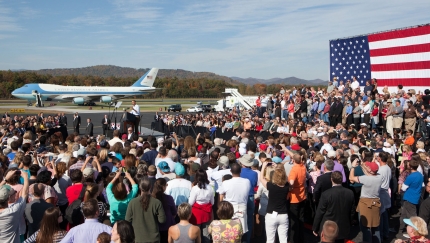
The first stop on the American Jobs Act Bus Tour was Asheville, North Carolina, a city of 76,000 located in the Blue Ridge Mountains.

Air Force One landed at Asheville Regional Airport, where President Obama was greeted by Senator Kay Hagan and Asheville Mayor Terry Bellamy. He spoke just before 11:00.

The American Jobs Act includes a proposal to provide $2 billion to improve safety, add capacity and modernize infrastructure at airports across the country .

Asheville Regional Airport could be eligible for $60 million of those funds. And as the President said, there's plenty of work to go around:

In this airport right here in Asheville, you've got a runway that needs to be widened and repaired. You've got a taxiway that's in the wrong spot –- which means that planes sometimes get too close together. So we could be doing some work right here at the Asheville Airport that would help boost tourism, help to boost the economy here, put people to work right now.

But it's not just here in Asheville. All across the state, you've got highways that need to be built. You've got bridges that need to be fixed. You've got schools that need to be modernized. And that's what America used to do best. We used to build things -- built the Transcontinental Railroad; built the Golden Gate Bridge; the Hoover Dam; the Grand Central Station. There's no reason why we should sit here and watch the best highways and the newest airports being built in China. We should be building them right here in the United States of America. Right here in North Carolina.

This afternoon, the President will stop for a BBQ lunch and later visit West Wilkes High School in Miller's Creek, North Carolina.

President Obama speaks at Asheville Regional Airport

President Barack Obama delivers remarks on the American Jobs Act at Asheville Regional Airport, Asheville, N.C., Oct. 17, 2011. The event kicks off the President’s three-day American Jobs Act Bus Tour. (Official White House Photo by Lawrence Jackson)

Related Topics: Economy, North Carolina

The White House

Office of the Press Secretary

Statement by the President on the Passing of Elouise Cobell

Michelle and I were saddened to hear about the passing of Elouise Cobell yesterday. Elouise spoke out when she saw that the Interior Department had failed to account for billions of dollars that they were supposed to collect on behalf of more than 300,000 of her fellow Native Americans. Because she did, I was able to sign into law a piece of legislation that finally provided a measure of justice to those who were affected. That law also creates a scholarship fund to give more Native Americans access to higher education, and give tribes more control over their own lands. Elouise helped to strengthen the government to government relationship with Indian Country, and our thoughts and prayers are with her family, and all those who mourn her passing.

The American Jobs Act Bus Tour

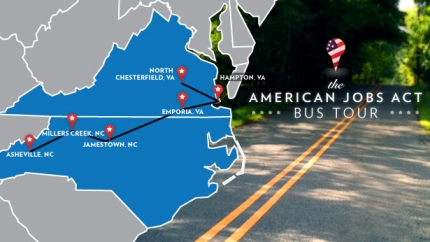
Bus Tour Map Graphic

President Obama begins the American Jobs Act Bus Tour this morning.

For three days, he'll tour cities in both North Carolina and Virginia -- visiting schools, an airport, a military base, and a fire station. He'll be talking about his plan to put Americans back to work, upgrade our country's infrastructure, and keep teachers and emergency responders on the job.

Last week, Senate Republicans voted to block the President's proposal, playing politics instead of working to grow our economy.

But this fight to create jobs and rebuild our nation's roads and bridges is far from over. On Wednesday, President Obama said:

We will keep organizing and we will keep pressuring and we will keep voting until this Congress finally meets its responsibilities and actually does something to put people back to work and improve the economy.

This bus tour puts a face on the teachers, firefighters, and police officers whose livelihoods are threatened by inaction.

The trip began this morning in Asheville, North Carolina and wraps up Wednesday in North Chesterfield, Virginia.

The first event was this morning at Asheville Regional Airport, where the President spoke about the need to upgrade the nation's infrastructure.

At 5:00 ET this afternoon, the President will speak from West Wilkes High School in Miller's Creek, North Carolina. You can watch those remarks live at whitehouse.gov/live.

You'll also be able to watch the President speak tomorrow from Guilford Technical Community College in Jamestown, North Carolina using the same link. On Wednesday, we'll also stream video of President Obama as he speaks at Joint Base Langley-Eustis in Hampton, Virginia and a firehouse in North Chesterfield, Virginia.


Related Topics: Economy, North Carolina, Virginia

President Obama at the Martin Luther King, Jr. Memorial Dedication: "We Will Overcome"

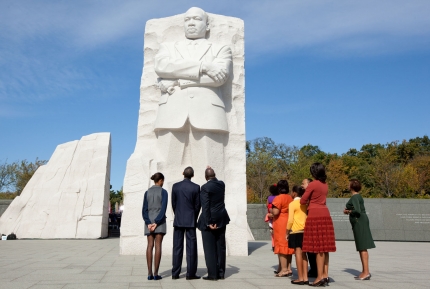
President Obama and the First Family tour the Martin Luther King Jr. National Memorial

President Barack Obama, First Lady Michelle Obama, daughters Sasha and Malia, and Marian Robinson tour the Martin Luther King Jr. National Memorial before the dedication ceremony in Washington, D.C., Sunday, Oct. 16, 2011. (Official White House Photo by Chuck Kennedy)

Today, nearly half a century after Martin Luther King, Jr. led the historic March on Washington for equality, tens of thousands came to the National Mall in Washington, D.C. for the Martin Luther King, Jr. Memorial Dedication. The memorial to Dr. King has been open since August, but the dedication was delayed due to Hurricane Irene. As President Obama said, though delayed, "this is a day that would not be denied."

President Obama, joined by the First Family, toured the memorial and then spoke at the dedication ceremony in honor of Dr. King's work to make his dream a reality for all. During his speech, President Obama reminded us that the progress towards Dr. King's vision has not come easily and there is still more to do to expand opportunity and make our nation more just:

Our work is not done.  And so on this day, in which we celebrate a man and a movement that did so much for this country, let us draw strength from those earlier struggles.  First and foremost, let us remember that change has never been quick.  Change has never been simple, or without controversy.  Change depends on persistence.  Change requires determination.  It took a full decade before the moral guidance of Brown v. Board of Education was translated into the enforcement measures of the Civil Rights Act and the Voting Rights Act, but those 10 long years did not lead Dr. King to give up.  He kept on pushing, he kept on speaking, he kept on marching until change finally came. 

And then when, even after the Civil Rights Act and the Voting Rights Act passed, African Americans still found themselves trapped in pockets of poverty across the country, Dr. King didn’t say those laws were a failure; he didn’t say this is too hard; he didn’t say, let’s settle for what we got and go home.  Instead he said, let’s take those victories and broaden our mission to achieve not just civil and political equality but also economic justice; let’s fight for a living wage and better schools and jobs for all who are willing to work.  In other words, when met with hardship, when confronting disappointment, Dr. King refused to accept what he called the “isness” of today.  He kept pushing towards the “oughtness” of tomorrow.

And so, as we think about all the work that we must do –- rebuilding an economy that can compete on a global stage, and fixing our schools so that every child -- not just some, but every child -- gets a world-class education, and making sure that our health care system is affordable and accessible to all, and that our economic system is one in which everybody gets a fair shake and everybody does their fair share, let us not be trapped by what is.  We can’t be discouraged by what is.  We’ve got to keep pushing for what ought to be, the America we ought to leave to our children, mindful that the hardships we face are nothing compared to those Dr. King and his fellow marchers faced 50 years ago, and that if we maintain our faith, in ourselves and in the possibilities of this nation, there is no challenge we cannot surmount.

Related Topics: Civil Rights, Economy, Service

President Obama Delivers Remarks at the Martin Luther King, Jr. Memorial Dedication

October 16, 2011 | 20:22 | Public Domain

In his remarks at The National Mall President Obama said, "For this day, we celebrate Dr. Martin Luther King, Jr.'s return to the National Mall. In this place, he will stand for all time, among monuments to those who fathered this nation and those who defended it; a black preacher with no official rank or title who somehow gave voice to our deepest dreams and our most lasting ideals, a man who stirred our conscience and thereby helped make our union more perfect."

Download mp4 (194MB) | mp3 (19MB)

The White House

Office of the Press Secretary

Remarks by the President at the Martin Luther King, Jr. Memorial Dedication

The National Mall
Washington, D.C.

11:51 A.M. EDT

THE PRESIDENT:  Thank you very much.  (Applause.)  Thank you.  (Applause.)  Please be seated.

An earthquake and a hurricane may have delayed this day, but this is a day that would not be denied.

For this day, we celebrate Dr. Martin Luther King, Jr.’s return to the National Mall.  In this place, he will stand for all time, among monuments to those who fathered this nation and those who defended it; a black preacher with no official rank or title who somehow gave voice to our deepest dreams and our most lasting ideals, a man who stirred our conscience and thereby helped make our union more perfect.

And Dr. King would be the first to remind us that this memorial is not for him alone.  The movement of which he was a part depended on an entire generation of leaders.  Many are here today, and for their service and their sacrifice, we owe them our everlasting gratitude.  This is a monument to your collective achievement.  (Applause.)

Some giants of the civil rights movement –- like Rosa Parks and Dorothy Height, Benjamin Hooks, Reverend Fred Shuttlesworth –- they’ve been taken from us these past few years.  This monument attests to their strength and their courage, and while we miss them dearly, we know they rest in a better place. 

And finally, there are the multitudes of men and women whose names never appear in the history books –- those who marched and those who sang, those who sat in and those who stood firm, those who organized and those who mobilized –- all those men and women who through countless acts of quiet heroism helped bring about changes few thought were even possible. “By the thousands,” said Dr. King, “faceless, anonymous, relentless young people, black and white…have taken our whole nation back to those great wells of democracy which were dug deep by the founding fathers in the formulation of the Constitution and the Declaration of Independence.”  To those men and women, to those foot soldiers for justice, know that this monument is yours, as well.

Nearly half a century has passed since that historic March on Washington, a day when thousands upon thousands gathered for jobs and for freedom.  That is what our schoolchildren remember best when they think of Dr. King -– his booming voice across this Mall, calling on America to make freedom a reality for all of God’s children, prophesizing of a day when the jangling discord of our nation would be transformed into a beautiful symphony of brotherhood.

It is right that we honor that march, that we lift up Dr. King’s “I Have a Dream” speech –- for without that shining moment, without Dr. King’s glorious words, we might not have had the courage to come as far as we have.  Because of that hopeful vision, because of Dr. King’s moral imagination, barricades began to fall and bigotry began to fade.  New doors of opportunity swung open for an entire generation.  Yes, laws changed, but hearts and minds changed, as well. 

Look at the faces here around you, and you see an America that is more fair and more free and more just than the one Dr. King addressed that day.  We are right to savor that slow but certain progress -– progress that’s expressed itself in a million ways, large and small, across this nation every single day, as people of all colors and creeds live together, and work together, and fight alongside one another, and learn together, and build together, and love one another.

So it is right for us to celebrate today Dr. King’s dream and his vision of unity.  And yet it is also important on this day to remind ourselves that such progress did not come easily; that Dr. King’s faith was hard-won; that it sprung out of a harsh reality and some bitter disappointments. 

It is right for us to celebrate Dr. King’s marvelous oratory, but it is worth remembering that progress did not come from words alone.  Progress was hard.  Progress was purchased through enduring the smack of billy clubs and the blast of fire hoses.  It was bought with days in jail cells and nights of bomb threats.  For every victory during the height of the civil rights movement, there were setbacks and there were defeats. 

We forget now, but during his life, Dr. King wasn’t always considered a unifying figure.  Even after rising to prominence, even after winning the Nobel Peace Prize, Dr. King was vilified by many, denounced as a rabble rouser and an agitator, a communist and a radical.  He was even attacked by his own people, by those who felt he was going too fast or those who felt he was going too slow; by those who felt he shouldn’t meddle in issues like the Vietnam War or the rights of union workers.  We know from his own testimony the doubts and the pain this caused him, and that the controversy that would swirl around his actions would last until the fateful day he died.

I raise all this because nearly 50 years after the March on Washington, our work, Dr. King’s work, is not yet complete.  We gather here at a moment of great challenge and great change.  In the first decade of this new century, we have been tested by war and by tragedy; by an economic crisis and its aftermath that has left millions out of work, and poverty on the rise, and millions more just struggling to get by.  Indeed, even before this crisis struck, we had endured a decade of rising inequality and stagnant wages.  In too many troubled neighborhoods across the country, the conditions of our poorest citizens appear little changed from what existed 50 years ago -– neighborhoods with underfunded schools and broken-down slums, inadequate health care, constant violence, neighborhoods in which too many young people grow up with little hope and few prospects for the future.

Our work is not done.  And so on this day, in which we celebrate a man and a movement that did so much for this country, let us draw strength from those earlier struggles.  First and foremost, let us remember that change has never been quick.  Change has never been simple, or without controversy.  Change depends on persistence.  Change requires determination.  It took a full decade before the moral guidance of Brown v. Board of Education was translated into the enforcement measures of the Civil Rights Act and the Voting Rights Act, but those 10 long years did not lead Dr. King to give up.  He kept on pushing, he kept on speaking, he kept on marching until change finally came.  (Applause.)

And then when, even after the Civil Rights Act and the Voting Rights Act passed, African Americans still found themselves trapped in pockets of poverty across the country, Dr. King didn’t say those laws were a failure; he didn’t say this is too hard; he didn’t say, let’s settle for what we got and go home.  Instead he said, let’s take those victories and broaden our mission to achieve not just civil and political equality but also economic justice; let’s fight for a living wage and better schools and jobs for all who are willing to work.  In other words, when met with hardship, when confronting disappointment, Dr. King refused to accept what he called the “isness” of today.  He kept pushing towards the “oughtness” of tomorrow.

And so, as we think about all the work that we must do –- rebuilding an economy that can compete on a global stage, and fixing our schools so that every child -- not just some, but every child -- gets a world-class education, and making sure that our health care system is affordable and accessible to all, and that our economic system is one in which everybody gets a fair shake and everybody does their fair share, let us not be trapped by what is.  (Applause.)  We can’t be discouraged by what is.  We’ve got to keep pushing for what ought to be, the America we ought to leave to our children, mindful that the hardships we face are nothing compared to those Dr. King and his fellow marchers faced 50 years ago, and that if we maintain our faith, in ourselves and in the possibilities of this nation, there is no challenge we cannot surmount.

And just as we draw strength from Dr. King’s struggles, so must we draw inspiration from his constant insistence on the oneness of man; the belief in his words that “we are caught in an inescapable network of mutuality, tied in a single garment of destiny.”  It was that insistence, rooted in his Christian faith, that led him to tell a group of angry young protesters, “I love you as I love my own children,” even as one threw a rock that glanced off his neck. 

It was that insistence, that belief that God resides in each of us, from the high to the low, in the oppressor and the oppressed, that convinced him that people and systems could change.  It fortified his belief in non-violence.  It permitted him to place his faith in a government that had fallen short of its ideals.  It led him to see his charge not only as freeing black America from the shackles of discrimination, but also freeing many Americans from their own prejudices, and freeing Americans of every color from the depredations of poverty.
    
And so at this moment, when our politics appear so sharply polarized, and faith in our institutions so greatly diminished, we need more than ever to take heed of Dr. King’s teachings.  He calls on us to stand in the other person’s shoes; to see through their eyes; to understand their pain.  He tells us that we have a duty to fight against poverty, even if we are well off; to care about the child in the decrepit school even if our own children are doing fine; to show compassion toward the immigrant family, with the knowledge that most of us are only a few generations removed from similar hardships.  (Applause.)

To say that we are bound together as one people, and must constantly strive to see ourselves in one another, is not to argue for a false unity that papers over our differences and ratifies an unjust status quo.  As was true 50 years ago, as has been true throughout human history, those with power and privilege will often decry any call for change as “divisive.”  They’ll say any challenge to the existing arrangements are unwise and destabilizing.  Dr. King understood that peace without justice was no peace at all; that aligning our reality with our ideals often requires the speaking of uncomfortable truths and the creative tension of non-violent protest.

But he also understood that to bring about true and lasting change, there must be the possibility of reconciliation; that any social movement has to channel this tension through the spirit of love and mutuality. 

If he were alive today, I believe he would remind us that the unemployed worker can rightly challenge the excesses of Wall Street without demonizing all who work there; that the businessman can enter tough negotiations with his company’s union without vilifying the right to collectively bargain.  He would want us to know we can argue fiercely about the proper size and role of government without questioning each other’s love for this country -- (applause) -- with the knowledge that in this democracy, government is no distant object but is rather an expression of our common commitments to one another.  He would call on us to assume the best in each other rather than the worst, and challenge one another in ways that ultimately heal rather than wound.

In the end, that’s what I hope my daughters take away from this monument.  I want them to come away from here with a faith in what they can accomplish when they are determined and working for a righteous cause.  I want them to come away from here with a faith in other people and a faith in a benevolent God.  This sculpture, massive and iconic as it is, will remind them of Dr. King’s strength, but to see him only as larger than life would do a disservice to what he taught us about ourselves.  He would want them to know that he had setbacks, because they will have setbacks.  He would want them to know that he had doubts, because they will have doubts.  He would want them to know that he was flawed, because all of us have flaws.

It is precisely because Dr. King was a man of flesh and blood and not a figure of stone that he inspires us so.  His life, his story, tells us that change can come if you don’t give up.  He would not give up, no matter how long it took, because in the smallest hamlets and the darkest slums, he had witnessed the highest reaches of the human spirit; because in those moments when the struggle seemed most hopeless, he had seen men and women and children conquer their fear; because he had seen hills and mountains made low and rough places made plain, and the crooked places made straight and God make a way out of no way.

And that is why we honor this man –- because he had faith in us.  And that is why he belongs on this Mall -– because he saw what we might become.  That is why Dr. King was so quintessentially American -- because for all the hardships we’ve endured, for all our sometimes tragic history, ours is a story of optimism and achievement and constant striving that is unique upon this Earth.  And that is why the rest of the world still looks to us to lead.  This is a country where ordinary people find in their hearts the courage to do extraordinary things; the courage to stand up in the face of the fiercest resistance and despair and say this is wrong, and this is right; we will not settle for what the cynics tell us we have to accept and we will reach again and again, no matter the odds, for what we know is possible.

That is the conviction we must carry now in our hearts.  (Applause.)  As tough as times may be, I know we will overcome.  I know there are better days ahead.  I know this because of the man towering over us.  I know this because all he and his generation endured -- we are here today in a country that dedicated a monument to that legacy. 

And so with our eyes on the horizon and our faith squarely placed in one another, let us keep striving; let us keep struggling; let us keep climbing toward that promised land of a nation and a world that is more fair, and more just, and more equal for every single child of God.

Thank you, God bless you, and God bless the United States of America.  (Applause.) 

END
12:12 P.M. EDT

The King Memorial: A Symbol of the Best in America

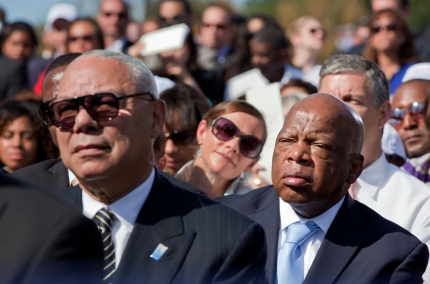
Rep John Lewis

Rep. John Lewis, D-Ga., attends the dedication ceremony for the Martin Luther King Jr. National Memorial in Washington, D.C., Sunday, Oct. 16, 2011. Colin Powell, left, and Secretary of Education Arne Duncan are also pictured. (Official White House Photo by Pete Souza)

On August 28, 1963, the day of the March on Washington, all of the platform speakers were invited to the White House to meet with President John F. Kennedy.  A few months earlier I had made my very first trip to the White House. I was only 23-years-old and also the brand-new chairman of the Student Non-Violent Coordinating Committee.  It was amazing.  A week into my new job I was headed to the White House to meet President Kennedy. 

I was with five other great men, including Martin Luther King Jr., Roy Wilkins, James Farmer, and Whitney Young, known as the Big Six leaders of the movement.  There were many women who were instrumental to our plans to march and many heroines of the movement, including Coretta Scott King, Fannie Lou Hamer, Dorothy Height, Ella Baker and Diane Nash.  However, as was customary in those times, none of them were in the room that day.  We told President Kennedy the people could not wait any longer.  We were planning to call on thousands to march on Washington. 

President Kennedy was visibly concerned.  He was sitting in the Oval Office in his rocking chair, and he began to rock a little more briskly.  He was concerned about violence.  He wanted to cool down rising tensions, but A. Philip Randolph, the founder of the Brotherhood of Pullman Car Porters, the dean of our movement, and the visionary behind the march assured him this would be a lawful, peaceful, non-violent march.  I will never forget.  Randolph told him, we could not wait any longer.  “Mr. President, he said, “if we cool down any more we will be in a deep freeze.”

After the largest march Washington had ever seen, the President stood in the door of his office relaxed and beaming.  He shook each hand and said, “You did a good job.  You did a good job.”  But when he got to Martin Luther King Jr. he said, “And you had a dream.”

Related Topics: Civil Rights, Service, Georgia