President Obama on the American Jobs Act in Chesterfield, Virginia

October 19, 2011 | 17:51 | Public Domain

Sixth stop on the American Jobs Act Bus Tour.

Download mp4 (171MB) | mp3 (16MB)

Read the Transcript

Remarks by the President on the American Jobs Act

Fire Station 9
North Chesterfield, Virginia 

2:29 P.M. EDT

THE PRESIDENT:  Hello, everybody! 

AUDIENCE:  Hello!

THE PRESIDENT:  It is good to be in Chesterfield County.  Thank you so much for the wonderful welcome. 

AUDIENCE MEMBER:  We love you!

THE PRESIDENT:  Well, I love you back.  (Laughter.) 

It is great to be in Virginia.  It is great to be here at Fire Station #9 with some of Chesterfield’s finest.  (Applause.)

AUDIENCE MEMBER: Ooh-ah!

THE PRESIDENT:  There you go.  

First of all, I want to thank Chief Urquhart not only for the introduction, but for the great service that he's been providing for -- 22 years, is it?

CHIEF URQUHART:  Yes, sir.

THE PRESIDENT:  -- 22 years.  Give him a big round of applause.  (Applause.)  And I want to say thank you to the Chief of Chesterfield County Fire and EMS, Loy Senter.  Give him a big round of applause.  (Applause.)  I appreciate opening up the firehouse here today.  But if the bell goes off, just ignore me, do your thing.  (Laughter.)   

We’ve been on a little road trip over the last few days.  I've got a pretty nice ride -- it's not your normal RV.  And it's parked outside.  We’ve been seeing some sights; we've been eating some good food.  Most importantly, we've been getting a chance to hear from the American people.  And it’s always nice to spend a few days outside of Washington, because it doesn’t seem like your voices are being heard the way they need to be heard in Washington. 

Times are tough all over, and a lot of folks here in Virginia have spent months looking for work.  Others are just barely making it -- and they're having to make hard choices and they're having to make sacrifices.  It’s hard, obviously, watching friends or family or neighbors who are struggling.  And all of us, I think, are mindful of the fact that the economy is not where it needs to be. 

I think most people understand that the economy and its problems didn’t happen overnight, so we're not going to solve all these challenges overnight.  It's going to take time to rebuild the kind of America in which everybody has a fair shot, everybody is paying their fair share; where responsibility is rewarded; where the deck is not stacked against middle-class families -- in fact, we have a middle class that is growing again and solid again and secure again, and people who are striving to get in the middle class have ladders of opportunity.  That's what we're striving for.

We're going to keep on fighting, we're going to keep on working to make sure that we've got the kind of economy that works for everybody, and not just some.  And here's the good news:  There are things we can do right now that will make a difference.  There are things that we can do right now that will put people back to work.  There are things we can do right now that will make sure that we are competitive in this global economy.

Some of the challenges we face we're going to have to work on for a while -- improving our schools, making sure that we've got the best infrastructure in the world, making sure that we're bringing down our deficit, making sure that we're continuing to invest in science and technology.  But there are things we can do right now that will make a difference.

And that’s why I sent to Congress the American Jobs Act.  (Applause.)  You can go ahead and clap.  Go ahead, nothing wrong with it.  (Applause.)

This is a jobs bill that contains the kind of proposals that in the past, at least, have been supported by Democrats and Republicans alike.  It’s paid for.  It will not add to our deficit.  And it's paid for by asking the wealthiest of us -- people like me -- to be able to put in a little bit more so that we can make sure that folks who are struggling get the help they need, and that the economy overall is improving.

Independent economists have said it will create nearly 2 million jobs.  That’s not my opinion.  That's not the opinion of people who work for me and have to tell me what I want to hear.  (Laughter.)  This is the opinion of independent economists.  They say it will help the economy grow.  People who study the economy for a living say this would give the economy the jolt that it needs.  

Now, a number of people have been asking during the course of this road trip, why have you been visiting some of the most Republican parts of North Carolina and Virginia?  And what I’ve had to remind them is that I’m not the Democratic President, I’m not the Republican President -- I’m the President of the United States of America.  (Applause.)  And I don’t care what party you belong to -- we’re all Americans and we’re all in this together. 

And that’s why we didn't call this the Democratic jobs plan or the Republican jobs plan -- we called it the American Jobs Act.  (Applause.)  We need to put people to work right now.  I think most Americans understand that.  A recent poll showed that 63 percent of the American people support what’s in the American Jobs Act.  Unfortunately, we’ve had 100 percent of Senate Republicans vote against it.  A majority think it’s a good idea to keep firefighters on the job.  (Applause.) 

As tough as the economy may be, I think people may not be aware -- for the last 19 months we’ve had private sector job growth.  We’ve seen more than 2 million jobs created in the private sector.  The problem is that state and local governments have been very hard pressed, and so they are cutting back on firefighters, police officers, teachers.  And that’s one of the biggest challenges we have -- not only because these folks sacrifice for us and provide extraordinary service to us, but also they go to restaurants and they go to the hardware store and they pay a mortgage.  And so if folks in the -- if we’ve got firefighters or police officers or teachers who are being laid off, that hurts the small business person down the street.  That means that somebody may have their home foreclosed on, and that brings property values down for everybody.   

So the provisions that we’ve got in the bill are ones that most people support -- keeping firefighters in the job; keeping cops on the job; putting teachers back in the classroom; giving tax cuts to families; giving tax cuts to small businesses; giving tax cuts to businesses who hire our veterans.  I just came from Hampton and we were down there talking to folks who have served our country -- this 9/11 generation -- and are coming back after making all those sacrifices and are finding themselves fighting for work.  We’ve got to do something about that.

The question is why Congress isn’t willing to move.  I just want to be fair -- I sent Congress the American Jobs Act and then my Republican friends put out a plan of their own, and they started out calling it "the Real American Jobs Act."  So they don't get points for originality.  (Laughter.)  But I did say, well, let’s see what you’ve got.  What are your ideas?  And the primary ideas in their jobs plan was to roll back regulations that keep our air and water clean; to go back to the system we had in Wall Street that caused this crisis in the first place --

AUDIENCE:  Nooo --

THE PRESIDENT:  -- to end the health care reform that we passed that will provide 30 million people health insurance and make sure that insurance companies can't take advantage of you.

Now, that is a plan, but it's not a jobs plan.  We can have an argument about health care, or we can have an argument about environmental regulations, but we can't pretend that that's going to actually put people back to work.  And that's the number-one priority that the American people have right now.

Their plan says that somehow if we eliminate regulations that keep our air and water clean for our kids, that that's going to help job growth.  My plan says, let's hire construction workers and put them back to work rebuilding roads and bridges and schools and fire stations all across the country.  (Applause.)

Their plan says that if we roll back health care reform, that somehow jobs are going to be created.  My plan says, let's give a tax cut to small businesses to hire the long-term unemployed and our veterans, and make sure that they've got a little more money to keep their doors open, expand their payroll, expand their inventory, get this economy moving.

Their plan says let's go back to a system on Wall Street where there were the kinds of rules that allowed people to take reckless bets that ended up affecting all of Main Street.  My attitude is, to strengthen this economy we've got to make sure that those rules are actually enforced, not watered down, and in the meantime, let's work to make sure that we're keeping taxes low for middle-class families who are still struggling to get by.

I just want to repeat:  dirtier air, dirtier water, fewer people on health care, less accountability on Wall Street -- that is not a jobs plan. 

I understand that some of my Republican friends feel very strongly about these ideas.  I'm happy to have a debate.  But in the meantime, let's focus on what will actually put people back to work.  Keeping first responders on the job -- that's a jobs plan.  (Applause.)  Putting more teachers in the classroom -- that's a jobs plan.  (Applause.) 

So what we decided to do, since 100 percent of Republicans in the Senate voted against this plan the first time, is we're going to give them another chance to listen to you.  We're going to let them vote on each of these ideas separately, and we'll see if they fight just as hard for your jobs as they fight for their own jobs. 

AUDIENCE:  Right!

THE PRESIDENT:  So the first vote we're going to ask Congress to take this week would put hundreds of thousands of firefighters back on the job, police officers back on the street, teachers back in the classroom. 

Now, Chesterfield has been lucky.  It isn't facing layoffs right now.  But a lot of these guys have seen their pay frozen.  You've got cities and states like Michigan and New Jersey that have had to lay off big chunks of their forces.  That means that firefighters can't always get to fires before they become major fires.  And that makes their job more dangerous.  It means police officers can't respond to every crime.  And when giving our children the best education possible we know is the ingredient for success in this new information and technology-rich economy, how can we be laying off teachers -- when other countries are hiring teachers in droves?  It's unfair to our kids.  It undermines our future.

So this week Congress is going to get to vote on whether or not hundreds of thousands of police officers and teachers and firefighters get back on the job.  And I don't know if these members of Congress -- maybe they haven't met some of these firefighters.  I don't think they want to tell them that their jobs aren’t worth saving.  Some of these guys are pretty big.  (Laughter.)  Captain Kemp is an ex-Marine -- which means he's still a Marine.  And these guys are risking their lives every day on our behalf.  These jobs are worth fighting for. 

Folks in Congress are also going to get a chance to decide  -- later in the month -- whether our construction workers should sit around doing nothing while China builds the best railroads, the best schools, the best airports in the world. 

We used to have the best stuff.  Think about -- the world used to say, let's travel to America.  Let's see the Golden Gate Bridge.  Let's see the Hoover Dam.  Let's see these amazing things that America built.  Are we going to be the generation where we stop building?  Where we've got rundown roads and bridges that are deemed obsolete?  That's not who America is. 

So Congress will have a chance to see if they want to put Americans back to work doing the work that America needs done.

They say that they value our veterans.  When I went before the joint Congress to present this American Jobs Act I said, let's give tax breaks to companies that are hiring our veterans. And we just got 25,000 -- a pledge of 25,000 jobs from companies all across the country, aiming for a goal of 100,000 veterans being hired by the end of 2013.  (Applause.)

So when I talked about this part of the plan before the joint session of Congress, everybody rose up -- Democrats and Republicans alike.  So the question now is, if you all stood and applauded, how are you going to vote?  It's not enough to applaud and go to a Veterans Day parade.  People need help.  And you've got a chance to help them right now.

These are the choices that Congress will be presented with in the next few weeks.  And if they vote against these proposals, if they say no to steps we know that will put people back to work right now, they're not going to have to answer to me -- they're going to have to answer to you.   They're going to have to come down here and tell folks in Virginia and all across the country why people are going to have to cope with fewer first responders; why your kids can’t have teachers back in the classroom.  They’re going to have to look construction workers in the eye and tell them why they’re sitting idle instead of rebuilding infrastructure that we know needs to be rebuilt. 

And they’re going to have to explain why we couldn’t afford to do it when we know that we can pay for all of this, plus keep taxes on middle-class families low, prevent them from going up, and all we have to do in order to pay for it is make sure the people like me are paying our fair share of taxes, and that companies no longer are getting special tax loopholes.  That’s it.

So when you hear that, well, the reason we’re not supporting it, we like the ideas but we don’t want to see higher taxes -- if we don’t pass this bill, taxes for the average family will go up, because the payroll tax cut that we passed in December will lapse.  If we do pass this bill, for 97, 98 percent of Americans, your taxes will stay low.  My taxes will go up a little bit, but I can afford it. 

A fair shot for everybody; a fair share from everybody -- that’s a principle that built America.  That’s how we created a middle class.

Now, they can do the right thing in Congress and put people back to work right now and reopen firehouses.  But I’m going to need your help.  I need you -- and that’s the reason I’m here.  It’s wonderful to have a chance to see everybody and shake hands and take pictures.  But the main reason I’m here is I want you to send a message to Congress that this is important.  Let them know.  Or get on the phone, write a letter, fax, tweet -- whatever it is that people do these days -- (laughter) -- and remind members of Congress what’s at stake here.

You know, it takes a special kind of bravery to be a firefighter.  When that bell rings, it takes a special kind of courage to answer the call and rush, at great risk to yourself, to help your fellow citizens.  And you know what, that’s the same kind of spirit that I believe embodies America -- looking out for one another, helping each other, being willing to make sacrifices for the greater good.  When our friends and neighbors are hurting, we don’t cross our arms and just do nothing.  We roll up our sleeves and we say we’re going to help; we’ll figure out how to solve this problem.  We are not people who sit idly by and ignore our challenges.  We step up and we meet those challenges. And that’s the opportunity we have right now.  (Applause.)

So I hope everybody is with us.  We hope that you are willing to contact your members of Congress.  Tell them to get busy.  Tell them to get to work.  Tell them to put people back to work.  And let’s show the world once again why the United States of America is the greatest country on Earth.  (Applause.)  

Thank you.  God bless you.  And God bless the United States of America.  Thank you very much.  (Applause.)

END
2:48 P.M. EDT

Close Transcript

The American Jobs Act Bus Tour: President Obama at Fire Station 9

2011 AJA Bus Tour Chesterfield

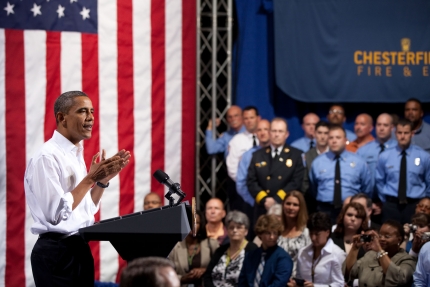
In Chesterfield, Virginia, President Obama stopped by Fire Station 9 to talk about the challenge facing police and fire fighters across the country.

In too many communities, local governments have made the choice to respond to tough economic times by cutting police forces and scaling back fire stations. Speaking to a crowd that included around 100 first responders, the President called the situation "dangerous":

Now, Chesterfield has been lucky. It isn't facing layoffs right now. But a lot of these guys have seen their pay frozen. You've got cities and states like Michigan and New Jersey that have had to lay off big chunks of their forces. That means that firefighters can't always get to fires before they become major fires. And that makes their job more dangerous. It means police officers can't respond to every crime. And when giving our children the best education possible we know is the ingredient for success in this new information and technology-rich economy, how can we be laying off teachers -- when other countries are hiring teachers in droves? It's unfair to our kids. It undermines our future.

The first piece of the American Jobs Act -- a $35 billion proposal to help keep teachers and first responders on the job-- is designed to tackle that problem and ensure that public safety isn't put at risk.

It is currently in the Senate.

And in Chesterfield, President Obama pressed Congress to take action right away:

[If] they vote against these proposals, if they say no to steps we know that will put people back to work right now, they're not going to have to answer to me -- they're going to have to answer to you. They're going to have to come down here and tell folks in Virginia and all across the country why people are going to have to cope with fewer first responders; why your kids can’t have teachers back in the classroom. They’re going to have to look construction workers in the eye and tell them why they’re sitting idle instead of rebuilding infrastructure that we know needs to be rebuilt.

President Obama on the American Jobs Act at Fire Station No. 9 in Virginia

President Barack Obama delivers remarks on the American Jobs Act at Fire Station No. 9 in North Chesterfield, Virginia during the American Jobs Act bus tour, Oct. 19, 2011. (Official White House Photo by Pete Souza)

Today, Senator Harry Reid, the Majority Leader, announced that the legislation could see a vote as soon as Friday.

The White House

Office of the Press Secretary

Remarks by the President on the American Jobs Act

Fire Station 9
North Chesterfield, Virginia 

2:29 P.M. EDT

THE PRESIDENT:  Hello, everybody! 

AUDIENCE:  Hello!

THE PRESIDENT:  It is good to be in Chesterfield County.  Thank you so much for the wonderful welcome. 

AUDIENCE MEMBER:  We love you!

THE PRESIDENT:  Well, I love you back.  (Laughter.) 

It is great to be in Virginia.  It is great to be here at Fire Station #9 with some of Chesterfield’s finest.  (Applause.)

AUDIENCE MEMBER: Ooh-ah!

THE PRESIDENT:  There you go.  

First of all, I want to thank Chief Urquhart not only for the introduction, but for the great service that he's been providing for -- 22 years, is it?

CHIEF URQUHART:  Yes, sir.

THE PRESIDENT:  -- 22 years.  Give him a big round of applause.  (Applause.)  And I want to say thank you to the Chief of Chesterfield County Fire and EMS, Loy Senter.  Give him a big round of applause.  (Applause.)  I appreciate opening up the firehouse here today.  But if the bell goes off, just ignore me, do your thing.  (Laughter.)   

We’ve been on a little road trip over the last few days.  I've got a pretty nice ride -- it's not your normal RV.  And it's parked outside.  We’ve been seeing some sights; we've been eating some good food.  Most importantly, we've been getting a chance to hear from the American people.  And it’s always nice to spend a few days outside of Washington, because it doesn’t seem like your voices are being heard the way they need to be heard in Washington. 

Times are tough all over, and a lot of folks here in Virginia have spent months looking for work.  Others are just barely making it -- and they're having to make hard choices and they're having to make sacrifices.  It’s hard, obviously, watching friends or family or neighbors who are struggling.  And all of us, I think, are mindful of the fact that the economy is not where it needs to be. 

I think most people understand that the economy and its problems didn’t happen overnight, so we're not going to solve all these challenges overnight.  It's going to take time to rebuild the kind of America in which everybody has a fair shot, everybody is paying their fair share; where responsibility is rewarded; where the deck is not stacked against middle-class families -- in fact, we have a middle class that is growing again and solid again and secure again, and people who are striving to get in the middle class have ladders of opportunity.  That's what we're striving for.

We're going to keep on fighting, we're going to keep on working to make sure that we've got the kind of economy that works for everybody, and not just some.  And here's the good news:  There are things we can do right now that will make a difference.  There are things that we can do right now that will put people back to work.  There are things we can do right now that will make sure that we are competitive in this global economy.

Some of the challenges we face we're going to have to work on for a while -- improving our schools, making sure that we've got the best infrastructure in the world, making sure that we're bringing down our deficit, making sure that we're continuing to invest in science and technology.  But there are things we can do right now that will make a difference.

And that’s why I sent to Congress the American Jobs Act.  (Applause.)  You can go ahead and clap.  Go ahead, nothing wrong with it.  (Applause.)

This is a jobs bill that contains the kind of proposals that in the past, at least, have been supported by Democrats and Republicans alike.  It’s paid for.  It will not add to our deficit.  And it's paid for by asking the wealthiest of us -- people like me -- to be able to put in a little bit more so that we can make sure that folks who are struggling get the help they need, and that the economy overall is improving.

Independent economists have said it will create nearly 2 million jobs.  That’s not my opinion.  That's not the opinion of people who work for me and have to tell me what I want to hear.  (Laughter.)  This is the opinion of independent economists.  They say it will help the economy grow.  People who study the economy for a living say this would give the economy the jolt that it needs.  

Now, a number of people have been asking during the course of this road trip, why have you been visiting some of the most Republican parts of North Carolina and Virginia?  And what I’ve had to remind them is that I’m not the Democratic President, I’m not the Republican President -- I’m the President of the United States of America.  (Applause.)  And I don’t care what party you belong to -- we’re all Americans and we’re all in this together. 

And that’s why we didn't call this the Democratic jobs plan or the Republican jobs plan -- we called it the American Jobs Act.  (Applause.)  We need to put people to work right now.  I think most Americans understand that.  A recent poll showed that 63 percent of the American people support what’s in the American Jobs Act.  Unfortunately, we’ve had 100 percent of Senate Republicans vote against it.  A majority think it’s a good idea to keep firefighters on the job.  (Applause.) 

As tough as the economy may be, I think people may not be aware -- for the last 19 months we’ve had private sector job growth.  We’ve seen more than 2 million jobs created in the private sector.  The problem is that state and local governments have been very hard pressed, and so they are cutting back on firefighters, police officers, teachers.  And that’s one of the biggest challenges we have -- not only because these folks sacrifice for us and provide extraordinary service to us, but also they go to restaurants and they go to the hardware store and they pay a mortgage.  And so if folks in the -- if we’ve got firefighters or police officers or teachers who are being laid off, that hurts the small business person down the street.  That means that somebody may have their home foreclosed on, and that brings property values down for everybody.   

So the provisions that we’ve got in the bill are ones that most people support -- keeping firefighters in the job; keeping cops on the job; putting teachers back in the classroom; giving tax cuts to families; giving tax cuts to small businesses; giving tax cuts to businesses who hire our veterans.  I just came from Hampton and we were down there talking to folks who have served our country -- this 9/11 generation -- and are coming back after making all those sacrifices and are finding themselves fighting for work.  We’ve got to do something about that.

The question is why Congress isn’t willing to move.  I just want to be fair -- I sent Congress the American Jobs Act and then my Republican friends put out a plan of their own, and they started out calling it "the Real American Jobs Act."  So they don't get points for originality.  (Laughter.)  But I did say, well, let’s see what you’ve got.  What are your ideas?  And the primary ideas in their jobs plan was to roll back regulations that keep our air and water clean; to go back to the system we had in Wall Street that caused this crisis in the first place --

AUDIENCE:  Nooo --

THE PRESIDENT:  -- to end the health care reform that we passed that will provide 30 million people health insurance and make sure that insurance companies can't take advantage of you.

Now, that is a plan, but it's not a jobs plan.  We can have an argument about health care, or we can have an argument about environmental regulations, but we can't pretend that that's going to actually put people back to work.  And that's the number-one priority that the American people have right now.

Their plan says that somehow if we eliminate regulations that keep our air and water clean for our kids, that that's going to help job growth.  My plan says, let's hire construction workers and put them back to work rebuilding roads and bridges and schools and fire stations all across the country.  (Applause.)

Their plan says that if we roll back health care reform, that somehow jobs are going to be created.  My plan says, let's give a tax cut to small businesses to hire the long-term unemployed and our veterans, and make sure that they've got a little more money to keep their doors open, expand their payroll, expand their inventory, get this economy moving.

Their plan says let's go back to a system on Wall Street where there were the kinds of rules that allowed people to take reckless bets that ended up affecting all of Main Street.  My attitude is, to strengthen this economy we've got to make sure that those rules are actually enforced, not watered down, and in the meantime, let's work to make sure that we're keeping taxes low for middle-class families who are still struggling to get by.

I just want to repeat:  dirtier air, dirtier water, fewer people on health care, less accountability on Wall Street -- that is not a jobs plan. 

I understand that some of my Republican friends feel very strongly about these ideas.  I'm happy to have a debate.  But in the meantime, let's focus on what will actually put people back to work.  Keeping first responders on the job -- that's a jobs plan.  (Applause.)  Putting more teachers in the classroom -- that's a jobs plan.  (Applause.) 

So what we decided to do, since 100 percent of Republicans in the Senate voted against this plan the first time, is we're going to give them another chance to listen to you.  We're going to let them vote on each of these ideas separately, and we'll see if they fight just as hard for your jobs as they fight for their own jobs. 

AUDIENCE:  Right!

THE PRESIDENT:  So the first vote we're going to ask Congress to take this week would put hundreds of thousands of firefighters back on the job, police officers back on the street, teachers back in the classroom. 

Now, Chesterfield has been lucky.  It isn't facing layoffs right now.  But a lot of these guys have seen their pay frozen.  You've got cities and states like Michigan and New Jersey that have had to lay off big chunks of their forces.  That means that firefighters can't always get to fires before they become major fires.  And that makes their job more dangerous.  It means police officers can't respond to every crime.  And when giving our children the best education possible we know is the ingredient for success in this new information and technology-rich economy, how can we be laying off teachers -- when other countries are hiring teachers in droves?  It's unfair to our kids.  It undermines our future.

So this week Congress is going to get to vote on whether or not hundreds of thousands of police officers and teachers and firefighters get back on the job.  And I don't know if these members of Congress -- maybe they haven't met some of these firefighters.  I don't think they want to tell them that their jobs aren’t worth saving.  Some of these guys are pretty big.  (Laughter.)  Captain Kemp is an ex-Marine -- which means he's still a Marine.  And these guys are risking their lives every day on our behalf.  These jobs are worth fighting for. 

Folks in Congress are also going to get a chance to decide  -- later in the month -- whether our construction workers should sit around doing nothing while China builds the best railroads, the best schools, the best airports in the world. 

We used to have the best stuff.  Think about -- the world used to say, let's travel to America.  Let's see the Golden Gate Bridge.  Let's see the Hoover Dam.  Let's see these amazing things that America built.  Are we going to be the generation where we stop building?  Where we've got rundown roads and bridges that are deemed obsolete?  That's not who America is. 

So Congress will have a chance to see if they want to put Americans back to work doing the work that America needs done.

They say that they value our veterans.  When I went before the joint Congress to present this American Jobs Act I said, let's give tax breaks to companies that are hiring our veterans. And we just got 25,000 -- a pledge of 25,000 jobs from companies all across the country, aiming for a goal of 100,000 veterans being hired by the end of 2013.  (Applause.)

So when I talked about this part of the plan before the joint session of Congress, everybody rose up -- Democrats and Republicans alike.  So the question now is, if you all stood and applauded, how are you going to vote?  It's not enough to applaud and go to a Veterans Day parade.  People need help.  And you've got a chance to help them right now.

These are the choices that Congress will be presented with in the next few weeks.  And if they vote against these proposals, if they say no to steps we know that will put people back to work right now, they're not going to have to answer to me -- they're going to have to answer to you.   They're going to have to come down here and tell folks in Virginia and all across the country why people are going to have to cope with fewer first responders; why your kids can’t have teachers back in the classroom.  They’re going to have to look construction workers in the eye and tell them why they’re sitting idle instead of rebuilding infrastructure that we know needs to be rebuilt. 

And they’re going to have to explain why we couldn’t afford to do it when we know that we can pay for all of this, plus keep taxes on middle-class families low, prevent them from going up, and all we have to do in order to pay for it is make sure the people like me are paying our fair share of taxes, and that companies no longer are getting special tax loopholes.  That’s it.

So when you hear that, well, the reason we’re not supporting it, we like the ideas but we don’t want to see higher taxes -- if we don’t pass this bill, taxes for the average family will go up, because the payroll tax cut that we passed in December will lapse.  If we do pass this bill, for 97, 98 percent of Americans, your taxes will stay low.  My taxes will go up a little bit, but I can afford it. 

A fair shot for everybody; a fair share from everybody -- that’s a principle that built America.  That’s how we created a middle class.

Now, they can do the right thing in Congress and put people back to work right now and reopen firehouses.  But I’m going to need your help.  I need you -- and that’s the reason I’m here.  It’s wonderful to have a chance to see everybody and shake hands and take pictures.  But the main reason I’m here is I want you to send a message to Congress that this is important.  Let them know.  Or get on the phone, write a letter, fax, tweet -- whatever it is that people do these days -- (laughter) -- and remind members of Congress what’s at stake here.

You know, it takes a special kind of bravery to be a firefighter.  When that bell rings, it takes a special kind of courage to answer the call and rush, at great risk to yourself, to help your fellow citizens.  And you know what, that’s the same kind of spirit that I believe embodies America -- looking out for one another, helping each other, being willing to make sacrifices for the greater good.  When our friends and neighbors are hurting, we don’t cross our arms and just do nothing.  We roll up our sleeves and we say we’re going to help; we’ll figure out how to solve this problem.  We are not people who sit idly by and ignore our challenges.  We step up and we meet those challenges. And that’s the opportunity we have right now.  (Applause.)

So I hope everybody is with us.  We hope that you are willing to contact your members of Congress.  Tell them to get busy.  Tell them to get to work.  Tell them to put people back to work.  And let’s show the world once again why the United States of America is the greatest country on Earth.  (Applause.)  

Thank you.  God bless you.  And God bless the United States of America.  Thank you very much.  (Applause.)

END
2:48 P.M. EDT

The White House

Office of the Press Secretary

President Obama Announces More Key Administration Posts

WASHINGTON, DC – Today, President Barack Obama announced his intent to nominate the following individuals to key Administration posts:

  • Carol J. Galante – Assistant Secretary and Federal Housing Commissioner, Department of Housing and Urban Development
  • David J. Chard – Member, Board of Directors of the National Board for Education Sciences
  • Larry V. Hedges – Member, Board of Directors of the National Board for Education Sciences
  • Hirokazu Yoshikawa - Member, Board of Directors of the National Board for Education Sciences

President Obama said, “I am grateful these accomplished men and women have agreed to join this Administration, and I’m confident they will serve ably in these important roles.  I look forward to working with them in the coming months and years.”

President Obama announced his intent to nominate the following individuals to key Administration posts:

Carol J. Galante, Nominee for Assistant Secretary and Federal Housing Commissioner, Department of Housing and Urban Development
Carol J. Galante is the Acting Assistant Secretary and Federal Housing Commissioner at the Department of Housing and Urban Development (HUD). In 2009, President Obama appointed Ms. Galante Deputy Assistant Secretary for the Office of Multifamily Housing at HUD.  Prior to joining the Administration, she was President and CEO of BRIDGE Housing, specializing in building mixed-income housing. Ms. Galante spent nearly 25 years of her career at BRIDGE managing large revitalization and economic development projects in partnership with government, private industry, and other nonprofit organizations.   She has also held key leadership positions as the Executive Director for Eden Housing, Inc., and in the housing and planning department of the City of Santa Barbara.  Ms. Galante holds a B.A. from Ohio Wesleyan University and a Master's of City and Regional Planning from the University of California, Berkeley.

Dr. David J. Chard, Nominee for Member, Board of Directors of the National Board for Education Sciences
Dr. David J. Chard is the Leon Simmons Endowed Dean and a Professor at the Southern Methodist University's Annette Caldwell Simmons School of Education and Human Development, positions he has held since 2007.  Dr. Chard served as the Director of Graduate Studies for the Department of Special Education at the University of Oregon from 2003 to 2005.  He also served as Associate Dean of the College of Education at the University of Oregon from 2005 to 2007, Director of Middle-Secondary Education at the University of Oregon from 2000 to 2003, and Director of Research and Evaluation of the Texas Center for Reading and Language Arts from 1997 to 2000.  From 1986 to 1990, Dr. Chard served as a classroom teacher for the U.S. Peace Corps in Lesotho, Africa.  He has served on a number of boards supporting high quality educational opportunities for children including as a member of the International Academy for Research in Learning Disabilities, member of the American Mathematical Association, and President for the Division for Research at the Council for Exceptional Children.  Dr. Chard holds a B.S. from Central Michigan University and a Ph.D. from the University of Oregon.

Dr. Larry V. Hedges, Nominee for Member, Board of Directors of the National Board for Education Sciences
Dr. Larry V. Hedges has been the Board of Trustees Professor of Statistics and a Faculty Fellow of the Institute for Policy Research at Northwestern University since 2005.  Previously, he was the Stella M. Rowley Distinguished Service Professor at the University of Chicago, where he served from 1980 to 2005, variously in the Departments of Education, Sociology, and Psychology, and in the Harris Graduate School of Public Policy Studies.  Dr. Hedges is the current President of the Society for Research on Educational Effectiveness and is a member of the National Academy of Education. He is also a fellow of the American Academy of Arts and Sciences, the American Educational Research Association, the American Psychological Association, and the American Statistical Association.  His research focuses on the development of quantitative methods for educational and social research, educational policy studies, large scale educational assessment, and the role of uncertainty in cognitive models. Dr. Hedges received a B.A. from the University of California, San Diego and an M.A. and Ph.D. in 1980 from Stanford University.

Dr. Hirokazu Yoshikawa, Nominee for Member, Board of Directors of the National Board for Education Sciences
Dr. Hirokazu Yoshikawa is a Professor of Education and the Academic Dean at the Harvard Graduate School of Education, positions he has held since 2006 and 2011 respectively.  He is a developmental and community psychologist whose research focuses on the development of young children in ethnically diverse and immigrant families and the effects of public policies and early childhood intervention on children.  Dr. Yoshikawa received the Boyd McCandless Award for early career contributions to developmental psychology from the American Psychological Association, and has served on the Board on Children, Youth and Families of the National Academy of Sciences as well as the U.S. Department of Health and Human Services Advisory Committee on Head Start Research and Evaluation.  In addition to his research in the U.S., he conducts research in Chile and China, and has consulted with UNICEF, the World Bank, and the Inter-American Development Bank concerning early childhood care and education in global contexts.  Dr. Yoshikawa received an M.A. in Psychology, a Ph.D. in Clinical Psychology from New York University, an M.M. in Piano Performance from The Julliard School, and a B.A.in English Literature from Yale University. 

The American Jobs Act Bus Tour: "An American Responsibility"

2011 AJA Bus Tour Hampton

This morning, President Obama visited Joint Base Langley-Eustis in Virginia to talk about what he calls an "American responsibility" -- honoring and supporting our nation's veterans.

He was introduced by the First Lady, Michelle Obama, who joined the American Jobs Act Bus Tour to make an announcement as part of the Joining Forces initiative. Mrs. Obama told the soldiers, airmen, and military spouses gathered at Langley-Eustis that too often potential employers fail to recognize the skills and talents that veterans and military families can bring to a job -- but, she said, this is a trend that can change:

[Today], I am proud to announce that the American Logistics Association has said they’re going to step up and do something about that. So today they’re committing to hiring 25,000 veterans and military spouses in the next two years. They do not want to miss out on your potential. They want America’s businesses to have the best, most talented, most hardworking employees around. Now, this announcement is a huge deal -- which is why the President is here...This commitment includes 270 companies of all shapes and sizes, which makes this the largest coordinated effort by the private sector to hire veterans that we’ve seen in years. And this commitment puts us a quarter of the way toward reaching the President’s challenge to the private sector to hire or train 100,000 vets and military spouses by the end of 2013.

The President discussed an another initiative to get those who served in our nation's Armed Forces into the civilian workforce -- a series of tax credits for employers who hire veterans that's part of the American Jobs Act. He told the crowd that he was going to push Congress to vote on the proposal:

And one of the votes I’m going to urge members of Congress to take is on whether or not they think it’s a good idea to give companies an incentive to hire the men and women who have risked their lives for our country. And I’m hopeful we can get both parties on board for this idea. When I first proposed this idea in a joint session of Congress, people stood up and applauded on both sides of the aisle. So when it comes for a vote in the Senate, I expect to get votes from both sides of the aisle. Don’t just applaud about it, vote for it. Vote for it.

"Standing up for our veterans," President Obama said, "is not a Democratic responsibility or a Republican responsibility. It is an American responsibility."


President and Mrs Obama on the American Jobs Act Bus Tour

October 19, 2011 | 25:14 | Public Domain

First Lady Michelle Obama announces commitments from 270 companies to hire 25,000 veterans and their spouses.

Download mp4 (241MB) | mp3 (23MB)

Read the Transcript

Remarks by the President and the First Lady on the American Jobs Act and Joining Forces

Joint Base Langley-Eustis
Hampton, Virginia

10:41 A.M. EDT 

MRS. OBAMA:  Hey, everyone!  (Applause.)  This is really cool.  I'm very thrilled, very honored to be here.  Number one, I never get to do anything with my husband.  (Laughter.)  I haven't seen him in three days.  This is a nice date!  It's good to see you.  You're looking good.  (Laughter and applause.)

And you all are looking good as well.  We are just proud to be here -- proud of you all.

First of all, let me thank Melissa for her service and for that wonderful introduction and for everything that she has done, along with her family, for this country. 

Truly one of my greatest pleasures as First Lady has been meeting folks like Melissa and all of you here today, hearing your stories, truly seeing your strength.  And I can’t tell you how much you inspire me, and all of us.  It's just something to watch.  You’ve inspired me not just to sit back in awe but to move forward in action. 

And all of you are the reason why Dr. Jill Biden and I started our Joining Forces initiative.  We want to rally this entire nation around our veterans and military families because we know just how incredible all of you are.  Truly.  Yes.  (Applause.) 

We want America to know that your veterans who have completed missions with enough variables involved to make most people’s head spin -- that you’re trained in state-of-the-art technologies; that you’ve managed dozens -- if not hundreds -- of your peers.  And when the stakes are the highest, that’s when you’re at your best.

And your spouses, your families, are just as amazing.  And I have met them -- (applause.)  Yes, for the military spouses.  (Applause.)  Military spouses pack in a full day of work; many of them then get back to get the kids to piano lessons; they volunteer at fundraisers; Skyping with loved ones who are deployed overseas; whip up dinner; put the kids into bed, and then crack open the textbooks to study at night. 

That's an average day.  To a military spouse, that's just Wednesday.  (Laughter.)  So I'm just exhausted thinking about them.  But so very proud, so very proud.  For most folks, that’s the kind of day that leaves us sprawled out on the couch, too exhausted to move.  But that's not a big thing for our military spouses.

So, for all of you troops, veterans, and military spouses here today, we're proud of you, and we want people to know that you have so many skills that are just second nature to all of you -- things like time management, organization, people skills, complex decision-making, and so many other incredible skills.

And that is really the reason why we’re here today -- because those are precisely the skills that we need in workplaces across America.  But the truth is that sometimes employers may not always know about all that you have to offer.  They might have trouble understanding a military resume.  Or they might see a spouse who’s lived in five cities in seven years as a red flag rather than a reality of military life. 

But today, I am proud to announce that the American Logistics Association has said they’re going to step up and do something about that.  So today they’re committing to hiring 25,000 veterans and military spouses in the next two years.  (Applause.)  They do not want to miss out on your potential.  They want America’s businesses to have the best, most talented, most hardworking employees around. 

Now, this announcement is a huge deal -- which is why the President is here.  It's huge enough for you to even be involved. (Laughter.)  This commitment includes 270 companies of all shapes and sizes, which makes this the largest coordinated effort by the private sector to hire veterans that we’ve seen in years.  (Applause.)  And this commitment puts us a quarter of the way toward reaching the President’s challenge to the private sector to hire or train 100,000 vets and military spouses by the end of 2013.  (Applause.)  

The businesses making this pledge include name brands like Proctor and Gamble, Tyson Foods, Hewlett-Packard -- but also smaller companies like Prime Team Services, which is planning to hire hundreds of military spouses and veterans next year alone. 

And today’s announcement really builds on the efforts of businesses and organizations already underway all across this country.  Siemens has hired hundreds of veterans already this year.  Sears is increasing the number of veterans and military spouses in their workforce by 10 percent.  We just made that announcement this week.  The Chamber of Commerce has hosted job fairs for veterans in cities across the country. 

And then companies like Kmart and Sam’s Club have promised us that if a military spouse who works at their stores has to move to a new duty station, they will do their very best to have a job waiting for them when they arrive.  (Applause.)  

So these are bold commitments.  And these are companies that are making these pledges not just because it’s the right thing to do or because it feels patriotic.  They’re also doing it because it’s good for their bottom line.  It's good for business.  Because they know that veterans and military spouses, like all of you here today, represent the best our country has to offer, and they want you on their team.

And really that’s what Joining Forces is all about.  It's really about tapping into all of that goodwill that’s already out there all across this country in every sector of society.  And it's important for you all to know that, because I know sometimes it feels like a struggle, like sometimes we don't know as a nation what you sacrifice, what your families have sacrificed.  But know that people are stepping up.  They're doing it every day, and they're doing it with pride and with pleasure.  And channeling all of that energy into making a real difference in the lives of our veterans and military families is really what we want to do for you.  And truly, it is a win-win for everyone.

The motto of Joining Forces is very simple:  Everyone can do something -- everyone can do something -- to honor and support the brave men and women who have served us all so well. 

In fact, that’s what the man I’m about to introduce -- this guy here -- (laughter) -- that's really what he does every day.  During his presidency, he's directed the federal government to help with childcare in military families, to address veterans’ homelessness, to step up on mental health issues, and to provide unprecedented support to our military families.

So now, it is my pleasure to introduce a man who is fighting for you every single day -- yes, get the cameras ready.  (Laughter and applause.)  It is your Commander-in-Chief -- and my husband -- the President of the United States, Barack Obama.  (Applause.)

THE PRESIDENT:  Hello Joint Base Langley-Eustis!  (Applause.)  Thank you very much. 

I hate following Michelle.  (Laughter.)  She’s so good.  How lucky am I to be married to Michelle Obama?  (Applause.)  See, for you men out there who are not yet married, let me explain.  The whole goal is to marry up -- (laughter) -- to try to improve your gene pool.  (Laughter.)  And we’re lucky to have her as First Lady of the United States of America, I think.  (Applause.)   I am thrilled to be here.  I want to thank the outstanding leaders who welcomed us here today:  Secretary of the Air Force Michael Donley is here.  (Applause.)  General Mike Hostage is here.  (Applause.)  Colonels Kory Auch and Kevin Robbins and Reggie Austin are here.  (Applause.) 

I want to give a shout-out to your outstanding senior enlisted leaders, including Chief Master Sergeants Kevin Howell and Marty Klukas.  (Applause.)  I want you to give a big round of applause to the Air Combat Command Heritage of America Band.  (Applause.)

We’ve got a lot of folks in the house today.  We’ve got Air Combat Command.  (Applause.)  We’ve got the 633rd Air Base Wing.  (Applause.)  We’ve got the 1st Fighter Wing -- (applause) -– with our amazing F-22 Raptors.  (Applause.)  I want to ride in one of those some day.  (Laughter.)  We’re going to have to set that up.

We’ve got the 480th Intelligence, Surveillance and Reconnaissance Wing.  (Applause.)  They can cheer, but they can’t talk about what they do.  (Laughter.)  They’d have to kill you.  And I see we’ve got some Army, too.  (Applause.)  

I want to salute Melissa Lee.  Thank you so much.  I want to salute Kathy Hostage.  I want to salute Kristin Auch and the extraordinary military spouses who are here as well.  (Applause.) We are inspired by them.  Michelle is an honorary military spouse because she has to put up with me.  (Laughter.)  But she and I both share such incredible admiration for the families of those who are serving in uniform.

We are grateful for our veterans who are here, including some very special airmen who taught the nation the true meaning of service and honor and equality.  We are honored to be joined by several of the legendary Tuskegee Airmen in the house.  (Applause.)  That’s what heroes look like right there.

Finally, I want to acknowledge your Governor, Bob McDonnell, and his lovely wife, Maureen, for joining us here today -- (applause) -- as well as Congressman Bobby Scott, who’s in the house.  (Applause.)  And I want to thank all the business leaders who have committed to hiring our nation’s heroes. 

Those of you here today who have worn the uniform of these United States have done so with honor and have done so with distinction.  In some of the most dangerous places on the planet, you have heroically performed and done everything that’s been asked of you.  Already, your generation has earned a special place in America’s history.  For that, you’ve got a grateful nation.  As Michelle said, don’t forget how everybody understands what you’ve done for this country. 

Over the past decade, nearly 3 million service members, like many of you -- our 9/11 generation of veterans -– have made the transition back to civilian life.  They’ve taken their leadership experience, their mastery of cutting-edge technologies, their ability to adapt to changing circumstances, and they’ve become leaders here at home.  They’ve become leaders in businesses all across the country. 

Just think about how many veterans have led their comrades on life-and-death missions by the time they were 25.  That’s the kind of responsibility every business in America should want to take advantage of.  Those are the Americans every company should want to hire. 

Now, of course, as Michelle mentioned, there are far too many veterans who are coming home and having to struggle to find a job worthy of their talents.  There are too many military spouses who have a hard time finding work after moving from base to base and city to city. 

That’s not right.  It doesn’t make any sense.  It doesn’t make sense for our veterans.  It doesn’t make sense for our businesses.  It doesn’t make sense for our families.  And it doesn’t make sense for America.  (Applause.) 

If you can save a life in Afghanistan, you can save a life in a local hospital or in a local ambulance.  (Applause.)  If you can oversee millions of dollars of assets in Iraq, you can help a business balance its books here at home.  (Applause.)  If you can juggle the demands of raising a family while a husband or wife are at war, you can juggle any demands of any job in the United States of America.  (Applause.)
 
We ask our men and women in uniform to leave their families -- our Guardsmen and Reservists to leave their jobs.  We ask you to fight, to sacrifice, to risk your lives for our country.  The last thing you should have to do is fight for a job when you come home.  Not here.  Not in the United States of America.  (Applause.)  

So this has been one of my top priorities as your Commander-in-Chief.  That's why we are fully funding the post-G.I. -- 9/11 G.I. Bill, which is helping more than 600,000 veterans and their family members pursue a college education.  (Applause.)

It’s why we fought to make sure the bill included non-college degrees and on-the-job training.  It’s why I directed the federal government to lead by example and hire more veterans -– including 100,000 as of this summer.  (Applause.) 

And it’s also why we’re here today.  As Michelle mentioned, back in August I challenged American businesses -- I challenged them to hire or train 100,000 post-9/11 veterans or their spouses by the end of 2013.  (Applause.)  And now, just a few months later, thanks to the many extraordinary companies who are here today, we’re already a quarter of the way there.  Already, they’ve committed to train or hire 25,000 veterans and spouses in the next two years.  (Applause.)

And this is incredible.  It’s a testament to their good business sense.  It’s a testament to their sense of patriotism.  It’s a testament to the fact that these veterans and military families are some of the most talented, trained, and experienced citizens that we have.  It’s a testament to these businesses’ commitment to this country. 

We’re still living through an economic crisis that partly came about because too many individuals and institutions were only thinking about their own interests -- because they embraced an ethic that said, what’s good for me is good enough.  Well, the men and women of the United States Armed Forces, they’ve got a different ethic.  You believe, your families believe, in something greater than your own ambitions.  You’ve embraced an ethic that says the only thing that’s good enough is what’s best for the United States of America.  (Applause.)  

And by making a commitment to these brave men and women, the companies who are represented here today have shown that they’ve got that same ethic.  They share in that belief that we’re all in this together.  Those companies who are represented here today are showing that they care about this country and those who serve it -- not just with words, not with just with slogans, not just with TV ads, but with the choices that you’re making. 

As President and Commander-in-Chief, I thank you for that.  And I also want to thank my extraordinary wife and Dr. Jill Biden, our Second Lady, for leading the effort to support and honor our military families, and making today possible.  Give them a big round of applause.  (Applause.)  She does all this and she looks cute.  (Laughter.)  That’s right.  (Laughter.)    

But considering how many veterans are out there looking for work, we can’t stop with today’s announcement.  We’ve got more work to do.  Some of you probably know that last month, I sent Congress a piece of legislation called the American Jobs Act.  Now, this is a bill that’s fully paid for, and it’s filled with the kind of proposals that traditionally Democrats and Republicans have supported in the past -- tax cuts for every small worker -- every worker and small business in America; funding to rebuild our schools and put our teachers back in the classroom so our children can get the education they deserve; a tax credit for small businesses that hire America’s veterans.

The idea here is even though so many companies who are here today have committed to hiring our nation’s heroes, we want to make it even easier for the businesses that haven’t made that commitment yet.  It’s the right thing to do for our veterans and it’s the right thing to do for America.  You give smaller companies who may be interested in hiring but are having a tough time -- give them a tax break if they hire a veteran.  Give them an even bigger tax break if they hire a disabled veteran.   

Now, so far Congress hasn’t acted on this proposal.  But I want you to know that I’m pushing them a little bit.  (Applause.) I’m going to keep pushing them a little bit.  In the coming weeks, we’re going to hold a series of votes in the Senate on individual pieces of my jobs bill.  And one of the votes I’m going to urge members of Congress to take is on whether or not they think it’s a good idea to give companies an incentive to hire the men and women who have risked their lives for our country.  And I’m hopeful we can get both parties on board for this idea. 

When I first proposed this idea in a joint session of Congress, people stood up and applauded on both sides of the aisle.  So when it comes for a vote in the Senate, I expect to get votes from both sides of the aisle.  (Applause.)  Don’t just applaud about it, vote for it.  Vote for it.  (Applause.) 

Standing up for our veterans is not a Democratic responsibility or a Republican responsibility -– it is an American responsibility.  (Applause.)  It is an obligation for every citizen who enjoys the freedoms that our heroes defend.  And it’s time for us to meet those obligations here today. 

This generation of veterans has learned that the challenges don’t end in Kandahar or Baghdad -- they continue right here at home.  And today, we’re saying to those veterans who fought for us, now we are fighting for you -- for more jobs, for more security, for the opportunity to keep your families strong, the chance to keep America competitive economically in the 21st century. 

These are tough times for America, but we faced tougher times before.  And nobody is tougher than the men and women of America’s Armed Forces.  (Applause.)  You all don’t quit.  Whenever we faced a challenge in this country, whether it was a depression or a civil war or when our Union was at stake, our harbor was bombed, our country was attacked on that September day -- we did not falter.  We did not turn back.  We picked ourselves up.  We pushed ourselves forward.  We got on with the task of fulfilling the ideas that so many Americans have struggled for, and sacrificed for, and given their lives for. 

And that’s the spirit all of you represent.  That’s the spirit our whole nation needs right now.  You remind us as a nation that that no problem is too hard and no challenge is too great, and no destiny is beyond our reach.  So let’s meet this moment.  Let’s get together and show the world just why it is that the United States of America is the greatest nation on Earth.  (Applause.)  

God bless you.  God bless our veterans.  God bless the men and women in uniform.  And God bless the United States of America.  (Applause.)

END
11:07 A.M. EDT 

Close Transcript

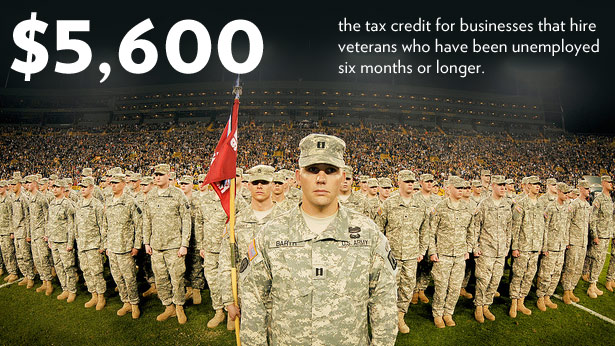
The American Jobs Act by the Numbers: 5,600

$5,600: The tax credit for businesses that hire veterans who have been unemployed six months or longer

This morning, President Obama and First Lady Michelle Obama were at Joint Base Langley-Eustis in Virginia as part of the American Jobs Act Bus Tour to discuss how the American Jobs Act will create jobs and put people back to work, including America's veterans.

While the President is on the road, we're pulling out numbers that show how the American Jobs Act will make an immediate impact in communities across the country.  Numbers like $5,600, the tax credit for businesses that hire veterans who have been unemployed for six months or longer.

Providing a tax credit incentive for businesses to employee veterans will help encourage hiring and make it easier for America's heroes to find jobs when they return home. And the tax credit rises to $9,600 for hiring veterans who also have service-connected disabilities.

As President Obama said when he first introduced the American Jobs Act to a joint session of Congress, "We ask these men and women to leave their careers, leave their families, risk their lives to fight for our country. The last thing they should have to do is fight for a job when they come home." During the address to Congress, members on both sides of the aisle stood and applauded in support of tax credits for businesses that hire veterans. President Obama is now calling for action:

So when it comes for a vote in the Senate, I expect to get votes from both sides of the aisle.  Don’t just applaud about it, vote for it.  Vote for it. 

The White House

Office of the Press Secretary

Remarks by the President and the First Lady on the American Jobs Act and Joining Forces

Joint Base Langley-Eustis
Hampton, Virginia

10:41 A.M. EDT 

MRS. OBAMA:  Hey, everyone!  (Applause.)  This is really cool.  I'm very thrilled, very honored to be here.  Number one, I never get to do anything with my husband.  (Laughter.)  I haven't seen him in three days.  This is a nice date!  It's good to see you.  You're looking good.  (Laughter and applause.)

And you all are looking good as well.  We are just proud to be here -- proud of you all.

First of all, let me thank Melissa for her service and for that wonderful introduction and for everything that she has done, along with her family, for this country. 

Truly one of my greatest pleasures as First Lady has been meeting folks like Melissa and all of you here today, hearing your stories, truly seeing your strength.  And I can’t tell you how much you inspire me, and all of us.  It's just something to watch.  You’ve inspired me not just to sit back in awe but to move forward in action. 

And all of you are the reason why Dr. Jill Biden and I started our Joining Forces initiative.  We want to rally this entire nation around our veterans and military families because we know just how incredible all of you are.  Truly.  Yes.  (Applause.) 

We want America to know that your veterans who have completed missions with enough variables involved to make most people’s head spin -- that you’re trained in state-of-the-art technologies; that you’ve managed dozens -- if not hundreds -- of your peers.  And when the stakes are the highest, that’s when you’re at your best.

And your spouses, your families, are just as amazing.  And I have met them -- (applause.)  Yes, for the military spouses.  (Applause.)  Military spouses pack in a full day of work; many of them then get back to get the kids to piano lessons; they volunteer at fundraisers; Skyping with loved ones who are deployed overseas; whip up dinner; put the kids into bed, and then crack open the textbooks to study at night. 

That's an average day.  To a military spouse, that's just Wednesday.  (Laughter.)  So I'm just exhausted thinking about them.  But so very proud, so very proud.  For most folks, that’s the kind of day that leaves us sprawled out on the couch, too exhausted to move.  But that's not a big thing for our military spouses.

So, for all of you troops, veterans, and military spouses here today, we're proud of you, and we want people to know that you have so many skills that are just second nature to all of you -- things like time management, organization, people skills, complex decision-making, and so many other incredible skills.

And that is really the reason why we’re here today -- because those are precisely the skills that we need in workplaces across America.  But the truth is that sometimes employers may not always know about all that you have to offer.  They might have trouble understanding a military resume.  Or they might see a spouse who’s lived in five cities in seven years as a red flag rather than a reality of military life. 

But today, I am proud to announce that the American Logistics Association has said they’re going to step up and do something about that.  So today they’re committing to hiring 25,000 veterans and military spouses in the next two years.  (Applause.)  They do not want to miss out on your potential.  They want America’s businesses to have the best, most talented, most hardworking employees around. 

Now, this announcement is a huge deal -- which is why the President is here.  It's huge enough for you to even be involved. (Laughter.)  This commitment includes 270 companies of all shapes and sizes, which makes this the largest coordinated effort by the private sector to hire veterans that we’ve seen in years.  (Applause.)  And this commitment puts us a quarter of the way toward reaching the President’s challenge to the private sector to hire or train 100,000 vets and military spouses by the end of 2013.  (Applause.)  

The businesses making this pledge include name brands like Proctor and Gamble, Tyson Foods, Hewlett-Packard -- but also smaller companies like Prime Team Services, which is planning to hire hundreds of military spouses and veterans next year alone. 

And today’s announcement really builds on the efforts of businesses and organizations already underway all across this country.  Siemens has hired hundreds of veterans already this year.  Sears is increasing the number of veterans and military spouses in their workforce by 10 percent.  We just made that announcement this week.  The Chamber of Commerce has hosted job fairs for veterans in cities across the country. 

And then companies like Kmart and Sam’s Club have promised us that if a military spouse who works at their stores has to move to a new duty station, they will do their very best to have a job waiting for them when they arrive.  (Applause.)  

So these are bold commitments.  And these are companies that are making these pledges not just because it’s the right thing to do or because it feels patriotic.  They’re also doing it because it’s good for their bottom line.  It's good for business.  Because they know that veterans and military spouses, like all of you here today, represent the best our country has to offer, and they want you on their team.

And really that’s what Joining Forces is all about.  It's really about tapping into all of that goodwill that’s already out there all across this country in every sector of society.  And it's important for you all to know that, because I know sometimes it feels like a struggle, like sometimes we don't know as a nation what you sacrifice, what your families have sacrificed.  But know that people are stepping up.  They're doing it every day, and they're doing it with pride and with pleasure.  And channeling all of that energy into making a real difference in the lives of our veterans and military families is really what we want to do for you.  And truly, it is a win-win for everyone.

The motto of Joining Forces is very simple:  Everyone can do something -- everyone can do something -- to honor and support the brave men and women who have served us all so well. 

In fact, that’s what the man I’m about to introduce -- this guy here -- (laughter) -- that's really what he does every day.  During his presidency, he's directed the federal government to help with childcare in military families, to address veterans’ homelessness, to step up on mental health issues, and to provide unprecedented support to our military families.

So now, it is my pleasure to introduce a man who is fighting for you every single day -- yes, get the cameras ready.  (Laughter and applause.)  It is your Commander-in-Chief -- and my husband -- the President of the United States, Barack Obama.  (Applause.)

THE PRESIDENT:  Hello Joint Base Langley-Eustis!  (Applause.)  Thank you very much. 

I hate following Michelle.  (Laughter.)  She’s so good.  How lucky am I to be married to Michelle Obama?  (Applause.)  See, for you men out there who are not yet married, let me explain.  The whole goal is to marry up -- (laughter) -- to try to improve your gene pool.  (Laughter.)  And we’re lucky to have her as First Lady of the United States of America, I think.  (Applause.)   I am thrilled to be here.  I want to thank the outstanding leaders who welcomed us here today:  Secretary of the Air Force Michael Donley is here.  (Applause.)  General Mike Hostage is here.  (Applause.)  Colonels Kory Auch and Kevin Robbins and Reggie Austin are here.  (Applause.) 

I want to give a shout-out to your outstanding senior enlisted leaders, including Chief Master Sergeants Kevin Howell and Marty Klukas.  (Applause.)  I want you to give a big round of applause to the Air Combat Command Heritage of America Band.  (Applause.)

We’ve got a lot of folks in the house today.  We’ve got Air Combat Command.  (Applause.)  We’ve got the 633rd Air Base Wing.  (Applause.)  We’ve got the 1st Fighter Wing -- (applause) -– with our amazing F-22 Raptors.  (Applause.)  I want to ride in one of those some day.  (Laughter.)  We’re going to have to set that up.

We’ve got the 480th Intelligence, Surveillance and Reconnaissance Wing.  (Applause.)  They can cheer, but they can’t talk about what they do.  (Laughter.)  They’d have to kill you.  And I see we’ve got some Army, too.  (Applause.)  

I want to salute Melissa Lee.  Thank you so much.  I want to salute Kathy Hostage.  I want to salute Kristin Auch and the extraordinary military spouses who are here as well.  (Applause.) We are inspired by them.  Michelle is an honorary military spouse because she has to put up with me.  (Laughter.)  But she and I both share such incredible admiration for the families of those who are serving in uniform.

We are grateful for our veterans who are here, including some very special airmen who taught the nation the true meaning of service and honor and equality.  We are honored to be joined by several of the legendary Tuskegee Airmen in the house.  (Applause.)  That’s what heroes look like right there.

Finally, I want to acknowledge your Governor, Bob McDonnell, and his lovely wife, Maureen, for joining us here today -- (applause) -- as well as Congressman Bobby Scott, who’s in the house.  (Applause.)  And I want to thank all the business leaders who have committed to hiring our nation’s heroes. 

Those of you here today who have worn the uniform of these United States have done so with honor and have done so with distinction.  In some of the most dangerous places on the planet, you have heroically performed and done everything that’s been asked of you.  Already, your generation has earned a special place in America’s history.  For that, you’ve got a grateful nation.  As Michelle said, don’t forget how everybody understands what you’ve done for this country. 

Over the past decade, nearly 3 million service members, like many of you -- our 9/11 generation of veterans -– have made the transition back to civilian life.  They’ve taken their leadership experience, their mastery of cutting-edge technologies, their ability to adapt to changing circumstances, and they’ve become leaders here at home.  They’ve become leaders in businesses all across the country. 

Just think about how many veterans have led their comrades on life-and-death missions by the time they were 25.  That’s the kind of responsibility every business in America should want to take advantage of.  Those are the Americans every company should want to hire. 

Now, of course, as Michelle mentioned, there are far too many veterans who are coming home and having to struggle to find a job worthy of their talents.  There are too many military spouses who have a hard time finding work after moving from base to base and city to city. 

That’s not right.  It doesn’t make any sense.  It doesn’t make sense for our veterans.  It doesn’t make sense for our businesses.  It doesn’t make sense for our families.  And it doesn’t make sense for America.  (Applause.) 

If you can save a life in Afghanistan, you can save a life in a local hospital or in a local ambulance.  (Applause.)  If you can oversee millions of dollars of assets in Iraq, you can help a business balance its books here at home.  (Applause.)  If you can juggle the demands of raising a family while a husband or wife are at war, you can juggle any demands of any job in the United States of America.  (Applause.)
 
We ask our men and women in uniform to leave their families -- our Guardsmen and Reservists to leave their jobs.  We ask you to fight, to sacrifice, to risk your lives for our country.  The last thing you should have to do is fight for a job when you come home.  Not here.  Not in the United States of America.  (Applause.)  

So this has been one of my top priorities as your Commander-in-Chief.  That's why we are fully funding the post-G.I. -- 9/11 G.I. Bill, which is helping more than 600,000 veterans and their family members pursue a college education.  (Applause.)

It’s why we fought to make sure the bill included non-college degrees and on-the-job training.  It’s why I directed the federal government to lead by example and hire more veterans -– including 100,000 as of this summer.  (Applause.) 

And it’s also why we’re here today.  As Michelle mentioned, back in August I challenged American businesses -- I challenged them to hire or train 100,000 post-9/11 veterans or their spouses by the end of 2013.  (Applause.)  And now, just a few months later, thanks to the many extraordinary companies who are here today, we’re already a quarter of the way there.  Already, they’ve committed to train or hire 25,000 veterans and spouses in the next two years.  (Applause.)

And this is incredible.  It’s a testament to their good business sense.  It’s a testament to their sense of patriotism.  It’s a testament to the fact that these veterans and military families are some of the most talented, trained, and experienced citizens that we have.  It’s a testament to these businesses’ commitment to this country. 

We’re still living through an economic crisis that partly came about because too many individuals and institutions were only thinking about their own interests -- because they embraced an ethic that said, what’s good for me is good enough.  Well, the men and women of the United States Armed Forces, they’ve got a different ethic.  You believe, your families believe, in something greater than your own ambitions.  You’ve embraced an ethic that says the only thing that’s good enough is what’s best for the United States of America.  (Applause.)  

And by making a commitment to these brave men and women, the companies who are represented here today have shown that they’ve got that same ethic.  They share in that belief that we’re all in this together.  Those companies who are represented here today are showing that they care about this country and those who serve it -- not just with words, not with just with slogans, not just with TV ads, but with the choices that you’re making. 

As President and Commander-in-Chief, I thank you for that.  And I also want to thank my extraordinary wife and Dr. Jill Biden, our Second Lady, for leading the effort to support and honor our military families, and making today possible.  Give them a big round of applause.  (Applause.)  She does all this and she looks cute.  (Laughter.)  That’s right.  (Laughter.)    

But considering how many veterans are out there looking for work, we can’t stop with today’s announcement.  We’ve got more work to do.  Some of you probably know that last month, I sent Congress a piece of legislation called the American Jobs Act.  Now, this is a bill that’s fully paid for, and it’s filled with the kind of proposals that traditionally Democrats and Republicans have supported in the past -- tax cuts for every small worker -- every worker and small business in America; funding to rebuild our schools and put our teachers back in the classroom so our children can get the education they deserve; a tax credit for small businesses that hire America’s veterans.

The idea here is even though so many companies who are here today have committed to hiring our nation’s heroes, we want to make it even easier for the businesses that haven’t made that commitment yet.  It’s the right thing to do for our veterans and it’s the right thing to do for America.  You give smaller companies who may be interested in hiring but are having a tough time -- give them a tax break if they hire a veteran.  Give them an even bigger tax break if they hire a disabled veteran.   

Now, so far Congress hasn’t acted on this proposal.  But I want you to know that I’m pushing them a little bit.  (Applause.) I’m going to keep pushing them a little bit.  In the coming weeks, we’re going to hold a series of votes in the Senate on individual pieces of my jobs bill.  And one of the votes I’m going to urge members of Congress to take is on whether or not they think it’s a good idea to give companies an incentive to hire the men and women who have risked their lives for our country.  And I’m hopeful we can get both parties on board for this idea. 

When I first proposed this idea in a joint session of Congress, people stood up and applauded on both sides of the aisle.  So when it comes for a vote in the Senate, I expect to get votes from both sides of the aisle.  (Applause.)  Don’t just applaud about it, vote for it.  Vote for it.  (Applause.) 

Standing up for our veterans is not a Democratic responsibility or a Republican responsibility -– it is an American responsibility.  (Applause.)  It is an obligation for every citizen who enjoys the freedoms that our heroes defend.  And it’s time for us to meet those obligations here today. 

This generation of veterans has learned that the challenges don’t end in Kandahar or Baghdad -- they continue right here at home.  And today, we’re saying to those veterans who fought for us, now we are fighting for you -- for more jobs, for more security, for the opportunity to keep your families strong, the chance to keep America competitive economically in the 21st century. 

These are tough times for America, but we faced tougher times before.  And nobody is tougher than the men and women of America’s Armed Forces.  (Applause.)  You all don’t quit.  Whenever we faced a challenge in this country, whether it was a depression or a civil war or when our Union was at stake, our harbor was bombed, our country was attacked on that September day -- we did not falter.  We did not turn back.  We picked ourselves up.  We pushed ourselves forward.  We got on with the task of fulfilling the ideas that so many Americans have struggled for, and sacrificed for, and given their lives for. 

And that’s the spirit all of you represent.  That’s the spirit our whole nation needs right now.  You remind us as a nation that that no problem is too hard and no challenge is too great, and no destiny is beyond our reach.  So let’s meet this moment.  Let’s get together and show the world just why it is that the United States of America is the greatest nation on Earth.  (Applause.)  

God bless you.  God bless our veterans.  God bless the men and women in uniform.  And God bless the United States of America.  (Applause.)

END
11:07 A.M. EDT 

The White House

Office of the Press Secretary

Notice Regarding the Continuation of the National Emergency with Respect to Significant Narcotics Traffickers Centered in Colombia

NOTICE

CONTINUATION OF THE NATIONAL EMERGENCY WITH RESPECT TO SIGNIFICANT NARCOTICS TRAFFICKERS CENTERED IN COLOMBIA

On October 21, 1995, by Executive Order 12978, the President declared a national emergency pursuant to the International Emergency Economic Powers Act (50 U.S.C. 1701-1706) to deal with the unusual and extraordinary threat to the national security, foreign policy, and economy of the United States constituted by the actions of significant narcotics traffickers centered in Colombia and the extreme level of violence, corruption, and harm such actions cause in the United States and abroad.

Because the actions of significant narcotics traffickers centered in Colombia continue to threaten the national security, foreign policy, and economy of the United States and cause an extreme level of violence, corruption, and harm in the United States and abroad, the national emergency declared on October 21, 1995, and the measures adopted pursuant thereto to deal with that emergency, must continue in effect beyond October 21, 2011.  Therefore, in accordance with section 202(d) of the National Emergencies Act (50 U.S.C. 1622(d)), I am continuing for 1 year the national emergency with respect to significant narcotics traffickers centered in Colombia.

This notice shall be published in the Federal Register and transmitted to the Congress.

BARACK OBAMA

THE WHITE HOUSE,
October 19, 2011. 

The White House

Office of the Press Secretary

Message Regarding the Continuation of the National Emergency with Respect to Significant Narcotics Traffickers Centered in Colombia

TO THE CONGRESS OF THE UNITED STATES:

Section 202(d) of the National Emergencies Act, 50 U.S.C. 1622(d), provides for the automatic termination of a national emergency unless, prior to the anniversary date of its declaration, the President publishes in the Federal Register and transmits to the Congress a notice stating that the emergency is to continue in effect beyond the anniversary date.  In accordance with this provision, I have sent to the Federal Register for publication the enclosed notice stating that the emergency declared with respect to significant narcotics traffickers centered in Colombia is to continue in effect beyond October 21, 2011.

The circumstances that led to the declaration on October 21, 1995, of a national emergency have not been resolved.  The actions of significant narcotics traffickers centered in Colombia continue to pose an unusual and extraordinary threat to the national security, foreign policy, and economy of the United States and cause an extreme level of violence, corruption, and harm in the United States and abroad.  For these reasons, I have determined that it is necessary to maintain economic pressure on significant narcotics traffickers centered in Colombia by blocking their property and interests in property that are in the United States or within the possession or control of United States persons and by depriving them of access to the U.S. market and financial system.

BARACK OBAMA

THE WHITE HOUSE,
October 19, 2011.