President Obama Signs Historic Legislation Signaling Progress on Trade and Jobs

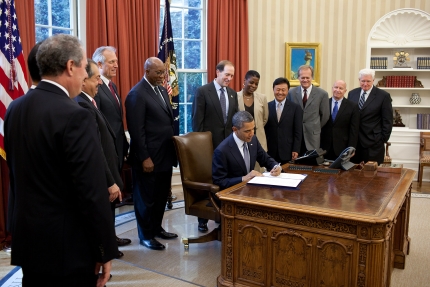
President Barack Obama signs the United States-Korea Free Trade Agreement Implementation Act

President Barack Obama signs the “United States-Korea Free Trade Agreement Implementation Act,” in the Oval Office, Oct. 21, 2011. (Official White House Photo by Pete Souza)

This morning, President Obama signed legislation implementing three job-supporting trade agreements with Korea, Colombia, and Panama. These trade agreements will help put Americans back to work and grow America’s economy.

At the same time, the President signed legislation renewing Trade Adjustment Assistance (TAA) that helps workers who have been hurt by increased global competition. He also signed legislation to renew trade preference programs that sustain the United States’ commitment to trade and economic development that lifts up some of the world’s poorest people.

With all the stories and speculation flying around the news these days, I know it’s hard to separate fact from fiction sometimes. So let me share three quick points that I hope will help you understand why this is good news for all American workers and families.

First, these agreements will increase U.S. exports and American jobs. The Korea agreement will support an estimated 70,000 U.S. jobs and increase U.S. GDP by at least $11 billion due to increased exports of goods alone. Chances are you’ll benefit from these agreements if you work for or with anyone who makes, grows, or provides goods and services to Korea, Colombia, or Panama. These agreements make it easier and more cost-effective to sell Made-in-the-USA products to consumers in each of these countries. In turn, increased exports of U.S. goods and services will support more and better jobs for farmers, ranchers, manufacturers, service providers, workers, and businesses all across the United States. And all three agreements have groundbreaking protections for labor rights, the environment, and intellectual property, so American workers and businesses will be able to compete on a level playing field.

Second, the President worked to improve these agreements when he came into office. All three faced significant opposition from Congress. But instead of surrendering to the status quo, the President told me to get to work. With Korea, he sent me back to the negotiating table to secure additional market access for U.S. automobile manufacturers. With Colombia, he stood firm on the principle that U.S. trade agreements must reflect American values, including respect for and protection of workers’ rights. And with Panama, he made sure that we addressed key concerns related to tax transparency and labor conditions. In each case, the President held out for a better, more balanced deal.

That brings me to the third and final point: President Obama also signed today legislation that strengthens and streamlines TAA, and renews key preference programs –- the Generalized System of Preferences (GSP) and the Andean Trade Preference Act (ATPA). Both TAA and our preference programs are key elements of President Obama’s balanced approach to trade. TAA helps those workers whose jobs are displaced by trade by providing job re-training programs, lower health insurance premiums, and assistance that keeps families on their feet. And GSP and ATPA uphold our commitment to support trade and economic growth that lifts up some of the world’s poorest people while helping American businesses get inputs they need and American consumers.

It’s important to note that Congress approved these trade measures with significant support in record time. In fact, the Korea agreement received more recorded votes than any free trade agreement in history. I think that’s a good indication that the President’s principled and pragmatic leadership has created a more balanced trade policy –- one that holds the promise of open markets and a level playing field with increased U.S. exports and better American jobs for many years to come. And since President Obama has prioritized enforcement of America’s trade agreements since day one, Americans can also be assured that we’ll hold our trading partners accountable for their obligations moving forward.

President Obama’s historic action today is a big step forward on trade and jobs. We look forward to working with Congress and the American people to continue pursuing a balanced trade policy that keeps American producers competitive abroad and supports jobs for more hard-working Americans here at home.
 

Related Topics: Economy, Foreign Policy

West Wing Week: 10/21/11 or "Right Now!"

This week, the President traveled to Detroit with the President of South Korea, dedicated the Martin Luther King, Jr. National Memorial, embarked on a three day American Jobs Act bus tour, bestowed the Presidential Citizens Medal, and hosted the Norwegian Prime Minister.

Watch West Wing Week here

10/21/11 West Wing Week or: "Right Now!"

October 20, 2011 | 8:33 | Public Domain

Welcome to the West Wing Week, your guide to everything that's happening at 1600 Pennsylvania Ave. This week, the President traveled to Detroit with the President of South Korea, dedicated the Martin Luther King, Jr. National Memorial, embarked on a three day American Jobs act bus tour, bestowed the Presidential Citizens Medal and hosted the Norwegian Prime Minister. That's October 14th to October 20th or: "Right Now!"

Download mp4 (202MB)

The White House

Office of the Press Secretary

President Obama Announces Another Key Administration Post

WASHINGTON, DC – Today, President Barack Obama announced his intent to nominate the following individual to a key Administration post:

  • Thomas M. Hoenig- Vice Chairman, Board of Directors of the Federal Deposit Insurance Corporation

President Obama announced his intent to nominate the following individual to a key Administration post:

Dr. Thomas M. Hoenig, Nominee for Vice Chairman, Board of Directors of the Federal Deposit Insurance Corporation
Dr. Thomas M. Hoenig was the President and Chief Executive Officer of the Federal Reserve Bank of Kansas City from 1991 to 2011.  As the President and CEO of the Federal Reserve Bank of Kansas City, Dr. Hoenig directed Federal Reserve activities in the Tenth Federal Reserve District.  Dr. Hoenig first joined the Federal Reserve Bank of Kansas City in 1973 as an economist in the banking supervision area.  He was named a Vice President in 1981 and Senior Vice President in 1986.  In addition to his work at the Federal Reserve, he has served as an instructor of economics at the University of Missouri-Kansas City.  Dr. Hoenig is a member of the Board of Trustees of the Ewing Marion Kauffman Foundation and serves on the boards of directors of Midwest Research Institute and Union Station.  He received a B.A. in Economics and Mathematics from Benedictine College and a M.A. and a Ph.D. in Economics from Iowa State University.

The White House

Office of the Press Secretary

Statement by the President on the Senate Confirmation of John Bryson as Secretary of Commerce

As Secretary of Commerce, John Bryson will be a key member of my economic team, working with the business community to promote job creation, foster growth, and help open up new markets around the world for American-made goods.  At such a critical time for our economy, I nominated John because I believe his decades of experience both in the public and private sector have given him a clear understanding of what it takes to put America on a stronger economic footing and create jobs.  I’m confident he will help us do that, and I look forward to working closely with him in the months and years ahead.

The White House

Office of the Press Secretary

President Obama Announces More Key Administration Posts

WASHINGTON, DC – Today, President Barack Obama announced his intent to nominate the following individuals to key Administration posts:

  • Bonnie Bassler –Member, National Science Board, National Science Foundation
  • Carla M. León-Decker – Member, National Credit Union Administration Board
  • Mark William Lippert – Assistant Secretary of Defense for Asian and Pacific Security Affairs, Department of Defense

President Obamasaid, “Our nation will be greatly served by the talent and expertise these individuals bring to their new roles.  I am grateful they have agreed to serve in this Administration, and I look forward to working with them in the months and years ahead.”

President Obama announced his intent to nominate the following individuals to key Administration posts:

Bonnie Bassler, Nominee for Member, National Science Board, National Science Foundation

Bonnie Bassler is a Howard Hughes Medical Institute Investigator and the Squibb Professor of Molecular Biology at Princeton University. She is the Immediate Past President of the American Society for Microbiology and the Chair of the Board of Governors of the American Academy of Microbiology. Her research focuses on the molecular mechanisms that bacteria use for intercellular communication.  Professor Bassler is a member of the National Academy of Sciences and the American Academy of Arts and Sciences. In 2009, she received the Wiley Prize in Biomedical Science.  Professor Bassler received the 2011 Richard Lounsbery Award, one of the highest honors bestowed by the National Academy of Sciences. She is a 2002 MacArthur Fellow.  She received her B.S. from the University of California, Davis and her Ph.D. from the Johns Hopkins University.

Carla M. León-Decker, Nominee for Member, National Credit Union Administration Board

Carla M. León-Decker is the President and CEO of the D.C. Federal Credit Union. From 1994 to 2000, Ms. León-Decker served at the PAHO/WHO Federal Credit Union, initially as Operations Manager and later as President and CEO. Before that, she was a branch manager at the Transportation Federal Credit Union where she served from 1988 to 1994. Ms. León-Decker is a credit union development educator and Co-Founder and Director of the Network of Latino Credit Unions & Professionals. She received her B.A. from Southeastern University and her M.A. in International Commerce and Policy from George Mason University.

Mark William Lippert, Nominee for Assistant Secretary of Defense for Asian and Pacific Security Affairs, Department of Defense

Mark William Lippert is currently serving on active duty as an Intelligence Officer in the United States Navy Reserve.  Previously, he was Chief of Staff for the National Security Council in 2009.  In 2008, he was Deputy Director for Foreign Policy on the Obama-Biden Transition Team and Senior Foreign Policy Adviser on the Obama for America campaign.  From 2007 to 2008, Mr. Lippert served as an Intelligence Officer with SEAL Team One in Iraq.  Previously, he worked as a foreign policy adviser for then-Senator Obama from 2005 to 2008.  From 2000 to 2005, he was a professional staff member on the Senate Appropriations Committee, where he advised Senator Patrick Leahy.  From 1999 to 2000 he was a foreign and defense policy adviser to Senator Tom Daschle and the Senate Democratic Policy Committee.  Mr. Lippert is a recipient of a Bronze Star Medal for his service in Iraq and a Joint Commendation Medal for his service in Afghanistan.  He holds a B.A. and M.A. from Stanford University.

The White House

Office of the Press Secretary

Remarks by President Obama and Prime Minister Stoltenberg After Bilateral Meeting

Oval Office

5:16 P.M. EDT

        PRESIDENT OBAMA:  Hello, everybody.  I am very happy to welcome Prime Minister Stoltenberg to the Oval Office, and his delegation to the United States.  Michelle and I have incredibly fond memories of our visits to Oslo, and the extraordinary hospitality that the Norwegian people extended to us and our family.

        It is fitting that we meet today, given the events that took place in Libya.  Obviously this was a NATO mission that was executed I think very effectively.  Part of the reason it was so effective was because of NATO partners like Norway.  I’ve said this before but I want to repeat, Norway punches above its weight.  And their participation in the humanitarian mission, protecting civilians, the capacity of Norwegian pilots, their willingness to engage in some very critical missions there, made an enormous difference.

        And so I began the meeting by thanking the people of Norway, the Norwegian military, and the Prime Minister for their leadership in helping to give Libya an opportunity to become a democracy.

        The people of Norway and the United States share a lot of bonds.  Obviously we have an enormous Norwegian-American population here, but we also share a lot of common values.  And so in our discussions we covered a wide range of issues.  We discussed our partnership in Afghanistan where Norway has been a consistent partner, and discussed how we are going to move the transition forward so that Afghans can take full responsibility for their security by 2014, as we agreed to in Lisbon.  

        We discussed the world economy, and we shared our intentions to work closely with our European partners to stabilize the eurozone area, but also to make sure that we are all participating in creating a system in which free trade, in which coordinated commercial practices, in which our focus on growing the economy, issues like energy security all involve close coordination between our two countries.  And we very much appreciate the partnership there.  

        We discussed the heartbreaking situation that occurred in Norway on July 22nd.  And as I’ve said before, I think everybody in the United States was horrified by the events there.  But I complimented the Prime Minister and the people of Norway for the grace with which they handled this extraordinarily difficult situation.  It underscored the importance of all of us cooperating in preventing terrorism of all kinds.  And the United States and Norway have established a very effective intelligence cooperation system, and that is continually being enhanced and improved.  And so we both agreed that we’re very pleased with the progress that we’ve made in making sure that we are working closely together to prevent the kind of senseless violence that we saw in Norway so recently, and that we’ve seen around the world over the last several years.

        And we also discussed a range of international issues of great importance.  We both share the belief that we need a two-state solution to Middle East, and want to work very closely with both the Israelis and the Palestinians to arrive at a negotiated settlement.  

        We discussed the situation in South Sudan, where -- and the conflict between Sudan and South Sudan.  And Norway and the United States have been two very important partners in a process to move towards a more peaceful resolution of conflicts there.  

        We discussed how we can work together in the United Nations and other multilateral fora around issues like climate change and maternal health.  

        And so I think that the state of cooperation and respect between the United States and Norway has never been higher.  I personally feel a great affinity for the people of Norway and grateful for the friendship and partnership that they’ve provided.  And I hope that this is not the last visit but one of many that we’ll have together here in the United States.  And I hope I have a chance to visit Norway again sometime soon.

        So, welcome, Mr. Prime Minister.

        PRIME MINISTER STOLTENBERG:  Thank you so much.

        PRESIDENT OBAMA:  Thank you.

        PRIME MINISTER STOLTENBERG:  Thank you.  Thank you so much, Mr. President, for your kind words.  And also thank you so much for the hospitality you have shown me and my delegation.  And we are very much impressed about your political agenda and also by your global leadership you have shown, and which we appreciate very much in Norway.

        We are also very grateful for the sympathy and the condolences you and the people of America conveyed to the people of Norway after the terrible attacks of the 22nd of July.  And I know that it was of great comfort for those who lost their loved ones.  And as you said, it underlines the importance of cooperation in fighting all kinds of terrorism.  We will continue to do so, and we will look into how we can expand our cooperation in fighting terrorism.

        We’ve worked together -- or we work together on many different issues; we cooperate on many different areas.  One of them are within -- or is within the NATO, the military alliance.  And as you mentioned, we have accomplished what we had as our aim for the military operations in Libya:  We protected civilians; we were able to stop Qaddafi of killing his own people.  And I think it shows that we are able to implement decisions by the U.N. and by the NATO, and that’s important in itself.

        We appreciate the cooperation we have in Afghanistan.  We are looking forward to focusing even more on the transition.  Norway went into Afghanistan together with our allies, and are going to leave Afghanistan together with our allies.

        I appreciate also very much that we had the opportunity to focus on the High North.  The High North is a area where we are seeing new possibilities, new challenges, but also new dangers.  And the ice is melting.  Actually, in the High North we see the consequences of global warming.  But at the same time, that opens up new possibilities for energy developments, but also for sea routes, and it increases the need for cooperation between the countries bordering the Arctic area, and the U.S. and Norway are among them.

        I appreciate that we can continue our cooperation when it comes to climate change, because we’ve worked together on halting deforestation, reducing deforestation.  And that’s the way we can achieve the biggest, the cheapest and the fastest reductions in emissions.  We work together in Indonesia in reducing deforestation.

        And I appreciate very much that we work together on child mortality, maternal health, and that’s an area where we have achieved a lot together during the last years.  

        So I appreciate very much this opportunity to meet with you, and you are always welcome to Norway and Oslo.  Thank you.

        PRESIDENT OBAMA:  Thank you very much.  Thank you, everybody.

        Q    Mr. President, does the Libya -- the death of Qaddafi vindicate your policy in Libya?

        PRESIDENT OBAMA:  We did exactly what we said we were going to do in Libya.  And I think it underscores the capacity of us to work together as an international community.  The United States obviously has unique capacities, and we were proud of the leadership we showed in that process.  But, increasingly, wherever we have the possibility of working with outstanding partners like Norway, then I think that we’re going to be even more effective.  And the United States will always preserve its right and duty to protect ourselves, our allies and our interests.  

        But I think what this shows is that, on a whole range of international issues, there is enormous capacity -- and we are able to leverage greater resources, more effectiveness, at lower cost -- when we’re able to work together.  So I’m very proud of the work that we did on this operation.  

        Most importantly I’m proud of what the Libyan people have achieved.  And I think they’ve got an enormous opportunity ahead of them.  They’ve got a lot of challenges as well, but we have now given them the opportunity to determine their own destiny.  And that’s something that we’ve seen across North Africa and the Arab world -- that there’s nothing unique in aspiring to freedom and human rights and democracy.  This is something that all people want to enjoy, and I’m very pleased that the Libyan people are going to have the opportunity to do so.  All right?

        Thank you very much, everybody.

        Q    Thank you.

        PRESIDENT OBAMA:  Thank you.

END 5:26 P.M. EDT

President Obama Meets with Prime Minister Jens Stoltenberg of Norway

October 20, 2011 | 10:24 | Public Domain

The two leaders discussed the death of Muammar el-Qaddafi and the progress that has been made in Libya.

Download mp4 (99MB) | mp3 (10MB)

The White House

Office of the Press Secretary

Fact Sheet: The United States and Norway - NATO Allies and Global Partners

President Obama hosted Norwegian Prime Minister Jens Stoltenberg for a meeting in the Oval Office on October 20.  The visit underscored the close ties between the United States and Norway, which are grounded in our common heritage, values, ideals and interests.  The leaders renewed their commitments in the following areas:

Defense and Security Cooperation:  As NATO allies, the United States and Norway are committed to each other’s defense and partner in critical crisis areas around the world.

  • Libya:  Norway was one of the first allies to step up and deploy fighter aircraft as part of the NATO civilian protection mission in Libya.  Six Norwegian F-16s played an important role during the first months of the mission and contributed substantially to its ultimate success. 
  • Afghanistan:  Norway is a key contributor to the NATO-led International Security Assistance Force (ISAF), providing more than 500 troops and police trainers, leading a Provincial Reconstruction Team, and providing approximately $120 million annually in development assistance.  It is also making significant contributions to the Afghan National Army Trust Fund and the Law and Order Trust Fund, which are critical to Afghanistan transition efforts. 
  • Bilateral Defense Cooperation:  The U.S. and Norwegian militaries enjoy a high level of cooperation and interoperability.  Approximately 500 Norwegian military personnel, including pilots, train in the United States annually and about 175 active military sales cases are in process.  Norway has selected the Joint Strike Fighter F-35 as its next generation supersonic fighter aircraft, and will be taking delivery of four JSF F-35 training aircraft in 2016.
  • Nuclear Security:  Norway strongly supports the President’s vision of a world without nuclear weapons, pledged $3.3 million for the International Atomic Energy Agency’s nuclear security work in developing countries at the 2010 Nuclear Security Summit, and participates in the Global Initiative to Combat Nuclear Terrorism and the G8 Global Partnership Against the Spread of Weapons and Materials of Mass Destruction.

Diplomatic Cooperation and Global Development:  The United States and Norway cooperate closely on some of the world’s most intractable challenges.  We share a commitment to democracy and development cooperation, as highlighted by Norway’s generous $4.6 billion foreign aid budget in 2011, which constitutes more than 1% of the country’s GDP.  The United States and Norway are two of the eight founding members of the Open Government Partnership (OGP), a multilateral effort that supports national efforts to promote transparency, fight corruption, strengthen accountability, and empower citizens. 

  • Middle East, Somalia, and Sudan:  Norway chairs the Ad-Hoc Liaison Committee (AHLC) to coordinate donor support to the Palestinian Authority and contributed $122 million to the Palestinian Authority in 2010, including $67 million in support of Palestinian institution building.  Norway is providing $112 million in humanitarian aid to Somalia and those affected by the famine in the Horn of Africa, and the United States and Norway are both members (along with the United Kingdom) of the Sudan Troika.
  • Global Issues Dialogue:  The United States and Norway established a formal Global Issues Dialogue in 2010, which is further strengthening our cooperation on civilian security and human rights issues.  A key area of our cooperation is empowering women as equal partners in preventing conflict and building peace in countries threatened and affected by war, violence, and insecurity.
  • Global Health:  The United States and Norway have agreed to expand their collaboration on women’s and children’s health globally through greater transparency in lifesaving global health efforts and the use of new technologies to improve impact, gender equity, accountability and governance.  Our mutual commitment to global health is reflected in support of the Global Alliance for Vaccines and Immunization (GAVI).  Together we pledged over 25% of the total $4.3 billion at a June 2011 pledging conference to vaccinate 250 million children by 2015.  This raises Norway’s total direct GAVI contributions to $1.2 billion.

Economic, Energy, and Environmental Cooperation:  The United States and Norway have a dynamic economic partnership that is creating jobs, driving the development of safe and secure energy sources, and fostering a healthy environment.

  • Trade, Investment and Jobs:  Bilateral trade in goods and services exceeded $15 billion in 2010 and Norway’s foreign direct investment in the United States totalled $14.4 billion.  Texas and Louisiana alone are home to 130 Norwegian companies, while U.S. exports to Norway support roughly 20,000 U.S. jobs.  By 2010, Norway’s Government Pension Fund Global (GPFG) held $28 billion in USG bonds and $97 billion in U.S. equity holdings.
  • Energy:  As the world’s second largest exporter of natural gas and seventh largest exporter of oil, Norway plays an important stabilizing role in energy markets and energy security.  Norway is the only developed country to have completed implementation of the Extractive Industries Transparency Initiative (EITI) and achieved “compliant” status under the EITI process.  In September, the United States committed to implement the EITI as part of its OGP National Action Plan.  The United States and Norway are also committed to increasing access to modern energy services for the 1.4 billion people on the planet today who do not have any access to energy. 
  • Environment, Climate Change and Green Growth:  The United States and Norway share a commitment to fostering new models of green growth that include sustainable land management, forest protection, expanding access to renewable energy, and increasing agricultural productivity.  This includes $1 billion that the United States and Norway have each pledged to jump start REDD+ activities in the short-term.  The two countries are working together to support Indonesia’s strong leadership to reduce greenhouse gas emissions and reduce emissions from deforestation and forest degradation (REDD+), including through strong political support for the Indonesia-Norway REDD+ Letter of Intent.  In this context, Norway today announced its commitment to match U.S. funding to support the new Indonesia Climate Change Center.
  • The Arctic:  In the Arctic Council, the United States and Norway co-chair a task force examining the role of certain greenhouse gases (such as methane and hydrofluorocarbons) and aerosols (such as black carbon), known collectively as "short-lived climate forcers," in causing global climate change.  Together with Russia, the United States and Norway also co-chair a task force to develop an international instrument on Arctic marine oil pollution preparedness and response.  The United States welcomes that Norway will host a new permanent secretariat for the Council in Tromso.

Cultural Ties:  Nearly five million Americans claim Norwegian ancestry, almost equal to Norway’s own population.  Our cultural relations are rich and dynamic, and both countries are working to encourage greater educational exchange opportunities.

  • Travel to the United States:  Over 126,000 Norwegian residents traveled to the United States in the first half of 2011 alone, an 11% increase over 2010.

Educational and Scientific Exchange:  More than 2,500 Norwegian students studied in the United States during the last academic year, ranking the United States as the third most popular destination for Norwegian students studying abroad.  The U.S.-Norway Fulbright program exchanges over 100 students and scholars annually, including the prestigious Fulbright Arctic Chairs Program supported by a $1 million contribution from the Norwegian government. 

President Obama Presents the 2011 Presidential Citizens Medals

October 20, 2011 | 22:06 | Public Domain

The President recognizes the 13 recipients of the Presidential Citizens Medal, one of the highest honors a civilian can receive.

Download mp4 (211MB) | mp3 (20MB)