The White House

Office of the Press Secretary

Remarks by the President at a Campaign Event

Private Residence
Los Angeles, California

6:04 P.M. PDT

THE PRESIDENT: Thank you. Thank you so much. Well, it is wonderful to see all of you here tonight, and I want to thank, first of all, J.L. and Mai for hosting us in this beautiful home. And the Smiths and the Browns and the Carters, thank you guys for your friendship and your support. You guys have just been wonderful.

I’m not going to make a long speech. What I’d rather do is have a conversation session with a group this size.

And by the way, I want to excuse if anybody smells chicken on me. (Laughter.) We stopped at Roscoe’s on the way down. (Laughter.) I think I have a spot on my tie from the hot sauce.

You know, a lot of you were involved in the campaign back in 2008, and it was an extraordinary time, because what we wanted to do was see if we could have a politics that reflected the best of who we are, a politics that was inclusive, a politics that was hopeful, a politics that wasn’t just about tearing the other guy down but was about lifting the whole country up. But also a politics that would focus on challenges that had been weighing down this country for decades: lack of health care for too many people and a system that was way too expensive even if you had health insurance; lack of an energy policy; a foreign policy where we were engaged in wars that weren’t making us safer necessarily and costing us huge amounts in terms of lives and treasure. Most importantly, an economy that wasn’t working for the American people as a whole.

There were a lot of us who were lucky, who were blessed and were doing well. But for middle-class families all across the country, you saw a flatlining of wages and incomes while the costs of everything from college to health care to retirement were going up and up.

And a lot of us who had been blessed, we know a lot of family members who still found themselves trapped and struggling in those circumstances.

And what I’m proud of is that over the last three years, we didn’t know when I first started running that we would end up being confronted with the worst financial crisis and the worst economic crisis since the Great Depression. We didn’t understand at that time, even after Lehman’s went down, how perilous things might be.

But in addition to making sure that we didn’t go into a Great Depression and stabilizing the financial system and reversing a contracting economy to one that was growing so that over the last two years we’ve seen private sector job growth just about every month, and 2 million jobs created just over the last two years -- in addition to all that, what we’ve also been able to do is still make progress on the things that we talked about making progress on.

And sometimes I think people forget how much has gotten done -- whether it’s passing health care for 30 million Americans who didn’t have it, and making sure that young people are able to stay on their parents’ health insurance and insurance companies aren’t dropping you when you’ve got coverage, to making sure that we were ending “don’t ask, don’t tell” so that anybody could serve this country that they love regardless of who they love, to ending the war in Iraq, to making sure that college loans and scholarships were accessible to young people all across the country, to saving the auto industry.

A lot of the things that we promised we’d do, we’ve done. And I carry around a little checklist, and I think we’ve gotten about 60 percent of it done so far. And that’s not bad for three years, because I need another five. (Laughter and applause.)

So we’ve made great progress, but we’ve got so much more work to do. And obviously, in Washington, the politics that I think people are hoping for is not what they’re getting. It’s still dysfunctional, it’s still perversely partisan. You still have folks who seem to be more interested in the short term and the party and elections than they are in the long term and the future and the next generation.

And we are fighting hard to break through and have the decency of the American people reflected in the decisions we make. Right now, we’ve got a big debate about a jobs bill that we’re putting forward. Obviously, the biggest problem we have right now is we stabilized the economy but with an unemployment rate that’s way too high. And we’re going to have to make a lot of progress if we’re going to be able to put people back to work.

And so we put forward ideas that traditionally have been supported by Democrats and Republicans –- let’s get construction workers who have been laid off and let’s put them back on the job rebuilding our roads and our bridges and our hospitals and our schools. Let’s make sure that teachers are back in the classroom -- we’re laying them off in droves all across the country at a time when it’s critical that our young people are able to succeed. Let’s make sure that we’re giving tax breaks to small businesses that need financing, but also small businesses who are hiring veterans, for example. These young men and women who have served us -- and I get the chance to meet them every day; incredibly talented -- and they’ve gone and fought for us and then suddenly they come back here and they’ve got to fight for a job? It makes no sense.

And yet, we have not gotten a single Republican vote out of this current Senate. And it’s primarily because they don’t think that, politically, it’s advantageous to do so. And I think that’s a mistake, and so we’re putting pressure on them.

Today, I announced helping homeowners refinance their homes, because a lot of them are underwater now and so they’re having trouble refinancing. But that could free up billions of dollars for American consumers who can then shop and go to Will’s movies -- (laughter) -- and spend money at whatever business Magic has -- (laughter) -- and could help grow the economy overall.

So the only way that we’re going to make progress is, I’m going to keep on making the case, I’m going to keep on pushing, but I’m also going to need to know that we’ve got a strong base of support behind us that is able to amplify our message, support our message, and get out there and have the same enthusiasm, the same passion as we did the first time.

And I’ve said this before -- this election will not be as sexy as the first one. Back then, I was -- it was still fresh and new, and I didn’t have any gray hair -- (laughter) -- and everybody loved the “Hope” posters and all that. (Laughter.) But this time it’s -- we’ve got to grind it out a little bit. We’ve got to grind it out.

But the cause is the same, and my passion is the same, and my commitment is the same. And so I hope all of you will join me, because I’m confident if you do that we’re going to win. And more importantly, we’re going to be able to guide the country in a path that helps over the long term.

So, all right. Thank you very much, everybody. (Applause.)

END
6:13 P.M. PDT

The White House

Office of the Press Secretary

Remarks by the President on the Economy and Housing

Private Residence, Las Vegas, Nevada

2:15 P.M. PDT

        THE PRESIDENT:  Good afternoon, everybody.

        AUDIENCE:  Good afternoon!

        THE PRESIDENT:  Thank you for letting me block your driveways.  (Laughter.)

        AUDIENCE MEMBER:  You’re welcome.

        THE PRESIDENT:  Well, it is wonderful to be with all of you.  And I want to thank Jose and Lissette and their wonderful children for letting us set up right in front of their house, and we just had a wonderful visit.  

        Without a doubt, the most urgent challenge that we face right now is getting our economy to grow faster and to create more jobs.  I know it; the people of Nevada know it; and I think most Americans also understand that the problems we face didn't happen overnight and so we’re not going to solve them all overnight either.  What people don’t understand, though, is why some elected officials in Washington don’t seem to share the same sense of urgency that people all around the country are.  

        Last week, for the second time this month, Republicans in the Senate blocked a jobs bill from moving forward -- a bill that would have meant nearly 400,000 teachers, firefighters, and first responders being back on the job.  It was the kind of proposal that in the past, at least, Republicans and Democrats have supported.  It was paid for, and it was supported by an overwhelming majority of the American people.  But they still said no.  

        Your senator, Majority Leader Harry Reid, he’s been fighting nonstop to help get the economy going.  But he’s not getting some help from some of the members of the Nevada delegation.  So we need them to get their act together.  Because the truth is, the only way that we can truly attack our economic challenges, the only way we can put hundreds of thousands of people back to work right now is with bold action from Congress.  

        That’s why I’m going to keep forcing these senators to vote on common-sense, paid-for jobs proposals.  But last month, when I addressed a joint session of Congress about our jobs crisis, I also said that I intend to do everything in my power to act on behalf of the American people -- with or without Congress.  

        So I’m here to say to all of you -- and to say to the people of Nevada and the people of Las Vegas -- we can’t wait for an increasingly dysfunctional Congress to do its job.  Where they won’t act, I will.  

        In recent weeks, we decided to stop waiting for Congress to fix No Child Left Behind, and decided to give states the flexibility they need to help our children meet higher standards. We took steps on our own to reduce the time it takes for small businesses to get paid when they have a contract with the federal government.  And without any help from Congress, we eliminated outdated regulations that will save hospitals and patients billions of dollars.

        Now, these steps aren’t substitutes for the bold action that we need to create jobs and grow the economy, but they will make a difference.  So we’re not going to wait for Congress.  

        I’ve told my administration to keep looking every single day for actions we can take without Congress -- steps that can save consumers money, make government more efficient and responsive, and help heal the economy.  And we’re going to be announcing these executive actions on a regular basis.

        Now, today what I want to focus on is housing, which is something obviously on the minds of a lot of folks here in Nevada.  Probably the single greatest cause of the financial crisis and this brutal recession has been the housing bubble that burst four years ago.  Since then, average home prices have fallen by nearly 17 percent.  Nationwide, more than 10 million homeowners are underwater.  That means that they owe more on their homes than those houses are worth.  And here in Las Vegas, the city that’s been hit hardest of all, almost the entire housing market is under severe stress.

        Now, this is a painful burden for middle-class families.  And it’s also a drag on our economy.  When a home loses its value, a family loses a big chunk of their wealth.  Paying off mortgage debt means that consumers are spending less and businesses are making less and jobs are harder to come by.  And as long as this goes on, our recovery can’t take off as quickly as it would after a normal recession.

        So the question is not whether or not we do something about it -- we have to do something about it.  The question is, what do we do and how fast do we move?  One idea that I’ve proposed is contained in the jobs act that is before Congress right now, and it’s called Project Rebuild.  

        A lot of homeowners in neighborhoods like this one have watched the values of their home decline not just because the housing bubble burst, but also because of the foreclosure sign next door, or the vacant home across the street.  Right now, there are hundreds of thousands of vacant homes like these and more than a million unemployed construction workers.  That doesn’t make any sense when there’s work to be done and there are workers ready to do it.  

        So Project Rebuild connects the two by helping the private sector put construction workers to work rehabilitating vacant or abandoned homes and businesses all across the country.  That will help stabilize home prices in communities like this one.  And it will help families like the Bonillas to buy a new home and build a nest egg.  

        This is something that Congress can pass right now, because it’s in the jobs bill.  We will put construction workers back to work and we will rebuild homes all across Nevada and all across the country.

        If Congress passes this jobs bill, we can get Project Rebuild moving right away.  If Congress acts, then people in Nevada and all across the country can get significant relief.  But remember what I said.  We can’t just wait for Congress.  Until they act, until they do what they need to do, we’re going to act on our own, because we can’t wait for Congress to help our families and our economy.

        Over the past two years, we’ve already taken some steps to help families refinance their mortgages.  Nearly one million Americans with little equity in their homes have gotten assistance so far.  And we’ve also made it easier for unemployed homeowners to keep their homes while they’re looking for a job.  And we’re working to turn vacant properties into rental housing, which will help reduce the supply of unsold homes and stabilize housing prices here in Las Vegas and all across the country.  

        But we can do more.  There are still millions of Americans who have worked hard and acted responsibly, paying their mortgage payments on time.  But now that their homes are worth less than they owe on their mortgage, they're having trouble getting refinancing even though mortgage rates are at record lows.

        So that's going to soon change.  Last month, I directed my economic team to work with the Federal Housing Finance Agency -- or FHFA -- and their partners in the housing industry to identify barriers to refinancing, knock those barriers down, and explore every option available to help many American homeowners to refinance.

        And today, I am pleased to announce that the agency that is in charge is going to be taking a series of steps to help responsible homeowners refinance and take advantage of low mortgage rates.  So let me just name those steps.

        Number one, the barrier will be lifted that prohibits responsible homeowners from refinancing if their home values have fallen so low that what they owe on their mortgage is 25 percent higher than the current value of their home.  And this is critically important for a place like Las Vegas, where home values have fallen by more than 50 percent over the past five years.  

        So let me just give you an example.  If you've got a $250,000 mortgage at 6 percent interest rates, but the value of your home has fallen below $200,000, right now you can’t refinance.  You’re ineligible.  But that’s going to change.  If you meet certain requirements, you will have the chance to refinance at lower rates, which could save you hundreds of dollars a month, and thousands of dollars a year on mortgage payments.

        Second, there are going to be lower closing costs, and certain refinancing fees will be eliminated -- fees that can sometimes cancel out the benefits of refinancing altogether, so people don't bother to refinance because they've got all these fees that they have to pay.  Well, we're going to try to knock away some of those fees.  

        Third, there's going to be more competition so that consumers can shop around for the best rates.  Right now, some underwater homeowners have no choice but to refinance with their original lender -- and some lenders, frankly, just refuse to refinance.  So these changes are going to encourage other lenders to compete for that business by offering better terms and rates, and eligible homeowners are going to be able to shop around for the best rates and the best terms.

        So you take these things together, this is going to help a lot more homeowners refinance at lower rates, which means consumers save money, those families save money, it gets those families spending again.  And it also makes it easier for them to make their mortgage payments, so that they don't lose their home and bring down home values in the neighborhood.

        And I'm going to keep on doing everything in my power to help to stabilize the housing market, grow the economy, accelerate job growth, and restore some of the security that middle-class families have felt slipping away for more than a decade.

        Now, let me just say this in closing.  These steps that I’ve highlighted today, they're not going to solve all the problems in the housing market here in Nevada or across the country.  Given the magnitude of the housing bubble and the huge inventory of unsold homes in places like Nevada, it's going to take time to solve these challenges.  We still need Congress to pass the jobs bill.  We still need them to move forward on Project Rebuild so we can have more homes like this, and wonderful families having an opportunity to live out the American Dream.

        But even if we do all those things, the housing market is not going to be fully healed until the unemployment rate comes down and the inventory of homes on the market also comes down. But that's no excuse for inaction.  That's no excuse for just saying “no” to Americans who need help right now.  It's no excuse for all the games and the gridlock that we’ve been seeing in Washington.  

        People out here don’t have a lot of time or a lot of patience for some of that nonsense that's been going on in Washington.  If any member of Congress thinks there are no unemployed workers or no down-on-their-luck neighborhoods in their district that would benefit from the proposals in the jobs bill, then they better think again.  They should come and talk to the families out here in Nevada.  These members of Congress who aren’t doing the right thing right now, they still have a chance to take meaningful action to put people back to work, and to help middle-class families and homeowners like the Bonillas.  

        But we can’t wait for that action.  I'm not going to wait for it.  So I’m going to keep on taking this message across the country.  Where we don't have to wait for Congress, we're just going to go ahead and act on our own.  And we're going to keep on putting pressure on Congress to do the right thing for families all across the country.  And I am confident that the American people want to see action.  We know what to do.  The question is whether we're going to have the political will to do it.

        All right?  So thank you so much, everybody.  God bless you. God bless the United States of America.  Thanks for welcoming me to your neighborhood.  (Applause.)

END 2:28 P.M. PDT

We Can't Wait: President Obama in Nevada

Last week, Republicans in the Senate blocked a jobs bill that would have meant jobs for around 400,000 teachers and first responders. Twice.

This week, President Obama is back on the road with a new message, which today, he shared with a crowd in Nevada:

So I'm here to say to all of you -- and to say to the people of Nevada and the people of Las Vegas -- we can’t wait for an increasingly dysfunctional Congress to do its job. Where they won't act, I will.

Instead of waiting for Congress to fix No Child Left Behind, the President directed his administration to move forward with a plan to give states the flexibility they need to help students meet higher standards. The Administration acted to cut dramatically the time it takes for small businesses who contract with the federal government to get paid. And last week, the President eliminated outdated regulations that will save hospitals and patients billions of dollars in the years ahead.

Now, President Obama is taking on housing.

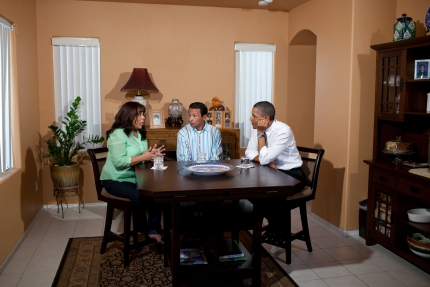
President Obama participates in a kitchen table discussion regarding the American Jobs Act

President Barack Obama participates in a kitchen table discussion regarding the American Jobs Act, with Jose and Lissette Bonilla at their home in Las Vegas, Nevada, Oct. 24, 2011. (Official White House Photo by Pete Souza)

Related Topics: Economy, Nevada

The White House

Office of the Press Secretary

Remarks by the President at a Campaign Event -- Las Vegas, NV

Bellagio Hotel and Casino
Las Vegas, Nevada

12:57 P.M. PDT

THE PRESIDENT: Hello, Vegas! (Applause.) Thank you. Thank you so much. It is good to be back in Las Vegas. It is good to be back in Nevada. I love coming to Vegas. The only people who love coming more is my staff. (Laughter.) I would not be surprised if some of them missed the plane, accidentally. (Laughter.) But is wonderful to be with all of you.

I want to especially thank Stephen for the incredible work that he is doing right now, because as a consequence of his work, we are going to see more tourism dollars in Las Vegas, more tourism dollars in Nevada, more tourism dollars in the United States of America. So please give him a big round of applause for all his efforts. (Applause.)

I see a lot of friends here, folks who have been with me for a long time. And to all of you, I just want to say thank you. But I'm here today not just because I need your help again. I am here because the country needs your help. I'm here because if you thought that the last election was critical to our future, then I can promise you that what happens in the coming year is going to be even more consequential. It's going to matter to our kids; it's going to matter to our grandkids.

For the past three years, we've been wrestling with two kind of crises -- we've been dealing with an economic crisis that left far too many folks without a job, far too many folks struggling with housing. But we've also been dealing with a political crisis.

All across the country people are crying out for action. A lot of folks have spent months looking for work. Others are doing their best just to get by, having to make tough decisions every single day. Maybe they don't go out to a restaurant because they can't afford the gas. Maybe they give up their retirement for now so that they can send their child to college. These Americans are not asking for a lot. They're not looking for handouts. They don't think government can or should solve all their problems. But they do believe what most of you believe -- that America should be a place where no matter where you come from, no matter what you look like, you can make it if you try; that this economy works best when it works for everybody, not just for those at the very top; that if opportunity exists for all Americans, then all of us do well -- folks in the middle and the folks at the top, as well as folks at the bottom.

Most Americans believe that hard work should pay off, that responsibility should be rewarded, that everybody in this country deserves a fair shake and everybody has a responsibility to do their fair share. And these beliefs aren't Democratic values; they're not Republican values -- they are American values. And they're the bedrock of what this country has always stood for. That's why I ran for President in the first place. That's why so many of you supported me -- poured your hearts into this campaign -- because you believed that it was time for our politics to reflect our values.

And three years later, it's clear that a big chunk of Washington has not gotten the message yet. Just look at what's been going on since I introduced my jobs bill in September. Now, this is a bill that is filled with proposals that, traditionally, Democrats and Republicans have supported in the past: tax cuts for workers and small businesses; funding to rebuild our roads and our bridges and our airports, our infrastructure, our transportation system; putting construction workers back on the job; hiring back teachers and cops, firefighters; giving incentives so that veterans are able to find work when they come home -- because, I promise you, if you've laid down your life or risked your life for this country, you should not have to fight for a job when you come home. (Applause.)

So those are the proposals contained in this bill. It's a bill that's fully paid for -- by asking those of us who make more than $1 million to pay a little more in taxes. Independent economists, people who look at this stuff for a living, say that it's the only plan out there right now that would create jobs in the short term as well as lay a foundation for economic growth in the long term. One economist said it would create nearly 2 million jobs next year -- 2 million. And by the way, that economist did not work for me. And polls show that an overwhelming majority of Americans support the proposals that are in this bill -- Democrats, independents and Republicans.

So we've got huge challenges in places like Nevada. We've got a jobs bill out there that is paid for and addresses those challenges. The question is, why, despite all the support -- despite all the experts who say this jobs bill couldn't come at a more important time, when so many people are hurting -- why the Republicans in Washington have said no? They keep voting against it. Now, maybe it's just because I am the one sponsoring it. I don't know. But last week, we had a separate vote on a part of the jobs bill that would put 400,000 teachers, firefighters and police officers back on the job, paid for by asking people who make more than $1 million to pay one-half of 1 percent in additional taxes. For somebody making $1.1 million a year, that's an extra $500. Five hundred bucks. And with that, we could have saved $400,000 jobs.

Most people making more than $1 million, if you talk to them, they'll say, I'm willing to pay $500 extra to help the country. They’re patriots. They believe we’re all in this thing together. But all the Republicans in the Senate said no. Their leader, Mitch McConnell, said that -- and I’m going to make sure I quote this properly -- saving the jobs of teachers and cops and firefighters was just -- I quote -- “a bailout.” A bailout. These aren’t bad actors who somehow screwed up the economy. They didn’t act irresponsibly. These are the men and women who teach our children, who patrol our streets, who run into burning buildings and save people. They deserve our support.

This is the fight that we’re going to have right now, and I suspect this is the fight that we’re going to have to have over the next year. The Republicans in Congress and the Republican candidates for President have made their agenda very clear. They have two basic economic principles: first, tax cuts for the very wealthiest and the biggest corporations, paid for by gutting investments in education and research and infrastructure and programs like Medicare. That’s agenda item number one. Second is just about every regulation that's out there they want to get rid of -- clean air, clean water -- you name it.

Now, I agree that there are some rules and regulations that put an unnecessary burden on business at a time when we can’t afford it. I mean, we’ve seen this in our travel bureau, where the bureaucracy for getting a visa to come visit Vegas is too long. We want to get them here quicker; they can stay longer and spend more. And that’s why, in addition to what we’re doing with the travel bureau, we’ve already identified 500 regulatory reforms that will save billions of dollars over the next few years -- billions of dollars over the next few years. But unfortunately, so far at least, we have not gotten any willingness on the other side to say that some regulations we can’t give up.

We are not going to win the race in this competitive 21st century economy by having the cheapest labor or the most polluted air. That’s a race to the bottom that we can’t win. There’s always going to be a country out there that can exploit its workers more, or pollute its air more, or pollute its water more, have lower worker safety standards. There’s always going to be somebody out there to win that competition. The competition we need to win is because we have the best scientists, and we’ve got the best universities, and we’ve got the best workers, and we have the best infrastructure, and we’ve got the best resorts, and we’ve got the best ideas, and we’ve got the best system, and it’s the most transparent and it’s the most accountable. That’s how we’re going to win the competition for the future. And that’s what’s at stake right now in this race.

And the worst part is that the ideas that the other side are propagating we’ve tried. I mean, it would be one thing if, you know what, the economy is not doing very well; let’s try something new. Let’s try a whole radical new agenda. But what they’re proposing we tried for 10 years. Remember? Does anybody remember?

AUDIENCE: Yes!

THE PRESIDENT: We cut taxes for our wealthiest citizens. We didn't enforce worker safety rules. We didn't enforce anti-pollution standards. We didn't enforce regulations on Wall Street. And where did we end up? We ended up with a decade in which income and wages for middle-class families flat-lined, and people tried to make up for it by propping up a housing bubble. And when it went bust we had the worst financial crisis and the worst economic crisis since the Great Depression. That’s the end of the road if you travel that path.

So we’ve got a different set of ideas here. We have a different set of values. And I repeat, they are not Democratic values alone. Abraham Lincoln, in the midst of a civil war, started land-grant colleges and the Homestead Act and built the Intercontinental Railroad, started the National Academy of Sciences. He understood -- the first Republican President -- that you've got to invest in the future in order to win it.

Dwight Eisenhower built the Interstate Highway System, invested in math and science in our schools. My grandfather benefited from a G.I. Bill -- like millions of others who came home heroes, and somebody said, you know what, if we give them opportunity, if we give them a chance, there is no doubt that everybody will be better off.

I would not be standing here today if somebody had not made an investment and said, you know what, not everybody is going to be born wealthy, not everybody is going to be born well-connected; why don't we make sure that we've got college scholarships out there and student loans so that people can go to college and give something back to this country. (Applause.)

So those are the values that we're going to be fighting for. And I have confidence that those are the values of the American people. And I know those are your values. And it's because you were willing to invest so much, not in me, but in an idea that we can have a politics that is different, have a politics that's focused on not just the here and now, not just focused on party, but is focused on country; not just focused on the next election, but focused on the next generation -- it's because you made that investment that we've already made some remarkable changes.

And things are tough right now, but I want everybody to remember what we have accomplished because of you. (Applause.) What we've accomplished because of you. As tough as things are right now, we were able to stabilize this economy and make sure it didn’t go into a Great Depression -- because of you. Because of your efforts, we were able to pass health care reform, and 30 million people are going to get health insurance in this country. (Applause.)

I just had somebody who's here tonight -- or here this afternoon -- mention the fact that their daughter is very sick. And my prayers are with the family. But, he said -- she is 23 years old right now -- "because of the Affordable Care Act, right now she is able to stay on my insurance." And that is a huge relief for families across the country. A million extra young people have health insurance because of you and we haven’t even finished implementing that plan. (Applause.)

Because of you, as promised, the war in Iraq will end by the end of this year and all our troops will be home -- all of them. (Applause.) And, by the way, the country is stronger and it is safer. And we are making a transition in Afghanistan, and al Qaeda is on the run and we have decimated their leadership -- because of you. (Applause.) Because of you, anybody can serve in our military now, regardless of who they love. “Don’t ask, don’t tell” is history, because of you. (Applause.)

Because of you, there are millions of young people who are getting Pell Grants and larger scholarships, because we’re no longer subsidizing big banks who were basically just a pass-through for student loans. That money is directly going to the students now and that’s making a huge difference all across the country. (Applause.)

So we’ve made an enormous difference already, but we’ve got so much more work to do. We’ve got to pass comprehensive immigration reform. (Applause.) We’ve got to make sure that we have a system that reflects that we’re a nation of laws and a nation of immigrants.

We’re going to have to have an energy policy in this country that makes sense -- because I am tired of the U.S. economy being held hostage to the spot oil market. We’ve got to develop clean energy that will not only put money back in the pocket of consumers -- (applause) -- but will also save our environment.

We still have to implement health care reform. We still have to implement financial regulatory reform. We have set up a consumer watchdog that is going to make sure no more hidden fees, no more abusive mortgage practices that had such a devastating effect here in Nevada. But we’ve got to make sure that it’s actually implemented. And the other side, one of their main agendas is to roll it back.

And most of all, we’ve got to grow an economy that is based not on bubbles, not on shifting sands, not on financial maneuvers, but it’s based on innovation and based on investment, and based on entrepreneurship. We can do those things. We can close the deficit and make the investment in the future that we need. But I’m only going to be able to do it if you’re there with me. I’m only going to be able to do that if you’re there with me. (Applause.)

You know, I turned 50 this summer. (Laughter.) My hair is a little grayer now. You noticed that, huh? Yes. My girls say it’s distinguished. (Laughter.) Michelle says it just makes me look old. (Laughter.) We’ve gone through some enormous challenges over the last three years, and as much good as we have done, I think there’s so much left to do that, understandably, a lot of people feel a little disenchanted. A lot of people feel discouraged.

That old “Hope” poster is fading. It’s getting dog-eared along the edges there. (Laughter.) But I just want to remind all of you that we never said this was going to be easy. We never said that change was going to happen overnight. The problems that we confront didn’t happen overnight; we weren’t going to solve them overnight. The challenges we face in terms of rebuilding an economy that works for everybody, making sure that once again we have the best education system in the world, making sure that once again anybody out there who has a good idea can go out there and make it, making sure that we’ve got a balanced approach to reducing our deficit and getting our fiscal house in order -- all those things we knew were going to take some time.

And so the main challenge that I have for all of you here today is to make sure that you remember why we got on this path in the first place; why we took this journey from the start. We didn't do it because it was going to be easy. You supported a candidate named Barack Hussein Obama. (Applause.) Polls didn't need to tell you that that was going to be hard. You didn't do it because you thought that change would happen overnight. You didn't do it because you were easily discouraged.

These days people look back at the campaign and they say, oh, that campaign was perfect, you know? It’s like, well, no it wasn’t. (Laughter.) We had all kinds of setbacks. We defied the odds. So many of you remember. And we’ll do it again. (Applause.) But we will do it again -- I still believe in you, and I believe in the American people. And I’m absolutely convinced that as long as we keep our eyes on where we need to go, here in Nevada and all across the country, that indomitable American spirit, that thing that has gotten us through every single tough time we’ve ever been in -- from Revolutionary War to Civil War, slavery, the women’s rights movement, the union movement -- every step of the way -- world wars and great depressions -- we’ve always come out stronger on the other side.

There's something about the American people where, when we are tested, when times are tough, it turns out we are tougher. And when our politics isn't working, then the American people rise up and make sure they work.

This is one of those moments. This is one of those times. And if you keep hoping, and you're willing to put your work and your effort behind it, I have no doubt that not only will we win this election, but more importantly, we're going to win the future and this country is going to be greater than it's ever been.

Thank you very much, everybody. God bless you. God bless the United States of America. (Applause.)

END
1:20 P.M. PDT

President Obama Speaks on Housing and the Economy

October 24, 2011 | 12:41 | Public Domain

The President speaks about Project Rebuild, part of the American Jobs act that will help the private sector put construction workers back to work rehabilitating vacant or abandoned homes and businesses, which will help stabilize home prices across the country.

Download mp4 (121MB) | mp3 (12MB)

Read the Transcript

Remarks by the President on the Economy and Housing

2:15 P.M. PDT

        THE PRESIDENT:  Good afternoon, everybody.

        AUDIENCE:  Good afternoon!

        THE PRESIDENT:  Thank you for letting me block your driveways.  (Laughter.)

        AUDIENCE MEMBER:  You’re welcome.

        THE PRESIDENT:  Well, it is wonderful to be with all of you.  And I want to thank Jose and Lissette and their wonderful children for letting us set up right in front of their house, and we just had a wonderful visit.  

        Without a doubt, the most urgent challenge that we face right now is getting our economy to grow faster and to create more jobs.  I know it; the people of Nevada know it; and I think most Americans also understand that the problems we face didn't happen overnight and so we’re not going to solve them all overnight either.  What people don’t understand, though, is why some elected officials in Washington don’t seem to share the same sense of urgency that people all around the country are.  

        Last week, for the second time this month, Republicans in the Senate blocked a jobs bill from moving forward -- a bill that would have meant nearly 400,000 teachers, firefighters, and first responders being back on the job.  It was the kind of proposal that in the past, at least, Republicans and Democrats have supported.  It was paid for, and it was supported by an overwhelming majority of the American people.  But they still said no.  

        Your senator, Majority Leader Harry Reid, he’s been fighting nonstop to help get the economy going.  But he’s not getting some help from some of the members of the Nevada delegation.  So we need them to get their act together.  Because the truth is, the only way that we can truly attack our economic challenges, the only way we can put hundreds of thousands of people back to work right now is with bold action from Congress.  

        That’s why I’m going to keep forcing these senators to vote on common-sense, paid-for jobs proposals.  But last month, when I addressed a joint session of Congress about our jobs crisis, I also said that I intend to do everything in my power to act on behalf of the American people -- with or without Congress.  

        So I’m here to say to all of you -- and to say to the people of Nevada and the people of Las Vegas -- we can’t wait for an increasingly dysfunctional Congress to do its job.  Where they won’t act, I will.  

        In recent weeks, we decided to stop waiting for Congress to fix No Child Left Behind, and decided to give states the flexibility they need to help our children meet higher standards. We took steps on our own to reduce the time it takes for small businesses to get paid when they have a contract with the federal government.  And without any help from Congress, we eliminated outdated regulations that will save hospitals and patients billions of dollars.

        Now, these steps aren’t substitutes for the bold action that we need to create jobs and grow the economy, but they will make a difference.  So we’re not going to wait for Congress.  

        I’ve told my administration to keep looking every single day for actions we can take without Congress -- steps that can save consumers money, make government more efficient and responsive, and help heal the economy.  And we’re going to be announcing these executive actions on a regular basis.

        Now, today what I want to focus on is housing, which is something obviously on the minds of a lot of folks here in Nevada.  Probably the single greatest cause of the financial crisis and this brutal recession has been the housing bubble that burst four years ago.  Since then, average home prices have fallen by nearly 17 percent.  Nationwide, more than 10 million homeowners are underwater.  That means that they owe more on their homes than those houses are worth.  And here in Las Vegas, the city that’s been hit hardest of all, almost the entire housing market is under severe stress.

        Now, this is a painful burden for middle-class families.  And it’s also a drag on our economy.  When a home loses its value, a family loses a big chunk of their wealth.  Paying off mortgage debt means that consumers are spending less and businesses are making less and jobs are harder to come by.  And as long as this goes on, our recovery can’t take off as quickly as it would after a normal recession.

        So the question is not whether or not we do something about it -- we have to do something about it.  The question is, what do we do and how fast do we move?  One idea that I’ve proposed is contained in the jobs act that is before Congress right now, and it’s called Project Rebuild.  

        A lot of homeowners in neighborhoods like this one have watched the values of their home decline not just because the housing bubble burst, but also because of the foreclosure sign next door, or the vacant home across the street.  Right now, there are hundreds of thousands of vacant homes like these and more than a million unemployed construction workers.  That doesn’t make any sense when there’s work to be done and there are workers ready to do it.  

        So Project Rebuild connects the two by helping the private sector put construction workers to work rehabilitating vacant or abandoned homes and businesses all across the country.  That will help stabilize home prices in communities like this one.  And it will help families like the Bonillas to buy a new home and build a nest egg.  

        This is something that Congress can pass right now, because it’s in the jobs bill.  We will put construction workers back to work and we will rebuild homes all across Nevada and all across the country.

        If Congress passes this jobs bill, we can get Project Rebuild moving right away.  If Congress acts, then people in Nevada and all across the country can get significant relief.  But remember what I said.  We can’t just wait for Congress.  Until they act, until they do what they need to do, we’re going to act on our own, because we can’t wait for Congress to help our families and our economy.

        Over the past two years, we’ve already taken some steps to help families refinance their mortgages.  Nearly one million Americans with little equity in their homes have gotten assistance so far.  And we’ve also made it easier for unemployed homeowners to keep their homes while they’re looking for a job.  And we’re working to turn vacant properties into rental housing, which will help reduce the supply of unsold homes and stabilize housing prices here in Las Vegas and all across the country.  

        But we can do more.  There are still millions of Americans who have worked hard and acted responsibly, paying their mortgage payments on time.  But now that their homes are worth less than they owe on their mortgage, they're having trouble getting refinancing even though mortgage rates are at record lows.

        So that's going to soon change.  Last month, I directed my economic team to work with the Federal Housing Finance Agency -- or FHFA -- and their partners in the housing industry to identify barriers to refinancing, knock those barriers down, and explore every option available to help many American homeowners to refinance.

        And today, I am pleased to announce that the agency that is in charge is going to be taking a series of steps to help responsible homeowners refinance and take advantage of low mortgage rates.  So let me just name those steps.

        Number one, the barrier will be lifted that prohibits responsible homeowners from refinancing if their home values have fallen so low that what they owe on their mortgage is 25 percent higher than the current value of their home.  And this is critically important for a place like Las Vegas, where home values have fallen by more than 50 percent over the past five years.  

        So let me just give you an example.  If you've got a $250,000 mortgage at 6 percent interest rates, but the value of your home has fallen below $200,000, right now you can’t refinance.  You’re ineligible.  But that’s going to change.  If you meet certain requirements, you will have the chance to refinance at lower rates, which could save you hundreds of dollars a month, and thousands of dollars a year on mortgage payments.

        Second, there are going to be lower closing costs, and certain refinancing fees will be eliminated -- fees that can sometimes cancel out the benefits of refinancing altogether, so people don't bother to refinance because they've got all these fees that they have to pay.  Well, we're going to try to knock away some of those fees.  

        Third, there's going to be more competition so that consumers can shop around for the best rates.  Right now, some underwater homeowners have no choice but to refinance with their original lender -- and some lenders, frankly, just refuse to refinance.  So these changes are going to encourage other lenders to compete for that business by offering better terms and rates, and eligible homeowners are going to be able to shop around for the best rates and the best terms.

        So you take these things together, this is going to help a lot more homeowners refinance at lower rates, which means consumers save money, those families save money, it gets those families spending again.  And it also makes it easier for them to make their mortgage payments, so that they don't lose their home and bring down home values in the neighborhood.

        And I'm going to keep on doing everything in my power to help to stabilize the housing market, grow the economy, accelerate job growth, and restore some of the security that middle-class families have felt slipping away for more than a decade.

        Now, let me just say this in closing.  These steps that I’ve highlighted today, they're not going to solve all the problems in the housing market here in Nevada or across the country.  Given the magnitude of the housing bubble and the huge inventory of unsold homes in places like Nevada, it's going to take time to solve these challenges.  We still need Congress to pass the jobs bill.  We still need them to move forward on Project Rebuild so we can have more homes like this, and wonderful families having an opportunity to live out the American Dream.

        But even if we do all those things, the housing market is not going to be fully healed until the unemployment rate comes down and the inventory of homes on the market also comes down. But that's no excuse for inaction.  That's no excuse for just saying “no” to Americans who need help right now.  It's no excuse for all the games and the gridlock that we’ve been seeing in Washington.  

        People out here don’t have a lot of time or a lot of patience for some of that nonsense that's been going on in Washington.  If any member of Congress thinks there are no unemployed workers or no down-on-their-luck neighborhoods in their district that would benefit from the proposals in the jobs bill, then they better think again.  They should come and talk to the families out here in Nevada.  These members of Congress who aren’t doing the right thing right now, they still have a chance to take meaningful action to put people back to work, and to help middle-class families and homeowners like the Bonillas.  

        But we can’t wait for that action.  I'm not going to wait for it.  So I’m going to keep on taking this message across the country.  Where we don't have to wait for Congress, we're just going to go ahead and act on our own.  And we're going to keep on putting pressure on Congress to do the right thing for families all across the country.  And I am confident that the American people want to see action.  We know what to do.  The question is whether we're going to have the political will to do it.

        All right?  So thank you so much, everybody.  God bless you. God bless the United States of America.  Thanks for welcoming me to your neighborhood.  (Applause.)

END 2:28 P.M. PDT

Close Transcript

The White House

Office of the Press Secretary

Readout of the President’s call with Egyptian Field Marshal Tantawi

President Obama called Egyptian Field Marshal Tantawi today to reaffirm the close partnership between the United States and Egypt and to underscore his full support for Egypt’s transition to democracy. The two leaders agreed that Egypt’s upcoming elections must be free and fair and be held in accordance with democratic standards. The President underscored that the United States supports a strong, peaceful, prosperous and democratic Egypt that responds to the aspirations of its people, and that the outcome of the election is for the Egyptian people to decide. He welcomed Egypt’s willingness to accept international election witnesses and urged that Egypt lift the emergency law and end military trials for civilians. The two leaders also discussed Egypt’s economic situation. The President emphasized his support for full funding by the Congress of the Administration’s request for assistance for Egypt, without conditions, and stressed his commitment to help Egypt secure international assistance to address its economic needs. The President and the Field Marshal also underscored their intention to continue to cooperate closely on counter-terrorism and regional security. They agreed to remain in close touch in the months ahead as Egypt moves forward with its transition to democracy.

The White House

Office of the Press Secretary

Presidential Proclamation -- United Nations Day

BY THE PRESIDENT OF THE UNITED STATES OF AMERICA

A PROCLAMATION

In 1945, 51 nations in a world shaken by war signed the Charter of the United Nations. Determined to move beyond an era of violence and uncertainty, these pioneers aimed to prevent conflict by addressing its causes. Today, the United Nations provides a forum to seek lasting peace by mediating international disputes, advancing human rights, and fostering global cooperation. On United Nations Day, we join our 192 fellow member states in celebrating the founding ideals of the Charter, and we recommit to the global pursuit of peace, justice, and human dignity.

Built out of the ashes of war and genocide, the United Nations emerged as a vehicle for human progress. Recognizing the power and virtue of working in concert, the founders of this institution set out to mend the wounds caused by World War II, embrace peace over chaos, and lay the foundation for global cooperation on shared goals. Now, as the fates of nations become ever more intertwined, the leadership, staff, and member states of the United Nations continue to play an essential role in addressing global issues from public health and economic development to climate change, transnational terrorism, and nuclear proliferation.

Extraordinary events have reminded the world that the collective action of ordinary citizens can lead the march toward liberty and justice. At a time of dramatic political transformation, the United Nations can embrace democratic movements and stand beside those who reject tyranny and oppression and look to the promise of freedom and prosperity. Together, we will help realize the aspirations of peoples long denied the opportunity to achieve their dreams.

The men and women who created the United Nations understood that peace is not simply the absence of war. The global community must continue not only to promote stability, but also defend the right of all peoples to live free and the right of all nations to chart their own course. The United States, working in and with the United Nations, will never accept a flawed status quo, but will pursue with vigor the world as we know it can be.

NOW, THEREFORE, I, BARACK OBAMA, President of the United States of America, by virtue of the authority vested in me by the Constitution and the laws of the United States, do hereby proclaim October 24, 2011, as United Nations Day.

I urge the Governors of the 50 States, and the officials of all other areas under the flag of the United States, to observe United Nations Day with appropriate ceremonies and activities.

IN WITNESS WHEREOF, I have hereunto set my hand this twenty-fourth day of October, in the year of our Lord two thousand eleven, and of the Independence of the United States of America the two hundred and thirty-sixth.

BARACK OBAMA

The White House

Office of the Press Secretary

President Obama Announces 2011 White House Tribal Nations Conference

WASHINGTON – On Friday, December 2, 2011, President Obama will host the White House Tribal Nations Conference at the Department of the Interior. As part of President Obama’s ongoing outreach to the American people, this conference will provide leaders from the 565 federally recognized tribes the opportunity to interact directly with the President and representatives from the highest levels of his Administration. Each federally recognized tribe will be invited to send one representative to the conference. This will be the third White House Tribal Nations Conference for the Obama Administration, and continues to build upon the President’s commitment to strengthen the nation to nation relationship with Indian Country. Additional details about the conference will be released at a later date.

We Can't Wait To Help Homeowners Refinance Their Mortgages

In a typical recession, this is how you expect a recovery to get its legs: Growing families begin to invest in new homes. That investment works its way through the economy. Builders, suppliers, realtors, and the broader community all benefit.

Today, that isn't happening.

In 2006, the median home price in the United States was $227,100. By May of this year, that price had fallen to $158,700.

Already, at least 5 million people have lost their homes due to foreclosure, and today, one in every three homes purchased is the product of a short sale or a foreclosed property.

Worse still, across the country, nearly 11 million owe more than their property is worth.

Millions of these people have done everything right. They've paid all their bills and kept current on their home loans. But right now, they're stuck with higher payments because their mortgages are underwater. They're not eligible to refinance because the decline in home prices have made their property worth less than what they owe. And that's a problem President Obama knows must be addressed.

All of these factors have contributed to a climate where new homes are being built at the lowest rate since World War II and where homeowners feel trapped by financial circumstances outside their control. Those two things together are holding back the recovery.

We can't wait to help homeowners. The situation is too serious, and too much good can come from improving the state of housing in this country.

So today, President Obama is taking action. It starts with finding ways to allow homeowners to refinance their mortgages.

The Home Affordable Refinance Program is designed to do just that. To date, it's already helped nearly 1 million homeowners improve their financial situations. But up until now, eligibility regulations and costs associated with the program have kept it from having a wider impact.

Now, a new set of rules will open the program to nearly anyone with a mortgage backed by Fannie Mae or Freddie Mac -- no matter what they owe -- so long as they are current on their payments, have no late payments in the last six months, and have not made more than one late payment in the past year.

The group that manages the program, the Federal Housing Finance Agency, will also waive a set of unnecessary costs and fees that were dissuading some from taking advantage of the program and work to get rid of certain restrictions in order to increase competition among lenders.

Millions of individuals could see up to $2,500 in savings every year.

But good as this program might prove to be, alone it won't be enough. The thing that pushes most homeowners into foreclosure is unemployment. Knowing that, Congress still has the opportunity to pass a housing program with sweeping potential -- the American Jobs Act.

Until they do, President Obama isn't waiting on lawmakers to take action. Today's announcement is just the start of things this Administration will do to get the economy growing again -- even if Congress refuses to make jobs a priority.

President Obama also can't wait for Congress to:

Related Topics: Economy, Housing

President Obama in Las Vegas

October 24, 2011 | 1:31 | Public Domain

The President meets with a Las Vegas family who was able to buy a home with help from the Administration’s housing policies.

Download mp4 (15MB) | mp3 (2MB)