Welcoming the Winners of the 2010 National Medals of Science, Technology and Innovation to the White House

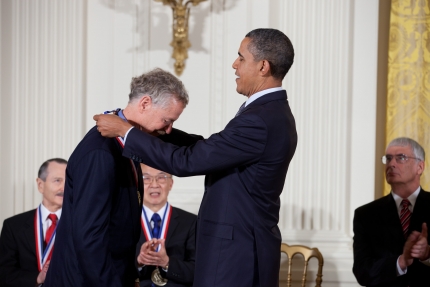
President Obama presents the 2010 National Medals of Science, Technology and Innovation

President Barack Obama presents the 2010 National Medals of Science, Technology and Innovation during a ceremony in the East Room of the White House, Oct. 21, 2011. National Medal of Science recipient Dr. Rudolf Jaenisch, Cambridge, Mass. (Official White House Photo by Chuck Kennedy)

President Obama today welcomed some of our nation's most outstanding innovators and inventors to the White House. They were all winners of the National Medals of Science and the National Medals of Technology and Innovation, our nation’s highest honor for inventions and innovation. The President praised the 2010 honorees work, and their influence as role models to the next generation of budding scientists:

Thanks to the men and women on the stage, we are one step closer to curing diseases like cancer and Parkinson’s.  Because of their work, soldiers can see the enemy at night and grandparents can see the pictures of their grandchildren instantly and constantly.  Planes are safer, satellites are cheaper, and our energy grid is more efficient, thanks to the breakthroughs that they have made. 

And even though these folks have not sought out the kind of celebrity that lands you on the cover of People magazine, the truth is that today’s honorees have made a bigger difference in our lives than most of us will ever realize. When we fill up our cars, talk on our cell phones, or take a lifesaving drug, we don’t always think about the ideas and the effort that made it all possible.  We don’t always ask ourselves how many sleepless nights went by and how many family dinners were sacrificed. But the folks behind me -- they know.  They worked those long nights. They made those sacrifices.  They took on those challenges and ran those experiments and devoted their lives to expanding the reach of human understanding.  

And that’s why we recognize them today. Because America has always been a place where good ideas can thrive and dreams can become real -- where innovation is encouraged and the greatest minds in the world are free to push the very limits of science and technology.  

To understand that, you don’t have to look any further than the people on this stage. Three-quarters of our honorees were born outside of the United States.  From China, Germany, India, Canada and England, they searched for the best universities and the most advanced labs -- and they found them here, because America is the best place in the world to do the work that they do.

The White House

Office of the Press Secretary

Readout of the President's calls with Colombian President Santos and Panamanian President Martinelli

Earlier this afternoon, President Obama called President Juan Manuel Santos of Colombia and President Ricardo Martinelli of Panama to congratulate each after having signed the implementing legislation for the Colombia and Panama Trade Promotion Agreements.  The President noted that the agreements indicate the deep and enduring ties between the United States and both Colombia and Panama.  In the calls the President underscored the importance of meeting the obligations of the agreements as each country moves toward implementation, as well as continued progress on implementation of the Colombia Labor Action Plan.  Finally, the presidents discussed issues of mutual interest, including the upcoming Summit of the Americas, the Middle East, and trade.

President Obama Honors the Country’s Top Innovators and Scientists

October 21, 2011 | 19:50 | Public Domain

The President recognizes the 2010 National Medal of Science and National Medal of Technology and Innovation recipients.

Download mp4 (189MB) | mp3 (18MB)

Read the Transcript

Remarks by the President at Presentation of the National Medals of Science and the National Medals of Technology and Innovation

East Room

2:09 P.M. EDT

THE PRESIDENT: Welcome, everybody. Please have a seat. It is a great pleasure to be with so many outstanding innovators and inventors. And I’m glad we could convince them all to take a day off -- (laughter) -- to accept our nation’s highest honor when it comes to inventions and innovation, and that is the National Medals of Science, and the National Medals of Technology and Innovation.

It’s safe to say that this is a group that makes all of us really embarrassed about our old science projects. (Laughter.) You know, the volcano with the stuff coming out -- (laughter) -- with the baking soda inside -- apparently, that was not a cutting-edge achievement -- (laughter) -- even though our parents told us it was really terrific.

But thanks to the men and women on the stage, we are one step closer to curing diseases like cancer and Parkinson’s. Because of their work, soldiers can see the enemy at night and grandparents can see the pictures of their grandchildren instantly and constantly. Planes are safer, satellites are cheaper, and our energy grid is more efficient, thanks to the breakthroughs that they have made.

And even though these folks have not sought out the kind of celebrity that lands you on the cover of People magazine, the truth is that today’s honorees have made a bigger difference in our lives than most of us will ever realize. When we fill up our cars, talk on our cell phones, or take a lifesaving drug, we don’t always think about the ideas and the effort that made it all possible. We don’t always ask ourselves how many sleepless nights went by and how many family dinners were sacrificed. But the folks behind me -- they know. They worked those long nights. They made those sacrifices. They took on those challenges and ran those experiments and devoted their lives to expanding the reach of human understanding.

And that’s why we recognize them today. Because America has always been a place where good ideas can thrive and dreams can become real -- where innovation is encouraged and the greatest minds in the world are free to push the very limits of science and technology.

To understand that, you don’t have to look any further than the people on this stage. Three-quarters of our honorees were born outside of the United States. From China, Germany, India, Canada and England, they searched for the best universities and the most advanced labs -- and they found them here, because America is the best place in the world to do the work that they do.

And now more than ever, it’s critical that we make the investments necessary to keep it that way. We live in a global economy where companies and factories can be located anywhere there’s an Internet connection. And to compete in that economy, we can’t cut corners by paying workers less or building cheaper products. We won’t be able to engage in a race to the bottom -- that's not who we are.

The key to our success has always been and always will be our unparalleled ability to think up new ideas, create new industries, and lead the way in discovery and innovation. And that’s how the future will be won.

Right now, unfortunately, barely more than one in 10 of all undergraduate students are enrolled in what we call the STEM subjects -- science, technology, engineering and math -- areas that will be critical if America is going to compete for the jobs of the future. And that’s troubling, because no matter how many great minds we attract from around the world, it won’t be enough if we can’t grow some here at home.

That’s why we’ve worked to make college more affordable, why we've set a goal to train 100,000 new teachers in the next decade, and started a Race to the Top to encourage schools to improve the way they teach these subjects. That’s why we’re working with businesses to train more engineers, and help community colleges provide more workers with the skills that businesses need.

And just as we’re working to cultivate the next generation of thinkers, we’re also working to fast-track the next generation of doers. We’ve made historic investments in technology and research, made the most meaningful reforms to our patent process in 50 years, and made it easier for entrepreneurs to turn new ideas into new businesses and new jobs. I want to thank someone who helped make that happen -- NASA Administrator Charles Bolden is here, and we're very pleased to have him as well.

As the men and the women on this stage will tell you, nobody gets here on their own. Each of them succeeded because they had a great teacher, a great mentor, or a great partner. Some of them don’t have to look far for inspiration. In fact, I hear that Jackie Barton’s husband won the same award she’s getting today in 2006 -- (laughter) -- and they plan on displaying their medals next to each other on a mantle at home -- which I would imagine will intimidate dinner guests. (Laughter.)

And just as each of today’s honorees has had someone in their lives who lit a spark, or kept that spark burning, they’ve paid it back by inspiring somebody else. When Peter Stang won this award, he made sure to thank the 100 post-doctoral and Ph.D. students he’s mentored over the years, because, as he said, “this recognizes their work as well.” When Jay Baliga first got interested in physics by picking up a book at the local bookstore, he remembered that and he now tells his students to go beyond the curriculum and come up with ideas of their own. When Richard Tapia remembers what it’s like growing up as a son of Mexican immigrants and the first one in his family to go to college, today, he is a world-class mathematician, but he, because of those memories, helps more young people –- especially women and minorities -- to get involved in math and in science.

And in the end, that’s what today is all about. One of the best ways we can inspire more young people to think big, dream big dreams is by honoring the people who already do -- folks who are smart and aren’t afraid to show it, but also folks who have taken that brilliance and gone out and changed the world.

Because that next generation is already coming; they’re already knocking on the door. A couple of weeks ago, I got a chance to meet the winners of the Google Science Fair. I want to point out that all three of them were girls. (Applause.) They had beat out 10,000 other applicants from over 90 countries. So I had them over to the Oval Office, and they explained their projects to me, and I pretended that I understood. (Laughter.)

One of the winners, Shree Bose, did her first experiment in second grade by trying to turn spinach blue. (Laughter.) In fourth grade, she built a remote-controlled garbage can. And for this science fair, at the age of 17, she discovered a promising new way to improve treatment for ovarian cancer -- at 17. And she also told me very matter-of-factly that she’ll be going to medical school and getting a doctorate, and I suspect she will do so. (Laughter.) She did not lack confidence.

And it’s young people like Shree, but also the people on this stage, who make me incredibly hopeful about the future. Even at a time of great uncertainty, their stories remind us that there are still discoveries waiting to be made and unlimited potential waiting to be tapped. All we have to do is encourage it and support it.

So I want to congratulate today’s honorees for their extraordinary and inspiring work. We could not be prouder of all of you.

And now it is my privilege to present the National Medals of Science and the National Medals of Technology and Innovation. (Applause.)

(The citations are read and the medals are presented.)

MILITARY AIDE: Jacqueline K. Barton. The 2010 National Medal Science to Jacqueline K. Barton, California Institute of Technology, for discovery of a new property of the DNA helix long-range electron transfer, and for showing that electron transfer depends upon stacking of the base pairs and DNA dynamics. Her experiments reveal a strategy for how DNA repair proteins locate DNA lesions and demonstrate a biological role for DNA-mediated charge transfer. (Applause.)

Ralph L. Brinster. The 2010 National Medal of Science to Ralph L. Brinster, University of Pennsylvania, for his fundamental contributions to the development and use of transgenic mice. His research has provided experimental foundations and inspiration for broad progress in germ line genetic modification in a range of species, which has generated a revolution in biology, medicine and agriculture. (Applause.)

Shu Chien. The 2010 National Medal of Science to Shu Chien, University of California, San Diego, for pioneering work in cardiovascular physiology and bioengineering, which has had tremendous impact in the fields of microcirculation, blood rheology, and mechanotransduction in human health and disease. (Applause.)

Rudolf Jaenisch. (Applause.) The 2010 National Medal of Science to Rudolph Jaenisch, Whitehead Institute for Biomedical Research and Massachusetts Institute of Technology, for improving our understanding of epigenetic regulation of gene expression, the biological mechanisms that affect how genetic information is variably expressed. His work has led to major advances in our understanding of mammalian cloning and embryonic stem cells. (Applause.)

Peter J. Stang. The 2010 National Medal of Science to Peter J. Stang, University of Utah, for his creative contributions to the development of organic super-molecular chemistry, and for his outstanding and unique record of public service. (Applause.)

Richard A. Tapia. The 2010 National Medal of Science to Richard A. Tapia, Rice University, for his pioneering and fundamental contributions in optimization theory and numerical analysis, and for his dedication and sustained efforts in fostering diversity and excellence in mathematics and science education. (Applause.)

Srinivasa S.R. Varadhan. The 2010 National Medal of Science to Srinivasa S. R. Varadhan, New York University, for his work in probability theory, especially his work on large deviations from expected random behavior which has revolutionized this field of study during the second half of the 20th century, and become a cornerstone of both pure and applied probability. The mathematical insights he developed have been applied in diverse fields, including quantum field theory, population dynamics, finance, econometrics and traffic engineering. (Applause.)

Rakesh Agrawal. The 2010 National Medal of Technology and Innovation to Rakesh Agrawal, Purdue University, for an extraordinary record of innovations in improving the energy efficiency and reducing the cost of gas liquifaction and separation. These innovations have had significant positive impacts on electronic device manufacturing, liquefied gas production and the supply of industrial gases for diverse industries. (Applause.)

B. Jayant Baliga. The 2010 National Medal of Technology and Innovation to B. Jayant Baliga, North Carolina State University, for development and commercialization of the insulated gate bipolar transistor and other power semiconductor devices that are extensively used in transportation, lighting, medicine, defense, and renewable energy generation systems. (Applause.)

C. Donald Bateman. The 2010 National Medal of Technology and Innovation to C. Donald Bateman, Honeywell, for developing and championing critical flight-safety sensors now used by aircraft worldwide, including ground-proximity warning systems and wind-shear detection systems. (Applause.)

Yvonne C. Brill. The 2010 National Medal of Technology and Innovation to Yvonne C. Brill, RCA Astro Electronics, for innovation in rocket propulsion systems and geosynchronous and low Earth orbit communication satellites, which greatly improved the effectiveness of space propulsion systems. (Applause.)

Michael F. Tompsett. The 2010 National Medal of Technology and Innovation to Michael F. Tompsett, TheraManager, for pioneering work in materials and electronic technologies including the design and development of the first charge-coupled device imagers. (Applause.)

THE PRESIDENT: Well, let’s, please, give one more big round of applause to the National Medals of Science, the National Medals of Technology and Innovation. (Applause.) We are very proud of them. And I hope all the young people who are either watching or who are here today take inspiration from the extraordinary work that they do.

I will say that the only problem with these wonderful awards is my military aides really have to practice reading the citations -- (laughter) -- because they are multi-syllabic. (Laughter.) But you did good. (Laughter and applause.)

All right, with that, I hope everybody enjoys this wonderful celebration and reception, and again, thank you so much for helping to make the world a better place.

Thank you, everybody. (Applause.)

END
2:29 P.M. EDT

Close Transcript

The White House

Office of the Press Secretary

Remarks by the President on Ending the War in Iraq

James S. Brady Press Briefing Room

CORRECTION:  “Now, even as we remove our last troops from Iraq, we’re beginning to bring our troops home from Afghanistan, where we’ve begun a transition to Afghan security and leadership.”
12:49 P.M. EDT

     THE PRESIDENT:  Good afternoon, everybody.  As a candidate for President, I pledged to bring the war in Iraq to a responsible end -- for the sake of our national security and to strengthen American leadership around the world.  After taking office, I announced a new strategy that would end our combat mission in Iraq and remove all of our troops by the end of 2011.
    
As Commander-in-Chief, ensuring the success of this strategy has been one of my highest national security priorities.  Last year, I announced the end to our combat mission in Iraq.  And to date, we’ve removed more than 100,000 troops.  Iraqis have taken full responsibility for their country’s security.

A few hours ago I spoke with Iraqi Prime Minister Maliki.  I reaffirmed that the United States keeps its commitments.  He spoke of the determination of the Iraqi people to forge their own future.  We are in full agreement about how to move forward.

So today, I can report that, as promised, the rest of our troops in Iraq will come home by the end of the year.  After nearly nine years, America’s war in Iraq will be over.

Over the next two months, our troops in Iraq -- tens of thousands of them -- will pack up their gear and board convoys for the journey home.  The last American soldier[s] will cross the border out of Iraq with their heads held high, proud of their success, and knowing that the American people stand united in our support for our troops.  That is how America’s military efforts in Iraq will end.

But even as we mark this important milestone, we’re also moving into a new phase in the relationship between the United States and Iraq.  As of January 1st, and in keeping with our Strategic Framework Agreement with Iraq, it will be a normal relationship between sovereign nations, an equal partnership based on mutual interests and mutual respect.

In today’s conversation, Prime Minister Maliki and I agreed that a meeting of the Higher Coordinating Committee of the Strategic Framework Agreement will convene in the coming weeks.  And I invited the Prime Minister to come to the White House in December, as we plan for all the important work that we have to do together.  This will be a strong and enduring partnership.  With our diplomats and civilian advisors in the lead, we’ll help Iraqis strengthen institutions that are just, representative and accountable.  We’ll build new ties of trade and of commerce, culture and education, that unleash the potential of the Iraqi people.  We’ll partner with an Iraq that contributes to regional security and peace, just as we insist that other nations respect Iraq’s sovereignty.

     As I told Prime Minister Maliki, we will continue discussions on how we might help Iraq train and equip its forces -- again, just as we offer training and assistance to countries around the world.  After all, there will be some difficult days ahead for Iraq, and the United States will continue to have an interest in an Iraq that is stable, secure and self-reliant.  Just as Iraqis have persevered through war, I’m confident that they can build a future worthy of their history as a cradle of civilization.

     Here at home, the coming months will be another season of homecomings.  Across America, our servicemen and women will be reunited with their families.  Today, I can say that our troops in Iraq will definitely be home for the holidays. 

This December will be a time to reflect on all that we’ve been though in this war.  I’ll join the American people in paying tribute to the more than 1 million Americans who have served in Iraq.  We’ll honor our many wounded warriors and the nearly 4,500 American patriots -- and their Iraqi and coalition partners -- who gave their lives to this effort.

And finally, I would note that the end of war in Iraq reflects a larger transition.  The tide of war is receding.  The drawdown in Iraq allowed us to refocus our fight against al Qaeda and achieve major victories against its leadership -- including Osama bin Laden.  Now, even as we remove our last troops from Iraq, we’re beginning to bring our troops home from Afghanistan, where we’ve begun a transition to Afghan security and leadership.  When I took office, roughly 180,000 troops were deployed in both these wars.  And by the end of this year that number will be cut in half, and make no mistake:  It will continue to go down. 

Meanwhile, yesterday marked the definitive end of the Qaddafi regime in Libya.  And there, too, our military played a critical role in shaping a situation on the ground in which the Libyan people can build their own future.  Today, NATO is working to bring this successful mission to a close.

So to sum up, the United States is moving forward from a position of strength.  The long war in Iraq will come to an end by the end of this year.  The transition in Afghanistan is moving forward, and our troops are finally coming home.  As they do, fewer deployments and more time training will help keep our military the very best in the world.  And as we welcome home our newest veterans, we’ll never stop working to give them and their families the care, the benefits and the opportunities that they have earned. 

This includes enlisting our veterans in the greatest challenge that we now face as a nation -- creating opportunity and jobs in this country.  Because after a decade of war, the nation that we need to build -- and the nation that we will build -- is our own; an America that sees its economic strength restored just as we’ve restored our leadership around the globe.

Thank you very much.

                             END           12:55 P.M. EDT


The White House

Office of the Press Secretary

Remarks by the President at Presentation of the National Medals of Science and the National Medals of Technology and Innovation

East Room

2:09 P.M. EDT

THE PRESIDENT: Welcome, everybody. Please have a seat. It is a great pleasure to be with so many outstanding innovators and inventors. And I’m glad we could convince them all to take a day off -- (laughter) -- to accept our nation’s highest honor when it comes to inventions and innovation, and that is the National Medals of Science, and the National Medals of Technology and Innovation.

It’s safe to say that this is a group that makes all of us really embarrassed about our old science projects. (Laughter.) You know, the volcano with the stuff coming out -- (laughter) -- with the baking soda inside -- apparently, that was not a cutting-edge achievement -- (laughter) -- even though our parents told us it was really terrific.

But thanks to the men and women on the stage, we are one step closer to curing diseases like cancer and Parkinson’s. Because of their work, soldiers can see the enemy at night and grandparents can see the pictures of their grandchildren instantly and constantly. Planes are safer, satellites are cheaper, and our energy grid is more efficient, thanks to the breakthroughs that they have made.

And even though these folks have not sought out the kind of celebrity that lands you on the cover of People magazine, the truth is that today’s honorees have made a bigger difference in our lives than most of us will ever realize. When we fill up our cars, talk on our cell phones, or take a lifesaving drug, we don’t always think about the ideas and the effort that made it all possible. We don’t always ask ourselves how many sleepless nights went by and how many family dinners were sacrificed. But the folks behind me -- they know. They worked those long nights. They made those sacrifices. They took on those challenges and ran those experiments and devoted their lives to expanding the reach of human understanding.

And that’s why we recognize them today. Because America has always been a place where good ideas can thrive and dreams can become real -- where innovation is encouraged and the greatest minds in the world are free to push the very limits of science and technology.

To understand that, you don’t have to look any further than the people on this stage. Three-quarters of our honorees were born outside of the United States. From China, Germany, India, Canada and England, they searched for the best universities and the most advanced labs -- and they found them here, because America is the best place in the world to do the work that they do.

And now more than ever, it’s critical that we make the investments necessary to keep it that way. We live in a global economy where companies and factories can be located anywhere there’s an Internet connection. And to compete in that economy, we can’t cut corners by paying workers less or building cheaper products. We won’t be able to engage in a race to the bottom -- that's not who we are.

The key to our success has always been and always will be our unparalleled ability to think up new ideas, create new industries, and lead the way in discovery and innovation. And that’s how the future will be won.

Right now, unfortunately, barely more than one in 10 of all undergraduate students are enrolled in what we call the STEM subjects -- science, technology, engineering and math -- areas that will be critical if America is going to compete for the jobs of the future. And that’s troubling, because no matter how many great minds we attract from around the world, it won’t be enough if we can’t grow some here at home.

That’s why we’ve worked to make college more affordable, why we've set a goal to train 100,000 new teachers in the next decade, and started a Race to the Top to encourage schools to improve the way they teach these subjects. That’s why we’re working with businesses to train more engineers, and help community colleges provide more workers with the skills that businesses need.

And just as we’re working to cultivate the next generation of thinkers, we’re also working to fast-track the next generation of doers. We’ve made historic investments in technology and research, made the most meaningful reforms to our patent process in 50 years, and made it easier for entrepreneurs to turn new ideas into new businesses and new jobs. I want to thank someone who helped make that happen -- NASA Administrator Charles Bolden is here, and we're very pleased to have him as well.

As the men and the women on this stage will tell you, nobody gets here on their own. Each of them succeeded because they had a great teacher, a great mentor, or a great partner. Some of them don’t have to look far for inspiration. In fact, I hear that Jackie Barton’s husband won the same award she’s getting today in 2006 -- (laughter) -- and they plan on displaying their medals next to each other on a mantle at home -- which I would imagine will intimidate dinner guests. (Laughter.)

And just as each of today’s honorees has had someone in their lives who lit a spark, or kept that spark burning, they’ve paid it back by inspiring somebody else. When Peter Stang won this award, he made sure to thank the 100 post-doctoral and Ph.D. students he’s mentored over the years, because, as he said, “this recognizes their work as well.” When Jay Baliga first got interested in physics by picking up a book at the local bookstore, he remembered that and he now tells his students to go beyond the curriculum and come up with ideas of their own. When Richard Tapia remembers what it’s like growing up as a son of Mexican immigrants and the first one in his family to go to college, today, he is a world-class mathematician, but he, because of those memories, helps more young people –- especially women and minorities -- to get involved in math and in science.

And in the end, that’s what today is all about. One of the best ways we can inspire more young people to think big, dream big dreams is by honoring the people who already do -- folks who are smart and aren’t afraid to show it, but also folks who have taken that brilliance and gone out and changed the world.

Because that next generation is already coming; they’re already knocking on the door. A couple of weeks ago, I got a chance to meet the winners of the Google Science Fair. I want to point out that all three of them were girls. (Applause.) They had beat out 10,000 other applicants from over 90 countries. So I had them over to the Oval Office, and they explained their projects to me, and I pretended that I understood. (Laughter.)

One of the winners, Shree Bose, did her first experiment in second grade by trying to turn spinach blue. (Laughter.) In fourth grade, she built a remote-controlled garbage can. And for this science fair, at the age of 17, she discovered a promising new way to improve treatment for ovarian cancer -- at 17. And she also told me very matter-of-factly that she’ll be going to medical school and getting a doctorate, and I suspect she will do so. (Laughter.) She did not lack confidence.

And it’s young people like Shree, but also the people on this stage, who make me incredibly hopeful about the future. Even at a time of great uncertainty, their stories remind us that there are still discoveries waiting to be made and unlimited potential waiting to be tapped. All we have to do is encourage it and support it.

So I want to congratulate today’s honorees for their extraordinary and inspiring work. We could not be prouder of all of you.

And now it is my privilege to present the National Medals of Science and the National Medals of Technology and Innovation. (Applause.)

(The citations are read and the medals are presented.)

MILITARY AIDE: Jacqueline K. Barton. The 2010 National Medal Science to Jacqueline K. Barton, California Institute of Technology, for discovery of a new property of the DNA helix long-range electron transfer, and for showing that electron transfer depends upon stacking of the base pairs and DNA dynamics. Her experiments reveal a strategy for how DNA repair proteins locate DNA lesions and demonstrate a biological role for DNA-mediated charge transfer. (Applause.)

Ralph L. Brinster. The 2010 National Medal of Science to Ralph L. Brinster, University of Pennsylvania, for his fundamental contributions to the development and use of transgenic mice. His research has provided experimental foundations and inspiration for broad progress in germ line genetic modification in a range of species, which has generated a revolution in biology, medicine and agriculture. (Applause.)

Shu Chien. The 2010 National Medal of Science to Shu Chien, University of California, San Diego, for pioneering work in cardiovascular physiology and bioengineering, which has had tremendous impact in the fields of microcirculation, blood rheology, and mechanotransduction in human health and disease. (Applause.)

Rudolf Jaenisch. (Applause.) The 2010 National Medal of Science to Rudolph Jaenisch, Whitehead Institute for Biomedical Research and Massachusetts Institute of Technology, for improving our understanding of epigenetic regulation of gene expression, the biological mechanisms that affect how genetic information is variably expressed. His work has led to major advances in our understanding of mammalian cloning and embryonic stem cells. (Applause.)

Peter J. Stang. The 2010 National Medal of Science to Peter J. Stang, University of Utah, for his creative contributions to the development of organic super-molecular chemistry, and for his outstanding and unique record of public service. (Applause.)

Richard A. Tapia. The 2010 National Medal of Science to Richard A. Tapia, Rice University, for his pioneering and fundamental contributions in optimization theory and numerical analysis, and for his dedication and sustained efforts in fostering diversity and excellence in mathematics and science education. (Applause.)

Srinivasa S.R. Varadhan. The 2010 National Medal of Science to Srinivasa S. R. Varadhan, New York University, for his work in probability theory, especially his work on large deviations from expected random behavior which has revolutionized this field of study during the second half of the 20th century, and become a cornerstone of both pure and applied probability. The mathematical insights he developed have been applied in diverse fields, including quantum field theory, population dynamics, finance, econometrics and traffic engineering. (Applause.)

Rakesh Agrawal. The 2010 National Medal of Technology and Innovation to Rakesh Agrawal, Purdue University, for an extraordinary record of innovations in improving the energy efficiency and reducing the cost of gas liquifaction and separation. These innovations have had significant positive impacts on electronic device manufacturing, liquefied gas production and the supply of industrial gases for diverse industries. (Applause.)

B. Jayant Baliga. The 2010 National Medal of Technology and Innovation to B. Jayant Baliga, North Carolina State University, for development and commercialization of the insulated gate bipolar transistor and other power semiconductor devices that are extensively used in transportation, lighting, medicine, defense, and renewable energy generation systems. (Applause.)

C. Donald Bateman. The 2010 National Medal of Technology and Innovation to C. Donald Bateman, Honeywell, for developing and championing critical flight-safety sensors now used by aircraft worldwide, including ground-proximity warning systems and wind-shear detection systems. (Applause.)

Yvonne C. Brill. The 2010 National Medal of Technology and Innovation to Yvonne C. Brill, RCA Astro Electronics, for innovation in rocket propulsion systems and geosynchronous and low Earth orbit communication satellites, which greatly improved the effectiveness of space propulsion systems. (Applause.)

Michael F. Tompsett. The 2010 National Medal of Technology and Innovation to Michael F. Tompsett, TheraManager, for pioneering work in materials and electronic technologies including the design and development of the first charge-coupled device imagers. (Applause.)

THE PRESIDENT: Well, let’s, please, give one more big round of applause to the National Medals of Science, the National Medals of Technology and Innovation. (Applause.) We are very proud of them. And I hope all the young people who are either watching or who are here today take inspiration from the extraordinary work that they do.

I will say that the only problem with these wonderful awards is my military aides really have to practice reading the citations -- (laughter) -- because they are multi-syllabic. (Laughter.) But you did good. (Laughter and applause.)

All right, with that, I hope everybody enjoys this wonderful celebration and reception, and again, thank you so much for helping to make the world a better place.

Thank you, everybody. (Applause.)

END
2:29 P.M. EDT
How Do We Help the Long-Term Unemployed?

We've talked a lot about how President Obama came into office facing the worst recession since the Great Depression. We've spent less time discussing another looming economic crisis: the plight of America's long-term unemployed.

Right now, nearly half -- 45 percent -- of the unemployed in this country have been out of work for six months or longer. The average period of unemployment lasts 40.5 weeks, the highest average since we began collecting this data in 1948.

At some point, the time you spend looking for a job itself becomes an impediment to finding work. Your skills erode and potential employers begin question to why other businesses haven't hired you.

Long-term unemployment is more than just a personal crisis. It can cause lasting and significant damage to the nation's economy.

In today's Wall Street Journal, Gene Sperling, director of President Obama's National Economic Council, argued that helping these individuals get back into the workforce is one reason why we need to take action now:

To see this type of economic hardship and choose not to put forward any immediate measures for job creation means turning a blind eye to the national crisis of long-term unemployment. It means saying that it is acceptable to sit on our hands in the face of projections of 1.5% to 2% growth in an economy where over 14 million people are already out of work and high unemployment is feeding weakness in the housing market. President Obama categorically disagrees.

The American Jobs Act lays out a specific set of proposals to offer targeted assistance to these people:

It includes a tax credit for hiring the long-term unemployed and veterans, and a ban on hiring discrimination against the unemployed. It also calls for major reforms to our unemployment-insurance system, including wage insurance to assist workers whose new job pays less than their old, a "Bridge to Work" program to help the unemployed reconnect with the labor force through temporary work, job-search assistance for all long-term unemployed, and support for unemployed workers looking to become entrepreneurs.

Of course, the President's plan will also help to create as many as 1.9 million jobs, according to independent economists. It will also lower unemployment and grow the economy by as much as 2 percent.

The time to take action is now; we can't afford to wait. As Sperling said, "The moment is too serious. The stakes are too high."
 

Related Topics: Economy

President Obama Has Ended the War in Iraq

Watch President Obama's full remarks here

Ed. Note: Shortly after President Obama’s remarks on ending the war in Iraq, we held a session of White House Office Hours on Twitter. Ben Rhodes, Deputy National Security Advisor for Strategic Communications, signed on @WHLive to answer your #WHChat questions on ending the war in Iraq responsibly, and bringing our troops home. Take a look at your questions and Ben's answers

In 2008, in the height of the presidential campaign, then-Senator Obama made a promise to give our military a new mission: ending the war in Iraq.

As the election unfolded, he reiterated this pledge again and again -- but cautioned that we would be "as careful getting out of Iraq as we were careless getting in."

Last year, the President made progress toward achieving that goal. He brought an end to the combat mission in Iraq, and through the course of the past 14 months, more than 100,000 troops have returned to their families.

Now, that promise will be wholly fulfilled. Today, President Obama announced that the rest of our troops will be home by the holidays:

Over the next two months, our troops in Iraq—tens of thousands of them—will pack up their gear and board convoys for the journey home. The last American soldiers will cross the border out of Iraq—with their heads held high, proud of their success, and knowing that the American people stand united in our support for our troops. That is how America’s military efforts in Iraq will end.

But this moment represents more than an accomplishment for the President. It marks a monumental change of focus for our military and a fundamental shift in the way that the our nation will engage in the world:

The United States is moving forward, from a position of strength. The long war in Iraq will come to an end by the end of this year. The transition in Afghanistan is moving forward, and our troops are finally coming home. As they do, fewer deployments and more time training will help keep our military the very best in the world. And as we welcome home our newest veterans, we’ll never stop working to give them and their families the care, the benefits, and the opportunities that they have earned.

President Obama on Ending War in Iraq

October 21, 2011 | 6:32 | Public Domain

President Obama fulfills a promise to the American people by announcing all troops will be withdrawn from Iraq by the end of the 2011 effectively ending the war in Iraq.

Download mp4 (63MB) | mp3 (6MB)

The White House

Office of the Press Secretary

President Obama Presents the National Medals of Science & National Medals of Technology and Innovation, and Announces Additional Steps to Help Bring More Cutting-Edge Ideas to Market

WASHINGTON, DC -- Today, at a ceremony at the White House, President Obama honored the recipients of the National Medal of Science and National Medal of Technology and Innovation—the highest honors bestowed by the United States government on scientists, engineers, and inventors. In addition, the President announced additional steps that will help convert more ideas from America’s universities, research labs and companies into new products, expanding our economy and creating 21st century jobs.

“I’m pleased to recognize these extraordinary scientists, engineers, and inventors for their work exploring the very frontiers of human knowledge and making our world a better place,” President Obama said. “It’s important to recognize that work, and to help make it easier for inventors and innovators like them to bring their work from the lab to the marketplace and create jobs.”

Honoring Those Who Discover, Create, and Build

The National Medal of Science recognizes individuals who have made outstanding contributions to science and engineering, and the National Medal of Technology and Innovation recognizes those who have made lasting contributions to America’s competitiveness and quality of life and helped strengthen the Nation’s technological workforce.

Today’s recipients in National Medal of Science include:

  • Dr. Jacqueline K. Barton (Pasadena, CA) for research on ways to use DNA molecules to direct the flow of electric charges over long distances, an unusual property of DNA that may facilitate the development of new medicines and could lead to DNA’s use in industrial processes.
  • Dr. Ralph L. Brinster (Philadelphia, PA) for his fundamental contributions to the development of gene-altered mice, whose availability for research helped generate a revolution in biology, medicine, and agriculture.
  • Dr. Shu Chien (San Diego, CA) for deepening our understanding of how the activity of genes inside cells can be affected by physical stimuli outside those cells—an understanding that is providing new insights into basic mechanisms of health and disease.
  • Dr. Rudolf Jaenisch (Cambridge, MA) for his investigations into biological mechanisms that can affect the activity of genes in cells and organisms, including work that may provide the foundation for innovative new therapies for a wide range of diseases.
  • Dr. Peter J. Stang (Salt Lake City, UT) for work on the processes by which individual molecules assemble into larger chemical systems—a field of study with biological and industrial applications ranging from improved petroleum refining to the development of synthetic molecules capable of photosynthesis for use in solar energy technology.
  • Dr. Richard A. Tapia (Houston, TX) who, in addition to his research on numerical analysis and other aspects of mathematics, has devoted himself to improving science and math education and supporting students from groups underrepresented in those fields, including women and minorities.
  • Dr. Srinivasa S.R. Varadhan (New York, NY) for his groundbreaking research in probability theory, which has potential applications in many areas of study including population dynamics, finance, and traffic engineering, including highway planning and management.

Today recipients in National Medal of Technology include:

  • Dr. Rakesh Agrawal (West Lafayette, IN) for his many innovations relating to liquefied gas production, which have resulted in significant energy and cost efficiencies and advanced the science of electronic device manufacturing while enhancing the supply of industrial gases for a wide range of industries.
  • Dr. B. Jayant Baliga (Raleigh, NC) for the development and commercialization of a range of power semiconductor devices that are extensively used today in  lighting, medicine, and renewable energy generation systems, including hybrid and electric vehicles and solar energy sources.
  • Mr. C. Donald Bateman (Redmond, WA) for developing and championing flight-safety sensors that are used in aircraft worldwide, including ground-proximity warning systems and wind-shear detection systems.
  • Ms. Yvonne C. Brill (Skillman, NJ) for innovation in rocket propulsion systems for geosynchronous and low earth orbit communication satellites, which greatly improved the effectiveness of space propulsion systems.
  • Dr. Michael F. Tompsett (Murray Hill, NJ) for pioneering work in materials and electronic technologies including the design and development of the first charge-coupled device imagers.

Moving Ideas from Lab to Market

A New Online Resource to Speed Commercialization of Technologies: In support of the President’s goals for the Advanced Manufacturing Partnership, the federal Manufacturing Extension Partnership (MEP) will launch a new searchable, web-based resource to assist manufacturers, tech firms, and entrepreneurs to turn more of their ideas into products and businesses. Integrated into the National Institute of Standards and Technology (NIST) MEP website, the site will enable businesses and entrepreneurs across the country to easily identify and contact more than 2,000 public-private organizations and initiatives designed to assist them. The site will profile more than 900 organizations that offer capital, intensive entrepreneurial support, technical assistance, and access to new markets. Among the users will be NIST MEP’s more than 1,400 technical experts located around the country who are focused on solving manufacturers’ challenges and identifying opportunities for growth. They will use the resource to improve the economic standing of the more than 34,000 manufacturers they work with annually, resulting in new sales and investments. This web resource will bring together in one place information that is currently scattered across the country.

Meet Your New Commerce Secretary

Late last night, the Senate voted to confirm John Bryson to head the U.S. Department of Commerce.

Mr. Bryson is a man with a wealth of experience in both the public and private sectors. For nearly two decades, he was the CEO of Edison International, a California-based energy company. He has served on the boards of some of America's leading companies, including Disney and Boeing. And as a young man, straight out of law school, he helped to found the Natural Resources Defense Council.

President Obama released the following statement:

As Secretary of Commerce, John Bryson will be a key member of my economic team, working with the business community to promote job creation, foster growth, and help open up new markets around the world for American-made goods. At such a critical time for our economy, I nominated John because I believe his decades of experience both in the public and private sector have given him a clear understanding of what it takes to put America on a stronger economic footing and create jobs. I’m confident he will help us do that, and I look forward to working closely with him in the months and years ahead.

Mr. Bryson takes over for Gary Locke -- the current ambassador to China.

Related Topics: Economy, California