The White House

Office of the Press Secretary

Statement by the President on the Attack in Turkey

The United States strongly condemns this morning's outrageous terrorist attack against Turkey, one of our closest and strongest allies. On behalf of the American people, I offer my condolences to the families of the victims and to all of the Turkish people.

The United States will continue our strong cooperation with the Turkish government as it works to defeat the terrorist threat from the PKK and to bring peace, stability and prosperity to all the people of southeast Turkey. The people of Turkey, like people everywhere, deserve to live in peace, security and dignity. As they pursue the future they deserve, they will continue to have a friend and ally in the United States. 

The White House

Office of the Press Secretary

First Lady Michelle Obama Announces Major Private Sector Commitment to Hire 25,000 Veterans and Military Spouses in Support of Joining Forces

270 companies committing to employ veterans and military spouses

WASHINGTON, DC – Today, while visiting Joint Base Langley-Eustis with President Obama on Day Three of the American Jobs Act bus tour, First Lady Michelle Obama announced that the American Logistics Association (ALA) and their 270 affiliate companies have committed to hiring 25,000 veterans and military spouses by the end of 2013. This commitment is part of the First Lady’s and Dr. Jill Biden’s Joining Forces initiative to support veterans and military families.  The ALA’s commitment will fulfill a quarter of the President’s challenge to the private sector to hire or train 100,000 veterans and military spouses by the end of 2013.  The announcement comes as the President and First Lady visit Joint Base Langley-Eustis to discuss the critical importance of hiring America’s veterans.

“We ask our men and women in uniform to leave their careers, leave their families, and risk their lives to fight for our country,” said President Obama.  “The last thing they should have to do is fight for a job when they come home.  That’s why I’ve made increasing job opportunities for veterans a critical priority for my Administration and why the American Jobs Act I proposed includes tax credits to make it easier for businesses to hire America’s veterans.”

“The ALA’s commitment today is the largest coordinated effort by the private sector we’ve seen in years, maybe ever. And they’re making these hires not just because it’s the right thing to do or the patriotic thing to do. They’re doing it because it’s good for their bottom line.  They know that these veterans and military spouses represent the best, and they want them on their team,” said First Lady Michelle Obama. “And that’s what Joining Forces is about, tapping into all that goodwill that’s out there, all across America, in every sector of society, and channeling it into meaningful action that’s a win-win for everyone.”

Led by the largest consumer packaged goods companies in the United States, the ALA includes major manufacturers such as Tysons Foods, Coca Cola, Unilever and ConAgra along with a multitude of specialty suppliers to the on-base military consumer channel. With annual sales of nearly $20 billion, these companies provide goods and services to a military channel comprised of military commissaries (grocery stores), exchanges (convenience stores, department stores, food concessions, gas stations, communications and electronics, ship’s stores, tactical retail outlets), Morale, Welfare, and Recreation sales and services (restaurants, child care, fitness centers, libraries, auto service) and Veteran’s Canteen Service (retail outlets in VA Hospitals and offices), as well as retail outlets on Coast Guard bases.  To achieve its goal, the Association will be teaming up with several on-going employment programs including the Military Spouse Employment Partnership (MSEP) and the Chamber of Commerce’s Hiring Our Heroes program.

First Lady Michelle Obama and Dr. Jill Biden created Joining Forces to bring Americans together to recognize, honor and take action to support veterans and military families as they serve our country and throughout their lives. The initiative aims to educate, challenge, and spark action from all sectors of society to ensure veterans and military families have the support they have earned. The initiative focuses on key priority areas – employment, education, and wellness while raising awareness about the service, sacrifice, and needs of America’s veterans and military families.

The ALA’s commitment to hire 25,000 veterans and military spouses by the end of 2013 will further promote the goal of Joining Forces to create greater connections between the American public and those inspirational men and women who have served and sacrificed so greatly for this country.

For more information about Joining Forces, visit www.joiningforces.gov .

President Obama on the American Jobs Act in Emporia, Virginia

October 18, 2011 | 27:37 | Public Domain

Fourth stop on the American Jobs Act Bus Tour.

Download mp4 (264MB) | mp3 (25MB)

Read the Transcript

Remarks by the President on the American Jobs Act -- Jamestown, NC

Guilford Technical Community College
Jamestown, NC

11:20 A.M. EDT

THE PRESIDENT: Thank you. (Applause.) Thank you so much. Thank you very much. Everybody, please have a seat. Have a seat. Hello, Jamestown! (Applause.) It is great to be here in North Carolina. (Applause.) Great to be here at the Ragsdale YMCA. (Applause.)

I want to, first of all, thank Linda for the outstanding introduction. Give her a big round of applause. (Applause.) I want to also acknowledge your congressman, Mel Watt, in the house. (Applause.) Mel is doing an outstanding job each and every day. I also want to acknowledge you mayor, Keith Volz, for the fine work that he's doing. (Applause.) He invited me back down here -- he said there are some pretty good golf courses down here -- (applause) -- and some fine restaurants. So I'm going to have to sample both the next time I'm here.

I had a chance to talk to Linda and a group of other teachers before I came out here. And I just want to say thank you to her, not only for the introduction but also for teaching. I got a chance to learn about the extraordinary work that Guilford Technical Community College is doing -- (applause) -- to train new teachers and place them in schools where kids need them the most. And one of the best ways to make a difference in the life of our nation is to make a difference in the life of every child. (Applause.) So I want to thank all the teachers who are in the audience for answering the call, because you are making our nation stronger. (Applause.)

Now, you may have heard we’re taking a little road trip this week. It’s a chance to get out of Washington. (Laughter.) I must admit I'm traveling not in the usual RV. The bus we got parked outside is -- Secret Service did a full going over, so it's decked out pretty good. (Laughter.) But it's a wonderful opportunity to get out of Washington and hit the road. We stopped for a little North Carolina barbecue and sweet tea along the way. (Applause.) Some hushpuppies. Don’t tell Michelle exactly what was on the menu. (Laughter.)

But the main reason we're out here, in addition to seeing the extraordinary views and meeting the wonderful people -- there's just something about North Carolina. People are just gracious and kind. Even the folks who don't vote for me are nice to me. (Laughter.) And that's just a -- that's a nice thing about this state.

The most important thing I wanted to do was to hear from people like you -- because it doesn’t seem like your voices are being heard in Washington right now. (Applause.) Times are tough for a lot of Americans. And here in North Carolina, there are a lot of folks who have been spending months looking for work and still haven’t found it yet. A lot of people are doing their best just to get by. Maybe they’ve been able to keep their job, but hours have been cut back, or some of their pay and benefits have been rolled back. There are people who are deciding you know what, we can’t afford taking that night out with the family because we’ve got to save on gas, or we’ve got to make the mortgage, or we’ve got to postpone our retirement to make sure that our child can go to college.

It’s tough. It’s hard. And I think most Americans know that our economic problems weren’t caused overnight, so they recognize they won’t be solved overnight. (Applause.) Even before the most recent economic crisis -- a lot of these challenges took a decade to build up -- in some cases, longer than a decade. Before the worst financial crisis since the Great Depression, wages and incomes had been flat for the vast majority of Americans for a decade. So people were struggling even before the crisis hit.

What that means is it’s going to take time for us to rebuild an America where hard work and responsibility are rewarded. It will take time to rebuild an America where we restore security and opportunity for folks who are in the middle class or trying to get into the middle class. It’s going to take time to rebuild an economy that’s built to last and built to compete; an economy that works for everybody, not just for folks at the top. (Applause.)

Rebuilding this America where everybody has got a fair shake and everybody gives their fair share; an economy where you know if you do the right thing and you’re looking after your family and you’re working hard and you educate yourself and you’re educating your kids and you’re contributing back to the community, that you know that you will be able to enjoy that piece of the American Dream -- restoring that economy will take some time. But we are going to get it done, Jamestown. (Applause.) We are going to keep fighting and we’re going to keep working to put people back to work, to help middle-class Americans get ahead, and to give our economy the jolt that it needs.

There are things we can do right now to help our economy. And that’s why I sent Congress the American Jobs Act. (Applause.) Now, this is a jobs bill with proposals of the sort that in the past have been supported by Democrats and Republicans. It’s paid for by asking our wealthiest citizens -- folks who make more than a million dollars a year -– to pay their fair share. (Applause.) Independent economists have said this jobs bill would create nearly 2 million jobs. That’s not my opinion, that’s not the opinion of people who work for me. The people who study the economy for a living are telling us that this jobs bill would put people back to work right away, and grow our economy at a time when the recovery has weakened.

But some folks in Washington don’t seem to be listening. They don’t seem to be listening. Just last week, all the Republicans in the Senate got together and blocked this jobs bill. They refused to even debate it. Now, keep in mind, one poll found that 63 percent of Americans support the ideas in this jobs bill –- (applause) -- but 100 percent of Republicans in the Senate voted against it. So the majority of the American people think it makes sense for us to put teachers back in the classroom and construction workers back to work, and tax breaks for small businesses, and tax breaks for folks who are hiring veterans. (Applause.) But we got a 100 percent “no” from Republicans in the Senate.

AUDIENCE: Booo --

THE PRESIDENT: Now, that doesn’t make any sense. Some people asked me yesterday why I was visiting Republican areas of North Carolina. I said, well, first of all, it’s because I just like North Carolina. (Laughter and applause.) Second of all, I’m not the Democratic President or Republican President -- I’m the President. (Applause.) And third of all, I don’t care if you’re a Republican or a Democrat -- (applause) -- because we're all Americans and we are in this together. We don’t need a Republican jobs act, or a Democratic jobs act; we need a jobs act. (Applause.) We need to put people back to work right now.

As I said, the ideas we put forward are ideas that in the past have been supported by Democrats and Republicans. So the question is what makes it different this time -- other than I proposed it? (Applause.)

Now, let me try to be fair. The Republicans did put out their own jobs bill. They called it the “Real American Jobs Act.” (Laughter.) So they don't get points for originality -- (laughter) -- but they put out the plan. And I said, okay, let’s see what you got -- because I want -- nobody has a bigger interest than me in seeing Democrats and Republicans cooperate to get some stuff done. I want that to happen. (Applause.)

So I said, let's see what you got. And here's what the plan boils down to: We're going to gut environmental regulations. We're going to drill more. We're going to roll back Wall Street reform.

AUDIENCE: Booo --

THE PRESIDENT: And we're going to repeal health care reform.

AUDIENCE: No!

THE PRESIDENT: Now, that's a plan, but it's not a jobs plan. And if you're wondering, I mean, we can just do a little bit of comparison shopping right now. We'll lift the hood and kick the tires and see our plan and their plan.
The Republican plan says that what’s standing between us and full employment is that we're preventing companies from polluting our air and our water too much. We, on the other hand, have said that let's put teachers back in the classroom here in North Carolina and all across the country -- (applause) -- who've been laid off because budgets have been tight at the state or local level. Let's put construction workers back to work rebuilding roads and bridges and schools all across North Carolina and all across the country. (Applause.) And lets put veterans back on the job. (Applause.) All right, so those are two choices.

Their plan says we’ll be better off if we deny 30 million Americans affordable health care choices, and kick young people off their parent's health insurance plans. Our plan says we’re better off if we give virtually every small business and worker in America a tax cut so that they've got more money in their pockets to hire more workers -- and to spend more at those wonderful restaurants that the Mayor talked about. (Applause.)

Their plan says we need to go back to the good old days before the financial crisis when Wall Street wrote its own rules. Our plan says we need to make it easier for small businesses on Main Street to grow and to hire and to push the economy forward. (Applause.)

So there's a contrast in approaches here. But here’s the kicker. Remember that group of economists who said our jobs plan would create jobs? Well, one of those same economists took a look at the Republican plan and said that it could actually cost us jobs; that it wouldn’t do much to help the economy right now when folks are hurting so bad.

So, look, we can have an argument about how much regulation we should have. We can have an argument, if you want, about health care -- I think we did the right thing. (Applause.) But don't pretend -- but you can’t pretend that creating dirtier air and water for our kids and fewer people on health care and less accountability on Wall Street is a jobs plan. (Applause.)

I think more teachers in the classroom is a jobs plan; more construction workers rebuilding our schools is a jobs plan; tax cuts for small business owners and working families is a jobs plan. (Applause.)

That’s the choice we face. And it’s up to you to decide which plan is the real American Jobs Act.

I want to emphasize I want to work with Republicans on ways to create jobs right now. I’m open to any serious idea. Just last week, Congress passed on a bipartisan basis a trade agreement that will allow us to start selling more goods into Korea -- because we buy an awful lot of Hyundais and Kias; I want them to buy some Fords and Chevys and Chryslers. (Applause.) Wherever we have the possibility to work together to move this economy forward, I’m going to seize on that opportunity. That’s the kind of progress on the economy we can keep on making.

But to do so, we’ve got to focus less on trying to satisfy one wing of one party. We’ve got to focus more on doing what it takes to help the American people. (Applause.)

And that’s why we’re going to give folks in Congress another chance. (Laughter.) They said no the first time, but we’re going to give them another chance to listen to you, to step up to the plate and do the right thing. We are going to give them another chance to do their jobs, and look out for your jobs.

And it may be that just the bill was too big the first time -- there was just too much stuff, and they weren't clear about what the jobs act would do. It was confusing to them. So what we're going to do is we’re going to break it up into separate pieces -- (laughter) -- and we're going to let them vote on each piece, one at a time. (Applause.) That way you can be crystal clear on where you stand on all the elements of the jobs bill.

The first vote that we asked Congress to take is scheduled for later this week. It’s a vote that would put hundreds of thousands of police officers back on the beat, firefighters back on the job, and teachers like Linda back in the classroom where they belong. (Applause.) All right? So that's the first part.

All over the country, budget cuts are forcing schools to lay off teachers in startling numbers. Here in North Carolina, nearly 2,000 classroom positions have been eliminated for this school year. I visited a school in Millers Creek yesterday where they’ve had to increase class sizes. There’s almost no money for things like textbooks.

I can tell you, the last thing a superintendent wants to do is lose teachers. Your governor has been fighting these education cuts. (Applause.) But it is unfair to our kids, and it undermines our future not to invest in education. (Applause.)

I had the President of South Korea here, and they are hiring teachers in droves. He's importing teachers from other countries to teach their kids. Their attitude is, we want our kids learning English when they're in first grade -- and we're laying off teachers here in North Carolina? We're not going to be able to compete. Our kids will fall behind.

One North Carolina teacher said, “We didn’t cause the poor economy. If anything, we built the good parts.” And that teacher is absolutely right. Our teachers build the good parts of our economy. It gives our children the skills they need to compete. It gives our children a future that is bright. We've got to invest in our education system. (Applause.)

So our plan would mean about 13,000 education jobs right here in North Carolina alone. (Applause.) That's why I need you all to tell the Senate let’s put our teachers back to work.

All right, so that’s part number one. Part number two: We’re going to give members of Congress a chance to vote on whether our construction workers should sit around doing nothing while China builds the newest airports and the fastest railroads. That doesn’t seem to me like the American way. We used to always have the best stuff. (Applause.) Right? People from all around the world would come to America to see the Golden Gate Bridge and the Hoover Dam -- (applause) -- and Grand Central Station and the interstate highways. We have dropped in terms of infrastructure in this country. We’re no longer number one. And that’s not how we -- that’s not how we built ourselves into a great economic superpower.

So Congress will have a chance to say whether unemployed Americans should continue to struggle -- or whether we are going to put them back to work, making our schools state-of-the-art; making sure that our roads and bridges aren’t crumbling. They’re going to have a chance to vote on whether or not we’re going to give people who are long-term unemployed a chance to get back on the job and reform our unemployment insurance system, and build a better life. They’re going to get a chance to take a stand on whether we should ask people like me to pay our fair share so that middle-class families and small businesses can get a tax cut. (Applause.)

I want to -- Linda, let me just say this. I’m going to make a point here about taxes, because there's been a lot of misinformation out there. I was watching the football game last night, and they had some ad that didn’t really make much sense. (Laughter.) So let me just be crystal clear just in case your friends or neighbors ask about this. What we have said is, in order to pay for the jobs plan and to close our deficit we should ask the very wealthiest Americans, top 2 percent, to pay a little bit more. I can afford it. Warren Buffett, he can afford it. And the fact of the matter is, is that some of the wealthiest Americans pay a lower tax rate than middle-class Americans.

AUDIENCE: Booo --

THE PRESIDENT: So the question is, are we going to set up a tax system that is fair, that helps us shrink the deficit, helps us to pay off our debts, and helps put people back to work? But I want to be clear. The vast majority of Americans would see a tax cut under this jobs bill. We’ve been cutting taxes. We haven’t been raising taxes, we’ve been cutting taxes. (Applause.) And we can continue to keep taxes low for middle-class and working families if we ask those at the very top to do their fair share. And a lot of them are willing to do it if they feel like it’s going to make the country stronger and reduce our deficit and put people back to work. (Applause.)

So don’t be bamboozled. (Laughter.) Don’t fall for this notion that somehow the jobs act is proposing to raise your taxes. It’s just not true. Under this -- here’s what will happen. If we don't pass the American Jobs Act, if we do not pass the provision in there that extends the payroll tax cut that we passed in December, most people here, your taxes will go up by $1,000. So voting no against the jobs bill is voting in favor of middle-class families’ income taxes going up. And that’s a fact. Don't take my word for it -- all the reporters here, they can check on the facts on this thing. That’s the truth.

And I’ve got to emphasize this: When you talk to most people who’ve done well, who’ve been blessed by this country, they’re patriots. They want to do the right thing. They’re willing to do more. They want their money well spent; they want to make sure that it’s not being wasted. That’s why we cut a trillion dollars out of the federal budget this summer. It’s why I’m proposing to cut more to close the deficit. But people are willing to do a little bit more because everybody understands we are in this together. That's how America has always moved forward. (Applause.)

So here’s the bottom line. Congress has a choice to make in the coming weeks. If they vote against the proposals I’m talking about, if they vote against taking steps that we know will put Americans back to work right now, they don't have to answer to me -- they’re going to have to answer to you. (Applause.) They’re going to have to come down here to North Carolina and tell kids why they can’t have their teachers back in the classroom. They’re going to have to tell those construction workers, look them in the eye and say, you know what, sorry, we can’t afford to rebuild those broken-down roads and those crumbling bridges. They’re going to have to explain to working families why their taxes are going up while the richest Americans and the largest corporations keep on getting a sweet deal.

And that’s where you come in. You are the ones who are going to be able to persuade them to think differently. We need your voices heard. I need you to give Congress a piece of your mind. Mel Watt is already doing fine, so you don't need to talk to Mel, he’s on the program. But these members of Congress, they work for you. And if they’re not delivering, it’s time you let them know. You’ve got to get on the phone or pay them a visit or write them a letter or tweet -- whatever you do -- (laughter) -- and remind them to do the right thing.

Remind them of what’s at stake here. Remind them that “no, we can’t” is no way to face tough times. When a depression hit we didn't say, “No, we can’t.” When World War II came, we didn't say, “No, we can’t.” Our grandparents and great-grandparents, they didn't say, “Nothing we can do about this. Let’s just spend all our time arguing in Washington.” They didn't say, “It’s too hard.” They didn't say, “We give up.” They said, “Let’s roll up our sleeves; let’s fight back.” And American won. (Applause.) When the space race started, Kennedy didn't say, “We can’t go to the moon; that’s too far.” He said, “Come on, America. Let’s go.” America won. We can win the space race. When we confront tough times, we don't give in to what is; we think about what ought to be.

There are too many Americans who are hurting right now for us to just sit by and do nothing. Now is the time to act. Now is the time to say, “Yes, we can.” We can create jobs. We can restore the middle class. We can reduce our deficits. We can build an economy that works for everybody. We are not a people who just sit around doing nothing when things aren't right. We are Americans, and we stand up, and we decide that the problem is going to be fixed. And that's the spirit we need to muster right now. (Applause.)

Let's meet this moment. Let's get to work. And let's remind everybody just why the United States of America is the greatest country on Earth.

Thank you. God bless you. God bless North Carolina. God bless the United States of America. Thank you. (Applause.)

END
11:46 A.M. EDT

Close Transcript

The White House

Office of the Press Secretary

President Obama Signs Puerto Rico Disaster Declaration

The President today declared a major disaster exists in the Commonwealth of Puerto Rico and ordered Federal aid to supplement commonwealth and local recovery efforts in the area affected by Tropical Storm María during the period of September 8-14, 2011.
 
The President's action makes federal funding available to affected individuals in the municipalities of Juana Díaz, Naguabo, and Yabucoa.
 
Assistance can include grants for temporary housing and home repairs, low-cost loans to cover uninsured property losses, and other programs to help individuals and business owners recover from the effects of the disaster.
 
Federal funding is also available on a cost-sharing basis for hazard mitigation measures for the entire commonwealth.
 
W. Craig Fugate, Administrator, Federal Emergency Management Agency (FEMA), Department of Homeland Security, named Justo Hernández as the Federal Coordinating Officer for federal recovery operations in the affected area.
 
FEMA said additional designations may be made at a later date if requested by the commonwealth and warranted by the results of further damage assessments.
 
FEMA said that residents and business owners who sustained losses in the designated counties can begin applying for assistance tomorrow by registering online at http://www.DisasterAssistance.gov or by calling 1-800-621-FEMA(3362) or 1-800-462-7585 (TTY) for the hearing and speech impaired. The toll-free telephone numbers will operate from 7 a.m. to 10 p.m. (local time) seven days a week until further notice.
 
FOR FURTHER INFORMATION MEDIA SHOULD CONTACT:  FEMA NEWS DESK AT (202) 646-3272 OR FEMA-NEWS-DESK@DHS.GOV

The American Jobs Act Bus Tour: President Obama Talks Education in Emporia

Emporia, VA

This afternoon, the American Jobs Act Bus Tour made its way into Virginia. 

Just after 3:00, President Obama arrived at Bluestone High School in Skipwith, where he received a tour of a computer lab and met Skrappy -- the robot built by students in the Bluestone Robotics Program. 

After handing the President a pair of safety glasses, the high school students demonstrated Scrappy's capabilities. 

From there, the President was off  to Emporia, where he visited Greensville County High School. 

Over the past three years, the high school has cut six teaching positions due to budget cuts. In the year ahead, school officials might need to layoff more teachers if they can't secure additional funding. 

Under the American Jobs Act, Greensville County Public Schools -- including the high school -- would be eligible for $1.6 million in federal money for retaining educators. 

The White House

Office of the Press Secretary

Remarks by the President on the American Jobs Act in Emporia, VA

Greensville County High School
Emporia, Virginia

5:43 P.M. EDT

THE PRESIDENT:  Hello!  (Applause.)  Thank you.  Thank you.  Hello, Eagles!  (Applause.)  Well, it is good to be here.  Thank you very much.  (Applause.)  It's great to be back in Virginia.  (Applause.)  It is great to be here at Greensville County High School.  (Applause.) 

I want to thank Jami Clements not only for the gracious introduction, but congratulate her on being selected as Greensville County Teacher of the Year.  (Applause.)  We're proud of everything that Jami has accomplished here at the school, but we also want to thank her for her service in our armed forces, and that is an extraordinary combination of service -- teaching and serving.  (Applause.)  And I know that the students feel very lucky to have her in the classroom.  And I like that she's teaching biology, because we need some scientists out there. 

In addition, I want to acknowledge, first of all the superintendent of schools, Philip Worrell.  Give your superintendent a big round of applause.  (Applause.)  And I want to acknowledge the principal, Wayne Scott.  (Applause.)  And finally, I want to thank your mayor, Mr. Sam Adams, for being with us here today.  (Applause.)

Now, some of you may have heard we’re taking a little road trip at the beginning of this week.  The RV is a little bigger than most.  (Laughter.)  We've got it parked outside.  But I decided it was time to get out of Washington and hit the open road.  (Applause.)  So we landed in Asheville, North Carolina -- and that truly is God's country -- and we drove through beautiful mountain roads and stopped for some barbecue and a little sweet tea.  And we went to Boone County, North Carolina, and they had a general store there with big barrels of candy, and so we stocked up for Halloween and -- don’t tell Michelle.  (Laughter.)  But we bought a lot of candy.  (Laughter.)
    
But most importantly, the reason that we have been traveling on the road is because I wanted to hear from folks like you.  It doesn’t seem like your voices are heard enough in Washington.  (Applause.)  They don't seem to be listening.  So I figured if I brought the press here, then they could hear you. 

Because times are tough for a lot of Americans.  Here in Virginia, there are a lot of folks who've spent months, maybe some folks spent years, looking for work.  Others are doing their best just to get by.  Maybe they're giving up going out to a restaurant -- they just can't afford it.  They've got to save on gas.  End of the month they're worried about making the mortgage payment.  Some people are postponing retirement to make sure that their children can go to college.  Hours have been cut back.  Family businesses on the brink of being shut down.  So it’s hard.

And I think most Americans know that our economic problems weren’t caused overnight.  Obviously we're going through the worst financial crisis since the Great Depression, and the aftermath hit Main Streets all across the country.  But even before the financial crisis hit, people had seen their wages flat, their incomes flat.

Had a chance to meet some farmers back here today -- crops are good this year, but family farms have been going through tough times.  Health care skyrocketing in terms of cost.  College tuition skyrocketing. 

AUDIENCE:  Yes!

THE PRESIDENT:  We don't have an energy policy in this country, so we're still dependent on foreign oil.  When gas shoots up, suddenly everybody doesn’t know what to do.  These are problems that built up over a decade or more.  They won’t be solved overnight.  It's going to take time to rebuild an America -- (applause) -- to rebuild an America where hard work is valued and responsibility is rewarded; where people don't feel like they've got the deck stacked against them; where everybody is getting a fair shot and everybody is contributing their fair share. 

It is going to take time to rebuild an America where we restore security for the middle class and opportunity for folks trying to get in the middle class, an economy that works for everybody and not just for folks at the top.  That’s our goal.  (Applause.) 

And it will take time to rebuild an economy that is competitive in the 21st century, that’s built to last -- one where we can out-build and out-compete, out-educate, out-innovate other nations -- which means we’ve got to step up on our education.  We’ve got to invest in basic science.  We’ve got to improve our infrastructure.  We've got to close our deficits.  We've got to get our fiscal house in order.  We got a lot of work to do.  It’s going to take time. 

But I’m here to tell you we are going to get it done.  We are going to keep fighting.  (Applause.)  We’re going to keep striving.  We’re going to focus on putting people back to work and helping middle-class Americans get ahead, and we will give the economy the jolt that it needs. 

And there are things that we can be doing right now to help the American people.  That’s why I sent Congress the American Jobs Act.  This is a jobs bill that contains the kind of proposals that in the past have been supported by both Democrats and Republicans.  It’s a bill that’s paid for.  It will not add to the deficit.  It will not be going on the credit card.  It will be paid for by asking our wealthiest citizens, our most fortunate -- people like me  -- people who are making more than a million dollars, to pay their fair share.  (Applause.) 

Independent economists have looked at this jobs bill, and they’ve said it will create nearly 2 million jobs.  That’s not my opinion, that’s not the opinion of folks who work for me -- that’s the opinion of people who study the economy for a living.  They tell us this will grow the economy and put people back to work right away.

So the question is, if it’s paid for, won’t add to the deficit, won’t result in increasing your taxes, will instead result in lowering your taxes, will put people back to work at a time when the unemployment rate is too high -- why wouldn’t we do it?  Why wouldn’t we pass it?  It turns out the folks in Washington aren’t listening to you. 

Last week, all the Republicans in the United States Senate got together and they blocked this jobs bill.  They refused to even debate it, even though a majority of senators wanted it debated.  But in the Senate you’ve got this rule where you got to get these days 60 votes to get something through.  Just a majority doesn’t seem to be enough. 

Meanwhile, one poll found that 63 percent of Americans support the ideas in this jobs bill.  And yet 100 percent of Republicans in the Senate voted against it.  Does that make any sense?

AUDIENCE:  No!

THE PRESIDENT:  Now, some people asked me yesterday why I’m visiting some place in North Carolina and Virginia that are mostly Republican.  (Laughter.)  What I said was, I’m not the Democratic President, I’m not the Republican President -- I’m the President.  (Applause.)  I’m everybody’s President.  I don't care if you’re a Republican or a Democrat.  This is not the Republican jobs act, this is not called the Democratic jobs act -- this is the American Jobs Act.  And everybody would be better off if we passed it.  (Applause.) 

Now, in fairness, let me say that after I sent Congress the American Jobs Act, Republicans decided, well, we’d better put out our own jobs act.  So they started out calling it the "Real American Jobs Act" -- that’s what they called it.  So they don't get points for originality.  (Laughter.)  But let’s examine what was in this jobs act.  I said let’s see what you’ve got.

As it turns out, the Republicans' plan boils down to a few basic ideas, and these are ideas we’ve heard before.  They said, we’re going to lower taxes for the wealthiest Americans and corporations.  We’re going to gut environmental regulations.

AUDIENCE:  Booo --

THE PRESIDENT:  We’re going to drill more.  We’re going to let Wall Street do what they were doing before we got into this mess.

AUDIENCE:  Booo --

THE PRESIDENT:  And we’re going to repeal health care reform. 

AUDIENCE:  No!

THE PRESIDENT:  All right, now, that is a plan -- but it’s not a jobs plan.  (Applause.)  That’s a plan, but it’s a plan to go back to doing the exact things that we were doing before we had a financial crisis that put so many people out of work.  Why would we think that it would work now? 

I mean, let’s do a little comparison-shopping here.  Let’s kick the tires a little bit on each plan. 

The Republican plan says that the only thing that's standing between us and full employment are laws that keep ours companies from polluting our air and our water.  My plan says let’s put teachers back in the classroom.  Let’s put police and firefighters back on the job.  Let’s hire construction workers to rebuild America.  Let’s put our veterans back on the job.  (Applause.)

Their plan says we’d be better off if we kick 30 million Americans who are slated to get health care off the rolls.  So the young people, for example, who are already getting health insurance by staying on their parent's plan, they’d be out of luck.  I don't know how that will contribute to creating jobs.

Our plan says we’re better off if we give a tax cut to virtually every small business and every worker in America.  That's in the American Jobs Act.  (Applause.)

Their plan says let’s go back and let Wall Street do exactly what they were doing before the financial crisis.  Let’s roll back all the Wall Street reforms that we fought tooth and nail to pass over the objections of lobbyists and special interests in Washington. 

Our plan says we need to make it easier for small businesses on Main Street to get financing and to hire and to push this economy forward. 

Now -- so those are the two plans.  Remember those -- group of economists who said our plan would create jobs?  Well, we asked one of them to take a look at the Republican plan.  We said, well, maybe we’re missing something here.  Maybe we don't understand exactly what their strategy is.  So we asked independent economists, please evaluate their plan.  And the economist says, well, you know what, this plan would actually cost jobs.  It won't do much to help the economy right now when folks are hurting, and could actually result in fewer jobs, not more jobs. 

So I don't know how you present a plan for jobs that results in less jobs.  (Laughter.)  Right?  I mean, they didn't call it the "American No Jobs Act."  (Laughter.)  So the question is, Virginia, do you want a plan that results in dirtier air and water for our kids, and fewer people on health care, and less accountability on Wall Street? 

AUDIENCE:  No!

THE PRESIDENT:  Or do we want to keep pushing a plan that puts more teachers in the classroom?

AUDIENCE:  Yes!

THE PRESIDENT:  More construction workers rebuilding our schools? 

AUDIENCE:  Yes!

THE PRESIDENT:  Tax cuts for small business owners and working families?

AUDIENCE:  Yes!

THE PRESIDENT:  That’s the choice that we face.  And I’ll let you decide which plan is the real American Jobs Act.

I just want to be clear.  I want desperately to work with Republicans on ways to create jobs right now.  Think about it.  Nobody is more interested -- other than the folks who are actually out of work -- than me in seeing this economy growing strong.  I’m open to any serious idea that is presented to create jobs. 

Just last week, Congress passed a bipartisan trade deal with Korea that will allow us to sell more American goods overseas, create more jobs here.  My attitude is we're buying a whole lot of Hyundais and Kias; I want to see some Koreans buying some Fords and Chryslers and Chevys.  (Applause.)  I want them to buy some fine Virginia peanuts.  (Applause.)  I know they use peanuts over there, but I'll bet they're not as good as Virginia peanuts.  (Applause and laughter.)  There's some good peanuts.  (Laughter.) 

AUDIENCE MEMBER:  Emporia peanuts!  (Laughter.)

THE PRESIDENT:  So that’s the kind of progress on our economy that we can keep on making, but to do so we've got to stop playing politics all the time.  We can’t just try to satisfy one wing of one party.  We’ve got to pull together, focus on creating jobs and helping the middle class right now, and helping people get into the middle class.

So what I decided was let’s give Congress another chance.  We’re going to give them another chance to listen to you, to step up to the plate, to do the right thing.  We will give them another chance to do their jobs so that you can keep your job or get a job.  (Laughter.) 

And so I was thinking about it.  I was thinking, well, maybe there was just too much stuff in my bill.  Maybe it was confusing to have all these component parts.  So what we decided is we’re going to break it up into smaller pieces so that we don’t confuse anybody, and let them vote on each piece one at a time.  That way, you can be crystal clear on where everybody stands on the different components of the American Jobs Act. 

So the first vote we asked Congress to take is scheduled for later this week.  And it’s a vote that’s going to put hundreds of thousands of police back on the beat, and firefighters back on the job, and teachers back in the classroom where they belong.  (Applause.)   

And you know why this is so important?  I don’t have to tell you this.  We are competing against Germany and China and Korea and all these countries, and they are hiring teachers in droves.  They are focused on making sure their children are topnotch in math and science and technology.  And yet, here all over the country, including here in Virginia, budget cuts are forcing schools to lay off teachers in disturbing numbers. 

Here in Greensville County, you’ve lost some teachers.  You could lose more if we don’t pass this jobs bill, and that’s not right.  It’s unfair to our kids.  It undermines our future.  We can’t have other countries adding teachers to prepare their kids for the global economy while we sit by and do nothing. 

As one teacher down in North Carolina said, “We didn’t cause the poor economy” -- us teachers.  “If anything, we built the good parts.”  He is right.  Teachers build the good parts of our economy.  They give our children a chance.  (Applause.)  They give young people the skills that allow them to go out and find a good job or start a business or invent a product.  Our plan would mean nearly 11,000 education jobs right here in Virginia. 

So I need all of you to tell the Senate:  Put those teachers back to work.  Put those teachers back to work.  Pass the jobs bill and put those teachers back to work.  (Applause.) 

But we’re not going to stop with that vote.  We’re going to have a few more votes.  We’ll give the Senate a chance to vote on putting unemployed construction workers back on the job.  Listen, I do not want China and Germany and other countries to build the newest roads and the newest bridges and the newest airports while ours are crumbling.  Farmers can't get their products to market if we’ve got broken-down infrastructure.  Businesses can't move their products and their people if we’ve got infrastructure that isn’t state of the art.  If we don't have the best airports, if we don't have the best roads, that will hurt our economy over the long term. 

Think about it.  We are the United States of America.  People used to travel from all around the world to look at what we built -- the Hoover Dam, Golden Gate Bridge, Grand Central Station, Interstate Highway System.  Now people aren’t coming to see what we built because they're building it over there.

So what we said was, well, the American Jobs Act, let’s put those construction workers back to work.  Let’s rebuild and make sure our bridges are safe and our roads are safe and our airports are state of the art.  (Applause.)

The Senate will have an opportunity to vote on that bill.  Then they're going to have a chance to vote on giving unemployed Americans the support they need to get back into the workforce and build a better life –- because in this country, if you’re willing to work hard, you should have the chance to get ahead.  (Applause.)  

And then we’re going to ask the Senate to vote on a provision that says veterans -- if you are a small business and you hire a veteran, you should get a tax break -- because I don't want folks who have sacrificed halfway around the world for our safety to come back here and not be able to find a job.  (Applause.)

And then we’re going to ask the Senate to pay for it by making sure that folks like me are paying their fair share.  (Applause.)  And if I’m paying my fair share, then you get a tax cut or a tax break.  Small businesses get a tax cut. 

And I have to say there’s been a lot of misleading information about this, so let me just be perfectly clear here.  Let me be painfully clear.  (Laughter.)  Just in case anybody asks you about it, what we are proposing is that the payroll tax cut that we passed in December gets extended, gets expanded, and that will mean an extra $1,500 in your pocket compared to if we do nothing. 

If we don’t pass this bill your taxes will go up by $1,000 --

AUDIENCE:  Whew!

THE PRESIDENT:  -- for the average family.  I know -- everybody says, I don’t want that.  (Laughter.) 

And to pay for it, people like me can afford to pay a little bit more.  Now, understand, we’re talking about the top 1, 2 percent of people at the very top of the incomes scales.  And we can afford it.  We don’t need a tax cut.  We didn’t ask for a tax break.  You got corporations who are getting special deals on their tax codes.  They don’t need a special deal.  Let’s give a good deal to hardworking men and women who are out there struggling to make ends meet.  (Applause.) 

So if anybody -- if you hear anybody saying, oh, Obama’s plan, he’s going to raise your taxes -- tell them, no, I’m going to keep your taxes low for 97, 98 percent of the American people.  For the top 1, 2 percent, you’ll go up a little bit, but you can afford it.  (Applause.)  You can afford it.  A fair shot for everybody.  A fair share from everybody. 

So those are the choices that the American people are going to have to face.  And those are the choices that the members of Congress are going to have to face in the coming weeks.  And if they vote against taking steps that we know will put people back to work, they’re not going to have to answer to me -- they’re going to have to answer to you.  (Applause.)  They’re going to have to come down to Virginia and tell their kids why they can’t have their teachers back.  They’re going to have to look those construction workers in the eye and say why we shouldn't rebuild America.  They’re going to have to explain to working families why their taxes are going up, while the taxes of well-to-do people keep on going down. 

So that’s where you come in.  I need your voices heard.  I need you to give Congress a piece of your mind. 

Tell these members of Congress they’re supposed to be working for you -- (applause) -- not working for special interests, not working for campaign contributions.  They’re working for you, the American people.  And they need to deliver, because they’re not delivering right now.  (Applause.)  

You've got to get on the phone -- you got to get on the phone and write letters and pay visits and tweet -- (laughter) -- whatever you do, and remind your elected leaders to do the right thing.  Tell them what's at stake.

Remind them that “No, we can’t” is not a good motto.  "No, we can't" is not how we get through tough times.  That's not how -- this is a country that's gone through a Revolutionary War.  This is a country that's gone through a Civil War.  This is a country that went through two World Wars, a Great Depression -- and we didn't just fold, we didn't just give up.  Our grandparents, our great-grandparents, they didn't just say, "No, we can't."  They didn't say, "This is too hard."  They didn't say, "We give up."  They didn't settle on the status quo.  They rolled up their sleeves.  They went after it.  They said, "America can do whatever we put our minds to when we are unified."  (Applause.) 

President Kennedy didn’t look up at the moon and say “Oh, that's too far!  We can't go there.”  He said, "We can make it."  And we did -- because that's the American spirit when it is unleashed.

I know we've been going through tough times.  But that's not an excuse for us to just sit back.  That should be a motivation for us to try that much harder.  (Applause.)  There are too many of our fellow Americans who are hurting too bad for us to just sit by and do nothing.  Now is the time for us to act.  Now is the time for us to say, “Yes, we can.”  (Applause.)  We don't sit back and do nothing when things aren't right.  We set our minds to it and we fix it.  We make things work.  We stick with it.  And that’s the spirit we've got to bring right now.

So I just want to say to all of you, Virginia, I hope -- I hope and I pray that all of us can get together and stay focused on what it takes to continue to make this a great nation.  (Applause.)  I don't want us to be playing politics all the time.  I want us to meet this moment.  I want us to get to work.  And I want us to show the world once again why the United States of America is the greatest nation on Earth. 

Thank you.  God bless you.  God bless the United States of America.  (Applause.) 

END
6:11 P.M. EDT

The White House

Office of the Press Secretary

President Obama Announces More Key Administration Posts

WASHINGTON – Today, President Barack Obama announced his intent to nominate the following individual to a key Administration post:

  • Freddy Balsera - Member, United States Advisory Commission on Public Diplomacy

The President also announced his intent to appoint the following individual to a key Administration post:

  • Albert Gonzales – Member, National Selective Service Appeal Board

President Obama said, “I am proud to nominate such impressive individuals to these important roles, and I am grateful they have agreed to lend their considerable talents to this Administration.  I look forward to working with them in the months and years ahead.

President Obama announced his intent to nominate the following individual to a key Administration post:

Freddy Balsera, Nominee for Member, United States Advisory Commission on Public Diplomacy
Freddy Balsera is the Founder and Managing Partner of Balsera Communications, a public relations firm in Coral Gables, Florida.  Prior to founding his company in 1999, Mr. Balsera worked for the Miami Dade County Mayor’s Office handling intergovernmental relations and media relations duties. Mr. Balsera currently serves on the board of the YMCA of Greater Miami and was elected to the Miami Dade College Alumni Hall of Fame in 2010.  In 2008, he worked with the Obama-Biden Transition Team as part of the agency review panel for the Federal Communications Commission.  He attended Barry University in Miami, Florida.

President Obama announced his intent to appoint the following individual to a key Administration post:

Albert Gonzales, Appointee as Member, National Selective Service Appeal Board
Albert Gonzales is the National Commander of the American GI Forum (AGIF), a Congressionally chartered veterans and civil rights organization.  Prior to being elected as AGIF National Commander, he served as the Forum’s Colorado State Commander and then as National Secretary.  Mr. Gonzales is a retired employee of Quest Communications, where he worked as a facility technician and manager from 1972 to 2004.  From 1975 to 1979, he served in the U.S. Air Force as an Air Traffic Controller.  Mr. Gonzales currently serves on the Board of Directors for the Hispanic Association on Corporate Responsibility.  He attended Eastern New Mexico University and the University of Colorado in Colorado Springs.

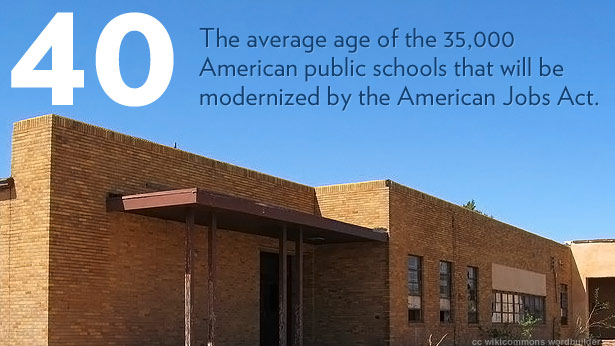
The American Jobs Act by the Numbers: 40

40: The average age of the 35,000 American public schools to be modernized by the American Jobs Act

Today, President Obama continues his American Jobs Act Bus Tour to highlight the many aspects of the American Jobs Act that will build an economy that lasts. Investments like preventing up to 280,000 teacher layoffs and putting construction workers back on the job rebuilding America's schools to provide all of our students with a world class education.

This week, we're bringing you numbers from the bus tour that demonstrate how the jobs bill will impact your community; numbers like 40, which is the average age of the American public schools that will be modernized with the American Jobs Act.

The American Jobs Act will invest in retrofitting at least 35,000 public schools across the country, supporting new science labs, Internet-ready classrooms and school renovations in both rural and urban communities. These investments will help give American students the edge they need to prepare for the 21st century economy and compete with students from around the world.

Education Secretary Arne Duncan explained the challenge we're up against:

[Imagine] trying to design the next generation of tablet computers using mainframe hardware from the Eisenhower administration. Or American automakers trying to out-engineer foreign competitors on an assembly line with equipment from the 1960s.

Unfortunately, just such antiquated facilities and barriers to innovation exist today in precisely the institutions that can least afford it: our nation’s public schools. The digital age has now penetrated virtually every nook of American life, with the exception of many public schools.

President Obama on the American Jobs Act in Jamestown, North Carolina

October 18, 2011 | Public Domain

Third stop on the American Jobs Act Bus Tour.

Download mp4 (251MB) | mp3 (24MB)

Read the Transcript

Remarks by the President on the American Jobs Act -- Jamestown, NC

Guilford Technical Community College
Jamestown, NC

11:20 A.M. EDT

THE PRESIDENT: Thank you. (Applause.) Thank you so much. Thank you very much. Everybody, please have a seat. Have a seat. Hello, Jamestown! (Applause.) It is great to be here in North Carolina. (Applause.) Great to be here at the Ragsdale YMCA. (Applause.)

I want to, first of all, thank Linda for the outstanding introduction. Give her a big round of applause. (Applause.) I want to also acknowledge your congressman, Mel Watt, in the house. (Applause.) Mel is doing an outstanding job each and every day. I also want to acknowledge you mayor, Keith Volz, for the fine work that he's doing. (Applause.) He invited me back down here -- he said there are some pretty good golf courses down here -- (applause) -- and some fine restaurants. So I'm going to have to sample both the next time I'm here.

I had a chance to talk to Linda and a group of other teachers before I came out here. And I just want to say thank you to her, not only for the introduction but also for teaching. I got a chance to learn about the extraordinary work that Guilford Technical Community College is doing -- (applause) -- to train new teachers and place them in schools where kids need them the most. And one of the best ways to make a difference in the life of our nation is to make a difference in the life of every child. (Applause.) So I want to thank all the teachers who are in the audience for answering the call, because you are making our nation stronger. (Applause.)

Now, you may have heard we’re taking a little road trip this week. It’s a chance to get out of Washington. (Laughter.) I must admit I'm traveling not in the usual RV. The bus we got parked outside is -- Secret Service did a full going over, so it's decked out pretty good. (Laughter.) But it's a wonderful opportunity to get out of Washington and hit the road. We stopped for a little North Carolina barbecue and sweet tea along the way. (Applause.) Some hushpuppies. Don’t tell Michelle exactly what was on the menu. (Laughter.)

But the main reason we're out here, in addition to seeing the extraordinary views and meeting the wonderful people -- there's just something about North Carolina. People are just gracious and kind. Even the folks who don't vote for me are nice to me. (Laughter.) And that's just a -- that's a nice thing about this state.

The most important thing I wanted to do was to hear from people like you -- because it doesn’t seem like your voices are being heard in Washington right now. (Applause.) Times are tough for a lot of Americans. And here in North Carolina, there are a lot of folks who have been spending months looking for work and still haven’t found it yet. A lot of people are doing their best just to get by. Maybe they’ve been able to keep their job, but hours have been cut back, or some of their pay and benefits have been rolled back. There are people who are deciding you know what, we can’t afford taking that night out with the family because we’ve got to save on gas, or we’ve got to make the mortgage, or we’ve got to postpone our retirement to make sure that our child can go to college.

It’s tough. It’s hard. And I think most Americans know that our economic problems weren’t caused overnight, so they recognize they won’t be solved overnight. (Applause.) Even before the most recent economic crisis -- a lot of these challenges took a decade to build up -- in some cases, longer than a decade. Before the worst financial crisis since the Great Depression, wages and incomes had been flat for the vast majority of Americans for a decade. So people were struggling even before the crisis hit.

What that means is it’s going to take time for us to rebuild an America where hard work and responsibility are rewarded. It will take time to rebuild an America where we restore security and opportunity for folks who are in the middle class or trying to get into the middle class. It’s going to take time to rebuild an economy that’s built to last and built to compete; an economy that works for everybody, not just for folks at the top. (Applause.)

Rebuilding this America where everybody has got a fair shake and everybody gives their fair share; an economy where you know if you do the right thing and you’re looking after your family and you’re working hard and you educate yourself and you’re educating your kids and you’re contributing back to the community, that you know that you will be able to enjoy that piece of the American Dream -- restoring that economy will take some time. But we are going to get it done, Jamestown. (Applause.) We are going to keep fighting and we’re going to keep working to put people back to work, to help middle-class Americans get ahead, and to give our economy the jolt that it needs.

There are things we can do right now to help our economy. And that’s why I sent Congress the American Jobs Act. (Applause.) Now, this is a jobs bill with proposals of the sort that in the past have been supported by Democrats and Republicans. It’s paid for by asking our wealthiest citizens -- folks who make more than a million dollars a year -– to pay their fair share. (Applause.) Independent economists have said this jobs bill would create nearly 2 million jobs. That’s not my opinion, that’s not the opinion of people who work for me. The people who study the economy for a living are telling us that this jobs bill would put people back to work right away, and grow our economy at a time when the recovery has weakened.

But some folks in Washington don’t seem to be listening. They don’t seem to be listening. Just last week, all the Republicans in the Senate got together and blocked this jobs bill. They refused to even debate it. Now, keep in mind, one poll found that 63 percent of Americans support the ideas in this jobs bill –- (applause) -- but 100 percent of Republicans in the Senate voted against it. So the majority of the American people think it makes sense for us to put teachers back in the classroom and construction workers back to work, and tax breaks for small businesses, and tax breaks for folks who are hiring veterans. (Applause.) But we got a 100 percent “no” from Republicans in the Senate.

AUDIENCE: Booo --

THE PRESIDENT: Now, that doesn’t make any sense. Some people asked me yesterday why I was visiting Republican areas of North Carolina. I said, well, first of all, it’s because I just like North Carolina. (Laughter and applause.) Second of all, I’m not the Democratic President or Republican President -- I’m the President. (Applause.) And third of all, I don’t care if you’re a Republican or a Democrat -- (applause) -- because we're all Americans and we are in this together. We don’t need a Republican jobs act, or a Democratic jobs act; we need a jobs act. (Applause.) We need to put people back to work right now.

As I said, the ideas we put forward are ideas that in the past have been supported by Democrats and Republicans. So the question is what makes it different this time -- other than I proposed it? (Applause.)

Now, let me try to be fair. The Republicans did put out their own jobs bill. They called it the “Real American Jobs Act.” (Laughter.) So they don't get points for originality -- (laughter) -- but they put out the plan. And I said, okay, let’s see what you got -- because I want -- nobody has a bigger interest than me in seeing Democrats and Republicans cooperate to get some stuff done. I want that to happen. (Applause.)

So I said, let's see what you got. And here's what the plan boils down to: We're going to gut environmental regulations. We're going to drill more. We're going to roll back Wall Street reform.

AUDIENCE: Booo --

THE PRESIDENT: And we're going to repeal health care reform.

AUDIENCE: No!

THE PRESIDENT: Now, that's a plan, but it's not a jobs plan. And if you're wondering, I mean, we can just do a little bit of comparison shopping right now. We'll lift the hood and kick the tires and see our plan and their plan.
The Republican plan says that what’s standing between us and full employment is that we're preventing companies from polluting our air and our water too much. We, on the other hand, have said that let's put teachers back in the classroom here in North Carolina and all across the country -- (applause) -- who've been laid off because budgets have been tight at the state or local level. Let's put construction workers back to work rebuilding roads and bridges and schools all across North Carolina and all across the country. (Applause.) And lets put veterans back on the job. (Applause.) All right, so those are two choices.

Their plan says we’ll be better off if we deny 30 million Americans affordable health care choices, and kick young people off their parent's health insurance plans. Our plan says we’re better off if we give virtually every small business and worker in America a tax cut so that they've got more money in their pockets to hire more workers -- and to spend more at those wonderful restaurants that the Mayor talked about. (Applause.)

Their plan says we need to go back to the good old days before the financial crisis when Wall Street wrote its own rules. Our plan says we need to make it easier for small businesses on Main Street to grow and to hire and to push the economy forward. (Applause.)

So there's a contrast in approaches here. But here’s the kicker. Remember that group of economists who said our jobs plan would create jobs? Well, one of those same economists took a look at the Republican plan and said that it could actually cost us jobs; that it wouldn’t do much to help the economy right now when folks are hurting so bad.

So, look, we can have an argument about how much regulation we should have. We can have an argument, if you want, about health care -- I think we did the right thing. (Applause.) But don't pretend -- but you can’t pretend that creating dirtier air and water for our kids and fewer people on health care and less accountability on Wall Street is a jobs plan. (Applause.)

I think more teachers in the classroom is a jobs plan; more construction workers rebuilding our schools is a jobs plan; tax cuts for small business owners and working families is a jobs plan. (Applause.)

That’s the choice we face. And it’s up to you to decide which plan is the real American Jobs Act.

I want to emphasize I want to work with Republicans on ways to create jobs right now. I’m open to any serious idea. Just last week, Congress passed on a bipartisan basis a trade agreement that will allow us to start selling more goods into Korea -- because we buy an awful lot of Hyundais and Kias; I want them to buy some Fords and Chevys and Chryslers. (Applause.) Wherever we have the possibility to work together to move this economy forward, I’m going to seize on that opportunity. That’s the kind of progress on the economy we can keep on making.

But to do so, we’ve got to focus less on trying to satisfy one wing of one party. We’ve got to focus more on doing what it takes to help the American people. (Applause.)

And that’s why we’re going to give folks in Congress another chance. (Laughter.) They said no the first time, but we’re going to give them another chance to listen to you, to step up to the plate and do the right thing. We are going to give them another chance to do their jobs, and look out for your jobs.

And it may be that just the bill was too big the first time -- there was just too much stuff, and they weren't clear about what the jobs act would do. It was confusing to them. So what we're going to do is we’re going to break it up into separate pieces -- (laughter) -- and we're going to let them vote on each piece, one at a time. (Applause.) That way you can be crystal clear on where you stand on all the elements of the jobs bill.

The first vote that we asked Congress to take is scheduled for later this week. It’s a vote that would put hundreds of thousands of police officers back on the beat, firefighters back on the job, and teachers like Linda back in the classroom where they belong. (Applause.) All right? So that's the first part.

All over the country, budget cuts are forcing schools to lay off teachers in startling numbers. Here in North Carolina, nearly 2,000 classroom positions have been eliminated for this school year. I visited a school in Millers Creek yesterday where they’ve had to increase class sizes. There’s almost no money for things like textbooks.

I can tell you, the last thing a superintendent wants to do is lose teachers. Your governor has been fighting these education cuts. (Applause.) But it is unfair to our kids, and it undermines our future not to invest in education. (Applause.)

I had the President of South Korea here, and they are hiring teachers in droves. He's importing teachers from other countries to teach their kids. Their attitude is, we want our kids learning English when they're in first grade -- and we're laying off teachers here in North Carolina? We're not going to be able to compete. Our kids will fall behind.

One North Carolina teacher said, “We didn’t cause the poor economy. If anything, we built the good parts.” And that teacher is absolutely right. Our teachers build the good parts of our economy. It gives our children the skills they need to compete. It gives our children a future that is bright. We've got to invest in our education system. (Applause.)

So our plan would mean about 13,000 education jobs right here in North Carolina alone. (Applause.) That's why I need you all to tell the Senate let’s put our teachers back to work.

All right, so that’s part number one. Part number two: We’re going to give members of Congress a chance to vote on whether our construction workers should sit around doing nothing while China builds the newest airports and the fastest railroads. That doesn’t seem to me like the American way. We used to always have the best stuff. (Applause.) Right? People from all around the world would come to America to see the Golden Gate Bridge and the Hoover Dam -- (applause) -- and Grand Central Station and the interstate highways. We have dropped in terms of infrastructure in this country. We’re no longer number one. And that’s not how we -- that’s not how we built ourselves into a great economic superpower.

So Congress will have a chance to say whether unemployed Americans should continue to struggle -- or whether we are going to put them back to work, making our schools state-of-the-art; making sure that our roads and bridges aren’t crumbling. They’re going to have a chance to vote on whether or not we’re going to give people who are long-term unemployed a chance to get back on the job and reform our unemployment insurance system, and build a better life. They’re going to get a chance to take a stand on whether we should ask people like me to pay our fair share so that middle-class families and small businesses can get a tax cut. (Applause.)

I want to -- Linda, let me just say this. I’m going to make a point here about taxes, because there's been a lot of misinformation out there. I was watching the football game last night, and they had some ad that didn’t really make much sense. (Laughter.) So let me just be crystal clear just in case your friends or neighbors ask about this. What we have said is, in order to pay for the jobs plan and to close our deficit we should ask the very wealthiest Americans, top 2 percent, to pay a little bit more. I can afford it. Warren Buffett, he can afford it. And the fact of the matter is, is that some of the wealthiest Americans pay a lower tax rate than middle-class Americans.

AUDIENCE: Booo --

THE PRESIDENT: So the question is, are we going to set up a tax system that is fair, that helps us shrink the deficit, helps us to pay off our debts, and helps put people back to work? But I want to be clear. The vast majority of Americans would see a tax cut under this jobs bill. We’ve been cutting taxes. We haven’t been raising taxes, we’ve been cutting taxes. (Applause.) And we can continue to keep taxes low for middle-class and working families if we ask those at the very top to do their fair share. And a lot of them are willing to do it if they feel like it’s going to make the country stronger and reduce our deficit and put people back to work. (Applause.)

So don’t be bamboozled. (Laughter.) Don’t fall for this notion that somehow the jobs act is proposing to raise your taxes. It’s just not true. Under this -- here’s what will happen. If we don't pass the American Jobs Act, if we do not pass the provision in there that extends the payroll tax cut that we passed in December, most people here, your taxes will go up by $1,000. So voting no against the jobs bill is voting in favor of middle-class families’ income taxes going up. And that’s a fact. Don't take my word for it -- all the reporters here, they can check on the facts on this thing. That’s the truth.

And I’ve got to emphasize this: When you talk to most people who’ve done well, who’ve been blessed by this country, they’re patriots. They want to do the right thing. They’re willing to do more. They want their money well spent; they want to make sure that it’s not being wasted. That’s why we cut a trillion dollars out of the federal budget this summer. It’s why I’m proposing to cut more to close the deficit. But people are willing to do a little bit more because everybody understands we are in this together. That's how America has always moved forward. (Applause.)

So here’s the bottom line. Congress has a choice to make in the coming weeks. If they vote against the proposals I’m talking about, if they vote against taking steps that we know will put Americans back to work right now, they don't have to answer to me -- they’re going to have to answer to you. (Applause.) They’re going to have to come down here to North Carolina and tell kids why they can’t have their teachers back in the classroom. They’re going to have to tell those construction workers, look them in the eye and say, you know what, sorry, we can’t afford to rebuild those broken-down roads and those crumbling bridges. They’re going to have to explain to working families why their taxes are going up while the richest Americans and the largest corporations keep on getting a sweet deal.

And that’s where you come in. You are the ones who are going to be able to persuade them to think differently. We need your voices heard. I need you to give Congress a piece of your mind. Mel Watt is already doing fine, so you don't need to talk to Mel, he’s on the program. But these members of Congress, they work for you. And if they’re not delivering, it’s time you let them know. You’ve got to get on the phone or pay them a visit or write them a letter or tweet -- whatever you do -- (laughter) -- and remind them to do the right thing.

Remind them of what’s at stake here. Remind them that “no, we can’t” is no way to face tough times. When a depression hit we didn't say, “No, we can’t.” When World War II came, we didn't say, “No, we can’t.” Our grandparents and great-grandparents, they didn't say, “Nothing we can do about this. Let’s just spend all our time arguing in Washington.” They didn't say, “It’s too hard.” They didn't say, “We give up.” They said, “Let’s roll up our sleeves; let’s fight back.” And American won. (Applause.) When the space race started, Kennedy didn't say, “We can’t go to the moon; that’s too far.” He said, “Come on, America. Let’s go.” America won. We can win the space race. When we confront tough times, we don't give in to what is; we think about what ought to be.

There are too many Americans who are hurting right now for us to just sit by and do nothing. Now is the time to act. Now is the time to say, “Yes, we can.” We can create jobs. We can restore the middle class. We can reduce our deficits. We can build an economy that works for everybody. We are not a people who just sit around doing nothing when things aren't right. We are Americans, and we stand up, and we decide that the problem is going to be fixed. And that's the spirit we need to muster right now. (Applause.)

Let's meet this moment. Let's get to work. And let's remind everybody just why the United States of America is the greatest country on Earth.

Thank you. God bless you. God bless North Carolina. God bless the United States of America. Thank you. (Applause.)

END
11:46 A.M. EDT

Close Transcript

The White House

Office of the Press Secretary

Remarks by the President on the American Jobs Act -- Jamestown, NC

Guilford Technical Community College
Jamestown, NC

11:20 A.M. EDT

THE PRESIDENT: Thank you. (Applause.) Thank you so much. Thank you very much. Everybody, please have a seat. Have a seat. Hello, Jamestown! (Applause.) It is great to be here in North Carolina. (Applause.) Great to be here at the Ragsdale YMCA. (Applause.)

I want to, first of all, thank Linda for the outstanding introduction. Give her a big round of applause. (Applause.) I want to also acknowledge your congressman, Mel Watt, in the house. (Applause.) Mel is doing an outstanding job each and every day. I also want to acknowledge you mayor, Keith Volz, for the fine work that he's doing. (Applause.) He invited me back down here -- he said there are some pretty good golf courses down here -- (applause) -- and some fine restaurants. So I'm going to have to sample both the next time I'm here.

I had a chance to talk to Linda and a group of other teachers before I came out here. And I just want to say thank you to her, not only for the introduction but also for teaching. I got a chance to learn about the extraordinary work that Guilford Technical Community College is doing -- (applause) -- to train new teachers and place them in schools where kids need them the most. And one of the best ways to make a difference in the life of our nation is to make a difference in the life of every child. (Applause.) So I want to thank all the teachers who are in the audience for answering the call, because you are making our nation stronger. (Applause.)

Now, you may have heard we’re taking a little road trip this week. It’s a chance to get out of Washington. (Laughter.) I must admit I'm traveling not in the usual RV. The bus we got parked outside is -- Secret Service did a full going over, so it's decked out pretty good. (Laughter.) But it's a wonderful opportunity to get out of Washington and hit the road. We stopped for a little North Carolina barbecue and sweet tea along the way. (Applause.) Some hushpuppies. Don’t tell Michelle exactly what was on the menu. (Laughter.)

But the main reason we're out here, in addition to seeing the extraordinary views and meeting the wonderful people -- there's just something about North Carolina. People are just gracious and kind. Even the folks who don't vote for me are nice to me. (Laughter.) And that's just a -- that's a nice thing about this state.

The most important thing I wanted to do was to hear from people like you -- because it doesn’t seem like your voices are being heard in Washington right now. (Applause.) Times are tough for a lot of Americans. And here in North Carolina, there are a lot of folks who have been spending months looking for work and still haven’t found it yet. A lot of people are doing their best just to get by. Maybe they’ve been able to keep their job, but hours have been cut back, or some of their pay and benefits have been rolled back. There are people who are deciding you know what, we can’t afford taking that night out with the family because we’ve got to save on gas, or we’ve got to make the mortgage, or we’ve got to postpone our retirement to make sure that our child can go to college.

It’s tough. It’s hard. And I think most Americans know that our economic problems weren’t caused overnight, so they recognize they won’t be solved overnight. (Applause.) Even before the most recent economic crisis -- a lot of these challenges took a decade to build up -- in some cases, longer than a decade. Before the worst financial crisis since the Great Depression, wages and incomes had been flat for the vast majority of Americans for a decade. So people were struggling even before the crisis hit.

What that means is it’s going to take time for us to rebuild an America where hard work and responsibility are rewarded. It will take time to rebuild an America where we restore security and opportunity for folks who are in the middle class or trying to get into the middle class. It’s going to take time to rebuild an economy that’s built to last and built to compete; an economy that works for everybody, not just for folks at the top. (Applause.)

Rebuilding this America where everybody has got a fair shake and everybody gives their fair share; an economy where you know if you do the right thing and you’re looking after your family and you’re working hard and you educate yourself and you’re educating your kids and you’re contributing back to the community, that you know that you will be able to enjoy that piece of the American Dream -- restoring that economy will take some time. But we are going to get it done, Jamestown. (Applause.) We are going to keep fighting and we’re going to keep working to put people back to work, to help middle-class Americans get ahead, and to give our economy the jolt that it needs.

There are things we can do right now to help our economy. And that’s why I sent Congress the American Jobs Act. (Applause.) Now, this is a jobs bill with proposals of the sort that in the past have been supported by Democrats and Republicans. It’s paid for by asking our wealthiest citizens -- folks who make more than a million dollars a year -– to pay their fair share. (Applause.) Independent economists have said this jobs bill would create nearly 2 million jobs. That’s not my opinion, that’s not the opinion of people who work for me. The people who study the economy for a living are telling us that this jobs bill would put people back to work right away, and grow our economy at a time when the recovery has weakened.

But some folks in Washington don’t seem to be listening. They don’t seem to be listening. Just last week, all the Republicans in the Senate got together and blocked this jobs bill. They refused to even debate it. Now, keep in mind, one poll found that 63 percent of Americans support the ideas in this jobs bill –- (applause) -- but 100 percent of Republicans in the Senate voted against it. So the majority of the American people think it makes sense for us to put teachers back in the classroom and construction workers back to work, and tax breaks for small businesses, and tax breaks for folks who are hiring veterans. (Applause.) But we got a 100 percent “no” from Republicans in the Senate.

AUDIENCE: Booo --

THE PRESIDENT: Now, that doesn’t make any sense. Some people asked me yesterday why I was visiting Republican areas of North Carolina. I said, well, first of all, it’s because I just like North Carolina. (Laughter and applause.) Second of all, I’m not the Democratic President or Republican President -- I’m the President. (Applause.) And third of all, I don’t care if you’re a Republican or a Democrat -- (applause) -- because we're all Americans and we are in this together. We don’t need a Republican jobs act, or a Democratic jobs act; we need a jobs act. (Applause.) We need to put people back to work right now.

As I said, the ideas we put forward are ideas that in the past have been supported by Democrats and Republicans. So the question is what makes it different this time -- other than I proposed it? (Applause.)

Now, let me try to be fair. The Republicans did put out their own jobs bill. They called it the “Real American Jobs Act.” (Laughter.) So they don't get points for originality -- (laughter) -- but they put out the plan. And I said, okay, let’s see what you got -- because I want -- nobody has a bigger interest than me in seeing Democrats and Republicans cooperate to get some stuff done. I want that to happen. (Applause.)

So I said, let's see what you got. And here's what the plan boils down to: We're going to gut environmental regulations. We're going to drill more. We're going to roll back Wall Street reform.

AUDIENCE: Booo --

THE PRESIDENT: And we're going to repeal health care reform.

AUDIENCE: No!

THE PRESIDENT: Now, that's a plan, but it's not a jobs plan. And if you're wondering, I mean, we can just do a little bit of comparison shopping right now. We'll lift the hood and kick the tires and see our plan and their plan.
The Republican plan says that what’s standing between us and full employment is that we're preventing companies from polluting our air and our water too much. We, on the other hand, have said that let's put teachers back in the classroom here in North Carolina and all across the country -- (applause) -- who've been laid off because budgets have been tight at the state or local level. Let's put construction workers back to work rebuilding roads and bridges and schools all across North Carolina and all across the country. (Applause.) And lets put veterans back on the job. (Applause.) All right, so those are two choices.

Their plan says we’ll be better off if we deny 30 million Americans affordable health care choices, and kick young people off their parent's health insurance plans. Our plan says we’re better off if we give virtually every small business and worker in America a tax cut so that they've got more money in their pockets to hire more workers -- and to spend more at those wonderful restaurants that the Mayor talked about. (Applause.)

Their plan says we need to go back to the good old days before the financial crisis when Wall Street wrote its own rules. Our plan says we need to make it easier for small businesses on Main Street to grow and to hire and to push the economy forward. (Applause.)

So there's a contrast in approaches here. But here’s the kicker. Remember that group of economists who said our jobs plan would create jobs? Well, one of those same economists took a look at the Republican plan and said that it could actually cost us jobs; that it wouldn’t do much to help the economy right now when folks are hurting so bad.

So, look, we can have an argument about how much regulation we should have. We can have an argument, if you want, about health care -- I think we did the right thing. (Applause.) But don't pretend -- but you can’t pretend that creating dirtier air and water for our kids and fewer people on health care and less accountability on Wall Street is a jobs plan. (Applause.)

I think more teachers in the classroom is a jobs plan; more construction workers rebuilding our schools is a jobs plan; tax cuts for small business owners and working families is a jobs plan. (Applause.)

That’s the choice we face. And it’s up to you to decide which plan is the real American Jobs Act.

I want to emphasize I want to work with Republicans on ways to create jobs right now. I’m open to any serious idea. Just last week, Congress passed on a bipartisan basis a trade agreement that will allow us to start selling more goods into Korea -- because we buy an awful lot of Hyundais and Kias; I want them to buy some Fords and Chevys and Chryslers. (Applause.) Wherever we have the possibility to work together to move this economy forward, I’m going to seize on that opportunity. That’s the kind of progress on the economy we can keep on making.

But to do so, we’ve got to focus less on trying to satisfy one wing of one party. We’ve got to focus more on doing what it takes to help the American people. (Applause.)

And that’s why we’re going to give folks in Congress another chance. (Laughter.) They said no the first time, but we’re going to give them another chance to listen to you, to step up to the plate and do the right thing. We are going to give them another chance to do their jobs, and look out for your jobs.

And it may be that just the bill was too big the first time -- there was just too much stuff, and they weren't clear about what the jobs act would do. It was confusing to them. So what we're going to do is we’re going to break it up into separate pieces -- (laughter) -- and we're going to let them vote on each piece, one at a time. (Applause.) That way you can be crystal clear on where you stand on all the elements of the jobs bill.

The first vote that we asked Congress to take is scheduled for later this week. It’s a vote that would put hundreds of thousands of police officers back on the beat, firefighters back on the job, and teachers like Linda back in the classroom where they belong. (Applause.) All right? So that's the first part.

All over the country, budget cuts are forcing schools to lay off teachers in startling numbers. Here in North Carolina, nearly 2,000 classroom positions have been eliminated for this school year. I visited a school in Millers Creek yesterday where they’ve had to increase class sizes. There’s almost no money for things like textbooks.

I can tell you, the last thing a superintendent wants to do is lose teachers. Your governor has been fighting these education cuts. (Applause.) But it is unfair to our kids, and it undermines our future not to invest in education. (Applause.)

I had the President of South Korea here, and they are hiring teachers in droves. He's importing teachers from other countries to teach their kids. Their attitude is, we want our kids learning English when they're in first grade -- and we're laying off teachers here in North Carolina? We're not going to be able to compete. Our kids will fall behind.

One North Carolina teacher said, “We didn’t cause the poor economy. If anything, we built the good parts.” And that teacher is absolutely right. Our teachers build the good parts of our economy. It gives our children the skills they need to compete. It gives our children a future that is bright. We've got to invest in our education system. (Applause.)

So our plan would mean about 13,000 education jobs right here in North Carolina alone. (Applause.) That's why I need you all to tell the Senate let’s put our teachers back to work.

All right, so that’s part number one. Part number two: We’re going to give members of Congress a chance to vote on whether our construction workers should sit around doing nothing while China builds the newest airports and the fastest railroads. That doesn’t seem to me like the American way. We used to always have the best stuff. (Applause.) Right? People from all around the world would come to America to see the Golden Gate Bridge and the Hoover Dam -- (applause) -- and Grand Central Station and the interstate highways. We have dropped in terms of infrastructure in this country. We’re no longer number one. And that’s not how we -- that’s not how we built ourselves into a great economic superpower.

So Congress will have a chance to say whether unemployed Americans should continue to struggle -- or whether we are going to put them back to work, making our schools state-of-the-art; making sure that our roads and bridges aren’t crumbling. They’re going to have a chance to vote on whether or not we’re going to give people who are long-term unemployed a chance to get back on the job and reform our unemployment insurance system, and build a better life. They’re going to get a chance to take a stand on whether we should ask people like me to pay our fair share so that middle-class families and small businesses can get a tax cut. (Applause.)

I want to -- Linda, let me just say this. I’m going to make a point here about taxes, because there's been a lot of misinformation out there. I was watching the football game last night, and they had some ad that didn’t really make much sense. (Laughter.) So let me just be crystal clear just in case your friends or neighbors ask about this. What we have said is, in order to pay for the jobs plan and to close our deficit we should ask the very wealthiest Americans, top 2 percent, to pay a little bit more. I can afford it. Warren Buffett, he can afford it. And the fact of the matter is, is that some of the wealthiest Americans pay a lower tax rate than middle-class Americans.

AUDIENCE: Booo --

THE PRESIDENT: So the question is, are we going to set up a tax system that is fair, that helps us shrink the deficit, helps us to pay off our debts, and helps put people back to work? But I want to be clear. The vast majority of Americans would see a tax cut under this jobs bill. We’ve been cutting taxes. We haven’t been raising taxes, we’ve been cutting taxes. (Applause.) And we can continue to keep taxes low for middle-class and working families if we ask those at the very top to do their fair share. And a lot of them are willing to do it if they feel like it’s going to make the country stronger and reduce our deficit and put people back to work. (Applause.)

So don’t be bamboozled. (Laughter.) Don’t fall for this notion that somehow the jobs act is proposing to raise your taxes. It’s just not true. Under this -- here’s what will happen. If we don't pass the American Jobs Act, if we do not pass the provision in there that extends the payroll tax cut that we passed in December, most people here, your taxes will go up by $1,000. So voting no against the jobs bill is voting in favor of middle-class families’ income taxes going up. And that’s a fact. Don't take my word for it -- all the reporters here, they can check on the facts on this thing. That’s the truth.

And I’ve got to emphasize this: When you talk to most people who’ve done well, who’ve been blessed by this country, they’re patriots. They want to do the right thing. They’re willing to do more. They want their money well spent; they want to make sure that it’s not being wasted. That’s why we cut a trillion dollars out of the federal budget this summer. It’s why I’m proposing to cut more to close the deficit. But people are willing to do a little bit more because everybody understands we are in this together. That's how America has always moved forward. (Applause.)

So here’s the bottom line. Congress has a choice to make in the coming weeks. If they vote against the proposals I’m talking about, if they vote against taking steps that we know will put Americans back to work right now, they don't have to answer to me -- they’re going to have to answer to you. (Applause.) They’re going to have to come down here to North Carolina and tell kids why they can’t have their teachers back in the classroom. They’re going to have to tell those construction workers, look them in the eye and say, you know what, sorry, we can’t afford to rebuild those broken-down roads and those crumbling bridges. They’re going to have to explain to working families why their taxes are going up while the richest Americans and the largest corporations keep on getting a sweet deal.

And that’s where you come in. You are the ones who are going to be able to persuade them to think differently. We need your voices heard. I need you to give Congress a piece of your mind. Mel Watt is already doing fine, so you don't need to talk to Mel, he’s on the program. But these members of Congress, they work for you. And if they’re not delivering, it’s time you let them know. You’ve got to get on the phone or pay them a visit or write them a letter or tweet -- whatever you do -- (laughter) -- and remind them to do the right thing.

Remind them of what’s at stake here. Remind them that “no, we can’t” is no way to face tough times. When a depression hit we didn't say, “No, we can’t.” When World War II came, we didn't say, “No, we can’t.” Our grandparents and great-grandparents, they didn't say, “Nothing we can do about this. Let’s just spend all our time arguing in Washington.” They didn't say, “It’s too hard.” They didn't say, “We give up.” They said, “Let’s roll up our sleeves; let’s fight back.” And American won. (Applause.) When the space race started, Kennedy didn't say, “We can’t go to the moon; that’s too far.” He said, “Come on, America. Let’s go.” America won. We can win the space race. When we confront tough times, we don't give in to what is; we think about what ought to be.

There are too many Americans who are hurting right now for us to just sit by and do nothing. Now is the time to act. Now is the time to say, “Yes, we can.” We can create jobs. We can restore the middle class. We can reduce our deficits. We can build an economy that works for everybody. We are not a people who just sit around doing nothing when things aren't right. We are Americans, and we stand up, and we decide that the problem is going to be fixed. And that's the spirit we need to muster right now. (Applause.)

Let's meet this moment. Let's get to work. And let's remind everybody just why the United States of America is the greatest country on Earth.

Thank you. God bless you. God bless North Carolina. God bless the United States of America. Thank you. (Applause.)

END
11:46 A.M. EDT