The White House

Office of the Press Secretary

Remarks by the President and the First Lady at a DNC Event

Gotham Hall
New York, New York
Tuesday, September 20, 2011

8:40 P.M. EDT

MRS. OBAMA:  Hi!  Thank you all so much.  Rest yourselves, because we need you rested because you’re going to have to work really hard.  (Laughter.)  I want to thank Mayor Booker for that very kind introduction and for his leadership.  He has worked closely with me on several of my initiatives.  He has been amazing -- energy, everything we need in this country. 

And thanks to all of you for such a warm welcome.  It is great to be in New York.  (Applause.)  Yay for New York!  And it’s great to be here with my husband, because the truth is we rarely get to travel together anymore.  They separate us.  It’s like you’re over there, you’re over there.  So this is sort of like our date night.  (Laughter.)  Yes.  And I would like to thank all of you for planning such a lovely, intimate evening for the two of us.  (Laughter.)  A little dinner, Alicia Keys.  Really nice touch.  (Laughter.)  Who knows what will happen?  (Laughter and applause.) 

In all seriousness, it is a pleasure to be here to introduce my husband tonight.  I am used to talking about him because when I go out on the road folks always ask me about him.  They want to know how is he doing, how is holding up, how is he different after two and a half years as President in the White House, how has he changed.  But the only difference that I can think of is that the salt is starting to catch up with the pepper in his hair.  (Laughter.)  I think it’s quite sexy, but it’s coming.

But other than that -- other than that, I have to tell you that so much is constant about my husband.  From the time that I first met him back at our law firm in Chicago -- we got some Sidley people here tonight I know.  (Applause.)  You might have heard about our story -- this skinny kid with the funny name, who had the audacity to ask his former mentor out on a date.  (Laughter.)  And then his idea of a date was taking me to a church basement.  (Laughter.)   

Well, that guy back then was pretty special.  And I saw it in him then in that church basement in Chicago, when he was a community organizer, talking with a group of South-Siders about the world as it is and the world as it should be.  That was the first thing that touched me about him.  I saw the way those folks’ lives mattered to him, all the way back then, and the way he connected with them.  That’s what I fell in love with. 

I saw it tore him up to see the laid-off workers, the single mothers, the senior citizens who had their communities turned upside down and didn’t know where to turn.  And I saw how those stories stuck with him, and how he dedicated his life to fighting for folks like them.

And I have to tell you that I still see that connection, that fire.  Every single day it is still there.  And I shared this with some of you this afternoon at our gathering.  We had a good gathering today, didn’t we, women?  (Applause.)  Fired up!  But I shared then, after a long day in the Oval Office, or after he's traveled throughout the country, and when the girls have gone to bed, Barack spends most night poring over stacks of letters from people he hears from -- from folks from all across the country, and he reads their stories word for word:  The woman dying of cancer because her health insurance wouldn’t cover her care.  The young person with so much promise and so few opportunities.  The man nearing retirement who just lost his job and is struggling to pay his family’s bills.

And I see the concern on Barack’s face, just like in that church basement.  And I hear that passion and determination.  He tells me, these folks are going through stuff you wouldn’t believe.  He says, we have to fix this.  We have so much more to do.  And when he gets up in the morning, those people’s stories are the first thing on his mind.  They’re with him in meetings in the Oval Office, and as he continues to travel throughout the country.  They’re with him when he’s fighting to put folks back to work; when he’s working to give our middle class a renewed sense of security; when he is out there pushing Congress to finally pass a jobs bill. 

I mean, that is the same connection that brought him back again and again to that church basement.  That’s the same man who won me over all those years ago.  And that is the same man who so many of you worked so hard to elect as President of the United States.

Now, I want you all to remember that when I first came out on the campaign trail I asked you all for one thing.  I personally asked you all -- many of you here -- I said, if I’m going to let my husband do this crazy this and give him up to the country and to the world, that I’m going to need you to have his back.  You promised me that.  I said, you have to have his back. Well, tonight, four years later, I’m going to say it again, because the truth is he can’t do this alone.  So I have to ask you again:  Do you have his back?  (Applause.)  Do you have his back?  Are you fired up?  Are you ready to go?

Well, if that’s the case, then I am proud to introduce my husband, the President of the United States of America, Barack Obama.  (Applause.)

THE PRESIDENT:  Hello, everybody!  Hello, New York!  (Applause.)  I’m in a New York state of mind.  (Applause.)  Thank you.  Thank you.  (Applause.)  What do you think about Michelle Obama?  (Applause.)  She’s not bad. 

Everybody please have a seat.  Have a seat.  Did you notice how she’s getting cuter?  (Laughter.)  She is remarkable, and it is the reason that I’ve got remarkable kids.  I have improved my gene pool.  (Laughter.)  And it is true, this is the closest we get to a date -- which I'm going to have to fix in about 14 months.  (Laughter.)

It is wonderful to see all of you.  Thank you, so much, for being here tonight in this spectacular setting.  There are a couple of people I want to make sure to acknowledge.  First of all, the remarkable Alicia Keys.  Thank you, so much, Alicia, for your performance.  (Applause.)  One of the finest public servants in the country, Mayor Cory Booker.  (Applause.)  The outstanding former Mayor of New York City, David Dinkins.  (Applause.)  The New York City public advocate Bill de Blasio.  (Applause.)  And my dear friend, the DNC Treasurer, Andy Tobias.  (Applause.)  We love Andy.

Now, the truth is, this is not my idea of a date night.  Normally, our dates don't end with me being before 400 of our closest friends.  But it is wonderful to be here.  And I’m here because I need your help.  I need your help, just like I needed your help in 2008.  In fact, I need your help to finish what we started in 2008.  (Applause.)

Back then, we started this campaign not because we thought it was a sure thing -- I just want to remind everybody of that.  The odds were not good.  This was not going to be a cakewalk.  My name was Barack Hussein Obama.  (Laughter.)  You didn’t need a poll to know that might be an issue.  (Laughter.)  But we forged ahead because we had an idea about what this country is, what it has been, and what it can be. 

Most of the people in this room, many of our parents, our grandparents -- we grew up with a faith in an America where hard work and responsibility paid off, and if you stepped up, and if you did your job, and if you were loyal to your company, that loyalty would be rewarded with a decent salary and good benefits -- you might get a raise.  And you had an assurance that life would be better for your kids and your grandkids. 

Over the last decade -- over the last couple of decades, that faith was shaken.  Seemed as if the world’s changed.  The deck kept getting stacked against middle-class Americans, and nobody in Washington seemed willing or able to do anything about it.  And in 2007, all of this culminated in a once in a lifetime economic crisis, a crisis that’s been much worse and much longer than your average recession -- something that most of us have never seen in our lifetimes.  And from the time I took office, we knew that because this crisis had been building for years, it was going to take us years to fully recover.

So the question now is not whether people are still hurting -- of course, people are still hurting.  As Michelle was saying, I read letters and emails every night.  I talk to people when I’m out on the road.  Their stories are heartbreaking -- men and women who’ve poured their lives into a small business, perhaps a business that’s been in their family for generations; suddenly closed.  Folks who have to cross off items from the grocery list so that they can pay for gas to get to the job -- if they’ve got a job.  Parents who postpone retirement so that their children don’t have to drop out of college.  Fathers who write to me and say, do you know what it’s like to have to come home and explain to your family that you’ve lost your job, and then spend month after month looking for a job, and those resumes go unanswered, and how you start losing confidence in yourself and you don't want to look your kids in the eye?

The question is not whether this country is going through hard times.  The question is where does this country go next?  We can go back to the ideas we tried in the last decade -- where corporations got to write their own rules and the most fortunate among us got all of our tax breaks, and jobs got shipped overseas, and incomes and wages flat-lined as the cost of everything went up, and this society became less equal, and opportunity was diminished for too many.  Or we can build the America we talked about in 2008 -- an America where everybody gets a fair shake, and everybody does their fair share.

And that is what this election is about.  That’s what we’ve spent the last two and a half years fighting for.  Every decision I’ve made, all the work that we’ve done, has been based on a simple idea.  And that is that everybody should have a shot, and burdens should be shared, and opportunities should be shared.  And even in the midst of crisis, those were the values that guided us.

So when we wanted to save the auto industry from bankruptcy, there were a lot of Republicans in Congress who fought us tooth and nail, said it was a waste of time and a waste of money.  But we did it anyway.  And we saved thousands of American jobs.  And we made sure taxpayers got their money back.  And, today, the American auto industry is stronger than ever, and they’re making fuel-efficient cars stamped with three proud words:  Made in America.  (Applause.)

When we wanted to pass Wall Street reform to make sure a crisis like this never happens again, lobbyists and special interests spent millions to make sure we didn't succeed.  And we did it anyway.  And we passed the toughest reform in history that prevents consumers from getting ripped off by mortgage lenders, or credit card companies -- which is why, today, there are no more hidden credit card fees, no more unfair rate hikes, and no more deception from banks.

And most of the Republicans voted against it.  (Applause.)  But we made it happen.  (Applause.)  And we were able to cut $60 billion in taxpayer subsidies to big banks, and use those savings to make college more affordable for millions of kids all across this country who want to go to college.  (Applause.)  And instead of giving more tax breaks to the biggest corporations, we cut taxes for small businesses and middle-class families.

The first law I signed was a bill to make sure that women earn equal pay for equal work -- because I’ve got daughters, and I want to make sure they’ve got the same chance as our sons.  (Applause.)  And, yes, we passed health care reform so that no one in America will go bankrupt because they get sick -- because this is the United States of America and we’re better than that. (Applause.)

One other thing we did that is worth mentioning tonight, in particular -- I just met backstage with young Americans who were discharged from the military because of "don't ask, don't tell." As of today, that will never happen again.  (Applause.)  As of today, no one needs to hide who they are to serve the country that they love.  As of today.  (Applause.) 

All of these were tough fights.  But they’re making a difference all across the country.  And we’ve got more fights that we’ve got to win.  We’ve got a long way to go to make sure that everybody in this country gets a fair shake, that the vision that mobilized us in 2008 is realized -- making sure that every American has a chance to get ahead.  And that’s where I need your help.

We’ve got a lot of work to do.  About a week ago, I sent to Congress a bill call the American Jobs Act.  Some of you might have heard about this.  (Applause.)  As I said before a joint session of Congress, every proposal in there has been supported by Democrats and Republicans in the past.  Everything in it will be paid for.  It will put people back to work.  It will put more money back in the pockets of working people.  And Congress should pass that jobs bill right away.  (Applause.)

We’ve got millions of constructions workers who don't have jobs right now.  This bill says, let’s put those men and women to work rebuilding our roads and our bridges and our highways and our schools.  I don't want the best airports and the fastest railroads being built in China.  I want them here in the United States of America.  (Applause.)  There’s work to be done, workers ready to do it.  We’ve got to tell Congress to pass this jobs bill.

Now, in places like South Korea they can’t hire teachers fast enough -- call teachers, nation-builders.  They know that educating their children is the key to competing in a global economy.  Here, we’re laying off teachers in droves.  It’s unfair to our kids.  It undermines their future.  And if we pass this jobs bill, thousands of teachers in every state will be back in the classroom where they belong.  That’s why we’ve got to tell Congress to pass this jobs bill.  (Applause.)

If we pass this bill, companies will get tax credits for hiring American veterans.  (Applause.)  We ask these men and women to suspend their careers, leave their families, risk their lives to protect this country.  They should not have to beg for a job when they come home.  (Applause.)

The jobs act will cut taxes for virtually every worker in America; cut taxes for every small business owner; give an extra tax cut to every small business who hires more workers or gives their workers an increase in wages. 

So don’t just talk about America’s job creators; do something for America’s job creators. (Applause.)  Don’t make a pledge that you’ll never raise taxes -- except when it comes to middle-class taxes, or when Obama proposes a tax cut.  Be consistent.  Pass this jobs bill.  (Applause.)

Now, a lot of folks in Congress have said we’re not going to support any new spending that’s not paid for.  I agree.  I think that’s important.  So yesterday I laid out a plan to pay for the American Jobs Act and that brings down our debt over time.  It adds to the $1 trillion in spending cuts that I already signed this summer, makes it one of the biggest spending cuts in history.  But it’s phased in so that it doesn’t hurt our recovery now.  It’s a plan that says if we want to close this deficit and we want to pay for this jobs plan, then we’ve got to ask the wealthiest Americans and the biggest corporations to pay their fair share.  (Applause.)

Now, the Republicans say they’re in favor of tax reform.  Let’s go.  Let’s reform this tax code.  And let’s reform it based on a very simple principle:  Warren Buffett’s secretary should not be paying a higher tax rate than Warren Buffett.  (Applause.) It’s a simple principle. 

In the United States of America a teacher or a nurse or a construction worker who makes $50,000 a year, they shouldn’t pay a higher tax rate than somebody pulling in $50 million.  It is not fair.  It is not right.  It has to change.  And the vast majority of Americans agree that it has to change.  (Applause.) 

Nobody wants to punish success -- that’s what you here when they try to respond to what should be some pretty obvious logic. Nobody wants to punish success in America.  That’s what’s great about America -- our belief that anybody can make if you try.  Anybody can open a business, have a great idea, go out there and make millions, make billions.  This is the land of opportunity.  It’s why people came to New York.  All I’m saying is that those who have done well, including the majority of people here tonight, we should pay our fair share in taxes.  (Applause.)  Contribute to the nation that made our success possible.  Pass it on -- pass on opportunity. 

And I think most wealthy Americans would agree if they knew that this would help us grow the economy and deal with the debt that threatens our future, and put people back to work.

See, I got some Amen's right here.

AUDIENCE:  Amen!

THE PRESIDENT:  This is a completely unbiased sampling.  (Laughter.) 

Now, you’re already hearing the Republicans in Congress dusting off the old talking points.  You can write their press releases.  “Class warfare,” they say.  You know what, if asking a billionaire to pay the same rate as a plumber or a teacher makes me a warrior for the middle class, I wear that charge as a badge of honor.  (Applause.)  I wear it as a badge of honor.  (Applause.)  Because the only class warfare I’ve seen is the battle that’s been waged against middle-class folks in this country for a decade now.  (Applause.)

Look, this is what it comes down to -- this is about priorities.  It’s always been about priorities.  It’s always been about choices.  If we want to pay for this jobs plan, and close the deficit, and invest in our future, the money has to come from somewhere.  Don’t tell me that you want good schools, don’t tell me that you want safe roads, don’t tell me that you believe in medical research, and then refuse to pay for it. 

We’ve got to make choices.  Would you rather keep tax loopholes for oil companies?  Or do you want to put construction workers and teachers back on the job?  Would you rather keep tax breaks for millionaires and billionaires?  Or do you want to invest in new schools, in medical research, in training more engineers?  Should we ask seniors to pay thousands of dollars more for Medicare?  Or should we ask the biggest corporations to pay their fair share?  That’s what this debate is about.  It’s what’s at stake right now.

This notion that the only thing that we can do to restore prosperity is to let corporations write their own rules, and give tax breaks to the wealthiest few, and tell everybody else that you’re on your own -- this idea that the only way we compete in a global economy in the 21st century is to make sure that we’ve got cheap labor and dirty air -- that’s not who we are.  We’re better than that.  That’s not the story of America.  We are rugged individualists.  We are self-reliant.  It’s been the drive and initiative of our workers and our entrepreneurs that has made this economy the engine and the envy of the world.  But there has always been another that says we’re in this together, we are connected.  (Applause.) 

There are some things we can only do together, as a nation. (Applause.)  And that is not a Democratic idea or a Republican idea; that’s been an American idea.  Lincoln believed in that idea, and Eisenhower believed in that idea, and FDR believed in that idea.  (Applause.)

That’s why this country gave millions of returning heroes, including my grandfather, the chance to go to college on the G.I. Bill.  That’s why a place like New York City has enjoyed the incredible vibrancy, because people thought 20, 30, 40 years ahead.  Let’s build a park in the middle of this metropolis.  It costs money, but it will make this city special.  Let’s invest in great universities.  It might cost a little bit, but think about all those young minds that are going to be shaped, what wonders they’re going to create.

It’s the reason Michelle and I had the chance to succeed beyond our wildest dreams.  Look at where we came from -- a little black girl on the South Side of Chicago; a little mixed kid in Honolulu.  (Laughter.)  A single mom -- (applause) -- we’re only here because somebody passed on this incredible notion, this exceptional American idea that it doesn’t matter where you come from; it doesn’t matter who you’re born to.  If you’re willing to put in the effort, if you’re willing to make sacrifices, you got a shot.  You got a chance.  (Applause.)

I was on a bus tour, through Iowa and Minnesota and my home state of Illinois, rural country -- corn everywhere, beans -- (laughter) -- small towns.  And we’d roll through on that bus, through these little towns, and everybody would be lining up along the road.  And these were rural communities, conservative  -- many of them I probably didn’t get a lot of votes.  But everybody was lined up -- little kids with the American flags, grandparents out in their lawn chairs, people waving, guys standing out in front of the auto shop, wiping their hands off, waving in their overalls.  And we stopped by a high school football game, talked to the coach, went by a public school, met with some of the kids.  And for all the venom and all the shouting in Washington, you’ve got this incredible sense of what the core of America is all about.  This incredible decency and optimism, and the belief that, no matter how tough things are sometimes, somehow, if we pull together, we’re going to get through it.

And in these little towns, by the way, all across the Midwest, suddenly you’ll see black faces and brown faces.  And in the country you can see new waves of immigrants, sort of filling in pockets of towns that previously had been aging, and whole new generations are starting all over again, building this incredible country.  And what’s amazing is you come here to Manhattan, and as you’re driving by and you look at the faces, you sense that same spirit, that same striving, hopeful energy.  Everybody just thinking, you know what, we’re going to make this happen.  We’ve got big dreams.  We’re not going to think small. 

Those things are connected.  This country, as divided as it seems sometimes, that core idea is there.  And that’s what we tapped into in 2008.  It wasn’t me; it was all of you.  It was the country insisting that we can do better than this.  And all that "hopey, changey stuff," as they say -- (laughter) -- that was real.  That wasn’t something worth being cynical about.  (Applause.)  That was real.  You could feel it.  You knew it. 

It’s still there, even in the midst of this hardship.  But it’s hard.  When I was in Grant Park that night I warned everybody, this is going to be hard.  This is not the end; this is the beginning.  And over the last two and a half years we’ve had some tough times.  And, understandably, over time, people sometimes, they get discouraged, and they lose sight of what launched us on this thing in the first place.  They start feeling discouraged, and the whole poster starts kind of fading.  (Laughter.)   

But I tell you what.  You travel around the country, you talk to the America people -- that spirit is still there.  It gets knocked around.  I get knocked around.  But it’s there and it’s worth fighting for.  It’s worth fighting for.  (Applause.)  And that’s why I need your help -- because I need everybody out here to be willing to fight for it.  I need everybody here to understand that America was not built by any single individual.  We built it together.  And we always have been one nation, under God, indivisible, with liberty and justice for all.  And we have been a nation of responsibilities to ourselves, but also responsibilities to one another.  And we’ve got to meet those responsibilities right now.

So maybe some people in Congress would rather settle these differences at the ballot box.  I’m ready to settle them at the ballot box.  I intend to win this next election because we’ve got better ideas.  (Applause.)  We’ve got better ideas.  But in the meantime, that’s 14 months away, and the American people don’t have the luxury of waiting that long. 

So let’s get to work right now.  Let’s act right now.  Let’s pass that jobs bill.  Let’s reform the tax code.  Let’s fix some schools.  Let’s rebuild our roads.  Let’s put teachers back to work.  Let’s invest in our basic research.  Let’s invest in America.  Let’s rebuild America.  Let’s think big.  Let’s dream big.  Let’s shake off the discouragement and the depression.  Let’s get to work.  Let’s get busy.  (Applause.)  

I’m ready to fight.  I hope you are, too.  God bless you.  God bless the United States of America.  Thank you.  (Applause.) 

END
9:15 P.M. EDT 
President Obama's Bilateral Meeting with Prime Minister Erdogan of Turkey

September 20, 2011 | 6:39 | Public Domain

President Obama and Prime Minister Erdogan of Turkey make a joint statement to the media after their bilateral meeting in New York City, New York.

Download mp4 (64MB) | mp3 (6MB)

Read the Transcript

Remarks by President Obama and Prime Minister Erdogan of Turkey before Bilateral Meeting

Waldorf Astoria Hotel
New York, New York

4:46 P.M. EDT

PRESIDENT OBAMA:  Well, I want to welcome Prime Minister Erdogan and his delegation to New York City and to the United States.  Turkey is a NATO ally, a great friend and partner on a whole host of issues.  I want to thank him for all the work that we’ve done together -- the cooperation in Afghanistan, the work that we most recently did in trying to provide freedom for Libya, and, in addition, the NATO obligations that both of us carry out together, most recently symbolized by the agreement of Turkey to host a missile defense radar.

Prime Minister Erdogan has shown great leadership on a range of issues and promoting democracy.  And we are very grateful to him for the work that we’ve done together. 

I do want to stress my deepest condolences for the loss of life through the explosion that took place in Ankara.  And I understand that the investigation is ongoing, but I think that this reminds us that terrorism exists in many parts of the world, and that Turkey and the United States are going to be strong partners in preventing terrorism.  And we look forward to working with you on these issues.

So, Mr. Prime Minister, thank you for your service and thank you for your friendship.

PRIME MINISTER ERDOGAN:  (As translated.)  Thank you very much, Mr. President.  I'm very pleased that we have this occasion to meet during this week as we meet here for the 66th General Assembly of the United Nations.

And as you have described the relationship between Turkey and the United States, we have a model partnership.  And this is a process which is ongoing, in which we have taken some very important steps and we will continue to take some important steps.  One of those issues that is very common to both of us is fighting against terrorism, and fighting against terrorism based on a common platform.  We have, unfortunately, lost three citizens today as a result of the blast in Ankara, but in the later hours there was another attack in Siirt, in a city in the eastern part of Turkey, where four young girls were killed as a result of an attack in a car, and these were civilian citizens.  And so these are events which give us great sadness.  And this is an area which we have to work on.           

As for whether or not we can completely eradicate terrorism I'm not very optimistic in thinking that perhaps we can completely eradicate it.  But I think that we have a lot of room to work together to make sure that we minimize terrorism to the lowest possible extent.  And to do that we have to keep working together on many areas of this effort -- work together in -- use technology so that we can continue to take joint steps in trying to fight against terrorism.  And those are some of the issues that we all will talk about.

I have also recently visited Egypt, Tunisia, and Libya, and we have also worked together in those countries, and Afghanistan as well, and also in Iraq.  So these are many of the areas where we will continue to talk to each other, so that Turkey and the United States continue with this model partnership to move into a better future.

And let me take this opportunity also to thank you for your hospitality today.

PRESIDENT OBAMA:  Thank you very much, everybody.

Q Was there any discussion of the Palestinian --

PRESIDENT OBAMA:  We're starting the meeting now.

END
4:54 P.M. EDT 

Close Transcript

The White House

Office of the Press Secretary

Remarks by President Obama and Prime Minister Erdogan of Turkey before Bilateral Meeting

Waldorf Astoria Hotel
New York, New York

4:46 P.M. EDT

PRESIDENT OBAMA:  Well, I want to welcome Prime Minister Erdogan and his delegation to New York City and to the United States.  Turkey is a NATO ally, a great friend and partner on a whole host of issues.  I want to thank him for all the work that we’ve done together -- the cooperation in Afghanistan, the work that we most recently did in trying to provide freedom for Libya, and, in addition, the NATO obligations that both of us carry out together, most recently symbolized by the agreement of Turkey to host a missile defense radar.

Prime Minister Erdogan has shown great leadership on a range of issues and promoting democracy.  And we are very grateful to him for the work that we’ve done together. 

I do want to stress my deepest condolences for the loss of life through the explosion that took place in Ankara.  And I understand that the investigation is ongoing, but I think that this reminds us that terrorism exists in many parts of the world, and that Turkey and the United States are going to be strong partners in preventing terrorism.  And we look forward to working with you on these issues.

So, Mr. Prime Minister, thank you for your service and thank you for your friendship.

PRIME MINISTER ERDOGAN:  (As translated.)  Thank you very much, Mr. President.  I'm very pleased that we have this occasion to meet during this week as we meet here for the 66th General Assembly of the United Nations.

And as you have described the relationship between Turkey and the United States, we have a model partnership.  And this is a process which is ongoing, in which we have taken some very important steps and we will continue to take some important steps.  One of those issues that is very common to both of us is fighting against terrorism, and fighting against terrorism based on a common platform.  We have, unfortunately, lost three citizens today as a result of the blast in Ankara, but in the later hours there was another attack in Siirt, in a city in the eastern part of Turkey, where four young girls were killed as a result of an attack in a car, and these were civilian citizens.  And so these are events which give us great sadness.  And this is an area which we have to work on.           

As for whether or not we can completely eradicate terrorism I'm not very optimistic in thinking that perhaps we can completely eradicate it.  But I think that we have a lot of room to work together to make sure that we minimize terrorism to the lowest possible extent.  And to do that we have to keep working together on many areas of this effort -- work together in -- use technology so that we can continue to take joint steps in trying to fight against terrorism.  And those are some of the issues that we all will talk about.

I have also recently visited Egypt, Tunisia, and Libya, and we have also worked together in those countries, and Afghanistan as well, and also in Iraq.  So these are many of the areas where we will continue to talk to each other, so that Turkey and the United States continue with this model partnership to move into a better future.

And let me take this opportunity also to thank you for your hospitality today.

PRESIDENT OBAMA:  Thank you very much, everybody.

Q Was there any discussion of the Palestinian --

PRESIDENT OBAMA:  We're starting the meeting now.

END
4:54 P.M. EDT 

President Obama Meets with World Leaders at the U.N. General Assembly

President Obama had a full day in New York City visiting the United Nations General Assembly to address a range of issues on the historic progress that has been made over the last year and the opportunities that lie ahead, including human rights abroad and the promotion of democracy.

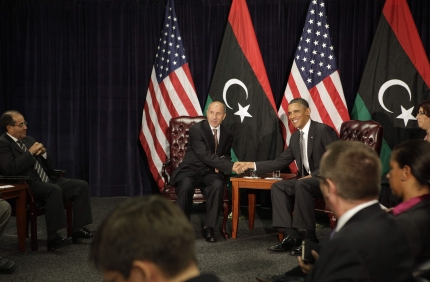
The President began his day meeting with Transitional National Council (TNC) Chairman, Mustafa Abdel Jalil at the United Nations North Lawn Building.

UNGA: potus greets Chairman Mustafa Abdel jalil

President Barack Obama greets Chairman Mustafa Abdel Jalil of the Transitional National Council at the United Nations North Lawn Building in New York, N.Y., Sept. 20, 2011. (Official White House Photo by Samantha Appleton September 20, 2011.

President Obama at the U.N. on Libya: "We will Stand with You"

Watch the video "President Obama at U.N.G.A. Libya Meeting".

Today, at the U.N. General Assembly, President Obama addressed a meeting of international partners to show support for the new Libya and plan for a post-Qaddafi future:

The Libyan people are writing a new chapter in the life of their nation.  After four decades of darkness, they can walk the streets, free from a tyrant.  They are making their voices heard -- in new newspapers, and on radio and television, in public squares and on personal blogs.  They’re launching political parties and civil groups to shape their own destiny and secure their universal rights.  And here at the United Nations, the new flag of a free Libya now flies among the community of nations.

Make no mistake -- credit for the liberation of Libya belongs to the people of Libya.  It was Libyan men and women -- and children -- who took to the streets in peaceful protest, who faced down the tanks and endured the snipers’ bullets.  It was Libyan fighters, often outgunned and outnumbered, who fought pitched battles, town-by-town, block-by-block.  It was Libyan activists -- in the underground, in chat rooms, in mosques -- who kept a revolution alive, even after some of the world had given up hope. 

It was Libyan women and girls who hung flags and smuggled weapons to the front.  It was Libyans from countries around the world, including my own, who rushed home to help, even though they, too, risked brutality and death.  It was Libyan blood that was spilled and Libya’s sons and daughters who gave their lives.  And on that August day -- after all that sacrifice, after 42 long years -- it was Libyans who pushed their dictator from power.   

At the same time, Libya is a lesson in what the international community can achieve when we stand together as one.  I said at the beginning of this process, we cannot and should not intervene every time there is an injustice in the world.  Yet it’s also true that there are times where the world could have and should have summoned the will to prevent the killing of innocents on a horrific scale.  And we are forever haunted by the atrocities that we did not prevent, and the lives that we did not save.  But this time was different.  This time, we, through the United Nations, found the courage and the collective will to act.

President Obama Salutes the People of Libya

September 20, 2011 | 12:21 | Public Domain

In a high-level meeting at the U.N. General Assembly, the President vows the new country has a friend in the U.S.

Download mp4 (118MB) | mp3 (12MB)

Read the Transcript

Remarks by President Obama at High-Level Meeting on Libya

United Nations
New York, New York

11:12 A.M. EDT

PRESIDENT OBAMA: Good morning. Mr. Secretary General, on behalf of us all, thank you for convening this meeting to address a task that must be the work of all of us -- supporting the people of Libya as they build a future that is free and democratic and prosperous. And I want to thank President Jalil for his remarks and for all that he and Prime Minister Jibril have done to help Libya reach this moment.

To all the heads of state, to all the countries represented here who have done so much over the past several months to ensure this day could come, I want to say thank you, as well.

Today, the Libyan people are writing a new chapter in the life of their nation. After four decades of darkness, they can walk the streets, free from a tyrant. They are making their voices heard -- in new newspapers, and on radio and television, in public squares and on personal blogs. They’re launching political parties and civil groups to shape their own destiny and secure their universal rights. And here at the United Nations, the new flag of a free Libya now flies among the community of nations.

Make no mistake -- credit for the liberation of Libya belongs to the people of Libya. It was Libyan men and women -- and children -- who took to the streets in peaceful protest, who faced down the tanks and endured the snipers’ bullets. It was Libyan fighters, often outgunned and outnumbered, who fought pitched battles, town-by-town, block-by-block. It was Libyan activists -- in the underground, in chat rooms, in mosques -- who kept a revolution alive, even after some of the world had given up hope.

It was Libyan women and girls who hung flags and smuggled weapons to the front. It was Libyans from countries around the world, including my own, who rushed home to help, even though they, too, risked brutality and death. It was Libyan blood that was spilled and Libya’s sons and daughters who gave their lives. And on that August day -- after all that sacrifice, after 42 long years -- it was Libyans who pushed their dictator from power.

At the same time, Libya is a lesson in what the international community can achieve when we stand together as one. I said at the beginning of this process, we cannot and should not intervene every time there is an injustice in the world. Yet it’s also true that there are times where the world could have and should have summoned the will to prevent the killing of innocents on a horrific scale. And we are forever haunted by the atrocities that we did not prevent, and the lives that we did not save. But this time was different. This time, we, through the United Nations, found the courage and the collective will to act.

When the old regime unleashed a campaign of terror, threatening to roll back the democratic tide sweeping the region, we acted as united nations, and we acted swiftly -- broadening sanctions, imposing an arms embargo. The United States led the effort to pass a historic resolution at the Security Council authorizing "all necessary measures" to protect the Libyan people. And when the civilians of Benghazi were threatened with a massacre, we exercised that authority. Our international coalition stopped the regime in its tracks, and saved countless lives, and gave the Libyan people the time and the space to prevail.

Important, too, is how this effort succeeded -- thanks to the leadership and contributions of many countries. The United States was proud to play a decisive role, especially in the early days, and then in a supporting capacity. But let’s remember that it was the Arab League that appealed for action. It was the world’s most effective alliance, NATO, that’s led a military coalition of nearly 20 nations. It’s our European allies -- especially the United Kingdom and France and Denmark and Norway -- that conducted the vast majority of air strikes protecting rebels on the ground. It was Arab states who joined the coalition, as equal partners. And it’s been the United Nations and neighboring countries -- including Tunisia and Egypt -- that have cared for the Libyans in the urgent humanitarian effort that continues today.

This is how the international community should work in the 21st century -- more nations bearing the responsibility and the costs of meeting global challenges. In fact, this is the very purpose of this United Nations. So every nation represented here today can take pride in the innocent lives we saved and in helping Libyans reclaim their country. It was the right thing to do.

Now, even as we speak, remnants of the old regime continue to fight. Difficult days are still ahead. But one thing is clear -- the future of Libya is now in the hands of the Libyan people. For just as it was Libyans who tore down the old order, it will be Libyans who build their new nation. And we’ve come here today to say to the people of Libya -- just as the world stood by you in your struggle to be free, we will now stand with you in your struggle to realize the peace and prosperity that freedom can bring.

In this effort, you will have a friend and partner in the United States of America. Today, I can announce that our ambassador is on his way back to Tripoli. And this week, the American flag that was lowered before our embassy was attacked will be raised again, over a re-opened American embassy. We will work closely with the new U.N. Support Mission in Libya and with the nations here today to assist the Libyan people in the hard work ahead.

First, and most immediately: security. So long as the Libyan people are being threatened, the NATO-led mission to protect them will continue. And those still holding out must understand -- the old regime is over, and it is time to lay down your arms and join the new Libya. As this happens, the world must also support efforts to secure dangerous weapons -- conventional and otherwise -- and bring fighters under central, civilian control. For without security, democracy and trade and investment cannot flourish.

Second: the humanitarian effort. The Transitional National Council has been working quickly to restore water and electricity and food supplies to Tripoli. But for many Libyans, each day is still a struggle -- to recover from their wounds, reunite with their families, and return to their homes. And even after the guns of war fall silent, the ravages of war will continue. So our efforts to assist its victims must continue. In this, the United States -- the United Nations will play a key role. And along with our partners, the United States will do our part to help the hungry and the wounded.

Third: a democratic transition that is peaceful, inclusive and just. President Jalil has just reaffirmed the Transitional National Council’s commitment to these principles, and the United Nations will play a central role in coordinating international support for this effort. We all know what is needed -- a transition that is timely, new laws and a constitution that uphold the rule of law, political parties and a strong civil society, and, for the first time in Libyan history, free and fair elections.

True democracy, however, must flow from its citizens. So as Libyans rightly seek justice for past crimes, let it be done in a spirit of reconciliation, and not reprisals and violence. As Libyans draw strength from their faith -- a religion rooted in peace and tolerance -- let there be a rejection of violent extremism, which offers nothing but death and destruction. As Libyans rebuild, let those efforts tap the experience of all those with the skills to contribute, including the many Africans in Libya. And as Libyans forge a society that is truly just, let it enshrine the rights and role of women at all levels of society. For we know that the nations that uphold the human rights of all people, especially their women, are ultimately more successful and more prosperous.

Which brings me to the final area where the world must stand with Libya, and that is restoring prosperity. For too long, Libya’s vast riches were stolen and squandered. Now that wealth must serve its rightful owners -- the Libyan people. As sanctions are lifted, as the United States and the international community unfreeze more Libyan assets, and as the country's oil production is restored, the Libyan people deserve a government that is transparent and accountable. And bound by the Libyan students and entrepreneurs who have forged friendships in the United States, we intend to build new partnerships to help unleash Libya’s extraordinary potential.

Now, none of this will be easy. After decades of iron rule by one man, it will take time to build the institutions needed for a democratic Libya. I’m sure there will be days of frustration; there will be days when progress is slow; there will be days when some begin to wish for the old order and its illusion of stability. And some in the world may ask, can Libya succeed? But if we have learned anything these many months, it is this: Don’t underestimate the aspirations and the will of the Libyan people.

So I want to conclude by speaking directly to the people of Libya. Your task may be new, the journey ahead may be fraught with difficulty, but everything you need to build your future already beats in the heart of your nation. It’s the same courage you summoned on that first February day; the same resilience that brought you back out the next day and the next, even as you lost family and friends; and the same unshakeable determination with which you liberated Benghazi, broke the siege of Misurata, and have fought through the coastal plain and the western mountains.
It’s the same unwavering conviction that said, there’s no turning back; our sons and daughters deserve to be free.

In the days after Tripoli fell, people rejoiced in the streets and pondered the role ahead, and one of those Libyans said, “We have this chance now to do something good for our country, a chance we have dreamed of for so long.” So, to the Libyan people, this is your chance. And today the world is saying, with one unmistakable voice, we will stand with you as you seize this moment of promise, as you reach for the freedom, the dignity, and the opportunity that you deserve.

So, congratulations. And thank you very much. (Applause.)

END
11:24 A.M. EDT

Close Transcript

The White House

Office of the Press Secretary

President Obama to participate in LinkedIn Town Hall in Mountain View, California on Monday, September 26th

President to visit Computer History Museum for “Putting America Back to Work: LinkedIn Presents a Town Hall with President Obama”

WASHINGTON, DC – On Monday, September 26th, President Obama will travel to Mountain View, California to participate in “Putting America Back to Work: LinkedIn Presents a Town Hall with President Obama.”  At the town hall, the President will answer questions about job creation and the economy from a live audience made up of LinkedIn members and employees, as well as questions that have been submitted from LinkedIn members across the country.

In conjunction with the President's visit, LinkedIn has launched a community focused on job creation and the economy. Through this group, people are invited to join the conversation with President Obama by submitting questions for the town hall, contributing comments, and sharing content with their own network. This group will serve as a platform for LinkedIn users to continue the discussion on putting America back to work and provide opportunities for LinkedIn members to engage with the White House and Administration officials following the town hall. People can submit questions for the President HERE and watch the town hall live on LinkedIn and WhiteHouse.gov/live.

LinkedIn is the world's largest professional network with more than 120 million members worldwide. At “Putting America Back to Work: LinkedIn Presents a Town Hall with President Obama,” the President will hear directly from LinkedIn members who range from small business owners and employees to community college students to veterans.

President Obama's Bilateral Meeting with President Karzai of Afghanistan

September 20, 2011 | 3:25 | Public Domain

Expresses sympathy for murder of former President Rabbani.

Download mp4 (33MB) | mp3 (3MB)

Read the Transcript

Remarks by President Obama and President Karzai of Afghanistan before Bilateral Meeting

Waldorf Astoria Hotel
New York, New York

12:06 P.M. EDT

THE PRESIDENT: I want to welcome President Karzai and his delegation. We have a lot of important business to do. And I very much appreciate the efforts that he's been taking in rebuilding Afghanistan and proceeding on the transition path that will ensure that the Afghans are ultimately responsible for their security and their prosperity.

We received some tragic news today that President Rabbani, who had been heading up the reconciliation process, was killed in a suicide attack. He was a man who cared deeply about Afghanistan and had been a valued advisor to President Karzai, and was a enormous contribution to rebuilding the country. So it is a tragic loss. We want to extend our heartfelt condolences to you and to his family, and the people of Afghanistan.

But, Mr. President, I think we both believe that despite this incident, we will not be deterred from creating a path whereby Afghans can live in freedom and safety and security and prosperity, and that it is going to be important to continue the efforts to bring all elements of Afghan society together to end what has been a senseless cycle of violence.

So we very much appreciate your presence here today. I know that you're going to have to leave after our meeting. But we want to give you an opportunity to speak to the press, as well.

PRESIDENT KARZAI: Thank you very much, Mr. President, for your message of condolence and support to myself and to the Afghan people on the very tragic loss and martyrdom of Professor Burhanuddin Rabbani, the chairman of the Afghan Peace Council, the former Afghan President, and Afghan patriot, who, as we see, has sacrificed his life for the sake of Afghanistan and for the peace of our country.

The mission that he had undertaken was vital, Mr. President, for the Afghan people and for the security of our country and for peace in our country. We will miss him very, very much. I don't think, Mr. President, that we can fill his place easily. He was one of the few people in Afghanistan with the distinction that we cannot easily find in societies. A terrible loss. But as you rightly say, this will not deter us from continuing on the path that we have, and we'll definitely succeed.

Thank you, Mr. President, for condemning this act of brutality and cowardice against President Rabbani. I will take that message from you to the Afghan people. This is a hard day for us in Afghanistan, but a day of unity and a day of continuity of our efforts.

Thank you.

END
12:10 P.M. EDT

Close Transcript

Putting America Back to Work: LinkedIn Presents a Town Hall with President Obama

We’re excited to announce that on Monday September 26th, President Obama will travel to Mountain View, California for a Town Hall with LinkedIn, the world's largest professional network. During the Town Hall, the President will answer questions about job creation and the economy from LinkedIn members across the country and hear directly from LinkedIn users who range from small business owners and employees to community college students to veterans. 

What's your question for President Obama on job creation and the economy? Ask it now on LinkedIn.

You’re invited to participate in the Town Hall with President Obama through LinkedIn – ask questions, add comments, share content, and watch the event live. Following the Town Hall, White House Administration officials will continue to engage in the conversation with LinkedIn members about putting America back to work. We hope you’ll join us.

Learn more about President Obama's plan to create jobs now here. Join the White House group on LinkedIn here.

Related Topics: Economy, California

President Obama on Open Government: "The Essence of Democracy"

Download Video: mp4 (582MB) | mp3 (56MB)

This week, President Obama is in New York City for the United Nations General Assembly to meet with partners and address a range of issues with the international community, including open government.

At the U.N. General Assembly last year, President Obama called on nations to make, "specific commitments to promote transparency, to fight corruption, to energize civic engagement, and to leverage new technologies so we can strengthen the foundations of freedom in our own countries." Today, the President outlined the progress that has already been made in response to his call to action:

And now we see governments around the world meeting this challenge, including many represented here today.  Countries from Mexico to Turkey to Liberia have passed laws guaranteeing citizens the right to information.  From Chile to Kenya to the Philippines, civil society groups are giving citizens new tools to report corruption.  From Tanzania to Indonesia -- and as I saw firsthand during my visit to India -- rural villages are organizing and making their voices heard, and getting the public services that they need.  Governments from Brazil to South Africa are putting more information online, helping people hold public officials accountable for how they spend taxpayer dollars. 

Here in the United States, we’ve worked to make government more open and responsive than ever before.  We’ve been promoting greater disclosure of government information, empowering citizens with new ways to participate in their democracy.  We are releasing more data in usable forms on health and safety and the environment, because information is power, and helping people make informed decisions and entrepreneurs turn data into new products, they create new jobs.  We’re also soliciting the best ideas from our people in how to make government work better.  And around the world, we’re standing up for freedom to access information, including a free and open Internet.