The White House

Office of the Press Secretary

President Obama Announces More Key Administration Posts

WASHINGTON – Today, President Barack Obama announced his intent to nominate the following individuals to key Administration posts:

  • Brian T. Baenig, Assistant Secretary for Congressional Relations, Department of Agriculture
  • Meg Bartley, Judge, United States Court of Appeals for Veterans Claims
  • Mary Beth Leonard, Ambassador to the Republic of Mali, Department of State
  • Gloria Wilson Shelton, Judge, United States Court of Appeals for Veterans Claims


The President also announced his intent to appoint the following individuals to key Administration posts:

  • Christopher Che, Member, President's Council on Jobs and Competitiveness
  • Linda K. Kerber, Member, Permanent Committee for the Oliver Wendell Holmes Devise
  • Judge Trina Thompson, Member, Coordinating Council on Juvenile Justice and Delinquency Prevention


President Obama said, “These fine public servants bring both a depth of experience and tremendous dedication to their new roles.  Our nation will be well-served by these men and women, and I look forward to working with them in the months and years to come.”

President Obama announced his intent to nominate the following individuals to key Administration posts:

Brian T. Baenig, Nominee for Assistant Secretary for Congressional Relations, Department of Agriculture
Brian Baenig is currently the Deputy Undersecretary for Marketing and Regulatory Programs at the Department of Agriculture, where he facilitates domestic and international marketing of U.S. agriculture. From 2009 to 2011, Mr. Baenig served as Deputy Staff Director on the Senate Committee on Agriculture, Nutrition and Forestry.  Prior to that, Mr. Baenig served as Senior Policy Advisor to Senator Leahy and as staff on the Senate Judiciary Committee. He also served for several years as a Legislative Assistant for Senator Paul Wellstone. Mr. Baenig holds a B.S. in Political Science from Saint Michael’s College.

Meg Bartley, Nominee for Judge, United States Court of Appeals for Veterans Claims
Meg Bartley is currently senior staff attorney at the National Veterans Legal Services Program (NVLSP) and also Director of Outreach and Education for the Veterans Consortium Pro Bono Program, where she has served since 2005.   Additionally, Ms. Bartley is the Editor of The Veterans Advocate® where she previously worked as Assistant Editor and contributing writer.  Ms. Bartley has represented veterans and their dependents and survivors before the United States Court of Appeals for Veterans Claims (CAVC) and the Board of Veterans’ Appeals since 1995. Following law school, Ms. Bartley served as a judicial law clerk for the Honorable Jonathan R. Steinberg , formerly of the CAVC.  Ms. Bartley holds a B.A. from Pennsylvania State University and a J.D. from American University Washington College of Law.

Mary Beth Leonard, Nominee for Ambassador to the Republic of Mali, Department of State
Mary Beth Leonard, a career member of the Senior Foreign Service, currently serves as Director of the Office of West African Affairs at the Department of State. Prior to this assignment, she most recently served as Deputy Chief of Mission in Mali. She was also Deputy Chief of Mission in Suriname.  Other positions overseas include: Deputy Principal Officer in Cape Town, South Africa; Economic and Commercial officer in Togo; Consular Officer in Namibia; and Consular and Economic Officer in Cameroon.  In Washington, Ms. Leonard has served in the State Department Operations Center and twice as a Desk Officer, in the Office of Southern African Affairs and Central African Affairs.  Ms. Leonard received a B.A. from Boston University, an M.A. from the Johns Hopkins University School of Advanced International Studies, and an M.A. in Security and Strategic Studies from the U.S. Naval War College.

Gloria Wilson Shelton, Nominee for Judge, United States Court of Appeals for Veterans Claims
Gloria Wilson Shelton is currently a staff attorney at the Department of Veterans Affairs (VA).  Prior to joining the VA, she was a Bureau Chief in the Office of the Attorney General of Maryland from 2007 to 2010. From 2003 to 2007, Ms. Shelton served as Principal Counsel in the Office of the Attorney General of Maryland Courts and Judicial Affairs Division. Ms. Shelton’s previous positions include Maryland State Assistant Attorney General, Deputy Legal Counsel for the Baltimore Police Department, Assistant Solicitor for the Baltimore City Housing Authority, and a judicial clerkship for the Court of Appeals of Maryland. Ms. Shelton has also served as an Adjunct Professor at the University of Maryland School of Law.  Ms. Shelton holds a B.S. from Morgan State University, an M.S. from Coppin State College, and a J.D. from the University of Baltimore School of Law.

President Obama announced his intent to appoint the following individuals to key Administration posts:

Christopher Che, Appointee for Member, President's Council on Jobs and Competitiveness
Christopher Che is the President and Chief Executive Officer of the Ohio-based Hooven Dayton Corporation, a provider of prime product labels, flexible packaging, promotional coupons and specialty printing solutions. He is also the President and CEO of a holding company, Che International Group, which owns Hooven Dayton. Previously, Mr. Che served as Chief Financial Officer for several companies, including Government Acquisitions, Inc., Corbus, LLC, and OR Group, Inc.  He has also served as a Board Member for a number of business and civic organizations, including the Dayton Area Chamber of Commerce, the Dayton Minority Economic Development Council, and the Dayton Area Business Advisory Council of the Federal Reserve Bank of Cleveland.  Mr. Che received a B.A. in Accounting from Wilmington College (Ohio) and an M.A. from Miami University of Ohio.

Linda K. Kerber, Appointee for Member, Permanent Committee for the Oliver Wendell Holmes Devise
Linda K.  Kerber is the May Brodbeck Professor in the Liberal Arts & Sciences at the University of Iowa and a lecturer in the University of Iowa College of Law.  In her writing and teaching, Professor Kerber has emphasized the history of citizenship, gender, and authority.  Among her books is No Constitutional Right to Be Ladies: Women and the Obligations of Citizenship, which won the Littleton-Griswold Prize for the best book on U.S. legal history and the Joan Kelley Prize for the best book on women's history.  Professor Kerber is an elected member of the American Philosophical Society and the American Academy of Arts and Sciences and she has served as President of the American Historical Association, President of the Organization of American Historians and President of the American Studies Association.  Professor Kerber received an A.B. from Barnard College, and M.A. from New York University, and a Ph.D. from Columbia University.

Judge Trina Thompson, Appointee for Member, Coordinating Council on Juvenile Justice and Delinquency Prevention
Judge Trina Thompson is the Presiding Judge of the Alameda County Juvenile Court.  She was first elected to the Alameda County Superior Court in November 2002 and sworn into office in January 2003.  Prior to her appointment as the Presiding Judge of the Juvenile Court in 2010, Judge Thompson presided over felony jury trials, adult truancy court, and was responsible, along with one of her colleagues, for managing the domestic violence calendar for Alameda County.  In 2001, Judge Thompson was appointed as a Juvenile Court Commissioner, responsible for hearing juvenile delinquency and dependency matters. Additionally, she was chair of the Alameda County Educational Task Force for the juvenile court to ensure the education of state-raised children. Prior to her appointment as Court Commissioner, Judge Thompson managed a private criminal defense practice from 1991 to 2000, focusing on juvenile, misdemeanor, felony and capital defense trials, and served as a public defender in Alameda County from 1987 to 1991.   Judge Thompson received an A.B. in Legal Studies from the University of California at Berkeley and graduated from UC Berkeley's Boalt Hall School of Law.
The White House

Office of the Press Secretary

Readout of the President's Call with President-elect Humala of Peru

Earlier this afternoon, President Obama called Ollanta Humala, President-elect of Peru, to congratulate him on his victory in the June 5 election.   President Obama commended the people of Peru for their commitment to democracy.  Noting the strong historic ties between the United States and Peru, the President underscored his interest in strengthening our bilateral partnership to continue work on a wide range of topics, including effective democratic governance, respect for shared values, broad-based economic growth and prosperity, citizen security, and other regional and global issues of mutual interest.

President Obama Discusses Economic Growth with America’s Mayors

President Meets with Conference of Mayors

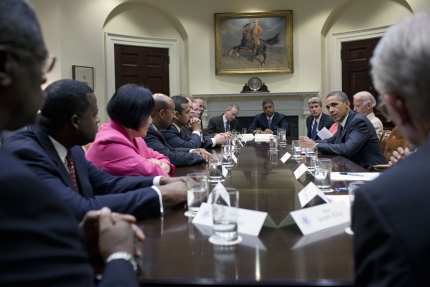
President Barack Obama meets with the U.S. Conference of Mayors leadership to discuss the economy and their local efforts to create jobs and spur economic growth, in the Roosevelt Room of the White House, June 20, 2011. (Official White House Photo by Pete Souza)

Monday afternoon, President Obama met with a bipartisan group of fourteen mayors to talk about the state of the economy in their cities and their just-ended meeting of the U.S. Conference of Mayors in Baltimore, Maryland.  The President, who was joined by Vice President Biden, Chief of Staff Bill Daley, and Senior Advisor Valerie Jarrett, stressed his continued commitment to working closely with mayors to spur job creation and economic growth.

Mayors attending included:

•         Mayor David Bing of Detroit, MI
•         Mayor Mick Cornett of Oklahoma City, OK
•         Mayor Buddy Dyer of Orlando, FL
•         Mayor Anthony Foxx of Charlotte, NC
•         Mayor Sly James of Kansas City, MO
•         Mayor Kevin Johnson of Sacramento, CA
•         Mayor Elizabeth Kautz of Burnsville, MN
•         Mayor Michael Nutter of  Philadelphia, PA
•         Mayor Jean Quan of Oakland, CA
•         Mayor Kasim Reed of Atlanta, GA
•         Mayor Joe Riley of Charleston, SC
•         Mayor R.T. Rybak of Minneapolis, MN
•         Mayor Scott Smith of Mesa, AZ
•         Mayor Antonio Villaraigosa of Los Angeles, CA
 
The newly-installed President of the U.S. Conference of Mayors, Mayor Antonio Villaraigosa, told the President that he appreciated the solid working relationship that mayors have with this White House and urged the President to continue fighting for investments in our nation's infrastructure.  Mayor Villaraigosa also urged Congress to address job creation and stressed the importance of education and workforce training programs.

The White House

Office of the Press Secretary

Remarks by the President at a DNC Event

Mandarin Oriental Hotel
Washington, D.C.

9:06 P.M. EDT


THE PRESIDENT: Thank you. Thank you, everybody. Thank you. (Applause.) Thank you, everybody. Please have a seat, have a seat.
 
It is wonderful to see all of you. I've got a lot of friends in the room here. People who knew me before anybody could pronounce my name. (Laughter.) People who knew me before I had gray hair. (Laughter.) It is wonderful to see those of you who’ve been friends for a long time, and it’s wonderful to see new friends here as well.

What I'd like to do is to make some very brief remarks at the top and then have a chance to take a few questions, because that will give us a chance to have a dialogue, and you might have some suggestion that we haven’t thought of. And it’s one of the great things about these kinds of events is people here have so much expertise in so many different areas that it’s a wonderful thing for me to be able to pick your brain as well as just you guys hearing me chatter.

We are obviously going through one of the toughest periods in American history. We went through the worst financial crisis since the Great Depression, and immediately after being elected, I had to take a series of very difficult steps to rescue ourselves from the brink. We had lost 4 million jobs in the six months before I was sworn in; lost another 4 million during the period probably six months after I was elected. And so as a consequence, we had to do some things that we didn’t expect we would have to do, just to save the economy -- stabilize the financial system, make sure that states and local governments didn’t have to lay off police officers and cops and firefighters. We had to save an auto industry. I never expected to be a automobile executive. (Laughter.)

As a consequence of that swift, decisive, and sometimes difficult period, we were able to take an economy that was shrinking by about 6 percent and create an economy that is now growing, and has grown steadily now over many consecutive quarters. Over the last 15 months we’ve created over 2.1 million private sector jobs. (Applause.) We have an auto industry that, for the first time in a very long time is profitable, and the Big Three automakers actually gaining market share, and not only gaining market share, but also gaining market share in the cars of the future so that they’re actually competing in compact cars and sub-compact cars and electric cars and hybrids.

And so I'm extraordinarily proud of the economic record that we were able to produce over the first two and a half years, but having said all that, the economy is still so tough for so many people around the country. The hole that was dug was so deep. And most importantly, the reasons that I decided to run for President in the first place still had not been fully addressed, because the fact is, is that even before this financial crisis, wages and incomes had flat-lined for most Americans. Those at the very top had seen themselves do very well, but the bottom 95 percent, the bottom 90 percent, they were treading water at a time when their cost of health care and cost of college education, cost of groceries, cost of gasoline all were going up. And that was before the crisis hit. And now they’ve got to worry about homes that have lost value and businesses that are just barely getting by.

And so although we’ve made a turn in a positive direction, the underlying structural challenges that we face remain. And so the reason that 2012 is important is because I did not just run for President to get us back to where we were; I ran for President originally to move us to where we need to be.

And what that means is that what we’ve begun we had to finish. We’ve begun to reform our education system, and thanks to programs like Race to the Top, we’re not just putting more money into the schools. We are saying to schools and states and local school districts, if you reform, if you get rid of the dogmas of the left or the right and you focus on student achievement and how to get the best possible teachers at the front of the classroom and we’re rewarding excellence and we are holding ourselves accountable, you know what, there’s no reason why we can’t make sure that we have the highest proportion of college graduates in the world and make sure that every single one of our young people are equipped to compete in a 21st-century economy. (Applause.)

We have begun the process of changing how we think about energy in this country –- made the largest investment in clean energy in our history through the Recovery Act; have stood up entire industries like advanced battery manufacturing; invested in making sure that wind power and solar power and biothermal energy, that all of these things are being developed and researched right here in the United States of America.

But the fact of the matter is, is that we are still way too dependent on foreign oil and the fuels of the past. And so part of our unfinished business is making sure that we are getting electric cars on our roads and that we are not only tapping into traditional energy sources here in the United States of America but we're also becoming more energy-efficient. We're at the cutting edge of a clean energy revolution that could not only free ourselves from dependence on foreign oil and clean up our environment, but also produce jobs right here in the United States of America. Our job is not finished when it comes to energy policy.

We're not done when it comes to rebuilding our infrastructure. America has always had the best stuff. We had the best roads, we had the best ports, we had the best airports. People would travel from around the world to marvel at the infrastructure we had built. We can't claim to have the best anymore. You go to airports in Beijing or Singapore that put a lot of our airports to shame. High-speed rail networks all through Europe that could be built here in the United States of America.

And so imagine what we could do putting people back to work right now doing the work that America needs to be done. We started. We made the largest investment in infrastructure since Dwight Eisenhower was President through the Recovery Act, but we've still got $2 trillion worth of repairs to be made. And think about all those unemployed construction workers out there that could be working right now rebuilding America for the future -- and not just the old traditional infrastructure, the new infrastructure -- a smart grid that would help us become more energy-efficient and get energy from wind farms or solar panels to the places where it's needed most; making sure that we've got the best broadband and 4G and 5G and -- so that we have the best communication networks in the world.

We started, but we haven't finished. We've started reforming our health care system, and I could not be prouder of the work that we did on the health care act -- but we now have to implement it, because health care costs are still going up too fast for families, for businesses, and for governments, state and federal, that are paying the bills.

And so this is a matter not only of making sure that 30 million Americans never again have to go bankrupt because somebody in their family gets sick. It's also making sure that we're getting a better bang for our health care dollar; that instead of taking five tests, you take one test and it's emailed to five doctors; that we make certain that preventive medicine is in place so that people aren't getting amputated because of diabetes -- they're not getting diabetes in the first place.

Those are the changes that we initiated through the Affordable Care Act, but we've got to finish the job. The same is true when it comes to financial reform -- making sure that we never go through the financial meltdown that we went through again. but also, at the same time, that we're looking after consumers and protecting them for the first time in a very long time, whether it's getting a mortgage or taking out a credit card. Our job is not finished.

We've made tremendous progress on a whole host of social issues, from ending "don't ask, don't tell" so that every American can serve their country regardless of who they love, to making sure that we've got equal pay for equal work, to making sure that we've got national service so that our young people can use their talents to help rebuild America.

But our job is not finished. We still have work to do on immigration reform, where we have to once again be a nation of laws and a nation of immigrants; one that welcomes the strength that comes from talented people from all around the world wanting to be here, but also making sure that we're doing it in orderly way.

And we sure have got a lot of work to do on the international front. When I came into office, we had two active wars. By the end of this year, one war will be done. And we will be transitioning in Afghanistan to turn over more and more security to the Afghan people.

But there's also enormous challenges and opportunities to all that's happening in the Arab world right now. And it requires us to articulate clearly what we stand for, what our values are, to reject isolationism, but it also requires us to recognize that us having influence in these affairs is going to have less to do with our firepower and more to do with our ideas and our example, our economic engagement, the quality of our diplomacy. We've still got more work to do.

So the bottom line is this. Back in 2008, on election night, in Grant Park -- it was a nice night in Chicago -- I said to people, this is not the end, this is the beginning. We've got a steep climb ahead of us to get to that summit where we want to be, where every single American knows that if they work hard, if they're doing the right thing, if they're carrying out their responsibilities, they have a chance at the American Dream.

We're just part of the way up that mountain. And the only way we're going to get all the way up that mountain is if we are as engaged, as motivated, as involved, as excited, working as hard as we were in 2008. And that may be a little bit of challenge -- because, let's face it, back in 2008, I was new. (Laughter.)

Now I'm gray. (Laughter.) I've got dings and dents. The old posters are all faded. (Laughter.) People make fun of hope and change. And some folks have said, well, change didn't happen as fast as I wanted, or it's not exactly as I expected, or why can't he just change the minds of all those Republicans. (Laughter.)

The thing is, change is never easy because we live in a democracy. And that's what's wonderful about this country, is we argue it out and ideas are tested and sometimes we lurch this way or that way and mistakes are made. But our general trajectory has always been to advance prosperity and equality and opportunity.

And so this process, as difficult as it has been, has also been invigorating. And I've never had more confidence in the possibilities of this great American experiment, partly because I get a chance to see and talk to Americans from every walk of life. And we are a good, decent people. And as hard as things have been, we are resilient and we come back.

And so if you're willing to join with me in what will be my last campaign -- (laughter) -- if you're willing to dig deep and talk to your friends and neighbors and coworkers and recognize, yes, we're a little older, we've matured a little bit, but that that fundamental project of delivering the American Dream for that next generation, that's just as urgent and as vital as ever, then I'm confident not only will we win in 2012 -- more importantly, we'll get a little further up that mountain. That's our job.

So, thank you very much, everybody. Thank you. Thank you. (Applause.)

END 9:23 P.M. EDT


The White House

Office of the Press Secretary

Remarks by the President at a DNC Event

Mandarin Oriental Hotel
Washington, D.C.

7:30 P.M. EDT

THE PRESIDENT:  Thank you, everybody.  It is wonderful to see so many great friends.  To Amy and all those who helped to organize tonight's dinner, I couldn't be more grateful.

Debbie Wasserman Schultz, our new DNC chair, thank you for all the extraordinary work that you're doing.  (Applause.)  I could not have made a better pick.

I want to spend most of the time in a conversation as opposed to just me making a long speech.  But I do want to talk a little bit about the context in which we meet this evening.  Obviously we're going through extraordinarily challenging times. We've gone through the worst economic crisis since the Great Depression, and a huge amount of energy has been devoted over the last two years to making sure that we pulled ourselves back from the brink; that an economy that was contracting is growing again, that we're putting more and more people back to work, that businesses are able to succeed, that we're educating our kids, that we're making investments that will help assure that America remains not only the most powerful country on Earth, but also one that is just and one that lives up to the American Dream -- the idea that anybody who has a good idea, anybody who's willing to work hard, that they've got a shot at not only living a good life but also passing on an even better life to their kids.

We also have an extraordinarily challenging international environment.  When I came into office we were in the midst of two wars.  We are almost done with our troop presence in Iraq, by the end of this year.  And in Afghanistan, we're in the process of a transition where we are starting to give more and more responsibility to Afghans for their own security, at the same time as we have been dogged in pursuing al Qaeda and are creating a situation where it is very, very difficult for them to operate.

But in the midst of all this, what we've now also seen is the kind of tumult taking place in the Middle East that we haven’t seen in a very long time.  And the consequences of what's happening there are potentially as significant as the consequences of what took place in Europe when the Berlin Wall came down.  It poses great challenges, but it also poses great opportunities.

And I think that the most important message I have for all of you here tonight is that even as we try to manage what is going to be a very difficult and challenging situation over the next 12 months, the next 24 months, the next decade, that one inviolable principle will be that the United States and Israel will always be stalwart allies and friends -- (applause) -- that that bond isn’t breakable and that Israel's security will always be at the top tier of considerations in terms of how America manages its foreign policy -- because it's the right thing to do, because Israel is our closest ally and friend, it is a robust democracy, it shares our values and it shares our principles.

Now, what's also going to be true is that both the United States and Israel are going to have to look at this new landscape with fresh eyes.  It's not going to be sufficient for us just to keep on doing the same things we’ve been doing and expect somehow that things are going to work themselves out.  We’re going to have to be creative and we’re going to have to be engaged.  We’re going to have to look for opportunities where the best impulses in the Middle East come to the fore and the worst impulses are weakened. 

We have to do so from a position of strength, which is why my administration has done more to promote Israel’s security, its qualitative military edge, its defense capabilities than any administration over the last 25 years.  And we have made that commitment consistently.  (Applause.)

But it also means that we’ve got to engage diplomatically.  It means that we’re going to have to find out who are the partners that can work with us and how do we strengthen them, and how do we isolate those who are unwilling to work with us and weaken them. 

And there are going to be moments over the course of the next six months or the next 12 months or the next 24 months in which there may be tactical disagreements in terms of how we approach these difficult problems.  But the broader vision, which is one in which Israel is a secure Jewish state, is able to live in peace with its neighbors, where kids can get on the bus or go to bed at night and not have to worry about missiles landing on them, where commerce and interactions between peoples in the region is occurring in a normal fashion, where the hopes and dreams of the original travelers to Israel, the original settlers in Israel, that those hopes and dreams that date back a millennium, that those hopes are realized.  That will remain our North Star.  That will remain our goal.

And I’m absolutely confident that we can achieve that goal. But it’s going to require some hard work.  And it’s going to require that not only this administration employs all of its creative powers to try to bring about peace in the region, but it’s also going to require all of you as engaged citizens of the United States who are friends of Israel making sure that you are giving us suggestions, you are in an honest dialogue with us, that you’re helping to shape how both Americans and Israelis think about the opportunities and challenges. 

All of you are leaders in your community.  And my hope is, is that through the kind of conversations that we’re having here tonight, that we’re going to be able to, together, craft the kind of strategy that not only leads to a strong America, but also leads to a strong Israel. 

So, to all of you who are here, thank you again for your past support, thank you for your friendship, and thank you for what I anticipate will be many years of collaboration between us in the years to come.  Thank you very much.  (Applause.)

             
END  7:38 P.M. EDT

The White House

Office of the Press Secretary

Statement by the President on the Approval of the Cobell Settlement by U.S. Senior District Judge Thomas F. Hogan

After fifteen years of litigation, today’s decision marks another important step forward in the relationship between the federal government and Indian Country.  Resolving this dispute was a priority for my Administration, and we will engage in government-to-government consultations with tribal nations regarding the land consolidation component of the settlement to ensure that this moves ahead at an appropriate pace and in an appropriate manner.  And going forward, my Administration will continue to strengthen our relationship with Indian Country.

The White House

Office of the Press Secretary

Statement by the President on World Refugee Day

As we mark World Refugee Day, I join with people around the globe in highlighting the plight of the 15 million refugees in the world today, and we reaffirm our commitment to support them as they seek a safe place to call home again.  In particular, we honor the courage of those who have been forcibly displaced from their homes, including men, women and children in Libya, Syria, Cote d'Ivoire who remind us that somewhere in the world, refugees are forced to flee their homes virtually every day.  

This year marks the 60th anniversary of the 1951 Convention Relating to the Status of Refugees – a landmark achievement of international law that sets forth certain rights of refugees and legal obligations of States relating to refugees.  Hundreds of thousands – and probably millions – of people around the world are alive today thanks to the help and protection they received from the international community when they were forced to flee their countries to escape violence, oppression, abuse, and other forms of persecution.  

This year is also the 50th anniversary of the 1961 Convention on the Reduction of Statelessness.  In at least 30 countries, nationality laws discriminate against women and limit their ability to acquire and transmit citizenship to their children or spouses, which can lead to statelessness.  The United States will continue to work to empower women and girls and ensure opportunities for displaced and stateless women throughout the world.

Our values and our interests dictate that the protection of the most vulnerable is a critical component of our foreign policy.  We have a moral imperative to save lives.  We also have interest in sustaining U.S. leadership, which enables us to drive the development of international humanitarian principles, programs, and policies like no other government in the world.  Such efforts promote reconciliation, security, and well-being in circumstances where despair and misery threaten stability and critical U.S. national security interests.

The White House

Office of the Press Secretary

Readout of the President's call with Prime Minister Erdogan of Turkey

President Obama called Turkish Prime Minister Recep Tayyip Erdogan to continue the two leaders’ consultations on regional developments.  The leaders agreed that the Syrian government must end the use of violence now and promptly enact meaningful reforms that respect the democratic aspirations of the Syrian people.  The President and Prime Minister also agreed that it is important to maintain international pressure on Gaddafi in order to transition to a new government that will reflect the will of the Libyan people.  Finally, the President and Prime Minister Erdogan agreed on the importance of a comprehensive Middle East Peace settlement that will ensure regional peace and stability.

Photostream: Behind the Scenes in May

We’ve just uploaded our latest batch of behind-the-scenes photographs to our Flickr photostream from the last two weeks of May. This batch includes images from the President and First Lady’s trip to Ireland and England, and the President’s trip to Poland and France. I included several from Ireland to show how enthusiastically the people reacted to the President and First Lady.

 Check out the photostream:


Pete Souza is Chief Official White House Photographer and Director of the White House Photography Office

Promoting an Open Investment Policy to Create Jobs and Grow the Economy

Today, President Obama released a statement on the United States Commitment to Open Investment Policy. The CEA also released a report on the benefits of foreign-based companies investing in the United States (known more formally as “Inbound Foreign Direct Investment”).

Our report highlights how the Administration’s open investment policy allows foreign-based companies to grow and expand their businesses across the country. These companies are building new facilities, investing in research and development, and growing warehouses, sales offices and service centers—creating millions of high-quality, well-paying jobs for American workers. These firms paid out wages and other forms of compensation that averaged more than $71,000 per U.S. employee in 2008, as compared to average earnings of $54,000 for full-time annual workers in the economy as a whole.

The U.S. continues to receive the most foreign direct investment of any country in the world. In 2010, U.S. inbound foreign direct investment rebounded sharply and increased by 49 percent from the economic crisis level it reached in 2009. This investment is particularly important to the U.S. manufacturing sector.  In 2008, the U.S. affiliates of foreign corporations employed 13 percent of the entire manufacturing workforce in the United States. And over 42 percent of the US affiliates’ total value-added production in 2008 was concentrated in the U.S. manufacturing sector.