Weekly Wrap Up: Forward in Afghanistan

A quick look at the week of June 20th, on WhiteHouse.gov and beyond:

Way Forward in Afghanistan: On Wednesday, the President addressed the nation about his plan to begin a drawdown of troops, including bring home 10,000 American troops by the end of this year.

Watch the President's full remarks here.

Weekly Address: Earlier this week, the President delivered your weekly address in which he reflects on his experiences as a parent and the necessity of being a good father.

#YoungAfrica: The First Lady's trip to Africa is in full swing as she traveled through Pretoria, Johannesburg and Cape Town, South Africa. Follow her trip, see photos and videos all right here.

Safeguarding Air Quality: In line with President Obama's strategy to expand domestic oil and gas production safely and responsibly, government agencies have answered the call to address air quality issues.

Behind the Scenes Photos: Official White House photographer Pete Souza uploaded photos from the last two weeks of May, a batch that includes lots of exciting shots. Check out the photostream!

Save our Lungs: To protect children and reduce tobacco-related deaths, the President signed the Family Smoking Prevention and Tobacco Control Act, preventing companies from advertising certain products to children.

Smartphone Security: The Department of Homeland Security helps us practice good cyber habits.

West Wing Week: A quick video clip that's your guide to everything that's happening at 1600 Pennsylvania Avenue, for the week of June 17th - June 23rd.

President Obama Speaks with Leaders of Armenia and Azerbaijan

Yesterday, President Obama placed calls to Armenian President Serzh Sargsian and Azerbaijani President Ilham Aliyev.  In each conversation, he encouraged his counterparts to take concrete steps toward a final settlement of the Nagorno-Karabakh conflict that has undermined peace and development in the South Caucasus for over 20 years.

Reaffirming the statement he issued with French President Sarkozy and Russian President Medvedev in Deauville last month, the President called upon both sides to engage constructively at the summit that President Medvedev convened today at Kazan, Russia.

While the two leaders made progress today, they have more work to do to reach agreement on the Basic Principles that would form the basis of a final peace agreement.  Armenia and Azerbaijan announced that “mutual understanding [was] achieved on a number of issues whose resolution contributes to the creation of the conditions for the approval of the Basic Principles.”

The President told both leaders yesterday that if Armenia and Azerbaijan demonstrate the leadership and courage to seize the opportunity created by the recent momentum in the talks, the United States will stand by them.  Now is the time, he said, to offer the people of the region a better future for themselves and for their children.

Liz Sherwood-Randall is Special Assistant to the President for National Security Affairs and Senior Director for European Affairs.

The White House

Office of the Press Secretary

President Obama Announces More Key Administration Posts

WASHINGTON – Today, President Barack Obama announced his intent to nominate the following individuals to key Administration posts:

  • Sung Y. Kim, Ambassador to the Republic of Korea, Department of State
  • Adrienne O’Neal, Ambassador to the Republic of Cape Verde, Department of State
  • Roy Woodall, Member, Financial Stability Oversight Council

The President also announced his intent to appoint the following individuals to key Administration posts:

  • Hyman Bass, Member, President’s Committee on the National Medal of Science
  • Patty Gerstenblith, Chairman, Cultural Property Advisory Committee
  • Sean C. Martin, United States Commissioner, Commission for the Conservation and Management of Highly Migratory Fish Stocks in the Western and Central Pacific Ocean
  • Patrick J. Murphy, Member, Board of Visitors to the United States Military Academy
  • Russell F. Smith III, United States Commissioner, Commission for the Conservation and Management of Highly Migratory Fish Stocks in the Western and Central Pacific Ocean
  • Marija Vojkovich, United States Commissioner, Commission for the Conservation and Management of Highly Migratory Fish Stocks in the Western and Central Pacific Ocean
  • Nancy C. Wilkie, Member, Cultural Property Advisory Committee

President Obama said, “It gives me great confidence that such dedicated and capable individuals have agreed to join this Administration to serve the American people. I look forward to working with them in the months and years to come.”

President Obama announced his intent to nominate the following individuals to key Administration posts:

Sung Y. Kim, Nominee for Ambassador to the Republic of Korea, Department of State
Sung Y. Kim became the Special Envoy for the Six-Party Talks in July 2008 and was accorded the rank of Ambassador. A career Foreign Service Officer, Ambassador Kim headed the Office of Korean Affairs from 2006 to 2008. Previously, he was the Political-Military Unit Chief at the U.S. Embassy in Seoul from 2002 to 2006. From 1999 to 2002, Ambassador Kim served as a Political Officer in Tokyo. Other overseas assignments include Kuala Lumpur and Hong Kong. In Washington, Ambassador Kim worked in the Office of Chinese Affairs and served as Staff Assistant in the Bureau of East Asian and Pacific Affairs. Prior to joining the Foreign Service, Ambassador Kim worked as a public prosecutor in the Los Angeles District Attorney’s office. He earned his B.A. from the University of Pennsylvania and received a J.D. from Loyola University Law School as well as an LL.M. from the London School of Economics.

Adrienne O’Neal, Nominee for Ambassador to the Republic of Cape Verde, Department of State
Adrienne O’Neal, a career member of the Senior Foreign Service, currently serves as the Director of the Senior Level Division of Career Development and Assignments in Human Resources at the Department of State. Previous assignments have included Deputy Chief of Mission at the U.S. Embassy in Lisbon, Director of the Office of Public Affairs and Public Diplomacy for Europe and Eurasian Affairs, and Deputy Press Secretary to the Director of National Drug Control Policy at the White House. Since joining the Foreign Service in 1983, Ms. O’Neal has also served overseas in Italy, Argentina, and Mozambique. From 2007 to 2009, Ms. O’Neal was Diplomat in Residence at the University of Michigan. Ms. O’Neal received a B.A. from Spelman College and a M.M.L. from Middlebury College.

Roy Woodall, Nominee for Member, Financial Stability Oversight Council
Roy Woodall is a former Commissioner of Insurance for the Commonwealth of Kentucky, serving in that capacity from 1966 to 1967. He recently retired as the Senior Insurance Policy Analyst at the Department of the Treasury, where he served from 2002 to 2011. From 2001 to 2002, Mr. Woodall was an Insurance Consultant for the Congressional Research Service. Previously, he served as President of the National Association of Life Companies (NALC), and upon NALC’s merger into the American Council of Life Insurers (ACLI), he served as ACLI’s Managing Director for Issues and Vice President/Chief Counsel for State Relations. He graduated from the University of Kentucky, where he earned a B.A. and a L.L.B.

President Obama announced his intent to appoint the following individuals to key Administration posts:

Hyman Bass, Appointee for Member, President’s Committee on the National Medal of Science
Hyman Bass is the Samuel Eilenberg Distinguished University Professor of Mathematics and Mathematics Education at the University of Michigan. He has served as the President of the American Mathematical Society and the International Commission on Mathematical Instruction and as Chair of the National Academy of Sciences’ Mathematical Sciences Education Board.  He is a member of the U.S. National Academy of Sciences, the American Academy of Arts and Sciences, the National Academy of Education, and the Third World Academy of Sciences.  He won the Van Amringe Prize for his book, Algebraic K-theory, and the Cole Prize in Algebra from the American Mathematical Society.  His work in education focuses mainly on mathematical knowledge for teaching, and on teaching and learning of mathematical reasoning in elementary classrooms.  In 2006 he received the National Medal of Science.  Professor Bass received his B.A. in mathematics from Princeton University and his M.S. and Ph.D. in mathematics from the University of Chicago.

Patty Gerstenblith, Appointee for Chairman, Cultural Property Advisory Committee
Patty Gerstenblith is a Distinguished Research Professor and Director of the Center for Art, Museum and Cultural Heritage Law at DePaul University College of Law in Chicago. She is founding president of the Lawyers’ Committee for Cultural Heritage Preservation and is a director of the U.S. Committee of the Blue Shield. Professor Gerstenblith has served as Chair, Senior Advisor, and Vice Chair of the Art and Cultural Heritage Law committee of the American Bar Association Section on International Law. From 1995 until 2002, she served as editor-in-chief of the International Journal of Cultural Property and from 2000 until 2003 as a member of the United States Cultural Property Advisory Committee. Her publications include the casebook Art, Cultural Heritage and the Law. Professor Gerstenblith received an A.B. in Classical and Near Eastern Archeology from Bryn Mawr College, a Ph.D. in Fine Arts and Anthropology from Harvard University and a J.D. from Northwestern University School of Law.

Sean C. Martin, Appointee for United States Commissioner, Commission for the Conservation and Management of Highly Migratory Fish Stocks in the Western and Central Pacific Ocean
Sean Martin has been a member of the Western Pacific Fishery Management Council since 2003 and has served as its chair and vice-chair. He has served on a variety of the Council's advisory panels, including those dealing with fisheries for highly migratory fish stocks. In addition, he has attended several international commission and management organization meetings related to the conservation and management of highly migratory fish stocks as a member of the U.S. delegation, including meetings of the Western and Central Pacific Fisheries Commission and it's advisory committee meetings. Since 1999, Mr. Martin has been the President of the Hawaii Longline Association, which represents the Hawaii-based longline fishing industry. He has served as a Director of the Western Fishboat Owners Association, and he has been appointed to the U.S. Coast Guard's Commercial Fishing Industry Vessel Advisory Committee. In addition, Mr. Martin has owned, operated, and crewed on a variety of commercial fishing vessels in the Pacific Ocean.

Patrick J. Murphy, Appointee for Member, Board of Visitors to the United States Military Academy
Patrick J. Murphy became the first Iraq war veteran elected to Congress in 2006 and is currently a partner at the law firm of Fox Rothschild LLP.  Volunteering for combat after the September 11 terrorist attacks, Mr. Murphy deployed to Baghdad in 2003 with the U.S. Army’s 82nd Airborne Division. He earned the Bronze Star for Service. Prior to deployment, Mr. Murphy was stationed at the United States Military Academy at West Point where he taught Constitutional Law to cadets. During his two terms in Congress, Mr. Murphy fought for a pay raise for U.S. troops, a new G.I. Bill for men and women returning from combat and increased protection for servicemembers under the Servicemembers’ Civil Relief Act.  Mr. Murphy received a B.A. from King’s College and a J.D. from Widener University School of Law.

Russell F. Smith III, Appointee for United States Commissioner, Commission for the Conservation and Management of Highly Migratory Fish Stocks in the Western and Central Pacific Ocean
Russell F. Smith III is Deputy Assistant Secretary for International Fisheries at the National Oceanic and Atmospheric Administration (“NOAA”), and is responsible for overseeing NOAA's work with other countries to ensure that fish stocks are sustainably managed. He currently serves as the acting United States Federal Commissioner for both the Western and Central Pacific Fisheries Commission and the International Convention for the Conservation of Atlantic Tunas. Mr. Smith came to NOAA from the office of the U.S. Trade Representative (“USTR”), where he was the Director for International Environmental Policy and Multilateral Environmental Agreements since 2006.  He joined USTR in 2002 as a Deputy Director in the Office of the Free Trade Area of the Americas.  Prior to that, he had many years of experience at the U.S. Department of Justice and in private practice.  He holds a J.D. from the University of Michigan and a B.A. from Yale.  

Marija Vojkovich, Appointee for United States Commissioner, Commission for the Conservation and Management of Highly Migratory Fish Stocks in the Western and Central Pacific Ocean
Marija Vojkovich is the Regional Manager of the Marine Region for the California Department of Fish and Game.  At the California Department of Fish and Game, she oversees all marine habitat, fisheries, and regulatory activities and coordinates closely with governmental agencies, non governmental organizations, and a diverse constituency.  Ms. Vojkovich has been a member of the Pacific Fishery Management Council for the past eight years, filling the State of California Principal Official seat.  As a member of the Council she has been active in issues associated with the Fishery Management Plan for U.S. West Coast Fisheries for Highly Migratory Species, which directs federal management of the West Coast based fisheries for the resources under the purview of the Western and Central Pacific Fisheries Commission. She has more than 30 years of experience in fisheries management and policy.  Ms. Vojkovich has a B.S. in Fisheries Management from California State University Humboldt.

Nancy C. Wilkie, Appointee for Member, Cultural Property Advisory Committee
Nancy Wilkie is the William H. Laird Professor of Classics, Anthropology and the Liberal Arts at Carleton College, Northfield, Minnesota and a former president of the Archaeological Institute of America.  She has conducted archaeological research in Greece, Egypt, Sri Lanka, and Nepal where she served as Senior Fulbright Lecturer.  Currently she is the Secretary of the U.S. Committee of the Blue Shield and a member of the Executive Board of the Register of Professional Archaeologists, the Advisory Board of Heritage Watch International, and the Managing Committee of the American School of Classical Studies at Athens. She was first appointed to the Cultural Property Advisory Committee in 2003 by former President George W. Bush.  Professor Wilkie received her A.B. from Stanford University and an M.A. and Ph.D. from the University of Minnesota.

President Obama Launches Advanced Manufacturing Partnership

President Barack Obama delivers remarks at the National Robotics Engineering Center (NREC)

President Barack Obama delivers remarks following a tour of the National Robotics Engineering Center at Carnegie Mellon University in Pittsburgh, Pa., June 24, 2011. The President spoke on the need to focus on cross-cutting technologies that will enhance the global competitiveness of U.S. manufacturing and speed up ideas from the drawing board to the manufacturing floor. (Official White House Photo by Pete Souza)

Today, President Obama visited Pittsburgh, Pennsylvania where he toured Carnegie Mellon University’s National Robotics Engineering Center (NREC) and delivered remarks to 150 leading manufacturing CEOs, university presidents, CMU students and faculty, senior leaders from federal agencies and a broad range of employers involved in manufacturing. 

In his remarks he announced the launch of the Advanced Manufacturing Partnership (AMP), a national effort that brings together industry, universities and the federal government to invest in emerging technologies that will create high quality manufacturing jobs and enhance our global competitiveness.

We’ve launched an all-hands-on-deck effort between our brightest academic minds, some of our boldest business leaders, and our most dedicated public servants from science and technology agencies, all with one big goal, and that is a renaissance of American manufacturing.

Throughout our history, our greatest breakthroughs have often come from partnerships just like this one.  American innovation has always been sparked by individual scientists and entrepreneurs, often at universities like Carnegie Mellon or Georgia Tech or Berkeley or Stanford.  But a lot of companies don’t invest in early ideas because it won’t pay off right away. And that’s where government can step in.  That’s how we ended up with some of the world-changing innovations that fueled our growth and prosperity and created countless jobs -- the mobile phone, the Internet, GPS, more than 150 drugs and vaccines over the last 40 years was all because we were able to, in strategic ways, bring people together and make some critical investments.

The White House

Office of the Press Secretary

Remarks by the President at Carnegie Mellon University's National Robotics Engineering Center

Carnegie Mellon University, National Robotics Engineering Center, Pittsburgh, Pennsylvania

11:02 A.M. EDT

        THE PRESIDENT:  Hello, hello, hello!  (Applause.)  Thank you very much.  Everybody, please have a seat.  Thank you.  Hello, Pittsburgh!  (Applause.)  It is good to be back.  Thank you, Senator Casey, and Mayor Ravenstahl, County Executive Dan Onorato, State Auditor Jack Wagner, and all of you for having me back here at Carnegie Mellon.  It is good to be here.  

        And it seems like every time I'm here I learn something.  So, for those of you who are thinking about Carnegie Mellon, it's a terrific place, and you guys are doing just great work.

        I just met with folks from some cutting-edge companies and saw some of their inventions here in your National Robotics Engineering Center.  But that’s not the only reason I’m here.  You might not know this, but one of my responsibilities as Commander-in-Chief is to keep an eye on robots.  (Laughter.)  And I’m pleased to report that the robots you manufacture here seem peaceful -- (laughter) -- at least for now.

        This is a city that knows something about manufacturing.  For generations of Americans, it was the ticket to a middle-class life.  Here and across America's industrial heartland, millions clocked in each day at foundries and on assembly lines to make things.  And the stuff we made -- steel, cars, planes -- was the stuff that made America what it is.  The jobs were good.  They paid enough to own a home, to raise kids, send them to college, to retire.  They were jobs that told us something more important than just how much money we made, what was in our paycheck.  These jobs also told us that we were meeting our responsibilities to our family and to our neighborhoods, and building our communities, and building our country.

        But for better and worse, our generation has been pounded by wave after wave of profound economic change.  Revolutions in technology have transformed the way we live and the way we work. Businesses and industries can relocate anywhere in the world, anywhere that there are skilled workers, anywhere that there is an Internet connection.  And companies have learned to become more efficient with fewer employees.  In Pittsburgh, you know this as well as anybody –- steel mills that once needed a thousand workers now do the same work with a hundred.

        And while these changes have resulted in great wealth for some Americans and have drastically increased productivity, they’ve also caused major disruptions for many others.  Today, a high school diploma no longer guarantees you a job.  Over the past 13 years, about a third of our manufacturing jobs have vanished.  And meanwhile, the typical worker’s wages have barely kept up with the rising costs of everything else.  And all this was even before a financial crisis and recession that pounded the middle class even more.

        Now, we’ve made some tough decisions that have turned our economy in a positive direction over the past two years.  We’ve created more than 2 million new jobs in the private sector over the past 15 months alone, including almost 250,000 in manufacturing.  But we still have to confront those underlying problems.  They weren’t caused overnight, and we won’t solve them overnight.  But we will solve them.  And we’re starting to solve them right here in Pittsburgh, and right here at Carnegie Mellon. (Applause.)

        And by the way, that’s why I ran for President.  Not just to get us back to where we were -- I ran for President to get us to where we need to be.  I have a larger vision for America –- one where working families feel secure, feel like they are moving forward and that they know that their dreams are within reach; an America where our businesses lead the world in new technologies like clean energy; where we work together, Democrats and Republicans, to live within our means, to cut our deficit and debt, but also to invest in what our economy needs to grow –- world-class education, cutting-edge research, and building the best transportation and communication infrastructure anywhere in the world.  That’s what it’s going to take for us to win the future.  And winning the future begins with getting our economy moving right now.

        And that’s why we’re here.  Carnegie Mellon is a great example of what it means to move forward.  At its founding, no one would have imagined that a trade school for the sons and daughters of steelworkers would one day become the region’s largest -- one of the region’s largest employers and a global research university.  And yet, innovations led by your professors and your students have created more than 300 companies and 9,000 jobs over the past 15 years -– companies like Carnegie Robotics.

        But more important than the ideas that you’ve incubated are what those ideas have become:  They’ve become products made right here in America and, in many cases, sold all over the world.  And that's in our blood.  That's who we are.  We are inventors, and we are makers, and we are doers.  

        If we want a robust, growing economy, we need a robust, growing manufacturing sector.  That’s why we told the auto industry two years ago that if they were willing to adapt, we’d stand by them.  Today, they’re profitable, they’re creating jobs, and they’re repaying taxpayers ahead of schedule.  (Applause.)  

        That's why we’ve launched a partnership to retrain workers with new skills.  That’s why we’ve invested in clean energy manufacturing and new jobs building wind turbines and solar panels and advanced batteries.  We have not run out of stuff to make.  We’ve just got to reinvigorate our manufacturing sector so that it leads the world the way it always has –- from paper and steel and cars to new products that we haven’t even dreamed up yet.  That’s how we’re going to strengthen existing industries; that's how we’re going to spark new ones.  That’s how we’re going to create jobs, grow the middle class, and secure our economic leadership.

        And this is why I asked my Council of Advisors on Science and Technology -- what we call PCAST -- a while back to look at the state of American manufacturing and the promise of advanced manufacturing.  The concept of advanced manufacturing is not complicated.  It means how do we do things better, faster, cheaper to design and manufacture superior products that allow us to compete all over the world.

        And so these very smart folks, many of whom are represented here, wrote up a report which is now up on the White House website.  But we didn't want to just issue a report, we wanted to actually get something done.  So we’ve launched an all-hands-on-deck effort between our brightest academic minds, some of our boldest business leaders, and our most dedicated public servants from science and technology agencies, all with one big goal, and that is a renaissance of American manufacturing.

        We’re calling it AMP, A-M-P -– the Advanced Manufacturing Partnership.  It’s made up of some of the most advanced engineering universities, like Carnegie Mellon, Georgia Tech, Stanford, Berkeley, Michigan; some of our most innovative manufacturers, from Johnson & Johnson to Honeywell, Stryker to Allegheny Technologies.  I’ve asked Susan Hockfield, the President of MIT, who is here -- there’s Susan -- (applause) -- and Andrew Liveris, the CEO of Dow Chemical -- (applause) -- to lead this partnership, and to work with my own advisors on science, technology and manufacturing.

        Throughout our history, our greatest breakthroughs have often come from partnerships just like this one.  American innovation has always been sparked by individual scientists and entrepreneurs, often at universities like Carnegie Mellon or Georgia Tech or Berkeley or Stanford.  But a lot of companies don’t invest in early ideas because it won’t pay off right away. And that’s where government can step in.  That’s how we ended up with some of the world-changing innovations that fueled our growth and prosperity and created countless jobs -- the mobile phone, the Internet, GPS, more than 150 drugs and vaccines over the last 40 years was all because we were able to, in strategic ways, bring people together and make some critical investments.

        I’ll take one example.  The National Science Foundation helped fund Stanford’s Digital Library Project in the 1990s.  The idea was to develop a universal digital library that anybody could access.  So two enterprising Ph.D. students got excited about the research that was being done at Stanford -- this is funded by NSF.  So these two Ph.D. students, they moved from campus to a friend’s garage, and they launched this company called Google.  And when the private sector runs with the ball, it then leads to jobs, building and selling, that is successful all over the world.  

        This new partnership that we’ve created will make sure tomorrow’s breakthroughs are American breakthroughs.  (Applause.) We’re teaming up to foster the kind of collaborative R&D that resulted in those same early discoveries, and to create the kind of innovation infrastructure necessary to get ideas from the drawing board to the manufacturing floor to the market more rapidly –- all of which will make our businesses more competitive and create new, high-quality manufacturing jobs.

        Now, to help businesses operate at less cost, the Energy Department will develop new manufacturing processes and materials that use half as much energy.  That will free up more money for companies to hire new workers or buy new equipment.

        To help businesses discover, develop, and deploy new materials twice as fast, we’re launching what we call the Materials Genome Initiative.  The invention of silicon circuits and lithium-ion batteries made computers and iPods and iPads possible –- but it took years to get those technologies from the drawing board to the marketplace.  We can do it faster.

        To help everyone from factory workers to astronauts carry out more complicated tasks, NASA and other agencies will support research into next-generation robotics.  And I just met with folks from a local company, RedZone Robotics, who make robots that explore water and sewer pipes.  And I have to say, it is fascinating stuff, when you watch -- the robot is about this big. It can go through any sewer system.  It’s operated remotely by the municipal worker.  It’s got a camera attached so it can film everything that it’s seeing.  It then transmits the data.  It goes into a citywide database, and can enhance the productivity of these workers by three or fourfold, and help the city make even better decisions.  Potentially this can save cities millions in infrastructure costs.  Companies also are training new workers to operate the robots, and analysts to pore through the data that’s being collected.  

        To help smaller manufacturers compete, federal agencies are working with private companies to make powerful, often unaffordable modeling and simulation software easier to access.  And I just saw an example.  A few years ago, Procter & Gamble teamed up with the researchers at Los Alamos National Labs to adapt software developed for war to figure out what’s happening with nuclear particles, and they are using these simulators to dramatically boost the performance of diapers.  (Laughter.)  Yes, diapers.  Folks chuckle, but those who’ve been parents -- (laughter) -- are always on the lookout for indestructible, military-grade diapers.  (Laughter and applause.)  

        But here’s what’s remarkable:  Using this simulation software that was developed at Los Alamos, Procter & Gamble has saved $500 million -- half a billion dollars -- as a consequence of this simulator.  Now, through the new partnership that we’re setting up, Procter & Gamble is offering its powerful fluid dynamics simulator to smaller manufacturers, and it’s doing it for free.  

        Now, this is not just because Procter & Gamble wants to do good.  It’s also they’ve got thousands of suppliers, and they're thinking to themselves, if we can apply this simulation technology to our smaller suppliers they're going to be able to make their products cheaper and better, then that, in turn, is going to save us even more money.  And it has a ripple effect throughout the economy.

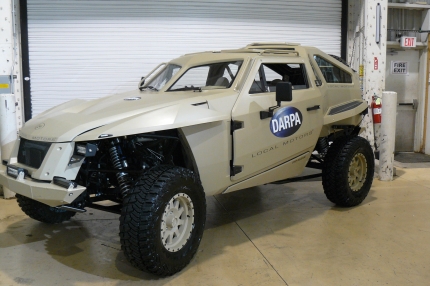
        Starting this summer, federal agencies will partner with industries to boost manufacturing in areas critical to our national security.  I just saw an example backstage.  The Defense Department scientists –- we call it DARPA -- the folks who brought us stealth technology and, by the way, who brought us the Internet –- wanted to see if it was possible to design defense systems cheaper and faster.  So they found a small company in Arizona called Local Motors, and they gave them a test:  You have one month to design a new combat support vehicle, and you’ve got three months to build it.  

        Their CEO, Jay Rogers, is here today, and as an ex-Marine who lost a couple of buddies in combat, understood the importance of increasing the speed and adaptability and flexibility of our manufacturing process for vehicles that are used in theater.

        So Local Motors solicited design ideas on their website, chose the best out of 162 that it received, built and brought this new vehicle here ahead of schedule.  We just took a look at it.  Not only could this change the way the government uses your tax dollars -- because think about it, instead of having a 10-year lead time to develop a piece of equipment with all kinds of changing specs and a moving target, if we were able to collapse the pace at which that manufacturing takes place, that could save taxpayers billions of dollars.  But it also could get products out to theater faster, which could save lives more quickly, and could then be used to transfer into the private sector more rapidly, which means we could get better products and services that we can sell and export around the world.  So it’s good for American companies.  It’s good for American jobs.  It’s good for taxpayers.  And it may save some lives in places like Afghanistan for our soldiers.

        So that’s what this is all about.  As futuristic and, let’s face it, as cool as some of this stuff is, as much as we are planning for America’s future, this partnership is about new, cutting-edge ideas to create new jobs, spark new breakthroughs, reinvigorate American manufacturing today.  Right now.  Not somewhere off in the future -- right now.  

        It’s about making sure our workers and businesses have the skills and the tools they need to compete better, faster, and smarter than anybody else.  That's what we’re about.  We are America, and we don’t just keep up with changing times, we set the pace for changing times.  (Applause.)  We adapt; we innovate; we lead the way forward.  (Applause.)   

        It’s worth remembering, there was a time when steel was about as advanced as manufacturing got.  But when the namesake of this university, Andrew Carnegie -- an immigrant, by the way -- discovered new ways to mass-produce steel cheaply, everything changed.  Just 20 years after founding his company, not only was it the largest, most profitable in the world, America had become the number one steelmaker in the world.  

        Now, imagine if America was first to develop and mass-produce a new treatment that kills cancer cells but leaves healthy ones untouched; or solar cells you can brush onto a house for the same cost as paint; or flexible display soldiers -- flexible displays that soldiers can wear on their arms; or a car that drives itself.  Imagine how many workers and businesses and consumers would prosper from those breakthroughs.  

        Those things aren’t science fiction –- they’re real.  They’re being developed and deployed in labs and factories and on test tracks right now.  They sprang from the imagination of students and scientists and entrepreneurs like all of you.  And the purpose of this partnership is to prove that the United States of America has your back, is going to be supporting you -- because that’s the kind of adventurous, pioneering spirit that we need right now.  (Applause.)  

        That’s the spirit that’s given us the tools and toughness to overcome every obstacle and adapt to every circumstance.  And if we remember that spirit, if we combine our creativity, our innovation, and our optimism, if we come together in common cause, as we've done so many times before, then we will thrive again.  We will get to where we need to be.  And we will make this century the American century just like the last one was.  

        Thank you very much, everybody.  (Applause.)  God bless you.  And God bless the United States of America.  (Applause.)

END 11:20 A.M. EDT

Now this is a cool ride!

Imagine seeing this in your rear-view mirror!

DARPA Combat Vehicle

The Defense Advanced Research Projects Agency car is a combat support vehicle for the Department of Defense, constructed by Local Motors from Arizona. (Photo by DARPA)

The look of that vehicle isn't the only cool thing about it: it's also the product of a new approach to manufacturing, which has the potential to reduce the overall process by a factor a five. Rather than the usual contracting model that takes several years, the Defense Advanced Research Projects Agency (known as "DARPA") asked a small company in Arizona, Local Motors, to fulfill the challenge in a little over four months. With only four weeks for planning, Local Motors democratized the process by receiving 162 high quality designs from hundreds of entrepeneurs and spent fourteen weeks building the car. The efficiency of the DARPA challenge reveals the potential impact of crowd-sourcing and small businesses on advanced manufacturing at the Department of Defense.

The vehicle illustrates the reason President Obama is heading to Pittsburgh's Carnegie Mellon University to kick-off the Advanced Manufacturing Partnership (AMP), a national collaboration between the government, industries, and universities to invest in cutting-edge technologies. WhiteHouse.gov will have live video of the President's remarks at 11:00 AM EDT.

The AMP is geared towards helping U.S. manufacturers reduce costs and speed ideas from the drawing board to the manufacturing floor, creating high quality jobs and increasing U.S. global competitiveness in manufacturing.

At Carnegie Mellon, the President will tour various next-generation technology projects that accelerate the manufacturing process and support the creation of good jobs. These cutting-edge products highlight the potential of advanced manufacturing in critical national security industries, the development of materials for small businesses, and innovative technology.

Related Topics: Economy, Innovations, Arizona

West Wing Week: "The Receding Tide"

Welcome to the West Wing Week, your guide to everything that's happening at 1600 Pennsylvania Ave. This week, President Obama addressed the nation on his plan to withdraw American troops from Afghanistan, delivering on a promise he made to the American people in December of 2009. He also traveled to Fort Drum in New York to meet with soldiers and their families, welcomed young elected officials to the White House, and talked to mayors from across the country about job creation and economic growth.

Watch West Wing Week here.

Find out more about the topics covered in this edition of West Wing Week:

"Your Commander-in-Chief Has Your Back"

The White House

Office of the Press Secretary

President Obama Launches Advanced Manufacturing Partnership

Today, at Carnegie Mellon University, President Obama launched the Advanced Manufacturing Partnership (AMP), a national effort bringing together industry, universities, and the federal government to invest in the emerging technologies that will create high quality manufacturing jobs and enhance our global competitiveness.  Investing in technologies, such as information technology, biotechnology, and nanotechnology, will support the creation of good jobs by helping U.S. manufacturers reduce costs, improve quality, and accelerate product development.

The President’s plan, which leverages existing programs and proposals, will invest more than $500 million to jumpstart this effort. The President believes that even as we live within our means, we must invest to win the future. Investments will be made in the following key areas: building domestic manufacturing capabilities in critical national security industries; reducing the time needed to make advanced materials used in manufacturing products; establishing U.S. leadership in next-generation robotics; increasing the energy efficiency of manufacturing processes; and developing new technologies that will dramatically reduce the time required to design, build, and test manufactured goods. Leading universities and companies will compliment these federal efforts helping to invent, deploy and scale these cutting-edge technologies.

“Today, I’m calling for all of us to come together- private sector industry, universities, and the government- to spark a renaissance in American manufacturing and help our manufacturers develop the cutting-edge tools they need to compete with anyone in the world,” said President Obama. “With these key investments, we can ensure that the United States remains a nation that ‘invents it here and manufactures it here’ and creates high-quality, good paying jobs for American workers.”

The AMP is being developed based on the recommendation of the President’s Council of Advisors on Science and Technology (PCAST), which released a report [today] entitled “Ensuring Leadership in Advanced Manufacturing.”  The PCAST report calls for a partnership between government, industry, and academia to identify the most pressing challenges and transformative opportunities to improve the technologies, processes and products across multiple manufacturing industries.

The AMP will be led by Andrew Liveris, Chairman, President, and CEO of Dow Chemical, and Susan Hockfield, President of the Massachusetts Institute of Technology. Working closely White House’s National Economic Council, Office of Science and Technology Policy and the PCAST, AMP will bring together a broad cross-section of major U.S. manufacturers and top U.S. engineering universities.  The universities initially involved in the AMP will be the Massachusetts Institute of Technology, Carnegie Mellon University, Georgia Institute of Technology, Stanford University, University of California-Berkeley, and University of Michigan.  The manufacturers initially involved in the AMP will be Allegheny Technologies, Caterpillar, Corning, Dow Chemical, Ford, Honeywell, Intel, Johnson and Johnson, Northrop Grumman, Procter and Gamble, and Stryker.  

The U.S. Government has had a long history of partnership with companies and universities in developing and commercializing the new technologies that have been the foundation of our economic success – from the telephone, to the microwave, to the jet engine, to the internet.  The AMP will provide the platform for similar breakthroughs in the next decade, by building a roadmap for advanced manufacturing technologies, speeding ideas from the drawing board to the manufacturing floor, scaling-up first-of-a-kind technologies, and developing the infrastructure and shared facilities to allow small and mid-sized manufacturers to innovate and compete.

Major Commitments to Advanced Manufacturing Being Made Today

To launch the AMP, the President today announced a number of key steps being taken by the federal government:

  • Building domestic manufacturing capabilities in critical national security industries: Starting this summer, the Departments of Defense, Homeland Security, Energy, Agriculture, Commerce and other agencies will coordinate a government-wide effort to leverage their existing funds and future budgets, with an initial goal of $300 million, to co-invest with industry in innovative technologies that will jumpstart domestic manufacturing capability essential to our national security and promote the long-term economic viability of critical U.S. industries.  Initial investments include small high-powered batteries, advanced composites, metal fabrication, bio-manufacturing, and alternative energy, among others. 
  • Reducing the time to develop and deploy advanced materials:  The Materials Genome Initiative, would invest more than $100M in research, training and infrastructure to enable U.S. companies to discover, develop, manufacture, and deploy advanced materials at twice the speed than is possible today, at a fraction of the cost.  In much the same way that advances in silicon technology helped create the modern information technology industry, advanced materials will fuel emerging multi-billion dollar industries aimed at addressing challenges in manufacturing, clean energy, and national security.
  • Investing in next-generation robotics:  The National Science Foundation, National Aeronautics and Space Administration, National Institutes of Health and the Department of Agriculture are coming together to make available today $70 million to support research in next generation robots.  These investments will help create the next generation of robots that will work closely with human operators – allowing new ability for factory workers, healthcare providers, soldiers, surgeons and astronauts to carry out key hard-to-do tasks. 
  • Developing innovative energy-efficient manufacturing processes:  The Department of Energy will launch an effort to leverage their existing funds and future budgets, with initial goal of $120 million to develop innovative manufacturing processes and materials to enable companies to cut the costs of manufacturing, while using less energy.   


Additional complementary steps as part of AMP will include:

  • Defense Advanced Research Projects Agency exploration of new approaches that have potential to dramatically reduce – by up to a factor of 5 – the time required to design, build, and test manufactured goods while enabling entrepreneurs to meet Defense Department needs.
  • Massachusetts Institute of Technology, Carnegie Mellon University, Georgia Institute of Technology, Stanford University, University of California-Berkeley, and University of Michigan commitment to form a multi-university collaborative framework for sharing of educational materials and best practices relating to advanced manufacturing and its linkage to innovation.  The universities will also join together with industry partners and leading government agencies to define research opportunities and build a collaborative roadmap for identify key technology priorities.
  • Commerce Department development of an advanced manufacturing technology consortium, starting with $12 million in FY12, to identify public private partnerships to tackle common technological barriers to the development of new products.
  • Proctor & Gamble announcement that it will make available advanced software at no cost to American small and mid-sized manufacturers through the recently launched Midwest Modeling and Simulation consortium.  This is a highly valuable digital design tool usually unavailable to smaller firms.
  • Department of Energy launch of an initiative with the Ford Motor Company and the National Association of Manufacturers to make use of the Department’s National Training & Education Resource to educate and train a new generation of manufacturers.
  • Defense Department investments, funded at $24 million in FY11, in domestic manufacturing technology that address urgent operational needs including improvements for transparent armor, stealth technology, and targeting systems.  The Department is also developing an online marketplace to increase domestic manufacturing capacity in industries critical to our national security by connecting U.S. manufacturers with product needs at the Department and other federal agencies.

West Wing Week "The Receding Tide"

June 23, 2011 | 4:25 | Public Domain

Welcome to the West Wing Week, your guide to everything that's happening at 1600 Pennsylvania Ave. This week, President Obama addressed the nation on his plan to withdraw American troops from Afghanistan, delivering on a promise he made to the American people in December of 2009. The President also traveled Fort Drum to meet with soldiers and their families, welcomed young elected officials to the White House, and talked to mayors from across the country about job creation and economic growth.

Download mp4 (51MB)