The White House

Office of the Press Secretary

Statement by the Press Secretary on S. 990

On Thursday, May 26, 2011, the President signed into law:
 
S. 990, the “PATRIOT Sunsets Extension Act of 2011,” which extends certain surveillance authorities included in the USA PATRIOT Act and the Intelligence Reform and Terrorism Prevention Act of 2004. 

President Obama at the G8 Summit in Photos

The President spent the day meeting with G-8 leaders in Deauville, France, including bilateral meetings with President Medvedev of Russia and Prime Minister Kan of Japan. Take a look at the day in photos:

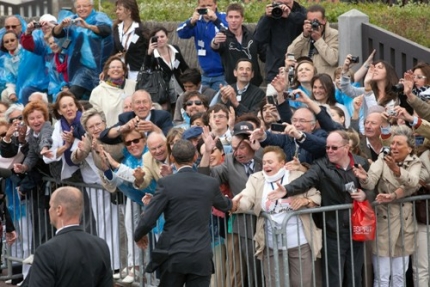
President Obama at G8

President Barack Obama shakes hands with people in the crowd as he arrives for the start of the G8 Summit in Deauville, France, May 26, 2011 May 26, 2011. (Official White House Photo by Official White House Photo by Lawrence Jackson)

G8 Leaders

President Barack Obama and other world leaders walk to the first working session at the G8 summit in Deauville, France, May 26, 2011. Pictured, from left are: European Commission President Jose Manuel Barroso; President Obama; French President Nicolas Sarkozy; Canadian Prime Minister Stephen Harper; Japanese Prime Minister Naoto Kan; German Chancellor Angela Merkel; and British Prime Minister David Cameron. May 26, 2011. (Official White House Photo by Official White House Photo by Lawrence Jackson)

The White House

Office of the Press Secretary

President Obama Announces More Key Administration Posts

WASHINGTON – Today, President Barack Obama announced his intent to appoint the following individuals to key Administration posts:

·         Scott Charney, Member, President’s National Security Telecommunications Advisory Committee
·         Dick Costolo, Member, President’s National Security Telecommunications Advisory Committee
·         David G. DeWalt, Member, President’s National Security Telecommunications Advisory Committee
·         Jamie Dos Santos, Member, President’s National Security Telecommunications Advisory Committee
·         Lisa Hook, Member, President’s National Security Telecommunications Advisory Committee
·         John D. Goldman, Member, Advisory Committee on the Arts for the John F. Kennedy Center for the Performing Arts

President Obama said, “I am proud to appoint such impressive men and women to these important roles, and I am grateful they have agreed to lend their considerable talents to this Administration. I look forward to working with them in the months and years ahead.”

President Obama announced his intent to appoint the following individuals to key Administration posts:

Scott Charney, Appointee for Member, President’s National Security Telecommunications Advisory Committee
Scott Charney is the Corporate Vice President of Microsoft's Trustworthy Computing (TwC) Group.  Before TwC, Mr. Charney served as Chief of the Computer Crime and Intellectual Property Section (CCIPS) in the Criminal Division of the U.S. Department of Justice. Mr. Charney also served as an Assistant District Attorney in Bronx County, N.Y., where he later was named Deputy Chief of the Investigations Bureau. He holds two B.A.s from the State University of New York in Binghamton and a J.D. from Syracuse University.

Dick Costolo, Appointee for Member, President’s National Security Telecommunications Advisory Committee
Dick Costolo is the current CEO and former COO of Twitter, Inc. He is also an advisor to LaunchBox Digital and a mentor at TechStars, LLC. Prior to Twitter, Mr. Costolo worked at Google from 2007 to 2009, following Google’s acquisition of FeedBurner, which he co-founded in 2004. Prior to FeedBurner, Mr. Costolo served as a Senior Vice President at 724 Solutions Inc. Mr. Costolo was also CEO, President and Co-Founder of Spyonit.com. Mr. Costolo holds a B.S. from the University of Michigan.

David G. DeWalt, Appointee for Member, President’s National Security Telecommunications Advisory Committee
David G. DeWalt is President of McAfee, which provides computer antivirus and security products and services.  Prior to joining McAfee, Mr. DeWalt was President of Software, Sales and Services at EMC, a provider of storage hardware solutions.  Previously, Mr. DeWalt was President and CEO of Documentum.  He also held executive-level positions at Eventus Software, Quest Software, Segue and Oracle.  He holds a B.S. from the University of Delaware.

Jamie Dos Santos, Appointee for Member, President’s National Security Telecommunications Advisory Committee
Jamie Dos Santos is the current President and CEO of Terremark Federal Group. She previously served as Chief Marketing Officer for Terremark Worldwide, Inc. Prior to joining Terremark, Ms. Dos Santos worked for several global companies including BellSouth, Bellcore and SAIC. Ms. Dos Santos sits on the AFCEA Intelligence Committee as well as the Information Technology Sector Coordinating Council for the U.S. Protection of Critical Information Infrastructure. Her educational background includes eight years in the Bellcore Training Center, the University of Florida and Harvard Business School for Continuing Education.

Lisa Hook, Appointee for Member, President’s National Security Telecommunications Advisory Committee
Lisa Hook is the President and CEO of Neustar, Inc. Prior to joining Neustar, Inc., Ms. Hook held leadership positions at AOL, Time Warner and Viacom. Ms. Hook also served as a senior advisor at the Federal Communications Commission. Ms. Hook currently serves on several corporate and non-profit boards, including Reed Eslevier PLC, Reed Elsevier NV, Reed Elsevier Group PLC and The Ocean Foundation. She holds a B.A. from Duke University and a J.D. from Dickenson School of Law.

John D. Goldman, Appointee for Member, Advisory Committee on the Arts for the John F. Kennedy Center for the Performing Arts
John Goldman is the President of the San Francisco Symphony and has served on the Symphony’s Board of Governors since 1996. He has been active in other community and philanthropic organizations, serving as the President of the Richard and Rhoda Goldman Fund and as former President of the Jewish Community Federation of San Francisco, Marin, Sonoma Counties, and the Peninsula. Prior to his position with the Symphony, he was the Chairman of Willis Bay Area, Inc. and CEO of Goldman Insurance Services.  He received a B.A. from Swarthmore College and an M.B.A. from the Stanford University Graduate School of Business.

President Obama Meets with Prime Minister Kan at G8 Summit

May 26, 2011 | 17:26 | Public Domain

President Obama and Japanese Prime Minister Naoto Kan speak to the press after meeting during the G8 Summit in Deauville, France.

Download mp4 (166MB) | mp3 (16MB)

Read the Transcript

Remarks by President Obama and Prime Minister Kan of Japan Before Bilateral Meeting in Deauville, France

6:12 P.M. CEST

     PRESIDENT OBAMA:  I just want to, very briefly, say how glad I am to have an opportunity to discuss important issues with Prime Minister Kan once again.  As I’ve said so often, we have one of the strongest alliances that has made both the United States and Japan safer and more prosperous for half a century now. 

     And obviously all of us were heartbroken by the extraordinary devastation that took place recently as a consequence of the tsunami and the earthquake and the nuclear crisis in Japan.  I repeatedly expressed to Prime Minister Kan that the U.S. will stand by Japan for as long as it takes to help recover.  And we are confident that Japan will emerge from these difficult times stronger than ever.

     In the meantime, we're going to continue to work together on a whole range of international and bilateral issues.  Japan has been a huge contributor to our efforts to deal with Afghanistan, to increase development there.  They have been a strong supporter and contributor to Pakistan and its efforts to improve government services in that country, development in that country. 

     We've worked together on issues like Iran sanctions.  We've worked together on a range of international development opportunities.  And obviously we continue to work together very closely in terms of security in East Asia, whether that's issues of how North Korea operates and making sure that they actually implement a denuclearization process, or thinking about the long-term security structures in East Asia.

     We've also had the opportunity to work together closely on trade issues, and we're both committed to making sure we're continually expanding opportunities for trade and commerce in the Asia Pacific region.

     So we have no better friend than the Japanese people.  We are deeply respectful of the outstanding leadership that Prime Minister Kan has provided during a time of great crisis in his country.  And we want to emphasize to the Japanese people that we will be with them throughout the rebuilding process, and are very confident that Japan will continue its role as a global leader.

     I apologize to the translator for not breaking that up into its component parts.  (Laughter.)

     PRIME MINISTER KAN:  (As translated.)  This is the first opportunity to meet President Obama after the earthquake disaster, and I would like to reiterate my sincere gratitude for the United States and its support.  And right after the disaster of the earthquake, we received a call from President, and since then, we have three times had a telephone conversation.  Right after the disaster the United States sent an aircraft carrier, the Ronald Reagan for its activity -- the U.S.-Japan’s activity under Operation Tomadachi.

     And as for the nuclear reactor accident, the United States provided us with the human resources and experts, and also the equipment, without hesitation.  And through this series of actions shown by the United States, and particularly President Obama, we fully and deeply recognize the depth of the Kizuna, or the bonds of friendship, between Japan and the United States.  And Japanese people are deeply grateful for what the United States has done.

     As for the assistance provided from the United States, Japan will definitely recover and reconstruct itself so that we will be participating, together with the United States, in various agenda in the global fora, and we would like to further increase our capability to do so, and I'm sure that we can do that. 

     Even since before the earthquake and the disaster, we have been working on the rebirth of Japanese economy and fiscal conservation and reform in Japan’s social security and those various challenges.  And the work on those agenda came to a halt right after the earthquake.  But along with our efforts on reconstruction from the disaster, we will be working on those challenges which have been pointed out even since before the earthquake.

     Japan has been planning its policy of a third opening of Japan after the Meiji Restoration and the era right after the Pacific war.  And the third opening was to open the country again to the world by proactively working on its economic and trade liberalization and deepening its ties with the world.  And we will be working hard again on these issues.

     And in our efforts to liberalize this trade liberalization there is this issue of TPP, and our original intention was to make a decision on the negotiations -- our stance on the negotiation for a TPP in June.  And that has been our policy that there has been a delay in the schedule because of the disaster.  But I would like to make the policy in the near future -- not so late in the near future.

     And we are fully aware of the various issues in the world such as the Middle East and North Africa, and Iran and Syria, and Afghanistan and Pakistan.  And Japan will continue to pursue our efforts in those areas, including in our assistance to Afghanistan and Pakistan.  And where we can, we will provide assistance and we would like work together with the United States on these issues.

     And, of course, we will be working together on the situation in East Asia, which deeply relates to the security of Japan.  And we have the issue of North Korea and its nuclear development, and how to stop their nuclear development is a challenge.  And also we have this issue of abduction by North Korea, and we will continue to pursue its resolution with the assistance of the United States.  And we will also work to ensure the denuclearization of North Korea.

     In any case, we will first work on the reconstruction of the Japanese economy so that it will be revitalized and enable us to make efforts on these issues in a proactive manner.  And we have been receiving a lot of assistance from the United States, and we will continue to ask for your cooperation.

END 6:29 P.M. CEST

Close Transcript

The White House

Office of the Press Secretary

Nominations Sent to the Senate

NOMINATIONS SENT TO THE SENATE:

Kathleen Kerrigan, of Massachusetts, to be a Judge of the United States Tax Court for the term of fifteen years, vice Harry A. Haines, term expired.

Albert G. Lauber, of the District of Columbia, to be a Judge of the United States Tax Court for the term of fifteen years, vice Stephen J. Swift, resigned.

Ronald David McCray, of Texas, to be a Member of the Federal Retirement Thrift Investment Board for a term expiring September 25, 2012, vice Andrew Saul, resigned.

Ronald David McCray, of Texas, to be a Member of the Federal Retirement Thrift Investment Board for a term expiring September 25, 2016.  (Reappointment)

Leon E. Panetta, of California, to be Secretary of Defense, vice Robert M. Gates.

David H. Petraeus, of New Hampshire, to be Director of the Central Intelligence Agency, vice Leon E. Panetta.

Arnold F. Stancell, of Connecticut, to be a Member of the National Science Board, National Science Foundation, for a term expiring May 10, 2014, vice Barry C. Barish, term expired.

The White House

Office of the Press Secretary

President Obama Announces Presidential Delegation to the Federal Republic of Nigeria to Attend the Inauguration of His Excellency Dr. Goodluck Ebele Jonathan

President Barack Obama today announced the designation of a Presidential Delegation to the Federal Republic of Nigeria to attend the Inauguration of His Excellency Dr. Goodluck Ebele Jonathan on May 29, 2011.

The Honorable Johnnie Carson, Assistant Secretary of State for African Affairs, Department of State, will lead the delegation.

Member of the Presidential Delegation:

The Honorable Terence P. McCulley, Ambassador to the Federal Republic of Nigeria, Department of State

President Obama and President Medvedev Meet Before G8 Summit

May 26, 2011 | 13:13 | Public Domain

President Obama and Russian President Dmitry Medvedev speak to the press after a bilateral meeting in Deauville, France.

Download mp4 (126MB) | mp3 (12MB)

Read the Transcript

Remarks by President Obama and President Medvedev of Russia after Bilateral Meeting in Deauville, France

12:59 P.M. CEST

      PRESIDENT OBAMA:  Let me just make a brief statement.  It is good once again to see my friend and partner, Dmitry Medvedev.  Over the past two years, I think that we have built an outstanding relationship and, as a consequence, we’ve been able to reset relations between the United States and Russia in a way that is good for the security and the prosperity of both of our countries.

      We’re implementing the New START treaty.  We’re cooperating on nonproliferation, on nuclear security, on intelligence and counterterrorism.  We’re enforcing strong sanctions on Iran.  And we’re cooperating on Afghanistan, where Russia has been very helpful in establishing supply lines for our troops there.

      But our cooperation has extended beyond the security areas, and much of our discussion today revolved around economics.  We’re pleased that we’ve established working groups around issues of rule of law and innovation, both of which are key priorities of President Medvedev as he continues to modernize the Russian economy.  And our teams have been working intensively around the issue of Russian accession to the WTO.

      We think that Russian accession to the WTO will be good for the Russian economy, will be good for the U.S. economy, it will be good for the world economy.  And we are confident that we can get this done.  And it will be a key building block in expanding trade and commerce that create jobs and benefit both countries.

      We also discussed the situation in the Middle East and North Africa, and shared our ideas about how we can manage the transition process that’s taking place throughout the region in a way that enhances prosperity and opportunity for people there and ensures stability and resolves conflicts in a peaceful way.

      And finally, we continued our discussions around the issue of missile defense.  And we committed to working together so that we can find an approach and configuration that is consistent with the security needs of both countries, that maintains the strategic balance, and deals with potential threats that we both share.

      We look forward to obviously additional discussions with the Russian President in the G8 process around the world economy, world finances, issues like nuclear security.  But I just want to emphasize that my interactions with President Medvedev have always been excellent.  I think that he is doing fine work in moving Russia forward on a whole range of issues.  And I appreciate the excellent cooperation that’s been established between our governments.

      And so, Dmitry, it’s good to see you again.  And I look forward to our work over the next day and a half.

      PRESIDENT MEDVEDEV:  (As translated.)  My counterpart and political partner, Barack Obama, has just precisely covered the issues discussed by us during the meeting, but I would like to also emphasize that I am satisfied with our personal relationship that helps us advance the relations between our two countries.

      Over the last several years, we have done a lot to make our relations different from what they used to be, and we stand high chances to continue this positive trend and develop it further on.

      It requires a lot of effort, and it requires continuing in the same vein, full of trust -- with relations full of trust between the two Presidents.  It does not mean that we’ll have common views and coinciding views on all the issues.  It’s impossible, and I believe that it’s not worth trying.  Each and every country is sure to have its own national priorities and interests.  But a lot depends on our relations.  It’s about maintaining the strategic balance of forces in our plans, which we have been able to keep this balance in place and after the New START treaty it has improved I think.

      Today we talked about how to keep on filling out these achievements and how to develop our relations in, well, quite sensitive issues including anti-missile defense.  I have told my counterpart, Barack Obama, that this issue will be finally solved in the future, like, for example, in the year 2020, but we, at present, might lay the foundation for other politicians’ activities.  And this would be a sound foundation for cooperation between our two countries in the future.  We will, of course, pursue this track, but political impetus are necessary.

      We have talked of Middle East and North Africa.  We’ll continue the discussions, especially in the framework of G20.  We have dealt with settling the Iran issue.  We also talked of the necessity and we have emphasized the necessity of improving economic cooperation between our countries and stepping up Russia’s WTO accession.  I hope we’ll be able to conclude this process finally.  But we need motivation and impetus for that.  And we have agreed as a result of these talks to instruct respectively our teams.

      Let me once again emphasize that I’m quite happy about the way our personal relationship develops.  I hope it will have a positive impact on our bilaterals.  We have a lot to do together.

      PRESIDENT OBAMA:  Thank you, everybody.


                             END             1:12 P.M. CEST

Close Transcript

The White House

Office of the Press Secretary

Readout of the President's Bilateral Meeting with Prime Minister Kan of Japan to the Travel Pool by National Security Council Senior Director for Asian Affairs

Centre Internationale de Deauville, Deauville, France

7:54 P.M. CEST

     MR. RUSSEL:  The fact of the matter is that the two leaders somewhat stole my thunder by giving you an accurate preview in their opening statements about what they were going to discuss.  And they followed up on each of the subjects that they touched on in their openings.

     The discussion began with a strong expression of appreciation on the part of the Japanese Prime Minister for all that the U.S. has done and the observation by President Obama that the ability of the two sides, both civilian and military, to cooperate as effectively as they did in the recovery efforts and in the aftermath of both the earthquake, tsunami, and on the nuclear emergency was really a reflection of how much progress over the past 50 years the U.S.-Japan alliance has made.

     They came back in the end of their meeting to the topic of the alliance.  The two leaders agreed that it’s important for Japan to continue its efforts to follow through on the agreement of last May to implement the realignment road map on Okinawa in order to ensure that the U.S.-Japan alliance and the basing arrangements are on a solid footing as we continue to work to enhance, revitalize and modernize our alliance.

     They talked at some length about economic and trade issues, beginning in the context of Japan’s economic recovery in the aftermath of the natural disasters that it’s suffered.  And the Prime Minister stressed, and the President encouraged Japan to redouble its efforts because of the important role that Japan plays in promoting economic growth across the board.

     That led them to a discussion of the Middle East, where they agreed that the profound and dramatic political transformation needs to be reinforced by economic growth and development, and that this is an area where the United States and Japan have, are, and will continue to invest heavily.  And the Japanese Prime Minister talked a little bit about some of the things that Japan continues to do both in the Middle East and North Africa, but also in Afghanistan and Pakistan, to promote development and stability.

     The President thanked him very much for that.

     They talked also about trade in connection with the upcoming APEC meeting that the President will chair and the TPP -- Trans-Pacific Partnership -- that the United States is working on and that Japan is interested in.  As the Prime Minister said in his public remarks, they are not, as a result of the earthquake, as far ahead in their internal process as he had hoped to be, but he evidenced great interest and the President underscored the importance of very high quality trade agreements in the Asian Pacific area.

     That pretty much covers it.  The President and the Prime Minister agreed that Prime Minister Kan would pay an official visit to Washington in September, probably early September, although the exact dates have yet to be nailed down.  This is something that they had intended to do and that events had slowed down a bit, and they --

     Q    When you say they intended to do, did you mean before the disaster?

     MR. RUSSEL:  Correct.  In Yokohama in November, they agreed -- the President invited the Prime Minister to come at that point.  They thought it would probably be towards the middle of the year.  For obvious reasons the Japanese have been pretty well occupied since March 11th.  But the Prime Minister indicated that the September timeframe worked well for him.

     Q    Wait, early September, did you say?

     MR. RUSSEL:  Yes.

     Q    And you said official visit -- does that mean a state dinner, anything like that, or just a visit in the Oval?  Is there anything special about this?

     MR. RUSSEL:  I think we have yet to work out the fine points of what it will entail as a practical matter, but that he would come for an official visit in his capacity as Prime Minister -- not just a quick hop to Washington or a meeting on the margins of the U.N. General Assembly or another multilateral meeting, but that the President would receive him in Washington for very substantive discussions.

     They talked a little bit about some of the work to be done and gave me and my colleagues a number of assignments.  So for that and for also the reason that I have to go to a dinner, I will stop here, and let me take questions, but I will have to excuse myself shortly.

     Q    Is there any concern on the part of the administration about the delays in the TPP?

     MR. RUSSEL:  It’s not a delay, from our perspective.  The Japanese themselves are working internally to get answers to questions about how they could proceed, whether they will proceed, and when they will proceed.

     Our work is moving apace with a view to getting done what we can with the current TPP negotiating partner.

     Q    And you want to get it done by APEC in Hawaii, right?

     MR. RUSSEL:  I'll leave that to Mike Froman to answer, because I'm not the best source for defining what the “it” is that should get done and by when.

     Q    One glaring thing that hasn’t been mentioned is nuclear safety standards and revisiting that.  And I thought that was one of the things that was going to come out of this meeting but it wasn’t mentioned.  Can you talk at all about -- and was that part of the discussion?  And if not, why not?

     MR. RUSSEL:  That’s one of the issues that is being covered in great depth in the context of the G8 discussions themselves.  So I think the two leaders didn’t feel it necessary to go into it, although the subject was raised in the meeting.

     Q    How was it raised in the meeting?  In what context? 

     MR. RUSSEL:  In terms of the importance of nuclear safety and the contribution that the Japanese Prime Minister is making in introducing it in the G8 and multilateral forums so that others can learn from Japan’s experience.

     Q    Am I fair in reading a bit of a subtext to the comments that we heard that the administration might have been urging Japan not to get too withdrawn as it tries to deal with this enormous disaster, and at the same time keep an eye on international affairs?  It seemed that Prime Minister Kan was saying that while that was going to be their -- revitalizing the economy would be their main priority, that they were going to stay engaged.  I mean, was that something that the President was looking for from the Japanese?

     MR. RUSSEL:  It is something that the President very much welcomes, namely, the commitment and the determination on the part of the Japanese leadership both to continue its active role in global affairs and meeting transnational challenges, and in regional affairs. 

     What was interesting and particularly welcome, I think, in what the Prime Minister said is that he made a connection between the recovery and the revitalization of Japan and the Japanese contribution to international economic growth.  He described this as a major point of “opening,” I think is the word that he used, and clearly looks on the period ahead as one in which Japan will strengthen its ability, in economic and in developmental terms, to support the rest of the world.

     Q    Thank you.

     MR. RUSSEL:  Thank you.

END 8:04 P.M. CEST

The White House

Office of the Press Secretary

Remarks by President Obama and Prime Minister Kan of Japan Before Bilateral Meeting in Deauville, France

Hotel Royal Barriere, Deauville, France

6:12 P.M. CEST

     PRESIDENT OBAMA:  I just want to, very briefly, say how glad I am to have an opportunity to discuss important issues with Prime Minister Kan once again.  As I’ve said so often, we have one of the strongest alliances that has made both the United States and Japan safer and more prosperous for half a century now. 

     And obviously all of us were heartbroken by the extraordinary devastation that took place recently as a consequence of the tsunami and the earthquake and the nuclear crisis in Japan.  I repeatedly expressed to Prime Minister Kan that the U.S. will stand by Japan for as long as it takes to help recover.  And we are confident that Japan will emerge from these difficult times stronger than ever.

     In the meantime, we're going to continue to work together on a whole range of international and bilateral issues.  Japan has been a huge contributor to our efforts to deal with Afghanistan, to increase development there.  They have been a strong supporter and contributor to Pakistan and its efforts to improve government services in that country, development in that country. 

     We've worked together on issues like Iran sanctions.  We've worked together on a range of international development opportunities.  And obviously we continue to work together very closely in terms of security in East Asia, whether that's issues of how North Korea operates and making sure that they actually implement a denuclearization process, or thinking about the long-term security structures in East Asia.

     We've also had the opportunity to work together closely on trade issues, and we're both committed to making sure we're continually expanding opportunities for trade and commerce in the Asia Pacific region.

     So we have no better friend than the Japanese people.  We are deeply respectful of the outstanding leadership that Prime Minister Kan has provided during a time of great crisis in his country.  And we want to emphasize to the Japanese people that we will be with them throughout the rebuilding process, and are very confident that Japan will continue its role as a global leader.

     I apologize to the translator for not breaking that up into its component parts.  (Laughter.)

     PRIME MINISTER KAN:  (As translated.)  This is the first opportunity to meet President Obama after the earthquake disaster, and I would like to reiterate my sincere gratitude for the United States and its support.  And right after the disaster of the earthquake, we received a call from President, and since then, we have three times had a telephone conversation.  Right after the disaster the United States sent an aircraft carrier, the Ronald Reagan for its activity -- the U.S.-Japan’s activity under Operation Tomadachi.

     And as for the nuclear reactor accident, the United States provided us with the human resources and experts, and also the equipment, without hesitation.  And through this series of actions shown by the United States, and particularly President Obama, we fully and deeply recognize the depth of the Kizuna, or the bonds of friendship, between Japan and the United States.  And Japanese people are deeply grateful for what the United States has done.

     As for the assistance provided from the United States, Japan will definitely recover and reconstruct itself so that we will be participating, together with the United States, in various agenda in the global fora, and we would like to further increase our capability to do so, and I'm sure that we can do that. 

     Even since before the earthquake and the disaster, we have been working on the rebirth of Japanese economy and fiscal conservation and reform in Japan’s social security and those various challenges.  And the work on those agenda came to a halt right after the earthquake.  But along with our efforts on reconstruction from the disaster, we will be working on those challenges which have been pointed out even since before the earthquake.

     Japan has been planning its policy of a third opening of Japan after the Meiji Restoration and the era right after the Pacific war.  And the third opening was to open the country again to the world by proactively working on its economic and trade liberalization and deepening its ties with the world.  And we will be working hard again on these issues.

     And in our efforts to liberalize this trade liberalization there is this issue of TPP, and our original intention was to make a decision on the negotiations -- our stance on the negotiation for a TPP in June.  And that has been our policy that there has been a delay in the schedule because of the disaster.  But I would like to make the policy in the near future -- not so late in the near future.

     And we are fully aware of the various issues in the world such as the Middle East and North Africa, and Iran and Syria, and Afghanistan and Pakistan.  And Japan will continue to pursue our efforts in those areas, including in our assistance to Afghanistan and Pakistan.  And where we can, we will provide assistance and we would like work together with the United States on these issues.

     And, of course, we will be working together on the situation in East Asia, which deeply relates to the security of Japan.  And we have the issue of North Korea and its nuclear development, and how to stop their nuclear development is a challenge.  And also we have this issue of abduction by North Korea, and we will continue to pursue its resolution with the assistance of the United States.  And we will also work to ensure the denuclearization of North Korea.

     In any case, we will first work on the reconstruction of the Japanese economy so that it will be revitalized and enable us to make efforts on these issues in a proactive manner.  And we have been receiving a lot of assistance from the United States, and we will continue to ask for your cooperation.

END 6:29 P.M. CEST

The White House

Office of the Press Secretary

Statement by the President on the Arrest of Ratko Mladic

Fifteen years ago, Ratko Mladic ordered the systematic execution of some 8,000 unarmed men and boys in Srebrencia.  Today, he is behind bars.  I applaud President Tadic and the Government of Serbia on their determined efforts to ensure that Mladic was found and that he faces justice.   We look forward to his expeditious transfer to The Hague.

Today is an important day for the families of Mladic’s many victims, for Serbia, for Bosnia, for the United States, and for international justice.  While we will never be able to bring back those who were murdered, Mladic will now have to answer to his victims, and the world, in a court of law.  From Nuremberg to the present, the United States has long viewed justice for war crimes, crimes against humanity, and genocide as both a moral imperative and an essential element of stability and peace. In Bosnia, the United States – our troops and our diplomats – led the international effort to end ethnic cleansing and bring a lasting peace. On this important day, we recommit ourselves to supporting ongoing reconciliation efforts in the Balkans and to working to prevent future atrocities.  Those who have committed crimes against humanity and genocide will not escape judgment.   

May the families of Mladic’s victims find some solace in today’s arrest, and may this deepen the ties among the people of the region.